Private Circuits: A Modular Approach
∗
Prabhanjan Ananth
†CSAIL, MIT
Yuval Ishai
‡Technion
Amit Sahai
§UCLA
Abstract
We consider the problem of protecting general computations against constant-rate random leakage. That is, the computation is performed by a randomized boolean circuit that maps a randomly encoded input to a randomly encoded output, such that even if the value of every wire is independently leaked with some constant probabilityp >0, the leakage reveals essentially nothing about the input.
In this work we provide a conceptually simple, modular approach for solving the above problem, providing a simpler and self-contained alternative to previous constructions of Ajtai (STOC 2011) and Andrychowicz et al. (Eurocrypt 2016). We also obtain several extensions and generalizations of this result. In particular, we show that for every leakage probabilityp <1, there is a finite basisBsuch that leakage-resilient computation with leakage probabilitypcan be realized using circuits over the basisB.
We obtain similar positive results for the stronger notion ofleakage tolerance, where the input is not encoded, but the leakage from the entire computation can be simulated given randomp′-leakage of input values alone, for any p < p′ <1. Finally, we complement this by a negative result, showing that for every basisBthere is some leakage probabilityp <1 such that for anyp′<1, leakage tolerance as above
cannotbe achieved in general.
∗This is an extended and corrected full version of [AIS18]. †[email protected]
Contents
1 Introduction 3
1.1 Our Contribution . . . 3
1.2 Technical Overview . . . 4
2 Preliminaries 6 2.1 Information Theoretic Secure MPC. . . 7
3 Circuit Compilers 8 3.1 Leakage Resilience . . . 9
3.2 Leakage Tolerance . . . 9
3.3 Our Results . . . 10
4 Composition Theorem: Intermediate Step 10 4.1 Composable Circuit Compilers . . . 11
4.1.1 Main Definition. . . 13
4.2 Base Case: Constant Simulation Error . . . 13
4.3 Composition Step. . . 17
4.4 Stitching Transformation: Exp to Poly Efficiency . . . 23
4.5 Main Construction: Formal Description . . . 25
5 Leakage Tolerant Circuit Compilers 30 5.1 Construction . . . 30
5.2 Negative Result. . . 36
6 Leakage Resilient Circuit Compilers 40
1
Introduction
Ishai, Sahai, and Wagner [ISW03] introduced the fundamental notion of a leakage-resilient circuit com-piler, which in its simplest form is defined as follows. The compiler consists of a triple of algorithms (Compile,Encode,Decode). Given any circuit C, the compiled version of the circuit ˆC =Compile(C) takes a randomly encoded input ˆx = Encode(x) and (using additional fresh randomness) produces an encoded output ˆy such thatC(x) =Decode(ˆy). Furthermore, suppose each wire in the compiled circuit ˆC leaks its value1with some probabilityp >0, independently for each wire. Then, informally speaking, we require that
the leaked wire values reveal essentially nothing about the inputxto the circuit.
The above notion of resilience to random leakage can be seen as a natural cryptographic analogue of the classical notion of fault-tolerant computation due to von Neumann [vN56] and Pippenger [Pip85], where every gate in a circuit canfailwith some constant probability. In addition to being of theoretical interest, the random leakage model is motivated by the fact that resilience to a notion of “noisy leakage,” which captures many instances of real-life side channel attacks, can be reduced to resilience to random leakage [DDF14]. The random leakage model is also motivated by its application to “oblivious zero-knowledge PCPs,” where every proof symbol is queried independently with probability p, which in turn are useful for constructing zero-knowledge proofs that only involve unidirectional communication over noisy channels [GIK+15].
We turn to discuss the state of the art on constructing leakage-resilient circuit compilers with respect to leakage probability p. The original work of [ISW03] only achieved security for values of pthat vanish both with the circuit size and the level of security. Ajtai [Ajt11] achieved the first leakage-resilient circuit compiler that tolerated some (unspecified) constant probability of leakage p. However, to say the least, Ajtai’s result is quite intricate and poorly understood. A more recent work of Andrychowicz, Dziembowski, and Faust [ADF16] obtained a simpler derivation of Ajtai’s result. However, their construction is still quite involved and relies on heavy tools such as expander graphs (also used in Ajtai’s construction) and algebraic geometric codes. The present work is motivated by the following, informally stated, question:
Is there a “simple” method of building leakage-resilient circuit compilers that can tolerate someconstant
probability of leakage p >0?
1.1
Our Contribution
Our main contribution is an affirmative answer to the above question. We present a conceptually simple, modular approach for solving the above problem, providing a simpler and self-contained alternative to the constructions from [Ajt11,ADF16]. In particular, our construction avoids the use of explicit constant-degree expanders or algebraic geometric codes.
Roughly speaking, our construction uses a recursive amplification technique that starts with a constant-size gadget, which only achieves a weak level of security, and amplifies security by a careful compo-sition of the gadget with itself. The existence of the finite gadget, in turn, follows readily from re-sults on information-theoretic secure multiparty computation (MPC), such as the initial feasibility rere-sults from [BOGW88,CCD88]. We refer the reader to Section1.2for a more detailed overview of our technique. We then extend the above result and generalize it in several directions, and also present some negative results. Concretely, we obtain the following results regarding constant-rate random leakage:
• For every leakage probability p <1, there is a finite basis Bsuch that leakage-resilient computation with leakage probability pcan be realized using circuits over the basisB.
• We obtain a similar positive result for the stronger2notion ofleakage tolerance, where the input is not
encoded, but the leakage from the entire computation can be simulated given random p′-leakage of input values alone, for anyp < p′<1.
1The original model of [ISW03] considers the worst-case notion oft-private circuits, where the leakage consists of an
adver-sarially chosen set oftwires. We will discuss this alternative model later.
2Note that leakage-tolerance can be easily used to achieve leakage-resilience by letting the encoder apply to the input a
secret sharing scheme that tolerates ap′-fraction of leakage, where the compiler is applied to an augmented circuit that starts
• Finally, we complement this by a negative result, showing that for every basisBthere is some leakage probability p = pB < 1 such that for any p′ < 1, leakage tolerance as above cannot be achieved in general, where pB tends to 1 as B grows. The negative result is based on impossibility results for information-theoretic MPC without an honest majority [CK91].
Our work leaves open two natural open questions. First, in the case of binary circuits, there is a huge gap between the tiny leakage probability guaranteed by the analysis of our construction (roughlyp= 2−14)
and the best one could hope for. This is the case even in the stronger model of leakage tolerance, where our negative result only rules out constructions that toleratep >0.8 leakage probability.
A second question is the possibility of tolerating higher leakage probability (arbitrarily close to 1) for the weaker notion ofleakage-resilientcircuits with input encoder. A partial explanation for the difficulty of this question is the possibility of using the input encoder to generate correlated randomness that enables information-theoretic MPC with no honest majority.3
We present our results formally in Section3.3.
1.2
Technical Overview
In this section, we give a high level overview of the composition-based approach that we utilize to get our main result.
In the composition-based approach, we start with a leakage-resilient circuit compiler CC0secure against p-random probing attacks and that has constant simulation errorε. Byp-random probing attacks, we mean that every wire in the compiled circuit is leaked with probabilityp. We refer to this leakage-resilient circuit compiler as a base gadget. The goal is to recursively compose this base gadget to obtain a leakage-resilient circuit compiler also secure againstp-random probing attacks but the failure probability is negligible (in the size of the circuit being compiled).
First Attempt. A naive approach to compose is as follows: to compile a circuitC, computeCC0.Compile(
· · ·CC0.Compile(C)· · ·). In thekthstep,CC0.Compileis executed forklevels of recursion. Its easy to see that
leakage on the resulting compiled circuit cannot be simulated if it holds that the simulation ofCC0.Compile
fails for every level of recursion. That is, the failure probability of the resulting circuit compiler is εk for k levels of recursion. If we setkto be the size of C then we obtain negligible simulation error, as desired. However, as the simulation error reduces with every recursion step, the size of the compiled circuit increases with every recursion step. Even if the compiled circuit in the base gadget had constant overhead, the size of the compiled circuit obtained after k steps grows exponential in k. This means that we need to devise a composition mechanism where the error probability degrades much faster than the size growth of the compiled circuit.
Our Approach: In a Nutshell. Our idea is to cleverly composen gadgets, each with simulation error
ε, in such a way that the composed gadget fails only if at least t of the gadgets fail, for some parameters
t, nwitht < n. Our composition mechanism ensures that the size of the composed gadget incurs a constant blowup whereas the simulation error degrades exponentially in 1ε.
To realize such a composition mechanism, we employ techniques from Cohen et al. [CDI+13]. Cohen et
al. showed how to employ player emulation strategy [HM00] to achieve a conceptually simpler construction of secure MPC in the honest majority setting. While the goal of Cohen et al. is seemingly unrelated to the problem we are trying to solve, we show that the player emulation strategy employed by their work can be adapted to our context.
3Indeed, the technique of Beaver [Bea91] can be used to obtain resilience to an arbitrary leakage probabilityp <1, but at the
We first recall their approach. They showed how to transform a threshold formula, composed solely of threshold gates, into a secure MPC protocol. In more detail, they start with a T-out-N threshold formula composed oft-out-nthreshold gates. They then show how to transform a secure MPC protocol fornparties toleratingtcorruptions into a MPC protocol forN parties tolerating at mostT corruptions (also written as
T-out-N secure MPC). At a high level, their transformation proceeds as follows: they replace the topmostt -out-nthreshold gate with aT-out-N secure MPC. That is, every input wire of the topmost gate corresponds to a party in the secure MPC protocol. Moreover, every party in this MPC is emulated by aT-out-N secure MPC. In other words, for every gate input to the topmost gate, the corresponding player is replaced with a
t-out-nsecure MPC. For instance, if the topmost gate had exactlyN gates as its children then the resulting MPC has n2 number of parties and can tolerate at most t2 number of corruptions. This process can be
continued (fordsteps, wheredis the depth of the formula) as long as the secure MPC protocol still satisfies polynomial efficiency.
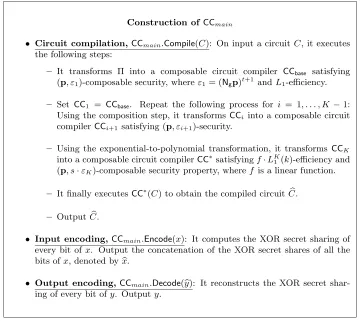
Armed with their methodology, we show how to construct a leakage-resilient circuit compiler. We start with at-out-nsecure MPC protocolΠin the passive security model. The functionality associated with this protocol takes as inputn shares of two bits (a, b) and outputs n shares of NAND(a, b)4. This secure MPC
protocol will be our base gadget for NAND; the security of MPC protocol can be invoked to prove that the base gadget is secure with respect to constant probability of wire leakage and constant simulation error, call itε0. We then compose this base gadget recursively as follows: in thekthlevel of recursion, we start withΠ
andemulatethe computation of every gate inΠwith the gadget computed using (k−1) levels of recursion, called the inner gadget. The protocol Π and the (k−1)th level gadget offer two layers of protection for
thekth-level gadget. Why should this be secure? if all the inner gadgets can always be simulated (i.e, no
simulation error) then the resulting kth-level gadget can also always be simulated. Unfortunately, this is
not true since the simulator of the inner gadget does fail with probability εk−1. So far, we have used the
security of only layer of protection, we now will use the security of the second layer of protection; i.e., we will invoke the security ofΠ. The insight here is that we can map the failure of inner gadgets to corrupting the corresponding parties in Π. And thus, as long as at mostt inner gadgets fail, we can invoke the simulator ofΠ to simulate the composed gadget. We can show that the probability that at mostt inner gadgets fail degrades exponentially in εk1
−1, whereεk−1 is the simulation error of the inner gadget. On the other hand,
the size of the composed gadget grows only by a constant factor. Expanding this out, we can conclude that afterk steps the size grows exponential inkwhereas the simulation error degradesdoublyexponential ink. Substitutingkto be logarithmic in the size ofC, we attain the desired result. While the current discussion focusses on the analysis for the random probing setting, similar (and a much simpler) analysis can also be done for the worst-case probing setting. Specifically, we can show that afterklevels of recursion, the circuit compiler is secure against worst case probing attacks with leakage parametertk.
Security Issues. Recall that the simulation of the composed gadget requires simulating all the inner gad-gets. Since the inner gadgets are connected to each other, we need to ensure that these different simulations are consistent with each other. To give an example, suppose there are two inner gadgets connected by a wire
w. The simulators for these two different inner gadgets could assign conflicting values to w. At its core, we handle this problem by keeping a budget of wires “in reserve,” and define a notion of composable simulation that can make use of this flexibility to resolve conflicts between simulators for components that share wires. For example, if two simulatorsS1andS2“want to disagree” about a wirew, we will break the tie by allowing
simulatorS1to decide the value in wirew, and asking the other simulatorS2 to use one of the reserve wires
to make up for the fact thatS2 did not get its wish for the value of wirew. This is possible because of the
flexibility inherent in the secret sharing schemes underlying the MPC protocols of the base gadget. Similar notions of composable leakage-resilient circuit compliers were considered in [BBD+16, BBP+16,BBP+17].
From NANDto arbitrary circuits. So far the above approach shows how to design a gadget for NAND tolerating constant wire leakage probability and with negligible simulation error. The fact that we design gadgets just for NAND gates is crucially used to argue that the size of the composed gadget blows up only
by a constant factor in each step. We show how to use this gadget to design a gadget for any circuit over NAND basis: to compile C, we replace every gate in C with a gadget for NAND. We then show how to stitch these different gadgets together to obtain a gadget forC.
Final Template. We now lay out our final template. We first define a special case of leakage-resilient circuit compilers, calledcomposablecircuit compilers. This notion will incorporate the composition-friendly simulation mechanism mentioned earlier.
• The first step is to design a composable circuit compiler for NAND tolerating constant wire leakage probability and has constant simulation error.
• We then apply our composition approach to obtain a composable circuit compiler for NAND tolerating constant wire leakage probability and has negligible simulation error.
• Finally, we show how to bootstrap a composable circuit compiler for NAND to obtain a composable circuit compiler for any circuit. The resulting compiler still tolerates constant wire leakage probability and has negligible simulation error.
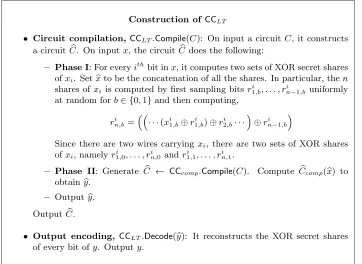
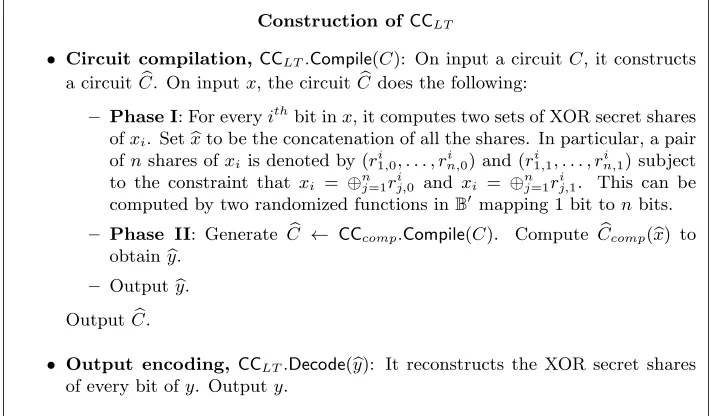
A leakage tolerant circuit compiler can be constructed by additionally designing a leakage resilient input encoder.
Organization. We first present the necessary preliminaries in Section 2. We then define the notion of circuit compilers in Section 3. We define leakage resilience and leakage tolerance in the same section. The notion of composable circuit compilers, that will be a building block for both leakage tolerant and leakage resilient circuit compilers, is presented in Section 4.1. We present the construction of composable circuit compilers in the following steps:
• We present the starting step (base case) in the composition step in Section 4.2.
• The composition step itself is presented in Section4.3.
• The result of the composition step doesn’t quite meet our efficiency requirements and so we present the exponential-to-polynomial transformation in Section4.4.
• Finally, we combine all these steps to present the main construction of a composable circuit compiler in Section4.5.
Armed with a construction of composable circuit compiler, we present a construction of leakagetolerant
circuit compilers in Section 5. We also present negative results that upper bounds the leakage rate in the random probing model in the same section.
We show implication of composable circuit compilers to leakage resilientcircuit compilers in Section6.
2
Preliminaries
We use the abbreviation PPT for probabilistic polynomial time. Some notational conventions are presented below.
• Suppose Ais a probabilistic algorithm. We use the notation y ← A(x) to denote that the output of an execution ofAon inputxisy.
• SupposeDis a probability distribution with supportV. We denote the sampling algorithm associated with Dto beSampler. We denote byx←−$ Sampler if the output of an execution ofSampler is x. For every x∈V,Sampler outputsxwith probabilitypx, as specified byD. Unless specified otherwise, we
only consider efficiently sampleable distributions. We also consider parameterized distributions of the formD={Daux}. In this case, there is a sampling algorithmSamplerdefined for all these distributions.
• Consider two probability distributions D0 and D1 with discrete support V and let their associated
sampling algorithms be Sampler1 andSampler2. We denoteD0≈s,εD1 if the distributionsD0 andD1
areε-statistically close. That is, v∈V|Pr[v←Sampler1]−Pr[v←Sampler2]|≤2ε.
Circuits. A deterministic boolean circuit C is a directed acyclic graph whose vertices are boolean gates and whose edges are wires. The boolean gates belong to a basis B. An example of a basis is B =
{AND,OR,NOT}. We will assume without loss of generality that every gate has fan-in (the number of input wires) at most 2 and fan-out5(the number of output wires) at most 2. A randomized circuit is a
cir-cuit augmented with random-bit gates. A random-bit gate, denoted byRAND, is a gate with fan-in 0 that produces a random bit and sends it along its output wire; the bit is selected uniformly and independently of everything else afresh for each invocation of the circuit. We also consider basis consisting of functions (possibly randomized) on finite domains (as opposed to just boolean gates). The size of a circuit is defined to be the number of gates in the circuit.
2.1
Information Theoretic Secure MPC
We now provide the necessary background of secure multiparty computation. In this work, we focus on information theoretic security. We first present the syntax and then the security definitions.
Syntax. We define a secure multiparty computation protocolΠ for nparties P1, . . . , Pn associated with
ann-party functionalityF :{0,1}ℓ1×· · ·×{0,1}ℓn×{0,1}ℓr →{0,1}ℓy1 ×· · ·×{0,1}ℓyn. We denote ℓi to
be the length of theithparty’s input,ℓ
yito be the length of thei
thparty’s output andℓ
ris the length of the
randomness input toF. In any given execution of the protocol, theith party receives as inputx
i∈{0,1}ℓi
and all the parties jointly compute the functionalityF(x1, . . . , xn;r), wherer∈{0,1}ℓr is sampled uniformly
at random. In the end, partyPi outputsyi, where (y1, . . . , yn) =F(x1, . . . , xn;r).
We defined suchn-party functionalities that additionally receive the randomness as input to be random-ized functionalities. In this work we only consider randomizedn-party functionalities and henceforth, the input randomness will be implicit in the description of the functionality.
Semi-honest Adversaries. We consider the adversarial model where the adversaries follow the instruc-tions of the protocol. That is, they receive their inputs from the environment, behave as prescribed by the protocol and finally output their view of the protocol. Such type of adversaries are referred to as semi-honest adversaries.
We define semi-honest security below. Denote RealΠF,S(x1, . . . , xn) to be the joint distribution over the
outputs of all the parties along with the views of the parties indexed by the setS.
Definition 1 (Semi-Honest Security). Consider a n-party functionality F as defined above. Fix a set of inputs (x1, . . . , xn), where xi ∈ {0,1}ℓi and let ri be the randomness of the ith party. Let Π be a n-party protocol implementingF. We say thatΠsatisfiesε-statistical security against semi-honest adversaries if for every subset of partiesS, there exists a PPT simulator Simsuch that:
{ ({yi}i /∈S,Sim({yi}i∈S,{xi}i∈S))}≈s,ε
RealΠF,S(x1, . . . , xn)
,
whereyi is the ith output of F(x1, . . . , xn). If the above two distributions are identical, then we say that Π satisfiesperfect security against semi-honest adversaries.
Starting with the work of [BOGW88, CCD88], several constructions construct semi-honest secure multi-party computation protocol in the information-theoretic setting assuming that a majority of the parties are honest.
5If a circuit has arbitrary fan-out, then this can be transformed into another circuit of fan-out 2 with a loss of logarithmic
3
Circuit Compilers
We define the notion of circuit compilers. This notion allows for transforming an input x, a circuit C (See Section2for a definition of circuits) into an encoded inputxand a randomized circuitCsuch that evaluation ofC onxyields an encodingC(x). The decode algorithm then decodesC(x) to yieldC(x).
Definition 2 (Circuit Compilers). A circuit compiler CC defined for a class of circuitsC comprises of the following algorithms (Compile,Encode,Decode)defined below:
• Circuit Compilation,Compile(C): It is a deterministic algorithm that takes as input circuit C and outputs a randomized circuit C.
• Input Encoding,Encode(x): This is a probabilistic algorithm that takes as input xand outputs an encoded inputx.
• Output Decoding, Decode(y): This is a deterministic algorithm that takes as input an encoding y and outputs the plain text string y.
The algorithms defined above satisfies the following properties:
• Correctness of Evaluation: For every circuit C∈C of input length ℓ, everyx∈{0,1}ℓ, it always
holds that y=C(x), where:
– C←Compile(C). – x←Encode(x). – y←C(x). – y←Decode(y).
• Efficiency: Consider a parameter k ∈ N. We require that the running time of Compile(C) to be
poly(k,|C|), the running time of Encode(x)to be poly(k,|x|)and the running time of Decode(C(x))to be poly(k,|C(x)|). We emphasize that the encoding complexity only grow poly-logarithmically in terms of the size ofC. Typically, k will be set topoly(log(|C|)).
Few remarks are in order.
Remark 1. The standard basis we consider in this work is {AND,XOR}. Unless otherwise specified, all the circuits considered in this work will be defined over the standard basis. Also unless otherwise specified, the compiled circuit is over the same basis as the original circuit.
Remark 2. Later, we also consider circuit compilers with relaxed efficiency guarantees, where we allow for the running time of the algorithms to be exponential in the parameter k.
Non-Boolean Basis. In this work, we also consider a setting where the compiled circuit is defined over a basis that is different from the basis of the original circuit (before compilation). We define this formally below.
Definition 3. Consider two collections of finite functionsB′andB. A circuit compilerCC= (Compile,Encode,Decode)
is defined over B′ (writtenCC overB′) for a class of circuitsC overBif it holds that for every C∈C over
basisB, the compiled circuit C, generated as C←Compile(C), is defined over basis B′.
3.1
Leakage Resilience
We adopt the definition of leakage resilient circuit compilers from [GIM+16].
Definition 4. A circuit compiler CC = (Compile,Encode,Decode) for a class of circuits C is said to be
ε-leakage resilient against a class of randomized leakage functions Lif the following holds: There exists a PPT simulator Sim such that for every circuit C : {0,1}ℓ
→ {0,1} and C ∈ C, input x ∈ {0,1}ℓ, leakage function L
comp ∈ L, the distribution Lcomp(C, x) is ε-statistically close to Sim(C), whereC←Compile(C)andx←Encode(x).
Informally, the above definition states that the leakageLcompon the computation of the compiled circuitC
on encoded inputxreveals no information about the inputx.
Remark 3. While the above notion considers leakage only on a single computation, this notion already implies the stronger multi-leakage setting where there are multiple encoded inputs and a leakage function is computed on every computation ofC. This follows from a standard hybrid argument 6.
p-Random Probing Attacks [ISW03,Ajt11, ADF16]. In this work, we are interested in the following probabilistic leakage function: every wire in the computation of the compiled circuitCon the encoded input
xis leaked independently with probabilityp.
More formally, denote the leakage function Lp = {Lcomp}, where the probabilistic function Lcomp is
defined below.
Lcomp
C,x: construct the set of leaked valuesSC
leak as follows. For every wirew(input wires included) in
Cand valuevw assigned towduring the computation ofConx, include (w, vw) with probability pinSleakC .
Also, include (w′, vw) inSleakC , ifw′ and ware two output wires of the same gate. OutputSleakC .
We define leakage resilient circuit compilers with respect to the leakage function defined above.
Definition 5(Leakage Resilience Against Random Probing Attacks). A circuit compilerCC= (Compile,Encode,
Decode) for a family of circuitsC is said to be (p,ε)-leakage resilient against random probing attacks if CC
isε-leakage resilient againstLp. Moreover, we define the leakage rate ofCC to bep.
3.2
Leakage Tolerance
Another notion we study is leakage tolerant circuit compilers. In this notion, unlike leakage resilient circuit compilers,Encodeis an identity function. Consequently, we need to formalize the security definition so that the leakage on the computation ofC onxcan be simulated with bounded leakage on the inputx.
Definition 6. A circuit compiler CC = (Compile,Encode,Decode) for a class of circuits C is said to be
ε-leakage tolerant against a class of leakage functions Lif the following two conditions hold:
• Encodeis an identity function.
• There exists a simulator Sim such that for every circuit C : {0,1}ℓ
→ {0,1} and C ∈ C, input x ∈ {0,1}ℓ, leakage function L = (L
comp, Linp) ∈ L, the distribution Lcomp(C, x) is ε-statistically close to Sim(C, Linp(x)), whereC←Compile(C)and x←Encode(x).
(p,p′)-Random Probing Attacks. As before, we are interested in the following probabilistic leakage function: every wire in the computation of the compiled circuitCon the encoded inputxis leaked indepen-dently with probabilityp.
More formally, denote the leakage function Lp,p′ = {(Lcomp, Linp)}, where the probabilistic functions Lcomp is as defined in Section3.1 andLinpis defined below.
Linp(x): construct the set of leaked values SleakI as follows. For every input wirewcarrying the ithbit ofx,
include (w, xi) in SleakI with probabilityp′. If (w, xi) is included, also include (w′, xi) in SleakI , where w′ is
the other input wire carryingxi. OutputSleakI .
We define leakage tolerance against random probing attacks below.
Definition 7 (Leakage Tolerance Against Random Probing Attacks). A circuit compiler CC = (Compile,
Decode) for a family of circuits C is said to be (p,p′,ε)-leakage tolerant against random probing attacks if
CCisε-leakage tolerant against Lp,p′. Moreover, we define the leakage rate of CCto bep.
3.3
Our Results
We state our results7below.
Leakage Tolerance: Positive Results. We show the following results in Section3.2.
Theorem 1 (Boolean Basis). There exist constants 0 <p<p′ <1 such that there is a (p,p′,)-leakage
tolerant circuit compiler, where is negligible in the circuit size.
Theorem 2(Finite Basis). For any0<p<p′<1there is a basisBover which there is a (p,p′,)-leakage tolerant circuit compiler, where is negligible in the circuit size.
Leakage Tolerance: Negative Result. The following theorem upper bounds the rate of a leakage tolerant circuit compiler in the random probing model. We present this result in Section3.2.
Theorem 3. For any basisBthere is0<p<1, such that for any0<p′<1, there is no(p,p′,0.1)-leakage
tolerant circuit compiler over B.
Leakage Resilience: Positive Results. We demonstrate a construction of leakage resilient circuit com-piler over boolean basis. Both the theorems below are shown in Section6.
Theorem 4 (Boolean Basis). There is a constant 0 < p <1 such that there is a (p,)-leakage resilient circuit compiler and is negligible in the circuit size.
In the same section, we present a construction of leakage resilient circuit compiler over finite basis.
Theorem 5(Finite Basis). For any 0<p<1there is a basisBover which there is a(p,)-leakage resilient circuit compiler, where is negligible in the circuit size.
4
Composition Theorem: Intermediate Step
We present a composition theorem, a key step in our constructions of leakage tolerant and leakage resilient circuit compilers. We identify a type of circuit compilers satisfying some properties, that we callcomposable circuit compilers. This notion will be associated with ‘composition-friendly’ properties.
Before we formally define the properties, we motivate the need for composable circuit compilers.
7Special thanks to Jean-S´ebastien Coron for pointing out an error in our result on the randomness complexity of private
• In our composition theorem, we need to ‘attach’ different circuit compiler gadgets. For instance, the output wires of circuit compilerCC1will be the input wires of another compilerCC2. In order to ensure
correctness, we need to make sure that the output encoding ofCC1 is the same as the input encoding
ofCC2. We guarantee this by introducing XOR encoding property that states that the input encoding
and output encoding are additive secret shares.
• While the above bullet resolves the issue of correctness, this raises some security concerns. In particular, when we simulate CC1 andCC2 separately, conflicting values could be assigned to the wires that join
CC1 and CC2. These issues have been studied in the prior works, mainly in the context of worst
case leakage [BBD+16,BBP+16,BBP+17]. And largely, this was not formally studied for the random
probing setting. We formulate the following simulation definition to handle this issue in the probabilistic setting: the simulatorSim= (Sim1,Sim2) (termed as partial simulator) will work in two main steps:
– In the first step, the simulator first determines the wires to be leaked. Then, Sim1 determines a
‘shadow’ of input and output wires that additionally need to be simulated.
– In the second step, the values for the input and output wires selected in the above step is assigned values. Then Sim2 is executed to assign the internal wire values.
At a high level Simworks as follows: first CC1.Sim1 and CC2.Sim1 is executed to obtain the shadow
of input and output wires that need to be simulated. At this point, we take the union of the output wires ofCC1 and input wires ofCC1 that need to be simulated. Then, we assign the values to all the
wires. Once this is done, we independently execute CC1.Sim2 and CC2.Sim2 to obtain the simulated
wire values in bothCC1 andCC2, as desired.
4.1
Composable Circuit Compilers
The syntax of composable circuit compilers is the same as that of circuit compilers (Definition2). In addition, it is required to satisfy the properties stated next.
XOR Encoding Property. We start with XOR encoding property. This property states that the input encoding (resp., output encoding) is an additive secret sharing of the inputs (resp., outputs).
Definition 8(N-XOR Encoding). A circuit compiler(Compile,Encode,Decode)for a family of circuitsCis said to haveN-XOR encoding propertyif the following always holds: for every circuitC∈C, x∈{0,1}ℓ, • Encode(x) computes XOR secret sharing ofxi for everyi ∈[ℓ], where xi is the ith input bit of x. It
then outputs the concatenation of the XOR secret shares of all the bits of x. It outputs x = (x1, . . . ,
xℓ)
∈ {0,1}ℓN, where x
i = ⊕Nj=1xij. That is, xi is a XOR secret sharing of
{xi j}j∈[N].
• Letx←Encode(x)andC←Compile(C). Upon evaluation, denote the output encoding to bey←C(x). Suppose C(x) =y ∈{0,1}ℓ′ and y = (y1, . . . ,yℓ′)∈{0,1}ℓ′N. We require that {yi
j} is a XOR secret sharing of yi, i.e., yi=⊕Nj=1yij.
WhenN is clear from the context, we drop it from the notation.
Composable Security (Random Probing Setting). Next, we define the composable security property. We first deal with the random probing setting. There are two parts associated with this security property.
• Simulation with Abort: We require that the simulator aborts with small probability.
Before stating the formal definition of composable security, we first set up some notation. We formalize the leakage function Lcomp defined in the previous section in terms of the following sampler algorithm,
RPDistrwp(·,·)8.
SamplerRPDistrwp(C, x): Denote the set of wires in C as W. Consider the computation of C on input
encodingx. For every wire w∈W, denoteval(w) to be the value assigned towduring the evaluation ofC
onx.
We construct the setSleakas follows: initiallySleakis assigned to be{}. For everyw∈W, with probability
p, include (w,val(w)) inSleak (i.e., with probability (1−p), the pair (w,val(w)) is not included). Output Sleak.
We define the notion of partial simulator below.
Definition 9 (Partial Simulator: Random Probing). A partial simulator Sim defined by a deterministic polynomial time algorithm Sim1 and probabilistic polynomial time algorithm Sim2 executes as follows: On input a circuit C,
• Denote W to be the set of wires in C. Construct a set Wlk as follows: include every wirew∈W in the setWlk with probabilityp.
• Sim1(C, Wlk) outputs (Winp,Wout, I). Winp is a subset of input wires, Wout is a subset of output wires and I denotes a set of indices.
• For every wire w∈Winp, include(w, v
w)∈Sinp such thatvw is a bit sampled uniformly at random. Similarly, construct the set Sout.
• Sim2
C,Wlk,Winp, Sinp,Wout, Sout, I
outputs Slk.
Finally,Simoutputs Slk.
We now define the notion of composable security in the random probing model.
Definition 10 (Composable Security: Random Probing). A circuit compiler CC = (Compile,Encode,
Decode) for C, consisting of circuits of input length ℓ, is said to be (p,ε)-composable secure against random probing attacks if there exists a probabilistic polynomial time partial simulator Sim= (Sim1,Sim2) such that the following holds:
• p-Partial Simulation: for every circuitC∈C, inputx∈{0,1}ℓ,
RPDistrwp
C,xC←Compile(C),
x←Encode(x)
≡Sim(C)L←Sim(C)∧L∕=⊥
C←Compile(C),
That is, conditioned on the simulator not aborting, its output distribution is identical toRPDistrwp(C, x).
4.1.1 Main Definition
We now present the definition of composable circuit compiler for the random probing model.
Definition 11 (Composable Circuit Compilers: Random Probing). A circuit compiler CC = (Compile,
Encode,Decode)is said to be a(p,ε)-secure composable circuit compiler in the random probing model ifCC
satisfies:
• XOR encoding property.
• (p,ε)-composable security.
We refer toCCas a secure composable circuit compiler and in particular, omit(p,ε)if this is clear from the context.
L-efficient Composable CC. En route to constructing composable circuit compiler, we construct an intermediate composable circuit compiler that produces exponentially sized compiled circuits. We define the following notion to capture this step.
Definition 12 (L-efficient Composable CC). A circuit compiler CC= (Compile,Encode,Decode) is an L-efficient composable circuit compiler for a class of circuitsC if for everyC∈C, we have|C|≤L(|C|), where
C←Compile(C).
In particular, CCis a composable circuit compiler ifL is a polynomial.
4.2
Base Case: Constant Simulation Error
We construct a composable circuit compiler CC = (Compile,Encode,Decode) for a class of circuits C. Let
Πbe a perfectly semi-honest securen-party computation protocol for ann-party randomized9functionality
F =F[C] (defined in Figure1) toleratingtnumber of corruptions witht≥2.
n-party functionality,F[C]
Input: (x1
1|| · · · ||xℓ1; · · · ; x1n|| · · · ||xℓn), whereℓis the input length ofC.
• It then computesxi =⊕nj=1xij for everyi∈[ℓ]. Denotexto be a bit string, where theith bit ofxisx
i.
• It then computesC(x) to obtainy. Letyi be theithoutput bit of y. Let the length ofybeℓy.
• Sample bitsyij uniformly at random such thatyi=⊕jn=1yji for every i∈[ℓy]. Setyi= (
yi
1, . . . ,yni), for everyi∈[n]. Output (y1, . . . ,yℓy).
Figure 1: FunctionalityF[C], parameterized by a circuitC.
We describe the scheme below.
Circuit Compilation, Compile(C): This algorithm takes as input circuit C :{0,1}ℓ
→{0,1}ℓ′
∈C. We associate a boolean circuitCktΠwithΠsuch that the following holds:
• ProtocolΠon input (x1;. . .;xn), wherexiisithparty’s input, outputs (y1;. . .;yn) if and only ifCkt Π
on inputx1|| · · · ||xn outputs (y1;. . .;yn).
• Furthermore, the gates of CktΠ can be partitioned into n sub-circuits such that the ith sub-circuit
implements theithparty inΠ. Denote theithsub-circuit to beCkt
i. Also, denote the number of gates
in CktΠ to beNg.
• The wires between the sub-circuits are analogous to the communication channels between the corre-sponding parties.
OutputC=CktΠ.
Input encoding, Encode(x): On input x ∈ {0,1}ℓ, it outputs the encoding
x = (x1;. . .;
xn), where
xj = (xj 1||. . .||x
j
ℓ) andxi=⊕nj=1x
j i.
Output decoding, Decode(y): It takes as input encoding y = (y1, . . . ,yn) and outputs y, where the ith
output bit ofy is computed asyi=⊕nj=1yij withyj = (y j 1, . . . ,y
j
ℓ′).
We first prove the correctness and efficiency properties of the above scheme.
Lemma 1. CCsatisfies correctness of encoding and correctness of evaluation properties.
Proof. The correctness of encoding property follows from the correctness of the XOR secret sharing scheme. The following bullets proves the correctness of evaluation property: consider an input x and a circuit
C:{0,1}ℓ
→{0,1}ℓ′
.
• By construction, the input encoding is a XOR secret sharing of the inputx.
• The correctness of protocolΠproves that the output of the evaluation ofC onxis a XOR sharing of
C(x).
• Thus, by construction, the output of the decoding algorithm is reconstruction of the XOR sharing of
C(x).
Lemma 2. CCsatisfies the efficiency property.
Proof. This follows from the fact that the total computational complexity of Π is polynomial in n,ℓ and
|C|.
Lemma 3. CCsatisfiesn-XOR encoding property.
Proof. The proof of this lemma follows from the construction of the encoding algorithm.
We now prove thatCCis composable secure against random probing attacks.
Proposition 1. LetΠ be a perfectly semi-honest securen-party computation protocol for n-party function-ality F (defined in Figure1) tolerating t corruptions, with t≥2. Then, CC is a (p,ε0)-secure composable circuit compiler, whereε0= (Ngp)t+1.
Proof. We already proved the correctness and efficiency properties of CC earlier. It suffices to prove the (p,ε0)-composable security ofCC.
Consider a circuit C ∈ C with input length ℓ and let x ∈ {0,1}ℓ. Let C
← Compile(C) and let x ←
Encode(x). LetCkti denotes the sub-circuit that implements theithparty.
We first describe a partial simulator, denoted bySim= (Sim1,Sim2). This will be defined along the lines
of partial simulator in the worst case setting.
Sim1(C, Wlk), which is defined below.
Sim1(C, Wlk): It takes as input compiled circuit C and a set of leaked wires Wlk. The first step is to
calculate the set of sub-circuits of C that are compromised. Recall that C can be partitioned into sub-circuits Ckt1, . . . , Cktn, where Ckti is theith sub-circuit implementing the ith party Pi. Construct a set I⊆[n]. Includei∈[n] in the setIif and only if there exists a wirew∈Ckti such thatw∈Wlk.
Now construct the set of input and output wires that need to be additionally leaked to carry out the simulation. Construct Winp as follows: includew
∈W in the setWinp if and only ifwis an input wire in Ckti andi∈I. Similarly construct the setWout.
Output the set (W,Winp,
Wout, I).
OnceSim1 is executed, construct a setSinpas follows: for every wirew∈Winp, sample a uniformly random
bitvw and include (w, vw)∈Sinp. Similarly, construct the setSout.
Sim2(C, Wlk,Winp, Sinp,Wout, Sout, I): It first checks if|I|≥t+ 1 and if the check passes, it aborts.
Other-wise, define a probabilistic polynomial time semi-honest adversaryAMPCforΠ as follows: it corrupts party
Pi, for everyi∈I. Upon termination of the protocol, it outputs the computation tableau of all partiesPi,
for i∈ I . Now, the security of Π guarantees that there exists a simulator SimMPC such that it simulates AMPCin the ideal world. The output ofSimMPCare the simulated wire values of all the parties indexed byI.
We denoteSleak to consist of (w, vw), for every wirew∈Wlk andvw is the value assigned towbySimMPC.
Finally,SimoutputsSleak.
Now that we have describedSim, we prove thatCCsatisfies composable security property. That is, we prove:
• RPDistrwpC, x≡Sim(C)L←Sim(C)∧L∕=⊥
• Sim(C) aborts with probabilityε0.
Consider the following hybrids.
Hyb1: The output of this hybrid is
RPDistrwp
C,x.
Hyb2: The output of this hybrid is
Hyb.SimC.
We define the following hybrid partial simulator Hyb.Sim= (Hyb.Sim1,Hyb.Sim2).
Hybrid Simulator, Hyb.Sim(C): It takes as input compiled circuitC and does the following: LetW be the set of wires in C. Construct a set of leaked wires Wlk as follows: include every wire w ∈ Wlk with
probabilityp. It then executesHyb.Sim1(C, Wlk), which is defined below.
Hyb.Sim1(C, Wlk): executeSim1(C, Wlk) to obtain (W,Winp,Wout, I).
OnceSim1 is executed, construct a setSinpas follows: for every wirew∈Winp, sample a uniformly random
bitvw and include (w, vw)∈Sinp. Similarly, construct the setSout.
Hyb.Sim2(C, Wlk,Winp, Sinp,Wout, Sout, I): It first checks if |I| ≥ t+ 1 and if so, it aborts. Otherwise,
executeC(x) honestly. Construct the set of leaked wire values Sleak as follows. For every wire w∈W, in-clude (w, vw)∈Sleak, wherevwis the value assigned to the wirewduring the evaluation ofC(x). OutputSleak.
Claim 1. The output distributions of hybrids Hyb1 andHyb2 are ε0-close.
Proof. The output distributions ofHyb1 andHyb2differ only in the event when the number of leaked wires (which is nothing but|I|) is at leastt+ 1. Therefore, it suffices to upper bound the probability of|I|≥t+ 1.
We prove the following.
Pr|I|≥t+ 1 : (Wlk,Winp,Wout, I)←Hyb.Sim1(C, Wlk)
≤ε0
LetXbe the random variable that calculates the number of wires that leak. We have,µ=E[X] =Ngp.
Letδbe such that (1 +δ)µ=t+ 1. We use the following Chernoffbound.
Lemma 4 (ChernoffBound [MU05]). Let X =ni=1Xi be the sum of 0/1 independent random variables. Then for anyβ >0,
Pr[X >(1 +β)E[X]]≤
eβ
(1 +β)(1+β) E[X]
Using the above Chernoffbound, we bound the error below.
Pr|I|≥t+ 1 : (Wlk,Winp,Wout, I)←Hyb.Sim1(C, Wlk)
= Pr[X≥t+ 1] = Pr[X≥(1 +δ)µ]
≤
eδ
(1 +δ)(1+δ) µ
≤
eδµ
(1 +δ)(1+δ)µ
·eµ (∵µ >0)
=
e
t+1
t+1 µ
t+1
=
et+1
(t+ 1)t+1
·µt+1
≤ µt+1(∵ t≥2) = (Ngp)t+1
This completes the proof.
Hyb3: The output of this hybrid is the output of simulatorSim.
Claim 2. The output distributions of Hyb2 andHyb3 are identical.
Proof. The difference between the output distributions ofHyb2andHyb3 is in the simulation of wire values ofCkti, for everyi∈I. In particular, bothHyb2 andHyb3 abort if|I|> tand if|I|≤t thenHyb2 assigns
wire values by executingC whileHyb3assigns wire values by executingSimMPC. In the corresponding MPC
protocolΠ, we view partyPi as being corrupted and there are less thantcorruptions inΠ. Thus, the claim
that the output distributions ofHyb2andHyb3are identical follows from the perfect security ofΠ.
From the above claims, it follows that the output distributions of Hyb1 and Hyb3 are ε0-close. Moreover,
4.3
Composition Step
We present the main composition step in this section. It allows for transforming a composable circuit compilerCCK satisfying (p,εK)-composable security intoCCK+1 satisfying (p,εK+1)-composable security,
whereεK+1is (exponentially) smaller thanεK. In terms of efficiency, the efficiency ofCCK+1degrades by a
constant factor. The main tool we use to prove the composition theorem is a perfectly secure MPC protocol that tolerates at mosttcorruptions.
We first present the transformation ofCCK into CCK+1. LetCCK = (CompileK,EncodeK,DecodeK) be
a composable circuit compiler. We now buildCCK+1as follows:
Circuit Compilation,CCK+1.Compile(C): It takes as input a circuitCand outputs a compiled circuitC.
There are two steps involved in the construction ofC. In Step I, we first consider a MPC protocolΠ10for a
randomized functionalityF and using this we construct a circuitCktΠ. In Step II, we convertCktΠinto
an-other circuitCkt∗Π. In this step, we make use of the compilerCCK. The output of this algorithm isC=Ckt∗Π.
Step I: ConstructingCktΠ. Consider an-party functionality F =F[C]; see Figure1.
LetΠdenote an-party information theoretically secure computation protocol forF. ConstructCktΠ as
done in Section4.2.
Step II: Transforming CktΠ into Ckt∗Π. Replace every gate in CktΠ with the CCK gadgets and then
show how to “stitch” all these gadgets together.
- Replacing Gate byCCKgadget: For every gateGin the circuitCktΠ, we execute the compilerCCK.Compile(G)
to obtainG.
- “Stitching” Gadgets: We createdCCK gadgets for every gate in the circuit. Now we show how to connect
these gadgets with each other.
LetGk be a gate inCktΠ. LetG′k andG′′k be two gates such that the output wires from these two gates
are inputs toGk. Let Gk ←CCK.Compile(Gk),G′k ←CCK.Compile(G′k) andGk′′←CCK.Compile(G′′k). We
connect the output ofG′kandG′′k with the input ofGk. That is, the output encodings ofG′kandG′′k form the
input encoding toGk. Here, we use the fact that the output encoding and the input encoding are computed
using the same secret sharing scheme, and in particular we use the XOR secret sharing scheme. We perform the above operation for every gate in CktΠ.
We denote the result of applying Step I and II toCktΠ to be the circuitCkt∗Π. Furthermore, we denoteCkt∗i
to be the circuit obtained by applying Steps I and II to sub-circuitsCkti. Note thatCkt∗i is a sub-circuit of
CktΠ. Moreover,Ckt∗i takes as input XOR secret sharing of the ithparty’s input and outputs XOR secret
sharing of theith party’s output.
OutputC=Ckt∗Π.
Input Encoding, CCK+1.Encode(x): On inputx, compute (x1,1, . . . , xℓ,1), . . . ,(x1,n, . . . , xℓ,n)), wherexi=
⊕n
j=1xi,j. Computexi,j←CCK.Encode(xi,j), for everyi∈[ℓ] andj∈[n]. Output
{xi,j}i∈[ℓ],j∈[n]
.
Output Encoding, CCK+1.Decode(y): On input
{yi,j}i∈[ℓ′],j∈[n]
, first computeCCK.Decode(yi,j) to
ob-tain yi,j, for every i ∈ [ℓ′], j ∈ [n]. It computes y, where the the ith bit of the output is computed as yi=⊕nj=1yji. Outputy=y1|| · · · ||yn.
Properties of CCK+1: We show thatCCK+1 satisfies the properties of a composable circuit compiler.
Lemma 5 (Correctness). Let CCK satisfy correctness of evaluation and correctness of encoding properties and let Π satisfy correctness property. Then, CCK+1 satisfies correctness of evaluation and correctness of encoding properties.
Proof. LetC←CCK+1.Compile(C). The proof of the lemma follows from the observations below.
• From the correctness ofΠ, it follows thatCktΠ computes the same functionality as circuitC.
• The correctness of CCK implies that the circuit Ckt∗Π takes as input XOR secret sharing of input x,
computes CktΠ (and hence, C) on x to obtainy and finally, computes the XOR secret sharing of y.
Recall that C=Ckt∗Π.
• The input encodingCCK+1.Encode(·) computes XOR secret sharing of the input. The output decoding
CCK+1.Encode(·) computes reconstruction of XOR secret sharing of the output.
Thus,CCK+1.Decode(CCK+1.Compile(CCK+1)(CCK+1.Encode(·) )) is functionally equivalent toC.
Lemma 6 (Efficiency). Let L be the total computational complexity ofΠ for the functionality F. Suppose it holds that |CCK.Compile(G)|≤LK for some gate Gthen it holds that|CCK+1.Compile(G)|≤LK+1. Proof. Recall thatCCK+1.Compile(·) was obtained by replacing every gate inΠwith a gadget generated using
CCK.Compile(·). Thus, the size ofCCK+1.Compile(·) is nothing but the product of the total computational
complexity ofΠand the size of every gadget computed usingCCK.Compile(·).
The following corollary is immediate from the above lemma.
Corollary 1. Suppose|CCbase.Compile(G)| is a constant, for some gate G. We have |CCK.Compile(G)| to be a polynomial inN as long asK≤log(N).
Lemma 7. CCK+1 satisfies XOR encoding property.
Proof. This is immediate from the description of the compiler,CCK+1.
We now prove the security ofCCK+1. We show thatCCK+1is secure against random probing attacks ifCCK
is secure against random probing attacks.
Proposition 2 (Security). Let CCK satisfy (p,εK)-composable security property. Then, CCK+1 satisfies
(p,εK+1)-composable security property, where εK+1= (NgεK)t+1.
Proof. We first construct a partial simulatorSimK+1 for the (K+ 1)thstep. Let SimK = (Sim1K,Sim2K) be
a partial simulator associated with CCK such that CCK satisfies (p,ε)-composable security property with
respect toSimK. We also employ the simulator of Π– to define this, first we need to define the real world
adversary participating in Π. AMPC is a semi-honest adversary that corrupts a subset of the parties and
outputs its entire view after the execution of the protocol. That is, it outputs the set{(w, vw) :w∈Ckti∧i∈ I}, where Ckti is the circuit implementation of partyPi andI consists of indices of all the parties that are
corrupted by A. Here, vw denotes the value carried by the wire w in the execution of the protocol. We
denoteSimΠMPC to be the ideal world adversary corresponding toA. Denote the partial simulator to beSimK+1= (Sim1K+1,Sim
2
Partial Simulator, SimK+1(C). It takes as input compiled circuitC. Denote W to be the set of wires
in C. Construct a set Wlk as follows: include every wire w ∈ W in the set Wlk with probability p. We
next describeSim1K+1andSimK+2; before that we establish some notation. LetCktΠbe the circuit obtained
by applying Step I on the circuitC. Recall thatCktΠ can be partitioned into sub-circuitsCkt1, . . . , Cktn,
where Ckti implements theith party inΠ. Let Ckt∗Π be the circuit obtained by applying Step II onCktΠ.
Correspondingly, letCkt∗
1, . . . , Ckt∗n be the partitions ofCkt∗Π.
Sim1K+1(C, Wlk): The goal is to determine the set of input and output wires ofCthat will be necessary for
the next stage. Looking ahead, values assigned to this set of wires will be necessary to simulate the internal wire values ofC. As a first step, we calculate the set of sub-circuits ofC that cannot be simulated by the simulator ofCCK. Denote this set byI. InitializeI=∅.
For every gateG∈CktΠ, do the following: let G←CCK+1.Compile(G) and let WG ⊆W be the set of
leaked wires in the gadgetG. ExecuteSimK(G, WG) and if the execution fails, includeiin the setI, where Gbelongs to the sub-circuitCkti.
We now construct the setWinp as follows:
• Consider the circuit Encode. Recall that Encodeoutputs a XOR secret sharing of the input. Every output wire of Encodecorresponds to a secret share of a input bit. That is, there is mappingψ that acts upon the output wire w and outputs ‘j’ if w corresponds to a secret share of thejth input bit.
SetWinp to consists of all wireswsuch that: (i) there is j
∈[n] such thatwis an input wire of Ckt∗ j
and, (ii)j ∈I.
Similarly construct the setWout. That is,
Wout consists of all the output wireswthat satisfy the following
condition: w∈Ckt∗j for somej ∈[n] and j∈I. Output (Wlk,Winp,Wout, I). This completes the
descrip-tion ofSim1K+1.
Let (Wlk,Winp,Wout, I) be the output of Sim1K+1. Construct the setsSinpand Sout as follows. For every
wire w ∈ Winp, include (w, v
w) in Sinp such that vw is a bit sampled uniformly at random. Similarly,
construct the setSout.
Sim2K+1(C, Wlk,Winp, Sinp,Wout, Sout, I): The goal is to compute the simulated values Slk for the leaked
wires in the setWlk. If|I|> tthen abort. Otherwise, initializeSlk =∅. Recall thatC can be partitioned
into sub-circuits{Ckt∗
i}i∈[n]. We consider two cases below.
Simulation of Wire Values in{Ckt∗
i}i∈I: Execute the simulator of the MPC protocolSimΠMPC(I,{S
inp i }i∈[ℓ],
{Sout
i }i∈[ℓ′]) to obtain the set SMPC. The setSMPC simulates the wire values in the sub-circuits {Ckti}i∈I
(corresponding to the corrupted parties) ofCktΠ. Using this, we construct the setSMPC∗ , which will consist
of the simulated wire values in the sub-circuits{Ckt∗i}i∈I ofCkt∗Π.
Since the output distributions of AMPC and SMPC are identically distributed,SMPC can be expressed as
∪i∈ITi and Ti consists of pairs of the form (w, vw) for every wire w∈Ckti andvw is the value carried by wduring the simulation. For every gate G∈Ckti, letwinp1 , w
inp
2 be the input wires andwout1 , wout2 be the
output wires of G. Let{vinpj , vout
j }j∈{1,2} be such that (winpj , v inp
j )∈SMPC and let (wjout, vjout)∈SMPC for
j∈{1,2}. Generate the simulated values corresponding to the gadgetG, whereG←Compile(G), as follows:
• Computev←Encode(vinp1 ||v2inp)
• Compute the circuitG on the input encodingv.
• Initialize the set, SG
MPC = ∅. For every wire w ∈ G, if vw was the value carried by w in G(v) then
include the pair (w, vw) inSMPCG .
We have computed the simulated wire values for all the gadgets in the sub-circuits{Ckt∗
i}i∈I. Now, compute
the setS∗
MPC as: SMPC∗ =∪G∈Ckt∗
i,i∈IS
G
Simulation of Wire Values in {Ckt∗i}i /∈I: We now simulate the values for the leaked wires in the
sub-circuits that are not indexed by the setI. For every gadgetG∈Ckt∗i fori /∈I, do the following:
• Consider the set Wlk
G =G∩Wlk. That is, WGlk is the set of wires inGthat are leaked.
• ExecuteSim1K(G, WGlk) to obtain (WGlk,W inp
G ,WGout, IG).
ConstructSGinpandSout
G for everyG∈Ckt∗i recursively as follows. IfGis an input gate, then include (w, vw)
in SGinp for every w∈WGinp, where vw is picked at random. Similarly construct SGout by including in SGout,
pairs of the form (w, vw) for everyw∈WGout and wherevwis a bit picked uniformly at random. SupposeG
is not an input gate, then letG′ andG′′ be gates such that they are connected to the input wires ofG. By
recursion, we have already constructedSGinp′ andS
inp G′′. SetS
inp G =S
inp G′ ∪S
inp
G′′. ConstructSGout by including
inSout
G , pairs of the form (w, vw) for everyw∈WGout and wherevw is a bit picked uniformly at random.
For everyG ∈Ckt∗
i, executeSim 2
K(WGlk,W inp
G ,WGout, S inp
G , SGout) to obtain SGlk. Include all the elements
ofSlk
G in the setSlk.
Output the set of leaked valuesSlk. This completes the description ofSimK+1.
We now argue that the simulated distribution of leaked wire values is statistically-close to the real distribution of leaked wire values. We employ the standard hybrid argument to argue this.
Consider a circuit C ∈ C and inputs x ∈ {0,1}ℓ, where ℓ is the input length of C. Let C
←
CCK+1.Compile(C) and letx←CCK+1.Encode(x) fori∈[q]. We prove:
• RPDistrwp
C,x≡SimK+1(C)
L←SimK+1(C)∧L∕=⊥
,
• SimK+1(C) aborts with probability ε
We state the hybrids below.
Hybrid Hyb1: The output of this hybrid is:
RPDistrwpC, x
That is, the output of this hybrid is the distribution of leaked wire values in the evaluation ofC onx, for everyi∈[q].
Hybrid Hyb2: We define a hybrid simulator denoted by Hyb2.SimK+1 = (Hyb2.Sim1K+1,Hyb2.Sim2K+1)
below. The output of this hybrid is,
Hyb2.SimK+1
C,x
Description ofHyb2.SimK+1. It takes as input compiled circuitCand inputx. DenoteWto be the set of
wires inC. Construct a setWlk as follows: include every wirew∈Win the setWlk with probabilityp. We
next describeSim1K+1andSim 2
K+1; before that we establish some notation. LetCktΠbe the circuit obtained
by applying Step I on the circuitC. Recall thatCktΠ can be partitioned into sub-circuitsCkt1, . . . , Cktn,
where Ckti implements theith party inΠ. Let Ckt∗Π be the circuit obtained by applying Step II onCktΠ.
Correspondingly, letCkt∗
1, . . . , Ckt∗n be the partitions ofCkt∗Π.
Hyb2.Sim1K+1(C, Wlk): It executesSim1K+1(C, Wlk) to obtain (Wlk,Winp,Wout, I). This completes the
de-scription ofHyb2.Sim1K+1.
Let (Wlk,Winp,Wout, I) be the output ofHyb2.Sim1K+1. Construct the setsSinp and Sout as follows. For
every wirew∈Winp, include (w, v
construct the setSout.
We describeHyb2.Sim2K+1 below. The two differences betweenSim1K+1 andHyb2.Sim1K+1 are (i) the simu-lator will not abort ifI≥tand, (ii) instead of simulating the sub-circuits indexed byI using the simulator
SimMPCwe instead use the values obtained in the real execution of the MPC protocolΠ.
Hyb.Sim2K+1(C, x,Wlk,Winp, Sinp,Wout, Sout, I): The goal is to compute the simulated valuesSlk for the
leaked wires in the setWlk. InitializeSlk =∅. Recall thatCcan be partitioned into sub-circuits{Ckt∗i}i∈[n].
We consider two cases below.
Simulation of Wire Values in{Ckt∗
i}i∈I: Evaluate the compiled circuitConx. For every wirew∈Ckt∗i
such thatw∈Wlk, include (w, vw) inSlkif and only ifvwis the value carried by the wirewin the evaluation
ofC(x).
Simulation of Wire Values in {Ckt∗i}i /∈I: This is identical to the analogous step in the description of
SimK+1.
Output the set of leaked valuesSlk.
Lemma 8. Assuming εK-simulation with abort property of CCK, the output distributions of hybridsHyb1 andHyb2 are identical.
Proof. We argue thatRPDistrwp(C, x) is identically distributed toHyb.SimK+1(C, x). Once we show this, the
proof of lemma follows from standard hybrid argument.
The distribution of leaked wiresWlk inRPDistrwp is identical to that ofHyb2.Sim. Let{Ckt∗i}i∈[n]be the
sub-circuits inC. The set of simulated wire values for the sub-circuits{Ckt∗i}i∈I, whereIis as constructed
inHyb2.SimK+1, is the same for bothRPDistrwp andHyb2.SimK+1.
We now focus on the leaked wire values in the sub-circuits {Ckt∗i}i /∈I. We use the security ofCCK to
argue this. For every i /∈ I, for every gadget G ∈ Ckt∗i, let DlkG denote the distribution of leaked wire
values in G as generated in Hyb2.SimK+1. From the description of Hyb2.SimK+1, it follows that DlkG is
identical to the output distribution of SimK(G). Moreover, SimK(G) does not abort. Otherwise, i would
have been included in the set I. Thus, we can apply the security ofCCK to argue that DGlk is identically
distributed with the leaked wire values of the gadget G in the distributionRPDistrwp(C, x). Since the wire
values are independently leaked, we can then use hybrid argument to argue that the distribution of the leaked wire values in {Ckt∗
i}i /∈I is identical in both RPDistrwp and Hyb2.SimK+1. Thus, the proof of the
lemma follows.
Hybrid Hyb3: As before, we define a hybrid simulatorHyb3.SimK+1 = (Hyb3.Sim 1
K+1,Hyb3.Sim 2
K+1). The
output of this hybrid is,
Hyb3.SimK+1
C,x
Description of Hyb3.SimK+1. This simulator is identical to the previous hybrid simulatorHyb2.SimK+1,
except that this simulator aborts if|I|> t(specifically,Hyb3.Sim 2
K+1 aborts). Lemma 9. The output distributions of hybridsHyb2 andHyb3 areεK+1-close.
Proof. To prove this lemma, it suffices to consider the indistinguishability of hybrids Hyb2 and Hyb3 when
there is only one input (instead ofq inputs). In this case, letI be as computed inHyb3.SimK+1. Observe
that the probability that|I|> tis the same as the distinguishing advantage between hybridsHyb2andHyb3.
Claim 3. Let W be the set of wires inC. For every wire w∈W, include it inWlk with probabilityp. We have,
Pr|I|> t : (Wlk,Winp,Wout, I)←Hyb2.Sim1K+1(C, W)
≤εK+1, whereεK+1 is as defined in the statement of the lemma.
Proof. Let X be the random variable that calculates the number of instantiations of SimK that fail. We
have,µ=E[X] =NgεK. We use Chernoffbound (Lemma4) to calculate εK+1. Let (δ+ 1)µ=t+ 1.
Pr[At least (t+ 1) instantiations ofSimK+1 fail] = Pr[X≥t+ 1]
= Pr[X≥(1 +δ)µ]
≤
eδ
(1 +δ)(1+δ) µ
≤
eδµ
(1 +δ)(1+δ)µ
·eµ (∵µ >0)
=
e
t+1
t+1 µ
t+1
=
et+1
(t+ 1)t+1
·µt+1
≤ µt+1 (∵ t≥2) = (NgεK)t+1
This completes the proof.
Hyb4: The output of this hybrid is,
SimK+1
C
Lemma 10. Assuming the perfect security of Π, hybrids Hyb3 andHyb4 are identically distributed.
Proof. The only difference betweenHyb3andHyb4is in the simulation of the wires in the sub-circuits indexed
by I. For simplicity, we consider the case when there is only one input x1 (i.e,q = 1). The general case,
whenqis arbitrary, follows from standard hybrid argument.
• We perform the following operations in Hyb3:
– Apply Step I to circuitC to obtain the circuitCktΠ. Recall thatCktΠis a circuit representation
of the protocol Π. It is divided into sub-circuits Ckt1, . . . , Cktn, with Ckti representing party Pi. Then, apply Step II onCktΠ to obtainCkt∗Π. The corresponding partitions are denoted by
Ckt∗
1, . . . , Ckt∗n.
– LetWbe the total set of wires inC. Denote byWlk, the set of leaked wires computed by including
every wirew∈W in Wlk with probabilityp.
– Compute Hyb3.SimK+1(C, Wlk) (note that both Hyb3.SimK+1 and Hyb4.SimK+1 are identical).
Let the output of this step be (Wlk,Winp,Wout, I). The simulator aborts if|I|> t.
– The values for the leaked wires in the sub-circuits not indexed by Iare simulated usingSimK. – The values for the leaked wires in the sub-circuits indexed by I, {Ckt∗
i}i∈I, are simulated as
follows: first compute Ckti on input x1, for i ∈ I, and then using the wire values generated
![Figure 1: Functionality F[C], parameterized by a circuit C.](https://thumb-us.123doks.com/thumbv2/123dok_us/7979835.1323492/13.612.122.487.408.554/figure-functionality-f-c-parameterized-circuit-c.webp)