Modelling ciphersuite and version negotiation
in the TLS protocol
∗Benjamin Dowling1 and Douglas Stebila1,2
1 School of Electrical Engineering and Computer Science 2 School of Mathematical Sciences
Queensland University of Technology, Brisbane, Australia {b1.dowling,stebila}@qut.edu.au
April 17, 2015
Abstract
Real-world cryptographic protocols such as the widely used Transport Layer Security (TLS) protocol support many different combinations of cryptographic algorithms (called ciphersuites) and simultaneously support different versions. Recent advances in provable security have shown that most modern TLS ciphersuites are secure authenticated and confidential channel establishment (ACCE) protocols, but these analyses generally focus on single ciphersuites in isolation. In this paper we extend the ACCE model to cover protocols with many different sub-protocols, capturing both multiple ciphersuites and multiple versions, and define a security notion for secure negotiation of the optimal sub-protocol. We give a generic theorem that shows how secure negotiation follows, with some additional conditions, from the authentication property of secure ACCE protocols. Using this framework, we analyse the security of ciphersuite and three variants of version negotiation in TLS, including a recently proposed mechanism for detecting fallback attacks.
Keywords: Transport Layer Security (TLS); ciphersuite negotiation; version negotiation; downgrade attacks; cryptographic protocols
∗
Contents
1 Introduction 3
2 The TLS Protocol 5
2.1 Ciphersuite negotiation in TLS . . . 5
2.2 Version negotiation in TLS . . . 6
3 Security definitions 6
3.1 Authenticated and confidential channel establishment (ACCE) protocols . . . 6
3.2 Negotiable ACCE protocols . . . 9
4 Negotiation-authentication theorem 11
5 Analysis of TLS ciphersuite negotiation 12
6 Analysis of TLS version negotiation 12
6.1 TLS no-fallback version negotiation is secure . . . 12
6.2 TLS fallback version negotiation is not secure . . . 12
6.3 TLS fallback version negotiation with SCSV is secure . . . 13
7 Discussion 14
A Proofs 17
A.1 Proof of Theorem 1 (negotiation-authentication) . . . 17
A.2 Proof of Corollary 1 (TLS ciphersuite negotiation) . . . 17
A.3 Proof of Corollary 2 (TLS no-fallback version negotiation) . . . 18
1
Introduction
The security of much communication on the Internet depends on the Transport Layer Security (TLS) protocol [DA99, DR06, DR08], previously known as the Secure Sockets Layer (SSL) protocol [FKK11]. TLS allows two parties to authenticate each other using public keys and subsequently establish a secure channel which provides confidentiality and integrity of messages. The general structure of all versions of SSL and TLS is that a handshake protocol is run, in which a set of cryptographic preferences are first negotiated, then an authenticated key exchange protocol is used to perform mututal or server-to-client authentication and establish a shared session key; and then therecord layer is active, in which the shared session key is used with authenticated encryption for secure communication. TLS supports many combinations of cryptographic parameters, called ciphersuites: as of this writing, more than 300 ciphersuites have been standardized, with various combinations of digital signature algorithms, key exchange methods, hash functions, ciphers and modes, and authentication codes.
Given the paramount importance of TLS, formal understanding of its security is an important goal of cryptography. Wagner and Schneier [WS96] were among the first to study SSL, and in particular compared SSLv3 [FKK11] to SSLv2 [Hic95]. A key difference was that SSLv3 provided authentication of the full handshake, whereas SSLv2 omitted the ciphersuite negotiation messages, leaving SSLv2 vulnerable to ciphersuite rollback attacks: an active attack could force clients and servers to negotiate weaker ciphersuites than the best they mutually support.
Provable security of TLS. A significant body of work is devoted to studying the provable security of TLS: the majority of it focuses on individual ciphersuites. Early work on the provable security of TLS analyzed truncated forms of the TLS handshake [JK02,MSW08] and a simplified record layer [Kra01]. More recently, unmodified versions of the TLS constructions have been studied by introducing suitable security definitions. Paterson et al. [PRS11] showed that certain modes of authenticated encryption in the TLS record layer satisfy a property known assecure length-hiding authenticated encryption. In 2012, Jager et al. [JKSS12] showed that, under suitable assumptions on the underlying cryptographic primitives, the signed-Diffie– Hellman TLS ciphersuite is a secureauthenticated and confidential channel establishment (ACCE) protocol, yielding the first full proof of security of an unmodified TLS ciphersuite. Subsequent efforts [KPW13, KSS13, LSY+14] have shown that most other TLS ciphersuites (using static or ephemeral Diffie–Hellman, RSA key transport, or pre-shared keys) are also secure. Other recent approaches to analyzing TLS include an alternative composability notion [BFS+13] and formal verification of an implementation [BFK+13].
Ciphersuite and version negotiation. This work aims to give a formal treatment of the negotiation of ciphersuites and versions in real-world protocols like TLS. Forciphersuite negotia-tion in TLS, the client sends in its first handshake message a list of its supported ciphersuites in order of preference, and the server responds with one of those that it also supports. With regards toversion negotiation, most browsers and servers support multiple versions of SSL and TLS, with the majority supporting and accepting SSLv3 and TLSv1.0 (with more modern software also supporting TLSv1.1 and TLSv1.2). The differences between versions can significantly affect security: TLSv1.1 and TLSv1.2 are less vulnerable to certain weaknesses in record layer encryption in some ciphersuites; SSLv3 does not support extensions in the ClientHelloand
ServerHellonegotiation messages; and some extensions such as the Renegotiation Information Extension [RRDO10] are essential to prevent certain types of attacks; and some ciphersuites with newer, more efficient and secure algorithms are only supported in TLSv1.2.
The TLS protocol standards support a limited version negotiation mechanism at present: the client sends the highest version it supports, and the server responds with the highest version it supports that is less than or equal to the client’s version, and that is the version the parties continue to use. However, some server implementations do not correctly respond toClientHello
messages containing higher versions, and instead of returning their highest supported version in the ServerHello message will instead fail and return an error. Thus, in practice a more complex version negotiation mechanism is often employed by web browsers, sometimes called the “downgrade dance”. The client’s browser will try to negotiate the highest version it supports (say, TLSv1.2); if the handshake fails, then the browser will retry with each lower enabled version (TLSv1.1, TLSv1.0, SSLv3) until it succeeds. This improved compatibility with incorrect server implementation comes at the cost of decreased efficiency and more importantly decreased security: the client and server have no way of detecting whether the negotiated version is actually the highest version they both support or a lower version due to an attacker maliciously injecting failure messages. In light of this potential downgrade attack, a very recent Internet-Draft by M¨oller and Langley has proposed a new backwards-compatible mechanism for detecting such attacks [ML15], but as of this writing has yet to be standardized or deployed. The SCSV extension is proposed to work as follows: If the client is falling back to an earlier version due to a handshake failure, the client includes the SCSV value indicating that it has fallen back; if the server observes the fallback SCSV but supports a higher version than the client requests, the server returns an error indicating that inappropriate fallback has been detected.
Contributions. We investigate the security of version and ciphersuite negotiation in TLS. We do so by introducing an extension to the ACCE security model that generically captures negotiation of “sub-protocols”. In particular, using ideas from the multi-ciphersuite ACCE security experiment of Bergsma et al. [BDK+14], we extend the ACCE security experiment to include “sub-protocols”: a single protocol (such as TLS) consists of anegotiation protocol NP
Having established the secure negotiation framework and tools we proceed to study version and ciphersuite negotiation in TLSin several forms:
1. Ciphersuite negotiation within a single version: For a fixed version of TLS, by application of the negotiation-authentication theorem we show that TLS provides secure ciphersuite negotiation.
2. Version negotiation, no fallback: For clients and servers that support multiple versions of TLS but do not attempt to fallback to earlier versions upon handshake failure, we show that TLS also provides secure version negotiation via the negotiation-authentication theorem.
3. Version negotiation, with fallback: For clients and servers that support multiple versions of TLS and where the clientwill fallback to earlier versions if the handshake fails, we see that secure negotiation is not provided demonstrating that our secure negotiation definition does detect this undesired behaviour.
4. Version negotiation, with fallback using signalling ciphersuite value (SCSV): A recent Internet-Draft [ML15] proposes the use of a special flag in the ClientHellomessage. We show that this SCSV does provide TLS with a secure version negotiation mechanism even when fallbacks are used.
2
The TLS Protocol
In this section, we give the details for ciphersuite negotiation and three variants of version negotiation in the TLS protocol. The following is a description of the two messages most relevant to TLS ciphersuite and version negotiation: the ClientHello and ServerHello messages; descriptions of the subsequent messages can be found in the TLS protocol specification [DR08].
• ClientHello: Sent by the client to begin the TLS handshake. Consists of: the highest version that the client supports v; a random noncerc; the optional identifier of previous
session that the client wishes to resume; a list of client ciphersuite preferences #c; and an optional list of extensionsextensions describing additional options or functionality.
• ServerHello: Sent by the server in response to ClientHello. Consists of: the negotiated choice of version v; a random nonce rs; a session identifier; the negotiated choice of
ciphersuite c∗; and an optional list of extensions.
2.1 Ciphersuite negotiation in TLS
Client sessionπ Server sessionπˆ
ClientHello.CipherSuite←π.#c π.sid←π.sidkClientHello
#c 0←
ClientHello.CipherSuite c∗=c
iwherei= min{j: ˆπ.cj∈#c 0}
ServerHello.cipher suite←c∗, π.cˆ ←c∗ ˆ
π.sid←π.sidˆ kClientHellokServerHello ClientHello
ServerHello
π.c←ServerHello.cipher suite π.sid←π.sidkServerHello
Figure 1: NPcs: Ciphersuite negotiation protocol in TLS
As indicated above, in TLS the client sends inClientHello.#c a list of supported ciphersuites, ordered from most preferred to least preferred. The server also has a list of supported ciphersuites ordered by preference, and selects its most preferred ciphersuite that the client also supports. This ciphersuite negotiation protocol NPcs is described algorithmically in Figure 1. In our
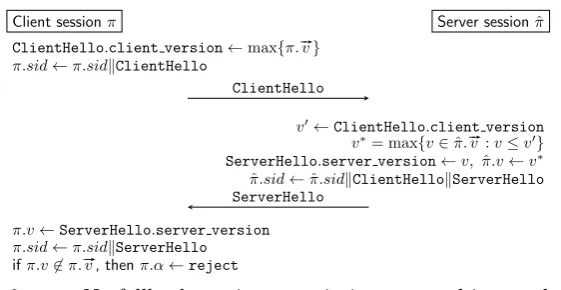
Client sessionπ Server sessionπˆ
ClientHello.client version←max{π.#v} π.sid←π.sidkClientHello
v0←ClientHello.client version v∗= max{v∈π.ˆ#v:v≤v0}
ServerHello.server version←v,π.vˆ ←v∗ ˆ
π.sid←π.sidˆ kClientHellokServerHello ClientHello
ServerHello
π.v←ServerHello.server version π.sid←π.sidkServerHello ifπ.v6∈π.#v, thenπ.α←reject
Figure 2: NPv: No-fallback version negotiation protocol in standard TLS
2.2 Version negotiation in TLS
As indicated in the standards, in TLS the client sends in ClientHello.v the highest version of TLS supports, and the server responds in its ServerHellomessage with the chosen version. In practice, buggy TLS server implementations sometimes reject unrecognised versions rather than negotiating a lower version, so some TLS clients will carry out fallback, where they try again with a lower supported version. We identify three variants of TLS version negotiation as follows. Recall again that in our formalism, the adversary activates each party with a vector #v of their supported versions for that session.
• No-fallback version negotiation, denotedNPv: Version negotiation as defined by the TLS
standards (Figure 1).
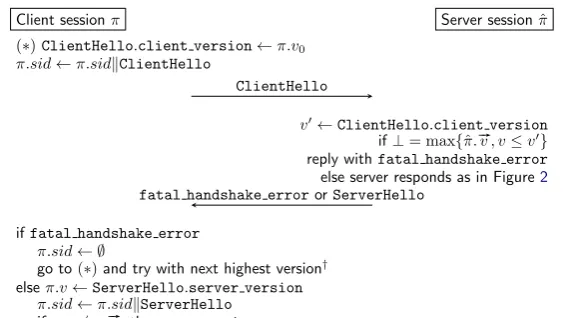
• Fallback version negotiation (the “downgrade dance”), denotedNPv-fb: Version negotiation
as defined by the TLS standards, but allowing version fallback (Figure3).
• Fallback version negotiation with SCSV, denoted NPv-fb-scsv: The client proceeds as in
fallback version negotiation, but when falling back to a lower version, the client also includes in its ciphersuite list afallback signalling ciphersuite value (SCSV) to indicate that it has fallen back; this ciphersuite cannot be negotiated, and instead simply serves as a flag. If the server sees that it would negotiate a version lower than its highest version and the client has included the fallback SCSV, the server aborts and responds with
inappropriate fallback (Figure4).
Note that the transcript (π.sid in our formalism) “resets” in fallback version negotiation: matching conversations are based solely on the last handshake, rather than all handshakes that may have fallen back.
3
Security definitions
We begin by introducing the standard authenticated and confidential channel establishment (ACCE) protocol framework as introduced by Jager et al. [JKSS12]. We then extend the definition to cover protocols which negotiate a sub-protocol, and define the secure negotiation property.
3.1 Authenticated and confidential channel establishment (ACCE) protocols
Client sessionπ Server sessionπˆ
(∗)ClientHello.client version←π.v0
π.sid←π.sidkClientHello
v0←ClientHello.client version if⊥= max{ˆπ.#v , v≤v0}
reply withfatal handshake error else server responds as in Figure2
iffatal handshake error π.sid← ∅
go to(∗)and try with next highest version† elseπ.v←ServerHello.server version
π.sid←π.sidkServerHello ifπ.v6∈π.#v, thenπ.α←reject
ClientHello
fatal handshake errororServerHello
†Note that the “go to (∗)” step in the client execution means that execution remains in the
same session for the client; however, the server, receiving a new ClientHello, will start a new session.
Figure 3: NPv-fb: Fallback version negotiation in TLS (the “downgrade dance”)
Client sessionπ Server sessionπˆ
(∗)ClientHello.client version←π.v0
π.sid←π.sidkClientHello
ClientHello
ifFALLBACK SCSV∈ClientHello.Cipher Suite andπ.vˆ 0>ClientHello.client version,
then reply withinappropriate fallbackand abort else server responds as in Figure3
fatal handshake errororinappropriate fallbackorServerHello
ifinappropriate fallbackthenπ.α←rejectand abort iffatal handshake error
π.sid← ∅
ClientHello.Cipher Suite←π.#ckFALLBACK SCSV go to(∗)and try with next highest version
elseπ.v←ServerHello.server version π.sid←π.sidkServerHello
ifπ.v6∈π.#v, thenπ.α←reject
Figure 4: NPv-fb-scsv: Fallback negotiation in TLS with signalling ciphersuite value
definition of Jager et al. [JKSS12], but our results apply equally to server-only authenticated ACCE [KPW13, KSS13]. Each ciphersuite in TLS is considered a separate ACCE protocol with independent long-term keys, which limits the application of the framework to implementations of TLS with no long-term key reuse.
Parties and sessions. The execution environment consists ofnP parties, denotedP1, P2, . . . PnP.
Each party Pi has a long-term public/private key pair (pki, ski), generated according to the
protocol specification. Each party can execute multiple runs of the protocol either sequentially or in parallel; each run is referred to as a session, and πis denotes the sth session at party i. For each session, the party maintains a collection of the following per-session variables, and we overload the notationπsi to refer to both the session itself and the corresponding collection of per-session variables.
• ρ∈ {init,resp}: The role of the party in the session.
• pid∈[nP]: The index of the intended peer of this session.
• α∈ {in-progress,accept,reject}: The execution status of the session.
• k: A session key, or⊥; kmay for example consist of sub-keys for bi-directional authentica-tion and encrypauthentica-tion.
• T: Transcript of all messages sent and received by the party in this session.
the protocol specification.1
• Any additional state specific to the protocol (such as ephemeral Diffie–Hellman exponents).
• Any additional state specific to the security experiment.
We use the notationπsi.ρetc. to denote each variable of a particular session.
While a session has set α←in-progress, we say that the session is in the pre-accept phase; after the session has set α←accept, we say that the session is in the post-accept phase.
Definition 1 (ACCE protocol). An ACCE protocol P consists of a probabilistic long-term public-private key pair generation algorithm, as well as probabilistic algorithms defining how the party generates and responds to protocol messages. The protocol specification also includes a stateful length-hiding authenticated encryption (sLHAE) scheme StE [PRS11, JKSS12] for sending and receiving payload data on the record layer.
Adversary interaction. In the security experiment, the adversary controls all interactions between parties: the adversary activates sessions with initialization information; it delivers messages to parties, and can reorder, alter, delete, replace, and create messages. The adversary can also compromise certain long-term and per-session values. The adversary interacts parties using the following queries.
The first query models normal, unencrypted operation of the protocol, generally corresponding to the pre-accept phase.
• Send(i, s, m) →$ m0: The adversary sends message m to session πis. Party Pi processes
m according to the protocol specification and its per-session variables πis, updates its per-session state, and optionally outputs an outgoing message m0.
There is a distinguished initialization message which allows the adversary to activate the session with certain information, such as the intended roleρ the party in the session, the intended communication partner pid, and any additional protocol-specific information; when we extend to the negotiable setting in the next subsection, this will include ciphersuite and/or version preferences.
This query may return error symbol ⊥if the session has entered stateα =acceptand no more protocol messages are to be transmitted over the unencrypted channel.
The next two queries model adversarial compromise of long-term and per-session secrets.
• Corrupt(i)→$ ski: Returns long-term secret key ski of partyPi.
• Reveal(i, s)→$ πs
i.k: Returns session key πis.k.
The final two queries,EncryptandDecrypt, model communication over the encrypted channel. The adversary can direct parties to encrypt plaintexts and obtains the corresponding ciphertext. The adversary can deliver ciphertexts to parties, which are then decrypted. To accommodate defining the security property of indistinguishability of ciphertexts, theEncrypt query takes two messages, and one of the tasks of the adversary is to distinguish which was encrypted. The exact specification ofEncryptandDecryptis specified in Figure 4 of [JKSS11] (the full version of [JKSS12]), and is omitted in this paper as these queries are not required for defining negotiable security.
ACCE security definitions. We now present the two sub-properties that define security of ACCE protocols. Like authenticated key exchange (AKE) security definitions, the ACCE framework requires that the protocol provides secure mutual authentication. The difference lies in the encryption-challenge: instead of key indistinguishability (found in AKE experiments) the ACCE framework requires that all payload data transmitted between parties (during the post-accept stage) is over an authenticated and confidential channel. The original motivation for this
1
distinction is that real-world protocols often have key confirmation messages (for example, TLS’s
Finishedmessage), which can act as a key-distinguisher in a AKE security framework. ACCE solves this by focusing on message confidentiality and integrity instead of key indistinguishability.
We start by defining matching conversations and the mutual authentication property of an ACCE protocol. Matching conversations is a property useful for describing the correctness and authentication of a protocol, first introduced by Bellare and Rogaway [BR93]. 2
Definition 2 (Matching sessions). A sessionπt
j matches session πis if:
• ifPi sent the last message inπsi.sid, thenπtj.sid is a prefix of πis.sid; or
• ifPi received the last message inπis.sid, thenπis.sid=πjt.sid,
where X is a prefix of Y if X contains at least one message and the messages in X are identical to and in the same order as the first|X|messages in Y.
Definition 3 (Mutual authentication). A session πsi accepts maliciously if
• πis.α=accept;
• πis.pid=j and noCorrupt(j) query was issued beforeπis.α was updated toaccept; and
• there is not a unique sessionπjt that matches πis.
We define AdvacceP -auth(A) as the probability that, when probabilistic adversary algorithm A
terminates in the ACCE experiment for protocol P, there exists a session that has accepted maliciously.
Channel security for ACCE protocols is defined as the ability of the adversary to break confidentiality or integrity of the channel. As the channel security definition does not play a role in the remainder of this paper, we omit the definition and refer the reader to Defini-tion 5.2 of [JKSS12] for details. Using the notation of Bergsma et al. [BDK+14], the expression AdvacceP -aenc(A) denotes the probability that the adversary Abreaks channel security of protocol
P.
Definition 4 (ACCE-secure). A protocol Pis said to be -ACCE-secure against an adversary
A if we have that AdvacceP -auth(A)≤ and AdvacceP -aenc(A)≤.
3.2 Negotiable ACCE protocols
In this section we define formally a negotiable ACCE protocol and the corresponding security notions. We do so by explaining the differences with Section3.1. The basis of our definition is the multi-ciphersuite ACCE definition of Bergsma et al. [BDK+14], but like the ACCE definitions above we do not consider use of the same long-term key in multiple sub-protocols. We then define the secure negotiation property.
Differences in execution environment. A negotiable ACCE protocol is composed of a
negotiation protocol NP and a collection ofsub-protocols SP# ; we use the notationNPkSP# to denote the combined protocol. For example:
• In TLS with multiple ciphersuites, the negotiation protocolNPcs consists of the sending
and receiving of theClientHelloandServerHellomessages as shown in Figure1, and each sub-protocolSPi corresponds to the remaining messages in ciphersuitei.
• For TLS with multiple versions, each sub-protocolSPi corresponds to a different version of TLS; the description of the negotiation protocol depends on whether and how fallback is handled, and is described in Section2.
2
Parties and sessions. In a negotiable ACCE protocol, each partyPihas a vector of long-term
public/private key pairs (pk# i,sk# i), one for each sub-protocol.
Each session in a negotiable ACCE protocol maintains two additional per-session variables:
• #n: An ordered list of negotiation preferences.
• n: The index of the negotiated sub-protocol.
In the execution ofNPkSP# , the protocol begins by running the negotiation protocol NP, which has as input the ordered list #n of negotiation preferences; the negotiation protocol updates per-session variables, and in particular updates the indexnof the negotiated sub-protocol. Once the negotiation protocol completes, subprotocol SPn is run, operating on the same per-session variables.
Adversary interaction. The adversary can interact with parties exactly as in Section3.1. The only difference is that in the distinguished initialization message in the Send query, the adversary also includes an ordered list #n of the sub-protocol preferences that the party should use in that session. For example, in ciphersuite negotiation, the adversary may direct the party to prefer RSA over Diffie–Hellman in one session and Diffie–Hellman over RSA in another session. For version negotiation in TLS, order of the list is descending and contiguous (i.e., if TLSv1.2 and TLSv1.0 are listed as supported, TLSv1.1 must be listed).
Secure negotiation. Intuitively, a negotiable protocol has secure negotiation if the adversary cannot cause the parties to successfully negotiate a worse sub-protocol than the best one they both support. We formalize this via an optimality function, which will be different for each protocol (for example, the optimality function for TLS ciphersuite negotiation is different from that of TLS version negotiation).
Definition 5(Optimal negotiation). Letω(#x ,#y)→zbe a function taking as input two ordered lists and outputting an element of one of the lists or⊥. We say that two sessionsπsi and πjt do not have optimal negotiation with respect toω unless
πis.n=πjt.n=ω(πis.#n , πjt.#n) . (1)
For TLS ciphersuite negotiation, the optimality function yields the first ciphersuite in the server’s ordered list of preferences also supported by the client:
ωcs(#x ,#y) =yi, wherei= min{j:yj ∈ #x} . (2)
For TLS version negotiation, the optimality function yields the highest version that is supported by both the client and the server:
ωvers(#x ,#y) = max{#x ∩ #y} . (3)
For TLS version negotiation, we impose the order
TLSv1.2>TLSv1.1>TLSv1.0>SSLv3.0>SSLv2.0 . (4)
We can now define what it means for a protocol to have secure negotiation, either of a particular sub-protocol or over all sub-protocols.
Definition 6 (Secure negotiation of a sub-protocol). We say that a session πs
i has negotiated a
sub-protocol n∗ insecurely with respect to ω if
• πis.α=accept;
• πis.n=n∗;
• πisandπjtdo not have optimal negotiation with respect toω, whereπjt is the unique session that matches πs
i.
We define Advneg,ω
NPkSP#,n∗(A) as the probability that, whenA terminates in the negotiable-ACCE
experiment forNPkSP# , there exists a session that has negotiated sub-protocoln∗ insecurely with respect toω.
Remark 1 (Secure negotiation vs. authentication). Secure negotiation, as defined is a stronger property than authentication: the third condition of Definition6 effectively incorporates the authentication security definition. Recall that authentication is based on matching session identifiers; if a protocol uses the full transcript as the session identifier, then negotiation generally reduces to authentication, which is shown in the theorem in the next section. However, if a protocol uses some subset of the transcript as the session identifier, or for example “resets” the session identifier partway through the handshake as in TLS version fallback, then negotiation becomes non-trivially different from authentication and requires further consideration, as we shall see in Section6.
4
Negotiation-authentication theorem
We now present our negotiation-authentication theorem, which allows us under certain conditions to relate the probability of an adversary forcing a user to insecurely negotiate toNPkSPn to the probability of an adversary breaking authentication inNPkSPn. At first glance, this seems obvious: if all of the messages in a protocol are securely authenticated, then it should be impossible for an adversary to trick the parties into negotiating something sub-optimal. There is a reason why the application of the theorem is not trivial: In practise, not all protocols authenticate all messages in the handshake. As we will see Section 6, version fallback in TLS results in some parts of the negotiation not being authenticated. Historically, ciphersuite downgrade in SSLv2 was possible as the negotiation phase wasn’t entirely authenticated.
To be able to apply this theorem, the protocol Phas to satisfy certain conditions as shown in the theorem statement below. Precondition 1 captures the notion that protocols where all handshake message are authenticated, or at least all handshake messages related to negotiation are authenticated, should allow us to reduce negotiation security to authentication security. Precondition 2 is a simply that, in the absence of an active adversary, parties negotiate correctly.
Theorem 1. Let NPkSP# be a negotiable ACCE protocol and let ω be an optimality function. Suppose that:
1. all message sent and received by a party in the negotiation phase are included in the session identifier; and
2. in the absence of an active adversary, negotiation is always optimal with respect to ω, then for all algorithms A and for all sub-protocolsSPn,
Advneg,ω
NPkSP#,n(A) = Adv
acce-auth
NPkSPn (A) . (5)
5
Analysis of TLS ciphersuite negotiation
Using our negotiation-authentication theorem from Section4, we can show that TLS is ciphersuite-negotiation secure. We do this by showing that ciphersuite ciphersuite-negotiation in TLS satisfies the two preconditions outlined in our negotiation-authentication theorem, and hence secure negotiation of ciphersuites is, not surprisingly, guaranteed by security of authentication. All outputs of ciphersuite negotiation are included in the session identifier (as seen in Figure 1), thus precondition 1 is satisfied, provided the ciphersuite has secure authentication. In addition, TLS ciphersuite negotiation is optimal in the presence of a passive adversary, so precondition 2 is also satisfied. Details appear in Appendix A.2.
Corollary 1. For the TLS protocol with ciphersuite negotiationNPcsas described in Figure1and TLS ciphersuites SP# , an adversary A who can force a user to negotiate insecurely to ciphersuite
SPn with respect to the TLS ciphersuite optimality function ωcs from equation (2) can also break authentication of that ciphersuite:
Advneg,ωcs
NPcskSP#,n(A) = Adv
acce-auth
SPn (A) . (6)
6
Analysis of TLS version negotiation
In this section, we consider the three variants of TLS version negotiation identified in Section2.2. The no-fallback version negotiation mechanism specified by the TLS standard, can easily be seen to be secure using our negotiation-authentication mechanism. When version fallback is permitted, version negotiation is no longer secure, as we demonstrate with a counterexample, and thus our model successfully captures this weakness of fallback. Finally, when the signalling ciphersuite value (SCSV) version fallback detection mechanism is used, we can show that TLS becomes version-negotiable secure.
6.1 TLS no-fallback version negotiation is secure
It is straightforward to apply our negotiation-authentication theorem to show that TLS with no-fallback version negotiation (NPv described in Figure 2), provides secure version negotiation.
Here the session identifier consists of the entire transcript, which includes the client and server’s version information, so precondition 1 of Theorem1 is satisfied. It is clear that TLS provides optimal version negotiation in the presence of a passive adversary, so precondition 2 is satisfied. Thus the negotiation-authentication theorem yields Corollary 2. Details appear in AppendixA.3.
Corollary 2. For the TLS protocol with no-fallback version negotiation NPv as described in Figure 2 and TLS versions SP# , an adversary A who can force a user to negotiate insecurely to version SPn with respect to the TLS version optimality functionωvers from equation (3) can also break authentication of that version:
Advneg,ωvers
NPvkSP#,n(A) = Adv
acce-auth
SPn (A) . (7)
6.2 TLS fallback version negotiation is not secure
When examining version negotiation in TLS with fallback (NPv-fb from Figure3), notice that
many differentClientHellomessages may be sent by the client before the handshake is accepted by the server. An active adversary may force this behaviour: instead of delivering the first few ClientHelloattempts at handshake messages to the server, the adversary responds with
error until the client attempts a TLSv1.0 ClientHello with a successful response. In this scenario, the session clearly has sub-optimal version-negotiation—the client and server both support TLSv1.2, but the adversary has caused a version 1.0 negotiation—and this provides a example that TLS with fallback is not version-negotiable secure.
In terms of our negotiation-authentication theorem, it fails to apply here because not every output of the negotiation phase is authenticated by the sub-protocol: only the successful
ClientHello message is included in the transcript and is considered for matching sessions. Much like the ciphersuite-downgrade vulnerability in SSLv2, this allows an active adversary to modify and delete any of the previous exchanges between the server and client.
6.3 TLS fallback version negotiation with SCSV is secure
Similar to TLS fallback version negotiation, TLS fallback version negotiation with SCSV (NPv-fb-scsvas described in Figure4) does not acknowledge or authenticate any messages previous to
thefatal handshake messagein the session identifier, and as such does not satisfy precondition 1 of Theorem 1. Thus, we cannot use the negotiation-authentication theorem to show that that fallback version negotiation with SCSV securely negotiates version. Instead, we provide a direct argument to show that fallback version negotiation with SCSV is secure provided that no-fallback TLS version negotiation is secure.
Theorem 2. For the TLS protocol with fallback version negotiation with SCSV NPv-fb-scsv as described in Figure 4 and TLS versions SP# , an adversary who can force a user to negotiate insecurely to versionSPn with respect to the TLS version optimality functionωversfrom equation3 can also break authentication of that version:
Advneg,ωvers
NPv-fb-scsvkSP#,n(A)≤Adv
acce-auth
SPn (A) . (8)
Proof. The security argument proceeds by showing that an adversary who is successful in breaking fallback version negotiation with SCSV is also successful in breaking authentication of the underlying ACCE protocol. We give a high-level description of the simulator behaviour below.
The simulator B in our argument recreates the SCSV mechanisms described in Figure 4
and ref. [ML15] using a version negotiation TLS challengerC for TLS with no-fallback version negotiation; more precisely,B simulates thenegexperiment for NPv-fb-scsvkSP# using a challenger
forNPvkSP# .
Binitially forwards all adversarial queries to the challengerCfor each session. After receiving theClientHellomessage for a sessionπ from the adversaryA, the simulator is able to determine whether the version in the ClientHello would cause a handshake error. If the error would occur, B replies to A directly with fatal handshake error. If the error would not occur, B
faithfully forwards all queries for that session betweenA and C.
Upon receiving afatal handshake errorfromAintended for a sessionπ, the simulator uses aSendquery to activate a new sessionπ0 that is activated identically toπ exceptFALLBACK SCSV
is also included in the list of supported ciphersuites and the list of supported versions forπ0 is modified to no longer include the highest supported version v of the sessionπ. Balso addsπ to a fallback listF L to determine which sessions have performed version-fallback.
Note that from A’s point-of-view, π0 and π are the same continuous session, and B now directs all queries sent to π toπ0 instead.
As well, B, upon receiving aClientHellofrom Athat contains FALLBACK SCSVin the list of supported ciphersuites, determines if the server’s highest supported version is higher than the client’s indicated version in theClientHello. If so,B replies with aninappropriate fallback
error message. Note that the alert is fatal, so the simulator B will disregard all further Send
This describes the simulator’s behaviour during the experiment. Suppose at some point A
breaks the negotiable security of a sessionπ∗. There are two cases:
1. Ifπ∗ does not appear onB’s fallback list F L, then all messages were forwarded faithfully between A and C. An insecure version fallback to version SPn in B’s simulation of
NPv-fb-scsvkSP# thus directly translates to insecure version negotiation to version SPn in
C’s execution of NPvkSP# . Hence, AdvnegNP ,ωvers
v-fb-scsvkSP#,n(A) ≤Adv
neg,ωvers
NPvkSP#,n(A). By Corollary 2,
Advneg,ωvers
NPv-fb-scsvkSP#,n(A)≤Adv
acce-auth SPn (A).
2. If π∗ does appear on B’s fallback list F L, then the simulator will have rejected any non-optimal handshakes containing the SCSV. It follows then that the session must have accepted maliciously (either by theA impersonating the server party or by modifying the handshake of the fallback session π∗0). Thus an insecure fallback to version SPn in B’s simulation ofNPv-fb-scsvkSP# directly translates to an authentication break in SPn. Hence,
Advneg,ωvers
NPv-fb-scsvkSP#,n(A)≤Adv
acce-auth SPn (A).
Need for contiguous support of TLS versions for fallback with SCSV. As shown
above, SCSV does give additional protection against version downgrade attacks in TLS imple-mentations that support version fallback. However, we observe that there is a drawback to the SCSV proposal as it stands: Non-contiguous support of versions in TLS implementations (a viable scenario in practise) can hamper interoperability between systems supporting checking for insecure fallback using SCSV.
In some implementations of TLS,3 users can select a non-contiguous subset of TLS version support. For example, a user could—for some reason—enable TLSv1.2 and TLSv1.0, but not TLSv1.1.
In relation to the SCSV, this can result in a connection attempt that could fail to accept without adversarial interaction. Consider the following scenario: suppose a client user selects TLSv1.2 and TLSv1.0 to support, and attempts to connect to a server that only supports TLSv1.1 and TLSv1.0, and will return a fatal handshake errorfor TLSv1.2. The client sends aClientHellowith TLSv1.2. After the server fails to parse the TLSv1.2 handshake correctly, it reply with afatal handshake errormessage. The client falls back, sending a newClientHello
message with its next highest supported version, TLSv1.0, and includes FALLBACK SCSVin the ciphersuite list to indicate it is falling back. The server notes the SCSV and rejects the handshake with inappropriate fallback as recommended in the SCSV proposal because the server’s highest supported version (TLSv1.1) is higher than the client’s indicated version (TLSv1.0), despite the fact that the optimal negotiated version would be TLSv1.0.
An alternative mechanism for secure version fallback would be to include a signalling ciphersuite value for each version it supports, allow the parties to detect insecure fallback while allowing non-contiguous version support.
7
Discussion
We have introduced provable security notions for negotiation in Internet protocols, and extended the definition of ACCE protocols to utilise previous comprehensive ACCE proofs of TLS ciphersuites. We develop a negotiation-authentication theorem and show that ciphersuite negotiation in TLS is secure, under certain conditions about long-term key reuse. We follow by showing that the version negotiation in standards-defined TLS and the TLS implementation with
3
the SCSV is also secure, but demonstrate that TLS implementations that utilise browser-based version fallback mechanisms are not version-negotiable secure. This analysis holds for TLS configurations that exclude sharing long-term keys across multiple versions. In practice, our analysis requires that TLS configurations (in order to have ciphersuite negotiation security) must use independent long-term keys and thus distinct digital certificates for each ciphersuite; this is currently a necessary cost in order to prevent cross-ciphersuite-like attacks from breaking authentication in TLS. To the best of our knowledge, no web server software currently permits configuring different certificate for different TLS ciphersuites with the same signing/key transport algorithm, nor different certificates for different TLS versions.
Future work. It seems possible that one could extend our analysis to include TLS configu-rations where long-term keys are shared across multiple versions but a singlefixed ciphersuite
(i.e. that TLS 1.2 and TLS 1.0 can reuse long-term keys in the same ciphersuite configuration). However in order to do so requires extensive modification of the negotiation framework to more closely resemble the multi-ciphersuite setting [BDK+14]. This remains a significant practical limitation on long-term key reuse across ciphersuites.
Proposed revisions to TLS in the current draft of TLS 1.3 [Res15] seem to make the protocol resistant to cross-ciphersuite and cross-version attacks. The main change is that, in TLS 1.3, the value signed using the long-term secret key now includes (the hash of) all handshake messages, including the negotiated version and ciphersuite. As a result, the multi-ciphersuite composition framework of Bergsma et al. [BDK+14] should be applicable to both version and multi-ciphersuite configurations of TLS: a signing oracle for a single sub-protocol could be constructed to avoid signing objects that would be valid in another sub-protocol, defeating the first step of the cross-ciphersuite attack. This could then imply negotiation-authentication security of TLS 1.3 with shared long-term keys. A thorough analysis is required to show this categorically, however.
Our techniques can also be applied to other protocols that negotiate cryptographic parameters or versions, the Secure Shell (SSH) protocol being a prime candidate. While SSH does have two versions, they are largely incompatible, and current best-practices including disabling v1 support, so there is little value in studying SSH version negotiation. However, SSH also supports multiple cryptographic algorithms, and our framework can easily be applied to SSH algorithm negotiation. Since the parties authenticate their entire transcript, including both the client’s and server’s algorithm preferences, our negotiation-authentication theorem readily implies that SSH has secure ciphersuite negotiation if it has secure authentication, which it does by the recent results of Bergsma et al. [BDK+14].
References
[BDK+14] Florian Bergsma, Benjamin Dowling, Florian Kohlar, J¨org Schwenk, and Douglas Stebila. Multi-ciphersuite security of the Secure Shell (SSH) protocol. In Gail-Joon Ahn, Moti Yung, and Ninghui Li, editors,ACM CCS 14, pages 369–381. ACM Press, November 2014.
[BFK+13] Karthikeyan Bhargavan, C´edric Fournet, Markulf Kohlweiss, Alfredo Pironti, and Pierre-Yves Strub. Implementing TLS with verified cryptographic security. In2013 IEEE Symposium on Security and Privacy, pages 445–459. IEEE Computer Society Press, May 2013.
[BFK+14] Karthikeyan Bhargavan, C´edric Fournet, Markulf Kohlweiss, Alfredo Pironti, Pierre-Yves Strub, and Santiago Zanella B´eguelin. Proving the TLS handshake secure (as it is). In Juan A. Garay and Rosario Gennaro, editors,CRYPTO 2014, Part II, volume 8617 ofLNCS, pages 235–255. Springer, August 2014.
[BR93] Mihir Bellare and Phillip Rogaway. Entity authentication and key distribution. In Douglas R. Stinson, editor,CRYPTO’93, volume 773 ofLNCS, pages 232–249. Springer, August 1993.
[DA99] Tim Dierks and Christopher Allen. The TLS protocol version 1.0, January 1999. RFC 2246.
[DR06] Tim Dierks and Eric Rescorla. The Transport Layer Security (TLS) protocol version 1.1, April 2006. RFC 4346.
[DR08] Tim Dierks and Eric Rescorla. The Transport Layer Security (TLS) protocol version 1.2, August 2008. RFC 5246.
[FKK11] Alan O. Freier, Philip Karlton, and Paul C. Kocher. The Secure Sockets Layer (SSL) protocol version 3.0, August 2011. RFC 6101; republication of original SSL 3.0 specification by Netscape of November 18, 1996.
[GKS13] Florian Giesen, Florian Kohlar, and Douglas Stebila. On the security of TLS renegotiation. In Ahmad-Reza Sadeghi, Virgil D. Gligor, and Moti Yung, editors, ACM CCS 13, pages 387–398. ACM Press, November 2013.
[Hic95] Kipp E. B. Hickman. The SSL protocol (version 0.2). http://www-archive.mozilla.org/ projects/security/pki/nss/ssl/draft02.html, February 1995.
[JK02] Jakob Jonsson and Burton S. Kaliski Jr. On the security of RSA encryption in TLS. In Moti Yung, editor, CRYPTO 2002, volume 2442 ofLNCS, pages 127–142. Springer, August 2002.
[JKSS11] Tibor Jager, Florian Kohlar, Sven Sch¨age, and J¨org Schwenk. On the security of TLS-DHE in the standard model. Cryptology ePrint Archive, Report 2011/219, 2011. http: //eprint.iacr.org/2011/219.
[JKSS12] Tibor Jager, Florian Kohlar, Sven Sch¨age, and J¨org Schwenk. On the security of TLS-DHE in the standard model. In Reihaneh Safavi-Naini and Ran Canetti, editors,CRYPTO 2012, volume 7417 of LNCS, pages 273–293. Springer, August 2012.
[KPW13] Hugo Krawczyk, Kenneth G. Paterson, and Hoeteck Wee. On the security of the TLS protocol: A systematic analysis. In Ran Canetti and Juan A. Garay, editors,CRYPTO 2013, Part I, volume 8042 of LNCS, pages 429–448. Springer, August 2013.
[Kra01] Hugo Krawczyk. The order of encryption and authentication for protecting communications (or: How secure is SSL?). In Joe Kilian, editor,CRYPTO 2001, volume 2139 ofLNCS, pages 310–331. Springer, August 2001.
[KSS13] Florian Kohlar, Sven Sch¨age, and J¨org Schwenk. On the security of DH and TLS-RSA in the standard model. Cryptology ePrint Archive, Report 2013/367, 2013. http: //eprint.iacr.org/2013/367.
[LSY+14] Yong Li, Sven Sch¨age, Zheng Yang, Florian Kohlar, and J¨org Schwenk. On the security of the pre-shared key ciphersuites of TLS. In Hugo Krawczyk, editor,PKC 2014, volume 8383 ofLNCS, pages 669–684. Springer, March 2014.
[ML15] Bodo M¨oller and Adam G. Langley. TLS fallback Signaling Cipher Suite Value
(SCSV) for preventing protocol downgrade attacks. https://tools.ietf.org/html/
draft-ietf-tls-downgrade-scsv-05, February 2015. Internet-Draft -05.
[MSW08] Paul Morrissey, Nigel P. Smart, and Bogdan Warinschi. A modular security analysis of the TLS handshake protocol. In Josef Pieprzyk, editor,ASIACRYPT 2008, volume 5350 ofLNCS, pages 55–73. Springer, December 2008.
[MVVP12] Nikos Mavrogiannopoulos, Frederik Vercauteren, Vesselin Velichkov, and Bart Preneel. A cross-protocol attack on the TLS protocol. In Ting Yu, George Danezis, and Virgil D. Gligor, editors,ACM CCS 12, pages 62–72. ACM Press, October 2012.
[PRS11] Kenneth G. Paterson, Thomas Ristenpart, and Thomas Shrimpton. Tag size does matter: Attacks and proofs for the TLS record protocol. In Dong Hoon Lee and Xiaoyun Wang, editors,ASIACRYPT 2011, volume 7073 of LNCS, pages 372–389. Springer, December 2011.
[RD09] Marsh Ray and Steve Dispensa. Renegotiating TLS, November 2009. http://
[Res15] Eric Rescorla. The Transport Layer Security (TLS) protocol version 1.3. https://tools. ietf.org/html/draft-ietf-tls-tls13-05, March 2015. Internet-Draft -05.
[RRDO10] Eric Rescorla, Marsh Ray, Steve Dispensa, and Nasko Oskov. Transport Layer Security (TLS) renegotiation indication extension, February 2010. RFC 5746.
[WS96] David Wagner and Bruce Schneier. Analysis of the SSL 3.0 protocol. InProc. 2nd USENIX Workshop on Electronic Commerce, 1996.
A
Proofs
A.1 Proof of Theorem 1 (negotiation-authentication)
[⇒] Show that AdvacceNPkSP-auth
n (A)≤Adv
neg,ω
NPkSP#,n(A).
We wish to show that if NPkSP# has secure negotiation ofn, thenNPkSPn has secure authenti-cation. By Definition6, every sessionπ where the user has negotiated toNPkSPn and accepted maliciously is also a session whereπ has insecurely negotiatedNPkSPn. (i.e. By our definition, authentication is a sub-condition of negotiation). Thus AdvacceNPkSP-auth
n (A)≤Adv
neg,ω
NPkSP#,n(A).
[⇐] Show that Advneg,ω
NPkSP#,n(A)≤Adv
acce-auth NPkSPn (A).
We wish to show that if a session π has secure authentication, then π has secure negotiation. Consider a session π that has accepted, but not maliciously. Since NPkSPn has secure authenti-cation, and all messages in the negotiation phase are included in the session identifiersidthen it follows thatA was passive in the negotiation phase of the session π. Thusπ and its partner negotiated in the presence of a passive adversary. By Precondition 2, we know that negotiation is always optimal with respect to ω in the presence of a passive adversary. Thusπ negotiated optimally to the sub-protocol NPkSPn, and thus AdvnegNPk,ωSP#,n(A)≤AdvacceNPkSP-authn (A).
It follows that Advneg,ω
NPkSP#,n(A) = Adv
acce-auth NPkSPn (A).
A.2 Proof of Corollary 1 (TLS ciphersuite negotiation)
To show that TLS ciphersuite negotiation (NPcsin Figure 1) is secure, we apply the
negotiation-authentication theorem. To do so, we must show that the protocol satisfies the two preconditions of Theorem 1.
Precondition 1. Here we must show that all outputs of the ciphersuite negotiation protocolNPcs
are included in the session identifier sidused to determine matching sessions. TheClientHello
andServerHellomessages are the only two outputs of the ciphersuite negotiation protocolNPcs.
Both are included in the session identifiersidin the per-session variables as we can see in Figure
1, and thus all outputs of the ciphersuite negotiation phase are included in the session identifier, so precondition 1 of the negotiation-authentication theorem is satisfied by TLS ciphersuite negotiation.
Precondition 2. Now we must show that ciphersuite negotiation protocol NPcs is always
optimal in the presence of a passive adversary. Recall that for ciphersuite negotiation in TLS, the optimality function isωcs(π.#c ,π.ˆ #c) = min{π.cˆ i: ˆπ.ci ∈π.#c}(equation (2)). As seen in Figure1,
in the presence of a passive adversary, the client ciphersuite list ClientHello.CipherSuite
is identical to the client’s π.#c. Hence, an honest server computes the optimal version ˆπ.c= min{π.cˆ i : ˆπ.ci ∈ClientHello.CipherSuite} = min{π.cˆ i : ˆπ.ci ∈ π.#c}. Furthermore, in the
presence of a passive adversary, the server-selectedServerHello.ciphersuitereceived by the client is identical to ˆπ.c, and thus
π.c= ˆπ.c= min{π.cˆ i : ˆπ.ci∈π.#c}=ωcs(π.#c ,π.ˆ #c) ,
A.3 Proof of Corollary 2 (TLS no-fallback version negotiation)
To show that TLS version negotiation without fallback (NPv in Figure 2) is secure, we apply the
negotiation-authentication theorem. To do so, we must show that the protocol satisfies the two preconditions of Theorem 1.
Precondition 1. First we must show that all outputs of the no-fallback version negotiation protocolNPv are included in the session identifier sidused to determine matching sessions. This
is very straightforward: the ClientHelloandServerHellomessages are the only two outputs of the version negotiation protocolNPv. Both are included in the session-identifier sid in the
per-session variables as we can see in Figure 2, and thus all outputs of the version negotiation phase are included in the session identifier, so precondition 1 of the negotiation-authentication theorem is satisfied by no-fallback version negotiation.
Precondition 2. Now we must show that the no-fallback version negotiation protocol NPv
is always optimal in the presence of a passive adversary. Recall that for version negotia-tion in TLS, the optimality funcnegotia-tion is ωvers(π.#v ,ˆπ.#v) = max{π.#v ∩π.ˆ #v} (equation (3)).
As seen in Figure 2, in the presence of a passive adversary, the nominated client version
ClientHello.client version is identical to the client’s max{π.#v} Hence, an honest server computes the optimal version ˆπ.v = max{v ∈ π.ˆ #v : v ≤ client version} = max{v ∈π.ˆ #v :
v≤max{π.#v}}= max{π.#v ∩π.ˆ #v}. Furthermore, in the presence of a passive adversary, the server-selectedServerHello.server versionreceived by the client is identical to ˆπ.v, and thus,
π.v= ˆπ.v= max{π.#v ∩π.ˆ #v}=ωvers(π.#v ,π.ˆ #v) ,
so precondition 2 of the negotiation-authentication theorem is satisfied by no-fallback version negotiation.
B
Need for contiguous support of TLS version for fallback with
SCSV
In some implementations of TLS,4 users can select a non-contiguous subset of TLS version support. For example, a user could—for some reason—enable TLSv1.2 and TLSv1.0, but not TLSv1.1.
In relation to the SCSV, this can result in a connection attempt that could fail to accept without adversarial interaction. Consider the following scenario: suppose a client user selects TLSv1.2 and TLSv1.0 to support, and attempts to connect to a server that only supports TLSv1.1 and TLSv1.0, and will return a fatal handshake errorfor TLSv1.2. The client sends aClientHellowith TLSv1.2. After the server fails to parse the TLSv1.2 handshake correctly, it reply with afatal handshake errormessage. The client falls back, sending a newClientHello
message with its next highest supported version, TLSv1.0, and includes FALLBACK SCSVin the ciphersuite list to indicate it is falling back. The server notes the SCSV and rejects the handshake with inappropriate fallback as recommended in the SCSV proposal because the server’s highest supported version (TLSv1.1) is higher than the client’s indicated version (TLSv1.0), despite the fact that the optimal negotiated version would be TLSv1.0.
4The current version of Microsoft Internet Explorer (11) and previous versions allow users to configure which