Factor Base Discrete Logarithms
in Kummer Extensions
Dianyan Xiao1, Jincheng Zhuang2,3, and Qi Cheng4 1
Institute for Advanced Study, Tsinghua University, Beijing, China 2
State Key Laboratory of Information Security, Institute of Information Engineering Chinese Academy of Sciences, Beijing, China
3
State Key Laboratory of Mathematical Engineering and Advanced Computing Wuxi, China
4
School of Computer Science, University of Oklahoma, Norman, OK, USA
Abstract. The discrete logarithm over finite fields of small character-istic can be solved much more efficiently than previously thought. This algorithmic breakthrough is based on pinpointing relations among the factor base discrete logarithms. In this paper, we concentrate on the Kummer extensionFq2(q−1) =Fq2[x]/(xq−1−A).It has been suggested
that in this case, a small number of degenerate relations (from the Borel subgroup) are enough to solve the factor base discrete logarithms. We disprove the conjecture, and design a new heuristic algorithm with an improved bit complexity ˜O(q1+θ) (or algebraic complexity ˜O(qθ)) to compute discrete logarithms of all the elements in the factor base {x+α|α∈Fq2}, where θ <2.38 is the matrix multiplication exponent
over rings. Given additional time ˜O(q4),we can compute discrete loga-rithms of at leastΩ(q3) many monic irreducible quadratic polynomials. We reduce the correctness of the algorithm to a conjecture concerning the determinant of a simple (q+ 1)-dimensional lattice, rather than to elusive smoothness assumptions. We verify the conjecture numerically for all prime powersqsuch that log2(q
2(q−1)
)≤5134, and provide theo-retical supporting evidences.
Keywords: Discrete logarithms, Finite fields, Kummer extension, Character Sum
1
Introduction
consists of small prime numbers, or small degree irreducible polynomials. It is closely related to the concept of smoothness, which plays a critical role in many algorithms attacking public key cryptosystems. An integer is smooth if all its prime factors are small. A polynomial is smooth if it can be factored into a product of irreducible polynomials of small degrees. If an equality of two smooth elements can be established in a finite field, one obtains a linear relation of logarithms of members in the factor base. While previous approaches use exhaustive search to find such relations, the new algorithms [10, 16, 17, 12] rely on a guided way, dubbed as “pinpointing” in [16]. It works very well in practice, inspires the first heuristic quasi-polynomial time algorithm [4], and produces a sequence of record-breaking numerical results. However, the correctness of these algorithms is based on smoothness assumptions that are difficult to prove using current number theoretical techniques.
In the method of [4], to solve the discrete logarithm problems in small char-acteristic fields such asFq2n=Fq2[X], the factor base consists of the polynomial
in Fq2[X] of degree 1. The logarithms of factor base elements can be solved by
the method proposed in [17]. From every element inP GL2(Fq2), one obtains an
equation, where the left hand side is a product of linear polynomials inFq2[X],
and the right hand side is of low degree. A relation is found if the right hand side can be factored completely into linear factors. It has been observed that for the Kummer extensionFq2(q−1), in the equation obtained from an element in the
Borel subgroup of P GL2(Fq2), the right hand is automatically linear [15]. The
relations from the subgroup give us a linear system ofq2−1 variables andO(q2) many equations, without using smoothness assumptions. A natural question is whether it is sufficient to solve the discrete logarithm of linear factors from this system. In this paper, we first give a negative answer to the question. We then propose to add a few simple relations that are not derived from an element in
P GL2(Fq2). Our examples show that after adding them, the discrete logarithm
can be computed. To analyze the algorithm, we formulate a conjecture concern-ing the determinant of a (q+ 1)-dimensional lattice. If the conjecture is true, it implies that discrete logarithms of the factor base (of cardinalityq2) in
Fq2(q−1)
can be solved in ˜O(q1+θ) bit operations ( or algebraic complexity ˜O(qθ)). We
have verified the conjecture numerically for allq’s such that log2(q2(q−1))≤5134, which covers all the fields that are practically relevant. We also provide theoret-ical evidences that support the conjecture.
Given a finite field Fpn, the group F∗pn is known to be cyclic. Finding one generator will have many applications, however this is not an easy problem. Several approaches have been taken to tackle this problem. One approach is to construct elements with high order, such as [22, 6, 1]. Another approach is to find a small generating set, such as [9, 20, 23]. One can also focus on some restricted parameters, such as small characteristics [15, 19].
– The Kummer extensions are usually the testbeds for new ideas on solving discrete logarithms. The efficiency of the algorithm in the Kummer case attains the upper bound, thus many of the numerical records are achieved in Kummer extensions.
– All the new algorithms are heuristic, even in the case of Kummer extensions, except a recent result in [11], where it is randomized. Removing the heuris-tic and/or the randomness from the algorithm, or even just weakening the heuristic, is an interesting and important problem. The Kummer extensions are naturally the first candidates for investigations.
1.1 New Method of Finding Relations
LetFq be a finite field withqelements. Leth0(x) andh1(x) be polynomials over
Fq2 of small degrees. Letgbe an element in Fq2 such thathgi=F∗q2. Following
Joux’s idea, we start with the identity inFq2[x]:
Y
α∈Fq
(x−α) =xq−x.
Applying the M¨obius transformation
x7→ ax+b
cx+d
where the matrixm=
a b c d
∈F2×2
q2 is nonsingular, we have
Y
α∈Fq
ax+b
cx+d−α
=
ax+b
cx+d
q
−ax+b
cx+d.
Clearing the denominator, we get
(cx+d) Y
α∈Fq
((ax+b)−α(cx+d))
= (ax+b)q(cx+d)−(ax+b)(cx+d)q = (aqxq+bq)(cx+d)−(ax+b)(cqxq+dq).
Multiplying both sides byh1(x) and replacingxqh1(x) byh0(x), we obtain
h1(x)(cx+d) Y
α∈Fq
((ax+b)−α(cx+d))
=(aqh0(x) +bqh1(x))(cx+d)−(ax+b)(cqh0(x) +dqh1(x))
(mod xqh1(x)−h0(x)). (1)
The left hand side is a product of linear polynomials if h1(x) has degree ≤1. Letf(x) be irreducible factor of xqh
1.2 Our Contributions
For any (n, q) (n < q) of cryptographic interests, the small degree polynomi-als h0(x) and h1(x) can be found easily so that xqh1(x)−h0(x) has an irre-ducible factor of degree n. However proving that they exist in general is a very hard mathematical problem. One can compare it with the much weaker Hansen-Mullen Conjecture [13, Conjecture B] concerning the distribution of irreducible polynomials with some prefixed coefficients, and subsequent work such as [23]. Because this work focuses on provability of the computational complexity, we feel that the Kummer extension Fq2(q−1) should be dealt with firstly. It can be
modeled by Fq2[x]/(xq−1−A), whereA∈Fq2 andxq−1−Ais irreducible over
Fq2. In this case, existence ofh0andh1 can be easily established, and in fact,
h1(x) = 1, h0(x) =Ax. Equation (1) becomes
(cx+d) Y
α∈Fq
((a−αc)x+ (b−αd))
=A(aqc−acq)x2+ ((bqc−adq)−A(bcq−aqd))x+ (bqd−bdq) (modxq−Ax).
(2)
If aqc = acq, then the right hand side has degree one, which gives us a relation. To satisfyaqc=acq, we can seta= 0, in which caseccan be made to 1; or we setc = 0, in which caseacan be made to 1; or we can seta= 1 and
c = 1. One can verify that these three cases give us the same set of relations, since they are in the same P GL2(Fq)−coset of the groupP GL2(Fq2), and the
elements in the same P GL2(Fq)−coset generate the same linear equation. We
need to note that ifbqd=bdq, the situation is similar, since the LHS quadratic
polynomial is a product of x and a non-trivial linear factor. W.l.o.g., we will assume thatc= 0 andd= 1.Denote X=x (mod xq−1−A), we have
Y
α∈Fq
(aX+b−α) = (Aaq−a)X+bq−b.
Ifb6∈Fq, then we can simply assume thatb=g, and obtain
aq Y
α∈Fq
X+g−α
a
= (aqA−a)
X+ g
q−g
aqA−a
.
Let log be the discrete logarithm based on a prefixed multiplicative generator of (Fq2(q−1))∗/Fq∗2. For example, loga= 0 for everya∈F∗q2. We obtain a linear
system
∀a∈F∗q2,
X
α∈Fq log
X+g−α
a
= log
X+ g
q−g
aqA−a
(3)
ofq2−1 equations inq2−1 variables, which represent log(X+h) (h∈
We observe that Aagqq−−ga runs over F
∗
q2 when a goes through F∗q2, then we
could write the variables in order logX+Aggqiq−−ggi
(i= 0,2,· · ·, q2−2). Con-sequently the linear system can be formulated as
∀0≤i≤q2−2, X
0≤j≤q2−2
mi,jlog
X+ g
q−g
gjqA−gj
= log
X+ g
q−g
giqA−gi
,
where
mi,j =
1,if∃α∈Fq, s.t. g−giα=
gq−g
Agjq−gj; 0,otherwise.
Denote the matrix M = (mi,j)0≤i,j≤q2−2. One can verify that the coefficient
matrix of the linear system isM−I. It becomes an interesting problem to study the eigenvalue ofM.
Note that
a b
0 1
|a∈F∗q2, b∈Fq2
is the Borel subgroup ofP GL2(Fq2). We should only considerP GL2(Fq)−coset
representatives, which can be partitioned into two subsets
a g
0 1
|a∈F∗q2
∪
a0 0 1
|a∈F∗q2/F∗q
.
The linear system (3) is obtained by considering the first subset. The second subset gives us a system ofq+ 1 equations:
∀a∈F∗ q2/F∗q,
X
α∈F∗
q log
X+−α
a
= 0. (4)
None of the equations contains the variable corresponding to logX, which is known as a trap [5]. But it is easy to calculate log(X) in the Kummer case since the order of X is small. Note that the linear system (3), as well as (4), is homogeneous. LetN be the largest factor ofq2(q−1)−1 that is free of prime factors ≤ q2−1 . If the solution space is one dimensional over
Z/NZ, then
the discrete logarithms of linear factors can be determined up to a scalar that depends on the logarithm base. We will show that the linear system (3) is not sufficient for the purpose of solving discrete logarithm of the factor base. To achieve this, we prove that the eigenvalues ofM, viewed as an integral matrix, include 1 with multiplicity at least (q−1)/2.
We also show that adding (4), we can reduce the number of variables in (3) fromq2−1 toq2−q−2, which derives a (q2−q−2)×(q2−q−2) matrixM0,
a direct summand ofM. We prove that all the complex eigenvalues ofM0 have complex norm √q, using the character sum technique. In particular, it implies that M0−I has no solution over complex numbers. As for the solvability over
l | q2(q−1)−1, M0 has eigenvalue 1 over
Fl with multiplicity 2, which shows
adding (4) does not help to determine the factor base discrete logarithms. We then propose to add a simple relation into the linear system. Note that overF∗q2(q−1)/F
∗
q2, (X+a)q 2
=X+Aqa+1, thus we get
∀a∈F∗q2, q2log(X+a) = log
X+ a
Aq+1
. (5)
The technique of using Frobenius action to reduce the smoothness basis size has been used in previous work [17]. Actually we can use
∀a∈F∗q2, qlog(X+a) = log
X+a
q
A
(6)
instead of (5) to have a slightly better algorithm, which will not improve the complexity order..
Observe that given the value log(X+a) for anya∈F∗q2, log(X+aβ) for all
β ∈F∗q can be computed from (5), since
1
Aq+1 is a generator of the multiplicative
group F∗q. This allows us to reduce the number of variables further to q+ 1.
We show that to find the factor base discrete logarithms, we need to solve a (q+ 1)×(q+ 1) matrix ˆM −I, where ˆM is a direct summand of M0 over
Z/NZ. The efficiency is improved to bit complexity O q3.38. To analyze the
new algorithm, we introduce a conjecture about the determinant of a simple (q+ 1)−dimensional lattice, derived from ˆM −I. The conjecture implies that this more efficient algorithm can solve the factor base discrete logarithm for any
Fq2(q−1). We have done an extensive numerical study to confirm the conjecture.
This paper is organized as follows. In Section 2, we decomposeM into a block diagonal form, and show that adding (4) essentially removes one small block from M , thus will not have a big impact on the efficiency of the algorithm. In Section 3, we show that adding (5) allows us to select just one block from the block diagonal form of M, which greatly improves the efficiency. We formulate a conjecture that implies the correctness of our algorithm, and supply some numerical and theoretical evidences. We make some concluding remarks in the last section.
2
Block Diagonal Form of
M
over
C
In this section, we show that the linear system (3) is singular overQwith a kernel of dimension at least (q−1)/2. To this end, we first decomposeM, viewed as a
C-linear transformation ofC[x]/(xq
2−1
−1),
M(xk) =
q2−2 X
i=0
mi,kxi=
X
α∈Fq
xlogg
(g+α)·Agkq−gk gq−g
into a direct sum of linear transformations. For the linear system (4), we have a correspondingC-linear transformation under the same base,
C(xk) = X
α∈Fq
xlogg
−α·Agkq−gk gq−g
, for all 0≤k≤q2−2.
Definition 1. Define two linear transformations G and T over the C-linear
spaceC[x]/(xq2−1
−1)as:
G(xk) =xk X
α∈Fq
xlogg(g+α), T(xk) =xkxloggAgk
(q−1)−1
gq−g .
Note that M, C, G and T are well-defined, since logg is a map fromF∗q2 to
Z/(q2−1)Zifg is a multiplicative generator ofFq2.
Theorem 1. We haveM =GT.
Proof. For any 0≤k≤q2−2, M(xk) = X
α∈Fq
xlogg
(g+α)·Agkq−gk gq−g
=
X
α∈Fq
xlogg(g+α)
·x
loggAgkqgq−−ggk
,
which proves the theorem. ut
According to Chinese Remainder Theorem, we have a ring isomorphism:
C[x]/(xq
2−1
−1)→
q−2 M
i=0
C[x]/(xq+1−ζqi−1),
where ζq−1=e
2πi
q−1. It decomposes the linear space C[x]/(xq2−1−1) intoq−1
subspaces, each has dimensionq+ 1. The following theorem shows that each of the components is an invariant subspace forT andG, thusM can be represented by a block-diagonal matrix.
Theorem 2. The linear transformationM overC[x]/(xq
2−1
−1) defined above is similar to a block-diagonal matrix:
M =U−1
M0
M1 . ..
Mq−2
U, (7)
where for i = 0,1,· · ·, q−2, Mi =M |C[x]/(xq+1−ζi
q−1), denoting the
transfor-mation of M acting on the invariant subspaceC[x]/(xq+1−ζi
Proof. LetVi,j be the polynomial
xjY
k6=i
(xq+1−ζqk−1)
in C[x]/(xq2−1−1). It is easy to see that for any 0 ≤j ≤q,0 ≤i ≤q−2, if
k6=i, we have
Vi,j = 0 (modxq+1−ζqk−1).
AndVi,0, Vi,1,· · · , Vi,q is a basis of subspaceC[x]/(xq+1−ζqi−1). One can verify that
T(xm(q+1)xn) =xm(q+1)xnxlogg
Ag(n+m(q+1))(q−1)−1
gq−g
=xm(q+1)xnxloggAgn
(q−1)−1
gq−g
=xm(q+1)T(xn)
for any integermandn. We haveT(Vi,j) =yVi,j0 for some integerj0andy∈C.
Thus, the space spanned by Vi,0, Vi,1,· · · , Vi,q is invariant under T. It is also
invariant underG, the block diagonal structure ofM is derived. ut
2.1 The Linear Transformation T
It turns out thatT is a very simple transformation.
Theorem 3. Let 0 ≤ i ≤ q−2 be an integer. Note that since 1(g−qA−qg+1)2 ∈ F∗q,
there must exist a unique complex number τ that is congruent to
xlogg
1−Aq+1
(gq−g)2 (modxq+1−ζi q−1). The linear transformation Ti=T |C[x]/(xq+1−ζi
q−1) can be represented by
D
0 y1
τ /y1 0
0 y2
τ /y2 0 . ..
0 yd
τ /yd 0
whereD=diagonal(γ1,· · · , γt)satisfying γj2=τ for all1≤j≤t. In addition,
Proof. In the polynomial ringC[x]/(xq+1−ζi
q−1), we have
T2(xk) =xlogg 1
−Aq+1
(gq−g)2 ·xk =τ xk,
since
AAggkqq−−ggk q
−Aggkqq−−ggk
gq−g =g k
· 1−A
q+1 (gq−g)2.
For any integer 0≤k1 ≤q, there must exist an integer k2 andy ∈C, such
thatT(xk1) =yxk2, andT(xk2) = τ yx
k1. Whenk
1=k2, we haveT(xk1) =γxk1 withγ2=τ. We claim that the number of thesek1 is at most 2.
Observe thatT(xk) = γxk for some γ ∈ C if and only if Ag
k(q−1)−1
(gq−g) ∈ Fq.
Then we must have
Agk(q−1)−1
gq−g
q =Ag
k(q−1)−1
gq−g .
NamelyAg2k(q−1)−2gk(q−1)+Aq = 0, which is a quadratic equation ingk(q−1). In addition,gq−1has orderq+ 1, thus there are at most two 0≤k≤qsatisfying the formula.
With proper order of the basis{1, x, x2,· · · , xq}, we obtain our conclusion. u t
Corollary 1. The characteristic polynomial of the linear transformation T0 =
T |C[x]/(xq+1−1) is
– (x2−1)q/2(x−1) if qis even;
– (x2−1)(q+1)/2 ifq is odd andt= 0;
– (x2−1)(q−1)/2(x−1)2 if qis odd and t= 2.
Let us consider the action ofM on subspace C[x]/(xq+1−1). By Chinese Remainder Theorem,
C[x]/(xq+1−1)∼=C[x]/(x−1)⊕C[x]/(xq+xq−1+· · ·+ 1).
In the componentC[x]/(x−1)∼=C, xq+xq−1+· · ·+ 1∈C[x]/(xq+1−1) is the
base. Acting on the base,G0=G|C[x]/(xq+1−1)is just a multiplication byq, and
T fixes the base. In the other componentC[x]/(xq+xq−1+· · ·+ 1), one base is
{xi(x−1)|0≤i≤q−1}.The actionG0is a multiplication by X
α∈Fq
xlogg(g+α)= X 1≤i≤q
xi=−1,
since for anyα∈Fq, β∈Fq, (g+α)/(g+β)6∈Fq ifα6=β. The eigenvalue of
M0is thus equal to the negation of eigenvalue of T0. Hence
Theorem 4. Let f0(x)be the characteristic polynomial of M0, we have
f0(x) =
From Theorem 4 , we conclude thatM has eigenvalue 1 with multiplicity at least (q−1)/2. HenceM −I has a kernel space of dimension (q−1)/2 overQ. It means that the q2−1 relations in the linear system (3) are not enough to compute the discrete logarithms of linear factors.
2.2 The Linear Transformation C
Theorem 5. We have
C=U−1
(q−1)T0 0
. .. 0
U
whereT0is a permutation matrix, andU is the same base change matrix in (7). Proof. It is easy to verify thatC=HT, whereH is a linear transformation over
C-linear spaceC[x]/(xq
2−1
−1) defined as:
H(xk) =xk X
α∈F∗q
xlogg(−α),
andT is defined in Definition 1.
In the ringC[x]/(xq+1−1), we have
X
α∈F∗q
xlogg(−α)= X 1≤j≤q−1
(xq+1)j=q−1.
That is, for any polynomialP ∈C[x]/(xq+1−1),
C(P(x)) =HT(P(x)) =T(P(x))· X
α∈F∗
q
xlogg(−α)
= (q−1)T(P(x))6= 0.
On the other hand, in the ringC[x]/(xq+1−ζqi−1), 1≤i≤q−2, we have X
α∈F∗
q
xlogg(−α)= X 1≤j≤q−1
(xq+1)j= X 0≤j≤q−1
(ζqi−1)j = 0.
Then for anyP(x), one may obtain:
C(P(x)) =T(P(x))· X
α∈F∗
q
xlogg(−α)= 0.
We conclude that the solution space of (4) belongs to the solution space of
Corollary 2. Adding the equations of (4) to the equations of (3), we obtain a linear systemM0−I where
M0=M1⊕M2⊕ · · ·Mq−2.
The corollary basically shows that after adding (4), the dimension of the linear system that we need to solve drops fromq2−1 toq2−q−2, which is only a negligible improvement.
3
The Main Theorem and the Conjecture
Assume thatq2(q−1)−1 has factorization
q2(q−1)−1 =pe11 pe22 · · ·pes
s N,
wherep1,· · ·, psare primes less thanq2, andN is free of prime factors less than
q2. DenoteS=pe1
1 p
e2
2 · · ·pess.To solve the discrete logarithm problem inFq2(q−1),
we factor the group through isomorphism
F∗q2(q−1) =∼Z/NZ×Z/SZ.
The discrete logarithm in the subgroup of order S can be solved in O(q2) by Pohlig-Hellman algorithm [18], since the group order is smooth. So we should focus on the subgroup of order N. To compute the discrete logarithm in this subgroup, we will have to solve the equation system (3) combining with (4) over Z/N Z. Ideally it is preferable to solve linear systems in a finite field Fl,
where l|N, as there are no zero divisors in a field. However it is hard and time-consuming to factor N in general. In order to avoid the complexity cost exp(12log2N +o(log2N)) for factoringN, we solve the linear system by com-puting the Smith Normal Form, instead of using the Gauss Elimination.
As we have shown in the previous sections, the system (3) alone is not enough, since it has a kernel overQof dimension much bigger than 1. Can we avoid the
problem by adding the linear equations (4)? We found that whenq= 31,M0has eigenvalue 1 with multiplicity 2 overFl for the prime factorl= 2521 ofN, thus
theM0−I have a kernel of dimension 2 overFl. Here we include the details:
For the caseq= 31, we build the extension fieldFq2 =Fq[x]/(x2−2x+3).
Letg=x (modx2−2x+ 3). One can verify that g is a multiplicative generator ofF∗
q2. The elementA is selected to beg. We compute h(x),
the characteristic polynomial of M0, and find that whenl = 2521, the power of the factorx−1 inh(x) (modl) is 2.
This shows that the discrete logarithm over the subgroup of sizel can not be uniquely determined by the linear system (3) plus (4). Furthermore, even in the case that (3) plus (4) is sufficient, it is not efficient, since we need to solve a linear system withO(q2) many variables, namely log(x+α), α∈
Fq2.
3.1 Computing the Discrete Logarithms of Factor Base
Let us consider the new linear system consisting of (3),(4)and(5). The new lin-ear system have only q+ 1 variables, and the coefficient matrix can be de-scribed by the action of G and T, as defined in Definiton 1, on the Z/N Z
-module (Z/N Z)[x]/(xq+1 −µ˜(gq+1)), where ˜µ is homomorphism from F∗q to
hq2i ∈(Z/N Z)∗ satisfying
˜
µ(1/Aq+1) =q2.
We will denote the coefficient matrix ofGT in base{xi|0≤i≤q}by ˆM, which
can be regarded as an integer matrix. We useLto denote the map from an integer matrix to the lattice generated by the row vectors of the matrix. Construct a lattice
Λ=L( ˆM−I) +NZq+1.
Theorem 6. We haveN|det(Λ)|Nq+1.
Proof. Note thatNZq+1 is a sublattice ofΛ , we conclude that det(Λ)|Nq+1.
The linear factorsX+a(a∈Fq2 ) generate the cyclic multiplicative group
F∗q2(q−1) [7]. From (5), we conclude thathX+g
i|0 ≤i≤qicontains the cyclic
multiplicative groupF∗q2(q−1)/hXi, which includes the subgroup of cardinalityN.
There is an injection from this subgroup into ofZq+1/Λ, thusN|det(Λ). Note that if we need to use a different base for theZ/N Z-module (Z/N Z)[x]/(xq+1− ˜
µ(gq+1)),the determinant of lattice remains the same. ut We make the following conjecture
Conjecture 1. det(Λ) =N.
It implies that we can use Smith Normal Form of Λ to find a generator of subgroup of cardinalityN, and determine the factor base discrete logarithm with respect to that element in the subgroup. We have verified the conjecture for all the prime power q less than 311 by generating instances as illustrated above. Details of the experiment are included in A.
Theorem 7. Assume that the conjecture is true. We can find a generator of the subgroup of cardinality N in F∗
q2(q−1), and compute the discrete logarithms
of linear factors with respect to the generator within O˜(qθ)algebraic operations,
whereθ <2.38 is the matrix multiplication exponent over rings.
Proof. Assuming that for any basisB of lattice Λ, we have the Smith Normal Form transformationD=S1BS2, whereDis the Smith Normal Form of lattice
Λ, andS1, S2 are corresponding transformations with respect to B. Then it is easy to verify that the last column ofS2are the ratio of the discrete logarithms of
X+g
q−g
A−1, X+
gq−g
Agq−g,· · · , X+
gq−g
Agkq−gk,· · ·, X+
gq−g
Ag−gq
Assuming that the last row of S2−1 is (e00, e01,· · ·, e0q), one may verify that hQq
k=0(X +
gq−g
Agkq−gk)e
0
ki contains the subgroup of F∗
q2(q−1) of order N. With
the ratio, it is easy to calculate the discrete logarithms of X+ Aggkqq−−ggk (k = 0,1,· · · , q) with respect to the generator. And the discrete logarithm of other elements in the factor base can be obtained through relation (5).
We need to compute the Smith Normal Form of B and its corresponding transform matrix over Z/NZ, which can be achieved within O(qθ) arithmetic
operations ([21]), whereθ is less than 2.38 according to [8]. ut
Remark 1. If necessary, we can also include a portion of irreducible quadratic polynomials in the factor base. The logarithms of these elements can be deduced once the logarithms of linear elements are known. Details are included in B.
3.2 Other Eigenvalues of M overC
Theorem 6 states thatN|det(Λ)|Nq+1.We conjecture that det(Λ) is in factN, so qualitatively the determinant of anN-ary lattice derived from ˆM−Ishould be small. In this subsection, we show that the determinant ofMi−I overCis
indeed small.
Theorem 8. For1≤i≤q−2, the complex norm of the determinant of Mi−I
is not zero, and it is no larger than(√q+ 1)q+1.
Note that the determinant is in general not a rational integer, but a cyclo-tomic integer in Z[ζq−1]. In our view, it provides a strong supporting evidence of the conjecture. The theorem follows easily from the statement that the eigen-values of Mi ( 1≤i≤q−2 ) have complex norm
√
q, which we prove in this subsection. First we compute the eigenvalue ofGi fori6= 0 .
Lemma 1. Acting on any subspaceC[x]/(xq+1−ζqi−1)(1≤i≤q−2), all of the eigenvalues ofGi have complex norm
√
q.
Proof. We can factorxq+1−ζqi−1completely overC, and by Chinese Remainder Theorem,
C[x]/(xq+1−ζqi−1)∼=
q
M
j=0
C[x]/(x−ζqj2(q−−11)+i),
where ζq2−1 =e2πi/(q 2−1)
. In each component, G is a multiplication by a con-stant, thus the eigenvalue ofGis equal to
X
α∈Fq
ζ(j(q−1)+i) logg(g+α)
q2−1 =
X
α∈Fq
µj(g+α),
whereµj is a multiplicative character fromF∗q2 to Cby sendingg toζ j(q−1)+i q2−1 .
Lemma 2. Let µ be a multiplicative character for F∗q2 that is not trivial over
F∗q, we have |
P
α∈Fqµ(g+α)|= √
q.
Note that ifµ is trivial overF∗
q2 , we have
P
α∈Fqµ(g+α) =q. Ifµ is not trivial over F∗q2 but is trivial over F∗q, then
P
α∈Fq,β∈Fqµ(gβ+α) = 0. On the other hand
X
α∈Fq,β∈Fq
µ(gβ+α) = X
α∈Fq
µ(α) + X
β∈F∗q X
α∈Fq
µ(gβ+α)
=q−1 + (q−1) X
α∈Fq
µ(g+α),
hence we have P
α∈Fqµ(g+α) = −1. This gives another way to explain the eigenvalues ofG0.
Proof. Observe that for any two pairs (α1, β1)6= (α1, β1) inF2q, whereα16=β1 andα26=β2, we have (g+α1)/(g+β1)6= (g+α2)/(g+β2).So the map from
F2q− {(a, a)|a∈Fq} toFq2 that sends (α, β) to (g+α)/(g+β) is an injection,
whose image isFq2−Fq, so we have
(X
α∈Fq
µ(g+α))(X
α∈Fq
µ−1(g+α))
=q+ X
α∈Fq,β∈Fq,α6=β
µ((g+α)/(g+β))
=q+ X
γ∈Fq2−Fq
µ(γ)
=q+ X
γ∈Fq2
µ(γ)− X
γ∈Fq
µ(γ)
=q.
u t
Note that
X
α∈Fq
µq(g+α) = X
α∈Fq
µ((g+α)q)
= X
α∈Fq
µ(gq+α)
= X
α∈Fq
µ(S−g+α)
=µ(−1) X
α∈Fq
µ(g+α).
Theorem 9. ForM in any subspace C[x]/(xq+1−ζi
q−1)(1≤i≤q−2), all of the eigenvalues of Mi have complex norm
√
q.
Proof. With the consideration of Theorem 3, T|C[x]/(xq−1−ζi
q−1) is a unitary
transformation under the basis 1, x,· · ·, xq. On the other hand, by Lemma 1,
1
√
qG|C[x]/(xq−1−ζqi−1)is also a unitary matrix under that basis. It can be
diago-nalized by the unitary matrix ˜U = (µj(gk))(j, k∈[q]), whereµj is a
multiplica-tive character fromF∗q2 to Csatisfyingµj(gq+1) =ζqi−1.
Thus we have that GT /√qis a unitary transformation([14]), which implies
our conclusion. ut
Corollary 3. Let 1≤i≤q−1. We haveMi×transpose(Mq−1−i) =qI.
With a direct deduction, we obtain the following theorem:
Theorem 10. Letf(x)be the characteristic polynomial of M, we have:
f(x) =
(x
−q)(x2−1)q2h(x), qis even; (x−q)(x2−1)q−21(x±1)h(x), q is odd,
whereh(x)is a polynomial inZ[x]with degreeq2−q−2, all of whose roots have
complex norm √q.
4
Concluding Remarks
In this work we focus on provability of the recent ground-breaking algorithm on the discrete logarithm over small characteristic finite fields. We feel that the Kummer case can be tackled using the current techniques, so we concentrate on this interesting case. We design a more efficient algorithm to solve the factor base discrete logarithm, and reduce the correctness of algorithm to a conjecture on the determinant of a simple lattice. We leave the proof of the conjecture as an open problem.
Acknowledgements
References
1. Elemetns of high order on finite fields from elliptic curves.Bull. Aust. Math. Soc., 81:425–429, 2010.
2. L.M. Adleman. A subexponential algorithm for the discrete logarithm problem with applications to cryptography. InFOCS, pages 55–60. IEEE Computer Society, 1979.
3. L.M. Adleman. The function field sieve. In L.M. Adleman and M. Huang, editors,
ANTS, volume 877 ofLNCS, pages 108–121. Springer, 1994.
4. R. Barbulescu, P. Gaudry, A. Joux, and E. Thom´e. A heuristic quasi-polynomial algorithm for discrete logarithm in finite fields of small characteristic. In P.Q. Nguyen and E. Oswald, editors, Advances in Cryptology - EUROCRYPT 2014, volume 8441 ofLNCS, pages 1–16. Springer, 2014.
5. Q. Cheng, D. Wan, and J. Zhuang. Traps to the BGJT-algorithm for discrete logarithms. LMS Journal of Computation and Mathematics, 17:218–229, 2014. 6. Qi Cheng, Shuhong Gao, and Daqing Wan. Constructing high order elements
through subspace polynomials. InProceedings of the Twenty-Third Annual
ACM-SIAM Symposium on Discrete Algorithms, SODA, pages 1457–1463, 2012.
7. F.R.K. Chung. Diameters and eigenvalues. Journal of American Mathematical Society, 2(2):187–196, 1989.
8. Don Coppersmith and Shmuel Winograd. Matrix multiplication via arithmetic progressions. Journal of symbolic computation, 9(3):251–280, 1990.
9. H. Davenport. On primitive roots in finite fields.Quart. J. Math., 8:308–312, 1937. 10. F. G¨ologlu, R. Granger, G. McGuire, and J. Zumbr¨agel. On the function field sieve and the impact of higher splitting probabilities. In R. Canetti and J.A. Garay, editors,Advances in Cryptology - CRYPTO 2013, volume 8043 ofLNCS, pages 109–128. Springer, 2013.
11. R. Granger, T. Kleinjung, and J. Zumbr¨agel. On the discrete logarithm problem in finite fields of fixed characteristic. Transactions of the AMS,, page to appear. Cryptology ePrint Archive, Report 2015/685.
12. R. Granger, T. Kleinjung, and J. Zumbr¨agel. On the powers of 2. Cryptology ePrint Archive, Report 2014/300, 2014.
13. T. Hansen and G.L. Mullen. Primitive polynomials over finite fields.Mathematics of Computation, 59(200):639–643, 1992.
14. F.E. Hohn. Elementary matrix algebra. Courier Corporation, 2013.
15. M. Huang and A.K. Narayanan. Finding primitive elements in finite fields of small characteristic. In Proc. 11th Int. Conf. on Finite Fields and Their Applications,
Topics in Finite Fields, AMS Contemporary Mathematics Series, 2015.
16. A. Joux. Faster index calculus for the medium prime case application to 1175-bit and 1425-bit finite fields. In T. Johansson and P.Q. Nguyen, editors,Advances in
Cryptology - EUROCRYPT 2013, volume 7881 ofLNCS, pages 177–193. Springer,
2013.
17. A. Joux. A new index calculus algorithm with complexity L(1/4+o(1)) in small characteristic. In T. Lange, K.E. Lauter, and P. Lisonek, editors,Selected Areas in
Cryptography - SAC 2013, volume 8282 ofLNCS, pages 355–379. Springer, 2013.
18. S.C. Pohlig and M.E. Hellman. An improved algorithm for computing logarithms over GF(p) and its cryptographic significance. IEEE Transactions on Information Theory, 24(1):106–110, 1978.
20. V. Shoup. Searching for primitive roots in finite fields. Mathematics of Computa-tion, 58:369–380, 1992.
21. A. Storjohann. Near optimal algorithms for computing smith normal forms of integer matrices. In E. Engeler, B.F. Caviness, and Y.N. Lakshman, editors,ISSAC 1996, pages 267–274. ACM, 1996.
22. J. von zur Gathen and I. Shparlinski. Gauss perionds in finite fields. InProceedingsf of 5th Conference of Finite Fields and their Applications, pages 162–177, 2001. 23. D. Wan. Generators and irreducible polynomials over finite fields.Mathematics of
Computation, 66(219):1195–1212, 1997.
A
Supporting numerical evidence
We have done amounts of experiments to support Conjecture 1. We constructed
Fq2 throughFp[x]/(f(x)), wherepis the characteristic andf(x) is a primitive
polynomial of Fp[x].Then g =xmodf(x) is a multiplicative generator of F∗q2.
Obviously,gq+1 is a generator ofFq, the subfield ofFq2 of degree 2.
The finite fieldK is extended asK=Fq2[x]/(xq−1−A) takingA=g. Thus
the matrix ˆM−Ican be easily computed by definition in Section 2 and Section 3. We checked det( ˆM −I) modN and det( ˆM −I) modN2. The experimental date showes that
det( ˆM −I) modN = 0, gcd(det( ˆM −I)/N, N) = 1
holds for every prime powerq≤311. Our conjecture 1 can be directly verified due to the fact that det(L)|det( ˆM−I),det(L)|Nq+1.
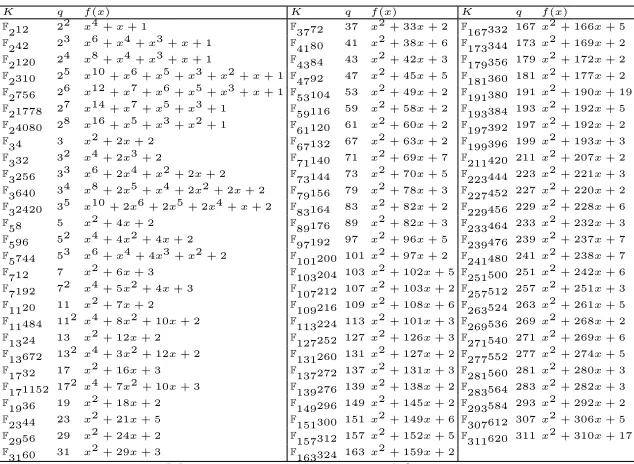
The verified instances are listed in the table.
Actually, f(x) is not necessarily a primitive polynomial of Fp[x]. We use
primitive polynomials to quickly find out a generator g. One may easily figure out that our conclusion also holds for general picked irreducible polynomialf ∈
Fp[x]. In addition, those instances takingA=gk with gcd(k, q−1) = 1 can be
verified as well.
B
Logarithms of quadratic polynomials
We would like to introduce an efficient method to compute the discrete loga-rithms of a portion of irreducible quadratic polynomials in Kummer extensions. We have the following observation.
Lemma 3. For the Kummer extension defined above, there exists an algorithm with cost O˜(q) that given discrete logarithms of linear factor, can compute the discrete logarithms of an arbitrary quadratic polynomials in the set
S=nX2+sX+ γ
A|s∈Fq2, γ ∈Fq
o
K q f(x) K q f(x) K q f(x)
F212 22 x4 +x+ 1 F3772 37 x2 + 33x+ 2 F167332167x2 + 166x+ 5
F242 23 x6 +x4 +x3 +x+ 1 F4180 41 x2 + 38x+ 6 F173344173x2 + 169x+ 2
F2120 24 x8 +x4 +x3 +x+ 1 F4384 43 x2 + 42x+ 3 F179356179x2 + 172x+ 2
F2310 25 x10 +x6 +x5 +x3 +x2 +x+ 1F4792 47 x2 + 45x+ 5 F181360181x2 + 177x+ 2
F
2756 26 x12 +x7 +x6 +x5 +x3 +x+ 1F53104 53 x2 + 49x+ 2 F191380191x2 + 190x+ 19
F21778 27 x14 +x7 +x5 +x3 + 1 F59116 59 x2 + 58x+ 2 F193384193x2 + 192x+ 5
F24080 28 x16 +x5 +x3 +x2 + 1 F61120 61 x2 + 60x+ 2 F197392197x2 + 192x+ 2
F34 3 x2 + 2x+ 2 F67132 67 x2 + 63x+ 2 F199396199x2 + 193x+ 3
F332 32 x4 + 2x3 + 2 F71140 71 x2 + 69x+ 7 F211420211x2 + 207x+ 2
F3256 33 x6 + 2x4 +x2 + 2x+ 2 F73144 73 x2 + 70x+ 5 F223444223x2 + 221x+ 3
F3640 34 x8 + 2x5 +x4 + 2x2 + 2x+ 2 F79156 79 x2 + 78x+ 3 F227452227x2 + 220x+ 2
F32420 35 x10 + 2x6 + 2x5 + 2x4 +x+ 2 F83164 83 x2 + 82x+ 2 F229456229x2 + 228x+ 6
F58 5 x2 + 4x+ 2 F89176 89 x2 + 82x+ 3 F233464233x2 + 232x+ 3
F596 52 x4 + 4x2 + 4x+ 2 F97192 97 x2 + 96x+ 5 F239476239x2 + 237x+ 7
F5744 53 x6 +x4 + 4x3 +x2 + 2 F101200101x2 + 97x+ 2 F241480241x2 + 238x+ 7
F
712 7 x2 + 6x+ 3 F103204103x2 + 102x+ 5F251500251x2 + 242x+ 6
F7192 72 x4 + 5x2 + 4x+ 3 F107212107x2 + 103x+ 2F257512257x2 + 251x+ 3
F1120 11 x2 + 7x+ 2 F109216109x2 + 108x+ 6F263524263x2 + 261x+ 5
F11484 112x4 + 8x2 + 10x+ 2 F113224113x2 + 101x+ 3F269536269x2 + 268x+ 2
F1324 13 x2 + 12x+ 2 F127252127x2 + 126x+ 3F271540271x2 + 269x+ 6
F13672 132x4 + 3x2 + 12x+ 2 F131260131x2 + 127x+ 2F277552277x2 + 274x+ 5
F1732 17 x2 + 16x+ 3 F137272137x2 + 131x+ 3F281560281x2 + 280x+ 3
F171152172x4 + 7x2 + 10x+ 3 F139276139x2 + 138x+ 2F283564283x2 + 282x+ 3
F1936 19 x2 + 18x+ 2 F149296149x2 + 145x+ 2F293584293x2 + 292x+ 2
F2344 23 x2 + 21x+ 5 F151300151x2 + 149x+ 6F307612307x2 + 306x+ 5
F2956 29 x2 + 24x+ 2 F157312157x2 + 152x+ 5F311620311x2 + 310x+ 17
F
3160 31 x2 + 29x+ 3 F163324163x2 + 159x+ 2
Table 1.Instances constructed forq≤311
Proof. Let us consider the polynomial which can split completely inFq2
q
Y
k=0
x−gk(q−1)+1=xq+1−gq+1.
Similarly to Joux’s methods, we operate M¨obius transformation
a b c d
∈
P GL2(Fq2) tox. We consider the simple situation where taking transformation
1b
0d
(d6= 0):
q
Y
k=0
(x+b−gk(q−1)+1d) =xq+1+bxq+bqx+bq+1−gq+1dq+1.
If we rewrite the equation above byX ≡xmod (xq−Ax) in Kummer ex-tension, then
q
Y
k=0
(X+b−gk(q−1)+1d) =A
X2+Ab+b
q
A X+
bq+1−gq+1dq+1
A
. (8)
We claim thatϕ(t) =At+tq is a bijective map from
Fq2toFq2. We only need
indicates thatA= (gq+12 t)q−1due to the fact thatg
q2−1
2 =−1. It is contrary to
the fact that gcd(loggA, q−1) = 1.
Therefore, for arbitrary (s, γ)∈Fq2×Fq, one can easily find a tuple (b, d)∈
F2q2, such that
Ab+bq
A =s,
bq+1−gq+1dq+1=γ. If d = 0, then X2+sX + γ
A is always reducible, since X
2+ Ab+bq
A +
bq+1
A =
(X +b)(X+ bAq); If d 6= 0, we can obtain the discrete logarithms by relation
(8) ut
We study the irreducibility of those quadratic polynomials in S = {X2+
sX+Aγ|s∈F2q, γ∈Fq}. When the characteristic is 2, there are two cases:s= 0
ors6= 0.
– Whens= 0, X2+Aγ is alaways reducible. Because loggγ−loggA≡2tmod (q2−1), γ 6= 0 is solvable fortsinceq2−1 is odd.
– Whens 6= 0, we know that if X2+sX+ γ
A is reducible, then there must
exist at∈F∗q2 such thatt2+st+ γ
A = 0. That is,
s=t+ γ
At, t∈F
∗ q2.
Ifγ = 0, s could be arbitrary elements inF∗q2; Ifγ 6= 0, consider the map
t7→t+Atγ . The map will sendt and Atγ to the same number, so there are
q2
2 −1 suchs’s satisfyings=t+
γ
At for somet∈F ∗ q2.
Thus we conclude that when the characteristic is 2, there are 12q2(q+ 1) reducible and 12q2(q−1) irreducible quadratic polynomials inS.
When the characteristic is an odd prime,X2+sX+Aγ is irreducible if and only if its discriminant∆=s2−4Aγ is a quadratic non-residue. Whenγ= 0, it is obviously reducible. Whenγ6= 0, we haves2−4Aγ is a quadratic residue if and only if∃ σ∈Fq2 such that s2−σ2= (s+σ)(s−σ) = 4Aγ. That is, there must
exist t∈F∗q2, such that
s+σ=t s−σ=At4γ .
Thens is supposed to have the forms= 12(t+At4γ) for some t∈F∗q2. With the
observation that 4Aγ is a quadratic non-residue, we have q22−1 such values for
t+4Atγ.
Finally, we obtain that when the characterisitc is odd, there are 12(q3+q2−