Classical Cryptographic Protocols in a Quantum World
∗
Sean Hallgren† ‡ Adam Smith† § Fang Song¶
Abstract
Cryptographic protocols, such as protocols for secure function evaluation (SFE), have played a cru-cial role in the development of modern cryptography. The extensive theory of these protocols, however, deals almost exclusively with classical attackers. If we accept that quantum information processing is the most realistic model of physically feasible computation, then we must ask: what classical protocols remain secure against quantum attackers?
Our main contribution is showing the existence of classical two-party protocols for the secure eval-uation of any polynomial-time function under reasonable computational assumptions (for example, it suffices that the learning with errors problem be hard for quantum polynomial time). Our result shows that the basic two-party feasibility picture from classical cryptography remains unchanged in a quantum world.
∗A preliminary version of this work appeared in Advances in Cryptology - CRYPTO 2011.
†Department of Computer Science and Engineering, Pennsylvania State University, University Park, PA, U.S.A.
‡Partially supported by National Science Foundation award CCF-0747274 and by the National Security Agency (NSA) under
Army Research Office (ARO) contract number W911NF-08-1-0298.
§Partially supported by National Science Foundation award CCF-0747294.
¶Department of Combinatorics & Optimization and Institute for Quantum Computing, University of Waterloo, Canada. Partially
Contents
1 Introduction 3
1.1 Our Contributions . . . 3
1.2 Related work . . . 5
1.3 Future Directions . . . 6
2 Preliminaries 7 3 Modeling Security in the Presence of Quantum Attacks 9 3.1 A General Quantum Stand-Alone Security Model . . . 10
3.1.1 The Model . . . 10
3.1.2 Modular Composition Theorem . . . 12
3.1.3 Variants of Quantum Stand-Alone Models: A Unified Framework . . . 13
3.2 Quantum UC Model: An Overview . . . 14
4 Classical Protocols with Quantum Security 16 4.1 Basing Quantum UC Secure Computation onFZK . . . 17
4.1.1 Simple Hybrid Argument. . . 17
4.1.2 Lifting CLOS to Quantum UC Security. . . 18
4.2 RealizingFZKwith Stand-alone Security . . . 20
4.2.1 Proof of Theorem 4.9: Quantum Stand-alone Secure ZKAoK . . . 21
4.3 Putting It Together . . . 24
5 Equivalence BetweenFZKandFCF 25 5.1 FromFZKtoFCF . . . 25
5.2 FromFCFtoFZK . . . 26
A Proof of Modular Composition Theorem 35
1
Introduction
Cryptographic protocols, such as protocols for secure function evaluation (SFE), have played a crucial role in the development of modern cryptography. Goldreich, Micali and Wigderson [38], building on the develop-ment of zero-knowledge (ZK) proof systems [40, 39], showed that SFE protocols exist for any polynomial-time function under mild assumptions (roughly, the existence of secure public-key cryptosystems). Research into the design and analysis of such protocols is now a large subfield of cryptography; it has also driven im-portant advances in more traditional areas of cryptography such as the design of encryption, authentication and signature schemes.
The extensive theory of these protocols, however, deals almost exclusively with classical attackers. How-ever, given our current understanding of physics, quantum information processing is the most realistic model of physically feasible computation. It is natural to ask:what classical protocols remain secure against quan-tum attackers? In many cases, even adversaries with modest quantum computing capabilities, such as the ability to share and store entangled photon pairs, are not covered by existing proofs of security.
Clearly not all protocols are secure: we can rule out anything based on the computational hardness of factoring, the discrete log [65], or the principal ideal problem [45]. More subtly, the basic techniques used to reason about security may not apply in a quantum setting. For example, some information-theoretically secure two-prover ZK and commitment protocols are analyzed by viewing the provers as long tables that are fixed before queries are chosen by the verifier; quantum entanglement breaks that analysis and some protocols are insecure against colluding quantum provers (Cr´epeauet al., [23]).
In the computational realm, rewindingis a key technique for basing the security of a protocol on the hardness of some underlying problem. Rewinding proofs consist of a mental experiment in which the ad-versary is run multiple times using careful variations of a given input. At first glance, rewinding seems impossible with a quantum adversary since running it multiple times might modify the entanglement be-tween its internal storage and an outside reference system, thus changing the overall system’s behavior.
In a breakthrough paper, Watrous [72] showed that a specific type of zero-knowledge proof (3-round, GMW-style protocols) can be proven secure using a rewinding argument tailored to quantum adversaries. Damg˚ard and Lunemann [24] showed that a similar analysis can be applied to a variant of Blum’s coin flipping protocol. Hallgren et al. [46] showed certain classical transformations from honest-verifier to malicious-verifier ZK can be modified to provide security against malicious quantum verifiers. Some information-theoretically secure classical protocols are also known to resist quantum attacks [20, 7, 32, 68]. Finally, there is a longer line of work on protocols that involve quantum communication, dating back to Bennett and Brassard [8]. Overall, however, little is known about how much of the classical theory can be carried over to quantum settings. See “Related Work”, below, for more detail.
1.1 Our Contributions
Our main contribution is showing the existence of classical two-party protocols for the secure evaluation of any polynomial-time function under reasonable computational assumptions (for example, it suffices that the learning with errors problem [64] be hard for quantum polynomial time). Our result shows thatthe basic two-party feasibility picture from classical cryptography remains unchanged in a quantum world. The only two-party general SFE protocols which had previously been analyzed in the presence of quantum attackers required quantum computation and communication on the part of the honest participants (e.g. [21, 27]).
Our contributions can be broken down as follows:
General Modeling of Stand-Alone Security with Quantum Adversaries. We describe a security model for two-party protocols in the presence of a quantum attackers. Proving security in this model amounts to showing that a protocol for computing a function f behaves indistinguishably from an “ideal” protocol in which f is computed by a trusted third party, which we call the ideal functionalityF. Our model is a quantum analogue of the model of stand-alone security developed by Canetti [12] in the classical setting. It slightly generalizes the existing model of Damg˚ard et al. [27] in two ways. First, our model allows for protocols in which the ideal functionalities process quantum information (rather than only classical functionalities). Second, it allows for adversaries that take arbitrary quantum advice, and for arbitrary entanglement between honest and malicious players’ inputs. Our model may be viewed as a restriction of the quantum UC model of Unruh [68] to noninteractive distinguishers, and we use that connection in our protocol design (see below). We also discuss possible variants of quantum stand-alone models and initiate a study on their relationships, which connects to interesting questions in a broad scope.
We show a sequential modular composition theorem for protocols analyzed in our model. Roughly, it states that one can design protocols modularly, treating sub-protocols as equivalent to their ideal versions when analyzing security of a high-level protocol. While the composition result of Damg˚ard et al. [27] allows only for classical high-level protocols, our result holds for arbitrary quantum protocols.
Classical Zero-knowledge Arguments of Knowledge Secure Against Quantum Adversaries. We con-struct a classical zero-knowledge argument of knowledge (ZKAoK) protocol that can be proven secure in our stand-alone model. Our construction is “witness-extendable” (Lindell [50]), meaning that one can sim-ulate an interaction with a malicious prover and simultaneously extract a witness of the statement whenever the prover succeeds. Our security proof overcomes a limitation of the previous construction of (two-party) quantum proofs of knowledge (Unruh [70]), which did not have a simulator for malicious provers. Such a simulator is important since it allows one to analyze security when using a proof of knowledge as a subpro-tocol. As in the classical case, our ZKAoK protocol is an important building block in designing general SFE protocols.
The main idea behind our construction is to have the prover and verifier first execute a weak coin-flipping protocol to generate a public key for a special type of encryption scheme. The prover encrypts his witness with respect to this public key and proves consistency of his ciphertext with the statement xusing the ZK protocols analyzed by Watrous [72]. A simulator playing the role of the verifier can manipulate the coin-flipping phase to generate a public key for which she knows the secret key, thus allowing her to extract the witness without needing to rewind the prover. A simulator playing the role of the prover, on the other hand, cannot control the coin flip (to our knowledge) but can ensure that the public key is nearly random. If the encryption scheme satisfies additional properties (that can be realized under widely used lattice-type assumptions), we show that the verifier’s view can nonetheless be faithfully simulated.
Classical UC Protocols in a Quantum Context: Towards Unruh’s Conjecture. We show that a large class of protocols which are secure against computationally bounded classical adversaries are also secure against quantum adversaries. Unruh [68] showed that any classical protocol which is proven UC-secure against unbounded classical adversaries is also UC-UC-secure against unbounded quantum adversaries. He conjectured (roughly, see [68] for the exact statement) that classical arguments ofcomputationalUC security should also go through as long as the underlying computational primitives are not easily breakable by quantum computers.
We provide support for this conjecture by describing a family of classical security arguments that go through verbatim with quantum adversaries. We call these arguments “simple hybrid arguments”. They use rewinding neither in the simulation nor in any of the steps that show the correctness of simulation.1
1In general, it is hard to clearly define what it means for a security proof to “not use rewinding”. It is not enough for the
Our observation allows us to port a general result of Canetti et al. [15] to the quantum setting. We obtain the following: in theFZK-hybrid model, where a trusted party implementing ZKAoK is available, there exist classical protocols for the evaluation of any polynomial-time function fthat are UC-secure against quantum adversaries under reasonable computational assumptions. As an immediate corollary, we get a classical protocol that quantum-UC emulates the ideal functionalityFCFfor coin-flipping, assuming UC-secure ZK. New Classical UC Protocols Secure Against Quantum Attacks. We construct new two-party protocols that are UC-secure against quantum adversaries. Adapting ideas from Lindell [50], we show a constant-round classical coin-flipping protocol from ZK (i.e. inFZK-hybrid model). Note that the general
feasibil-ity result from above already implies the existence of a quantum-UC secure coin-flipping protocol, but it needs polynomially many rounds. Conversely, we can also construct aconstant-round classical protocol for ZKAoK that is UC-secure against quantum adversaries, assuming a trusted party implementing coin-flipping, i.e. in theFCF-hybrid model (essentially equivalent to thecommon reference stringmodel, where all participants have access to a common, uniformly distributed bit string). This establishes the equivalence betweenFZKandFCFin the quantum UC model, which may be of independent interest, e.g., in simplifying protocol designs. It has also motivated a subsequent work by Fehr et el. [34] where they showed interesting connections between ideal functionalities in the quantum-UC model in a systematic way.
Implications. The modular composition theorem in our stand-alone model allows us to get the general feasibility result below by combining our stand-alone ZKAoK protocol and the UC-secure protocols in
FZK-hybrid model:
Under standard assumptions, there exist classicalSFE protocols in the plain model (without a shared random string) which are stand-alone-secure against staticquantumadversaries. This parallels the classic result of Goldreich, Micali and Wigderson [38].
The equivalence of zero-knowledge and coin-flipping functionalities in the UC model also has inter-esting implications. First, the availability of a common reference string (CRS) suffices for implementing quantum-UC secure protocols. Secondly, given our alone ZKAoK protocol, we get a quantum stand-alone coin-flipping protocol.
Independently of our work, Lunemann and Nielsen [54], via a different route, also showed the exis-tence of classical two-party SFE protocols secure against quantum attacks. See the discussion at the end of “Related Work”.
1.2 Related work
In addition to the previous work mentioned above, we expand here on three categories of related efforts. Composition Frameworks for Quantum Protocols. Systematic investigations of the composition prop-erties of quantum protocols are relatively recent. Canetti’s UC framework and Pfitzmann and Waidner’s closely relatedreactive functionalityframework were extended to the world of quantum protocols and ad-versaries by Ben-Or and Mayers [5] and Unruh [67, 68]. These frameworks (which share similar semantics) provide extremely strong guarantees—security in arbitrary network environments. They were used to ana-lyze a number of unconditionally secure quantum protocols (key exchange [6] and multi-party computation with honest majorities [7]). However, many protocols are not universally composable, and Canetti [13] showed that classical protocols cannot UC-securely realize even basic tasks such as commitment and zero-knowledge proofs without some additional setup assumptions such as a CRS or public-key infrastructure.
composable framework called Abstract Cryptography [55], and it has been adapted to analyzing quantum protocols as well [29].
Analyses of Quantum Protocols.The first careful proofs of security of quantum protocols were for key ex-change (Mayers [57], Lo and Chau [53], Shor and Preskill [66], Beaver [2]). Research on quantum protocols for two-party tasks such as coin-flipping, bit commitment and oblivious transfer dates back farther [11, 9], though some initially proposed protocols were insecure [57]. The first proofs of security of such proto-cols were based on computational assumptions [28, 21]. They were highly protocol-specific and it was not known how well the protocols composed. The first proofs of security using the simulation paradigm were for information-theoretically-secure protocols for multi-party computations assuming a strict majority of honest participants [20, 22, 7]. More recently, Dupuis et al. [30, 31] constructed two-party quantum proto-cols for evaluating arbitrary unitary operations, which they proved secure under reasonable computational assumptions in a simulation-based definition similar to what we propose in this work. There was also a line of work on thebounded quantum storagemodel [26, 25, 32, 69] developed tools for reasoning about spe-cific types of composition of two-party protocols, under assumptions on the size of the adversary’s quantum storage. Many tools have been developed in recent years on modeling and analyzing composable security for protocols of device-independent quantum key-exchange and randomness expansion [33, 71, 58, 18]. Straight-Line Simulators and Code-Based Games.As mentioned above, we introduce “simple hybrid ar-guments” to capture a class of straightforward security analyses that go through against quantum adversaries. Several formalisms have been introduced in the past to capture classes of “simple” security arguments. To our knowledge, none of them is automatically compatible with quantum adversaries. For example, straight-line black-box simulators [49] do not rewind the adversary nor use an explicit description of its random coins; however, it may be the case that rewinding is necessary to prove that the straight-line simulator is actually correct. In a different vein, thecode-based games of Bellare and Rogaway [4] capture a class of hybrid arguments that can be encoded in a clean formal language; again, however, the arguments concerning each step of the hybrid may still require rewinding.
Independent Work. Lunemann and Nielsen [54] independently obtained similar results to the ones de-scribed here, via a slightly different route. Specifically, they start by constructing a stand-alone coin-flipping protocol that is fully simulatable against quantum poly-time adversaries. Then they use the coin-flipping protocol to construct a stand-alone ZKAoK protocol, and finally by plugging into the GMW construction, they get quantum stand-alone-secure two-party SFE protocols as well. The computational assumptions in the two works are similar and the round complexities of the stand-alone SFE protocols are both polynomial in the security parameter. Our approach to composition is more general, however, leading to results that also apply (in part) to the UC model.
1.3 Future Directions
Our work suggests a number of straightforward conjectures. For example, it is likely that our techniques in fact apply to all the results in CLOS (multi-party, adaptive adversaries) and to corresponding results in the “generalized” UC model [16]. Essentially all protocols in the semi-honest model seem to fit the simple hybrids framework, in particular protocols based on Yao’s garbled-circuits framework (e.g. [3]). It is also likely that existing proofs in security models which allow super-polynomial simulation (e.g., [62, 63, 1]) will carry through using a similar line of argument to the one here.
knowledge? Do our analyses apply to extensions of the UC framework, such thegeneralized UCframework of Canetti et al. [16]? Finally, more generally, which other uses of rewinding can be adapted to quantum adversaries? Aside from the original work by Watrous [72], Damg˚ard and Lunemann [24] and Unruh [70] have shown examples of such adaption.
Organization. The rest of the paper is organized as follows: Section 2 reviews basic notations and def-initions. In Section 3, we propose our quantum stand-alone security model. We show our main result in Section 4. Specifically, Section 4.1 establishes quantum-UC secure protocols inFZK-hybrid model. A
quantum stand-alone-secure ZKAoK protocol is developed in Section 4.2. Finally in Section 5, we discuss equivalence ofFZKandFCF.
2
Preliminaries
Form ∈ N,[m]denotes the set{1, . . . ,m}. We usen ∈ Nto denote asecurity parameter. The security parameter, represented in unary, is an implicit input to all cryptographic algorithms; we omit it when it is clear from the context. Quantities derived from protocols or algorithms (probabilities, running times, etc.) should be thought of as functions ofn, unless otherwise specified. A function f(n)is said to be negligible if f =o(n−c)for any constantc, and negl(n)is used to denote an unspecified function that is negligible in n. We also usepoly(n)to denote an unspecified function f(n) =O(nc)for some constantc. WhenDis a probability distribution, the notationx ← Dindicates thatxis a sample drawn according toD. WhenD is a finite set, we implicitly associate with it the uniform distribution over the set. IfD(·)is a probabilistic algorithm,D(y)denotes the distribution over the output ofDcorresponding to inputy. We will sometimes use the same symbol for a random variable and for its probability distribution when the meaning is clear from the context. LetX={Xn}n∈NandY= {Yn}n∈Nbe two ensembles of binary random variables. We callX,Yindistinguishable, denotedX≈Y, if|Pr(Xn=1)−Pr(Yn =1)| ≤negl(n).
We assume the reader is familiar with the basic concepts of quantum information theory (see, e.g., [61]). We use a sans serif letter (e.g. X) to denote both a quantum register and the corresponding Hilbert space. We use Xnif we want to be specific about the security parameter. Let Hndenote the space forn qubits. LetD(X)be the set of density operators acting on spaceXandL(X,Y)be the set of linear operators from spaceXtoY.
Quantum Machine Model. We adapt Unruh’s machine model in [68] with minor changes. A quantum interactive machine (QIM) M is an ensemble of interactive circuits {Mx}x∈I. The index set I is
typi-cally the natural numbersNor a set of strings I ⊆ {0, 1}∗ (or both). We give our description here with
respect to{Mn}n∈N. For each value n of the security parameter, Mn consists of a sequence of circuits
{Mn(i)}i=1,...,`(n), whereM
(i)
n defines the operation ofMin one roundiand`(n)is the number of rounds for whichMnoperates (we assume for simplicity that`(n)depends only onn). We omit the scripts when they are clear from the context or are not essential for the discussion. Machine M(or rather each of the circuits that it comprises) operates on three registers: a state registerSused for input and workspace; an output reg-isterO; and a network registerNfor communicating with other machines. The size (or running time)t(n)
ofMnis the sum of the sizes of the circuitsM(i)n . We say a machine is polynomial time ift(n) = poly(n) and there is a deterministic classical Turing machine that computes the description of M(i)n in polynomial time on input(1n, 1i).
When two QIMs M and M0 interact, they share network registerN. The circuits M(i)n and M0(i)n are executed alternately fori = 1, 2, ...,`(n). When three or more machines interact, the machines may share
A non-interactive quantum machine (referred to as QTM hereafter) is a QIM M with network register empty and it runs for only one round (for alln). This is equivalent to thequantum Turing machinemodel (see [73]).
A classical interactive Turing machine is a special case of a QIM, where the registers only store classical strings and all circuits are classical. This is also called an interactive Turing machine (ITM) with advice (Canetti [12, 13]).
Indistinguishability of Quantum States. Letρ = {ρn}n∈Nandη = {ηn}n∈N be ensembles of mixed states indexed by n ∈ N, where ρn and ηn are both r(n)-qubit states for some polynomially bounded functionr. We first define a somewhat weak notion of indistinguishability of quantum state ensembles.
Definition 2.1((t,ε)-weakly indistinguishable states). We say two quantum state ensemblesρ ={ρn}n∈N andη={ηn}n∈Nare(t,ε)-weakly indistinguishable, denotedρ≈twqc,ε η, if for everyt(n)-time QTMZ,
|Pr[Z(ρn) =1]−Pr[Z(ηn) =1]| ≤ε(n).
The states ρ andηare called weakly computationally indistinguishable, denoted ρ ≈wqc η, if for
ev-ery polynomialt(n), there exists a negligible ε(n)such thatρn andηnare (t,ε)-weakly computationally
indistinguishable.
A stronger notion of indistinguishability of quantum states was proposed by Watrous [72, Definition 2]. The crucial distinction is that a distinguisher is allowed to take quantum advice.
Definition 2.2 ((t,ε)-indistinguishable states). We say two quantum state ensembles ρ = {ρn}n∈N and
η ={ηn}n∈Nare(t,ε)-indistinguishable, denotedρ≈tqc,ε η, if for everyt(n)-time QTMZ and any mixed
stateσn,
|Pr[Z(ρn⊗σn) =1]−Pr[Z(ηn⊗σn) =1]| ≤ε(n).
The statesρandηare calledquantum computationally indistinguishable, denotedρ ≈qc η, if for every
polynomialt(n), there exists a negligibleε(n)such thatρnandηnare(t,ε)-indistinguishable.
The two definitions above subsume classical distributions as a special case, since classical distributions can be represented by density matrices that are diagonal with respect to the standard basis.
Indistinguishability of Quantum Machines.Now we introduce the notion of distinguishing two QTMs.
Definition 2.3((t,ε)-indistinguishable QTMs). We say two QTMsM1andM2are(t,ε)-indistinguishable,
denotedM1 ≈tqc,ε M2, if for anyt(n)-time QTMZ and any mixed stateσn ∈ D(Sn⊗Rn), whereRnis an arbitrary reference system,
Pr[Z((M1⊗1L(R))σn) =1]−Pr[Z((M2⊗1L(R))σn) =1]
≤ε(n).
Machines M1 and M2 are called quantum computationally indistinguishable, denoted M1 ≈qc M2, if
for every polynomialt(n), there exists a negligibleε(n)such that M1 andM2 are(t,ε)-computationally
indistinguishable.
This definition is equivalent to quantum computationally indistinguishable super-operators proposed by Watrous [72, Definition 6]. If we do not restrict the running time of the distinguisher, we obtain a statistical notion of indistinguishability. Let TD(·,·)be the trace distance between density operators.
Definition 2.4(ε-indistinguishable QTMs in diamond norm). We say two QTMsM1andM2areε-indistinguishable
in diamond norm, denotedM1≈ε M2, if for anyσn∈ D(Sn⊗Rn),Rbeing an arbitrary reference system, TD[(M1⊗1L(R))σn,(M2⊗1L(R))σn]≤ε(n).
QIMs M1andM2are said to beindistinguishable in diamond norm, denotedM1 ≈ M2, if there exists a
Indistinguishability of QIMs. Next, we generalize the definitions of indistinguishability above to inter-active quantum machines. Let Z and M be two QIMs, we denote hZ(σ),Mi as the following process:
machine Z is initialized withσ, it then provides input to M and interacts with M. In the end, the output
register ofMis given toZ andZ generates one classical bit on its own output register.
Definition 2.5((t,ε)-indistinguishable QIMs). We say two QIMsM1andM2are(t,ε)-interactively
indis-tinguishable, denotedM1≈ti,ε M2, if for any quantumt(n)-time interactive machineZ and any mixed state
σnont(n)qubits,
|Pr[hZ(σn),M1i=1]−Pr[hZ(σn),M2i=1]| ≤ε(n).
QIMs M1 and M2 are calledquantum computationally interactively indistinguishable, denoted M1 ≈qci M2, if for everyt(n)≤ poly(n), there exists a negligibleε(n)such thatM1andM2are(t,ε)-interactively
indistinguishable.
We may call suchZ an interactive distinguisher. We can likewise definestatistically interactively indistin-guishableQIMs, denotedM1 ≈qsi M2, if we allow unbounded interactive distinguisherZ.
Remark 1. Quantum interactive machines, as we defined earlier, actually can be seen as a subset of quantum strategies, formulated in [44]. Namely, a QIM is a strategy in which each channel can be implemented by a uniformly generated circuit. Therefore we can as well define statistically interactively indistinguishability using thek · kr norm for quantum strategies. See Gutoski [42] and Chiribella et al. [17] for details about characterizing distinguishability of quantum strategies using thek · krnorm.
Ideal functionalities.We sketch ideal functionalities, i.e., the programs of a trusted party in an ideal proto-col, for a few basic cryptographic tasks.
• Commitment FCOM: At “Commit” stage, Alice (the committer) inputs a bit b and Bob (the receiver)
receives fromFCOMa notification that a bit was committed. At “Open” stage, Alice can input the command
opentoFCOMwho then sends Bobb.
•Oblivious TransferFOT: Alice (the sender) inputs2bits(s0,s1)and Bob (the receiver) inputs a selection
bitc∈ {0, 1}. Bob receivesscfromFOT.
•Zero-knowledgeFZK: LetRLbe an NP relation. Upon receiving(x,w)from Alice,FZKverifies(x,w)
?
∈
RL. If yes, it sendsxto Bob; otherwise it instructs Bob to reject.
•Coin FlippingFCF: Alice and Bob input the request1n toFCF, andFCFrandomly choosesr ← {0, 1}n
and sends it to Alice. Alice respondsFCFwith “acc” or “rej” indicating continuing or aborting respectively.
In the case of “acc”,FCFsendsrto Bob and otherwise sends Bob⊥. Note the functionality is asymmetric
in the sense that Alice gets the coins first. This avoids the complicated issue about fairness, which has been an active line of research in classical cryptography (see for example [19, 48, 59, 41]) and is beyond the scope of this paper.
3
Modeling Security in the Presence of Quantum Attacks
3.1 A General Quantum Stand-Alone Security Model
Our model follows the real-world/ideal-worldsimulation paradigm. It proceeds in three high-level steps: (i) Formalizing the process of executing a protocol in the presence of adversarial activities. (ii) Formalizing an ideal-world protocol for realizing the desired task. This is an (imaginary) idealized protocol which captures the security guarantees we want to achieve. (iii) Finally we say a (real-world) protocol realizes a task securely if it “behaves similarly” to the ideal-world protocol for that task (Definition 3.3). “Behaving similarly” is formalized by the notion of stand-aloneemulationbetween protocols (Definition 3.1, 3.2).
Our definition can be viewed in two ways: either as a quantum analogue of Canetti’s classical stand-alone model [12] or as a relaxed notion of (a variant of) Unruh’s quantum UC security [68]. Prior to our work, stand-alone security definitions for quantum attacks were largely developed ad hoc2; the first systematical treatments appear in [32, 27]. Our model generalizes the existing model of Damg˚ardet al.[27] in two ways. First, our model allows protocols in which the functionalities can process quantum information (rather than only classical functionalities). Second, it allows adversaries that take arbitrary quantum advice, and for arbitrary entanglement between honest and malicious players’ inputs. This distinction is reflected in the composability that the model provides (see details in Section 3.1.2). While the composition results of Damg˚ardet al.allow only for classical high-level protocols, our result holds for arbitrary quantum protocols.
3.1.1 The Model
We describe our model for the two-party setting; it is straightforward to extend to multi-party setting. We first introduce a few important objects in our model. We formalize a cryptographic task by an interactive machine called afunctionality. It contains the instructions to realize the task, and we usually denote it byF orG. While our model applies to both classical and quantum functionalities, our focus in this work will be efficient classical functionalities. Namely F is a classical probabilistic polynomial-time machine. A two-party protocol for a taskF consists of a pair of interactive machines(A,B). We call a protocol poly-time if(A,B)are both poly-time machines. We typically use Greek letters (e.g.,Π) to denote protocols. If we want to emphasize that a protocol is classical, i.e., computation and all messages exchanged are classical, we then use lower-case letters (e.g.,π). Finally, an adversary, usually denotedAorS, is another interactive
machine that intends to attack a protocol. Very often we abuse notation and do not distinguish a machine and the player that runs the machine. This should not cause any confusion.
Protocol Execution. We consider executing a protocolΠ = (A,B) in the presence of an adversaryA. Their state registers are initialized by a secure parameter1nand a joint quantum stateσn. AdversaryAgets activated first and coordinates the execution. Specifically, the operations of each party are:
• AdversaryA: it may eitherdelivera message to some party orcorrupta party. Delivering a message is simply instructing the designated party (i.e., the receiver) to read the proper segment of his network register. We assume all registers are authenticated so thatAcannot modify them and in particular if the register is private to the party,Amay not read the content. Other than that,Acan for example schedule the messages to be delivered in any arbitrary way. IfAcorrupts a party, the party passes all of its internal state toAand follows the instructions ofA. In the two-party setting, corrupting a party can be simply thought of as substituting the machine ofAfor the machine of the corrupted party.
• Parties inΠ: once a party receives a message fromA, it gets activated and runs its machine. At the end of one round, some message is generated on the network register. AdversaryAis activated again and controls message delivery. At some round, the party generates some output and terminates.
2E.g., Fehr and Schaffner [32] write: ”It is still common practice in quantum cryptography that every paper proposes its own
Clearly, we can view Π andA as a whole and model the composed system as another QIM, call it MΠ,A. Then executingΠin the presence ofAis just running MΠ,A on some input state, which may be entangled with a reference system that will be handed to the distighuisher.
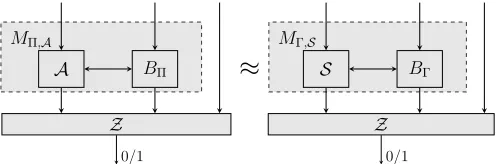
Protocol Emulation.As indicated earlier, a secure protocol is supposed to “emulate” an idealized protocol. Here we formally define emulation between protocols. Let ΠandΓ be two protocols. Let MΠ,A be the
composed machine ofΠand an adversaryA, and MΓ,S be that ofΓand another adversaryS. Informally,
ΠemulatesΓif the two machinesMΠ,AandMΓ,S are indistinguishable.
Definition 3.1(Computationally Quantum-Stand-Alone Emulation). LetΠandΓbe two poly-time proto-cols. We sayΠ computationally quantum-stand-alone(C-QSA) emulates Γ, if for any poly-time QIMA there exists a poly-time QIMSsuch that MΠ,A≈qc MΓ,S .
Definition 3.2(Statistically Quantum-Stand-Alone Emulation). Let ΠandΓ be two poly-time protocols. We sayΠstatistically quantum-stand-alone(S-QSA) emulatesΓ, if for any QIMAthere exists an QIMS that runs in poly-time of that ofA, such thatMΠ,A ≈ MΓ,S.
A B⇧
M⇧,A
Z
0/1
⇡
S BM ,S
Z
0/1
1
Figure 1: Quantum stand-alone emulation between protocols.
Remark 2. (i) The adversaryS is usually called a simulator because typical constructions ofS simulate the givenAinternally. (ii) In the statistical setting, we require the complexity ofS andAto be polynomially related. This ensures that the statistical notion actually implies the computational one. See Canetti [12] for discussion of this issue in the classical context.
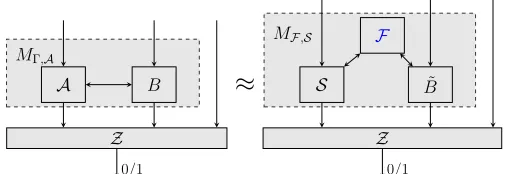
Ideal-world Protocol and Secure Realization of a Functionality. We formalized protocol emulation in a general form which applies to any two protocols. But it is of particular interest to emulate a special type of protocol which captures the security guarantees we want to achieve. We formalize the so-called ideal-world protocolΠ˜F for a functionality F. In this protocol, two (dummy) parties A˜ andB˜ have access to an additional “trusted” party that implementsF. We may abuse notation and call the trusted partyF too. BasicallyA˜ andB˜invokeFwith their inputs, and thenFruns on the inputs and sends the respective outputs
back to A˜ andB. An execution of˜ Π˜ with an adversaryS is similar to our prior description for executing
a (real-world) protocol, except thatF cannot be corrupted. Likewise, we denote the composed machine of
F andΠ˜F as MF,S. We state the definition in the computational setting; statistical emulation is defined
analogously.
Definition 3.3(C-QSARealization of a Functionality). LetF be a poly-time two-party functionality and Π be a poly-time two-party protocol. We say Πcomputationally quantum-stand-alone realizes F, if Π
C-QSAemulatesΠ˜F. Namely, for any poly-timeA, there is a poly-timeSsuch that MΠ,A≈qc MF,S.
A B M,A
Z
0/1
⇡
S B˜MF,S F
Z
0/1
1
Figure 2: Quantum Stand-alone Realization of a functionality.
that for any poly-timeAthere exists a poly-timeS such that, for any poly-time Z and stateσn, we have
EXECΠ,A,Z ≈IDEALF,S,Z .
Types of Attack. Typically, we need to speak of security against a specific class of adversaries. We have distinguished two classes of adversaries according to their computational complexity, i.e., poly-time vs. unbounded time. We also categorize adversaries according to how they corrupt the parties and how they deviate from the honest behavior defined by the protocol. The standard two types of corruptions considered in the literature are static vs. adaptive corruptions. Under static corruption, the identities of corrupted parties are determined before protocol starts. In contrast, adaptive corruption allows an adversary to change the party to corrupt adaptively during the execution. This work only concerns static corruption.
In terms of what dishonest behaviors are permitted for an adversary, again two classes are considered standard in the literature: semi-honest(a.k.a. passive or honest-but-curious) andmalicious(a.k.a. active). A semi-honest adversary, after corrupting a party, still follows the party’s circuit, except that in the end it processes the output and the state of the party. A malicious adversary, however, can substitute any circuit for the corrupted party. In the definitions of the protocol emulation, unless otherwise specified, the two adversaries in the real-world and ideal-world must belong to the same class. For example, if Ais semi-honest,S must also be semi-honest.
These notions of different classes of adversaries naturally extend to quantum adversaries, except for one subtlety in defining semi-honest quantum adversaries. There are two possible definitions. One definition, which may be referred to as the Lo-Chau-Mayers semi-honest model [52, 56], allowsAto run the circuit of the corrupted party, which is specified by the protocol, coherently. Namely Apurifies the circuit of corrupted party so that all operations are unitary. For example, instead of measuring a quantum state, the register is “copied” by a CNOT operation to an ancillary register. Another definition forces the adversary to exactly faithfully follow the corrupted party’s circuit during the protocol execution, so that any quantum measurement occurs instantaneously and possibly destructively. In other words, in the second model, a semi-honest quantum adversaryAonly corrupts a party at the end of the protocol execution, and then processes the internal state and transcript that the corrupted party holds. This second model is generally weaker than the first, in the sense that the adversary is more restricted. In this paper, we focus on the second of these two notions.
3.1.2 Modular Composition Theorem
It is common practice in the design of large protocols to divide a task into several subtasks. We first realize each subtask, and then use these modules as building blocks (subroutines) to realize the initial task. In this section, we show that our definition allows such modular design.
also using multiple subroutines in a protocolΠ. However, we require that at any point, onlyonesubroutine call be in progress; that is, we handlesequential composition. This is weaker than the “network” setting, where many instances and subroutines may be executedconcurrently.
We can show that our quantum stand-alone model admits a modular composition theorem.
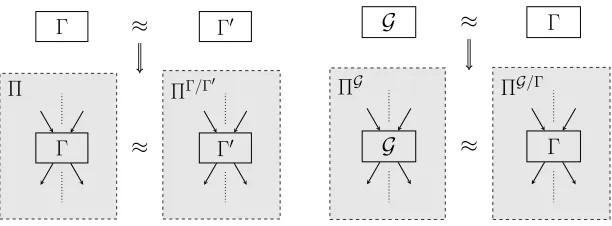
Theorem 3.4(Modular Composition: General Statement). LetΠ,ΓandΓ0be two-party protocols such that Γ0C-QSA(resp.S-QSA) emulatesΓ, thenΠΓ/Γ0C-QSA(resp. S-QSA) emulatesΠ.
The proof can be found in Appendix A. Here we discuss an important type of protocol where the com-position theorem is especially useful.
Protocols in a Hybrid Model. We next define ahybridmodel, in which the parties can make calls to an ideal-world protocolΠ˜G of some functionalityG3. We call such a protocol aG-hybridprotocol, and denote itΠG. The execution of a hybrid-protocol in the presence of an adversaryAproceeds in the usual way.
Now assume that we have a protocolΓthat realizesGand we have designed aG-hybrid protocolΠG
re-alizing another functionalityF. Then the composition theorem allows us to treat sub-protocols as equivalent to their ideal versions when analyzing security of a high-level protocol.
Corollary 3.5(Modular Composition: Realizing Functionalities). LetFandGbe poly-time functionalities. LetΠG be aG-hybrid protocol thatC-QSA(resp.S-QSA) realizesF, andΓbe a protocol thatC-QSA(resp.
S-QSA) realizesG, thenΠG/ΓC-QSA(resp.S-QSA) realizesF.
⇡ 0
⇧
⇡ 0
⇧ / 0
1
G ⇡
G
⇧G
⇡
⇧G/
1
Figure 3: Illustration of modular composition theorem: the general case (left) and in hybrid model (right).
3.1.3 Variants of Quantum Stand-Alone Models: A Unified Framework
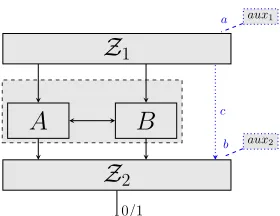
When defining a security model, there are lots of choices qualifying and quantifying the power of the adver-saries to account for various security requirements. Here we provide an abstract stand-alone model for both classical and quantum cryptographic protocols, illustrated in Figure 4, which contains three natural choices for the adversaries which we think are essential. This abstract model captures all existing stand-alone se-curity models (including ours) and this allows for a unified study of, and comparison among, these models. The relationship between these models may be interesting beyond the study of SFE.
The model contains an environmentZ and a protocol. Depending on whether the protocol is in real or ideal world, we have the honest party, the (real-or ideal-world) adversary and possibly the trusted party. Here we think of the environment as two separate machines: Z1, which we may call an input sampler, prepares
inputs to the players; andZ2that receives outputs and makes the decision. Now we consider the following
choices:
A
B
Z
1Z
2c aux1
a
aux2
b
0/1
1
Figure 4: Possible choices in defining a security model
(a) DoesZ1, the input sampler, have a quantum adviceaux1? In other words, do we allow arbitrary input
states or only states that can be generated efficiently?
(b) DoesZ2, which is essentially a distinguisher, take quantum adviceaux2?
(c) DoesZ1pass a state toZ2? Namely, does the environment keep state during the execution?
Notice that positive answers potentially give more power to the adversaries and thus provides stronger security guarantee. Also note that all machines are always allowed to take classical advice. We may denote a security model asM·,·,· where the subscripts are from{aux1,aux1,aux2,aux2,state,state}indicating
each of the choices made for the model. For exampleMaux1,aux2,statecorresponds to the model thatZ1gets
quantum advice;Z2takes no quantum advice andZ1passes state toZ2–this exactly leads to our model in
Def. 3.1. Similarly,Maux1,aux2,stateis the model whereZ1 andZ2both take quantum advice, and there is
state passing fromZ1toZ2.
We say two modelsMandM0are equivalent if for any two protocolsΠandΓ, it holds thatΠemulates ΓinMif and only if ΠemulatesΓinM0. It is conceivable that some of the23=8combinations collapse
to the same model. For example, if all players are classical circuits, then all eight modelsM·,·,· collapse.
This is because classical (non-uniform) machines can only measure a quantum state in computational basis to obtain a classical string from a certain distribution. But a classical circuit can be hardwired with any classical string, and so (quantum) advice gives no extra power to a classical circuit. Passing state likewise becomes vacuous.
When we consider an adversary and environment consisting of quantum circuits, the situation becomes generally more complicated. We can observe that choice (b) becomes irrelevant once we permit arbitrary in-put state and state passing (i.e.,Maux1,aux2,state≡ Maux1,aux2,state). We conjecture that state passing makes
no difference either. If this is indeed true, then all the variants collapse when Z1 takes quantum advice.
On the other hand, if Z1 takes no advice (i.e. only efficiently generated input states are allowed), we are
left with two variantsMaux1,aux2,· andMaux1,aux2,·. The relationship between these two models is closely
related to the fundamental question in quantum complexity theory regarding BQP/poly =? BQP/qpoly.
We leave further investigations as future work. In Appendix B, we discuss another variant that appears in the literature [27, 32], in whichZ1may only generate input states of a special form. We show that this does
not change the model in the case thatZ1takes quantum advice.
3.2 Quantum UC Model: An Overview
run it in a network environment. In view of this issue, Canetti [13] proposed the (classical) Universally Com-posable (UC) security model. It differs from the stand-alone definition of security in that the environment is allowed to beinteractive: during the execution of the protocol, the environment may provide inputs and receive the outputs of the honest players, and exchange arbitrary messages with the adversary. In contrast, the environment in the stand-alone model runs only at the end of the protocol execution (and, implicitly, before the protocol starts, to prepare the inputs to all parties). UC-secure protocols enjoy a property called general(oruniversal)composition4: loosely speaking, the protocol remains secure even if it is run concur-rently with an unbounded number of other arbitrary protocols (whereas proofs of security in the stand-alone model only guarantee security when only a single protocol at a time is running).
Earlier work on defining UC security and proving universal composition in the quantum setting appears in [5, 67]. We will adapt the somewhat simpler formalism of Unruh [68].
Modulo a small change in Unruh’s model (quantum advice, discussed below), our stand-alone model is exactly the restriction of Unruh’s model to anon-interactiveenvironment, that is one which is idle from the start to the finish of the protocol. The only apparent difference is that in the UC model, the environment runs for some time before the protocol starts to prepare inputs, while in Section 3.1 we simply quantify over all joint statesσof the honest players’ and adversary’s inputs. This difference is only cosmetic, though: the
stateσcan be taken to be the joint state of the outputs and internal memory of the environment at the time
the protocol begins.
We make one change to Unruh’s model in order to be consistent with our earlier definitions and the work of Watrous on zero-knowledge [72]: we allow the environment to take quantum advice, rather than only classical advice. In the language of [68, p. 11], we change the initialization phase of a network ex-ecution to create a state ρ ∈ P(HN)which equals the classical string|(ε,environment,ε)iin Hclass
(instead of|(ε,environment,z)i), and an arbitrary stateσinHquant (instead of|εi). Hereεdenotes the
empty string. Moreover, we change the definition ofindistinguishable networks[68, p. 12] to quantify over all statesσinstead of all classical strings z. This change is not significant for statistical security, since an
unbounded adversary may reconstruct a quantum advice state from a (exponentially long) classical descrip-tion. However, it may be significant for polynomial-time adversaries: it is not known how much quantum advice affects the power of, say BQP, relative to classical advice. For completeness, we state this modified definition of quantum UC security below.
Definition 3.6(Computationally Quantum-UC Emulation). LetΠandΓbe two-party protocols. We sayΠ computationally quantum-UC (C-QUC) emulatesΓ, if for any poly-time QIM A, there is a poly-time QIM
S such thatMΠ,A ≈qci MΓ,S(as per Def. 2.5).
Here MΠ,A (and MΓ,A likewise) denotes the composed system of Π and A, which can be viewed as a QIM. Its network register consists of part of the adversary’s network register, and is used for ex-ternal communication with another party (e.g., an environment). Alternatively, define EXECΠ,A,Z :=
{hZ(σn),MΠ,Ai}n∈N,σn∈D(Hn)andEXECF,S,Z := {hZ(σn),MΓ,Si}n∈N,σn∈D(Hn). We can rephrase the
condition as “for any poly-time QIMA, there is a poly-time QIM S, such that for any poly-time QIMZ, EXECΠ,A,Z ≈EXECΓ,S,Z.”
If we allow A and Z to be unbounded machines, i.e., we require that MΠ,A ≈qsi MΓ,S, then we
get the notion of statistically quantum-UC (S-QUC) emulation. As suggested in [43], we can also use
the k · kr norm on strategies to define it. Namely, we require that for any A there exists S such that
kMΠ,A−MΓ,Skr≤negl(n).
General (Concurrent) Composition.The most striking feature of UC model is that it admits a very general
4There is a distinction between UC security (a definition that may be satisfied by a specific protocol and ideal functionality) and
form of composition, concurrent composition5. Specifically, consider a protocolΠthat makes subroutine calls to a protocolΓ. In contrast to the stand-alone setting, we now allow multiple instances ofΓrunning concurrently. (For a formal description of general composition operation, see Canetti [13].) As before, we writeΠΓ/Γ0
to denote the protocol obtained byΠby substitutingΓ0 for subroutine calls toΓ.
Our modifications of Unruh’s definition do not affect the validity of theuniversal compositiontheorem:
Theorem 3.7(Quantum UC Composition Theorem (Unruh [68])). LetΠ,ΓandΓ0 be poly-time protocols. Assume thatΓquantum-UC emulatesΓ0. ThenΠΓ/Γ0quantum-UC emulatesΠ.
There is another useful property that simplifies the proof of UC emulation. In both classical and quantum UC models, it suffices to consider a special adversary, which is called thedummyadversaryAdummy. The dummy adversaryAdummy just forwards messages between a protocol and an environment and leaves any further processing to the environment. Here we only restate the completeness of dummy adversary in the quantum setting:
Theorem 3.8(Completeness of the dummy adversary (Unruh [68, Lemma 12])). Assume thatΠ quantum-UC emulatesΓ with respect to the dummy adversary (i.e., instead of quantifying over all adversaries, we fix A := Adummy). Then Πquantum-UC emulates Γ. This holds both for computational and statistical settings.
4
Classical Protocols with Quantum Security
This section studies what classical protocols remain secure againstquantum attacks in the computational setting. LetF be a classical two-party poly-time functionality. For technical reasons,F needs to be well-formed. See [13, 15] for a formal definition and discussions. Throughout this paper, we only consider well-formed functionalities as well. Classically, there are two important families of secure protocols:
• Stand-alone secure computation [38]: Assuming the existence of enhanced trapdoor permutations,
there exists poly-time protocols that computationally stand-alone emulatesF.
• Universal-composable secure computation [15]: Assuming the existence of enhanced trapdoor per-mutations, there exists protocols in theFZK-hybrid model that computationally UC emulatesF.
Our main result shows that these general feasibility results largely remain unchanged against quantum attacks:
Theorem(Informal). For any classical two-party functionalityF, there exists a classical protocolπ that
quantum computationally stand-alone emulates F, under suitable quantum-resistant computational as-sumptions.
The proof of the theorem can be broken into two parts. First we show a quantum analogue of [15] in Section 4.1. Namely, there exist functionalities, such as FZK, that are as powerful as to realizing any
other functionalities based on them, even with respect to computationally quantum-UC security. To achieve this, we develop a framework called simple hybrid arguments in Sect 4.1.1 to capture a large family of classical security analyses that go through against quantum adversaries. As a result, it amounts to design a (stand-alone) secure protocol forFZK, which is the content of Section 4.2. We stress that security of existing
protocols forFZKrelies on a sophisticated rewinding argument, and it is not clear if the arguments are still
valid against quantum adversaries. Hence we need new ideas to get around this difficulty.
5People often refer to this type of composition as UC composition, presumably because security in the UC model implies
4.1 Basing Quantum UC Secure Computation on
F
ZKWe show here thatFZKis sufficient for UC secure computation of any two-party functionality against any
computational bounded quantum adversaries. That is, for any well-formed functionalitiesF, there exists an
FZK-hybrid protocol thatC-QUCemulatesF. We stress that these protocols are allclassical, which can be
implemented efficiently with classical communication and computation devices.
Theorem 4.1. LetF be a two-party functionality. Under Assumptions 1 and 2, there exists a classicalFZK
-hybrid protocol thatC-QUCemulatesF in the presence of polynomial-timemalicious quantumadversaries withstaticcorruption.
Assumption 1. There exists a classical pseudorandom generator secure against any poly-time quantum distinguisher.
Based on this assumption and the construction of [60], we can obtain a statistically binding and quantum computationally hiding commitment schemeπcom. All commitment schemes we use afterwards refer to this
one. This assumption also suffices for Watrous’s ZK proof system for any NP-language against quantum attacks.
Assumption 2. There exists adenseclassical public-key crypto-system that is IND-CPA (chosen-plaintext attack) secure against quantum distinguishers.
A public-key crypto-system is dense if a valid public key is indistinguishable in quantum poly-time from a uniformly random string of the same length. Although it is likely that standard reductions would show that Assumption 2 implies Assumption 1, we chose to keep the assumptions separate because the instantiation one would normally use of the pseudorandom generator would not be related to the public-key system (instead, it would typically be based on a symmetric-key block or stream cipher). Both assumptions hold, for instance, assuming the hardness ofleaning with errors(LWE) problem [64].
4.1.1 Simple Hybrid Argument.
Our analysis is based on a new abstraction called asimple hybrid argument(SHA). It captures a family of classical security arguments in the UC model which remains valid in the quantum setting (as long as the underlying primitives are secure against quantum adversaries).
Definition 4.2(Simply related machines). We say two QIMsMaandMbare(t,ε)-simply relatedif there is
a time-tQTMMand a pair of classical distributions(Da,Db)such that
(a) M(Da)≡ Ma(for two QIMsN1andN2, we sayN1≡ N2if the two machines behave identically on
all inputs, that is, if they can be described by the same circuits),
(b) M(Db)≡ Mb, and
(c) Da ≈2qct,ε Db.
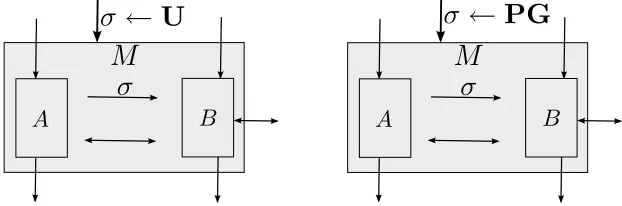
Example 1. Figure 5 illustrates a pair of simply related machines.
Lemma 4.3. If two machinesMa andMbare(t,ε)-simply related, thenMa ≈tqci,ε Mb, i.e., they are(t,ε)
-interactively indistinguishable (as per Definition 2.5).
Proof. By definition, Ma ≡ M(Da) and Mb ≡ M(Db). If there is a Z with quantum advice σ that
Figure 5: Two simply related machines: Mais machine Mon inputσchosen uniformly at random; Mbis machineMon input a pseudorandom stringPG(r).
sampledfrom either Da orDb, simulateshZ(σ),M(d)i, and outputs whateverZ outputs. Obviously,D runs in time at most2tand distinguishesDa andDbwith the same advantage thatZ distinguishes Maand Mb. Thus we conclude|Pr(hZ(σ),Mai = 1)−Pr(hZ(σ),Mbi = 1)| ≤ εfor any time-t environment Z.
Definition 4.4(Simple hybrid argument). Two machines M0andM`are related by a (t,ε)-simple hybrid
argument of length ` if there is a sequence of intermediate machines M1,M2, ...,M`−1 such that each
adjacent pairMi−1,Miof machines,i=1, . . . ,`, is(t,`ε)-simply related.
Lemma 4.5. For anyt,εand`, if two machines are related by a(t,ε)-simple hybrid argument of length`,
then the machines are(t,ε)-interactively indistinguishable.
Proof. This is by a standard hybrid argument. Suppose, for contradiction, there exists a time-tmachineZ with adviceσsuch that
|Pr(hZ(σ),M0i=1)−Pr(hZ(σ),M`i=1)| ≥ε.
Then by triangle inequality we can infer that there must exist someisuch that
|Pr(hZ(σ),Mii=1)−Pr(hZ(σ),Mi+1i=1)|> ε/`.
However, by assumption Mi and Mi+1 are (t,`ε)-simply related and in particular no time-t machines can distinguish them with advantage greater thanε/`.
4.1.2 Lifting CLOS to Quantum UC Security.
Now we apply oursimple hybrid argumentframework to analyze the protocol in CLOS. We first review the structure of the construction of CLOS in the static setting:
(a) LetFbe a two-party functionality. Design a protocolπthat computationally (classical) UC (C-CUC)
emulates F against semi-honest adversaries. The protocol uses a semi-honest oblivious transfer (ShOT) protocol, which can be constructed assuming existence of enhanced trapdoor permutations.
(b) Let FCP be the “commit-and-prove” functionality of [15, Figure 8]. A protocol is constructed in
FZK-hybrid model thatC-CUCemulatesFCP, assuming existence of a statistically binding and
(c) InFCP-hybrid model, a generic complierCOMP is designed. Letπ0 = COMP(π)be theFCP-hybrid
protocol after compilation. It is shown in [15, Proposition 8.1] that: for every classical adver-sary A0, there exists a classical adversaryAwith running time polynomial in that of A0 such that EXECπ0,A0,Z ≡EXECπ,A,Z. That is, the interaction ofA0with honest players runningπ0isidentical
to the interaction ofAwithπin the semi-honest model, i.e.,Mπ0,A0 ≡ Mπ,A.
It then follows that, by the UC composition theorem,π0 C-CUCemulatesF in theFZK-hybrid model.
We then show how to make the construction secure against quantum adversaries using proper quantum-resistant assumptions. The key observation is that the security proofs of the semi-honest protocol and of theFCP protocol in theFZK-hybrid model fall into our simple hybrid argument framework. Thus once we
augment the computational assumptions to be quantum-resistant, they immediately become secure against quantum adversaries. This is stated more precisely below.
Observation 4.6(CLOS proof structure). In CLOS, the security proofs for the semi-honest protocol and the protocol forFCPinFZK-hybrid model against static adversaries consist of simple hybrid arguments with
t = poly(n)andε=negl(n).
Moreover, the underlying indistinguishable distributions in the CLOS arguments consist of either (i) switch-ing between a real public key and a uniformly random strswitch-ing, (ii) changing the plaintext of an encryption, or (iii) changing the message in the commit phase of a commitment protocol.
From this observation, we get the corollary below.
Corollary 4.7(CLOS—simple hybrids). (a) In theFZK-hybrid model and under Assumption 1, there is a
non-trivial protocol that UC-emulatesFCPin the presence of polynomial-timemaliciousstatic
quan-tumadversaries.
(b) Let F be a well-formed two-party functionality. In the plain model, there is a protocol that UC-emulates F in the presence of polynomial-time semi-honest static quantum adversaries under As-sumption 2.
Proof. Observation 4.6 tells us there are two types of proofs in CLOS, so we only have to show both can be augmented to hold against quantum adversaries. On the one hand, simple hybrid arguments in CLOS still hold if we make assumptions 1 and 2, because the underlying distributions in these hybrid experiments will remain indistinguishable against quantum distinguishers. On the other hand, we know quantum UC composition also holds by Theorem 3.7.
More specifically, for the FCP protocol inFZK-hybrid model, the simply hybrid machines in its proof
are related by switching the messages being committed. Hence FCP protocol remains secure against
ma-licious static quantum adversaries under Assumption 1. In the semi-honest setting, an OT protocol can be constructed from a dense crypto-system (Assumption 2), see Goldreich [37]. Its proof consists of simply related machines that are related by either switching between a valid public key and a random string (when sender is corrupted) or switching the plaintext of an encryption (when receiver is corrupted). Therefore, this protocol C-QUCemulates FOT against semi-honest quantum adversaries. Next in FOT-hybrid model,
the construction for an arbitraryF is unconditionally secure, which, by Unruh’s lifting theorem, remains quantum-UC secure. Hence quantum UC composition theorem gives that there is a classical protocol that
C-QUC emulatesF in the presence of semi-honest static quantum adversaries.
Combining the previous arguments we can prove Theorem 4.1.
Proof of Theorem 4.1. Fix a well-formed functionalityF and letπbe the protocol forF in the semi-honest
C-QUCemulatesF. Theorem 3.8 tells us that it suffices to consider the classical dummy adversaryAdummy.
By [15, Proposition 8.1], the interaction of the dummy adversaryAdummywithπ0(in theFCPhybrid model)
is identical to the interaction of the adversaryAwithπ(in the semi-honest model). By the security ofπin
the semi-honest model, there exists an ideal-world adversaryS such that MF,S ≈qci Mπ,A ≡ Mπ0,Adummy.
Thus, π0 securely emulates F in the FCP-hybrid model against malicious adversaries. By the quantum
UC composition theorem, we can compose π0 with the protocol for FCP to get a protocol secure against
malicious quantum adversaries in theFZK-hybrid model.
4.2 Realizing
F
ZK with Stand-alone SecurityIn this section, we construct a protocol ΠZK that quantum stand-alone emulates FZK. In the stand-alone
model,FZKis more commonly referred to aszero-knowledge argument of knowledge.
We will use a dense encryption scheme E = (Gen, Enc, Dec) as in Assumption 2. Note that Enc is a randomized algorithm and we denote by Encpk(m,r)the encryption of a message m under a public key pkusing randomnessr, But unless when needed, we usually omit the randomness in the notation and writeEncpk(m). We will also need a result of Watrous’s [72], where he showed that there exist classical zero-knowledge proofs for any NP language that are secure against any poly-time quantum verifiers. For completeness we give his definition (adapted to our terminology) of quantum computational zero-knowledge proof [72, Definition 7].
Definition 4.8. An interactive proof system(P,V)for a languageLisquantum computational zero-knowledge if, for every poly-time QIMV0, there exists a poly-time QIMSV0that satisfies the following requirements.
(a) The verifierV0 and simulatorSV0 agree on the polynomially bounded functionsqandrthat specify
the number of auxiliary input qubits and output qubits, respectively.
(b) Let MhP,V0i(x) be the machine describing that interaction between V0 and P on input x, and let MSV0(x) be the simulator’s machine on input x. Then the ensembles {MhP,V0i(x) : x ∈ L} and {MSV0(x): x∈ L}are quantum computationally indistinguishable as per Definition 2.3.
Now that we have all building blocks ready, our construction of a classical ZKAoK protocol is as follows.
Theorem 4.9. ProtocolΠZK quantum stand-alone-emulatesFZK.
ZKAoK ProtocolΠZK
Phase 1
(a) Vchoosesa← {0, 1}nat random, and sendsPa commitment ofa:c=comm(a).
(b) Psendsb← {0, 1}ntoV.
(c) VsendsPstringa.
(d) Vproves toPthatcis indeed a commitment ofausing Watrous’s ZK protocol.
(e) PandVsetpk= a⊕band interpret it as a public key. Phase 2
(a) P, holding an instancex and a witness w, encryptsw under pk. Lete = Encpk(w). P sends(x,e)toV.
(b) Pproves toVthateencodes a witness of xusing Watrous’s ZK protocol. Vaccepts if it accepts in this ZK protocol. Otherwise it rejects and halts.
4.2.1 Proof of Theorem 4.9: Quantum Stand-alone Secure ZKAoK
For the sake of clarity, we propose a non-interactive notion ofsimple hybrid argument, analogous to Def. 4.4, which formalizes a common structure in stand-alone security proofs.
Definition 4.10(Simply related non-interactive machines). We say two QTMsMaandMbare(t,ε)-simply relatedif there is a time-tQTMMand a pair of QTMs(Na,Nb)such that
(a) MNa ≡ M
a (for two QTMs N1 and N2, we say N1 ≡ N2 if they can be described by the same
circuits),
(b) MNb ≡ M
b, and
(c) Na ≈2qct,ε Nb.
Remark 3. (i) MN is the machine that gives M oracle access to N. (ii) As a typical example of a pair of indistinguishable QTMs, consider Na being a QTM describing a ZK protocol with a (dishonest) veri-fier, and Nb being a simulator’s machine. Then by definition of a valid simulator, we have Na ≈qc Nb. (iii) Machines(Na,Nb)in the definition also capture pair of indistinguishable classical distributions that are efficiently samplable. Namely, we can letNa andNbbe algorithms that sample from distributionsDa and Dbrespectively.
Definition 4.11(Simple hybrid argument (non-interactive version)). Two machinesM0andM`are related by a(t,ε)-simple hybrid argument of length`if there is a sequence of intermediate machinesM1,M2, ...,M`−1
such that each adjacent pairMi−1,Miof machines,i=1, . . . ,`, is(t,`ε)-simply related.
Lemma 4.12. For anyt,εand`, if two machines are related by a(t,ε)-simple hybrid argument of length`,
then the machines are(t,ε)-indistinguishable.
Proof. Suppose for contradiction, there exists a time-t QTM Z with advice σ such that |Pr[Z((M0⊗
1L(R))σn) = 1]−Pr[Z((M`⊗1L(R))σn) = 1]| > ε. Then by triangle inequality we can infer that there
by assumption Mi and Mi+1are (t,ε/`)-simply related and in particular no time-t QTMs can distinguish
them with advantage greater thanε/`.
Remark 4. Actually, the proof of our modular composition can be seen as a simple hybrid argument. Specifically in step 3,MΠ0,AandMΠ,Sare simply related byMΓ0,A
Γ0 andMΓ,AΓ.
We now prove Theorem 4.9 following the (non-interactive) simply hybrid argument framework.
Proof of Theorem 4.9. We denote the two ZK proof systems in Phase 1 & 2 by ZK1and ZK2 respectively. The two NP languages, formalized below, are denoted byL1andL2respectively.
L1 = {(c,a):∃r∈ {0, 1}∗s.t.comm(a,r) =c}
L2 = {(pk,x,e):∃w,r∈ {0, 1}∗, s.t.Encpk(w,r) =e∧(x,w)∈RL}
The simulators of ZK1and ZK2are denoted by S1andS2respectively. We stress that Watrous’s ZK
pro-tocol has negligible completeness and soundness errors, and in addition the simulator succeeds for arbitrary quantum poly-time verifiers on true instances, except with negligible probability.
Prover is Corrupted.For any real-world adversaryA, we construct an ideal-world adversaryS.
SimulatorS:Prover is corrupted
Input:Aas a black box; security parameter1n.
1. S initializesAwith whatever input state it receives.
2. InPhase 1,S does the following:
(a) Computec=comm(0n)and send it toA. (b) Obtainb∈ {0, 1}nfromA.
(c) RunGen(1n)to obtain(pk,sk). Senda = pk⊕btoA. (d) Run the simulatorS1for ZK1with input(c,a).
3. InPhase 2,S obtains(x,e)and executes ZK2withA. If ZK2succeeds,S decryptseto get
w=Decsk(e)and sends(x,w)toFZK.
4. S outputs whateverAoutputs.
LetMFZK,Sbe the QTM of ideal-world interaction betweenS,FZKandV; and letMΠZK,A(P)describing
real-world interaction betweenAandV.
Lemma 4.13. MΠZK,A(P) ≈qc MFZK,S.
Proof. We define a sequence of machines to form a hybrid argument: Now it is easy to see:
• M0 ≈qc M1. These two QTMs would behave differently only if ZK2 succeeds butwis not a valid
witness. NamelyA(corrupted prover) has managed to prove a false statement thateencodes a true witness. By soundness property of ZK2, however, this only occurs with negligible probability.
• MachinesM1, . . . ,M4form a simple hybrid argument. More specifically, each adjacent pair of
Hybrid Machines:relatingMΠZK,A(P)andMFZK,S
• M0 := MFZK,S. Specifically, on any input state, the output has two parts: one part
corre-sponds to the adversaryA’s output state, and the other corresponds to the dummy verifier’s output, which is accepting ifwobtained bySin step 3 is a valid witness, i.e.,(x,w)∈ RL.
• M1: differ fromM0only in that M1 always let the dummy verifier accept as long as ZK2
succeeds.
• M2: differs from M1 in the message a in Phase 1: instead of sending pk⊕b, in M2,
a← {0, 1}nis set to be a uniformly random string.
• M3: in the first step of Phase 1,M3commits toainstead of committing to0n.
• M4: instead of running simulatorS1, M4 executes the actual ZK1protocol. Observe that
M4≡ MΠZK,A(P).
– M1andM2are simply related by switching valid public keys to uniformly random strings.
– M2andM3are simply related by changing the messages being committed to.
– M3andM4are simply related via a pair of indistinguishable QTMsNaandNb, whereNais the simulatorS1, andNbis the machine describing ZK1.
ThusMΠZK,A(P) ≈qc MFZK,S.
Verifier is Corrupted.We construct ideal worldS for any adversaryAthat corrupts the verifier as follows:
SimulatorS:Verifier is corrupted
Input:Aas a black box; security parameter1n.
1. S initializesAwith whatever input state it receives.
2. Wait till getxfromFZK. Then do the following.
3. InPhase 1,S behave honestly and aborts ifAaborts. Let the outcome bepk.
4. InPhase 2:
(a) S picks an arbitrary string, say0w(n), and sende =Encpk(0w(n))toA. (b) S runs the simulatorS2for ZK2with input(pk,e,x).
5. S outputs whateverAoutputs.
LetMFZK,Sbe the QTM of ideal-world interaction betweenP,FZKandS; and letMΠZK,A(V)describing
the real-world interaction betweenPandA.
Lemma 4.14. MΠZK,A(V)≈qc MFZK,S.