46
Constructive solutions for the achievement of fine bubble generators
based on micro-drilling technologies
Beatrice Tănase 1, Daniel Besnea 1 Rasha Mlisan 1, Mihaela Constantin1 and Nicolae Băran 1 3 Department ofThermotechnics, Engines, Thermic and Refrigeration Plants, Politehnica University of Bucharest,
Bucharest, CP 060042, Romania
Abstract
The paper presents three types of air fine bubble generators and the micro-drilling technologies experimental studied in the Department of Thermotechnics, Engines, Thermic and Refrigeration Plants from Politehnica University of Bucharest. The purpose of this paper is to study the constructive factors of fine bubble generators that influence the transfer of oxygen from air to water. Fine bubble generators (FBG) were executed on micro-processing numerically controlled specialized machines: it was subjected to experimental researches; the advantages of these new types of fine bubble generators compared to the existing solutions-porous diffusers are revealed.
Keywords: Micro-drilling, micro processing, fine bubble generators, water oxygenation, dissolved oxygen.
1. Introduction
Water aeration represents the enrichment of it with dissolved oxygen naturally or artificially through its transfer from air to water.
Water enrichment with dissolved oxygen is possible by introducing pure oxygen or ozone, in which case, the water is not subjected to aeration process, but ozonization process. These can only occur artificially by human intervention.
The dissolved oxygen, along with other factors that influence the aeration process [1] [2], temperature, atmospheric pressure and salinity, are the main drivers on the aquatic ecosystem functions development.
The oxygen is considered a gas with a relatively low solubility in water, solubility strongly influenced by the factors listed above, namely temperature, salinity and atmospheric pressure.
Taking into account the many types and forms of bubble generators, the numerous factors that influence their efficient functioning, there is a need of some theoretical and experimental research to study the water oxygenation processes.
The research purpose of this paper aims to achieve some water oxygenation plants that can produce air bubble with a diameter as small as possible which accelerates the increase of the dissolved oxygen concentration of in water.
The issue presented in this paper is completed with a series of experimental measurements and original contributions.
2. The design and the construction of new
types of fine bubble generators
In the case of pneumatic aeration equipment’s, oxygen transfer rate to water is given by [3] [4]:
31
L s
dC kg
a k C C
d m s
(1)
where: akL – volumetric mass transfer coefficient [s-1]; Cs – mass concentration of oxygen in water at saturation [kg/m3]; C – current mass concentration of oxygen in water [kg/m3].
From the specialty literature [3] [4], it is known that the specific interfacial area (a) significantly decreases as the gas bubbles diameter grow.
As a result, there is a need to create a network of air dispersion in water through bubbles with small diameter. Considering the previous research [3] [4] [5] and the existing FBG test stand architecture in the Faculty of Mechanical Engineering and Mechatronics from Politehnica University of Bucharest were chosen three versions:
Version I: FBG where the perforated plate has 152 orifices Ø 0.1 mm;
Version II: FBG where the perforated plate has 17 orifices Ø 0.3 mm;
Version III: FBG where the perforated plate has 6 orifices Ø 0.5 mm.
Version I presentation
ISSN 2348 – 7968
47
Fig. 1 The FBG perforated plate a) plan view; b) cross section.
With the notations in Figure 1, on the FBG design, the following conditions must be complied [6] [7]:
0 0
1) s 3; 2)d 8
d d
(2)
In the case of version I it becomes:
0 0
2 2
20 ; 20
0.1 0.1
s d
d d
(3)
Figure 2 shows the assembly of FBG in version I.
Fig. 2 Fine air bubble generator
1 - compressed air tank (capsule); 2 - gasket; 3 - orifice plate; 4 - compressed air supply pipe Ø 18 mm; 5 - connection for measuring the
air pressure in the tank; 6 - plate fixing screws.
This type of FBG (Figure 3) was subjected to tests in an experimental installation built in the laboratories of Politehnica University of Bucharest. Other FBG with perforated plate by spark-erosion are presented in [8] [9].
Fig. 3 Plan view of the FBG, version I.
The fine bubble generator is made of a aluminum plate with a thickness of 5 mm; in order to ensure a correct fastening and sealing in the aeration device, the micro-orifice of 0.1 mm required a milling of a 3 mm technological channel. The orifice in the plate with d0 = 0.1 mm were performed using a specialized CNC precision machine for micro-processing (Figure 4).
Fig. 4 Assembly photography of the machine KERN Micro.
This machine has an accuracy of ± 0.5 μm and can process parts with a height of 220 mm and 350 mm diameter.
Version II presentation
Figure 5 shows the perforated plate with 17 orifices of Ø 0.3 mm and in Figure 6, the FBG is presented. As a constructive form, a rectangular shape plate was chosen. A sketch of this plate is shown in Figure 5:
Fig. 5 Perforated plate with orifices of Ø 0.3 mm.
For this plate, a new constructive form of fine bubble generator was developed. This shape can be observed in Figure 6.
48 Version III presentation
In Figure 7 is observed the perforated plate with 6 orifices of Ø 0.5 mm, and Figure 8 shows the FBG in the third version. As a constructive form, a rectangular shape for the orifice plate was selected. A sketch of this plate is shown in Figure 7:
Fig. 7 Perforated plate with orifices of Ø 0.5 mm.
For this plate, a rectangular fine bubble generator body was designed. Figure 8 shows the three-dimensional image of it:
Fig. 8 Fine air bubble generator, version III.
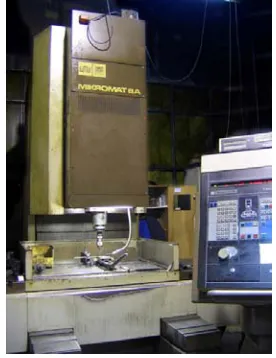
For the versions II and III, the orifice in the perforated plates were performed by a micro processing machine, Micromat type 6A (Figure 9) using a drill of Ø 0.3 mm and 0.5 mm.
Fig. 9 Micro processing machine, Micromat type 6A.
This machine has a performing three-dimensional positioning system, having a positioning error up to 10 micrometers and a workbench in length Lmax = 800 mm, width lmax = 550 mm and a height of Hmax = 500 mm.
3. The experimental plant presentation
The research aim is to determine the dissolved oxygen concentration variation in water for the 3 versions of FBG. The experimental stand consists of [10] [11]:
- Compressor (1), to produce compressed air with the following operating parameters: maximum discharge pressure p = 8 bar, aspirated flow rate = 200 dm3/min, electric motor power P = 1.1 kW at rpm n = 2850 rpm/min, tank volume (V = 24 dm3). The compressor is equipped with a manometer 0-16 bar to show the pressure in the compressor tank and a pressure reducing valve for the establishment of the pressure in the piping system.
- Air pipes for the delivery of the compressed air, made of plastic, with the inner diameter of Ø15 mm and a wall thickness of 2 mm; its supplies the fine bubble generator with air and ensures the evacuation of the excess air supplied by the compressor to the atmosphere.
- The aeration tank constructed of Plexiglas plates with thickness of 5 mm, having the dimension, 0.5×0.5×1.5(W × L × h).
- Fine bubble generator.
The sketch of the stand used for the experimental researches is presented in Figure 10.
1
V=24 dm3
2 3 4 5 6
mbar toC
mg/l
oC a b
c 500
7 8 9 10 11 12 13
14 15
Fig. 10 Sketch of the experimental plant for researches regarding water oxygenation
1-electro compressor with air tank; 2– pressure reducer; 3– manometer; 4– connector for air exhaustion in the atmosphere; 5– T-joint; 6– rotameter; 7– pipe for the transport of the compressed air to the
FBG; 8–digital manometer; 9– oxygen meter; 10–digital thermometer; 11– water tank; 12- mechanism for the probe actuation; 13– oxygen meter probe; 14– FBG; 15–electronics control: a– supply unit, b- switch,
ISSN 2348 – 7968
49
4. Experimental research methodology
During the experimental researches the following parameters were kept constant:
- The pressure inside the FBG, p = 1290 mm H2O; - The height of the water layer above the FBG, H = 500 mm H2O;
- Water temperature t≈24 °C and air temperature t≈25 °C; - Air input section in the water mass;
Based on previous research [1] [3] this section of was chosen equal to: A = 1.20·10-6 m2.
The experimental researches were conducted as follows: 1. The water tank is filled: H = 500 mm;
2. The water temperature in the tank and the initial dissolved O2 concentration in the water are measured. 3. The compressor is turned on and the compressed air temperature is measured.
4. The FBG is inserted in the tank and the time (τ = 0) is noted.
5. Every 15 minutes, the dissolved oxygen concentration in water is measured.
6. The duration of the experiments is 120 minutes, ie eight measurements set are performed.
5. Experimental obtained results
For the three versions of the FBG, common elements were: - Air input section in the water: A = 1.20·10-6 m2;
- The water temperature in the tank: t = 24oC; - Compressed air temperature: t = 25 ° C;
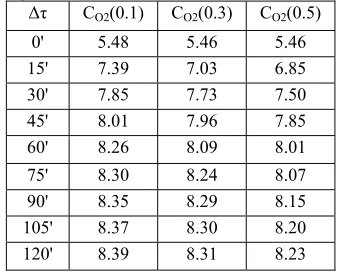
- The initial O2 concentration in water: C0 = 5. 48 mg/l; - The duration of the experiments, τ = 120 minutes. As a result of the measurements the data shown in Table 1 were obtained.
Table 1: Experimental data on the dissolved O2 concentration in water
Δτ CO2(0.1) CO2(0.3) CO2(0.5) 0' 5.48 5.46 5.46 15' 7.39 7.03 6.85 30' 7.85 7.73 7.50 45' 8.01 7.96 7.85 60' 8.26 8.09 8.01 75' 8.30 8.24 8.07 90' 8.35 8.29 8.15
105' 8.37 8.30 8.20
120' 8.39 8.31 8.23
Based on the results in Table 1, the graphs in Figure 11 were plotted.
Fig. 11 The variation of dissolved oxygen concentration in water function of time
1 - FBG version I; 2 - FBG, version II; 3 - FBG version III.
From Figure 11, it is noted that the FBG in version I is the most efficient.
6. Conclusions
The oxygenation process efficiency is influenced by the following factors:
- Water depth at which the air is introduced;
- The size of the air bubbles introduced into the water; - The flow regime obtained by introducing compressed air into the water mass.
2. The advantages of fine bubble aeration systems are: - Are simple in terms of construction;
- The operational life is high;
- Does not require periodical maintenance;
- Particularly low resistance; particularly low resistance generates low pressure loss, leading to energy savings in air compression station [12].
3. After the experimental measurements the followings were found:
The dissolved oxygen concentration in water increases faster when using small orifice plate;
From Figure 11 it is observed that the most
advantageous is to work with a FBG at which the plate has 0.1 mm orifices;
Creating a FBG at which the plate has 0.1 mm orifices, the experimental plant, the research methodology and the obtained results represents an original contribution of the authors.
References
50 Thesis, Faculty of Mechanical Engineering and
Mechatronics, POLITEHNICA University of Bucharest, 2013.
[2] S. Stoianovici, D. Robescu, D. Stamatoiu, “Design and building of water oxygenation equipments”, CERES Publishing House, Bucharest, 1985.
[3] S. Pătulea, “Influence of functional parameters and of fine bubble generators architecture on the efficiency of aeration plants” (in Romanian), PhD Thesis, Faculty of Mechanical Engineering and Mechatronics, POLITEHNICA University of Bucharest, 2012.
[4] G. Mateescu, “Hydro-gas-dynamics of fine bubble generators” (in Romanian), PhD Thesis, Faculty of Mechanical Engineering and Mechatronics, POLITEHNICA University of Bucharest, 2011.
[5] E. B. Tănase, N. Băran, R.Mlisan, “An efficient Solution for Water Oxygenation”, Asian Engineering Review, vol 1, no.3, pp 36-40, 2014.
[6] T. Miyahara, Y. Matsuba, T. Takahashi, “The size of bubbles generated from perforated plates”, Int. Chem. Eng., vol. 23, pp. 517 – 523, 1983.
[7] G. Oprina, I. Pincovschi, Gh. Băran, “Hydro-gas-dynamics of aeration systems endowed with bubble generators” (in Romanian), POLITEHNICA PRESS Publishing House, Bucharest, 2009.
[8] I. Căluşaru, M. Băran, A. Costache, G.-L. Ionescu, O. Donţu, “A new solution to increase the performance of the water oxygenation process”, Revista de chimie, vol. 64, no. 10, pp. 1143 – 1145, 2013.
[9] I. Căluşaru, N. Băran, Al. Pătulea, “The influence of the constructive solution of fine bubble generators on the concentration of oxygen dissolved in water”, Advanced Materials, vols. 538 – 541, pp. 2304 – 2310, 2012.
[10] Al. Pătulea, I. Căluşaru, N. Băran, “Reasearches regarding the measurements of the dissolved concentration in water”, Advanced Materials Research, vols. 550 – 553, pp. 3388 – 3394, 2012.
[11] N. Băran, M Vlăsceanu, M. Băran, E. Tănase, “Increasing the performance of oxygenation installations”, TERMOTEHNICA, no. 1, Bucharest, pp. 16 – 21, 2014. [12] M. Vlăsceanu, N. Băran, M. Băran, “Decrease of Energy
Consumption in the Case of Water Oxigenation Processes”, ELSEVIER, Energy Procedia, vol. 50, pp. 454-459, 2014
Elena-Beatrice Tănase was born in Romania, Câmpina, on April 6, 1990. She graduated from Politehnica University – Bucharest. She is today a PhD student in the Faculty of Mechanical and Mechatronics of Politehnica University – Bucharest.
Daniel Besnea was born in Buzău, Romania on July 19, 1967. He studied at the Politehnica University of Bucharest and received PhD. Degree from the same university. Since 2006 he worked as a Lector in the Faculty of Mechanical and Mechatronics Engineering.
Rasha Mlisan-Cusmawas born in Syria, Damask, on January 6, 1990. She graduated from Politehnica University – Bucharest. She is today a PhD student in the Faculty of Mechanical and Mechatronics of Politehnica University – Bucharest.
Mihaela Constantinwas born in Turnu Măgurele, Romania, on January 26, 1985. She graduated from the Politehnica University - Bucharest, and
received a PhD degree from the same university. She is today Lector in the Faculty of Mechanical and Mechatronics and Mechatronics Engineering of the Politehnica University – Bucharest.