ISSN(Online): 2319-8753 ISSN (Print): 2347-6710
International Journal of Innovative Research in Science,
Engineering and Technology
(A High Impact Factor, Monthly, Peer Reviewed Journal)
Visit: www.ijirset.com Vol. 8, Issue 9, September 2019
A Comprehensive Study on Wireless
Sensor Network Link Failures
Krishna Chaitanya Sanagavarapu
1System Analyst, Teknatio Inc, Philadelphia, PA1
ABSTRACT: Proof and findings from area trials as well as literary works have actually revealed that WSN in real-world implementations still exhibit interaction integrity concerns. There is a pushing need to get rid of the functional obstacles associated with deploying this intricate modern technology. This paper examines the existing remedies in the literary works made to find or mitigate generally located WSN network difficulties.
KEYWORDS: WSN, failures, QoS
I.INTRODUCTION
WSN consists of spatially distributed independent sensor nodes developed to sense, step and gather details regarding the physical or ecological conditions. These nodes are usually geared up with gadgets such as wireless microcontrollers, modular sensing units, batteries and energy-harvesting capabilities. Sensor information is gathered as well as sent wirelessly from one node to one more. Depending upon the carried out optimization procedure and applications [1], sensor nodes can form a reactive network topology with self-organizing capacities to make sure that sensing units information can be communicated reliably to the location nodes. Optimization method guarantees that the needs of WSN applications are met without the need for human intervention. These needs, frequently described as Quality of Service (QoS) aid to for instance, keep optimal information throughput for information sensitive applications and also reduce end-to- end latency for information critical applications.
The demand of little form factor as well as bill of product constraints on sensor nodes limit their sources such as energy, memory, computational power and interactions transmission capacity. In particular, energy in battery-powered WSN is a scarce source. Considered that the longevity of WSN applications depends upon the power consumption rate of sensor nodes, power effectiveness becomes one of the prime factors to consider in creating an optimization protocol. To stay clear of energy shortage in WSN, optimization method should be well balanced between power consumption, system performance, as well as operational fidelity while relying on a light memory impact.
Evaluation of Link Quality in Real-World Environments
ISSN(Online): 2319-8753 ISSN (Print): 2347-6710
International Journal of Innovative Research in Science,
Engineering and Technology
(A High Impact Factor, Monthly, Peer Reviewed Journal)
Visit: www.ijirset.com Vol. 8, Issue 9, September 2019
Limitations of Single Criterion Web Link Quality Evaluation
[4] presented Weighted Regression Estimator (WRE) to approximate link quality. WRE is a regression design where the weightage for every regression is established by the spatial distance between a set of nodes. WRE thinks about the characteristics of uneven radio breeding and also the link quality of nodes in very same geographical region. Writers described that WRE improves the robustness of web link quality analysis given that neighbouring nodes in the same area experience similar web link quality. This job assumes that all environmental dynamics influence nodes regionally and also the level of impact can be determined with distance, which is not always real. For instance, link failings from asymmetrical communications as well as covert incurable problems do not affect nodes regionally. Moreover, received signal toughness determined do not associate well with distance in between connecting nodes, especially in an indoor environment with the presence of human movements.
The quality of a link is generally classified as inadequate, intermediate and also great. [5] recommended the use of Intermediate Quality Web Link Transformation Procedure to alternate interaction networks as well as to boost a link of Intermediate Quality (INTELLIGENCE) into a "excellent" one. Writers said that Packet Reception Rate differs across different channels which IQ web links can be enhanced through channel variety. For instance, there is an 85% chance of locating a better channel for an existing relate to 70% PRR. Nevertheless, this job presumes that all reasons for link failings break down PRR. Authors in [6] has shown that when sharing interaction channel with relentless Wi-Fi traffic, only 5% of all losses can be captured using PRR indication while the remainder of the losses can just be found from network access failure. This suggests that Wi-Fi web traffic do not influence every web link quality metrics just as. Given that ILTP figures out a link quality using just PRR, network obstacles that do not impact PRR (e.g. Wi-Fi website traffic) may continue to be undiscovered.
Assessment of Link Quality using Cross Layer Parameters
A failure discovery mechanism belonging to a specific layer of a method pile ought to not be depictive if it does rule out the responses from other layers. As an example, a link failure can be potentially credited to either inadequate time synchronization characteristic of MAC layer or inadequate end-to-end connection quality of the routing layer. Using info from numerous layers such as cross-layer parameters can give even more details concerning the quality of a web link.
Four-Bit estimator (4B) proposed in [2], is a cross-layer web link quality metric that considers of 4 various link properties. These buildings include the chance of decoding mistake throughout packet reception at the link layer, family member relevance of a link by contrasting among the neighbours at the network layer, and also verification of inbound and outgoing function through acknowledgement at the physical layer. It is stated that the network layer criteria allow family member web links comparison with adjoining nodes, while physical as well as link layer specifications are extra reliable at estimating the quality of a web link at reception. The efficiency of 4B was then assessed with Collection Tree Procedure, which constructed and also preserved a tree network. It is found that a 4B-based CTP generated a better performance in terms of package distribution than a CTP that utilizes Estimated variety of Transmission. Via simulation, 4B nodes favoured shorter communication distance in between nodes. This is since a much shorter communication distance is reasoned to have better quality due to far better web link budget plan as well as minimal possibilities of web link crookedness at the web link layer. Thus, the deepness matters of directing courses in the network increased as well as the total variety of retransmissions lowered.
ISSN(Online): 2319-8753 ISSN (Print): 2347-6710
International Journal of Innovative Research in Science,
Engineering and Technology
(A High Impact Factor, Monthly, Peer Reviewed Journal)
Visit: www.ijirset.com Vol. 8, Issue 9, September 2019
link in time, Signal to Sound Ratio used to separate a bad as well as top quality network, Home window Mean with Exponential Weightage Moving Ordinary strategy to gauge information throughput overtime, and also the PRR distinction between uplink and also downlink for link asymmetry procedure. Baccour et al. highlighted that WSN communication network quality is normally assessed with functions of imprecisely gauged network properties such as a web link quality threshold of 0.95 packet delivery. Unlike timeless logic, Fuzzy logic is made use of to take care of inaccurate information, supplying approximate truth of a suggestion based on etymological variables and also reasoning guidelines. As an example, a channel can be unsteady, stable, as well as very stable. Utilizing cross-layer information and etymological depiction of web link quality assessment, F-LQE nodes are examined extensively in an outdoor simulated experiment and also have demonstrated remarkable network efficiency by avoiding the use of unsteady links and also loud networks.
II.WIRELESS SENSOR NETWORK LINK FAILURES AND EXISTING DETECTION MODELS
In identifying the causes of web link failings is explained as crucial for the optimization procedure to function properly. WSN, being deployed within a vibrant atmosphere may provide it hard to pinpoint the specific sources of web link failures. Consequently, in this section, the generally discovered network difficulties, referring to WSN interaction integrity are reviewed.
Imperfect System and also Running Problems
WSN and also its operating conditions are incomplete. These blemishes consist of but not limited to, uneven antenna propagation, mismatching of equipment characteristics as well as also ecological elements such as temperature and also moisture problems. They are known to break down the analysis of web link quality between interacting nodes as well as are usually accounted as probabilistic variables and also random elements throughout modelling.
Energy diminished wireless sensor nodes
To reduce the general equipment size as well as constructed price, wireless sensor nodes are commonly equipped with batteries of little ability. Batteries substitute in a remote atmosphere as well as for a huge network size is impractical. Thus, energy effectiveness is viewed as among the key style goals in a battery-powered WSN. The wireless transceiver is the primary energy consumer in a wireless sensor node. The design of an optimization procedure ought to stay clear of extreme usage of transceiver such as long term still listening where a node listens to a network for packets that are planned for it or various other nodes, and also too much control-packet overhead where a node transfers packets aggressively to maintain a network.
On the contrary, in order for a WSN to be specific, responsive and also reliable, extra monitoring tasks including energetic transceivers are commonly needed. These tasks include continuous tracking of the networks as well as added control packages for durable communication, both of which are clashing objectives with lessening the consumption of energy. As a result, the selection of optimization method have to balance both the integrity of data transfer and the associated energy consumption.
ISSN(Online): 2319-8753 ISSN (Print): 2347-6710
International Journal of Innovative Research in Science,
Engineering and Technology
(A High Impact Factor, Monthly, Peer Reviewed Journal)
Visit: www.ijirset.com Vol. 8, Issue 9, September 2019
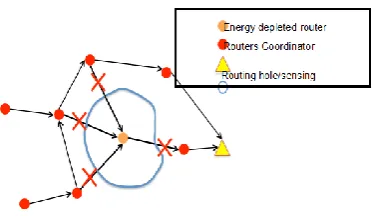
constantly associate with energy-depleted nodes. Nodes in the same area can be shadowed by large physical challenges, or affected by regularity jamming, leaving affected nodes inaccessible.
Figure 1. Network routing hole
WSN nodes normally do not have the details of the power consumption prices or energy residual of neighbouring nodes. The lack of understanding of inaccessible energy diminished nodes causes consistent retransmissions or network penetrating if a detour towards the location node is inaccessible. Discovery of transmitting or insurance coverage holes is necessary to make sure that impacted nodes can customize their jobs dynamically, according to the power consumed and estimation of the network lifetime. Power diminished node emerge as a node-level symptom where just the affected node stops transmitting information. A dispersed discovery of node abnormalities can be highly efficient. As an example, routine "keep-alive" broadcast is a common system in ZigBee PRO basic utilized to inform neighbouring nodes that a node is still "to life" and also available.
Reducing specific sensor nodes power intake does not ensure maximizing a network's overall lifetime. To manipulate maximum network residual energy, a reasonable power consumption of nodes across the network should be prioritized. Reduced Power Adaptive Clustering Pecking Order (LEACH) techniques are recognized to lengthen the lifetime of the network by distributing the energy usage amongst nodes in collections. LEACH protocols require all the nodes to share their energy standing among adjoining nodes, including the estimate of the network lifetime based upon power intake prices. Sharing of this info permits the collection heads to be turned based upon the remaining energy of the nodes within each collection. Given that a cluster head eats extra energy from longer channel listening and also data aggregations, an even consumption of energy amongst sensor nodes is attained from rotations.
ISSN(Online): 2319-8753 ISSN (Print): 2347-6710
International Journal of Innovative Research in Science,
Engineering and Technology
(A High Impact Factor, Monthly, Peer Reviewed Journal)
Visit: www.ijirset.com Vol. 8, Issue 9, September 2019
III.CONCLUSION
WSN nodes have limited lifespan and also computational capability. For nodes to check the dynamics within the operating atmosphere need continuous power draining pipes procedures such as the discovery of second preamble to identify package collision, monitoring of multipath effects on multiple networks, as well as hearing neighbouring node's transmitted packages to figure out temporal links. This paper assessed the network obstacles in an indoor atmosphere that have an impact on WSN communication reliability.
REFERENCES
[1] Abuarqoub, M. Hammoudeh, F. Al-Fayez, O. Aldabbas, "A questionnaire on wireless sensor networks simulation devices and also testbeds," In Sensors, Transducers, Indicator Conditioning as well as Wireless Sensors Networks Innovations in Sensors: Testimonials, vol. 3, Lad 14, 2017.
[2] J. Moritz, "Inspection of deployment-specific simulation for the marketing of wireless sensor network", Ph.D Thesis, Technical University of Braunschweig, 2018.
[3] "JN5168-001-Myy Datasheet", NXP Laboratories UK, 2013.
[4] "ZigBee PRO Bundle Consumer Overview", NXP Laboratories UK, 2014.
[5]R. Akl, D. Tummala, and also X. Li, "In the house propagation modelling at 2.4 GHz, for IEEE 802.11 networks," In the sixth IASTED Int. Multi-Conf. on Wireless as well as Optical Comm, Banff, Canada, 2006.
[6]Anusha Medavaka, P. Shireesha, “Analysis and Usage of Spam Detection Methodin Mail Filtering System” in “International Journal of Information Technology and Management”, Vol. 12, Issue No. 1, February-2017 [ISSN : 2249-4510]
[7]Anusha Medavaka, P. Shireesha, “Review on Secure Routing Protocols in MANETs” in “International Journal of Information Technology and Management”, Vol. VIII, Issue No. XII, May-2015 [ISSN : 2249-4510]
[8]Anusha Medavaka, P. Shireesha, “Classification Techniques for ImprovingEfficiency and Effectiveness of HierarchicalClustering for the Given Data Set” in “International Journal of Information Technology and Management”, Vol. X, Issue No. XV, May-2016 [ISSN : 2249-4510]
[9]Anusha Medavaka,P. Shireesha, “Optimal framework to Wireless RechargeableSensor Network based Joint Spatial of theMobile Node” in “Journal of Advances in Science and Technology”, Vol. XI, Issue No. XXII, May-2016 [ISSN : 2230-9659]
[10] Anusha Medavaka,“Enhanced Classification Framework on SocialNetworks” in “Journal of Advances in Science and Technology”, Vol. IX, Issue No. XIX, May-2015 [ISSN : 2230-9659]
[11] Anusha Medavaka,P. Shireesha, “A Survey on TraffiCop Android Application” in “Journal of Advances in Science and Technology”, Vol. 14, Issue No. 2, September-2017 [ISSN : 2230-9659]
[12] Anusha Medavaka,Dr.P.Niranjan, P. Shireesha, “USER SPECIFIC SEARCH HISTORIES AND ORGANIZING PROBLEMS” in “International Journal of Advanced Computer Technology (IJACT)”, Vol. 3, Issue No. 6 [ISSN : 2319-7900]
[13] Krishna Chaitanya Sanagavarapu, “PARALLEL PROCESSING ON FP-TREE BASED FREQUENT ITEM SET MINING” in “Airo International Research Journal”, Volume VI, Aug-2015 [ISSN : 2320-3714]
[14] Krishna Chaitanya Sanagavarapu, “CLASSIFICATION OF DATA MINING SYSTEMS AND FUNCTIONALITY OF DATA MINING” in “AiroInternational Research Journal”, Volume VIII, July-2016 [ISSN : 2320-3714]
[15] Krishna Chaitanya Sanagavarapu, “A STUDY ON SOURCES AND TYPES OF DATA TOWARDS DATA MINING” in “Airo International Research Journal”, Volume XII, July-2017 [ISSN : 2320-3714]
[16] Krishna Chaitanya Sanagavarapu,“Advantages and Evolution of Cloud Computing” in “International Journal of Scientific Research in Science and Technology”, Vol. 3, Issue No. 3, Apr-2017[ISSN : 2395-602X]
[17] Krishna Chaitanya Sanagavarapu,“A Review on Pattern Mining Research Issues” in “International Journal of Scientific Research in Science and Technology”, Vol. 4, Issue No. 5, June-2018[ISSN : 2395-602X]
[18] Krishna Chaitanya Sanagavarapu, “A Comprehensive Overview on Multidimensional Frequent Pattern Mining” in “Journal of Advances and Scholarly Researches in Allied Education”, Vol. 15, Issue No. 12, Dec-2018 [ISSN : 2230-7540]
[19] Krishna Chaitanya Sanagavarapu, “An Overview on the Design of Frequent Pattern Mining Algorithms” in “Journal of Advances and Scholarly Researches in Allied Education”, Vol. XI, Issue No. 22, Jul-2016 [ISSN : 2230-7540]
[20] Krishna Chaitanya Sanagavarapu, “Evolution of Social Networks and Social Networking Sites” in “Journal of Advances in Science and Technology”, Vol. X, Issue No. XXI, Feb-2016 [ISSN : 2230-9659]
[21] Anusha Medavaka,“Monitoring and Controlling Local AreaNetwork Using Android APP” in “International Journal of Research”, Vol. 7, Issue No. IV, April-2018 [ISSN : 2236-6124]
[22]Anusha Medavaka, "Algorithm Feasibility on IoT Devices with Memory and Computational Power Constraints", International Journal of Science and Research (IJSR), Volume 8, Issue 5, May 2019[ISSN : 2319-7064]
ISSN(Online): 2319-8753 ISSN (Print): 2347-6710
International Journal of Innovative Research in Science,
Engineering and Technology
(A High Impact Factor, Monthly, Peer Reviewed Journal)
Visit: www.ijirset.com Vol. 8, Issue 9, September 2019
[24]Anusha Medavaka,“Identification of Security Threats and Proposed Security Mechanisms for Wireless Sensor Networks” in “International Journal of Scientific Research in Computer Science, Engineering and Information Technology”, Vol. 5, Issue No. 3, May-2019 [ISSN : 2456-3307]
[25]Anusha Medavaka,“A REVIEW ONDISPLAYING KNOWLEDGE INTO THE UNLIMITED WORLDVIEW OF BIGDATA” in “International Journal of Research and Analytical Reviews”, Vol. 6, Issue No. 2, May-2019 [ISSN : 2348 –1269 ]
[26] Anusha Medavaka,“A Comprehensive Study on Characteristics of Big Data and the Platform Used in Big Data” in “International Journal for Scientific Research & Development”, Vol. 7, Issue No. 3, May-2019[ISSN : 2321-0613 ]
[27] Anusha Medavaka, “An Overview of Security Mechanisms Towards Different Types of Attacks” in “International Journal of Scientific Research in Science and Technology”, Vol. 4, Issue No. 10, October-2018[ISSN : 2395-602X ]
[28] Anusha Medavaka,“A study on the process of hiding protective information from the big data processing databases” in “International journal of basic and applied research”, Vol. 9, Issue No. 6, June-2019[ISSN : 2278-0505]
[29] Anusha Medavaka,“K-Means Clustering Algorithm to Search into the Documents ContainingNatural Language” in “International Journal of Scientific Research in Science and Technology”, Vol. 3, Issue No. 8, Dec-2017[ISSN : 2395-602X]
[30] Anusha Medavaka,Siripuri Kiran, “Implementation of dynamic handover reduce function algorithm towards optimizing the result in reduce function” in “International Journal of Academic Research and Development”, Vol. 4, Issue No. 4, July-2019[ISSN : 2455-4197] [31] Anusha Medavaka,Siripuri Kiran, “A COMPREHENSIVE SURVEY IN INTERNET OF THINGS SMART APPLICATIONS” in
“International Journal of Research”, Vol. VIII, Issue No. III, March-2019[ISSN : 2236-6124]