1
Department of Computer Science and Engineering AKS University Satna, India
Department of Computer Science and Engineering AKS University, Satna, India
ABSTRACT
In this paper wireless sensor network (WSN) is a large network consists of a group of distributed networks, in this network no. of sensors are interconnected by means of wireless communication channels. Wireless sensor network is one of the growing technologies for sensing and performing the different tasks, it increases data traffic. So that large volume of data transmission and restricted bandwidth congestion occurs. This paper review Data-Link Layer Techniques, Network Layer Techniques, Transport Layer Techniques, and Cross-Layer Based Techniques to control data congestion with related these protocols. KEYWORDS: Wireless Sensor Network (WSN), Multipath Routing Protocol, Congestion Control Techniques, Rate Reduction, Congestion Control, Rate control, Network Performance.
1.1WIRELESS SENSOR NETWORK
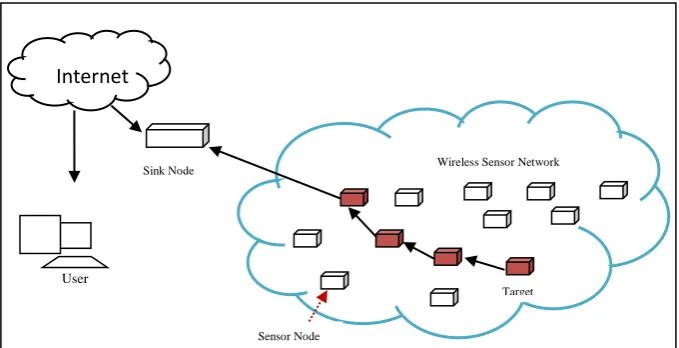
Wireless sensor network (WSN) is a large network consists of a group of distributed autonomous sensors are interconnected by wireless communication channels to monitor physical and environmental conditions, such as temperature, sound, pressure, etc. when it increases data traffic.
Fig. 1 Architecture of Wireless Sensor Network
Internet
User
Sink Node Wireless Sensor Network
Target
Sensor Node
International Journal of Research Publications
Volume-3, Issue-1,April 2018
Accepted and Published Manuscript
Review of Congestion Control Techniques in Wireless Sensor Network
Akhilesh A. Waoo, Varsha Tiwari
PII : Akhilesh A. Waoo.100315201885
DOI: 100315201885
Web: http://ijrp.org/paper_detail/86
To appear in: International Journal of Research Publication (IJRP.ORG)
Received date: 19 Apr 2018
Accepted date: 28 Apr 2018
Published date: 06 May 2018
Please cite this article as: Akhilesh A. Waoo, Varsha Tiwari , Review of
Congestion Control Techniques in Wireless Sensor Network ,
International Journal of Research Publication (Volume: 3, Issue: 1),
http://ijrp.org/paper_detail/86
This is a PDF file of an unedited manuscript that has been accepted for
publication. As a service to our customers we are providing this final
version of the manuscript.
Review of Congestion Control Techniques in Wireless
Sensor Network
Akhilesh A. Waoo
Department of Computer Science and
Engineering
AKS University Satna, India
Varsha Tiwari
Department of Computer Science and
Engineering
AKS University, Satna, India
ABSTRACT
In this paper wireless sensor network (WSN) is a large network consists of a group of distributed networks, in this network no. of sensors are interconnected by means of wireless communication channels. Wireless sensor network is one of the growing technologies for sensing and performing the different tasks, it increases data traffic. So that large volume of data transmission and restricted bandwidth congestion occurs. This paper review Data-Link Layer Techniques, Network Layer Techniques, Transport Layer Techniques, and Cross-Layer Based Techniques to control data congestion with related these protocols.
KEYWORDS
:
Wireless Sensor Network (WSN), Multipath Routing Protocol, Congestion Control Techniques,Rate Reduction, Congestion Control, Rate control, Network Performance.
1.1
WIRELESS SENSOR NETWORK
Wireless sensor network (WSN) is a large network consists of a group of distributed autonomous sensors are interconnected by wireless communication channels to monitor physical and environmental conditions, such as temperature, sound, pressure, etc. when it increases data traffic.
Fig. 1
Architecture of Wireless Sensor Network
Internet
User
Sink Node Wireless Sensor Network
Target
There are two main traffics in Wireless Sensor Network namely first upstream traffic is many-to-one traffic and second downstream traffic is one-to-many. Therefore, in WSN lifecycle of network create data congestion problem and hence, no. of implementation techniques & important requirements becomes to wireless sensor network.
1.2
CONGESTION IN WIRELESS SENSOR NETWORK
When no. of wireless sensor creates big communication network, it generated data traffic is called data congestion. In this problem source nodes nearby sink grows the many-to-one & one-to-many traffic nature of data communication between many source & sink results in bottleneck around sink. In WSN architecture, the reason of congestion is channel quality to degrade and loss of packets per unit time increases and leads to packet drops at the buffer. Therefore, in WSN congestion problem solved by different techniques and using related protocols.
1.3
REASONS FOR CONGESTION
Congestion can also generate due to the packet loss, which takes place during collision. So, In this type of network congestion becomes more accountable due to interaction of concurrent data transmission over varying radio links or due to increase in the reporting rate to the base-station, in such cases, congestion can happen in the network. There is an opportunity of resources due to high reporting rates by no. of events. In WSN architecture network congestion becomes more server, some packets will be dropped due to limited buffer size. This case will call loss of packets in resultant, decreases in throughput & waste of energy.
1.4
TYPES OF CONGESTION IN WSN
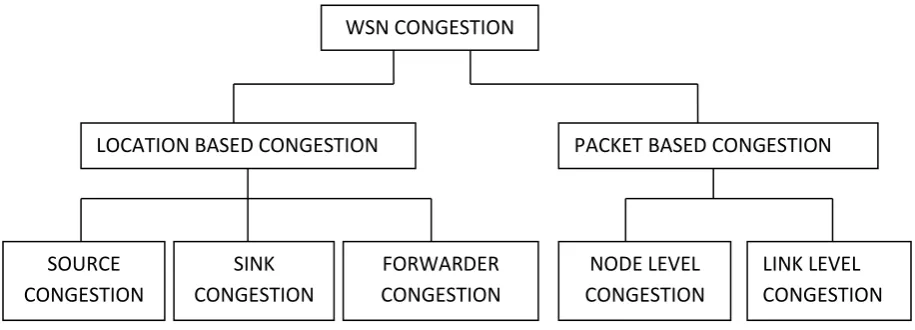
Congestion problem in communication in WSN can be classified in two major categories namely to concern location and the causes for packet loss as shows in (figure 2).
Fig. 2
Types of Congestions in WSN
1.2.1Location based congestion
There is first problem of congestion in wireless sensor network, and these location-based congestion three types define are as follows:
WSN CONGESTION
PACKET BASED CONGESTION
LOCATION BASED CONGESTION
SOURCE
CONGESTION
SINK
CONGESTION
FORWARDER
CONGESTION
NODE LEVEL
CONGESTION
I. Source congestion
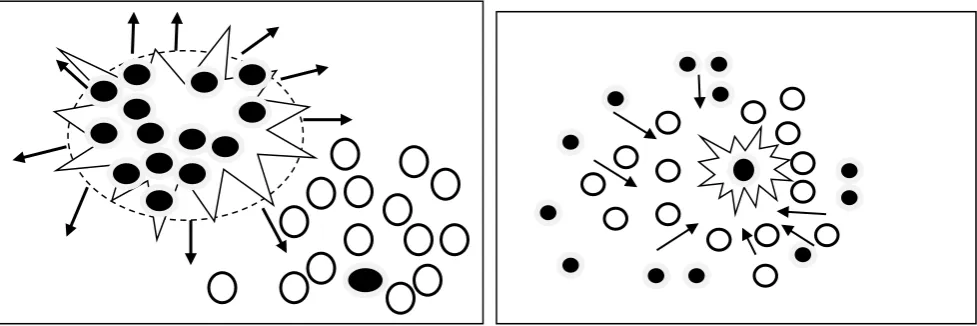
These nodes will act as sources for further transmission. The node’s radio range is greater, and its sensing range is also greater. So as sources fall in each other's radio range, they can communicate with each other. This type of congestion can be controlled by careful scheduling between these sources which allows only a small number of nodes (out of all the nodes within the event range) to report to the sink (figure 3(a)).
II. Sink Congestion
In the sink congestion, the sensors observe an event at a high data rate, sink nodes (the nodes around them) will sense a high volume of traffic. If a hot-spot occurs around a sink, the packets will be lost inside the congested area near the sink and dropping of a packet around the sink needs recovery of packets by some means. And this type of congestion side of effect is that the battery power of all the nodes that are around the sink will be exhausted quickly, making the sink in accessible from the rest of the network. Therefore, an effective way of eliminating sink congestion is to place multiple sinks that are equivalently scattered across the sensor field or mobile sink (figure 3(b)).
Fig. 3
(a) Source Congestion and (b) Sink Congestion
.
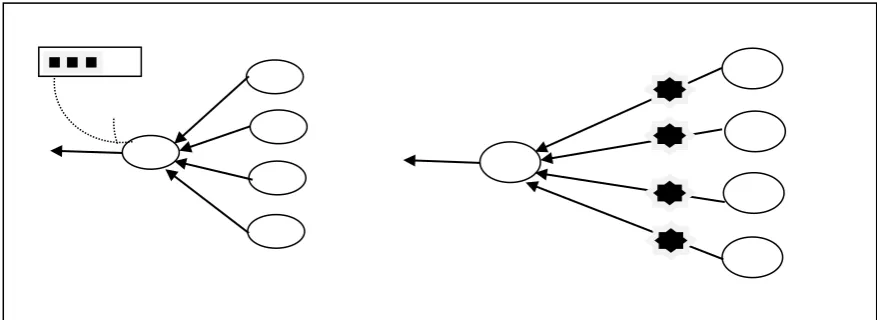
III. Forwarder Congestion
Fig. 4
Forwarder congestion: (a) Intersection hot spot merging traffic and
(b)Intersection hot spot
crossing traffic
1.2.2 Causes of Packet Loss
There are mainly two causes for congestion in WSNs. The firstly case is node level congestion which occurs when the packet-arrival rate exceeds the packet-service rate. So, in this type of congestion is common in conventional networks. And Packet loss in turn can lead to retransmission and therefore consumes additional energy (Figure 5(a)).
And the secondly case is link level congestion which occurs due to contention, interference, and bit-error rate. In link-level congestion increases packet service time, and decreases both link utilization and overall throughput, and wastes energy at the Sensor nodes shows in (Figure 5(b)).
Therefore, in both, node level and link-level Congestions have direct impact on energy efficiency and Quality of Service (QoS). Hence, packet loss problem can be controlled by the congestion must be efficiently.
Fig.5
(a) Node-level Congestion and (b) Link Level Congestion
2.
TECHNIQUES OF CONGESTION CONTROL
Source 1
Source 2
Source 3 Sink 3
Sink 2
In wireless sensor network architecture made by no. of four types OSI layers. Hence these methods are deployed by different layers of the OSI stack.
CONGESTION CONTROL MACHENISM IN WSN
The congestion is one of the major issues in WSN. Hence, an accurate and efficient congestion detection technique is required as a first step to mitigate congestion. Recent solutions solving the congestion problem in WSNs were studied. Channel collision can be overcome using mechanisms employed by the data link layer: Carrier Sense Multiple Access (CSMA), Frequency Division Multiple Access (FDMA), and Time Division Multiple Access (TDMA).
Based on the layer of OSI models in which the mechanism operates, and the congestion control mechanisms are classified. There are four types of classifications are briefly analyzed and discussed below:
• Data Link Layer Techniques
• Network Layer Techniques
• Transport Layer Techniques
•
Cross Layer Based Techniques2.1.1
Data Link Layer Techniques
The congestion control mechanisms that operate in the data link layer are as follows:
•
Self-organizing Medium Access Control (SMACS)
A self-organizing Medium Access Control (SMACS) is one of the SMAC, TDMA (Time Division Multiple Access) based techniques in which TDMA techniques should be included to the data link layer congestion control mechanism as nodes have to switch-off for some-time to avoid idle listening and through this avoid energy observation of the device. Hence, this technique is only suitable for low-power radio application in data link layer.
•
On-demand TDMA with Priority Bases Communication Scheduling
In data link layer techniques of congestion control, On-demand TDMA extension of IEEE802.15.4 MAC layer with priority-based communication scheduling mechanism in nearby routing devices. Moreover, it can guarantee the communication performance and satisfy the requirements of the industrial applications.
•
Congestion Control and Fairness (CCF)
A congestion Control and Fairness (CCF) adjusts the traffic rate based on packer service time along with fair packet scheduling algorithms. This technique is designed to work with any MAC protocol in the data link layer. However, it exists in the transport layer. CCF uses packet service to deduce the availability of the service rate.
2.1.2
Network Layer Techniques
The congestion control mechanisms that work on the network layer are as follows:
•
Beacon Order Based RED (BOB-RED)
•
Congestion Avoidance, Detection and Alleviation
In network layer techniques congestion control, Congestion Avoidance, Detection and Alleviation (CADA), all the sensor nodes in the WSN are not responsible to send information to the sink node when some event is detected. Only some of the selected number of sensor nodes can send information about the event to the sink. And other nodes are concealed from sending the same and inaccurate data. Hence, the network traffic from the area where event is detected can be minimized. Sometimes, it results in the reduced network throughput.
2.1.3
Transport Layer Techniques
The congestion control mechanisms that operate on the data link layer are as follows:
•
Pump Slowly Fetch Quickly (PSFQ)
In transport layer techniques of congestion control PSFQ, a simple and scalable transport is considered, and the needs of different data applications are satisfied by PSFQ. PSFQ is a transport protocol that is suitable for constrained devices. There are includes three main functions: (a) message relaying, (b) relay-initiated error recovery and (c) selective reporting.
•
Light UDP
Transport layer protocol Light UDP approach can be effectively deployed by applications for which delivery of all data has more priority than its integrity multimedia protocols, stream video, and voice IP.
•
Reliable UDP
Reliable UDP is also a transport layer protocol, the main feature of which is that it is working on UDP or IP stack and provides reliability in order delivery.
•
Sen.TCP
In transport layer protocol Sen.TCP are uses open loop hop-by-hop congestion control. Sen.TCP uses hop-by-hop for control and detects congestion using local congestion degree. And Sen.TCP to determine the current local congestion degree in each intermediate sensor nodes of WSNs uses average of local packet service and average local packet inter-arrival time conjointly.
2.1.4
Cross-Layer Based Techniques-
The congestion control mechanisms based on the cross-layer approach are as follows:
•
Congestion Detection and Avoidance (CODA)
The Congestion Detection and Avoidance (CODA) technique combines three mechanisms: (a) receiver-based congestion detection,
(b) open-loop hop-by-hop backpressure, (c) closed-loop multi-source regulation.
•
XLP
•
PCCP
Priority based congestion Control protocol (PCCP) is an upstream congestion control protocol in WSN which measures congestion degree as the ratio of packet interarrival time to the packet service time.
3.
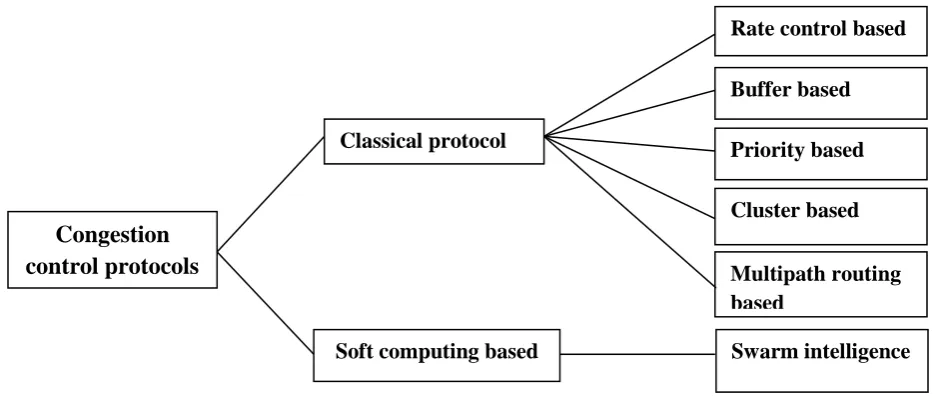
Classification of Congestion Control Protocols
Fig. 6
Congestion Control Protocols
3.1 Classical Protocols
In wireless sensor network classical protocols are first type of data congestion control techniques, these are as follows:
3.1.1 Rate Control Based Protocols
In these types of congestion control protocol no. of each node estimates the number of flows derived from upstream nodes and based on this it modulates the rate when congestion is detected. The protocols that follow this approach are as follows:
1. Congestion Detection and Avoidance (CODA) 2. Event-to-Sink Reliable Transport (ESRT) 3. Pump Slowly, Fetch Quickly (PSFQ)
3.1.2 Buffer Based Protocols
Buffer based protocols forward their packets to their upstream neighbors, only when buffer has enough space to hold the packets Some of the buffer-based congestion control protocols for WSN are briefly explained below-
1. Congestion Avoidance Based on Lightweight Buffer Management. 2. Buffer based Media Access and Greedy Routing Scheme.
3. Reliable Data Transport in Sensor Networks (RMST).
Congestion
control protocols
Classical protocol
Rate control based
Buffer based
Priority based
Cluster based
Multipath routing
based
3.1.3 Priority based protocols
In Wireless Sensor Networks Congestion Control protocols mechanism, different packets of different importance in serving of event-detection. There are some types of the priority-based congestion control mechanisms include the following:
a) Priority-based Congestion control in wireless Sensor Networks (PCCP) b) Priority based Queue Management (PBQM)
3.1.4 Cluster based Protocols
Cluster based congestion control mechanisms are developed keeping in mind the following as:
a) Provision for distributed mechanisms for congestion control and b) Management of flows from multiple classes of traffic.
Congestion in existing method is estimated and action is taken on a per node basis where as in cluster-based mechanisms congestion is monitored in its localized scope. In cluster approach the nodes are divided into various cluster groups and in each group, there is three no. of cluster head as follows.
A. Cluster-Based Congestion Control for Supporting Multiple Classes of Traffic (CMOUT) B. Clustering based Energy Efficient Congestion Aware Protocol
C. Cluster Based Congestion Control Protocol (CBCC)
3.1.5
Congestion Control by Multi-Path Routing
In this protocol, in the presence of congestion the traffic is transmitted using multiple paths to reach the destination and high priority packets are transmitted. Hence, these protocols achieve a high degree of reliability are as follows:
1. Congestion Aware Routing (CAR) 2. Traffic Aware Dynamic Routing (TADR) 3. Biased Geographic Routing (BGR)
3.2 Soft Computing (SC)
Soft computing techniques are smart and intellectual techniques that enhance the effectiveness of WSNs. Soft computing techniques optimize power consumption, network challenges and design and deployment aspects. Soft computing paradigms such as follows: Swarm Intelligence (SI), Fuzzy Logics (FL), Games Theory (GT) have been applied to different WSN applications and deployment based on their dynamic and heterogeneous characteristics.
3.2.1Swarm Intelligence
The soft computing is an evolved system of collective intelligent groups of simple agents that interacts with each group in the environment around. It is characterized with decentralization. Individual agents act by following simple rules that accumulatively lead to global system behavior.
• An Approach for Autonomous Decentralized Communication Networks to Swarm Intelligence Congestion
Control.
Conclusion
In this paper a brief review on causes for congestion, with reason avoidance and controlling techniques of the congestion is presented. Congestion control mechanisms is classified only to tackle the problem of congestion in wireless sensor networks from different aspects and situations. With related protocols, are provide relief data congestion problem in wireless sensor network communication system.
References
[1] Szewczyk R., Mainwaring A., Polastre, J., and Culler, D. (2004), An Analysis of a Large-Scale Habitat Monitoring, 214-226.
[2] Kay, R. and Mattern, F. (2004), The Design Space of Wireless Sensor Networks, IEEE Wireless Communications, 1-9.
[3] Paek, J., Chintalapudi, K., Cafferey J., Govindan R., and Masri, S. (2005), A Wireless Sensor Network for Structural Health Monitoring: Performance and experience, 1-9.
[4] Akyildiz, I., F., Melodia, T., and Chowdhury, K. R. (2007), A survey on wireless multimedia sensor networks, Computer Networks, 921-960.
[5] Wang, C., Li, B., Sohraby, K. and Daneshmand, M. (2007), Upstream Congestion control in wireless sensor networks through cross-layer optimization, 786-795.
[6] Monowar, Md. M., Rahman, Md. M., Khan A., and Hong, C. (2009), Congestion Control Protocol for Wireless Sensor Networks Handling Prioritized Heterogeneous Traffic, 148-161.
[7] Mohajerzadeh, A. H., Yaghmaee, Md. H. (2010), Tree Based Energy and Congestion Aware Routing Protocol for Wireless Sensor Networks, 93-196.
[8] Sridevi, S., Usha, M. and Lithurin, G.P.A. (2012), Priority Based Congestion Control for Heterogeneous Traffic in Multipath Wireless Sensor Networks, 350-357.
[9] Michopoulos, V., Guan, L., Oikonomou, G., Phillips, I. (2012) A Comparative Study of Congestion Control Algorithms in IPv6 Wireless Sensor Networks, 1-6.
[10] Avhad Kalyani, B. (2012) Congestion Control in Wireless Sensor Network-A Survey, IJCOT, 2249-2593. [11] Lin, M.-Sh., Leu, J.-Sh., Yu, W.-Ch., Yu, M.-Ch. and Wu, J.-L. C. (2011) BOB-RED queue management for
IEEE 802.15.4 wireless sensor networks, 1186-1499.
[12] Hoang, D.B. and Kamyabpour, N. (2012), An energy driven architecture for wireless sensor networks, IEEE 13th International Conference on Parallel and Distributed Computing, 121-230.
[14] Sankarasubramaniam, Y.,Ozgur, A., Akyildiz, I. (2003), ESRT Eventto-Sink Reliable Transport in Wireless Sensor Networks, In the Proceedings of ACM Mobihoc, 177-189.
[15] Wang, C.,Sohraby, K., and Li, B. (2005) Sen.TCP: A hop-by-hop congestion control protocol for wireless sensor networks, 1-4.
[16] Mehmet C. Vuran, I., Akyildiz, F. (2010), XLP:A Cross-Layer Protocol for Efficient Communication in Wireless Sensor Networks, IEEE Transactions on Mobile Computing, vol. 9, issue 11, 1578- 1591.
[17] Wang, C., Li. B., Sohraby, K., Daneshmand, M. (2007), Upstream Congestion Control in Wireless Sensor Networks Through Cross-Layer Optimization, 786-795.
[18] Sayyad, J. and Choudhari, .N.K. (2015), Congestion Control Techniques in WSN and Their Performance Comparisons, Priyadarshini College of Engineering, Nagpur, India, 108-113.