Scheme
Ryann Cartor1 and Daniel Smith-Tone1,2
1Department of Mathematics, University of Louisville, Louisville, Kentucky, USA
2National Institute of Standards and Technology, Gaithersburg, Maryland, USA
[email protected],[email protected]
Abstract. Multivariate Public Key Cryptography is a leading option for security in a post quantum society. In this paper we propose a new encryption scheme, EFLASH, and analyze its efficiency and security.
Key words: Multivariate Cryptography, HFE, PFLASH, Discrete Dif-ferential, MinRank
1
Introduction
In the 1990’s, Peter Shor developed a polynomial time algorithm to factor and compute discrete logarithms using a quantum computer. This discovery has changed the focus of the future of cryptography. With large scale quantum com-puting increasingly being viewed as an inevitability, as opposed to a mere pos-sibility, research in the field of post-quantum cryptography is more important than ever. In response to this need, the National Institute of Standards and Technology (NIST) is actively searching for ways to refine security standards to keep critical data confidential in a world with large scale quantum computing.
The NIST call for proposals for post-quantum standards, see [1], highlights the attributes required of any solution to the post-quantum predicament. A plethora of possible post-quantum cryptosystems have been proposed at this time, including (but not limited to) lattice-based cryptosystems, code-based cryptosystems, multivariate cryptosystems, and hash-based signatures. Each of these areas rely on mathematical problems for which there is no obvious quantum advantage. In this article, we focus on the application of multivariate cryptog-raphy to secure encryption.
1.1 Recent History of Multivariate Encryption
on the MQ-problem, the problem of solving systems of quadratic equations over a field, which is known to be NP-hard. Thus, we can be assured the problem is difficult even for quantum computers.
Recently we have seen new candidates and strategies emerge for multivariate encryption. Previously, multivariate schemes centered around bijective functions that map from vector spaces of size n back into a vector space of size n. The problem with this strategy is that there are not many bijective quadratic maps. Furthermore, of the maps that do exist, many of these functions were either too hard to invert, or too easy to invert. The common practice to try to overcome this downfall was to try to hide an easily invertible function by composing the bijective function with affine maps.
In 2013, Tao et al. proposed relaxing thebijective condition for the central function and replacing it with aninjective map with a much larger codomain in [2]. In theory, this would make hiding the structure of the map while maintaining efficient inversion easier to accomplish. The recent resurgence of multivariate encryption is due primarily to this change in philosophy. Many schemes have been proposed along these apparently promising lines.
Some notable schemes that increase the codomain size of the central map-pings include the ABC Simple Matrix scheme, see [2], which utilizes a large matrix algebra structure; ZHFE, see [3],which is similar to a high degree ver-sion of HFE with a single variable over the extenver-sion; and SRP, see [4], which combines the Square encryption scheme, Rainbow signature scheme, and Plus method. Although these schemes appear promising, many of these schemes have subsequently been the victims of surprising (if not disabling) cryptanalysis. The attacks on ABC from [5–7] work well if the base field is small, and both ZHFE and SRP were broken in [8] and [9], respectively.
1.2 Our Contribution
We propose a new encryption system, EFLASH, based on a primitive with strong security results. The scheme is a projectedC∗− scheme with a parameterization effective for encryption. This scheme also follows the philosophy of increasing the size of the codomain to avoid ciphertext collision. We accomplish this increase in codomain size by replacing the traditional projection with an embedding into a larger space. Interestingly, we are able to essentially eliminate decryption failures with a much smaller blow-up factor than most recent proposals for multivariate encryption.
1.3 Organization of Paper
The paper is organized as follows. The section following the introduction in-troduces the idea of big field schemes and describes relevant big field schemes, namelyC∗, PFLASH and HFE. Then the subsequent section outlines the crypt-analytic techniques that have had the most success attacking big field schemes. After that, we introduce the algebraic structure of our scheme in Section 4 where we discuss the algebraic aspects of EFLASH and methods for encryption and decryption. Finally, we discuss the resistance to relevant attacks and parameter selection for EFLASH.
2
Big Field Schemes
EFLASH belongs to a family of multivariate cryptosystems known as “big field” schemes. These schemes rely on the multiplicative structure of a degreed exten-sionFqd of the finite fieldFq. Letφ:Fdq →Fqd be a vector space isomorphism (we will also denote Fdd as K). Notice that univariate monomials of the form
Xqi+qj
inFqd[X] are the product of two Frobenius automorphisms overFq, and hence are the product of two Fq-linear functions. Thus φ◦Xq
i+qj
◦φ−1 (ex-pressed here and throughout the paper with left-to-right function composition) is coordinate-wise quadratic when expressed overFq. Thus functions of the form
X
0≤i,j<d
αijXq i+qj
are said to be Fq-quadratic.
To disguise the structure of the central map of such schemes one applies an morphism of polynomials, essentially choosing random linear maps mixing the input and output spaces of the central map. Formally, we define these morphisms as follows.
Definition 1 A polynomial morphism is a map between two systems of poly-nomials, F : Fn
q → Fmq and G : Frq → Fsq defined by a pair of affine maps
T :Fm
q →Fsq andU :Frq →Fqn such thatG=U◦F◦T. If both T andU are
invertible, then the morphism is said to be an isomorphism and F and G are said to be isomorphic.
The following diagram illustrates the entire construction utilizing the big field.
Fnq Fdq Fdq F m q
K K
U F T
φ f
φ−1
2.1 C∗
Matsumoto and Imai introduced the C∗ scheme at Eurocrypt ‘88, effectively introducing the world to massively multivariate cryptography. The scheme uses a big field construction where the quadratic monomial mapf :K→Kis defined by (x)f =xqθ+1and is hidden by a polynomial isomorphism. The public key for the scheme is given byP =U ◦φ◦f ◦φ−1◦T.
Encryption of a plaintext is accomplished by evaluating the public polynomi-alsP at an encoding of the plaintextx, and is thus very efficient. Decryption is accomplished by inverting each of the three component maps individually. The inversion of v= (u)f is performed by solvingh(qθ+ 1) = 1( mod qn−1), and calculatingu=vh. This process can be cumbersome, depending on the degree of extension and the exponentθ.
2.2 PFLASH
Following the break ofC∗, efforts to modify the scheme to add security lead to the discovery of PFLASH. The PFLASH scheme is a specific parametrization of a projectedC∗− scheme. Both the projection and minus modifiers were initially proposed in in relation toC∗in [10]. The purpose of the projection modifier is to change the simplicity of the central map by fixing the value ofdinput variables. The composition of the projection and an affine map U create a projection onto a codimension d hyperplane. The minus modifier eliminates r equations from the public key. Note the composition of the minus projection with the affine map T has corank r. The public key of PFLASH(q, n, r, d) is given by (x)P = (x)πd◦U◦φ◦f◦φ−1◦T◦πr
The scheme works as a digital signature primitive. To verify a signature, an individual evaluates the public polynomials at the given signature. To create a signature, the signer finds a preimage of each of the private maps. In order to find a preimage ofφ−1◦T◦πr, randomly append rvalues to the message, then applyT−1 andφ. After invertingf, an element that is in the preimage ofU◦φ
and in the image of πd is selected as the signature.
PFLASH has strong security arguments, including a proof of security against differential attacks that can be found in [11]. Due to the modifications of the scheme, the public key is not isomorphic to the private monomial function, but rather only a polynomial morphism exists between the central map and the public key. As shown in [12], the morphism of polynomials problem is NP-hard, which gives hope that the information lost to the public key may secure the scheme.
2.3 HFE
Given K, the degreen extension of F, a quadratic polynomial f : K→ K
with degree boundD is chosen. The functionf has the following form:
(x)f =Xqi+i≤qjj≤Dαi,jxq i+qj
+ X
i qi≤D
βixq i
+γ,
whereαi,j, βi, γ∈K. The public key is then constructed via the isomorphism:
P =U◦φ◦f◦φ−1◦T.
Inversion for this scheme is achieved by taking a ciphertext y = (x)P and computing v = (y)T−1◦φ. The next step is to solve v = (u)f for u via the Berlekamp algorithm, see [14], and finally recoveringx= (u)φ−1◦U−1.
3
Cryptanalyses of Big Field Schemes
There are three main cryptanalytic techniques that are applicable to big field multivariate cryptosystems. In a sense, all of these techniques are related to Q-rank. The MinRank key recovery attack has a complexity directly dependent on the Q-rank of the central map. The differential symmetry attack is relevant when the Q-rank of the central map is minimal in the relevant algebra. The direct algebraic attack has a complexity dependent on the degree of regularity of the public key which is usually a linear function of the Q-rank. We review each of these techniques.
3.1 MinRank
The first effective attack on HFE was presented in [15] and is now commonly called the Kipnis-Shamir (KS) attack. Their idea is to express the central poly-nomial as a single quadratic form on an a large representation of the extension field. Specifically, choose a representation ψ : K → A of the form ψ(X) = (X, Xq, . . . , Xd). Then one can choose a matrix representationFof the central mapf such that
(X)f =hX Xq· · · Xqd−1
i
FhX Xq · · · Xqd−1
i>
.
As the reader easily notices, the degree bound onf implies thatFhas only a small block of nonzero values and thus has low rank. We call the rank of this quadratic form the Q-rank off.
The attack in [15] exploits this low Q-rank property by using interpolation to find a formula for the public key over the extension field, computing the matrix forms of all of the Frobenius powers of this map, and then finding a low rank linear combination of these matrices with coefficients chosen fromK. The attack
can be effective, but all of the algebra takes place inKwhich can be cumbersome.
the modeling of the low rank property in the KS attack requires structures de-fined overK, the authors of [16] noticed that aK-linear combination of thepublic
quadratic forms defined overFq has low rank. Thus one may construct a system of equations over the small field, resolve this system via Gr¨obner bases over the small field, and finally recover the variety over the big field. Requiring the most intensive calculations to be performed over the base field provided a significant advantage.
PFLASH is algebraically equivalent to an HFE- scheme (with a more efficient inversion process), and though the MinRank problem is less over-defined, the technique can, in principle, still be applied. To see this equivalence, note that the removal of equations can be modeled as a projection whose minimal polynomial, see [17, Definition 1], has low degree. Thus, there is a basis in which one can compose a low degree linear map with the low Q-rank central map of PFLASH producing a low Q-rank composition. As shown in [18, 11], the Q-rank of the PFLASH public key is too large for this attack to be effective.
3.2 Differential Techniques
A second class of attacks that has proven effective against big field schemes is the family of differential attacks involving the recovery of a symmetric relation to remove the minus modifier, or as a tool for accessing a low Q-rank. The discrete differential of a functionf :K→Kis the bivariate function
Df(a, x) =f(a+x)−f(a)−f(x) +f(0).
The differential operation D is linear and acts in many ways like a derivative; e.g. the differential of a Fq-quadratic map is Fq-bilinear, the differential of a
Fq-cubic function is Fq-bi-quadratic, etc. The operatorsD2, Dx, and so on all work analogously as do dxd22,
∂ ∂x, etc.
Differential attacks have been the basis of several cryptanalyses, see [19, 20, 5, 6, 9, 7]. The two basic techniques are linear differential symmetry attacks and differential invariant attacks.
Linear differential symmetry attacks attempt to find linear mapsLthat “fac-tor through” the differential of the central map in an interesting way. Specifically, the goal is to find mapsLsatisfying
Df(La, x) +Df(a, Lx) =ΛLDf(a, x).
If such a map can be found, it allows one to “remove” the minus modifier by discovering new linear combinations of the central maps that are linearly inde-pendent of the public key.
Such an attack is what broke SFLASH in [20]. IfLrepresents multiplication by an element σ ∈ K, then one can factor out σ from the differential due to
The other differential attack model, the invariant attacks, use the low rank structure on a large subspace of the public key to enhance the linear algebra search version of MinRank. Specifically, if a large subspace of the public key have the property that the matrices representing the functions as quadratic form map a particular subspace V simultaneously into another subspace W of the same dimension, then any projection producing two full rank differentials
Df1 and Df2 allow one an advantage in recovering V, since V is left invariant byDf1Df2−1. This attack has been applied to undermine some of the proposed parameters for ABC and cubic ABC in [5–7] and was used to break the balanced oil-vinegar scheme in [21]. This attack was shown to be useless against PFLASH in [18].
3.3 Algebraic Attacks
The most straightforward attack is to try to directly invert the public key via Gr¨obner bases. The complexity of solving such systems relies on the degree of regularity of the system, which can be defined as the smallest degree at which a nontrivial syzygy producing a degree fall is generated in the Gr¨obner basis algorithm.
As shown in [22], the degree of regularity for HFE- systems satisfies the bound
dreg ≤(q−1)
jdlogq(D)e+a
2
k
+ 2.
This upper bound is fairly tight for small fields and provides a fair estimate of the complexity of the direct algebraic attack on HFE-.
4
Description of EFLASH
Our scheme will be a new parameterization of a projectedC∗−. A major differ-ence between our scheme and the previously studied PFLASH, is the size of the projection. The size of our projectionπwill be much larger.
4.1 Algebraic Structure
We will letnbe the number of variables andd > nbe the degree of the extension field overFq. We will letm≥nbe the number of equations (m < d) and denote the number of equations removed by a =d−m. We will compose our central map (x)f =xqθ+1 with affine maps S and T from (Fq)d to (Fq)d. We let φ be
(Fq)d (Fq)d (Fq)d (Fq)d
Fqd Fqd
(Fq)n
(Fq)m
S T
φ f
φ−1
π
τ
Our public equationsP can be found by computingP=π◦S◦φ◦f◦φ−1◦T◦τ, where (x)f =xqθ+1
(recall that we are using left to right composition notation).
4.2 Encryption and Decryption
To encrypt a message x, the sender would just compute (x)P = (x)π◦S◦φ◦ f ◦φ−1◦T◦τ =y to get cipher texty. To decrypt the message we will take advantage of some of the weaknesses that an unmodifiedC∗ scheme possesses.
To decrypt, we exploit the more efficient method of inversion Patarin devel-oped in his linearization equations attack from [23]. Specifically, ifv = (u)(φ◦ f◦φ−1) then there is a system ofdpolynomials of the form
X
0≤i,j<d
αi,j,`uivj+
X
0≤i<d
βi,`ui+
X
0≤i<d
γi,`vi+δ`
in the coefficients ofuandvwhich are simultaneously zero. Composing the right inverse of π◦S andT with uandv, respectively, we obtain a bilinear relation between the plaintext xandy0= (x)π◦S◦φ◦f◦φ−1◦T. Given access to the private key the calculation of this bilinear relation is immediate.
Inversion, given the ciphertexty, is then accomplished by concatenating every possible suffix ya to discover y0 = y||ya. Success is determined by solving the affine system inxinduced from the linearization equations upon inputy0. If the affine system has a solution,x, we can be assured that (x)P=y.
It is statistically unlikely that there are multiple preimages. Under the sim-plifying heuristic that outputs of f are independent and uniformly distributed, which is certainly not the case but seems statistically close, there areqn distinct, randomly disributed outputs ofπ◦φ◦f◦φ−1◦T. The probability that any two lie in any fixed particular coset of ker(τ) is 1−(1−q−m)qn−qn−m(1−q−m)qn−1
5
Resistance to Known Attacks
The security analysis of EFLASH is quite related to that of PFLASH because of the similar algebraic structure. There are three attack methods that must be considered. Since the scheme requires more equations than variables to ensure a low probability of decryption failure, we require a careful analysis of the direct algebraic attack to ensure that the degree of regularity of the scheme is not too low. Second, in light of the attack on HFE- schemes, see [24], we require a MinRank analysis. Finally, given the history of the lineage of theC∗family, we require an analysis of symmetric differential methods.
5.1 Algebraic Attack
The first relevant attack for EFLASH is the direct algebraic attack. Algebraically, EFLASH is a high degree projected HFE- scheme, in the sense that EFLASH has a low Q-rank like HFE. Applying a projection to the input variables cannot increase the Q-rank, so we analyze the Q-rank of the central map composed with the minus modifier.
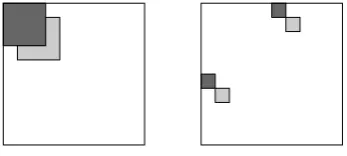
The key observation is that, unlike the case of HFE in which removing one equation in general increases the Q-rank by one, since the quadratic form asso-ciated with the central map is so sparse, the removal of one equation in general increases the rank bytwo. To see this, note that the coefficients of the quadratic form associated with HFE are restricted to a square submatrix whose size is typically the Q-rank of the map. A codimension one projection allows these co-efficients to bleed into another row and column, which increases the size of the square by one. In contrast, the size of the smallest square containing the nonzero values in the quadratic form of the EFLASH central map is usually much larger than the Q-rank of EFLASH; in fact, the codimension one projection can pro-duce two elements in original rows and columns, see Figure 1.
Fig. 1. The shape of the matrices representing the central maps of HFE- and C∗−. The darkly shaded regions represent nonzero values of the central map without the minus modifier, the lightly shaded regions represent new nonzero values introduced by the removal of one equation. Unshaded areas have coefficients of zero.
Thus, the central map of EFLASH has Q-rank 2+2a. By the formula provided in [22], we compute an upper bound on the degree of regularity,
Whenq is small this bound is known to be fairly tight. The complexity of the algebraic attack on EFLASH is therefore estimated to beO n+dregdregω
, where 2≤ω≤3 is the linear algebra constant.
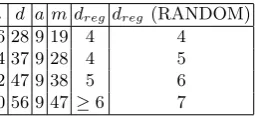
We conducted experiments on some small scale instances of EFLASH to study the behavior of the degree of regularity for values of n and m = d−a
of a similar ratio to a full sized scheme with a low decryption failure rate. The results are shown in Table 1.
n d a m dregdreg (RANDOM)
16 28 9 19 4 4
24 37 9 28 4 5
32 47 9 38 5 6
40 56 9 47 ≥6 7
Table 1. The degree of regularity of small scale EFLASH parameters in comparison to that of random systems of the same size.
The data show that the degree of regularity grows with the size of the system whenais fixed. Until the our resource permissions were limited on the machine, each sufficiently large system exhibited a degree of regularity at most one less than that of a random system. We do not have a solid theoretical argument for why the degree of regularity should be bounded thusly; however, for the sizes of schemes necessary to achieve security, the upper bound provided by (1) is already strictly less than the degree of regularity of random systems of the same size. We therefore conclude that for smallqthe bound provided by (1) is tight.
5.2 MinRank Attack
We can denote the calculations used to find our public equations P as matrix multiplications. LetF∗ibe the matrix representation of theithFrobenius power of the central mapf. Then the matrixF∗0represents our central mapf, and is
thed×dmatrix with 1’s in the (0, θ) and (θ,0) coordinates and zeros elsewhere. Matrices S and T are d×d affine maps. We can also consider π as a linear embedding from (Fq)nto (Fq)d, andτas a linear projection from (Fq)dto (Fq)m. Let σ be a primitive element of the extension, and thus {1, σ, σ2, . . . , σd−1} is a basis vector over Fq. Then mappings of φ and φ−1 can be represented as multiplication ofMd andMd−1, respectively, where
Md=
1 1 . . . 1
σ σq . . . σqd−1 ..
. ... . . . ...
σd−1σ(d−1)q . . . σ(d−1)qd−1
We can express the actions ofτ by the followingd×dmatrix,
τ∗=
Im 0m×a 0a×m 0a×a
.
Notice thatτ∗: (
Fq)d→(Fq)d. We will callP∗:=π◦S◦φ◦f◦φ−1◦T◦τ∗.
P and P∗ will be comprised of the same mpublic equations, but P∗ will then have arows of 0 appended to it.
ConsiderR=φ−1◦T◦τ∗◦φ. ThenR:Fqd→Fqdis linear. If we let (x)
e
τ=
Πr∈ker(R)(x−r), then we know by proposition 2 in [11], there exists a nonsingular linear map Re from Fqd to Fqd such that xR =xτeRe. Let Te =φ◦eτ◦Re◦φ−1.
This brings us to the following claim.
Claim 1 (x)P∗=xπ◦S◦φ◦f◦φ−1◦T◦τ∗=xπ◦S◦φ◦f◦φ−1◦Te
Proof.
π◦S◦φ◦f◦φ−1◦Te=π◦S◦φ◦f◦φ−1◦φ◦τe◦Re◦φ−1
=π◦S◦φ◦f◦τe◦Re◦φ−1 (∗)
=π◦S◦φ◦f◦R◦φ−1
=π◦S◦φ◦f◦φ−1◦T◦τ∗◦φ◦φ−1
=π◦S◦φ◦f◦φ−1◦T◦τ∗
=P∗
Now, let us reconsider (∗). We know that our public key is equivalent to (∗), so we see that
P∗=π◦S◦φ◦f◦eτ◦Re◦φ−1
=π◦S◦φ◦f◦eτ◦φ−1◦φ◦Re◦φ−1
=π◦S◦φ◦fˆ◦φ−1◦Tb
Where ˆf is our new central map and ˆf =f◦eτ andTb=φ◦Re◦φ−1. We now
considerFb∗ito be theithFrobenius power of the new central map ˆf =f◦eτ. If we
denoteh=φ◦fˆ◦φ−1, then we can find symmetric matrices (H1, . . . ,H
d)∈(Fq)d
such thathi=xHix>. As shown in [16] we see,
(H1, . . . ,Hd) = (MdFb∗0M>d, . . . ,MdFb∗(d−1)M>d)M−
1
d . (2)
If we denote the public key byP = (g1, g2, . . . , gm)>, then we can consider the symmetric matrices (G1,G2, . . . ,Gm) that correspond to the public
(G1, . . . ,Gm) = (πSMdFe∗0M>dS>π>, . . . , πSMdFe∗(d−1)M>dS>π>)M−d1Te
(3) When we consider our original central map, we saw that F∗0 has rank 2. Looking at our new central map ˆf, we see thatτeincreases the rank. If we insist that θis betweena+ 1 andd−a−1, thenFb∗0has rank 2(a+ 1), as discussed
in Section 5.1.
Notice that the embeddingπ: (Fq)n→(Fq)d, and the affine mapS will not
increase the rank of the right hand side of (3), so it will not affect our MinRank attack. ApplyingTbnormally does increase the rank, but it does not increase the
min-Q-rank because it just produces new linear combinations of these matrices. Using these facts and the analysis from [16] we find that we are solving the MinRank problem:
rank m−1
X
k=0
λiGi
≤2(a+ 1)
By the analysis in [25] and [26], the complexity of solving MinRank with the given parameters isO m+dreg
dreg
ω
, wheredreg is the degree of regularity of the minors system and ω is the linear algebra constant. Treating EFLASH as a special case of HFE-, we may derive the degree of regularity of the minors system from [24, Conjecture 2] by using the Q-rank in place of the sum of the logarithm of the degree bound and the number of equations removed . Then we may estimate that the degree of regularity of the minors system isdreg = 2a+ 3.
5.3 Discrete Differential Attack
In [11], it is shown that almost all parameters of PFLASH are secure against differential adversaries. The proof relies on the fact that the corank of the pro-jection is relatively small. Since EFLASH uses a corank d−n projection, the security proof does not apply and so we must use other arguments.
By the symmetric argument to that of [24, Lemma 2], we can express our projection πunder the appropriate basis as a polynomial in Kof degree qd−n.
Thus, the central quadratic form can be considered a quadratic form in the
d−n “variables” π(x)qi, for 0 ≤ i ≤ d−n. In characteristic two, there are at least as many linearly independent quadratic monomials as in GF(2); thus, there are at least d−n2+1
linearly independent quadratic monomials inπ(x)qi, for 0≤i≤d−noverK.
We expect that the locus of stabilizing pairs of matrices is zero-dimensional overK, though it is necessarily positive dimensional overFqsince scalar multiples induce symmetry for any map. We performed experiments and found that the solution space was zero-dimensional over Kin all cases. We conclude that the
6
Parameter Selection
In choosing parameters for EFLASH, we need to consider security against the direct algebraic attack, the MinRank attack, and fault attacks exploiting de-cryption failure. We address the constraints each of these attacks places on pa-rameters, as well as efficiency concerns.
The complexity of both the direct attack and the MinRank attack is directly related to the Q-rank of the public key. In the case of very small fields, such as GF(2), the degree of regularity is little larger than the Q-rank, 2a+ 2; thus, several equations must be removed to achieve security. Over GF(2), each increase in a doubles decryption time while making the direct attack approximately n
times harder and the MinRank attack approximately 2mtimes harder.
To address decryption failures, we note that the probability estimate of Sec-tion 4 is approximately q2n−2m. We set an reasonable bound 2−B on the prob-ability of decryption failure and may setm=n+2lgB(q) to achieve this bound.
For larger q, the MinRank attack seems to be the most concerning. For efficiency reasons, it is impractical to have a largea; therefore, an instance with large q is vulnerable to MinRank. For this reason, we recommend the choice
q= 2 withaandn sufficiently large to resist the algebraic attack. Our specific parameter selections for classical security levels are summarized in Table 2.
Scheme Security Public Key B Enc. (ms) Dec. (ms) Dec. Failure EFLASH(2,80,101,5) 80-bit 38892 0.7 194 2−32 EFLASH(2,134,159,9) 128-bit 169613 1.3 12758 2−32 Table 2.Parameters and performance of EFLASH(q, n, d, a) at the 80-bit and 128-bit classical security levels.
In principle, Grover search should affect the security of these schemes, but at this time we are not aware of a result that indicates a Grover search would be feasible for such large parameters. It is possible that Grover search could halve the dimension of the preimage search space. Thus, we may have to roughly double the size of the plaintext. To protect against the possible threat of Grover search we consider the parameter selections shown in Table 3.
On the other hand, we may consider the possibility of the cryptosystem being implemented on a quantum device so that the search step in decryption may be Groverized. Therefore Grover’s algorithm may, in fact, improve efficiency.
7
Conclusion
In this paper we propose a new multivariate encryption scheme, EFLASH, de-rived from the lineage of PFLASH. One can view EFLASH as a parameterized projectedC∗− scheme, where the projectionπmay be viewed as an embedding that maps from a smaller field to a much larger field. Thus, EFLASH follows the recent trend of achieving encryption with injective expansion maps.
EFLASH inherits some of the solid security justification from it digital sig-nature forebear, PFLASH, though some of the security arguments are weakened by the massive cokernel of the projection. Still, the analysis of the security of EFLASH against each of the primary modes of attack on big field schemes is straightforward and encouraging. In this sense, it makes sense to consider the scheme as a sort of “standard candle” for the advancement of big field multivari-ate cryptanalysis. If EFLASH is to be broken, it seems that new a new technique will need to be discovered.
References
1. Cryptographic Technology Group: Submission requirements and evaluation cri-teria for the post-quantum cryptography standardization process. NIST CSRC (2016) http://csrc.nist.gov/groups/ST/post-quantum-crypto/documents/call-for-proposals-final-dec-2016.pdf.
2. Tao, C., Diene, A., Tang, S., Ding, J.: Simple matrix scheme for encryption. In Gaborit, P., ed.: PQCrypto. Volume 7932 of Lecture Notes in Computer Science., Springer (2013) 231–242
3. Porras, J., Baena, J., Ding, J.: Zhfe, a new multivariate public key encryption scheme. [27] 229–245
4. Yasuda, T., Sakurai, K. In: A Multivariate Encryption Scheme with Rainbow. Springer International Publishing, Cham (2016) 236–251
5. Moody, D., Perlner, R.A., Smith-Tone, D.: An asymptotically optimal structural attack on the ABC multivariate encryption scheme. [27] 180–196
6. Moody, D., Perlner, R.A., Smith-Tone, D. In: Key Recovery Attack on the Cubic ABC Simple Matrix Multivariate Encryption Scheme. Springer (2017)
7. Moody, D., Perlner, R.A., Smith-Tone, D.: Improved attacks for characteristic-2 parameters of the cubic ABC simple matrix encryption scheme. [28] 255–271 8. Cabarcas, D., Smith-Tone, D., Verbel, J.A.: Key recovery attack for ZHFE. [28]
289–308
9. Perlner, R.A., Petzoldt, A., Smith-Tone, D. In: Total Break of the SRP Encryption Scheme. Springer, In press. (2017)
10. Patarin, J., Goubin, L., Courtois, N.: C*-+ and HM: variations around two
schemes of t. matsumoto and h. imai. In Ohta, K., Pei, D., eds.: Advances in Cryptology - ASIACRYPT ’98, International Conference on the Theory and Ap-plications of Cryptology and Information Security, Beijing, China, October 18-22, 1998, Proceedings. Volume 1514 of Lecture Notes in Computer Science., Springer (1998) 35–49
12. Patarin, J., Goubin, L., Courtois, N.: Improved algorithms for isomorphisms of polynomials. In Nyberg, K., ed.: Advances in Cryptology - EUROCRYPT ’98, International Conference on the Theory and Application of Cryptographic Tech-niques, Espoo, Finland, May 31 - June 4, 1998, Proceeding. Volume 1403 of Lecture Notes in Computer Science., Springer (1998) 184–200
13. Patarin, J.: Hidden Fields Equations (HFE) and Isomorphisms of Polynomials (IP): Two New Families of Asymmetric Algorithms. In: EUROCRYPT. (1996) 33–48
14. Berlekamp, E.R.: Factoring polynomials over large finite fields. Mathematics of Computation24(1970) pp. 713–735
15. Kipnis, A., Shamir, A.: Cryptanalysis of the hfe public key cryptosystem by re-linearization. Advances in Cryptology - CRYPTO 1999, Springer 1666 (1999) 788
16. Bettale, L., Faug`ere, J., Perret, L.: Cryptanalysis of hfe, multi-hfe and variants for odd and even characteristic. Des. Codes Cryptography69(2013) 1–52
17. Daniels, T., Smith-Tone, D.: Differential properties of the HFE cryptosystem. [27] 59–75
18. Chen, M.S., Yang, B.Y., Smith-Tone, D.: Pflash - secure asymmet-ric signatures on smart cards. Lightweight Cryptography Workshop 2015 (2015) http://csrc.nist.gov/groups/ST/lwc-workshop2015/papers/session3-smith-tone-paper.pdf.
19. Hashimoto, Y.: Cryptanalysis of multi-hfe. IACR Cryptology ePrint Archive2015
(2015) 1160
20. Dubois, V., Fouque, P.A., Shamir, A., Stern, J.: Practical Cryptanalysis of SFLASH. In Menezes, A., ed.: CRYPTO. Volume 4622 of Lecture Notes in Com-puter Science., Springer (2007) 1–12
21. Shamir, A., Kipnis, A.: Cryptanalysis of the oil & vinegar signature scheme. CRYPTO 1998. LNCS1462(1998) 257–266
22. Ding, J., Kleinjung, T.: Degree of regularity for HFE-. IACR Cryptology ePrint Archive2011(2011) 570
23. Patarin, J.: Cryptoanalysis of the Matsumoto and Imai Public Key Scheme of Eurocrypt’88. In Coppersmith, D., ed.: CRYPTO. Volume 963 of Lecture Notes in Computer Science., Springer (1995) 248–261
24. Vates, J., Smith-Tone, D.: Key recovery attack for all parameters of HFE-. [28] 272–288
25. Bardet, M., Faugere, J.C., Salvy, B.: On the complexity of gr¨obner basis compu-tation of semi-regular overdetermined algebraic equations. In: Proceedings of the International Conference on Polynomial System Solving. (2004)
26. Bardet, M., Faug´ere, J., Salvy, B., Yang, B.: Asymptotic behaviour of the degree of regularity of semi-regular polynomial systems. Proc. of MEGA 2005, Eighth International Symposium on Effective Methods in Algebraic Geometry (2005) 27. Mosca, M., ed.: Post-Quantum Cryptography - 6th International Workshop,
PQCrypto 2014, Waterloo, ON, Canada, October 1-3, 2014. Proceedings. Volume 8772 of Lecture Notes in Computer Science., Springer (2014)
A
Toy Example
We illustrate our scheme by presenting a toy example. We generate public and private keys and perform a decryption. For simplicity, we consider linear, as opposed to affine, transformations.
A.1 Public and Private Key Generation
Let q = 2, n = 4, d = 8 and a = 2. We construct the degree d extension field K=F2[x]/
x8+x4+x3+x2+ 1. We randomly select theC∗ monomial
f(x) = x25+1. We next randomly select the invertible transformation T and embeddingU:
T =
1 0 1 1 1 0 1 0 0 1 0 1 0 1 1 1 1 1 0 0 0 0 0 0 0 1 1 0 1 1 0 1 0 0 1 0 0 1 0 1 1 0 0 0 0 1 1 1 0 1 0 1 1 1 1 0 0 0 0 1 1 1 0 1
, andU =
0 1 1 0 1 0 0 1 0 1 1 1 0 0 0 0 1 0 1 1 1 0 1 0 1 0 1 0 0 0 0 0
.
We fixΠ : F8q → F6q, the projection onto the first 6 coordinates. Then the public keyP =Π◦T◦φ−1◦f◦φ◦U in symmetric matrix form overFq is given by:
P1=
0 0 0 1 0 0 0 0 0 0 0 1 1 0 1 0
,P2=
1 0 1 1 0 1 0 0 1 0 0 1 1 0 1 0
,P3=
0 1 0 1 1 0 1 0 0 1 1 0 1 0 0 1
,
P4=
0 1 1 1 1 0 0 1 1 0 0 0 1 1 0 0
,P5=
0 0 1 1 0 1 0 1 1 0 0 1 1 1 1 0
,P6=
0 0 1 1 0 0 1 0 1 1 0 0 1 0 0 0
.
We note thatP has some linear terms that can be found on the diagonals of the public matrices.
The plaintextxand the output,v, ofφ−1◦f◦φ◦U are related by linearization equations due to the relation
where u = φ(U x) and v = φ(v). Given our choice of basis we generate these linearization equations, written here in matrix form:
L1=
1 1 1 1 1 1 0 1 0 0 0 0 1 0 1 0 1 0 1 1 0 1 1 0 1 1 0 0 0 0 1 0
,L2=
1 1 1 1 0 0 1 1 1 0 1 0 0 0 0 0 1 1 1 0 0 0 1 1 0 1 1 1 1 1 1 0
,L3=
1 0 0 1 0 0 1 1 1 0 0 1 0 0 1 0 1 0 0 0 0 0 1 1 0 0 1 0 1 1 0 1
,
L4=
1 1 0 0 0 1 1 1 1 1 1 0 1 1 0 1 1 1 0 1 1 1 1 0 1 1 1 1 0 1 0 1
,L5=
0 0 0 0 1 1 0 1 0 0 1 0 1 0 0 0 0 1 1 1 0 1 0 1 1 0 0 1 1 1 0 1
,L6=
0 0 0 0 0 1 1 1 0 1 1 1 1 1 0 1 0 0 1 0 1 1 1 1 0 1 0 1 1 1 1 1
,
L7=
1 1 0 0 1 0 0 0 1 1 0 0 1 0 0 1 1 1 1 1 0 0 1 1 0 1 1 1 1 1 1 1
,L8=
1 1 1 1 1 0 0 0 1 0 0 0 1 0 0 0 0 1 0 1 1 1 1 1 0 1 0 0 0 1 1 1
.
A.2 Encryption and Decryption
Encryption is accomplished by evaluating the public key at the ciphertext. We randomly choose a plaintext
x=0 1 1 0.
Computing (x)P we obtain the ciphertext
y=
0 1 0 0 1 1
.
Decryption is accomplished by first appending a random suffix onyto form
y0, applyingT−1, and then solving the linear system defined by the linearization equations. Our first attempt appends the zero vector toy. Thus
y0=
0 1 0 0 1 1 0 0
.