ABSTRACT
GARDNER, GRANT EAN. Biotechnology Risks and Benefits: Science Instructor Perspectives and Practices. (Under the direction of M. Gail Jones.)
Developing scientifically literate students who understand the socially contextualized nature of science and technology is a national focus of science education reform.
Understanding teachers’ views on this topic is of equal importance. This document focuses on the topic of risks and benefits posed by science and technology as an important topic for which the socially contextualized nature of science and technology readily emerges.
Following introduction of a theoretical model and a review of the literature, two research studies are described that examined teachers’ perceptions of the risks posed by biotechnology and the role of risk topics in an undergraduate science course.
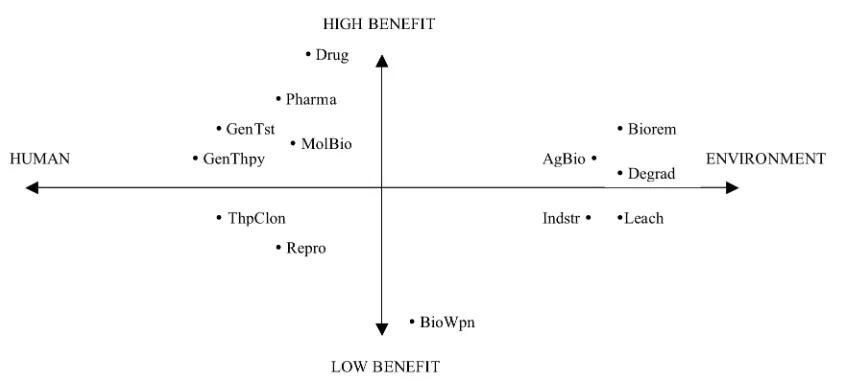
The first research study examines four groups of science educators; pre-service science teachers, in-service science teachers, science graduate teaching assistants, and science professors (n = 91). The participants completed a survey and card sort task to determine their perceptions of the risks of biotechnology. The results show that teacher perceptions were shaped by the risk severity, regulation processes, public acceptance, fear, reciprocal benefits, and whether the applications would impact humans or the environment. Factors determining risk perception included personal worldviews, trust in communicating institutions, and personal experiences with biotechnology. The different types of science teachers were compared and contrasted in light of these factors and the implications of instructor perceptions on science pedagogy are discussed.
Biotechnology Risks and Benefits: Science Instructor Perspectives and Practices
by
Grant Ean Gardner
A dissertation submitted to the Graduate Faculty of North Carolina State University
In partial fulfillment of the requirements for the degree of
Doctor of Philosophy
Science Education
Raleigh, North Carolina 2009
APPROVED BY:
_______________________________ ______________________________
Dr. M. Gail Jones Dr. James Minogue
Committee Chair
________________________________ ______________________________
BIOGRAPHY
Grant was born in Corpus Christi, Texas on November 21st, 1978 and has lived a nomadic lifestyle with residences in Texas, Ohio, Pennsylvania, New Jersey, Germany, Tennessee, and North Carolina. Although he currently considers North Carolina home, he will always be a Texan at heart.
ACKNOWLEDGMENTS
To my committee chair and mentor Dr. Gail Jones: Thank you for knowing what I needed to do to better myself as an academic and as a researcher when I often was not aware of it myself. Your support, leadership, and (most of all) patience have given me the
confidence to find my niche.
To my committee: Dr. Eric Wiebe, thank you for challenging me to go places with my thinking and writing that were sometimes uncomfortable but always made me learn something new. Dr. Miriam Ferzli, thank you for knowing where I am coming from and where I want to go, and doing what was needed to help me get there. Dr. James Minogue, thank you for being willing to come in at the bottom of the ninth to help out. Dr. Meg Blanchard, thank you for being a steadying voice among the chaos.
To our research group: Dr. Amy Taylor, Jennifer Forrester, Laura Robertson, and Denise Krebs, you all made the journey through this doctoral degree worth it. Thanks for running the race with me.
To others who helped move this research along: Thanks go to Dr. Nietfeld who helped in designing and refining many of the instruments in this study. Thanks also go to Patty Aune who was integral in organizing and preparing my entry into the biology laboratories.
TABLE OF CONTENTS
LIST OF TABLES ... vi
LIST OF FIGURES ...vii
INTRODUCTION. RISK, SCIENCE, AND TECHNOLOGY EDUCATION ... 1
Science, Technology, and Society ... 2
STS and Risk Perception ... 3
Document Context and Organization ... 8
References ... 10
BACKGROUND. RESEARCH TRENDS IN RISK PERCEPTION OF SCIENCE AND TECHNOLOGY ... 13
Introduction ... 14
Defining Risk ... 15
Risk Research Frameworks ... 18
The Psychometric Paradigm ... 19
History and Theory ... 19
Assumptions and Limitations ... 27
Cultural Theory ... 28
History and Theory ... 28
Assumptions and Limitations ... 32
Integrated Approaches ... 33
Conclusions and Implications ... 34
References ... 36
RESEARCH STUDY I. SCIENCE INSTRUCTORS’ RISK PERCEPTION OF BIOTECHNOLOGY: IMPLICATIONS FOR SCIENCE INSTRUCTION ... 43
Introduction ... 44
Attitudes and Risk Perception ... 46
Risk Perception and Biotechnology ... 48
Students Studying Science Content ... 49
Science Teachers ... 50
Risk Perception Research Frameworks ... 51
Psychometric Paradigm ... 52
Cultural Theory ... 54
Study Description ... 56
Participants ... 57
Instruments ... 59
Data Analysis ... 64
Risk Perception ... 64
Results ... 66
Risk Perception ... 66
Factors Contributing to Risk Perception ... 73
Discussion ... 81
Implications for Science Education ... 88
References ... 90
Appendices... 98
Appendix A. Teacher Risk Perception Survey ... 99
Appendix B. Card Sort Items ... 105
RESEARCH STUDY II. GRADUATE TEACHING ASSISTANTS AND THE RISKS AND BENEFITS OF BIOTECHNOLOGY: PRACTICE AND PERSPECTIVES ... 106
Introduction ... 107
GTAs and STS ... 108
Methods ... 111
Contexts and Participants ... 111
Instructional Content ... 112
Data Collection ... 113
Data Analysis ... 114
Results ... 115
Instructional Frames ... 115
Interview Themes ... 119
Discussion ... 126
References ... 130
Appendices... 134
Appendix A. Outline Format of Power-Point Lecture Template ... 135
LIST OF TABLES
Table 2.1 Common hazard attributes used in the psychometric paradigm ... 20
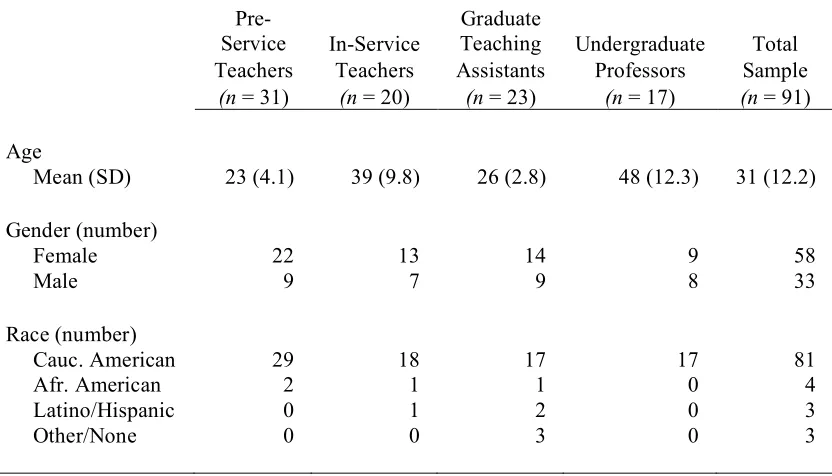
Table 3.1 Demographic information of science educator participants ... 58
Table 3.2 General risk perception index comparisons ... 60
Table 3.3 Survey items corresponding to cultural theory worldviews ... 62
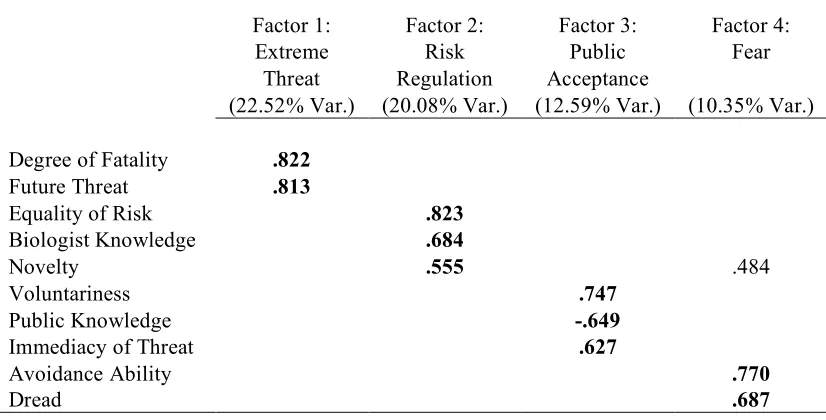
Table 3.4 Varimax rotated factor matrix of the psychometric dimensions ... 67
Table 3.5 Mean scores on each of the psychometric risk factors ... 68
Table 3.6 Cultural theory results by instructor sample ... 74
Table 3.7 Examples of risk decision making factors ... 76
Table 3.8 Examples of use of trust in decision making ... 78
Table 3.9 Correlations of demographic variables with general risk perception index ... 80
Table 3.10 Relationship of psychometric variables to Savadori et al. (2004) study ... 83
Table 4.1 Demographic information for participants ... 112
LIST OF FIGURES
Figure 1.1 A model of factors influencing risk perception in the context of
science-technology and society issues ... 7
Figure 2.1 Factors showing hazard formation and human reactions to risk ... 17
Figure 2.2 A personality profile of X-rays and nuclear power using the psychometric paradigm ... 21
Figure 2.3 Location of food hazard risks along a perceptual space ... 23
Figure 2.4 The grid-group space defining the four worldviews of cultural theory ... 30
Figure 3.1 Grid and group dimensions forming the worldview categories of cultural theory ... 55
Figure 3.2a Multidimensional scaling plot for pre-service science teachers ... 70
Figure 3.2b Multidimensional scaling plot for in-service science teachers ... 70
Figure 3.2c Multidimensional scaling plot for graduate teaching assistants ... 71
INTRODUCTION
Science, Technology, and Society
The pursuit of scientific and technological innovation has a long history in American
culture. For example, breakthroughs in military technology applicable to civilian life have
arisen during our nations’ global conflicts. More recently, the United States has been at the
forefront of research and development in information technology as well as in areas of
health-care and pharmaceuticals. Scaffolding and maintaining national interest in innovative
science and technology are science educators at all levels who have the responsibility of
preparing informed citizens to participate and work in modern society (DeBoer, 1991).
Research and development in science and technology continues to advance at an
exponential rate. Many of these technologies are considered “emergent” in that much of the
theoretical science behind them is understood but practical applications are either limited or
are still in the process of development. Some examples of current emergent technologies
include advances in nanotechnology, information technology, and biotechnology (Trefil,
2008).
The novelty of emergent technologies means that many of the greater impacts of
derived applications on society are uncertain (ESTO, 2001). Scientific uncertainty can result
in public opposition to development of new technologies, largely due to a lack of personal
knowledge or heightened fear surrounding human health risks (Slovic, Fischoff, &
Lichtenstein, 1979). For example, genetically modified (GM) foods have met with opposition
in the United Kingdom despite expert reassurance of their safety (Gaskell, Bauer, Durant, &
of emergent technologies in order to prepare future citizens for public participation in this
critical discourse?
In order to negotiate the complex challenges posed by the development of emergent
technologies, future citizens need a certain level of science literacy. Promotion of science
literacy has been recognized as a goal of formal science education that should be nurtured as
early as possible (Bybee, 1997; Trefil, 2008). However, definitions of science literacy remain
a source of vigorous debate (Roberts, 2007). Trefil (2008) offers a definition for science
literacy as, “the matrix of knowledge needed to understand enough about the physical
universe to deal with issues that come across our horizon, in the news or elsewhere (p. 28).”
Although broad, this definition is intuitively appealing and will be the conceptualization used
for the remainder of this discussion.
STS and Risk Perception
In the context of emergent science and technology, student understanding of the
interactions of science-technology-society (STS) is one component of science literacy that
could be especially relevant. In its simplest form, objectives of STS curricula involve an
understanding of the interactions of science and technology within a social context.
Aikenhead (1994) describes STS approaches as those that focus on:
[A] technological artifact, process or expertise; the interaction between technology
and society; a societal issue related to science or technology; social science content
that sheds light on a societal issue related to science and technology; a philosophical,
A mature understanding of issues in STS requires not only an understanding of the relevant
content and theory, but also of the nature of science and technology and the science processes
required to produce the technology (Hodson, 1988). This is not to imply that understanding
issues of STS are more important than ideas such as the nature of science and technology in
general. The interaction and importance of these concepts is admittedly complex within the
greater framework of science literacy.
One of the primary objectives of STS education is to evoke positive affective
responses in students to science and technology. By highlighting the relevance of science and
technology to students’ daily lives, the argument is that students will develop more positive
attitudes toward STS issues (Bennett, Lubben, & Hogarth, 2007). Attitudes can be broadly
defined as the degree of positive or negative emotive or behavioral responses toward a
particular object or event. The magnitude and direction of an attitude can affect intentions,
behavioral responses, and decision-making regarding STS issues (Dawson & Soames, 2006).
Outside of the classroom, one of the most prevalent STS contexts that students
encounter related to emergent technologies is the risk to society posed by their development.
This is often the focus of the popular news media (Jarman & McClune, 2007). Risks of
emergent technologies can be directed toward human health, the environment, cultural
worldviews, and numerous other foci. Both the Benchmarks for science literacy (AAAS,
1993) and the National science education standards (NRC, 1996) suggest that students
should learn about risk, risk analysis, the need for trade-offs among risks and benefits,
decision-making. For example, the Benchmarks for science literacy (AAAS, 1993) section
discussing the nature of technology suggests that high school students should:
… realize that analyzing risk entails looking at probabilities of events and at how bad
the events would be if they were to happen. Through surveys and interviews, students
can learn that comparing risks is difficult because people vary greatly in their
perception of risk, which tends to be influenced by such matters as whether the risk is
gradual or instantaneous (global warming versus plane crashes), how much control
people think they have over the risk (cigarette smoking versus being struck by
lightning), and how the risk is expressed (the number of people affected versus the
proportion affected) (section 3.B).
These goals are further supported by both risk (Biscoe, 1992) and education researchers
(Riechard, 1993) who call for a focus on risk literacy in public education.
In the formation of attitudes toward emerging technologies, understanding issues of
risk and how they might be perceived are extremely important (Sjöberg, 2002). Risk
perception is a broad concept that refers to how individuals choose to process and interpret
information about risk. Constructing perceptions about the risks surrounding the research and
development of emergent technologies is one of the critical factors in swaying attitudes in
one direction along the positive-negative continuum. For example, if you perceive an
application as particularly risky to your health or the health of your family your attitude
toward that application will be affected. Additionally, individuals have been found to form
generalized attitudes about science and technology that are consistent across science contexts
even when considering issues that they know very little about (Cobb & Macoubrie, 2004;
avoidance of products, managing personal and social risks, information seeking behavior,
and willingness to participate in discourses and decision making about risk issues.
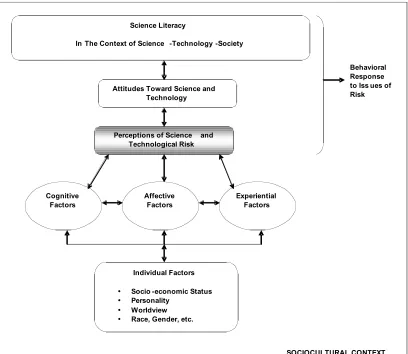
The perception of risks associated with science and technology can be influenced by
numerous factors (Sjöberg, 2008). In response to this complexity, a model developed by the
researchers is presented below. Factors directly contributing to perceptions of science and
technological risk can be broadly delineated into cognitive, affective, and experiential
(Figure 1.1). These are the lenses through which individuals filter issues of risk and which
shape their perceptions. These factors are not independent; each one affects and mediates the
others. Cognitive factors refer to the ways that individuals use conscious thought to mentally
manipulate information. Examples of cognitive factors include how individuals rationally
deal with factual information or their reflective judgment about controversial issues. Affective
factors are emotional and visceral responses to risk such as fear associated with a particularly
tragic incident (i.e. the 911 attacks). Finally, experiential factors are the personal interactions
that individuals have had with science and technology, including formal education. All of
these factors are dynamic, in that they are variable between contexts and across time (they
have a developmental component) and exist within a larger sociocultural context.
The perception of the risks associated with science and technology are also
constrained by individual factors. Sociocultural characteristics such as personality,
worldview, gender, race and socio-economic status all limit how an individual views
information through the cognitive, affective, and experiential lenses. To extend a metaphor,
risk perception is the construction and interpretation of risk information much like visual
constrained by both individual genetic and cultural factors that shape the ability of the
receiving organ to accept this information.
!
Science Literacy
In The Context of Science -Technology -Society
Attitudes Toward Science and Technology
Perceptions of Science and Technological Risk
Behavioral Response to Iss ues of Risk
Cognitive Factors
Affective Factors
Experiential Factors
Individual Factors
• Socio -economic Status
• Personality
• Worldview
• Race, Gender, etc.
SOCIOCULTURAL CONTEXT
Document Context and Organization
Few studies examine students’ understanding and perceptions of the risks of science
and technology specifically (Covitt, Gomez-Schmidt, & Zint, 2005; Gardner et al., 2008),
although some have evaluated attitudes from a general perspective (Lamanauskas &
Makarskaité-Petkeviciené, 2008; Prokop, Leskova, Kubiatko, & Diran, 2007; Sáez, Niño, &
Carretaro, 2008). In addition, there are no known studies that specifically examine teachers’
perceptions of the risks of science and technology. An understanding of instructors’ risk
perceptions is important, because reflective knowledge of this topic will likely influence their
beliefs about the social intersection of emergent science and technology as well as their
subsequent pedagogical practice when addressing STS themes. The following study has two
goals: (a) assess the risk perception of an emergent technology (biotechnology) of various
groups of science educators, and (b) examine how a specific group of science teachers
(science graduate teaching assistants) view the role of risk in the teaching of STS-related
issues.
The document that follows is organized into three chapters addressing the research
conducted in partial fulfillment of requirements for a doctorate in Science Education. The
first chapter provides an overview of research in the risk perception of science and
technology and is intended to provide the reader with a global view of the frameworks
utilized in the study. The discussion covers the history and usage of risk research frameworks
in the context of science and technology and further provides a justification for their use in
The second chapter consists of a research manuscript that describes phase one of the
dissertation research in which four samples of science educators (pre-service science
teachers, in-service science teachers, biology graduate teaching assistants, and undergraduate
professors of biology) were surveyed to determine their perceptions of the risks of
biotechnology. Quantitative and qualitative data were analyzed using established risk
perception frameworks to understand what aspects of biotechnology instructors found
particularly risky and what factors might explain these formed perceptions. Differential risk
perception is compared and contrasted for the four teacher groups as well. Implications of
teacher perceptions and attitudes toward the teaching of emergent are discussed.
The third chapter is a research manuscript that details phase two of the study. In this
phase, biology graduate teaching assistants were provided with a lecture outline regarding
genetically modified crops and their potential social and environmental risks and benefits.
Data sources consisted of teacher observations and post-lecture semi-structured interviews.
An interpretive approach was used to analyze the qualitative data sources. Topics of concern
References
Aikenhead, G. (1994). What is STS teaching? In J. Solomon & G. Aikenhead (Eds.), STS
education: International perspectives on reform. New York, NY: Teachers College
Press.
American Association for the Advancement of Science (AAAS). (1993). Benchmarks for
science literacy. New York, NY: Oxford University Press.
Bennett, J., Lubben, F., & Hogarth, S. (2007). Bringing science to life: A synthesis of the
research evidence on the effects of context-based and STS approaches to science
teaching. Science Education, 91, 347-370.
Biscoe, G. J. (1992). Need for risk standards and education. Risk Analysis, 12, 331.
Bybee, R. W. (1997). Achieving scientific literacy—from purpose to practices. Portsmouth,
NH: Heinemann.
Cobb, M. D., & Macoubrie, J. (2004). Public perceptions about nanotechnology: Risks,
benefits, and trust. Journal of Nanoparticle Research, 6, 395-405.
Covitt, B. A., Gomez-Schmidt, C., & Zint, M. T. (2005). An evaluation of the risk education
module. Journal of Environmental Education, 36(2), 3-13.
Dawson, V. & Soames, C. (2006). The effect of biotechnology education on Australian high
school students’ understanding and attitudes about biotechnology processes. Research
in Science & Technological Education, 24, 183-198.
DeBoer, G. E. (1991). A history of ideas in science education: Implications for practice. New
ESTO. (2001). On science and precaution in the management of technological risk. In A.
Stirling (Ed.), European Commission Joint Research Center and European Science
and Technology Observatory (EUR 19056/EN/2).
Gardner, G. E., Jones, M. G., Taylor, A. R., Forrester, J. H., Krebs, D., & Robertson, L.
(2008). Undergraduate engineering students’ perceptions of the risks and benefits
associated with nanotechnology. Manuscript submitted for publication.
Gaskell, G., Bauer, M. W., Durant, J., & Allum, N. C. (1999). Worlds apart? The reception
of genetically modified foods in Europe and the U.S. Science, 285, 384-387.
Hodson, D. (1988). Toward a philosophically more valid science curriculum. Science
Education, 72, 19-40.
Jarman, R., & McClune, B. (2007). Developing scientific literacy: Using news media in the
classroom. New York, NY: Open University Press.
Lamanauskas, V., & Makarskaité-Petkeviciené, R. (2008). Lithuanian university students’
knowledge of biotechnology and their attitudes toward the taught subject. Eurasia
Journal of Mathematics, Science, & Technology Education, 4, 269-277.
National Research Council (NRC). (1996). National science education standards.
Washington, DC: National Academy Press.
Prokop, P., Leskova, A., Kubiatko, M., & Diran, C. (2007). Slovakian students’ knowledge
and attitudes toward biotechnology. International Journal of Science Education, 29,
Riechard, D. E. (1993). Risk literacy: Is it the missing link in environmental education?
Journal of Environmental Education, 25(1), 8-12.
Roberts, D. A. (2007). Scientific literacy/science literacy. In S. K. Abell & N. G. Lederman
(Eds.) Handbook of research on science education (pp. 729-780). Mahwah, NJ:
Lawrence Erlbaum Associates.
Sáez, M. J., Niño, A. G., & Carretero, A. (2008). Matching society values: Students’ views of
biotechnology. International Journal of Science Education, 30, 167-183.
Sjöberg, L. (2002). Attitudes toward technology and risk: Going beyond what is immediately
given. Policy Sciences, 35, 379-400.
Sjöberg, L. (2008). Genetically modified food in the eyes of the public and experts. Risk
Management, 10, 168-193.
Slovic, P., Fischoff, B., & Lichtenstein, S. (1979). Rating the risks. Environment, 21(3),
14-20, 36-39.
BACKGROUND
Introduction
On a daily basis, individuals make a multitude of seemingly unimportant and often
unconscious decisions about the risks and benefits of their actions. In a somewhat satirical
introduction to his manuscript, Wilson (1979) states, “from the moment I climb out of bed I
start taking risks” (p. 41). He then proceeds to analyze risk decisions that he makes in a
single day: from turning on a light in his house (risk of electrocution due to out-dated wiring)
to his choice of drinking water (risk of chloroform poisoning due to hyper-concentration of
anti-microbial chlorine). The conclusion is apparent: risk is ubiquitous and unavoidable, yet
individuals frequently take for granted many of the common risks associated with day-to-day
life.
People typically notice low probability/high consequence (LP/HC) risks. Many of
these LP/HC hazard concerns are applications associated with science and technology. For
example, risks associated with the fracturing of nuclear reactors or a toxic chemical spill in a
populated area are examples that spark conversation and gain media attention much more
than the risk of death from a single automobile accident (Waller & Covello, 1984). In
addition, the media often features risks and benefits of emergent technologies as important to
the discourse of innovative science (Jarman & McClune, 2007).
The science supporting emergent technologies is often uncertain because of a lack of
extensive longitudinal research. The general public tends to view uncertainty with fear, and
fear garners people’s attention. Examples of emergent research that people view as risky due
to high levels of uncertainty include carbon capture and storage technology, genetically
consequence events and the uncertainty associated with emergent science and technology
monopolize the publics’ attention? The challenge lies in understanding the perception of risk
of emergent science and technology.
Defining Risk
In order to better understand the construct of risk, it is necessary to define the term
“hazard” which refers to negative or undesired impacts of a particular event (Wachbroit,
1991). Risk is defined as the probability or likelihood of the occurrence of a hazard. This
scientific-technical or rationalist perspective numerically quantifies risk through values, such
as the number of people the hazard effects or thresholds of toxicity for particular harmful
agents (Renn, 1992). Depending on the hazard, these numbers can vary dramatically.
The earliest attempt to algorithmically quantify risk in the context of science and
technology occurred in the WASH-1400 Reactor Safety Study (1975) that examined the
probabilistic risk of a nuclear power plant accident occurring in the United States. The
simplistic equation that emerged from the study is shown below:
The first variable in this algorithm refers to the probability of occurrence of a particular
hazard. The second variable refers to the severity of the hazard measured in some quantity
heuristic, this two-dimensional definition of risk is nothing more than a simplification for a
construct that is in reality multi-dimensional (Kaplan & Garrick, 1981).
To further complicate the definition, a rationalist perspective is only one way to
define risk within a sociocultural context. For example, why are there more people afraid to
fly than drive when data shows auto accidents kill far more people than plane crashes every
year? This has to do with how people use and interpret numerical risk data. Individuals do
not necessarily use technical probabilities as the most relevant information in
decision-making regarding issues of risk, but instead often rely on cognitive short-cuts (heuristics) and
biases born of personal experience and other cognitive and affective factors (Tversky &
Kahneman, 1974). According to Slovic, Fischoff, and Lichtenstein (1979), “the hard facts
only go so far and then human judgment is needed to interpret the findings and determine
their relevance for the future (p. 14).”
Morgan (1981) proposed a model built on this more comprehensive definition of risk
(Figure 2.1). Both human activities and natural processes can cause hazard situations. These
events are concrete and can be defined by the probability of exposure to the hazard (exposure
potential) and how that hazard will go about causing an undesired effect on the target of risk
(effects processes). For example, the probability of exposure to asbestos for some people
might be low, but the effects of this toxin on the lungs can be rapidly carcinogenic.
According to Morgan, scientifically derived realities are mediated by human perceptions and
evaluations of those probabilities. Morgan’s process model envisions risk as an interaction of
Figure 2.1: Factors showing hazard formation and human reactions to risk (Morgan, 1981).
Numerous things can effect risk perception: The nature and scale of the hazard,
whether the individual has experience with the hazard, the level of control in avoiding the
hazard, the familiarity of the hazard, and trust in the communicating institution, just to name
a few of the more important factors (Slovic et al., 1979). When individuals make decisions
about risk, numerous cultural- and value-based factors come into play in shaping their
perceptions as well. Evaluations and reactions to risk are socially constructed. For example,
the strength of one’s religious convictions may play a larger role in the perceived risk of
stem-cell technology as apposed to a quantitative evaluation.
CAUSES OF HAZARDS • Natural Processes • Human Activities
TECHNICAL REALITY OF RISK
• Exposure Potential • Effects Processes
How then is risk to be conceptualized? Is it strictly numerical and probabilistic or a
social construction of those who must evaluate its significance? Many risk researchers prefer
to envision the risk construct as lying along a continuum (Bradbury, 1989; Lupton, 1999). At
one end of the scale is a consideration of risk as purely quantifiable and at the other end is the
conceptualization of risk as a purely social construct. This becomes a useful tool depending
upon the goal of the research agenda and helps situate risk research frameworks.
Risk Research Frameworks
Renn (1992) reviewed and synthesized the common frameworks and methodologies
used in risk analysis. He classified risk frameworks in terms of their common contextual uses
and analytical methods. Those frameworks that lie mostly on the scientific-technical end of
the risk spectrum included: actuarial approaches involving methods of statistical prediction
and inferential extrapolation, epidemiological-toxicological approaches involving the
analysis of health impacts on communities, engineering approaches involving probabilistic
event analysis, and economic approaches involving cost-benefit analyses.
Those frameworks that rely more heavily on socially constructed views of risk
included: social theories involving case study analyses of complex social interactions with
and reaction to risk events, cultural theories involving grid-group analyses, and psychological
theories involving psychometric analyses. Although distinct, all of these frameworks have
1996). The psychometric paradigm of risk and the cultural theory of risk will be discussed
below.
The Psychometric Paradigm
History and Theory
The psychometric paradigm grew out of critiques of a paper by Starr (1969) who
attempted to quantify how societies decide the acceptability of risky activities. His
conclusions were as follows: a) acceptability of risk is roughly proportional to the third
power of the potential benefits, b) the general public will accept voluntary risks that are
roughly 1,000 times greater than involuntary risks if benefits are held constant, and c)
acceptability of risk is inversely proportional to the number of persons exposed. The
assumptions and generalizability of Starr’s work have been critiqued extensively (Fischoff,
Slovic, & Lichtenstein, 1979). However, limitations of these studies led to subsequent
research that attempted to quantify hazard characteristics and reveal a more complete picture
of how risk is being perceived. Some of these limitations will be discussed later in this
section.
Slovic and colleagues who developed the psychometric paradigm of risk perception,
borrowed from personality theory and asked participants to rate various qualities of hazards
along a Likert scale. Over the history of psychometric research, numerous (sometimes
upwards of 18) hazard “personality” characteristics have been identified and examined, with
the most widely used of these listed below (Table 2.1). From this data researchers quantify
psychometric analyses then allow for comparisons between various characteristics of hazards
that are often useful in determining policy decisions (Slovic et al., 1979).
Table 2.1
Common hazard attributes used in the psychometric paradigm (Slovic, 1987)
1. The degree to which the effects of the risk are delayed
2. The degree to which the risks are precisely known to those exposed 3. The degree of novelty of the risk to the community
4. The degree to which the risks are precisely known to science experts 5. The degree to which the effects of the risk are observable
6. The degree to which a risk is faced voluntarily
7. The degree of control an individual has in avoiding the risk 8. The degree of fear associated with the risk
9. The degree to which the effects of the risk will be felt globally 10. The degree to which the effects will be fatal to those exposed 11. The degree to which effects will be equitable
12. The degree to which effects will be catastrophic 13. The degree of impact of the risk to future generations 14. The degree to which the risks are easily reduced
15. The degree to which the risk is steadily increasing over time
Figure 2.2 shows the personality profile for the perception of risk of X-rays and
nuclear power (Fischoff, Slovic, Lichtenstein, Read, & Combs, 1978). The points on the
figure are based on means from aggregate data on a seven-point Likert scale survey. The
figure allows for a comparison of the sample groups’ perception of risk of the two
technologies. For example, participants deemed X-rays to pose much more chronic risks than
the catastrophic risks of nuclear power. In contrast, whether the risks are known to the
Figure 2.2: A personality profile of X-rays and nuclear power using the psychometric paradigm (Fischoff et al., 1978).
Once particular hazard attributes have been rated, the most common method of
analysis used in psychometric studies is a principle component factor analysis. It is often
found that they are inter-correlated and can, therefore, be reduced to a smaller set of
higher-order factors (Slovic, 1992). For example, Slovic (1987) found that for wide ranges of
hazards, those judged to be “controllable” also tend to be judged “voluntary” and “not
feared.” The most commonly calculated of these higher order factors are “unknown risk”
(typically including variables 1 through 5 in the Table 2.1) and “dread risk” (typically
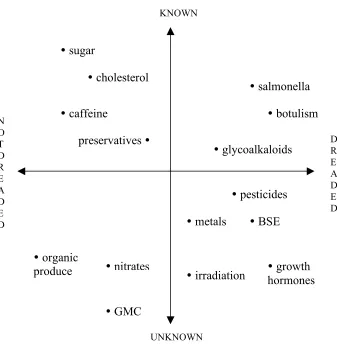
Results from psychometric studies of multiple hazards are represented as spatial or
perceptual maps using the higher-order factors as axes. Individual hazards can then be plotted
along the two-dimensional space based on the average Likert score for those higher-order
factors. As seen in the example below in Figure 2.3 (recreated from Fife-Shaw and Rowe,
1996) axis one is whether a hazard is considered known or unknown by participants. Axis
two is whether the hazard is dreaded or not dreaded. For this particular plot involving
food-related hazards, things like salmonella and botulism are considered known, but dreaded. In
contrast, risks from organic produce are considered unknown, but not particularly feared.
Perceptual maps such as these allow for a comparison of hazards and often reflect the
perceptions and attitudes of people. The factor of “dread risk” seems to be particularly
important because hazards that fall high along this axis (such as botulism and bovine
spongiform encephalopathy) tend to be the first for which individuals want protection from
the institutions that regulate their safety and distribution (Slovic, 1992). This seems intuitive,
because risk evaluations are associated with the affective response of fear. Additionally,
these perceptual maps are useful in tracking the change in group risk perceptions over time
by monitoring shifts in positions of particular hazards in the two dimensional space
Figure 2.3: Location of food hazard risks along a perceptual space (Fife-Shaw &Rowe, 1996).
Renn and Rohrmann (2000) categorize the objectives of psychometric studies into
four domains: to establish risk as a subjective concept, to validate the opinions of the general
public as important in risk considerations, to integrate technical/physical and
social/psychological attributes of risk perception criteria to decision making models, and to
agendas of risk researchers in response to scientific experts’ technical risk assessments and
their subsequent devaluing of public opinion on issues of policy.
In general, one of the major objectives of psychometric research has been to
understand the structural differences in risk perception between different samples of
individuals. Studies utilizing the psychometric paradigm have found that differences in risk
perception exist between cultures (Savadori, Rumiati, & Bonini, 1998; Slovic, 1992), races
(Flynn, Slovic, & Mertz, 1994), and genders (Gustafson, 1998). For example, men and
women tend to worry about the same aspects of risk, but men systematically worry less. This
has been explained as a result of the social construction of gender roles and how these roles
reflect the focus of concern for particular genders (Gustafoson, 1998). Although interesting,
research along this strand has not been as common in the past decade.
The most commonly emphasized difference between groups in psychometric studies
is that of science experts and what are commonly called “laypersons” (this term is not meant
to be perjorative and has become an accepted vernacular to refer to members of the general
public in this research strand).
Experts are seen as purveying risk assessments characterized as objective, analytic,
wise, and rational – based upon the real risks. In contrast, the public is seen to rely
upon perceptions of risk that are subjective, often hypothetical, emotionally foolish,
and irrational (Slovic, 1997, p. 278).
If there is an expert-lay gap in risk perception, the implications for public support of research
Many of the studies of risk are based on the assumption that an expert-lay gap exists,
but the empirical evidence needed to make this assumption is limited. In a recent manuscript,
Rowe and Wright (2001) reviewed this body of literature to answer whether the quantitative,
“differences in expert and lay judgment [are] a myth or a reality?” Areas of science and
technology addressed in this review included the areas of chemical toxicology (Kraus,
Malmfors, & Slovic, 1992; Slovic, Malmfors, Krewski, Niel, & Barlett, 1995), nuclear waste
(Barke & Jenkins-Smith, 1993; Flynn, Slovic, & Mertz, 1993), ecological aquatic toxicology
(McDaniels, Axelrod, Cavanagh, & Slovic, 1997), oil and gas production (Wright, Pearman,
& Yardley, 2000), and global climate change (Lazo, Kinnell, & Fisher, 2000). Rowe and
Wright (2001) concluded that there is not enough evidence to determine if lay and expert
perceptions of risk are truly different. They assert that limitations in research designs of
many of these studies do not allow for definitive conclusions. Furthermore, expert and lay
samples rarely are defined explicitly and demographic factors often are not controlled for.
Despite these methodological concerns, research in this strand continues with little
resolution to the debate. In a more recent study, Savadori et al. (2004) examined the
perceptions of the risks of biotechnology of fifty-eight doctoral students in biology
(considered the expert sample) as compared to fifty-eight members of the general public. The
two samples differed, with experts perceiving less risk overall from biotechnology especially
in areas of food and medical related applications. Siegrist, Keller, Kastenholz, Frey, and
Wiek (2007) examined individuals’ risk perception of nanotechnology using psychometric
scales. They concluded that several perceptual variables were similar in experts and
risky than the general public. Experts also had more trust in governing institutions to manage
nanotechnology risks equitably.
Sjöberg (2008) recently examined public and expert perceptions of genetically
modified foods (GMFs) partially within the psychometric framework. This research
differentiated between personal risk and general risk and found that experts judge personal
risk very similarly to how it is judged by the the general public. However, when the discourse
is shifted to general risk, experts seem to rely less on the subjective factors posed by the
psychometric paradigm and rely more on numerical probability and rationalistic evaluation.
An additional recent challenge to the psychometric paradigm is that it ignores “the
possibility of social, cultural and institutional factors [that] might affect the way in which
risks are understood and evaluated by individual members of the public” (Marris, Langford,
Saunderson, & O’Riordan, 1997, p. 304). When studies were conducted on individuals,
significant variability in risk perceptions appeared that are not apparent in analyses with
aggregate samples (Gardner & Gould, 1989). In other words, aggregate analyses tend to
over-estimate the similarities between members of the general public, when they are really a
widely heterogenous group. These variables included trust in the information-giving
institution or individual (Siegrist & Cvetkovich, 2000), the perceived benefits of the hazard
(Alhakami & Slovic, 1994), training in science (Karpowicz-Lazreg & Mullet, 1993),
personal experience with the hazard (Barnett & Breakwell, 2001) and numerous other
personality factors such as risk aversion (Chauvin, Hermand, & Mullet, 2007).
Studies utilizing the psychometric paradigm have confirmed that risk perception, like
framework is that it allows for the risk construct to be fragmented into more useable chunks.
These chunks can then be quantified for comparing and contrasting risk perceptions of
individuals or groups. Research has provided a deeper understanding about why experts and
the general public may perceive risks differently on issues of science and technology.
Finally, individual variability will always be present, but carefully defined sample groups and
an awareness of potentially confounding individual factors will likely limit this variability in
aggregate studies.
Assumptions and Limitations
The psychometric paradigm is based on several assumptions, not the least of which is
that individuals can provide meaningful answers to difficult questions on survey forms. The
results also depend on the hazards studied, which characteristics are ascribed to the hazards,
and the method of data analysis. Additionally, these studies assess perceptions and not
behaviors (Slovic, 1992). Finally, studies utilizing the psychometric paradigm tend to focus
on what individuals use to rate hazards and how they distribute the value along hazard
characteristics. They do not tend to examine why people have those perceptions or why they
place value on specific attributes (Renn, 1992). In other words, psychometric studies are
answering questions as to the structure of risk perception and not the factors that might cause
it.
The use of the psychometric paradigm is not without its critics. Sjöberg (2000) argues
that researchers often attribute too much interpretive power to factor analytic methods. The
intention of factor analysis is reduction of complex multi-variate data, and researchers should
many of the analyses are based on the limited number of variables initially made popular by
Starr (1969). Other additional variables (such as risks potentially perceived as immoral and
unnatural) might also be important in individuals’ assessment of risk (Slovic, 1992). Finally,
the psychometric paradigm tends to take into account mean data and not raw data and,
therefore, likely neglects much of the inherent variability that occurs between individuals.
Despite these concerns, the continuing prevalence of the psychometric paradigm in
the literature suggests that it maintains its utility as research tool for understanding how
groups and individual perceive potential science and technological risks. Modified and
updated forms of analysis have been used to examine various research strands of risk
perception of science and technological hazards.
Cultural Theory
History and Theory
As opposed to the psychometric paradigm, cultural theory approaches to risk analysis
emerged from the field of anthropology (Douglas & Wildavsky, 1982). Douglas and
Wildavsky describe attitudes and perceptions of social groups as constructed based on shared
values and beliefs (worldviews). Cultural theory is unique in drawing a distinction between
patterns of social relations and worldviews. In cultural theory analyses, possession of a
particular worldview (fatalist, hierarchist, egalitarian, and individualist) is defined by two
variables known as “grid” and “group.” These variables described below define the scope of
social interactions for individuals and are believed to influence how an individual perceives
The group variable measures the range of interactions that an individual chooses to
have in larger social units. “Weak” group individuals tend to have open-ended social
networks, frequent interactions with differing social groups, tend to fend for themselves, and
are competitive. On the other hand, “strong” group individuals frequently interact with the
same social group for a variety of activities, depend on one-another for support and
validation, and promote group solidarity (Rayner, 1992).
The grid variable measures the nature of social interactions and typically indicates the
extent to which individuals consider themselves bound by the rules and norms of the larger
social unit. Low grid individuals tend to believe that opportunities should be available for
anyone regardless of social status, kinship, race, gender, age, etc. High grid individuals on
the other hand, believe that the rules are established to maintain specific people within their
prescribed social role (Rayner, 1992).
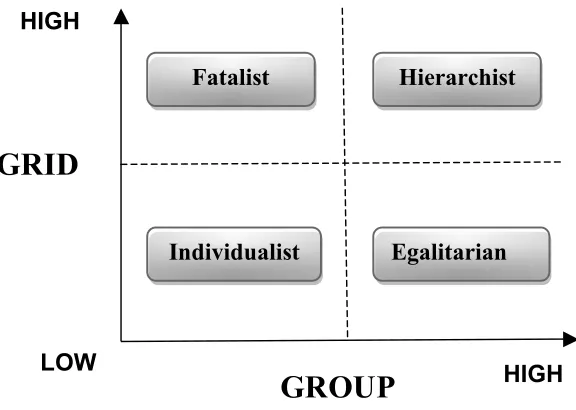
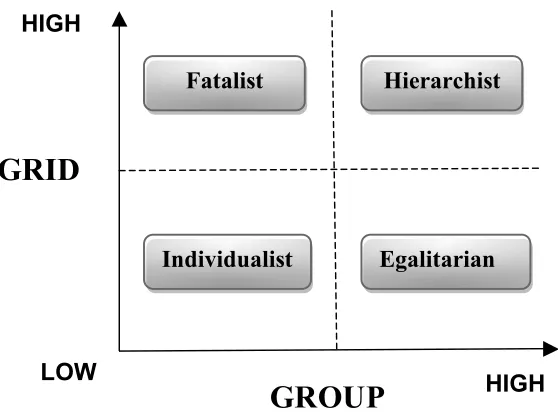
If axes are created from the intersection of the two variables, they create a four
quadrant grid-group space within which four worldviews are defined (Figure 2.4).
Characteristics of each of these worldviews were recently reviewed by Tsohou, Karyda,
Kokolakis, and Kiountouzis (2006). Fatalists (high grid-low group) believe they are
constrained by social rules, yet feel like “outsiders” that have little influence to change those
rules or control over their personal lives. Heirarchists (high grid-high group) strongly define
their identities by their membership to a particular social group and feel the rules of that
group supersede any other. Individualists (low grid-low group) strongly dissociate
themselves from being defined by particular social group and believe that all socially
that group membership is important, but that group relationships should be negotiated and
authority can be called into question.
Figure 2.4: The grid-group space defining the four worldviews of cultural theory.
The implication of cultural theory on risk research is that risk perception can follow from
patterns of social relations (Brenot, Bonnefous, & Marris, 1998). In other words, individuals
that fall into these particular worldview categories tend to perceive risks in similar ways.
In order to measure individuals’ membership within each of these worldview
categories, a series of questionnaires has been developed (Dake, 1991, 1992; Wildavsky &
Dake, 1990). Participants rate their agreement with statements on a Likert scale that are
inter-correlated to indicate a person’s strength of membership within the worldview categories.
For example, individuals who agree strongly with the statement, “A person is better off if he
LOW HIGH
HIGH
GROUP
GRID
Fatalist
Individualist
Hierarchist
or she doesn’t trust anyone” is considered a fatalist. Examples of statements in each category
are shown below.
• Fatalism: There is no use in doing things for people; you only get it in the back in the
long run.
• Hierarchy: People should be rewarded according to their position in society.
• Individualism: In a fair system, people with more ability should earn more money.
• Egalitarianism: If people in this country were treated more equally, we would have
fewer problems.
Based on these categories, how do individuals in each worldview expected to
perceive the risks of science and technology? For fatalists, others largely determine what is
risky, since they feel that they have little role to play in the decision-making process. These
individuals often prefer to be unaware of danger since they feel it is unavoidable.
Hierarchists fear technology that disrupts the “natural order” of things. However, when it
comes time for decisions to be made, this group trusts the experts or leaders of their social
group to make the correct decisions for the universal good (Oltedal, Moen, Klempe, &
Rundmo, 2004). Individualists are especially sensitive to risks that impinge on an
individuals’ personal freedom. However, they often feel that regardless of the acceptability of
the risk decided on by the group at large, it is up to the individual to avoid it (Langford,
Georgiou, Bateman, Day, & Turner, 2000). Egalitarians reject risks that would lead to
unequal distribution of repercussions (such as developing nuclear technology when the waste
opinion, because they fear that the strong institutional ties of experts may lead abuse of
power (Oltedal et al., 2004).
Initial results utilizing this framework reported that cultural worldviews correlated
well to risk perceptions (Dake & Wildavsky, 1991). However, additional studies have not
obtained results with as high levels of reliability (Marris et al, 1996; Seifert & Togersen,
1995; Sjöberg, 1995). In a recent study of the correlation of risk perception and cultural
theory, Bouyer, Bagdassarian, Chaabanne, and Mullet (2001) found only a weak association
between worldviews and risk perception. Cultural theory typically explains only small
portions of the variance in individual risk perception, however it is a useful tool because
unlike the psychometric paradigm it seeks to answer why risk is perceived as it is.
Assumptions and Limitations
Can four worldviews realistically explain perceptions of risk across all individuals?
Certainly, cultural theory limits itself in making such claims (Boholm, 1996; Johnson, 1991).
Douglas responded to this criticism in a recently revised version of her theory:
Why four? Not because four types are all that there are, but for the sake of having a
parsimonious model of organizations, in two dimensions only. If any one protests
that there are really five hundred or two thousand types, or six or eight dimensions,
they mistake the nature of the exercise. Eleven thousand or a million would NOT be
enough to cover the variety that is out there. But for explanatory value, three, four or
five types of social environment are enough to generate three, four, or five
Douglas asserts that simplicity and utility are the goals of grid-group analysis and not a
representation of every individual’s reality.
The worldview constructs are measured with quantitative measures that, if interpreted
as continuous, allow researchers to place individuals along a degree of worldviews. An
individual may not be wholly fatalist, but might fall along a continuum of this worldview. If
results are interpreted in this manner, it allows for a more fluid interpretation of which
worldview category individuals might fall into. However, results are rarely interpreted in this
manner, which likely weakens some of the assertions of the theory.
Another criticism of cultural theory is that worldviews appear static (Boholm, 1996;
Johnson, 1991). Although some researchers, such as Douglas hold to this view, others have
adopted a mobility hypothesis in which cultural theory predicts perceptions only in specified
contexts. Depending on the social interaction, individuals can exist in multiple worldview
quadrants at different times (Rayner, 1992). This implies that studies in risk perception
should not attempt to generalize obtained worldviews to contexts outside the scope of the
study as some have attempted. An interesting question then becomes, how limited are these
contexts? Do individuals fall into worldviews categories when making decisions about the
risks of science and technology in general, or are worldview biases only consistent for very
specific applications or their potential hazardous outcomes?
Integrated Approaches
Integrative approaches to the analysis of risk perception have been suggested
cultural theory and psychometric approaches. Their conclusions are: a) cultural theory
effectively classifies groups into worldview categories but not individuals, b) the
psychometric paradigm explains the variance in risk perception more effectively than either
cultural theory or demographic variables, c) cultural theory predicts risk perception only in
certain hazard contexts (supporting the mobility hypothesis), d) groups that hold certain
worldviews interpret psychometric risk characteristics in similar ways, and, e) worldviews
correlate with distinct views on trust, liability, and consent in the context of risk.
Integrative approaches to risk perception using these frameworks can be useful, as
long as one understands their assumptions and limitations. The psychometric paradigm can
reveal how individuals or groups define particular hazards cognitively. Cultural theory
provides a single perspective on why individuals perceive risk the way they do. If measures
from these two theories are bolstered with interviews, in which an individual is allowed to
expound on his or her understanding of risk, then a relatively clear picture of risk perception
can be painted.
Conclusions and Implications
Understanding risk perceptions of the general public, particularly associated with
science and technology, has implications for public policy and regulation. The psychometric
paradigm provides a means for researchers to understand the critical characteristics of a
potential hazard that individuals perceive as risky. Cultural theory provides a framework
through which to understand why certain groups of individuals might respond to risk posed
design of effective and targeted communication strategies that could potentially reduce
public resistance to the research and development of new technologies.
What is less obvious is the role that risk perception research frameworks play in
formal and informal science education. Science educators are not only responsible for
providing their students with the appropriate content knowledge to understand science, but
also for developing mature attitudes and perceptions of this field. Negative attitudes coupled
with high perceptions of risk could increase student resistance to learning. This correlation is
seen when students (or their parents) resist learning about such technological innovations as
reproductive cloning or stem cell research due to the perceived risk it poses to their cultural
and religious views. In addition, understanding how instructors view the risks posed by
various applications in science and technology could have a part to play in their pedagogical
References
Alhakami, A. S., & Slovic, P. (1994). A psychological study of the inverse relationship
between perceived risk and perceived benefit. Risk Analysis, 14, 1085-1096.
Barke, R. P., & Jenkins-Smith, H. C. (1993). Politics and scientific expertise: Scientists, risk
perception, and nuclear waste policy. Risk Analysis, 13, 425-439.
Barnett, J., & Breakwell, G. M. (2001). Risk perception and experience: Hazard personality
profiles and individual differences. Risk Analysis, 21, 171-178.
Boholm, A. (1996). Risk perception and social anthropology: Critique of cultural theory.
Ethnos, 61, 64-84.
Bouyer, M., Bagdassarian, S., Chabanne, S, & Mullet, E. (2001). Personality correlates of
risk perception. Risk Analysis, 21, 457-465.
Bradbury, J. A. (1989). The policy implications of differing concepts of risk. Science,
Technology, and Human Values, 14, 380-399.
Chauvin, B., Hermand, D., & Mullet, E. (2007). Risk perception and personality facets. Risk
Analysis, 27, 171-185.
Dake, K. (1991). Myths of nature: Cultural and social construction of risk. Journal of Social
Issues, 48, 21-37.
Dake, K. (1992). Orienting dispositions in the perception of risk: An anlaysis of
contemporary worldviews and cultural biases. Journal of Cross-Cultural Psychology,
22, 61-82.
Douglas, M. (1999). Four cultures: The evolution of a parsimonious model. GeoJournal, 47,
Douglas, M., & Wildavsky, A. (1982). Risk and culture: An essay on the selection of
technological and environmental dangers. Berkeley, CA: University of California
Press.
Fife-Shaw, C. R., & Rowe, G. (1996). Public perceptions of everyday food hazards: A
psychometric study. Risk Analysis, 16, 487-500.
Fischoff, B., Slovic, P., & Lichtenstein, S. (1979). Weighing the risk. Environment, 21(4),
17-38.
Fischoff, B., Slovic, P., Lichtenstein, S., Read, S., & Combs, B. (1978). How safe is safe
enough? A psychometric study of attitudes toward technological risks and benefits.
Policy Sciences, 9, 127-152.
Flynn, J., Slovic, P., & Mertz, C. K. (1993). Decidedly different: Expert and public views of
risks from a radioactive waste repository. Risk Analysis, 13, 643-648.
Flynn, R., Bellaby, P., & Ricci, M. (2006). Risk perception of an emergent technology: The
case of hydrogen energy. Forum: Qualitative Social Research, 7(1). Article 19. 25
pp.
Flynn, J., Slovic, P., & Mertz, C. K. (1994). Gender, race, and perception of environmental
health risks. Risk Analysis, 14, 1101-1108.
Gardner, G. T., & Gould, L. C. (1989). Public perception of the risks and benefits of
technology. Risk Analysis, 9, 225-242.
Gustafson, P. E. (1998). Gender differences in risk perception: Theoretical and
Jarman, R., & McClune, B. (2007). Developing scientific literacy: Using news media in the
classroom. New York, NY: Open University Press.
Johnson, B. B. (1991). Risk and culture research: Some cautions. Journal of Cross-Cultural
Psychology, 22, 141-149.
Kaplan, S., & Garrick, B. J. (1981). On the quantitative definition of risk. Risk Analysis, 1,
11-27.
Karpowicz-Lazre, C., & Mullet, E. (1993). Societal risk as seen by the French public. Risk
Analysis, 13, 252-258.
Kraus, N. N., Malfors, T., & Slovic, P. (1992). Intuitive toxicology: Expert and lay
judgments of chemical risks. Risk Analysis, 12, 215-231.
Langford, I., Georgiou, S., Bateman, I., Day, R., & Turner, R. (2000). Public perceptions of
health risks from polluted coastal bathing waters: A mixed methodological analysis
using cultural theory. Risk Analysis, 20, 691-705.
Lazo, J. K., Kinnell, J. C., & Fisher, A. (2000). Expert and layperson perceptions of
ecosystem risk. Risk Analysis, 20, 179-193.
Lupton, D. (1999). Risk. London, England: Routledge.
Marris, C., Langford, I., & O’Riordan, T. (1996). Integrating sociological and psychological
approaches to public perception of environmental risks: Detailed results from a
questionnaire survey. CSERGE Working Paper GEC 96-07. University of East
Marris, C., Langford, I., Saunderson, T., & O’Riordan, T. (1997). Exploring the
“psychometric paradigm”: Comparisons between aggregate and individual analyses.
Risk Analysis, 17, 303-311.
McDaniels, T. L., Axelrod, L. J., Cavanagh, N. S., & Slovic, P. (1997). Perception of
ecological risk to water environments. Risk Analysis, 17, 341-352.
Oltedal, S., Moen, B.-E., Klempe, H., & Rundmo, T. (2004). Explaining risk perception: An
evaluation of cultural theory. Norwegian University of Science and Technology,
Department of Psychology, Trondheim, Rotunde Paper Volume 85.
Rayner, S. (1992). Cultural Theory and Risk Analysis. In S. Krimsky & D. Golding (Eds.),
Social Theories of Risk (pp. 83-115). Westport, CT: Praeger
Renn, O. (1992). Concepts of risk: A classification. In S. Krimsky & D. Golding (Eds.),
Social Theories of Risk (pp. 53-79). Westport, CT: Praeger.
Renn, O., & Rohrmann, B. (2000). Cross-cultural risk perception: A survey of empirical
studies. Dordrecht, Netherlands: Kluwer Academic.
Rowe, G. & Wright, G. (2001). Differences in expert and lay judgment of risk: Myth or
reality? Risk Analysis, 21, 341-356.
Savadori, L., Rumiati, R., & Bonini, N. (1998). Expertise and regional differences in risk
perception: The case of Italy. Swiss Journal of Psychology, 57, 101-113.
Savadori, L., Savio, S., Nicotra, E., Rumiati, R., Finucane, M., & Slovic, P. (2004). Expert
and public perception of risk from biotechnology. Risk Analysis, 24, 1289-1299.
Siegrist, M., & Cvetkovich, G. (2000). Perception of hazards: The role of social trust and
Siegrist, M., Keller, C., Kastenholz, H., Frey, S., & Wiek, A. (2007). Laypeople’s and
experts’ perception of nanotechnology hazards. Risk Analysis, 27, 59-69.
Sjöberg, L. (1995). Explaining risk perception: An empirical and quantitative evaluation of
cultural theory. Rhizikon: Risk Research Reports, No. 14. Center for Risk Research,
Stockholm, Sweden.
Sjöberg, L. (2000). Factors in risk perception. Risk Analysis, 20, 1-11.
Sjöberg, L. (2008). Genetically modified food in the eyes of the public and experts. Risk
Management, 10, 168-193.
Slovic, P. (1987). Perception of risk. Science. 236, 280-285.
Slovic, P. (1992). Perception of risk: Reflections on the psychometric paradigm. In S.
Krimsky & D. Golding (Eds.), Social Theories of Risk (pp. 117-152). Westport, CT:
Praeger.
Slovic, P. (1997). Trust, emotion, sex, politics and science. Surveying the risk assessment
battlefield. In M. Bazerman, D. Messick. A. Tenbrunsel, & K. Wade-Benzoni (Eds.),
Environment, ethics, and behavior (pp. 277-313). San Francisco, CA: New Lexington
Press.
Slovic, P., Fischoff, B., & Lichtenstein, S. (1979). Rating the risks. Environment, 21
(3),14-20, 36-39.
Slovic, P., Malmfors, T., Krewski, D., Mertz, C. K., Neil, N., & Bartlett, S. (1997). Intuitive
toxicology II: Expert and lay judgments of chemical risks in Canada. Risk Analysis,
Starr, C. (1969). Social benefit versus technological risk: What is our society willing to pay
for safety? Science, 165, 1232-1238.
Tsohou, A., Karyda, M., Kokolakis, S., & Kiountouzis, E. (2006). Formulating information
systems risk management strategies through cultural theory. Information
Management & Computer Security, 14(3), 198-217.
Tversky, A., & Kahneman, D. (1974). Judgment under uncertainty: Heuristics and biases.
Science, 185, 1124-1131.
Wachbroit, R. (1991). Describing risk. In M. A. Levin & H. S. Strauss (Eds.), Risk
Assessment in Genetic Engineering. Environmental Release of Organisms (pp.
368-377). New York, NY: McGraw-Hill.
Waller, R. A. & Covello, V. T. (1984). Low Probability / High Consequence Risk Analysis.
New York, NY: Plenum.
WASH-1400. (1975). Reactor Safety Study—An Assessment of Accident Risks in U.S.
Commercial Nuclear Power Plants. NUREG-75/014, Washington, D.C.: Nuclear
Regulatory Commission.
Wildavsky, A., & Dake, K. (1990). Theories of risk perception: Who fears what and why?
Daedalus, 119, 41-60.
Wright, G., Pearman, A., & Yardley, K. (2000). Risk perception in the U.K. oil and gas
production industry: Are expert loss-prevention managers’ perceptions different from
RESEARCH STUDY I
Introduction
Preparing students to enter into public life as scientifically literate citizens remains an
important goal of science education (Laugksch, 2000). One factor that will greatly influence
student development of scientific literacy is their attitudes toward science and technology and
the subsequent behaviors that result from these attitudes (Dawson & Schibeci, 2003; Prokop,
Leskova, Kubiatko, & Diran, 2007). Attitudes can have a significant influence on future
acceptance of new advances in science and technology (Lee, Scheufele, & Lewenstein,
2005). The interaction of attitudes toward technology and its acceptance is especially
important in the area of biotechnology, an area of science that will play an increasingly larger
role in students’ lives in the coming years (Bal, Samanci, & Bozkurt, 2007).
Attitudes toward science and technology are mediated by a number of factors (Prokop
et al., 2007). One of the most critical factors is the perception of the risks and benefits
associated with research and development of biotechnology applications (Fischoff, Slovic, &
Lichtenstein, 1978; Sjöberg, 2002). Biotechnology is an emergent science which many in the
general public perceive as risky to society in general (Slovic, 1987; Savadori et al., 2004).
For example, the development of genetically modified (GM) food has met with public
resistance in the United Kingdom despite expert reassurance of product safety (Gaskell,
Bauer, Durant, & Allum, 1999).
Due to its importance to the public dialogues surrounding biotechnology, risk is an
important theme in scientific literacy education. The topic of risk in science education has
been addressed only briefly in the literature in the context of environmental science