COST IN PAKISTANI CORPORATE SECTOR
SAQIB MUNEER
COST IN PAKISTANI CORPORATE SECTOR
SAQIB MUNEER
A thesis submitted in fulfilment o f the
requirements for the award o f the degree o f
Doctor o f Philosophy (Management)
Faculty o f Management
Universiti Teknologi Malaysia
This thesis work is dedicated to my parents and my family who have always loved
me unconditionally and whose good examples have taught me to work hard for the
things that I aspire to achieve. This thesis work is dedicated to my brother, Dr. Babar
Zaheer Butt, who has been a constant source o f support and encouragement during
the challenges o f my study and life. I would also like to dedicate this work to my
ACKNOWLEDGEMENT
All praise to Allah, the lord o f the worlds, and His Prophet Muhammad
(peace be upon him), his family and his companions. First o f all, I wish to express
my gratitude and deep appreciation to Almighty Allah, who made this study possible
and successful.
This study would not be accomplished unless the honest espousal that was
extended from several sources for which I would like to express my sincere
thankfulness and gratitude. Yet, there were significant contributors for my attained
success and I cannot forget their input, especially my research supervisors, Dr.
Norkhairul Hafiz Bajuri and Dr. Saif-ur-Rehman who did not leave any stone
unturned to guide me during my research journey.
I shall also acknowledge the extended assistance from the administrations of
Faculty o f Management (FM) and School o f Graduate Studies (SPS) who supported
me all through my research experience and simplified the challenges I faced.
ABSTRACT
ABSTRAK
K ajian ini m engkaji aplikasi am alan kew angan dan kesannya terhadap
prestasi firm a dal am keadaan ekonom i bagi pasaran bam di Pakistan. A malan
kew angan firm a m erangkum i keputusan staiktur modal, keputusan polisi dividen,
teknik penilaian pelaburan, polisi modal kerja, kaedah m engukur kos modal dan
penilaian kew angan m enggunakan nisbah kewangan. K ajian ini m enganalisis data
utam a firm a kew angan dan bukan kew angan yang disenaraikan di B ursa Saham
K arachi (KSE), Pakistan. D ata daripada 141 buah firm a telah dianalisis
m enggunakan analisis deskriptif dan analisis faktor melalui teknik regresi linear dan
regresi pelbagai untuk m engesan hubungan antara am alan kew angan dan prestasi
firma. M agnitud dan kepentingan kesan penyederhana (m oderator) iaitu kos agensi
telah diperiksa dengan m enggunakan analisis regresi berganda terhadap hubungan
antara keputusan struktur modal dan keputusan polisi dividen dengan prestasi firma.
Iiasil kajian deskriptif m enunjukkan bahaw a am alan kew angan dipatuhi dalam
sektor korporat di Pakistan serta m em pengaruhi prestasi firma. K eputusan kajian
ju g a m enunjukkan bahaw a keputusan struktur modal dan keputusan polisi dividen
m em punyai kesan p o sitif yang signifikan ke atas prestasi firma. Teknik penilaian
pelaburan, polisi modal kerja, kaedah m engukur kos modal dan penilaian prestasi
yang m enggunakan nisbah kew angan didapati m em punyai hubungan signifikan
terhadap prestasi firma. Seterusnya, kos agensi bukan sahaja m em berikan kesan
yang besar kepada prestasi firma, tetapi ju g a m enyederhanakan hubungan antara
keputusan polisi dividen dan prestasi firma. N am un, kos agensi tidak
m enyederhanakan hubungan antara keputusan struktur modal dan prestasi firma.
K ajian ini m em punyai im plikasi teori dan praktikal bagi pengurus dan pengamal
m engenai m agnitud setiap am alan kew angan berhubung dengan kos agensi dan
CHAPTER
TITLE
PAGE
DECLARATION
ii
DEDICATION
iii
ACKNOW LEDGEMENT
iv
ABSTRACT
v
ABSTRAK
vi
TABLE OF CONTENTS
vii
LIST OF TABLES
xi
LIST OF FIGURES
xiii
LIST OF ABBREVIATIONS
xiv
LIST OF SYMBOLS
xvi
LIST OF APPENDICES
xvii
1
INTRODUCTION
1
1.1
Introduction
1
1.2
Background o f the Study
2
1.3
Financial Practices
4
1.3.1
Capital Structure Decisions
4
1.3.2
Dividend Policy Decisions
5
1.3.3
Investment Appraisal Techniques
6
1.3.4
Working Capital Policy
7
1.3.5
Methods of Measuring Cost of Capital
7
1.3.6
Financial Assessment using Financial Ratios
8
1.3.7
Agency Cost
9
1.4
Stock Markets in Pakistan
10
1.5
Problem Statement
14
1.6
Research Questions
17
1.7
Research Objectives
18
1.8
Significance of the Study
18
1.9
Scope of Study
22
1.10
Operational Definitions of Variables
22
1.11
Organization of Thesis
25
LITERATURE REVIEW
27
2.1
Introduction
27
2.2
Financial Practices (Primary Data based Review)
28
2.3
Financial Practices (Secondary Data based Review)
30
2.3.1
Capital Structure Decisions
30
2.3.2
Dividend Policy Decisions
42
2.3.3
Investment Appraisal Techniques
52
2.3.4
Working Capital Policy
67
2.3.5
Methods of Measuring Cost of Capital
71
2.3.6
Financial Assessment Using Financial Ratios
75
2.4
Agency Cost
80
2.5
Conclusion
88
DATA AND METHODOLOGY
3.1
Introduction
3.2
Appraisal of Prior Research Methodologies
3.3
Research Design
3.3.1
Classification of Research Design
3.3.2
Selecting Research Design or Paradigm
3.3.3
Methods or Techniques of Research
3.4
Variable Definition, Survey Instrument
3.4.1
Measurements of Variable for Survey
3.4.2
Dependent Variable
3.4.3
Independent Variables
3.4.4
Agency Cost
3.5.2
Model for the Study
102
3.6
Data Collection Method
107
3.6.1
Primary data Collection
107
3.6.2
Target Population
108
3.6.3
Sampling Frame
109
3.6.4
Sampling Methods
110
3.6.5
Sampling Unit
111
3.6.5
Response Rate
111
3.7
Pilot Testing
112
3.7.1
Reliability
113
3.7.2
Validity
114
3.8
Data Analysis
115
3.8.1
General Consideration
115
3.8.2
Descriptive Statistics
116
3.8.3
Bivariate Data Analysis
117
3.8.4
Multivariate Analysis
118
3.9
Conclusion
122
4
ANALYSIS AND FINDINGS
123
4.1
Introduction
123
4.2
Data Analysis
124
4.2.1
Data Normality
125
4.2.2
Descriptive Analysis
126
4.2.3
Association between Variables
136
4.3
Inferential Analysis
139
4.3.1
Measurement Development
139
4.3.2
KMO and Bartlett's Test
139
4.3.3
Confirmatory Factor Analysis
142
4.3.4
Measurement Model Fit (First Stage)
148
4.3.5
Testing for Hypotheses (Second Stage)
160
4.5
Multiple Regression Analysis and Findings
163
4.5.1
Impact of Financial Practices on Firm
performance
163
4.5.2
Agency Cost as a Moderator
168
4.6
Summary of the Results
172
5
DISCUSSIONS AND CONCLUSION
174
5.1
Introduction
174
5.2
Conclusions on Research Questions and Model Testing
176
5.2.1
Conclusions Related to Financial Practices
176
5.2.2
Conclusion of Agency cost
183
5.2.3
Conclusions of Firm Performance
183
5.3
Financial Practices, Agency Cost And Firm Performance
(Model Fit)
185
5.3.1
Financial Practices and Firm Performance
187
5.3.2
Moderating Effect of Agency Cost
188
5.4
Summary of Research Question Answers
189
5.5
Implications of the Research Study
195
5.5.1 Implications for Financial Practices of Firms
195
5.6
Contribution to the Knowledge
199
5.7
Limitations o f the Study
201
5.8
Recommendations for the Further Research
203
REFERENCES
Appendices A-E
205
TABLE NO.
TITLE
PAGE
1.1
List o f Companies with Market Capitalization
11
3.1
Target Population
108-109
3.2
Response Rate o f the Survey
112
3.3
Construct Validity
113
4.1
Stage and Statistical Methods
124
4.2
Types o f Industries
127
4.3
Findings o f Firm Characteristics
128
4.4
Structure o f Firms in Sample by type o f Business within
Industry
4.5
Structure o f Firms in Sample by type o f Ownership within
type o f Business
129
4.6
Structure o f Firms in Sample by type o f Ownership within
Industry
130
4.7
Descriptive Statistics o f Capital Structure Decisions
131
4.8
Descriptive Statistics o f Dividend Policy Decisions
132
4.9
Descriptive
Statistics
o f
Investment
Appraisal
Techniques
133
4.10
Descriptive Statistics o f Working Capital Policy
133
4.11
Descriptive Statistics o f Methods o f Measuring Cost of
Capital
134
4.12
Descriptive Statistics o f Financial Assessment using
Financial Ratios
134
4.13
Descriptive Statistics o f Firm Performance
135
4.14
Descriptive Statistics o f Agency Cost
136
4.15
Correlation
between
Independent,
Dependent
and
Demographic Variables
137
4.16
Multi-collinearity Statistics
138
4.17
KMO & Bartlett's Test
140
4.18
Index Category and the Level o f Acceptance for every
Index
143-144
4.19
Description o f Fit Indicators
145
4.20
Summary
o f Findings
(CFA):
Capital
Structure
Decisions
149
4.21
Summary o f Findings (CFA): Dividend Policy Decisions
150
4.22
Summary o f Findings (CFA): Investment Appraisal
Techniques
152
4.23
Summary o f Findings (CFA): Working Capital Policy
154
4.24
Summary o f Findings (CFA): Methods o f Measuring
Cost o f Capital
4.25
Summary o f Findings (CFA): Performance Assessments
using Financial Ratios
157
4.26
Summary o f Findings (CFA): Agency Cost
158
4.27
Summary o f Findings (CFA): Firm Performance
159
4.28
Summary o f Findings: Model Fit
161
4.29
Construct Validity
163
4.30
Regression Model using Firm Performance as Dependent
Variable
164
4.31
Results o f Hypotheses Testing
167
4.32
The Effect o f CSD on Firm Performance by Moderating
Agency Cost
169
4.33
The Effect o f DPD on Firm Performance by Moderating
Agency Cost
171
4.34
Hypothesized Moderation Relationship and Results
172
5.1
The Results o f Research Hypotheses
190
FIGURE NO.
TITLE
PAGE
1.1
KSE 100 Index
13
3.1
Model for the Research Study
106
4.1
Standardize Residual Histogram
125
4.2
Normal P-P Plot
126
4.3
Types o f Industries
127
4.4
Model Fit o f Capital Structure Decisions
149
4.5
Model Fit o f Dividend Policy Decisions
151
4.6
Model Fit o f Investment Appraisal Techniques
153
4.7
Model Fit o f Working Capital policy
154
4.8
Model Fit o f Methods o f Measuring Cost o f Capital
156
4.9
Model Fit o f Performance Assessment using
Financial
Ratios
157
4.10
Model Fit o f Agency Cost
159
4.11
Model Fit o f Firm Performance
160
4.12
Model Fit o f Firm Performance
162
4.13
The Effect o f CSD on Firm Performance by
Moderating
Agency Cost
169
4.14
The Effect o f DPD on Firm Performance by
Moderating
Agency Cost
171
5.1
Structure o f the Chapter 5
175
LIST OF ABBREVIATIONS
AC
-
Agency Cost
ARR
-
Accounting Rate o f Return
ASF
-
Alternative Sources o f Financing
CAPM
-
Capital Asset Pricing Model
MMCOC
-
Methods o f Measuring Cost o f Capital
CCI
-
Constraint on Capital Investment
CPAP
-
Contribution o f Project to Aspect o f Performance
CR
-
Cash ratio
CSD
-
Capital Structure Decisions
CSE
-
Common Stock Equity
CSR
-
Capital Structure Ratio
DCF
-
Discounted Cash Flow
DDM
-
Dividend Discount Model
D/E
-
Debt per Equity Ratio
DEVA
-
Discounted Economic Value Added
DIS
-
Dividend as a Source o f Information
DPD
-
Dividend Policy Decisions
DPS
-
Dividend per Share
EPS
-
Earnings per Share
FAR
-
Financial Assessment through Financial Ratios
FCF
-
Free Cash Flow
GPR
-
Gross Profit Ratio
ICR
-
Interest Coverage Ratio
IRR
-
Internal Rate o f Return
IST
-
Investment Selection Techniques
KSE
-
Karachi Stock Exchange
LTD
-
Long-term Debt
NPR
-
Net Profit Ratio
NPT
-
Net Present Value
OP
-
Organization’s Performance
OPR
-
Operating Profit Ratio
PBP
-
Pay Back Period
PDCC
-
Project Dependent Cost o f Capital
P/E
-
Price per Earnings Ratio
PER
-
Performance
PI
-
Profitability Index
PMA
-
Profit margin/total Assets
PSE
-
Preferred Stock Equity
RI
-
Residual Income
ROA
-
Return on Assets
ROCE
-
Return on Capital Employed
ROE
-
Return on Equity
ROI
-
Return on Investment
RR
-
Rate o f Return
RRR
-
Required Rate o f Return
STA
-
Sales/total Assets
STD
-
Short-term Debt
TIE
-
Times interest earned ratio
TPR
-
Target Payout Ratio
WACC
-
Weighted average Cost o f Capital
LIST OF SYMBOLS
Ai
-
Independent but Controllable Variable
BBj
-
Independent but Uncontrollable Variable
F
-
Shows the Relationship between Dependent and
Independent Variable (functional relationship)
Variables Ai and BBj
OI
-
Dependent Variable
P0
-
Symbolize or Abbreviated as Constant or Intercept
P
-
Beta Value or Slope o f Regression Equation
LIST OF APPENDICES
APPENDIX
TITLE
PAGE
A
Prior Literature Summer o f Financial Practices
244
B
Definitions o f Variables and Measures o f Variables
246
C
Questionnaire
248
D
List o f Respondent Companies
254
INTRODUCTION
1.1
Introduction
1.2
Background of the Study
In current business conditions, rapid changes, innovations, technology and
globalization are direct to make more competition among firms. Consequently, in
this competitive business environment, profit, growth and survival o f a firm depend
upon the innovativeness o f the firm (Kannadhasan and Nandagopal, 2008). Thus,
firm can compete with market dynamic conditions only if it has strong financial
position and flexible firm structure (Mathews, 2005). Rational analysts are always
considered markets’ efficiency while think about the investing and financing
decisions. It believes that markets are always efficient, which raises two questions
here, what will happen if markets are not always efficient? In addition, what will
happen if analysts are not themselves always rational (Baker & Wurgler, 2012)?
Decision related to anything cannot be made in vacuum since decision-making is
very complicated activity. A firm cannot rely only on the complex models and
individual resources, which are not able to provide a good result o f investment in
projects (Kannadhasan, 2008). Cognitive psychology o f a manager is important in
the analysis o f the problem and variables including problems. While solving the
problem, situation o f decision-making activity in solving the individual specific
problem is involved, which enlarges the environment as well (Barberis & Shleifer,
2003).
1979). In investment decision, investors should keep in mind their risk tolerance
level, financial goals and other constraints. In addition, an optimum decision of
investment can play a significant and active role in their choices (Archer &
Ghasemzadeh, 1999; Combe, 1999; Bridges, 1999; Sommer, 1999; Cooper
et al.,
2000). Optimum investment process is valuable for intuitional investors and not
suitable for individual investor who is vulnerable to behavioral prejudices. In the
past, investment decisions were based on forecasting, market timing and
performance, because the major aim o f an investment is to make wealth. In addition,
investors were not fully satisfied and made little profit from investment due to
ordinary outcomes o f investment (Kiyilar & Acar, 2009). The existing gap between
desired results and actual results forced them to investigate and find out the reasons
behind these outcomes. In the investigation process, it is found that fundamental
mistakes (irrational investment decisions) in decision-making process are behind
these results. It is realized that the behaviour o f decision-makers is important for
avoiding such mistakes, which can create a barrier in better investment decisions
(Kannadhasan, 2008). However, in order to explain the various investor behaviors in
financial markets, it is necessary to understand the corporate culture, financial
practices and their impact on performance.
separately (by including one or two practice only) by researchers, but collectively,
only few researchers have examined these practices. In addition, there is a need of
comprehensive analysis to determine the perception about practices and level of
implications in corporate sector. Since financial managers, financial executives and
financial analysts believe that these practices are very important for the improvement
o f firm performance, if appropriately practiced, which can also play a critical role in
the development o f firms (Hunjra
et al.,
2011). In addition, it is necessary to explain
the role o f financial practices for the betterment o f firm performance (Morgan &
Tang, 1992; Cowton & Pilz, 1995; Hunjra
et al.,
2011).
1.3
Financial Practices
1.3.1
Capital Structure Decisions
Capital structure o f a firm consists o f debt and equity proportions and it can
be referred to financial framework o f a firm. In addition, it has always been popular
among scholars o f financial studies (Myers, 1984; Heng & San, 2011). One can drive
the significance o f capital structure from the fact that basic purpose o f capital
structure is to fulfill the needs o f various stakeholders. Therefore, development of
new theories on optimal capital structure started from the last century and economic
world was surprised when Modigliani and Miller (1958) came up with their
irrelevance theorem o f capital structure. They claim that under certain circumstances,
the value o f the firm is independent o f its financial structure. However, institutional
environment and firm’s characteristics are the major determinants in the selection of
optimal structure (Allayannis
et al.,
2002; Marques & Santos, 2003; Grundstromer &
Gustafsson, 2007; Antoniou
et al.,
2008; Pratheepkanth, 2011). Capital structure
occupies the decisions regarding different sources o f funding1, which are useful to
enhance the performance and firm needs for various sources o f fund to finance its
investments as well as business operations (Saeedi & Mahmoodi, 2011). Therefore,
decisions about capital structure (debt/equity) are significant for value, growth and
better performance o f a firm (Antoniou
et al.,
2008; Akintoye, 2008; Arbabiyan &
Safari, 2009; Frank & Goyal, 2009; Al-Taleb & Al-Shubiri, 2011).
1.3.2 Dividend Policy Decisions
1.3.3 Investment Appraisal Techniques
Investment appraisal techniques are generally most surveyed topics in
corporate finance, in the terms o f financial practices (see, e.g. Sangster, 1993;
Mccaffarey
et al.,
1997). The fundamental purpose o f investment appraisal
techniques is to determine the long-term investment decisions (e.g. new machinery,
replacement o f machinery, research development projects, new plant, and new
product) o f a firm are worth hunting. Therefore, it would not be wrong to say that
these techniques determine the budget for capital investments or capital expenditures
(Seteven, 2003). In area o f financial practices, investment appraisal techniques are
very important although these techniques have some issues related to forecasting
(Akalu, 2001; Hunjra
et al.,
2012). However, from fundamentals o f investment
techniques, risk analysis is one o f them (Akalu, 2001). In investment appraisal
techniques, mostly used and accepted techniques include basic techniques2 and
discounted cash flow techniques3, which are based on time value o f money
(Farragher, Kleiman & Sahu, 1999; Liljeblom & Vaihekoski, 2004; Kantudu, 2007;
Akinbuli, 2011). Although, for selection o f techniques, firms should follow a proper
selection procedure, as Farragher
et al.
(1999) explained that for the effective and
successful capital expenditure, it is necessary to make some plans. While selecting a
suitable technique for investment appraisal, one should keep in mind these plans (e.g.
strategic analysis, investment goals, investment opportunities, forecasting cash flow,
evaluating the risks) (Akalu, 2002; Milis
et al.,
2009; Afonso & Cunha, 2009).
Therefore, vigorous investment appraisal techniques are very important for firm
because these help the managers in ranking and selecting the best-suited projects.
These techniques are very significant for a firm’s growth, value and performance
(Arnold, 1998; Drury, 2000; Olawale
et al.,
2010; Halttunen, 2012).
1.3.4 Working Capital Policy
The debates on capital structure decisions and dividend policy as well as
investment appraisal techniques are related to long-term decisions o f a firm
(Mccaffarey
et al.,
1997; Hunjra
et al.,
2011), while working capital policy deals in
management o f operations o f firm (mature within one year), liabilities and assets
(Mccaffrey
et al.,
1997; Hayajneh & Yaseeni, 2011). Therefore, almost every firm
follows two types o f working capital policies, aggressive policy and conservative
policy. In aggressive working capital policy, firms take high risk for high profit by
investing fewer amounts in current assets (Weinraub & Visscher, 1998 and Gardner
et al.,
1986). This policy includes high risk because o f the creditor who might claim
for money and due to some reasons, firms are unable to settle creditor’s claim, so it
might create trouble for firms (Weinraub & Visscher, 1998; Nazir & Afza, 2009).
For avoiding such kinds o f dilemmas, it would be better for business to adopt
conservative working capital policy. The advantage o f this policy is that firm keeps a
balance between current assets and current liabilities, and keeps protection to
overcome any uncertain condition (Pinches, 1994). This policy can be very useful for
firm in reducing risk but it decreases the opportunity o f increasing production by
decreasing available amount for firm (Teruel & Solano, 2007; Gill
et al.,
2010; Niazi
et al.,
2011; Qazi
et al.,
2011). Many researchers (e.g. Afza & Nazir, 2007; Nazir &
Afza, 2009; AL- Shubiri, 2011) have documented that working capital policy has
strong impact on performance o f a firm. The significance o f working capital policy
can be analyzed through the fact that it has strong effect on firm profitability. In
addition, such risk affects the value and growth o f a firm but working capital policy
reduces that risk and enhances the performance (Smith, 1980).
1.3.5 Methods of Measuring Cost of Capital
generating finance in the markets (Al-Mutairi, 2011). In financial practices,
investment decision making is very critical task (Kester
et al.,
1999). Investing in a
new project needs capital and this capital might bring some costs. It is difficult to
find out that source o f finance has cost or not, because every source o f finance may
or may not impose some cost on company (Rajatanavin & Venkatesh, 2007).
Therefore, in these managerial decisions-making fields, some methods are used to
calculate the cost o f capital (Benetti, Decourt & Terra, 2007; Chazi, Terra & Zanella,
2010). These methods include weighted average cost o f capital (WACC), capital
asset pricing model (CAPM) and dividend discount model (DDM). In these methods,
CAPM is a popular method in firms for calculating cost o f capital (Kester
et al.,
1999; Graham & Harvey, 2001; Brounen, De Jong & Koedijk, 2004). However, in
corporate finance decisions, impact o f methods o f measuring cost o f capital on firm’s
performance is very important because it is hard to estimate the accurate cost o f any
source o f financing. Consequently, it is certain that high cost o f capital has negative
impact on performance o f a firm (Bacidore
et al.,
1997; Firer
et al.,
2004; Vazquez &
Trombetta, 2007; Rehman & Zaman, 2011).
1.3.6 Financial Assessment using Financial Ratios
Financial assessment o f a firm is very vital in financial practices; hence,
financial assessment ratios are used as instruments to determine whether firm’s plans
make financial sense (Horta et al., 2012). Therefore, evaluation o f a business
accurately plays a key role in the success o f a firm. In the strong competitive
environment o f 21st century, it is significant for a firm to have considerable financial
and non-financial structure4. In the old times (before 21st century), financial
statements (income statements and balance sheets) were managed manually on
annual basis and were used for assessing the performance o f a firm (Mccaffarey
et
al.,
1997). The assessment o f performance is planned and survival o f a firm in long
run depends upon the performance. Therefore, for measuring the overall prosperity
o f a firm, managers use performance assessment (Brigham & Ehrhard, 2005).
Generally, financial performance is related to the revenue o f a firm that how to
generate profit by utilizing assets efficiently and effectively (Bashir, 2003). The term
performance assessment provides the overall financial health o f a firm and can be
used in the comparison o f similar firms across the same industry (Kaplan & Norton,
1996). However, performance can be defined in the form o f growth, value, profit,
output, productivity, brand image, sales etc (Almazari, 2011). Over the years, many
tools and techniques have been developed for analyzing and judging the financial
performance o f a company (Palepu
et al.,
2000). One o f the most popular tool to
evaluate these aspects is financial ratios assessment. Prior researchers (e.g.,
McCaffery
et al.,
1997; Jahangir, Shill & Haque, 2007; Prasetyantoko & Parmono,
2008; Marimuthu, 2010; Ong, Teo & The, 2011; Memon & Tahir, 2012), evaluated
the performance by using financial ratios persistently. These ratios include Price per
Earnings ratio (PE), Return on Assets (ROA), Sales/Total Assets (STA), Cash Ratio
(CR), Earnings Per Share (EPS), Return on Equity (ROE), Times Interest Earned
ratio (TIE), Profit Margin/Total Assets (PMA), and Debt per Equity Ratio (D/E).
Moreover, financial assessment by using financial ratios has shown strong positive
impact on firm performance (Sufian, 2007; Niazi
et al.,
2011; Ong
et al.,
2011;
Singh, 2011).
1.3.7 Agency Cost
Economic concept o f agency cost is defined as, the cost o f hiring or selecting
an agent (manager, management etc) by principal (firm, person, group o f persons,
etc) to work on its behalf (Jensen, Solberg & Zorn, 1992; Hall, 1998). This cost
arises due to the conflict o f interest between principal and agent because agent has
more knowledge about the firm and market conditions. Therefore, it is hard for
principal to measure the activities o f agent5 (Myers, 2000). There are mostly two
types o f agency costs in business environment, agency cost o f capital structure
(debt/equity) and agency cost o f dividend policy (free cash flow). Agency cost o f
capital structure arises due to the conflict o f interest between shareholder and
management. Shareholders will have to bear this cost as long as the interest of
management differs from shareholders (Brigham & Gapenski, 1993). On the other
hand, the agency cost o f debt occurs due to the conflict o f interest between debt
holders and shareholders (Khan
et al.,
2012). The debt-holders put some restrictions
on firm while providing a debt because they want to secure their interest in the firm.
They feel a threat from the management and shareholders. Similarly, interest of
management and shareholders is against the debt-holders because management can
transfer money to shareholders in many ways and leave the debt-holder without
interest. Easterbrook (1984) and Jensen (1986) presented the agency cost o f free cash
flow and they argued that free cash flow available in firms is also responsible for
agency cost (Yermack, 2006; Zhang, 2009). After paying all the obligation o f firm,
management can utilize the free cash for its own interest instead o f distributing it to
shareholders, and this action o f management is against the interest o f shareholders
(Jensen, 1986). In this situation, dividend payment plays a positive role in reducing
the agency cost; higher dividend payment reduces the available free cash flow to
management and expects to reduce the agency cost (Rozeff, 1982; Lozano
et al.,
2005). Moreover, higher payments o f dividend are also an indicator o f better future
performance, growth and profit o f firm (Litzenberger & Lang, 1989; Utami &
Inanga, 2011). Therefore, many researchers documented the impact o f agency costs
on capital structure decision, dividend policy as well as on firm’s performance
(Lasfer, 1999; Jong & Dijk, 2002; Byrd, 2010; Stephan
et al.,
2011; Bell, 2012).
1.4
Stock Markets in Pakistan
that have a potential to become one o f the world's large economies in the 21st
century (KSE Articles, 2015).
In contemporary market dominated economic system, stock market performs
a key role by mobilizing the financial means from savers to the potential investors
(Mala and White, 2006; Shahbaz
et al.,
2008). An active equity market plays an
important role in forecasting the economic growth o f a country and is treated as a
barometer o f the economy (Singh, 2011). It exhibits the capital growth, saving and
investor’s faith in financial sector. Capital market being the most prominent
component o f financial system drives the financial strength through effective
resource mobilization and consequently influences the economic growth and
development o f a country (Buyuksalvarci, 2010).
During the last decade, improvements in regulatory framework have
motivated the local as well as foreign investors to make investments and the stock
market has achieved exceptional performance (IMF Country Report, 2010). On
December 31, 2014, 557 companies were listed on KSE, with average market
capitalization o f Rs.7380531 million (US$72287.3 million) (Economic Survey,
2013-2014). The companies listed at KSE have been classified into 34 sectors,
representing almost all sectors o f Pakistan’s economy. Authorities have taken
number o f steps to improve the operations o f capital market for enhancing the
progression and solidity o f financial sector and capital market in Pakistan (Javed,
2008). These steps included, implementing the code o f corporate governance,
establishing code o f conduct for brokers, controlling through circuit breakers,
electronic entry book system, no restriction on transfer o f dividend and capital gain,
no prior approval for issuance and transfer o f shares to the foreigners, and setting up
a National Clearing Company to promote clearing and settlement activities (Osei,
1998; Javed, 2008; IMF Country Report, 2010). These improvements generated
returns and contributed to the economic growth through strengthening the economic
and financial forces (Hondroyiannis
et al.,
2005; Nieuwerburgh
et al.,
2006).
Table 1.1: List o f Companies with Market Capitalization
Years
2010
2011
2012
2013
2014
Listed Companies
644
638
573
560
557
Listed Capital (Rs in
million)
919.26
1,048.87
1,094.40
1,129.82
1,168.89
Market Capitalization
(million)
3,268.95
2,945.71
4,242.4
6,056.50
7,380.74
New
Companies
Listed
6
4
4
3
6
Listed
Capital
(in
million)
33,438.45
16,010.82
8,161.04
4,545.07
26,973.48
Source: Karachi Stock EExchange (www.kse.com.pk, 2015)
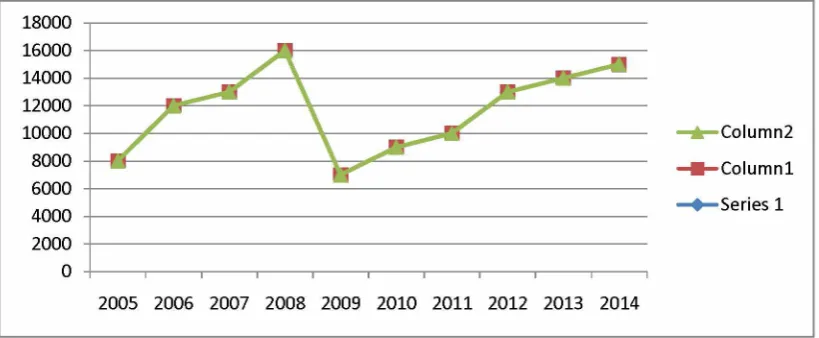
affecting Pakistan, downward trend in KSE-100 index is observed. As at the end of
March 2008, the aggregate market capitalization on KSE stood at $56 billion, which
dropped to just $20 billion on January 2009, showing a significant decrease o f $36
billion (Economic Survey, 2008-09). However, over the last four years (2011 to
2014) improvement in the performance (increase in market capitalization and
profitability) o f banking, oil and gas, chemical and personal goods attracted the
foreign investors; which consequently has improved the KSE-100 index (Economic
Survey, 2013-2014).
2000 0
2005 2006 2007 2008 2009 2010 2011 2012 2013 2014
Figure 1.1 KSE 100 Index (2015). Source: www.kse.com.pk
1.5
Problem Statement
Corporate sector has a vital role in the growth and development o f economy.
It is clear from the literature that financial practices are very important, and
management should concentrate on the proper utilization o f these practices in
decision-making (Pinegar & Wilbricht, 1989). Past studies on financial practices
(e.g. McCaffery
et al.,
1997; Graham & Harvey, 2001; Brounen
et al.,
2004;
Rajatanavin & Venkatesh, 2007; Al-Mutairi & Hasan, 2011; Hunjra
et al.,
2011) are
evident that these practices are reviewed in different sets o f clauses. McCaffery
et al.
(1997) reviewed capital structure decision, dividend policy decision, investment
appraisal techniques, working capital policy, and financial assessment using financial
ratios. Graham & Harvey (2001) examined investment appraisal techniques, cost of
capital, and capital structure decision. Al-Mutairi & Hasan (2011) investigated
investment appraisal techniques, cost o f capital, capital structure decision and
dividend policy decision. Importantly, most o f the prior studies have been conducted
in developed countries and these studies have provided descriptive analysis (see:
appendix A). In addition, these studies have not investigated the relationship between
financial practices and firm’s performance.
between net cash flow or operations o f firm (short-term assets and liability
management) to reduce the threat o f potential problems (liquidity, bankruptcy, short
term fluctuations etc.). According to Bei & Wijewardana (2012), demographics
changes o f firm and market systematic factors (e.g. demand, supply etc.) have impact
on working capital policy. Moreover, different working capital policies are
differently affecting the firm’s performance due to the structure o f firm and market
conditions. Working capital policy can increase the firm performance but Palani &
Mohideen (2012) documented that only few studies have been conceded to inspect
this relationship by using primary data analysis. Thus, more research is needed to
highlight the important o f working capital in firm growth.
Methods o f measuring cost o f capital are major standards that help in the
assessment o f different financial sources. It also assists in accepting and rejecting an
investment proposal, since it estimates the financing cost, which a firm must have to
pay. However, which method is significant in forecasting the accurate cost o f capital
is still a puzzling issue for management (Kumar, Anjum & Nayyar, 2012). As, most
o f the firms rely on their experience and capital assets pricing model (CAPM) to
evaluate the cost o f capital because there is a lack o f awareness on new methods like
internal rate o f return, weighted average cost o f capital and project dependent cost of
capital (Hunjra
et al.,
2012).
this context, most o f the prior studies (e.g. Berger & Di-Patti, 2006; Brockman &
Unlu, 2009; Caelers, 2010; Khan
et al.,
2012) documented the relevancy o f agency
costs in capital structure decision and dividend policy but regarding the relationship
between agency costs and capital structure, previous studies are comparatively
inadequate (Tsuji, 2011). Similarly, the agency costs o f debt and free cash flow have
been widely discussed (Gonenc, 2005), but the affects o f free cash flow (FCF) cost
on firm’s performance have not been examined (Al-Taleb, 2012). Therefore, this
study is used agency cost as a moderator to highlight the impact o f agency cost on
the firm performace.
1.6
Research Questions
Descriptive and empirical investigations (e.g. see McCaffery
et al.,
1997;
Graham & Harvey, 2001; Benetti
et al.,
2007; Rajatanavin & Venkatesh, 2007;
Chazi
et al.,
2010; Al-Mutairi & Hasan; Hunjra
et al.,
2011) show that proper
utilization o f financial practices leads to growth and stability o f a firm. Financial
practices are very significant for the success (performance) o f the firm (e.g. see Al-
Mutairi & Hasan; Hunjra
et al.,
2011). Therefore, the purpose o f this study is to
investigate the application o f financial practices and its impact on firm performance
as well as moderating role o f agency cost. Specifically, to examine the following
issues:
1. What are the financial practices currently being practiced among firms in
Pakistan?
2. What is the empirical relationship between financial practices and firm
performance?
3. Does agency cost moderate the relationship between capital structure
decisions and firm performance?
4. Does agency cost moderate the relationship between dividend policy
decisions and firm performance?
1.7
Research Objectives
with performance is the central objective o f this study. Other objectives o f this study
are follows:
1. To explore the financial practices which are currently being practiced among
firms in Pakistan.
2. To investigate the effect o f financial practices on firm performance.
3. To examine the moderating impact o f agency cost on the relationship
between capital structure decisions and firm performance.
4. To inspect the moderating impact o f agency cost on the relationship between
dividend policy decisions and firm performance.
1.8
Significance of the Study
and agency cost that have been followed in developed markets are applicable in
emerging markets (e.g. Pakistani markets). From a practical perspective, there is a
lesson from findings o f the research that guides to improve the managerial practices
and financial decisions as well as their contributions to corporate performance. The
finding o f this study from listed companies on Karachi Stock Exchange (KSE) could
provide a useful template for future research in other emerging and developing
markets.
In financial practices, the concept o f cost o f capital is crucial since there are
various misconceptions present about this concept (Kester
et al.,
1999). A number of
studies (e.g. Bacidore
et al.,
1997; Firer
et al.,
2004; Vazquez & Trombetta, 2007;
Rehman & Zaman, 2011) documented the importance o f cost o f capital in
minimizing the risk o f extra financing source cost. However, how a firm chooses a
method to determine the reasonable amount o f cost o f capital and which method is
better, is still a riddle (Kumar, Anjum & Nayyar, 2012). As Hujra
et al.
(2012)
claimed that their work is pioneer in financial practices in Pakistan and they paid no
attention on the importance o f methods o f measuring cost o f capital. Therefore, this
study intends to explore the methods, which are currently being pursued in
calculating the cost o f capital, and preference o f the management regarding selection
o f method. Moreover, this study aspires to inspect the role and significance of
methods o f measuring cost o f capital in firm performance. This study provides the
better understanding to management on methods o f measuring cost o f capital and
helps them in selection o f methods.
structure decisions and dividend policy decisions with firm’s performance. This
study helps the management in selecting dividend policy and capital structure to
minimize the agency cost.
The literature review points out the existing gap in understanding the issues
o f financial practices, moderating role o f agency cost and their impact on firm’s
performance. In addition, the emerging markets evidence is limited, for example,
Hujra
et al.
(2012) claim that their research on financial practices especially
investment appraisal techniques is a pioneer study in the context o f Pakistan. They
documented that financial practices are important for the growth o f firm. On the
other hand, Gul
et al.
(2012) documented that their study is pioneer work in the
context o f Pakistan, which addresses the agency problems. Therefore, this research
adds to body o f knowledge o f financial practices through providing an opportunity to
contribute to overall performance o f corporate sector. Moreover, this study gives
voices to potential companies’ managers by providing them an opportunity to
contribute to overall performance o f the firm in terms o f agency costs related
decisions. This study provides evidence on the importance o f the relationship
between financial practices and firm’s performance. From a theoretical significant
perspective, this study fills a gap in understanding the perceptions o f different
stakeholders groups o f firms related to agency costs issues.
importance o f these practices in firm’s performance. This study discloses the vital
role o f financial practices in firm performance and provides the evidence on the
significance o f financial practices.
1.9
Scope of the Study
This research is a survey study on application o f financial practices in
corporate sector and its impact on performance o f a firm in the current economic
conditions o f Pakistan. This study can be generalized to the other economies keeping
in sight their own country specific factors o f corporate sector. Particularly, this study
investigates, which financial practices are being carried out and at what extent in
Pakistani corporate sector. In this study, primary data is used in measuring the
financial practices, agency cost and firm performance. This study chooses financial
and non-financial firms, which are listed in Karachi Stock Exchange (KSE). More
than 650 financial and non-financial firms are listed on KSE and out them 350 firms
are selected (based on the dividend policy o f firms) by this study. These firms follow
financial practices, since, not all firms follow financial practices properly. Most of
the prior studies on financial practices are conducted in developed countries and
these studies provide only descriptive findings o f financial practices. This study
investigates the application o f financial practices and their impact on firm
performance in developing market. In addition, this study examines the moderating
role o f agency cost on the relationship o f capital structure and dividend policy with
firm performance.
1.10
Operational Definitions
1.10.1 Financial Practices
Financial practices involve any decision made by managers that have any
financial implication on operation o f the business.” (Al-Mutairi, 2011; p1)
1. 10.1.1 Capital Structure Decisions
The capital structure is how a firm finances its overall operations and growth
by using different sources o f funds. Debt comes in the form o f bond issues or long
term notes payable, while equity is classified as common stock, preferred stock or
retained earnings (Pratheepkanth, 2011; p2).
1. 10.1.2 Dividend Policy Decisions
A dividend policy is a company's approach to distributing profits back to its
owners or stockholders. If a company is in a growth mode, it may decide that it will
not pay dividends, but rather re-invest its profits (retained earnings) in the business
(Amidu, 2007; p104).
1. 10.1.3 Investment Appraisal Techniques
1.10.1.4 W orking C apital Policy
It is a measure o f both a company's efficiency and its short-term financial
health. The working capital ratio (Current Assets/Current Liabilities) indicates
whether a company has enough short term assets to cover its short term debt
(Appuhami, 2008; p9).
1. 10.1.5 M ethods of M easuring C ost of C apital
Cost o f capital refers to the opportunity cost o f making a specific investment.
It is the rate of return that could have been earned by putting the same money into a
different investment with equal risk. Thus, thecost o f capital is the rate o f return
required to persuade the investor to make a given investment (Nel, 2011; p5337).
1.10.1.6 Financial A ssessm ent using Financial Ratios
It is a process o f evaluating businesses, projects, budgets and other finance-
related entities to determine their suitability for investment. Typically, financial
analysis is used to analyze whether an entity is stable, solvent, liquid, or profitable
enough to be invested in (Wen, 2010; p3).
1.10.2 Agency C ost
1.10.3 F irm P erform ance
A subjective measure o f how well a firm can use assets from its primary
mode o f business and generate revenues. It is a general measure o f a firm's overall
financial health over a given period o f time, and can be used to compare similar
firms across the same industry or to compare industries or sectors in aggregation
(Graham & Harvey, 2001; p21).
1.11
O rganization of Thesis
Aspire o f this particular study is to examine the application o f financial
practices in Pakistani corporate sector and its effect on performance o f firm as well
as the moderating role of agency cost. The proposed thesis is projected into five
chapters, which demonstrates and adds towards research streams o f financial
practices, firm ’s performance and agency cost add to different analysis tools.
Moreover, all chapters o f this thesis are prepared and intimately allied on each other.
In addition, all characteristics, which have argued in each chapter, are essential parts
for the erection and implementation o f a theoretical gallows on how efficiently
financial practices can utilize for the betterment o f the firm ’s performance.
In this study, first chapter ‘Introduction’ presents the financial practices and
their impact on firm performance as well as the moderating role o f agency cost. The
chapter has the background of the study, which includes the importance o f finance in
decision making o f financial practices and importance o f these practices in firm ’s
performance. Moreover, acknowledgement o f problem statement, questions of
research, objectives o f research, significance o f the study, scope o f this research and
operational definitions o f variables are included in this chapter.
necessary theoretical background and empirical support for the thesis. Afterward in
this chapter, concluding remarks and outcome o f this literature review o f earlier
survey studies is covered.
In this particular thesis, research methodology outlines, research framework,
research model and hypotheses o f this study are presented in chapter three for the
anticipated interconnectivity of the financial practices and firm performance along
with interactive role o f agency cost. This chapter also discloses the types o f research,
data collection methods, data sampling, data analysis techniques, mathematical
model, verbal model and statistical tools that are used for inspecting the relationship
between financial practices and performance o f firm as well as the moderating effect
o f agency cost.
Abassi, A., Muzammil, M., & Qazi, F. (2012). Determinants o f Dividend Payout in
Pakistan.
American Journal o f Scientific Research, 49,
21-26.
Abdi, M., Fathi, R. M., Faghih, A., & Tavakoli, S. (2011). Performance Evaluation
o f Metal Ore Mining Firms in Tehran Stock Exchange Using o f VIKOR and
AHP Methodology.
European Journal o f Scientific Research, 63(1),
110-121.
Abdulrasheed, A., Adenola, K. Y., & Atanda, O. A. (2011). Determinants of
Performance: A Cross Generational Analysis o f Nigerian Banks.
European
Journal o f Social Sciences,
24(40), 458-465.
Abor, J., & Bokpin, G. A. (2010). Investment Opportunities, Corporate Finance, and
Dividend Payout Policy: Evidence from Emerging Markets.
Studies in
Economics and Finance,
27(3), 180-194.
Abrahamsen, S., & Balchen, W. T. (2010). Do Dividends Predict Future Firm
Performance? BI Norwegian School o f Management - Thesis
Abu-Rub, N. (2012). Capital Structure and Firm Performance; Evidence from
Palestine Stock Exchange.
Journal o f Money, Investment and Banking
,
23
,
109-117.
ADB
Report.
(2008).
Asian
Development
Bank
Report
2008,
from
http://www.adb.org/Documents/Assessments/Private-Sector/PAK/Private-
Sector-Assessment.pdf
Adefila, J. J., Oladipo, J. A., & Adeoti, J. O. (2004). The Effect o f Dividend Policy
on the Market Price o f Shares in Nigeria: Case Study o f Fifteen Quoted
Companies. Working Paper Series
AFP. (2011). Current Trends in Estimating and Applying the Cost o f Capital Report
o f Survey Results.
Afza, T., & Nazir, M. S. (2007). Is it Better to be Aggressive or Conservative in
Managing Working Capital?
Journal o f Quality and Technology
Management,
3(2), 11-21.
Afza, T., & Nazir, M. S. (2007). W orking Capital Management Practices o f Firms:
Empirical Evidence from Pakistan, in the Proceedings o f 9th South Asian
Management Forum (SAMF) held on February 24-25, 334-343, North South
University, Dhaka, Bangladesh.
Agrawal, A., & Knoeber, C. R. (1996). Firm Performance and Mechanisms to
Control Agency Problems between Managers and Shareholders.
Journal o f
Financial and Quantitative Analysis,
31(3), 377-397.
Agarwal, R., & Elston, J. A. (2001). Bank-Firm Relationships, Financing and Firm
Performance in Germany.
Economics Letters, 72,
225-232.
Agha, M. (2008). Investment, Total Payout, Firm Performance and Managerial
Incentives: The Tradeoff model. University o f Western Australia, working
paper, 1-48.
Aghion, P., Fally, T., & Scarpetta, S. (2007). Credit Constraints as a Barrier to the
Entry and Post-Entry Growth o f Firms.
Economic Policy, 22,
731-779.
Agyei, S. K., & Marfo-Yiadom, E. (2011). Dividend Policy and Bank Performance
in Ghana.
International Journal o f Economics and Finance,
3(4), 202-207.
Ahmed, H., & Javid, A. (2009). Dynamics and Determinants o f Dividend Policy in
Pakistan (Evidence from Karachi Stock Exchange Non-Financial Listed
Firms).
International Research Journal o f Finance and Economics, 25,
148
171.
Ahmed, H., & Javid, A. (2009). The Determinants o f Dividend Policy in Pakistan.
International Research Journal o f Finance and Economics, 29,
110-125.
Aisyah. B. P. (2010). Impact o f W ork Design on Psychological W ork Reaction and
Job Performance among Technical Workers: A Longitudinal Study in
Malaysia. University o f Waikato. Hamilton, New Zealand.
Akalu, M. M. (2002). Evaluating the Capacity o f Standard Investment Appraisal
Methods: Evidence from the practice. Tinbergen Institute Discussion Paper.
Akinbuli, F. S. (2011). Evaluation o f the Application o f Capital Investment Appraisal
Techniques by Corporate Firms in Nigeria.
Middle Eastern Finance and
Economics, 13,
103-116.
Akintoye, I. R. (2007). Optimising Firm Performance: A Closer Look at The Capital
StructureLink:http://www.eurojournals. com/ejss_7_1_02.
Akintoye, I. R. (2008). Sensitivity o f Performance to Capital Structure.
European
Journal o f Social Sciences,
7(1), 23-31.
Akkoyun, O. (2012). Simulation-Based Investment Appraisal and Risk Analysis o f
Natural Building Stone Deposits.
Construction and Building Materials, 31,
326-333.
Akerlof, G. A. (1970). The Market for Lemons: Quality Uncertainty and the Market
Mechanism.
Quarterly Journal o f Economics,
84(1970), 488-500.
Al-Ajmi, J., Al-Saleh, N., & Hussain, H. A. (2011). Investment Appraisal Practices:
A Comparative Study o f Conventional and Islamic Financial Institutions.
Advances
in Accounting,
incorporating Advances
in International
Accounting, 27,
111-124.
Al-Farisi, A. S., & Hendrawan, R. (2012). Effect o f Capital Structure on Banks
Performance: A Profit Efficiency Approach Islamic and Conventional Banks
Case in Indonesia.
International Research Journal o f Finance and
Economics, 86,
6-19.
Al-Hunnayan, S. H. (2011). The Payout Policy in the GCC: The Case o f Islamic
Banks. Doctoral thesis, Durham University.
Ali, W., & Hassan, U. H. S. (2010). Relationship between the Profitability and
Working Capital Policy o f Swedish Companies. Umea School o f Business
working paper.
Allayannis, G., Brown, G. W., & Klapper, L. F. (2002). Capital Structure and
Financial Risk: Evidence from Foreign Debt Use in East Asia. Bank working
paper.
Allen, F, Qian, J., & Qian, M. (2005). Law, Finance, and Economic Growth in
China.
Journal o f Financial Economics,
77, 57-116.
Almajali, A. Y., Alamro, S. A., & Al-Soub, Y. Z. (2012). Factors Affecting the
Financial Performance o f Jordanian Insurance Companies Listed at Amman
Stock Exchange.
Journal o f Management Research
,
4
(2), 266-289.
Al-Malkawi, N. A. H., Rafferty, M., & Pillai, R. (2010). Dividend Policy: A Review
o f Theories and Empirical Evidence.
International Bulletin o f Business
Administration, 9,
171-200.
Almazari, A. A. (2011). Financial Performance Evaluation o f Some Selected
Jordanian Commercial Banks.
International Research Journal o f Finance and
Economics, 68,
50-63.
Al-Mwalla, M. (2012). The Impact o f Working Capital Management Policies on
Firm's Profitability and Value: The Case o f Jordan.
International Research
Journal o f Finance and Economics, 85,
147-153.
Al-Mutairi, M. (2011). Corporate Finance Decisions, Governance, Environmental
Concerns and Performance in Emerging Markets: the case study o f Kuwait.
PHD thesis.
Al-Mutairi, M., & Hasan, H. (2011). Empirically Evidence Examining the effect of
Corporate finance Decisions on Corporate Performance in the Absence of
Taxes Context Kuwait. Paper Presented at the seventh International
Conference Sheraton Deira Dubai and UAE.
Al-Najjar, B., & Hussainey, K. (2009a). The Association between Dividend Payout
and Outside Directorships.
Journal o f Applied Accounting Research, 10(1),
4
19.
Al-Shabibi, B. K., & Ramesh, G. (2011). An Empirical Study on the Determinants
o f Dividend Policy in the UK.
International Research Journal o f Finance and
Economics, 80
, 105-120.
Alshafey, H. A., & Amin, R. A. (2010). The Relative Importance o f Sports
Investment Projects types with the B.O.O.T System.
World J. Sport Sci.,
3(S),
1203-1212.
Al-Taleb, G. (2012). M easurement o f Impact Agency Costs Level o f Firms on
Dividend and Leverage Policy: An Empirical Study.
Interdisciplinary
Journal o f Contemporary Research in Business,
3(10), 234-243.
Al-Taleb, G., & Al- Shubiri , F. N. (2011). Capital Structure Decisions and Debt
Maturity Structure: an Empirical Evidence from Jordan.
The Journal o f
Commerce, 3
(4), 49-60.
Aluja, J. G. (1996). Towards a New Paradigm o f Investment Selection in
Uncertainty.
Fuzzy Sets and Systems, 84,
187-197.
Amason, A. C. (1996). Distinguishing the Effects o f Functional and Dysfunctional
Conflict on Strategic Decision Making: Resolving a Paradox for Top
Management Teams.
Academy o f Management Journal,
39(1), 123-148.
Amidu, M. (2007). How Does Dividend Policy Affect Performance O f The Firm On
Ghana Stock Exchange?
Investment Management and Financial Innovations
,
4(2), 103-112.
Amjed, S. (2011). Impact o f Financial Structure on Firm ’s Performance: A study of
Pakistan’s Chemical Sector. Allama Iqbal Open University working paper.
Ammann, M., & Verhofen, M. (2007). Testing Conditional Asset Pricing Models
Using a Markov Chain Monte Carlo Approach.
Eur. Finan. Manage.,
14(3),
391-418.
Ampenberger, M., Schmid, T., Achleitner, A. K., & Kaserer, C. (2009). Capital
Structure Decisions in Family Firms - Empirical Evidence from a Bank-
Based Economy. European Finance Association (EFA), EFA 2009 Bergen
Meetings.
Anderson, J.C. and Gerbing, D.W. ( 1988) Structural Equation Modeling in Practice:
A Review and Recommended two-Step Approach,
Psychological Bulletin
103(3), 411-423.
Andor, G., Mohanty, K. S., & Toth, T. (2011). Capital Budgeting Practices: A
Survey o f Central and Eastern European Firms. Budapest University of
Technology and Economics working paper.
Ang, J. S. (1987). Do Dividends Matter? A Review o f Corporate Dividend Theories
and Evidence, Salomon Brother Center for the Study o f Financial Institutions.
Monograph Series in Finance and Economics, 2.
Ang, S. J., Cole, A. R., & Lin, W. J. (2000). Agency Costs and Ownership Structure.
The Journal o f Finance,
55(1), 81-106.
Anil, K., & Kapoor, S. (2008). Determinants o f Dividend Payout Ratios - A Study of
Indian Information Technology Sector.
Int Res J Finance Econ, 15,
1-9.
Antoniou, A., Guney, Y., & Paudyal, K. (2008). The Determinants o f Capital
Structure: Capital Market-Orientated Versus Bank-Orientated Institutions.
Journal o f Financial and Quantitative Analysis,
43(1), 59-92.
Appannan, S., & Sim, W. L. (2011). A Study on Leading Determinants o f Dividend
Policy in Malaysia Listed Companies for Food industry under Consumer
product sector. 2nd International Conference on Business and Economic
Research (2nd ICBER 2011) Proceeding, 945-976.
Arbabiyan, A. A., & Safari, M. (2009). The Effects o f Capital Structure and
Profitability in the Listed Firms in Tehran Stock Exchange.
Journal o f
Management Perspective,
1(33), 159-175.
Appuhami, B. A. R. (2008). The Impact o f Firm s’ Capital Expenditure on Working
Capital Management: An Empirical Study across Industries in Thailand.
International Management Review,
4(1), 8-21
Arbuckle, J. L. (1999). Amos 4.0 [Computer software]. Smallwaters: Chicago.
Archbold, S., & Vieira, D. E. F. S. (2008). Corporate Dividend Policies: Survey
Evidence from Finance Directors in the UK and Portugal. W orking paper.
Archer, N. P., & Ghasemzadeh, F. (1999). An Integrated Framework for Project
Portfolio Selection.
International Jou