• No results found

A model for the compressible, viscoelastic behavior of human amnion addressing tissue variability through a single parameter

N/A
N/A
Protected

Academic year: 2020

Share "A model for the compressible, viscoelastic behavior of human amnion addressing tissue variability through a single parameter"

Copied!
15
0
0

Loading.... (view fulltext now)

Full text

(1)

(will be inserted by the editor)

A model for the compressible, viscoelastic behavior of

human amnion addressing tissue variability through a single

parameter

Arabella Mauri* · Alexander E. Ehret* · Davide S.A. De Focatiis · Edoardo Mazza

Received: date / Accepted: date

Abstract A viscoelastic, compressible model is pro-posed to rationalize the recently reported response of human amnion in multiaxial relaxation and creep ex-periments. The theory includes two viscoelastic contri-butions responsible for the short- and long-term time-dependent response of the material. These two con-tributions can be related to physical processes: water flow through the tissue and dissipative characteristics of the collagen fibers, respectively. An accurate agree-ment of the model with the mean tension and kin-ematic response of amnion in uniaxial relaxation tests was achieved. By variation of a single linear factor that accounts for the variability among tissue samples, the model provides very sound predictions not only of the uniaxial relaxation but also of the uniaxial creep and strip-biaxial relaxation behavior of individual samples. This suggests that a wide range of viscoelastic behaviors due to patient-specific variations in tissue composition

*AM and AEE share first authorship of this article.

A. Mauri·A. E. Ehret

Institute of Mechanical Systems, Department of Mechanical and Process Engineering, ETH Zurich, 8092 Zurich, Switzer-land

Tel.: +41-44-6322630 Fax: +41-44-6321145

E-mail:{mauri,ehret}@imes.mavt.ethz.ch

D. S. A. De Focatiis

Division of Materials, Mechanics and Structures, Faculty of Engineering, University of Nottingham, NG7 2RD Notting-ham, United Kingdom

E. Mazza

Institute of Mechanical Systems, Department of Mechanical and Process Engineering, ETH Zurich, 8092 Zurich, Switzer-land

Empa. Swiss Federal Laboratories for Materials Science and Technology, 8600 D¨ubendorf, Switzerland

can be represented by the model without the need of recalibration and parameter identification.

Keywords Biological Membrane · Compressible Viscoelastic Model · Specimen Variability · Human Amnion·Creep·Stress Relaxation

1 Introduction

The formulation and validation of a suitable constitutive model for the human amnion is important to better pre-dict complex in vivo loading conditions and represents the first step towards the development of numerical sim-ulation methods to address clinically relevant questions conditions as well as to analyze in detail the results of mechanical experiments for the determination of tissue strength and fracture properties. Such a model repres-ents the first step towards the development of numerical simulation tools to address clinical questions, as for ex-ample potential structural weakening caused by pren-atal surgery [Devlieger et al, 2006; Beck et al, 2012] or increased rupture risk associated with cervical opening or pelvic floor laxity [Menon et al, 2015].

(2)

Oyen et al, 2004, 2005] along with the limited strain ac-cumulation in creep experiments also observed in other soft tissues [Anssari-Benam et al, 2012; Grashow et al, 2006; Hingorani et al, 2004; Thornton et al, 2001]. New microscopic insight [Mauri et al, 2015b] revealed sub-stantial thickness changes in uniaxial and biaxial exten-sion which, together with the large lateral contraction observed in uniaxial loading [B¨urzle and Mazza, 2013; Mauri et al, 2015c], imply that the human amnion is able to considerably change its volume by changing its water content. Based on a combination of macro- and microscopic results, it was hypothesized in Mauri et al [2015c] that the relaxation behavior can be separated into a short-term phase, during which the tissue volume is reduced, water is expelled and fibers reorient, and a long-term phase, which is characterized by the dissipat-ive, time-dependent behavior of the fibers themselves.

Accordingly, a suitable modeling framework is re-quired in order to capture these compressible and time-dependent characteristics. Only very few contributions have concerned themselves with models of the time-dependent behavior of FM tissue. A quasi-linear vis-coelastic model was considered and found inadequate for amnion by Oyen et al [2005]. Pr´evost [2006] sugges-ted a formulation based on a multiplicative decompos-ition of the in-plane deformation gradient into elastic and viscous parts, which was, however, not further stud-ied or compared to experimental data. In general, a large number of viscoelastic theories have been pro-posed or customized for various soft tissues [see e.g. Ehret, 2011], including the mentioned quasilinear [see Fung, 1993] and fractional order viscoelastic models [e.g. Doehring et al, 2005], explicitly rate-dependent theories [e.g. Limbert and Middleton, 2004] or mod-els with tensor or scalar valued strain- or stress-like internal variables [e.g. Holzapfel, 1996; Nguyen et al, 2007; Ehret and Itskov, 2009]. Time-dependent beha-vior is also intrinsic to fluid-saturated porous media, and the according multiphasic theory has been used to rationalize the mechanics of soft tissues such as tendon, cartilage or intervertebral disc tissues [Ateshian et al, 2004; Atkinson et al, 1997; Ehlers et al, 2006; Jacobs et al, 2014].

The soft tissue model proposed by Rubin and Bod-ner [2002] provides a versatile framework [Helfenstein et al, 2010] to represent the mechanical behavior of col-lagenous tissues [Mazza et al, 2005; Barbarino et al, 2011; B¨urzle and Mazza, 2013; Weickenmeier and Jab-areen, 2014; Flynn and Rubin, 2014; Safadi and Ru-bin, 2014] offering the possibility to include dissipative, inelastic characteristics. In application to FM tissues, Jabareen et al [2009] used an elastic isotropic formu-lation of the Rubin-Bodner (RB) model to represent

the uniaxial response of the amnion. An orthotropic extension with representative fiber families distributed within the membrane plane was proposed by B¨urzle and Mazza [2013] to capture the response of amnion under uniaxial and biaxial loads [B¨urzle et al, 2013], and the extremely large transverse contraction in uniaxial ten-sion tests [B¨urzle and Mazza, 2013]. In the present con-tribution, a compressible, time-dependent formulation of the RB model is used to rationalize the time depend-ent behavior of the amnion. The model is calibrated from uniaxial relaxation experiments and validated by comparison with strip-biaxial relaxation as well as uni-and equibiaxial creep tests [Mauri et al, 2015c].

Human biological tissues are characterized by large intra- and inter-subject variability [e.g. B¨urzle et al, 2013; Pierce et al, 2015], and representative mean curves of the tissue are usually obtained by testing of, and av-eraging over a large number of specimens. This variabil-ity in human tissues is not an experimental artifact, but rather an intrinsic and integral property of the mater-ial, viz. the healthy human tissue. Material parameters describing the mechanical characteristics of soft tissues such as FM [Jabareen et al, 2009; B¨urzle et al, 2013], aorta [Schriefl et al, 2015; Reeps et al, 2013] and liver tissue [Mazza et al, 2007; Yarpuzlu et al, 2014] have been correlated with histological or biochemical proper-ties to understand effects arising from tissue heterogen-eity. In the present contribution, we propose a straight-forward modeling approach that includes the charac-teristic human variability arising from the differences in tissue by a single scalar “patient- or region-specific” parameter, and a set of general “tissue-specific” para-meters that holds for all tested samples from different membranes.

2 Constitutive Model 2.1 Kinematic framework

LetF= Gradχ(X, t) denote the deformation gradient of the motionχ(X, t) of a particle with positionX of a material body in the reference state at timet=t0. Here

and henceforth, the dependence of kinematic quantities on space and time will not be explicitly indicated unless needed to distinguish between different events in time. The volume change of infinitesimal volume elements at (X, t) is expressed by J = detF, l = ˙FF−1 denotes

the spacial velocity gradientd= (l+lT)/2 is the

sym-metric rate of deformation tensor and the left Cauchy-Green tensor readsb=FFT. The collagen structure in

(3)

i = 1,2, ..., N, in the reference state. An affine trans-formation maps them onto the set of non-unit vectors

mi = FMi with length λ

f,i = |mi|. Note that colla-gen fibers are not expected to deform affinely with the extracellular matrix; thus the families of fibers intro-duced in these models represent the collagen network in a phenomenological sense. The temporal change ofb and the vectorsmiis given by the material time deriv-atives [cf. e.g. Rubin, 1996; Rubin and Bodner, 2002; Haupt, 2002]

˙

b=lb+blT, m˙ i=lmi, i= 1,2, .., N. (1) Due to dissipative mechanisms, the strains associated with storage of elastic energy in the matrix and fibers, expressed by be andmie, respectively, may differ from

the total deformations. In line with the theory outlined in [Rubin, 1994a,b, 1996; Rubin and Bodner, 2002] the material rates of the kinematic quantities relating to these elastic deformations are expressed in a general form by

˙

be=lbe+belT−a,

˙

mie=lmie−ai, i= 1,2, ..., N, (2) where the tensor a and vectors ai specify the rates of the inelastic deformations [cf. Rubin and Bodner, 2002]. Integration of the rate equations (2) finally defines the history of be and mie over time. The terms a and ai can be specified in order to incorporate a specific vis-coelastic behavior. While in the original model as well as recent extensions [Rubin and Bodner, 2002; Weick-enmeier and Jabareen, 2014] it was assumed that dis-sipation occurs due to viscoplastic isochoric deforma-tions of the isotropicmatrixmaterial, the model presen-ted herein takes into account dissipative mechanisms arising from viscoelasticity associated with the volu-metricdeformation of the matrixand the deformation of the fibers. This is in agreement with the observa-tions in our recent study [Mauri et al, 2015c] that the temporal decay of tension in relaxation tests can be sep-arated into a short and a long-term phase, which were attributed to tissue volume reduction and dissipative fiber behavior, respectively.

2.2 Dissipative volumetric and fiber deformations

Applying the multiplicative decomposition of the de-formation gradientF=J1/3F¯ [Flory, 1961] into

volu-metric and volume preserving parts, the material time derivative of the left Cauchy-Green tensor (1)1 has the

decoupled form

˙

b=lb+blT=J2/˙3b¯ = 2

3J

−1/3J˙b¯+J2/3b˙¯. (3)

The two material time derivatives in (3) calculate as

˙ J =J

2b

−1: ˙b=Jtrd, b˙¯=lb¯+ ¯blT2

3(trd)¯b, (4) where the second one (4)2ensures that ¯bremains

unim-odular during the evolution [Rubin, 1994a]. Eqns. ((3) and (4)) suggest that dissipation associated with volu-metric and isochoric deformations can be considered separately. As stated in the previous section, we attrib-ute the dissipation in the matrix exclusively to volumet-ric changes. This assumption implies that the material rate of the isochoric elastic left Cauchy-Green tensor remains unaltered from (4)2 so that

˙¯

be= ˙¯b. (5)

Since we assume the dissipation in the matrix to be re-lated to the volumetric changes only, the material rate of the deviatoric elastic left Cauchy-Green tensor re-mains unaltered from (3) so that ˙¯be = ˙¯b. The rate of

elastic volume change Je = √

detbe, however, is

pre-scribed by ˙

Je=Jetrd−ΓM (6)

and differs from ˙J by the rate of dissipative volume change ΓM, which is generally a function of all

kin-ematic variables. Reinserting (6) into (3) and replacing be forbandJe forJ, one obtains

˙ be =

2 3J

2/3

e (trd)¯be+Je2/3

lb¯e+ ¯belT−

2 3(trd)¯be

−2 3J

−1/3

e ΓMb¯e=lbe+belT−

2 3J

−1

e ΓMbe, (7)

hence specifying the tensora in (2)1 as

a= 2 3J

−1

e ΓMbe. (8)

The evolution law for the elastic component of the fiber vectors (2)2is subject to the requirement of invariance

under superimposed rigid body motions [Rubin, 1994a]. A pull-back of the vectorme to the reference

configur-ation (the index i is omitted for the sake of brevity) yieldsMe =F−1me with material time derivative

˙

Me =F−1˙me=F−1m˙ e−F−1lme. (9)

The Lie time derivative, see [Holzapfel, 2000, Sec. 2.8, 5.3], ˙me−lme =F(F−1˙me) is objective since for an

arbitrary orthogonal transformation Q =Q(t) super-imposed onto the current state of deformation, so that F∗=QFandm∗e =Qme, one verifies

F∗(F∗−˙1

m∗

e) =F

M˙

(4)

and, accordingly, invariance of the evolution equation (2)2 imposes that a likewise transforms as1 a∗ =Qa.

In the following, the particular representations

ai =ΓFimie (11)

are considered with scalar, objective functionsΓFi of the kinematic variables b,be and allmke,k= 1,2, ..., N.

2.3 Constitutive assumptions

Although generally inappropriate to depict the com-plexity of the non-linear dissipative model, the image of a rheological scheme with springs and dashpots fa-cilitates understanding the constitutive assumptions. Fibers can be imagined as parallel viscoelastic “Maxwell-type” elements. Strain-energy storage is only related to the length λe of the fiber vectors me. The matrix

is represented by two further, parallel components: a spring depending on the total deformations (b) and a “Maxwell-type” element, whose elastic part experiences the deformationsbe. Restricting to a reduced set of

in-variants [see e.g. Ehret and Itskov, 2007], this implies a free energy function of the form

Ψ = ˆΨ(I, J, Ie, Je, λe,1, ..., λe,N), (12)

where Ψ is the free strain energy per unit reference volume and the scalar arguments are given by

I= trb, J = √

detb, Ie= trbe, Je= p

detbe, λe,i=|m|e,i, i= 1,2, ..., N. (13)

The material time derivative of Eqn. (12) yields in view of Eqns. ((2), (7) and (11)),

˙ Ψ = ∂Ψ

∂I ˙ I+∂Ψ

∂J ˙ J+ ∂Ψ

∂Ie

˙ Ie+

∂Ψ ∂Je

˙ Je+

N

X

i=1 ∂Ψ ∂λe,i

˙ λe,i

= ∂Ψ ∂II: ˙b+

∂Ψ ∂J

J 2b

−1: ˙b+ ∂Ψ ∂Ie

I: ˙be

+ ∂Ψ ∂Je

Je

2 b −1 e : ˙be+

N

X

i=1 ∂Ψ ∂λe,i

λ−e,i1mie·m˙ ie

=

2∂Ψ ∂Ib+ 2

∂Ψ ∂Ie

be+ ∂Ψ

∂JJ+ ∂Ψ ∂Je Je I + N X i=1 ∂Ψ ∂λe,i

λ−e,i1mie⊗mie

#

:d

−Je−1ΓM

1 3

2∂Ψ

∂Ie

be+ ∂Ψ ∂Je

JeI

:I

1 In Rubin’s work [Rubin, 1994a,b, 1996] this is satisfied by

dissipative rates of the form a =Lpme, where the

second-order tensorLp transforms asL∗p = QLpQT under

super-posed rigid body motions. The approach in Eq. (11) is con-sistent with the particular choiceLp=ΓFI.

N

X

i=1 λe,i

∂Ψ ∂λe,i

ΓFi. (14)

For convenience, we separate the Cauchy stress σ in matrix (σM,σMe) and fiber (σFe) parts. The

Clausius-Planck form of the second law of thermodynamics [see e.g. Holzapfel, 2000], can hence be written as

Jσ:d−Ψ˙ =J(σM+σMe+σFe) :d−Ψ˙ ≥0, (15)

and inserting Eqn. (14), one identifies the stress contri-butions

σM=

2 J

∂Ψ ∂Ib+

∂Ψ ∂JI,

σMe=

2 J

∂Ψ ∂Ie

be+ Je

J ∂Ψ ∂Je

I,

σFe=

1 J N X i=1 ∂Ψ ∂λe,i

1 λe,i

mie⊗mie. (16)

The remaining part imposes the thermodynamic re-striction

Je−1ΓM

1

3JσMe:I+ N

X

i=1 λe,i

∂Ψ ∂λe,i

ΓFi ≥0 (17)

that guarantees a non-negative rate of local entropy production [see e.g. Coleman and Gurtin, 1967; Holza-pfel, 2000].

2.4 Particular forms of the constitutive equations

Starting from the FM model by B¨urzle and Mazza [2013], we apply three major modifications: the matrix ma-terial is assumed to be compressible and viscoelastic, and the representative set of fibers, which was origin-ally equorigin-ally spaced within the membrane plane, is given a small alternating off-plane inclination ±ϑ. The unit vectors, defining the directions of theN representative fibers, thus read (Remark 1)

Mi = cosφisinθe1+ sinφisinθe2+ (−1)icosθe3,

φi=

π N

i−3

2

, θ=π

2 −ϑ. (18)

Moreover, the free energy representation (12) is spe-cified so that the viscoelastic matrix contribution de-pends only on the volume change Je, i.e. it becomes

independent ofIe. This reflects the assumption that Je

represents the volume change due to compression of the fluid contained in the matrix, which is small due to the very low compressibility of water. The free energy for the so-obtained variant of the RB model reads [cf. Ru-bin and Bodner, 2002; B¨urzle and Mazza, 2013]

Ψ =µ0 2q(e

qg1), g=g

(5)

Compared to the original RB model [Rubin and Bod-ner, 2002], the volumetric termg1 depends on the

vis-coelastic volumetric deformations Je and is given by a

penalty function for nearly-incompressible hyperelastic materials [Simo and Taylor, 1982], in agreement with the just mentioned weak compressibility of water. More-over,g2represents the contribution of the compressible

solid matrix and is hence given in terms of the com-pressible neo-Hookean model [see e.g. Holzapfel, 2000]. Finally, the affine fiber stretches in the fiber strain-energy were replaced by λie and the parameter ¯m3 = N m3 was introduced in order to make the material

law “independent” of the number of fiber families used to establish a quasi-isotropic in-plane response. Hence g1,g2,g3 read

g1=g1(Je) =m1(Je−1)2+ (lnJe)2, g2=g2(I, J) =m2(I−3) +

m2 m5

J−2m51,

g3=g3(λe,i) = ¯ m3 m4

1 N

N

X

i=1

hλe,i−1i2m4, (20)

where h•i denote Macaulay brackets. In view of (16), the Cauchy stress tensorσ =σMe+σM+σFe is thus

given by

σMe= µ0eqg

J m1 J

2

e −Je+ lnJe

I,

σM= µ0eqg

J m2 b−J −2m5I

,

σiFe=µ0e qg

J ¯ m3 λe,i

hλe,i−1i

2m4−1mi

e⊗m

i

e,

σFe=

1 N

N

X

i=1

σiFe. (21)

Finally, the dissipative rates ΓM and ΓFi have to be

defined such that (17) is satisfied. Here, we suggest the simple representations

ΓM=kMJαMtr(σMe),

ΓFi =kFλe,i

∂Ψ ∂λe,i

=kFtr(JσiFe) (22)

with three positive constantskM,kFandαM, and chosen

such that both the observed uniaxial relaxation and creep responses could be captured. While the second of these equations represents a simple linear relation between the fiber Kirchhoff stress and the inelastic rates Γi

F, the first one entails a power-law relationship between

the volume change of the tissue and the dissipative rate ΓM, which can be motivated by drawing parallels with

the fluid flow in porous media (see the discussion Sec. 4.3).

Remark 1 The alternating off-plane inclination of the fibers in (18)does not affect the in-plane quasi-isotropy obtained withN families [cf. B¨urzle and Mazza, 2013]. However, it induces a slight asymmetry of the struc-ture with respect to the membrane plane. This is irrel-evant if there is no shear across the thickness, as usu-ally assumed for thin membranes. In the general case, this asymmetry can be avoided by tilting the fiber fam-ilies symmetrically in both directions, i.e. +ϑand−ϑ, thereby doubling their number.

2.5 Special case: compressible elastic formulation

The constitutive model established by the Eqns. ((18)-(21)) contains as a special case an elastic compressible model suitable to account for the quasi-static behavior of the amnion. This model applies if the time-scale of observation is long enough that the outflow of water has entirely ceased (Je →1) yet short enough that no

sub-stantial creep occurs in the fibers (λe,i → λf,i). With these assumptions, it follows from Eqns. (20) and (21) that

g= m2(I−3) + m2 m5

J−2m51

+m¯3 m4

1 N

N

X

i=1

hλf,i−1i

2m4, (23)

σ=µ0e qg

J "

m2 b−J−2m5I

+1 N

N

X

i=1

¯ m3 λf,i

hλf,i−1i

2m4−1(FM

i)⊗(FMi)

#

.

(24)

Multiplication of (24) by the current thickness of the membrane yields a refined representation of the model by B¨urzle and Mazza [2013, Eq. 10 therein]. Similar to the latter, the refined model yields accurate agree-ment with the tension and lateral stretch responses in uniaxial tension and provides an excellent prediction of the equibiaxial tension response [Mauri et al, 2015a]. However, while the original, incompressible model im-plies an increase in thickness in uniaxial tension, the refined model agrees well with the reduction in thick-ness observed by multiphoton microscopy [Mauri et al, 2015c] as illustrated in Fig. 1.

2.6 Numerical framework

(6)

1 1.05 1.1 1.15 1.2 1.25 0.4

0.6 0.8 1 1.2 1.4 1.6 1.8 2

λ1 [−]

In−plane and out−of−plane kinematics:

λ2

[−],

λ3

[−]

λ2 Bürzle and Mazza 2013 λ3 Mauri et al. 2015 λ2 incomp. model

λ3 incomp. model λ2 comp. model λ3 comp. model

Fig. 1 Comparison of lateral in-plane (λ2) and out-of-plane

(λ3) stretches vs. stretch in loading direction in uniaxial

ten-sion for the incompressible model with planar fibers [B¨urzle and Mazza, 2013] and the refined, compressible model with slightly inclined fibers together with corresponding experi-mental data reported in [B¨urzle and Mazza, 2013; Mauri et al, 2015b]. Parameters of the compressible model: ¯µ0 =

0.131 N/mm;q= 2.96;ϑ= 9.51◦;m

2= 0.00228; ¯m3= 41.1;

m4= 1.27;m5= 0.463.

to compute the special cases of homogeneous uniaxial, strip- and equi-biaxial tension under time-dependent loading, which necessitated appropriate algorithms to compute the rate equations (2). Procedures to integrate the evolution equations appearing in RB type models have been developed in [Rubin, 1989, 1996; Rubin and Bodner, 2002], and recently by Rubin and Papes [2011] and Hollenstein et al [2013]. The numerical integration of the evolution equations (7) and (11) forme and be

follows the predictor-corrector scheme used to compute the deviatoric elastic left Cauchy-Green tensor in [Ru-bin and Bodner, 2002, Appendix A]. The recent modi-fications to obtain the exact result in the case of zero dissipation [Rubin and Papes, 2011; Hollenstein et al, 2013; Flynn and Rubin, 2014], which adopt the idea of a relative deformation gradient from the configurations at time tn to tn+1 [see Simo, 1992; Simo and Hughes,

2000], have been included.

Taking into account that the deformation gradient F=F(X, tn+1) calculates from the previously achieved

value Fn = F(X, tn) as F = Fn +∆F, an elastic predictor can be calculated, assuming that the whole deformation increment ∆F is elastic. To this end, the incremental deformation gradient h= F(Fn)−1 is

in-troduced and it is predicted thatF∗e =hFne. With this, the estimator forbeatn+1 reads [cf. Rubin and Papes,

2011; Hollenstein et al, 2013; Flynn and Rubin, 2014]

b∗e =hbnehT, (25)

independent of the size of the time step∆t. By means of numerical integration of the evolution equation (7), here by the backward Euler method (Remark 3), the predictor can be corrected as

be =b∗e−∆t

2 3J

−1

e ΓMbe, (26)

which implies

be =

1 + 2∆t 3Je

ΓM −1

b∗e =κb∗e, (27) Je=

p

detbe=κ3/2 p

detb∗

e =J

n

3/2deth (28)

and yields the implicit equation forκas

1−

1 + 2 3

∆t κ3/2Jn

e deth ΓM

κ= 0. (29)

to be solved similar as in [Rubin and Bodner, 2002]. An analogous strategy is suggested to compute the evolving fiber vectors mi

e. For the sake of clarity, the

fiber indexi is omitted in what follows, but the same procedure applies to all families of fibers. The elastic predictor is chosen as

m∗e =hmne (30)

and, in regard of (11), the inelastic correction leads to

me =m∗e−∆tΓFme

⇔ me= [1 +∆t ΓF]− 1

m∗e =νm∗e. (31)

Again, this yields the implicit equation for the scalarν to be solved

1−[1 +∆tΓF]ν= 0. (32)

Finally, Eq. (31) yields the updatedmeandλe=|me|.

Applying this procedure to allNfamilies of fibers deliv-ers a single valueνi, for each fiber family, respectively. Remark 2 Eq. (6) could be integrated directly to ob-tainJe at tn+1 and update be =J

2/3 e b¯ =J

2/3

e J−2/3b.

With predictorJe∗= (deth)Jen and corrector Je=κ0Je∗

one would have to solve instead of (29)

1−

1 + ∆t κ0J

e ΓM

κ0= 0, (33)

which generally leads to another result forJe. The same

update would be obtained only if κ0 = κ3/2. Inserting

this into (33), one obtains

1−

1 + ∆t κ3/2J

e ΓM

[image:6.595.56.255.103.328.2]
(7)

which differs from (29) by a factor of 2/3. However, with the abbreviationz= (κ3/2J

e)−1∆tΓM, Eqns. (29)

and (33)can be expanded in a Taylor series as

κ= (1 +2 3z)

−1= 12

3z+O(z

2),

κ= (1 +z)−2/3= 1−2

3z+O(z

2),

respectively, converging to the same result for z1.

Remark 3 The implicit Euler method may be replaced by other algorithms but care has to be taken that they satisfy the concept of objective integrators [see e.g. Ru-bin and Papes, 2011; Hollenstein et al, 2013]. For the present calculations, which were free of superimposed ri-gid body motions by definition, an efficient trapezoidal rule was applied, so that the update y=yn+1 in Eqns.

(26)and (30)was of the formy=y∗−(∆t/2)( ˙yn+ ˙y) instead of y=y∗−∆ty˙.

2.7 Parameter identification

All parameters were obtained by minimizing the weight-ed least-squares error between model and experimental mean nominal tension and kinematic (contraction) re-sponses from the relaxation phase of uniaxial relaxa-tion tests (R-U). To this end, the model Cauchy stress

σ (21) was converted to nominal membrane tension T =HJσF−T, where H denotes the thickness of the

amnion samples in the reference state. This is treated as an unknown and lumped withµ0into a single

para-meter ¯µ0 = Hµ0, which has units of force per unit

length [cf. B¨urzle and Mazza, 2013]. In accordance with this, the parameters ¯kM = kM/H and ¯kF = kF/H

were defined so that the dissipative rates (22) and, cor-respondingly, the evolution equations (2) become in-dependent of the membrane thickness H. Finally, the principal tension responses Tj, j = 1,2,3, were com-puted for the special cases of uniaxial, strip-biaxial and equibiaxial tension in order to compare with the experi-mental data. To this end, the experiexperi-mental local stretch or tension histories in loading direction were used as input and the boundary value problems with corres-ponding boundary conditions were solved numerically, including the integration of the evolution equations (see Sec. 2.6). This provided at each time point those prin-cipal stretches and tensions which were not prescribed, and which were compared to the available experimental responses.

The experimental curves were based on the meas-ured force per initial width of the samples, the optically determined in-plane stretch in loading directionλ1, the

lateral stretchλ2(both evaluated in the central area of

the specimen) and the thickness ratio λ3 of the

mem-brane acquired by multiphoton microscopy, see [Mauri et al, 2015c,b] for details. Experimental data were ob-tained from mechanical tests performed on term fetal membranes. Mean curves of the relaxation uniaxial ex-periments, used for parameter identification, were com-puted as explained in the Appendix. We emphasize that the reconstructed loading was not included in the ob-jective function for parameter identification.

The initial values of the parameters ¯µ0,q,m2,4,5, ¯m3

andϑfollowed from the values that had been identified for the compressible elastic model described in Sec. 2.5. For the remaining parameters ¯kM,FandαM, which

[image:7.595.356.477.404.564.2]

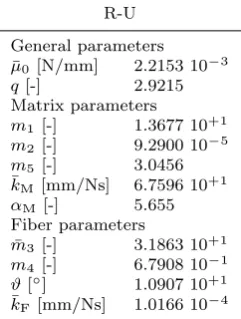
con-trol the dissipative behavior in the matrix and fibers, starting values were chosen such that both the relax-ation and creep response were qualitatively captured. Minimization of the objective function was performed based on the MATLAB routine fminsearch. The para-meter set obtained by this means is given in Table 1.

Table 1 Parameters representing the fitting to the mean re-laxation curve under uniaxial tension configuration.

R-U

General parameters ¯

µ0[N/mm] 2.2153 10−3 q[-] 2.9215 Matrix parameters

m1[-] 1.3677 10+1 m2[-] 9.2900 10−5

m5[-] 3.0456

¯

kM[mm/Ns] 6.7596 10+1

αM[-] 5.655

Fiber parameters ¯

m3[-] 3.1863 10+1 m4[-] 6.7908 10−1 ϑ[◦] 1.0907 10+1

¯

kF[mm/Ns] 1.0166 10−4

After identifying the parameters by adjustment of the model to the mean relaxation curve, the model was compared to each individual experiment in a second step, where all parameters except the factor ¯µ0 were

kept constant. The specimen specific ¯µ0 was

determ-ined by comparing one single value from experiment and simulation. In the uniaxial and strip-biaxial relax-ation tests, this value was the peak tension at the end of the (sample specific) loading ramp. For uniaxial creep tests, the value ofλ1at the beginning of the creep phase

(8)

3 Results

3.1 Mean relaxation response

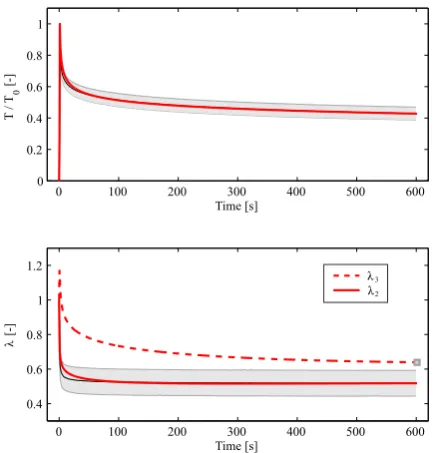
The fitted volumetric time-dependent model is shown in Fig. 2 and compared with the mean experimental data from Mauri et al [2015c]. The proposed model formula-tion nicely captures the large tension relaxaformula-tion char-acteristic of the amnion and its corresponding volume changes. The in-plane contraction is slightly underes-timated in the initial relaxation phase; however this dif-ference lies within the standard deviation of the exper-imental results (gray shadow). The out-of-plane stretch λ3 slightly increases in the first 0.5 s of the very fast

loading and finally reaches the long-term value experi-mentally observed in Mauri et al [2015c].

0 100 200 300 400 500 600

0.4 0.6 0.8 1 1.2

Time [s]

λ

[-]

0 100 200 300 400 500 600

0 0.2 0.4 0.6 0.8 1

T/T

0

[-]

Time [s]

λ λ

2 3

Fig. 2 Fit of the model to the mean relaxation response of the amnion under uniaxial tension configuration (R-U). The experimental mean and standard deviation are shown in gray, and the model in red. The model is able to nicely represent the tension relaxation of the amnion and its in-plane (solid line) and out-of plane (dashed line) kinematic behavior.

3.2 Sample-specific relaxation curves

The model response after adjustment of the parameter ¯

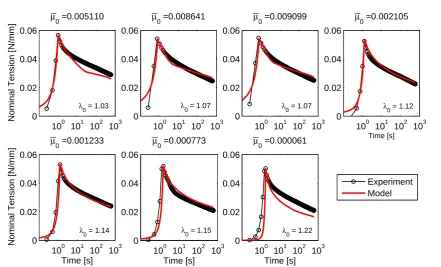
µ0is shown for each experimental curves in Fig. 3.

Spe-cimens with a behavior in the variability spread are very well captured with the fit of this single parameter. Note that the logarithmic scale enhances the differences

between model and experiment in the loading phase of the relaxation tests, and that few experimental data points were available for the very fast loading phase (less than 2 s) as a result of limitations in the rate of image acquisition. Thus, the differences between model and experiments in the loading regime are due to the fact that the loading phase has not been considered during the parameter identification of the model.

3.3 Prediction of uniaxial creep and strip-biaxial relaxation experiments

This model calibrated with the uniaxial relaxation (R-U) experiments is able to reproduce the very small creep accumulation typical of soft tissues and reported for the human amnion in Mauri et al [2015c]. The variab-ility of the specimens in the uniaxial creep experiments (C-U) could likewise successfully be accounted for by adjustment of the parameter ¯µ0. We restrict in Fig. 4

to presenting the best and worst fitting obtained, to demonstrate the robustness of this procedure. In both cases, the model is able to capture the very small creep strain accumulation in the loading direction and the corresponding creep accumulation in the transverse dir-ection - in addition to the strong lateral contraction during loading. The largest discrepancy between the model and the experimental data occurs in the first part of the fast loading, similarly as for the relaxation experiments.

100 101 102 103 0.4

0.5 0.6 0.7 0.8 0.9 1 1.1 1.2

Time [s]

λ2

[−]

λ1

[−]

Best Fit

100 101 102 103 0.5

0.6 0.7 0.8 0.9 1 1.1 1.2

Time [s] Worst Fit

Exp. Model

Fig. 4 The in-plane stretches under uniaxial creep configur-ation (C-U) are shown for the best and worst model fit. The reported curves include the initial loading up to the constant creep force.

[image:8.595.51.268.322.549.2] [image:8.595.312.524.483.599.2]
(9)

100 101 102 103 0

0.02 0.04 0.06

Time [s]

μ0 =0.000061

Experiment Model

100 101 102 103 0

0.02 0.04 0.06

Time [s]

μ0 =0.000773

100 101 102 103 0

0.02 0.04 0.06

Time [s]

Nominal Tension [N/mm]

μ0 =0.001233

100 101 102 103 0

0.02 0.04 0.06

Time [s] μ0 =0.002105

100 101 102 103 0

0.02 0.04 0.06

μ0 =0.009099

100 101 102 103 0

0.02 0.04 0.06

μ0 =0.008641

100 101 102 103 0

0.02 0.04 0.06

Nominal Tension [N/mm]

μ0 =0.005110

λ0 = 1.03 λ0 = 1.07 λ0 = 1.07 λ

0 = 1.12

λ0 = 1.22

λ0 = 1.15

λ0 = 1.14

Fig. 3 The value of the ¯µ0parameter is shown for each R-U specimen. The agreement between experiments and model fitting

is remarkable, especially considering that the local stretch during relaxation (λ0) varies largely among specimens (from 1.07

to 1.22).

relaxation behavior in R-B tests is considerably differ-ent from the R-U case [Mauri et al, 2015c]. In particular, the tension level after 10 min drops to 53% of the initial value for strip-biaxial and to 46% for the uniaxial con-figurations. Similarly as for the C-U data, the best and worst fit are reported in Fig. 5. Although, the model seems to overestimate slightly the nominal tension in the long-term regime, the overall fit is very good for a model calibrated with only uniaxial relaxation data.

100 101 102 103 0

0.01 0.02 0.03 0.04 0.05 0.06

Time [s]

Nominal Tension [N/mm]

Best Fit

100 101 102 103 0

0.01 0.02 0.03 0.04 0.05 0.06

Time [s] Worst Fit

Exp. Model

λ0 = 1.09

λ0 = 1.11

Fig. 5 The best and worst fits are shown for the tension relaxation under strip-biaxial configuration (R-B).

[image:9.595.67.509.82.349.2]

The specimen-specific parameter (¯µ0) is reported in

Table 2 for all considered experiments, showing a vari-ability in the same order of magnitude of the experimental-curves. Notably, its value is also visibly affected by the

origin of the membrane, see e.g. M1 and M2, indic-ating that the distribution of the parameter (¯µ0)

[image:9.595.339.496.535.719.2] [image:9.595.51.271.544.656.2]

in-cludes both the inter- and intra-subject variability of the healthy human amnion.

Table 2 Specimen-specific parameter ¯µ0for all membranes.

Specimen Membrane µ¯0 [N/mm]

(10)

4 Discussion

4.1 Large tension relaxation but very small creep strain accumulation

This volumetric viscoelastic model based on the frame-work proposed by Rubin and Bodner [2002] was de-veloped to capture the macroscopic and microscopic mechanical behavior of the human amnion as repor-ted in Mauri et al [2015c]. The large volume reduc-tion observed experimentally motivated the compress-ible formulation of the viscoelastic model. The 11 para-meters contained in the model were fitted to the re-laxation response under uniaxial tension configuration (cf. Table 1 and Fig. 2) and used to predict the re-sponse of the uniaxial creep (Fig. 4) and strip-biaxial relaxation (Fig. 5) experiments. The viscoelastic be-havior of human amnion, especially the interrelation of large tension reduction during relaxation and the very small strain accumulation during creep are en-compassed in this model. This interrelation is a charac-teristic of many soft biological tissues [Thornton et al, 2001; Lakes and Vanderby, 1999] and is missing in the quasilinear viscoelastic (QLV) formulation [Thornton et al, 1997; Haslach, 2005; Oyen et al, 2005; Sopakay-ang and De Vita, 2011; Anssari-Benam et al, 2012].

Although this model remains phenomenological, e-lastic and dissipative effects can be associated with mat-rix and fiber components, based on insights gained with detailed experimental investigations. The present for-mulation is able to capture the two mechanisms sugges-ted in Mauri et al [2015c] for the time-dependent beha-vior of the amnion, i.e. a short-term relaxation response related to fiber alignment and water outflow from the matrix on the one hand, and a long-term relaxation related to dissipative fiber behavior on the other one. The coupling between the matrix and the fibers is very strong and determines the resulting equilibrium in the model.

This approach allowed the formulation of a simple model able to reproduce the compressible and time-dependent behavior of human amnion under different multiaxial loading conditions in both relaxation and creep states.

4.2 Inter- and intra-subject variability

Large variability between specimens has typically been observed in previous investigations of the human am-nion [e.g. Jabareen et al, 2009; B¨urzle and Mazza, 2013] and is reflected by the scatter of the specimen-specific parameter (¯µ0). El Khwad et al [2005] reported a similar

inter- and intra-patient variability in the value of FM

strength, which is even larger if specimens of the cer-vical region are considered. This variability is intrinsic in the material inhomogeneity and correlates with the amount of collagen in the tissue [B¨urzle et al, 2013]. We believe that the variability in mechanical response is in-duced by a different amount of mechanically significant material in the specimen, rather than by differences in its internal organization and microstructure. This hy-pothesis is in agreement with the results of the renor-malization procedure proposed in Mauri et al [2015c], where the relative shift of the curves is neutralized by the normalization of the curves at the common peak force and would also explain the very small variability observed in the normalized curves of the relaxation data [Mauri et al, 2015c; Oyen et al, 2004]. Correspondingly, the differences between specimens can be explained in the proposed modeling formulation by one single para-meter ¯µ0 = Hµ0, which is a coefficient of all tension

components (cf. Eqns. (21)).

M1 M2 M3 M4 M5

0 0.002 0.004 0.006 0.008 0.01 0.012

μ0

[N/mm]

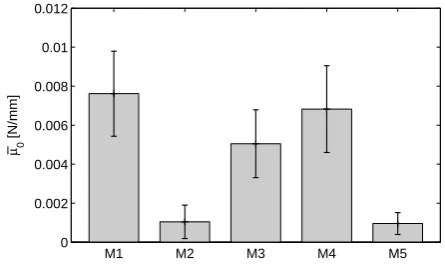
Fig. 6 Distribution of the modeling parameter ¯µ0within

dif-ferent patients. Parameter values are reported for each mem-brane (M) as mean±standard deviation.

As opposed to patient-specific simulations (e.g. Jac-obs et al [2014]), where the complete material model is specifically defined for each patient, the presented model can be applied to any FM, with only ¯µ0 as

pa-tient specific input. The distribution of ¯µ0contains the

inter- and intra-patient variability (see Fig. 6) and can be used to define a confidence interval representative of the healthy term human amnion. This new interpreta-tion of the model parameter ¯µ0 represents a first step

[image:10.595.300.523.352.485.2]
(11)

4.3 Limitations and future directions

Based on the parameter set reported in Table 1, the equibiaxial creep behavior under constant tension was simulated and compared to the first cycle of the creep inflation experiments in [Mauri et al, 2015c], the res-ults of which were provided in terms ofd/d0, the

accu-mulated apex displacementdof the inflated membrane with respect to the displacement d0 at the beginning

of the creep phase. Adjustment of ¯µ0 and a

meaning-ful quantitative comparison of the model with the test data is only possible by inverse FE analysis. As a first approximation, however,d/d0 is comparable to the

ra-tioε/ε0, whereε=λ−1 denotes the in-plane strain in

the equibiaxially stretched membrane and, again, the subscript 0 refers to its value at the beginning of the creep phase. The result shown in Fig. 7 indicates that

0 100 200 300 400 500 600 1

1.05 1.1 1.15

Time [s]

d/d

0

[−]

ε

/

ε0

[−]

C−EB model

C−I 1st

Fig. 7 Prediction of creep in planar equibiaxial tension based on the parameters in Table 1 and comparison with the exper-imentally observed ratio of apex displacement in creep infla-tion experiments [Mauri et al, 2015c].

the long-term accumulation of biaxial creep strain is significantly over-predicted by the model. While it is possible to avoid this discrepancy by a more involved formulation of the dissipative rates Γi

F (cf. Eq. (22)),

this optimization is beyond the scope of this study, which aimed at the definition of a very simple model formulation able to reproduce the interrelation of uni-axial relaxation and creep behavior.

Generally, a modification ofΓM and ΓFi, which are

presently given by simple phenomenological formula-tions, bears great potential for an improvement of the model. In fact, for ΓM a relation with the theory of

porous media (TPM), see e.g. [de Boer, 2000] may be drawn by rewriting (6) such thatJetrd= ˙Je+ΓM. This

states that the change of current volume of contained water with tissue volume is composed of the change due to the actual (but very small) elastic compressibility, and ofΓM, which can thus be attributed to a

dissipat-ive flow of the water through the matrix. According to Darcy’s law, the latter should be driven by the pressure

gradient in the tissue. Here, due to the membrane di-mensions, the latter might be assumed to be dominated by the component in thickness direction [cf. with as-sumptions in Taber and Puleo, 1996]. Further, the flow may be assumed constant through the thickness, so that the pressure itself becomes the driving force. Indeed, ΓMdepends on the hydrostatic pressure term trσMein

the present formulation. Seen from this perspective, the power law down-weightingΓMwith reducing volume in

(22) might be motivated with a changing permeabil-ity as was realized in refined TPM models [Ehlers and Eipper, 1999].

The constitutive model developed in the present study can be used to investigate the deformation beha-vior, strength and fracture properties of non-pathological tissue at the end of gestation. Obviously, most clin-ical questions are related to the mechanclin-ical response of amnion earlier in pregnancy or in case of pathological conditions. Future investigations will address preterm tissue and tissues subjected to deterioration associated with biochemical agents [Moore et al, 2006]. The pro-posed model formulation might be used as a basis to define corresponding constitutive equations to analyze pathological conditions and to identify specific model parameter changes associated with tissue deterioration and preterm rupture. Systematic investigation of the relation between the effect of biochemical factors and mechanical properties will inform corresponding modi-fications of the model formulation in order to quantify the effect of e.g. inflammatory processes or decidual bleeding [Kumar et al, 2011] on the ability of amnion to resist physiological loading conditions.

5 Conclusion

A compressible and time-dependent model for the hu-man amnion has been formulated and validated. A new approach to the interpretation and definition of its para-meters has been presented, which allows representing the intra- and inter-membrane variability with one single parameter. This approach demonstrated the predictive capabilities of the selected formulation for relaxation and creep in uniaxial and biaxial loading states.

[image:11.595.49.269.325.438.2]
(12)

enabled a 3-month visiting professorship at the ETH Zurich during the first half of 2013.

Appendix

Experimental materials and methods

The experimental data published in Mauri et al [2015c] were used to calibrate and validate the proposed model. Additional tests were performed to increase the num-ber of R-U specimens from different membranes to bet-ter evaluate the model. For these additional amnion samples, after informed written consent of the patients was given (Ethical Committee of the District of Zurich Stv22/2006 and Stv07/07), preparation, testing and post processing were performed as described in Mauri et al [2015c]. All membranes were collected from term elect-ive caesarean sections. The model response under dif-ferent multiaxial relaxation and creep configurations was computed with the time, force and local strain his-tories of all experiments. The local in-plane stretches were extracted from the images recorded with 4 Hz through the video extensometer system, similarly to Perrini et al [2015]. The holding stretch in relaxation tests was defined by a target force [cf. Mauri et al, 2015c], which resulted in different values for the stretch due to the variability of the specimen properties. There-fore, the mean relaxation curve was calculated after synchronizing the times for which the target force was reached (times at peak). To simulate the complete de-formation history of the experiment, an according rep-resentative loading ramp with constant rate was gen-erated from the average local stretch and the average time at the peak.

References

Anssari-Benam A, Gupta HS, Screen HRC (2012) Strain transfer through the aortic valve. Journal of Biomechanical Engineering 134(6):061,003

Ateshian GA, Chahine NO, Basalo IM, Hung CT (2004) The correspondence between equilibrium biphasic and triphasic material properties in mixture mod-els of articular cartilage. Journal of Biomechanics 37(3):391–400

Atkinson TS, Haut RC, Altiero NJ (1997) A poroelastic model that predicts some phenomenological re-sponses of ligaments and tendons. Journal of Bio-mechanical Engineering 119(4):400–405

Barbarino GG, Jabareen M, Mazza E (2011) Experi-mental and numerical study on the mechanical beha-vior of the superficial layers of the face. Skin Research and Technology 17(4):434–444

Beck V, Lewi P, Gucciardo L, Devlieger R (2012) Pre-term prelabor rupture of membranes and fetal sur-vival after minimally invasive fetal surgery: A sys-tematic review of the literature. Fetal Diagnosis and Therapy 31(1):1–9

de Boer R (2000) Current State of Porous Media The-ory. Springer Berlin Heidelberg

Bourne G (1962) The foetal membranes. Postgraduate Medical Journal 38:193–201

B¨urzle W, Mazza E (2013) On the deformation be-havior of human amnion. Journal of Biomechanics 46(11):1777–1783

B¨urzle W, Haller CM, Jabareen M, Egger J, Mallik AS, Ochsenbein-K¨olble N, Ehrbar M, Mazza E (2013) Multiaxial mechanical behavior of human fetal mem-branes and its relationship to microstructure. Bio-mechanics and Modeling in Mechanobiology 12:747– 762

Coleman BD, Gurtin ME (1967) Thermodynamics with internal state variables. The Journal of Chemical Physics 47(2):597–613

Devlieger R, Millar L, Bryant-Greenwood G, Lewi L, Deprest J (2006) Fetal membrane healing after spon-taneous and iatrogenic membrane rupture: A review of current evidence. American Journal of Obstetrics and Gynecology 195(6):1512–1520

Doehring TC, Freed AD, Carew EO, Vesely I (2005) Fractional order viscoelasticity of the aortic valve cusp: An alternative to quasilinear viscoelasticity. Journal of Biomechanical Engineering 127(4):700– 708

Ehlers W, Eipper G (1999) Finite elastic deformations in liquid-saturated and empty porous solids. Trans-port in Porous Media 34(1-3):179–191

Ehlers W, Karajan N, Markert B (2006) A porous me-dia model describing the inhomogeneous behaviour of the human intervertebral disc. Materialwissenschaft und Werkstrofftechnik 37(6):546–551

Ehret AE (2011) Generalised concepts for constitutive modelling of soft biological tissues. Dissertation RWTH Aachen University, Lehr-und Forschungsge-biet Kontinuumsmechanik

Ehret AE, Itskov M (2007) A polyconvex hypere-lastic model for fiber-reinforced materials in applic-ation to soft tissues. Journal of Materials Science 42(21):8853–8863

Ehret AE, Itskov M (2009) Modeling of anisotropic softening phenomena: Application to soft biological tissues. International Journal of Plasticity 25(5):901– 919

(13)

weak zone overlying the lower uterine pole and cer-vix before onset of labor. Biology of Reproduction 72(3):720–726

Flory P (1961) Thermodynamic relations for high elastic materials. Transactions of the Faraday Society 57:829–838

Flynn C, Rubin M (2014) An anisotropic discrete fiber model with dissipation for soft biological tissues. Mechanics of Materials 68:217–227

Fung YC (1993) Biomechanics: Mechanical properties of living tissues. New York: Springer-Verlag

Grashow JS, Sacks MS, Liao J, Yoganathan AP (2006) Planar biaxial creep and stress relaxation of the mitral valve anterior leaflet. Annals of Biomedical Engineering 34(10):1509–1518

Haslach HWJ (2005) Nonlinear viscoelastic, thermody-namically consistent, models for biological soft tis-sue. Biomechanics and Modeling in Mechanobiology 3(3):172–189

Haupt P (2002) Continuum mechanics and theory of materials, second edition edn. Springer-Verlag Berlin Heidelberg New York

Helfenstein J, Jabareen M, Mazza E, Govindjee S (2010) On non-physical response in models for fiber-reinforced hyperelastic materials. International Journal of Solids and Structures 47(16):2056–2061 Hingorani RV, Provenzano PP, Lakes RS, Escarcega A,

Vanderby J Ray (2004) Nonlinear viscoelasticity in rabbit medial collateral ligament. Annals of Biomed-ical Engineering 32(2):306–312

Hollenstein M, Jabareen M, Rubin M (2013) Modeling a smooth elastic-inelastic transition with a strongly objective numerical integrator needing no iteration. Computational Mechanics 52(3):649–667

Holzapfel GA (1996) On large strain viscoelasticity: Continuum formulation and finite element applica-tions to elastomeric structures. International Journal for Numerical Methods in Engineering 39(22):3903– 3926

Holzapfel GA (2000) Nonlinear solid mechanics: a con-tinuum approach for engineering. West Sussex, Eng-land: John Wiley & Sons, Ltd

Jabareen M, Mallik AS, Bilic G, Zisch AH, Mazza E (2009) Relation between mechanical properties and microstructure of human fetal membranes: An attempt towards a quantitative analysis. European Journal of Obstetrics & Gynecology and Reproduct-ive Biology 144:S134–S141

Jacobs NT, Cortes DH, Peloquin JM, Vresilovic EJ, Elliott DM (2014) Validation and application of an intervertebral disc finite element model utilizing in-dependently constructed tissue-level constitutive for-mulations that are nonlinear, anisotropic, and

time-dependent. Journal of Biomechanics 47(11):2540– 2546

Kumar D, Schatz F, Moore R, Mercer B, Rangaswamy N, Mansour J, Lockwood C, Moore J (2011) The ef-fects of thrombin and cytokines upon the biomech-anics and remodeling of isolated amnion membrane, in vitro. Placenta 32(3):206–213

Lakes RS, Vanderby R (1999) Interrelation of creep and relaxation: A modeling approach for ligaments. Journal of Biomechanical Engineering 121(6):612– 615

Lavery JP, Miller CE (1977) The viscoelastic nature of chorioamniotic membranes. Obstetrics and Gyneco-logy 50(4):467–472

Limbert G, Middleton J (2004) A transversely isotropic viscohyperelastic material: Application to the model-ing of biological soft connective tissues. International Journal of Solids and Structures 41(15):4237–4260 Mauri A, Perrini M, Mateos J, Maake C,

Ochsenbein-K¨olble N, Zimmermann R, Ehrbar M, Mazza E (2013) Second harmonic generation microscopy of fetal membranes under deformation: Normal and altered morphology. Placenta 34(11):1020–1026 Mauri A, Ehret A, De Focatiis D, Mazza E (2015a)

Characterization and modeling of the mechanical be-havior of human amnion. In: Proceedings of the 16th International Conference on Deformation, Yield and Fracture of Polymers, Kerkrade, NL

Mauri A, Ehret AE, Perrini M, Maake C, Ochsenbein-K¨olble N, Ehrbar M, Oyen ML, Mazza E (2015b) De-formation mechanisms of human amnion: Quantitat-ive studies based on second harmonic generation mi-croscopy. Journal of Biomechanics 48(9):1606–1613 Mauri A, Perrini M, Ehret AE, Focatiis DSD, Mazza E

(2015c) Time-dependent mechanical behavior of hu-man amnion: Macroscopic and microscopic charac-terization. Acta Biomaterialia 11:314–323

Mazza E, Papes O, Rubin M, Bodner S, Binur N (2005) Nonlinear elastic-viscoplastic constitutive equations for aging facial tissues. Biomechanics and Modeling in Mechanobiology 4(2-3):178–189

Mazza E, Nava A, Hahnloser D, Jochum W, Bajka M (2007) The mechanical response of human liver and its relation to histology: An in vivo study. Medical Image Analysis 11(6):663–672

Menon R, Nicolau NN, Bredson S, Polettini J (2015) Fetal membranes: Potential source of preterm birth biomarkers. General Methods in Biomarker Research and their Applications pp 483–529

(14)

Nguyen T, Jones R, Boyce B (2007) Modeling the aniso-tropic finite-deformation viscoelastic behavior of soft fiber-reinforced composites. International Journal of Solids and Structures 44(25-26):8366–8389

Oxlund H, Helmig R, Halaburt J, Uldbjerg N (1990) Biomechanical analysis of human chorioamniotic membranes. European Journal of Obstetrics & Gynecology and Reproductive Biology 34(3):247–255 Oyen ML, Calvin SE, Cook RF (2004) Uniaxial stress-relaxation and stress-strain responses of human am-nion. Journal of Materials Science: Materials in Medi-cine 15(5):619–624

Oyen ML, Cook RF, Stylianopoulos T, Barocas VH, Calvin SE, Landers DV (2005) Uniaxial and biaxial mechanical behavior of human amnion. Journal of Materials Research 20(11):2902–2909

Oyen ML, Calvin SE, Landers DV (2006) Premature rupture of the fetal membranes: Is the amnion the major determinant? American Journal of Obstetrics and Gynecology 195(2):510–515

Perrini M, Mauri A, Ehret AE, Ochsenbein-K¨olble N, Zimmermann R, Ehrbar M, Mazza E (2015) Mech-anical and microstructural investigation of the cyclic behavior of human amnion. Journal of Biomechanical Engineering 137(6):061,010

Pierce DM, Maier F, Weisbecker H, Viertler C, Ver-brugghe P, Famaey N, Fourneau I, Herijgers P, Holza-pfel GA (2015) Human thoracic and abdominal aortic aneurysmal tissues: Damage experiments, statistical analysis and constitutive modeling. Journal of the Mechanical Behavior of Biomedical Materials 41:92– 107

Pr´evost TP (2006) Biomechanics of the human chori-oamnion. Master’s thesis, Massachusetts Institute of Technology

Reeps C, Bundschuh RA, Pellise k J, Herz M, van Marwick S, Schwaiger M, Eckstein HH, Nekolla SG, Essler M (2013) Quantitative assessment of glucose metabolism in the vessel wall of abdominal aortic an-eurysms: correlation with histology and role of par-tial volume correction. The International Journal of Cardiovascular Imaging 29(2):505–512

Rubin M (1989) A time integration procedure for plastic deformation in elastic-viscoplastic metals. Zeitschrift f¨ur angewandte Mathematik und Physik ZAMP 40(6):846–871

Rubin M (1994a) Plasticity theory formulated in terms of physically based microstructural variables-part i. theory. International Journal of Solids and Structures 31(19):2615–2634

Rubin M (1994b) Plasticity theory formulated in terms of physically based microstructural variables-part ii. examples. International Journal of Solids and

Struc-tures 31(19):2635–2652

Rubin M (1996) On the treatment of elastic deforma-tion in finite elastic-viscoplastic theory. Internadeforma-tional Journal of Plasticity 12(7):951–965

Rubin M, Bodner S (2002) A three-dimensional non-linear model for dissipative response of soft tis-sue. International Journal of Solids and Structures 39(19):5081–5099

Rubin M, Papes O (2011) Advantages of formulating evolution equations for elastic-viscoplastic materials in terms of the velocity gradient instead of the spin tensor. Journal of Mechanics of Materials and Struc-tures 6(1):529–543

Safadi M, Rubin M (2014) Modeling rate-independent hysteresis in large deformations of preconditioned soft tissues. International Journal of Solids and Struc-tures 51(18):3265–3272

Schriefl AJ, Schmidt T, Balzani D, Sommer G, Holzap-fel GA (2015) Selective enzymatic removal of elastin and collagen from human abdominal aortas: Uniaxial mechanical response and constitutive modeling. Acta Biomaterialia 17:125–136

Simo J (1992) Algorithms for static and dynamic multi-plicative plasticity that preserve the classical return mapping schemes of the infinitesimal theory. Com-puter Methods in Applied Mechanics and Engineer-ing 99(1):61–112

Simo J, Taylor R (1982) Penalty function formula-tions for incompressible nonlinear elastostatics. Com-puter Methods in Applied Mechanics and Engineer-ing 35(1):107–118

Simo JC, Hughes TJ (2000) Computational Inelasti-city, Interdisciplinary applied mathematics, vol 7. Springer-Verlag, Berlin

Sopakayang R, De Vita R (2011) A mathematical model for creep, relaxation and strain stiffening in parallel-fibered collagenous tissues. Medical Engineering & Physics 33(9):1056–1063

Taber LA, Puleo AM (1996) Poroelastic plate and shell theories. In: Selvadurai A (ed) Mechanics of Poroelastic Media, Solid Mechanics and Its Applic-ations, vol 35, Springer Netherlands, pp 323–337 Thornton GM, Oliynyk A, Frank CB, Shrive NG (1997)

Ligament creep cannot be predicted from stress re-laxation at low stress: A biomechanical study of the rabbit medial collateral ligament. Journal of Ortho-pedic Research 15(5):652–656

Thornton GM, Frank CB, Shrive NG (2001) Ligament creep behavior can be predicted from stress relaxa-tion by incorporating fiber recruitment. Journal of Rheology (1978-present) 45(2):493–507

(15)

fi-nite element formulation based on the relative de-formation gradient. International Journal for Numer-ical Methods in BiomedNumer-ical Engineering 30(11):1238– 1262

Figure

Fig. 1 Comparison of lateral in-plane (λ2) and out-of-plane(λ3) stretches vs. stretch in loading direction in uniaxial ten-sion for the incompressible model with planar fibers [B¨urzleand Mazza, 2013] and the refined, compressible model withslightly inclined
Table 1 Parameters representing the fitting to the mean re-laxation curve under uniaxial tension configuration.
Fig. 2 Fit of the model to the mean relaxation response ofthe amnion under uniaxial tension configuration (R-U)
Fig. 3 The value of the ¯is remarkable, especially considering that the local stretch during relaxation (µ0 parameter is shown for each R-U specimen
+3

References

Related documents

Method: This study investigates patients with type 2 diabetes and hypertension for which concentrations of total high-density lipoprotein (HDL) and low-density lipoprotein

In order to estimate whether starting in different positions of model state space has an impact on predictability, we calculated the anomaly correlation and NRMSE metrics again but

It examined the determinants of female's involvement and commitment in the higher education institutions in Saudi Arabia and the relationship between females'

Experiments were designed with different ecological conditions like prey density, volume of water, container shape, presence of vegetation, predator density and time of

Race condition is an error in clinical programming software which results when two processes try to access the same resource and the result depends on the transaction of

Passed time until complete analysis result was obtained with regard to 4 separate isolation and identification methods which are discussed under this study is as

Therefore, no agreement exists among the groups as to the legitimate methods for resolving conflict; this leads to military interference in politics that most commonly takes the