JDDJ!.!3117
IDENTIFICATION AND CLASSIFICATION OF PROJECT MANAGERS’
KNOWLEDGE NEEDS
Muzani Mustapa1, Fara Diva Mustapa2 , Fuziah Ismail3 and Khairul Anwar Hj Husin4 1,2,3,
Department of Quantity Surveying, Universiti Teknologi Malaysia, UTM Skudai 81310, Johor Bahru, Malaysia
[email protected],[email protected],[email protected]
4
Faculty of Engineering & Technical Studies, Open University Malaysia
ABSTRACT: This paper is set-out to identify and classify knowledge and skills areas that
construction project manager had to acquire in order to deliver the project successfully. Classifications of their knowledge are drawn apart from the correlation between determination of project success and project management besides established from project management ‘Body of Knowledge’. Range of project managers were interviewed in order to determine their knowledge needs and assessed on its impact and value to the project.
Keywords: Classification, knowledge, impact and value, project manager.
1. INTRODUCTION
Project management in construction encompasses a set of objectives which may be
accomplished by implementing a series of operations subject to resource constraints.
There are potential conflicts between the stated objectives with regard to scope, cost,
time and quality, and the constraints imposed on human material and financial
resources (Hendrickson and Tung, 1998). Hence, it is understandable that in a context
of great uncertainty and on going competition, all projects will impose different
challenges particularly on those involve in managing the project. The project manager
is responsible for planning, organising and controlling the project. In order to deliver
successful project, project manager and his team have to clearly understand what
factors and criteria in the project needs to be managed.
Thus, to become a successful project manager who responsible in managing the
successful project, he or she needs to posses an appropriate level of knowledge and
skills. By possessing such knowledge on project management techniques, project
managers would be able to plan and execute their construction projects to maximise the
chances of project to success. Accordingly, this paper determines the knowledge and
skills required by project managers in undertaking their jobs in construction project as
its principal focus. It sets out to explore the wider range of knowledge and skills of
JDDJ!.!3117
Following that, the identification and classification of their knowledge are
developed. A number of project managers from construction background were
interviewed and assessed on their perceptions about project success, current knowledge
and skills and also impact of personal attitudes in delivering the project. In turn, the
perceptions of their knowledge needs were then given by all hierarchical of
construction project managers.
2. OVERVIEW OF PROJECT MANAGERS’ KNOWLEDGE
In a construction project, project management can be defined as the process by which
the project manager plans and controls tasks or activities within the project and
harnesses the resources available such as people, material, time, money, information,
knowledge, equipment and space to achieve set goals, standards and objectives (De Wit,
1988). Due to this diverse and complex nature of the project system, Goodwin (1993)
suggests project integration as one of the key functions of the project manager.
Consequently, this function requires a broad base of knowledge and skills.
The knowledge areas required by project managers for practice transcend the
scope covered by the professional and accreditation bodies. Although the term ‘Body of
Knowledge’ itself reflects the list of knowledge and skills required by professional
project manager, it is not a guarantee for construction project manager to perform their
tasks. Modern project management practice therefore, demands other general and
management knowledge, coupled with skills that extend beyond the technical aspects
of traditional engineering areas.
Generally, the Project Management Body of Knowledge (PMBOK) outlined by
Project Management Institute (2000) contains a wealth of literature and training
material dealing with every aspect of project management from scope control to
financial management, from estimating to team building, from communication to
contracting, and more. Nevertheless, these documented ‘Body of Knowledge’ are more
accurately described as project management knowledge classification structures
(Curling, 1995). Thus, it must be developed and attained through training, experience
JDDJ!.!3117
3. RESEARCH METHODOLOGY
This section outlines the methodologies that guide this project and the measures taken
to obtain the necessary data. According to Creswell (2003), the use of mixed method
approaches between both qualitative and quantitative methods in the one study are
become widely accepted. Thus, this study will use a survey approach (quantitative
approach) that incorporates qualitative in-depth interview made across six construction
project managers from various levels of experiences. The qualitative methods will
include identification of project manager’s knowledge needs from their perception. In
sequence, this qualitative data will be used to establish a classification of construction
project managers’ knowledge.
3.1 Qualitative Approach
The in-depth interviews along with questionnaires were adopted as a means in
facilitated their perceptions on level of knowledge needed in undertaking their tasks. In
all, six (6) respondents from four contractor firms were interviewed. Interviews were
broken down into three different categories based on their level of experience and their
discipline, in order to gain different perception on their knowledge needed in each
category. These are namely junior (0-5 years), middle (6-10 years) and senior level
(more than 11 years). The entire project managers were interviewed has obtained and
qualified for membership from their professional institutions. Thus, consequently
indicate that all respondents have basic understanding, capable and possess necessary
knowledge in their particular field. The tabulation of project managers’ qualification
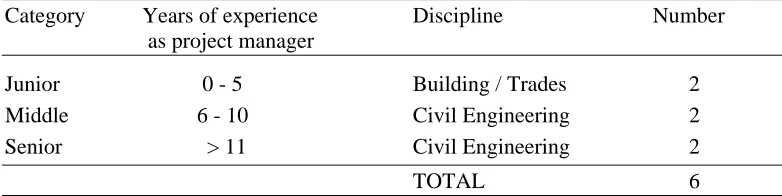
according to their categories are shown in Table 1.
Table 1. Profile of Interview Sample
Category Years of experience Discipline Number as project manager
Junior 0 - 5 Building / Trades 2
Middle 6 - 10 Civil Engineering 2
Senior > 11 Civil Engineering 2
TOTAL 6
Throughout an interview, relevant information about determination of project
success in the project management and its relationship with knowledge, competence
and skills can be gained. In addition, crucial and significant knowledge needed from the
JDDJ!.!3117
3.2 Quantitative Approach
As elicitations of information gathered through interviews are generally qualitative, the
technique of scales derived from questionnaire was therefore adopted to enable
quantitative analysis for the various information and notions expressed by the
respondents. Evaluations were made on the crucial phases of construction project
encountered by project managers in applying their knowledge and skills and the ranks
of importance of knowledge and skills needed by project managers.
4. RESEARCH FINDINGS
4.1 Identification and Classification of Project Manager’s Knowledge
Based on the literature reviewed, project managers’ knowledge and skills had been
identified fall under two main categories which is primary knowledge and secondary
knowledge. As a construction project manager viewed as an expert who is proficient at
providing effective solutions and managing project, he requires a sort of knowledge and
skills which is came from experience and learning process. Thus, the identification of
explicit and implicit knowledge tends to be more reflect to the knowledge that project
manager possess.
a. Classification of Project Managers’ Explicit Knowledge
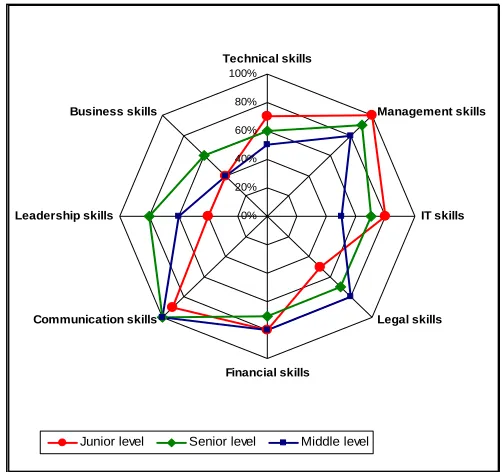
All project managers from the three different categories; junior, middle and senior
level have indicated the need for a diverse set of knowledge and skills as mapped in
Figure 2.
0% 20% 40% 60% 80% 100%
Technical skills
Management skills
IT skills
Legal skills
Financial skills Communication skills
Leadership skills Business skills
Junior level Senior level Middle level
JDDJ!.!3117
Communication and management skills indicated the most essential knowledge
and skills needed by all level of project managers relatively. Meanwhile, the
financial skills were consistently indicated as the knowledge needed by all level of
project managers with an average of 80%. For other knowledge and skills such as
information technology (IT), legal, leadership and business are plotted randomly for
its importance across all project manager categories. Surprisingly, technical
knowledge is relatively the least essential project management skill with an average
percentile score of 60% compared to management, communication and financial
skills in all categories.
Apart from business skills, it indicates that project managers at the senior level
are more concerned with the business aspects compared to middle and junior level
project manager. While, in discussing the knowledge needed by each category,
leadership skills have shown a significant knowledge needs by senior project
managers while both the other groups did not. Apparently, from the result it shows
that leadership skills are amongst the lowest knowledge and skills needed rated by
junior project managers. It is believed that in such level, these skills are relatively
less applied due to their less exposure in managing the projects. Accordingly, it is
evident that across the level of project managers, the need for leadership skills is
more significant.
As mentioned by the one of senior project manager interviewed, the
fundamental key in the project management is about managing people and
leadership skills and not necessary on the technical aspect of the particular project.
Although the technical aspect of the project is essential but by having such
knowledge and skills in management aspect, project manager can acquire better
technical knowledge from his project team. Thus, with aid and teamwork spirit
within the project team, it ensures the project manager to deliver the project
successfully irrespective of any type of project.
In discussing about the needs of technical skills by each category, project
manager from junior level were observed as the highest category compared to
middle level and senior level. Instead of admitted a needs in technical knowledge,
both groups; middle and senior level project managers stated that the importance by
having technical knowledge is considered as a supportive knowledge and not an
essential knowledge to become a project manager due to the characteristic of
construction project that is different and unique for every single project. Thus, the
JDDJ!.!3117
consistent with those expressed by Edum-Fotwe and McCaffer (2000), whilst much
of the knowledge needed to manage the construction projects is unique to project
management. To summarise, communication and management skills are both two
highly rated skills and knowledge by project manager, thus represented the most
needed skills and knowledge by project manager in all level.
b. Classification of project managers’ implicit knowledge
In project management, the intuition based on experience resembles implicit
knowledge (Tobin, 1997). Implicit knowledge is considered as a part of integrated
knowledge of project manager. This question aims to identify the personalities
attributes as implicit knowledge for project managers in undertaking their job during
crucial phases of the project. Both junior project managers interviewed
acknowledged the personalities as a big issue in the construction industry nowadays.
In fact, the personalities of the project manager is essential in overcome conflict
arise during the construction phases despite of knowledge and skills he possesses.
Consequently, it ensures the project manager delivers the job efficiently.
In discussing on the criteria for nominating project manager to lead the project,
both junior project managers recognised the needs of experience and personalities
are important rather than needs of higher qualification. As emphasised by the project
managers interviewed, the ideal and effective project manager is a role model for
others. He also stated that an effective project manager leads by doing. Thus, project
manager are required to lead, correct and communicate with the team and workers.
Evidence from the questions about the selection of project managers indicates
that personalities are one of the major factors besides of experience and knowledge
on specific technical task. One of senior project managers interviewed who had been
involved in the recruitment and selection process of project managers in his
company affirmed that qualification and knowledge background in construction is
not a key essential to become a project manager. One of the key assessments in
selecting the project manager is personalities. However, this personality factor is
elusive knowledge for project manager. Another senior project manager interviewed
also mentioned the needs of personalities and individual factors have a contribution
to the project success. Whilst carry out the project with the same company or
organisation but with featuring different individuals, the result could not be the same
JDDJ!.!3117
4.2 Implication of Project Managers’ Knowledge in Project Life Cycle
Each phase in the construction projects are varied by its needs, characteristics and
requirements (Morris, 1998). Apparently, each project phase requires formal decision
point by the project manager. In order to assess the critical success factors in
construction projects, the project life cycle had been used as a yardstick on measuring
the critical success factors of the project. As the successful of project tends to be
measured against cost, time and quality, it is important for the project managers apply
their knowledge, either explicit or implicit during the project life-cycle. However, these
two classifications of knowledge seem to be applied mutually in all phases of project
life-cycle.
It perceived that each project phase involves different tasks and appropriate
knowledge and skills needed to perform by the project manager and his team. As a
result, all respondent were asked about their perception on applying knowledge and
skills throughout the project phases. It is observed that the crucial stage of the
construction project in applying the knowledge and skills by the project manager is
relatively crucial throughout the project phases from the pre-design stage until project
completion. As a project passes through its later phases and into routine operation, it
requires the project manager to effectively planned, organised, monitored and controlled
the tasks. In that, the project manager needs to rely and apply the knowledge and skills
they possess.
At the planning stage, project manager and his team focus on breaking down
projects into work package in order to allocate the resources to the project before
executing it. Thereby, apart from project managers’ explicit knowledge, knowledge and
skills such as technical knowledge and management are required at this stage. The used
of the implicit knowledge at this stage is heavily depends on their level of experience
and similarity of the project managed in the past. According to that, senior group of
project managers interviewed recognise that defining and understanding the client’s
needs in the project is essential.
Due to the largest impact upon the final cost outcome of a project is to be attained
during the earlier stages of project life-cycle that is design stage, the needs of implicit
knowledge such as decision making and communication are deemed to be necessary for
project managers. By having knowledge and skills in decision making, it can prevent
the project from running over the time period and budget. Thus, without such
JDDJ!.!3117
shown by a project manager to make quick and correct decisions, the project team tend
to lose confidence with the project manager.
At a construction stage whereas theoretically crucial stage for carrying on with
subsequent operations and thus for making the project a success, project managers’
implicit knowledge were needed and anticipated at this stage. As mentioned by the
project managers interviewed, during construction stage project manager needs to
effectively planned, organised, monitored and controlled the tasks. The implicit
knowledge anticipated during this stage is basically came from learning-experience
such as health and safety issues which require project managers’ own decision and
experience.
4.3 Impact and Value of Project Managers’ Knowledge in the Project
As discussed in the literature, characteristics of projects are considered as the influence
factor of the management of projects. Another aspect which is consistently referred to
is the organisational scope in which the project; the project manager and team are
required to operate. A project manager’s involvement in the phase of projects starting
with inception and concluding with project close-out is one of the person’s primary
roles. (Chan et al., 2004). Thus, question about how the project managers’ knowledge
had an impact and value to the project was posed to all respondents.
All the project managers indicated that project managers’ knowledge had an
impact and value to the project in various ways. One of the middle project manager
believed by having a general knowledge such as management and leadership, those
project manager can give an impact to both the client and project team. He referred to
the ability of project manager in coordinating resources and personalities in the project
team led the project to be completed on time, cost and quality. Besides of project
managers’ knowledge, the experience of project manager is also essential and
contributed to the value of the project they manage. Further, four of the project
managers agreed that by having an experience of the similar type of project, the project
manager can easily identified and rectified the problem arose during the construction
period.
The comments raised by the junior groups of project managers interviewed
emphasise that project manager can apply their knowledge on the specific area such as
technical, business, financial and information technology in order to give an added
value to the project. Thus, by posses all of the combination of that knowledge, project
JDDJ!.!3117
the project and minimising costs and completion of projects within time. In addition,
the value of project will increase, when it has a key purpose and focuses on mission and
strategic priorities of project that came from project managers’ knowledge.
A group of senior project manager had their own perception on how project
manager can add value to the project. They emphasised that a key enabler to enhance
the project value is through the project managers’ knowledge in management and their
personalities (implicit knowledge) hold in the project. Thereby, in managing and to
satisfying the parties involved in the project, it is essential for project manager to
ensure his project team do their work efficiently. It is by encouraging the team and
trusting the team to use their experiences, ability to encourage team to communicate
and ability to recognise strength and weaknesses of his project team.
It can be concluded that apart of project managers’ knowledge, combination of
explicit and implicit knowledge can enhance the project value. Risk, time, and quality
improvement are the indicators mentioned by the respondents on how project
managers’ knowledge can give an impact to the project value.
5. CONCLUSION
Throughout the discussion in this paper it was evident that in order for the project
manager to deliver the project successfully, he must posses a combination of explicit
and implicit knowledge and skills. Apart from the explicit knowledge that had been
classified, communication and management skills are both two highly rated skills and
knowledge by project manager, thus represented the most needed skills and knowledge
by project manager in all level irrespective of their level of experience and maturity. In
turn, the implicit knowledge needed by project manager is good personalities and
behaviour such as decision-making, self-confident, motivator, leadership, and
organisational commitment.
Subsequently, this implicit knowledge had been acknowledged as indirect
attribute to the project success. Apart from their combination of explicit and implicit
knowledge, it shows that such knowledge can enhance and bring the impact to the
project. In discussing about the crucial stages of project in applying project managers’
knowledge, it has been identified that throughout the project phases, it is more essential
for project manager to rely and apply on knowledge and skills they possess at each
phase. It requires the project manager to effectively planned, organised, monitored and
JDDJ!.!3117
Apart from the classification that has been made, it can be used for establishing
project managers’ knowledge requirements and as a basis for developing guidelines to
improve project managers’ knowledge needs and their career path. Through the
guidelines, assessment on level of knowledge required in such level of appointment can
be made. For organisation, particularly human resource manager it can be used as a tool
to measure project managers’ performance against a range of key performance criteria
based on measurable competencies and personality traits.
6. REFERENCES
Chan, P.C., Scott, D. and Chan, P.L. (2004), “Factor Affecting the Success of a Construction Project”, Journal of Construction Engineering and Management,
2004. Vol. 4, pp 153-155.
Creswell, J.W., (2003), Research Design: Qualitative, Quantitative and Mixed Method
Approaches, Sage Publication, London.
Curling, David H. (1995), “Editorial Session for Project Management Issue”,
International Journal of Project Management, Vol. 13(2), pp 67.
De Wit A. (1988), “A Measurement of Project Success”, International Journal of
Project Management, Vol. 6(11), 287-293
Edum-Fotwe, F.T. and McCaffer, R., (2000), “Developing Project Management Competency: Perspectives from the Construction Industry”. International Journal
of Project Management, Vol. 18, pp 111-124.
Goodwin RSC (1993), “Skills Required of Effective Project Managers”, Journal of
Management in Engineering, ASCE, 1993, Vol. 9 pp 217-226.
Hendrickson, C. and Tung, Au (1989), Project Management for Construction
Fundamental Concepts for Owners, Engineers, Architects, and Builders, Prentice
Hall, Pittsburg.
Morris, P. W. (1998), The Management of Projects, Thomas Telford, London.
Project Management Institute (2000), A Guide to The Project Management Body of
Knowledge (PMBOK Guide), Project Management Institute, Newtown Square.