Cluster Based Factors Promoting Knowledge Sharing
Ismail Bile Hassan
1 e-mail: [email protected]Mohd Zaidi Abd Rozan
2 e-mail: [email protected]Author(s) Contact Details:
1, 2
Faculty of Computer Science and Information Systems, Universiti Teknologi Malaysia, 81310, Skudai, Johor, Malaysia
Abstract - The achievement of economies in the future will be based on how organizations use, acquire, value and share knowledge effectively and efficiently particularly in knowledge–based organizations such as universities. Furthermore, most organizations are likely to over-emphasize on systems and tools, rather than on the disregarded but important knowledge sharing (KS) preferences within an organization. However, University research groups are knowledge-intensive institutions, where the knowledge creation and distribution are consistently practiced and factors that can play important role in promoting KS should be identified. This paper examined factors that can play important roles in promoting KS among different research groups and grouped it into similar preferences. Survey based methodology was utilized for this study from a population of 330 members of Universiti Teknologi Malaysia’s Knowledge Economy Research Alliance (RAKE). Questionnaire items were designed based on the concepts of factors promoting KS and a two-step Cluster Analysis procedure was applied onto 80 responses received by forming two clusters. The study result examined that respondents in cluster 1 believe that KS can become a culture in university research groups if top management regularly supports and reinforces KS practice while respondents in cluster 2 separately agree that availability of technical documents such as research reports and templates for reference which could promote KS. Further study can be conducted by proposing cluster based academic researcher recommendation approach that can suit academic researchers with different character set of KS and this will enable fully utilization of knowledge.
Keywords – knowledge sharing; factors promoting knowledge sharing; university research groups; cluster analysis
1. INTRODUCTION
Knowledge is a valuable resource for keeping important heritage, establishing core competences, learning new things, solving problems and initiating new era for the organizations and people from now and in the future. It is not something strange that the importance of an organization is partly presented by the physical resources of the organization. For instance, sophisticated devices, building infrastructure and funds exemplify these resources. The additional importance of manufactured goods is mainly shown by the past familiarity and understanding of the expert employees who designed and introduced it to the world. This experience is commonly tacit knowledge that is difficult to capture since it is residing in the brain of the people [1].
One well-known feature that has prepared the innovative economy distinctive is that it deals with a distinctive source called “knowledge”. Dissimilar other conventional assets, i.e. land, labor and capital to an extent point, once it is disseminated and shared, knowledge turn into an unrestricted asset [7]. The non-exclusivity and non- rivalry nature of unrestricted assets make it vital for knowledge holders to plan their knowledge distribution and signpost decision. However, once formed, knowledge desires to be disseminated rapidly and broadly since dynamic knowledge is the “gem” while inactive knowledge is the “stone”. Alternatively, knowledge is the “power”, holding knowledge is like holding the competitive power of the innovative economy.
The problem of knowledge sharing (KS) and hoarding happened in all university research groups. Failure to comprehend the link between the contradictory benefits has explained why several university research groups unsuccessful to extend a competent means to handle the storehouse of the intellectual capital of the organization and to attain their predetermined goals [7]. The research of knowledge distribution is overwhelmed by those concentrating on knowledge distribution activities inside the commercial companies. Clearly, the final objective of organizational knowledge distribution in this institution is profits motivated. On the other hand, the matter of KS is equally vital for an innovation-based organization, for instance, a university, where knowledge creation, sharing and use are embedded in the organization. Although there is no straight method to determine the result of knowledge distribution in university research groups, the effect of knowledge distribution might be bigger than those formed by the business organization. Therefore, KS in an organization is a work of community-of practice such as members of a particular research groups.
innovation-driven economy for Malaysia’s Knowledge-based Economy, UTM had established Knowledge Economy Research Alliance (RAKE). In order to achieve Innovation driven research University, the collaboration among interdisciplinary experts is crucial. RAKE is a research alliance which consists of 32 research groups within UTM of existing centers of Excellence, laboratories and informal or formal groups of professors with multidisciplinary experts. Hence, it is necessary to examine factors that can play important role in promoting KS among RAKE members.
One of the challenges of KS environment is to get people to share their knowledge. But, why should people give away their knowledge, while it is their key sources of personal advantages? In some organization sharing is natural but some other believes that knowledge has competency power [16]. Hence, this research will be designed to concentrate on several of the concealed matters in literature, for instance: What are the factors that can play important role in promoting KS among university research groups. This paper examines factors that can promote KS among RAKE members. In this challenging atmosphere, it is motivating to study the promoting factors of KS practice among RAKE members. Furthermore, the result would provide valuable approaches for guiding administrative and academic staffs at educational institutions to map and execute successful study and KS practices among the research groups.
2. RELATED WORKS
KS refers to the degree that experience can be exchanged [2]. KS is called as a “procedure of getting experience or transferring knowledge from a sender to a receiver” [2]. The idea of KS has received a vast importance, and both academic institutes and Researchers are excited to figure out, investigate and search the factors promoting KS. The objective of knowledge exchanging can be either finding latest knowledge or make use of current knowledge that is a somehow logical difference where performing will mainly involves part of both procedures.
On the other hand, the literature states five primary contexts that can result better implementation of KS, such as the association between the receiver and the source, the structure and place of the knowledge, the receiver’s knowledge tendency, the source’s knowledge-exchanging competence, and the larger platform that the sharing is taking place[3]. Therefore, the work on previous studies regarding factors promoting KS was discussed in the following sections.
A. Individual Knowledge in Organizations
Knowledge exists at multiple levels within organizations. Even though individuals form one part of the storehouse of the organization’s intellectual capital, the exchanging of individual knowledge is crucial to the formation, sharing, and managing knowledge at all the other parts inside an organization. In their definitive work on the Knowledge Creating Company, were among the first to recognize the importance of individual employees in the knowledge creation process. According to them, knowledge formation must be considered as a procedure while knowledge having by individuals is enlarged and internalized as portion of the intellectual capital storehouse of the organization. Thus, knowledge is created through interaction between individuals at various levels in the organization and organizations cannot formulate knowledge without involvement of the employees and knowledge will have less effect on the organizational performance if the employees don’t share their knowledge [13].
Individual knowledge is “that part of an organization’s knowledge which resides in the brains and bodily skills of the individual”. It involves all the knowledge possessed by the individuals that can be used separately to a particular type of tasks and problems. Because individuals have cognitive limits in terms of storing and processing information, individual knowledge tends to be specialized and domain specific in nature [10].From the above discussions, we can conclude that where the knowledge belongs to does not create any obstacle. Knowledge purposely must be captured, created, organized, presented and distributed to the right people who need it.
B. Processes of Knowledge Sharing (KS)
Personal knowledge can turn into team knowledge when a person distributes his experience with other team members. On the other hand, the experience of a group turns into individual knowledge while individually acquired knowledge from the group added with a personal storehouse of knowledge turns into new personal knowledge. A person can exchange his experience with another person and this can lead new personal experience and knowledge for the latter. Exchanging knowledge among various groups may result to new team experience and knowledge. In the level of the organization, these procedures appear less simple to conceptualize as exchanging of knowledge occurs in different organizations. In the initial phase, difference between implicit and explicit knowledge have been discussed.
As the researcher described at the knowledge management model, the quadrants involved are in the context of socialization, explication, implication and the combination of all contexts [13].
FIGURE 1:Four dissimilar sub-processes of KS [13]
C. Motivational Issues in Creating a KS Environment
KS is the essential obligation of an organization with KS culture. Among the biggest obstacle for organizations is to move down the path stem of knowledge management from well-improved practices of hoarding knowledge, practices that have been well rewarded in the past. Employees’ motivation to hoard knowledge has been done because this would provide them competitive advantage. Developing an organizational culture where sharing knowledge is the norm; is the biggest challenge nowadays [11].
Rewards and recognition systems were introduced since they believe that they can increase the values of the organization, contribute better output and result daily studying by clearly accepting responsibility model behaviors and continuing success. The two types are reliant on managers accepting the lower level manager’s success as a person or members of group. Rewards and gratitude require being timely, honest and suitably coordinated to the individual or the achievement [11]. Therefore, she also state that rewards enlarge contribution and attention when rewards are:
(i)
Made dependent on excellence or output or are provided for gathering apparent principles of an output(ii)
Made dependent on obstacle issues provided for achieving each element of a difficult skill(iii)
Delivered for high effort and activity.Incentives are not naturally terrible or excellent for public. Rewards may have pessimistic impact, but these impacts are rarely and might be simply prohibited. In the working environment, careful organizing of rewards may improve staffs’ desire and output and this is can happen when rewards are somehow connected to the achievement of output and to an individual achievement of difficult tasks. When incentives are associated to particular principle of output, people are more satisfied and creative workers will be formed [11] .She also mentioned that, several of the complexity linked with presentation assessment relates equally to incentives and gratitude agenda are:
(i)
You can't handle what you can't evaluate(ii)
You can't enhance what you can't assess(iii)
High presentation groups and persons need clear objectives(iv)
Pay for presentation requires metrics. Which she claims that the measurement is difficult for some reasons such as:• It is not mostly clear what outcome must be measured Even if you are acquainted with what to assess it is not mostly apparent how the assessment should be carried out.
• Teams are made up of individuals, thus measurement must be done at both the team and individual levels.
D. Factors Promoting KS
FIGURE 2: Knowledge sharing factors [12]
Communication is also a driver to sharing. An open-door communication policy, including open communication between individuals, groups and departments to get new perspectives, is therefore needed to create a supportive culture [6]. At the same time employees must feel emotionally free and safe to develop trust among them and within the organization in order to be able to learn and share knowledge which in turn is promoted by open communication. According to a research work done by [9] on a study in six post-graduate institutions in Pakistan, the researcher suggested a culture based KS model after realizing that previous models are lack of differentiating between knowledge and knowledge assets. Four factors influence knowledge flow in organization which is communication channel, individual attitude, group attitude and organizational policies/culture.
This proposed model considers individual attitude as firstly they acquire new knowledge from others and secondly transfer knowledge to colleagues in the group. Mutual respect, equality and indiscrimination are important in KS between individuals. Individual interact between them to develop a group where good individuals will become good groups. This model looks dynamic group as important to increase KS. Organizational policies develop corporate culture and play an important part for the development of KS and innovation activities in an organization [9]. Furthermore, there are positive and negative factors that can influence KS while the negative factors are known as barriers to KS. The result of a previous research conducted in Singapore indicated that KS is influenced by cultural factors, motivation to share knowledge, management support, and trust and teamwork spirit [7].
E. KS Strategies
A review of the literature on strategies of KS also identified some of the regularly applied strategies as described by KS in UNFPA (2003)[15]:
• Communities of Practice: this is a group of individuals who have a common interest by doing a task together.
• Knowledge Networks: this can be defined as an official and prepared group-arranged interaction which concentrates on portions of knowledge which are important to the institutions.
• Retrospect: this can also be defined as deep debate which occurs immediate after finishing of a particular activity to capture the lesson learnt during that program. The important concept for this gathering is to exchange the result with top managers, improve the performance of the group and finally increase the team quality.
• Storytelling: this is called a storytelling session in which an individual who attended a workshop or seminar will share the knowledge received from others inside the organization [5].
Furthermore, KS strategies are also categorized here based on delivery method, and fall into three categories: writing, speaking, and information technologies as described by [8] regarding KS strategies. Writing creates permanent KS products. The biggest advantage of written documents is durability: a well-written article on a research project or body of research can be useful for years after it is written, even if the author has moved on to other things. So some of the categories of written materials are: Research publications and technical reports, books, newsletters and media advisories, However, Spoken KS strategies also include conferences, lectures and presentations, workshops, conversation sessions, and meetings while some of the information technology tools that can be used for KS are: websites, discussion forums, and emails.
3. MATERIALS AND METHODS
analyzed by using cluster analysis technique in SPSS software which is used extensively by researchers involved in the development and evaluation of tests and scales. Cluster analysis is a categorization technique with the aim to organize a set of cases into clusters [14]. The target is to set up a set of clusters such that cases within a cluster are more alike to one another than they are to cases in other clusters. Hence, there are a number of clustering methods and One of them is Two-step Cluster Analysis which is an examining instrument intended to expose natural clusters inside a data set that would be if not visible. The algorithm in use by this method has numerous attractive functionalities which distinguish it from traditional clustering methods:
• The capability to produce clusters based on both categorical and continuous variables.
• Automatic selection of the number of clusters.
• The ability to analyze large data files efficiently
Therefore, Two-step Cluster Analysis procedure was used in this study so that promoting factors to KS of RAKE members who can presents the similarity among them according to their preferences and needs can be introduced.
4. RESULTS AND DISCUSSION
Demographically, out of the 80 responses received, 23 (28.8%) of the respondents were females while the remaining 57 (71.52%) respondents were males. Considering the job positions and research experience, 61.2% of these respondents were lecturers while 15%, 13.8% and 8.8% were senior lecturers, associate professors and professors respectively
A. Cluster Distribution
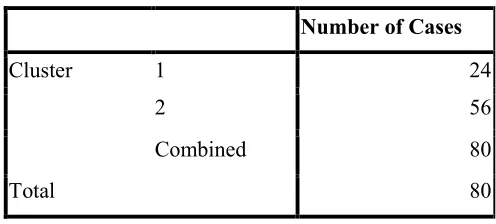
Two-step Cluster Analysis procedure is used in order to identify factors promoting KS among academic researchers and this can presents the similarity among them. Furthermore, the below mentioned cluster distribution Table 2 shows the frequency of each cluster. Out of the 80 cases assigned to clusters, 24 and 56 were assigned to the first and second cluster respectively.
TABLE 1: Cluster distribution to the third
Number of Cases
Cluster
1
24
2
56
Combined
80
Total
80
B. Contribution and importance of each variable in each cluster
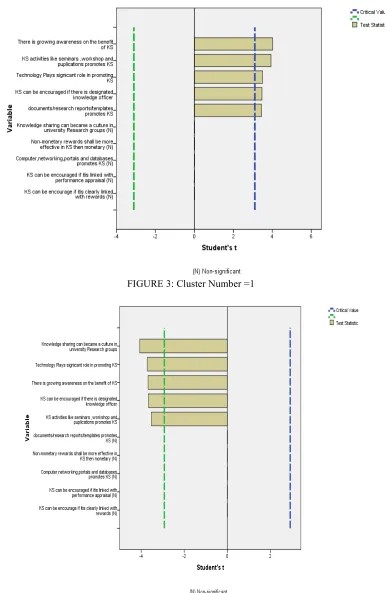
The individual variable importance charts are produced with a separate chart for each cluster. The variables are placed on the Y-axis in descending sequence of their significance. The dashed vertical lines indicate the critical values for indicating the importance of every variable. In order to consider a variable to be important, its t statistic must go beyond the dashed line in either a positive or negative direction. A negative t statistic shows that the variable generally takes smaller than average values inside this cluster, while a positive t statistic indicates the variable takes greater than average values. Hence the following figures show importance of the individual variables and their contributions in each cluster.
C. Analysis on cluster based factors promoting KS
that availability of KS activities like seminars, competitions, publication of Journals and workshops promote KS but respondents in cluster 2 only mentioned that availability of Technical documents/ Research reports/ templates for reference Purposes promote KS.
FIGURE 3: Cluster Number =1
5. CONCLUSION
In any organization employees consists of individuals and understanding their preferences regarding factors promoting KS may result better KS practice. Promoting KS among academic researchers will result fully knowledge utilization in educational institutions. Therefore, both the respondents in cluster 1 and 2 agreed that some factors concerning organizational policy, technology, communication channels and cultural factors promotes KS. However, there is a presence of little difference in views among the respondents in cluster 1 and 2 where respondents in cluster 1 believe that KS can become a culture in university research groups if top management regularly supports and reinforces KS practice while respondents in cluster 2 separately agree that availability of technical documents/ Research reports/ templates for reference Purposes promote KS. However, future study can be conducted to provide suitable platforms such as cluster-based academic researcher recommender approach, in order to meet the KS preferences among academic researchers with different character set of KS.
ACKNOWLEDGMENT
Author would like to thank RAKE UTM members who participated in the study as respondents.
REFERENCES
[1] AL., J. V. E. (2008), doi:10.1016/j.ins.2008.05.001) Multiple-vector user profiles in support of knowledge sharing, Inform. Sci.
[2] Bircham-connolly, h., corner, j and bowden, s. (2005) an empirical study of the impact of question structure on recipient attitude during knowledge sharing. Electronic journal of knowledge management, 32, 1-10.
[3] Cummings, j. (2003) enhancing development effectiveness through excellence and independence in evaluation. The world bank operations evaluation department.
[4] Davenport, t. H., prusak, l (2000) working knowledge: how organizations manage what they know. Boston: harvard business school press.
[5] Faul, m. A. C. (2004) knowledge sharing toolkit” : an evolving collection of practical knowledge sharing techniques. Available at http://www.bellanet.org.
[6] Filipczak, b. (1997) it takes all kinds: creativity in the workforce.
[7] Kamal kishore jain, m. S. S., gurvinder kaur sidhu (2007) knowledge sharing among academic staff: a case study of business schools in klang valley, malaysia. University tun abdul razak, malaysia.
[8] Lily tsui, s. A. C., laurie schnirer ,sheena stewart (2006) a handbook on knowledge sharing:strategies and recommendations for researchers, policymakers, and service providers, edmonton, alberta
[9] Lodhi, s. A. (2005) culture based knowledge sharing model. National college of business administration & economics. Pakistan.
[10]
Lam, A. (2000) Embedded firms, Embedded knowledge: Problems of Collaboration and
Knowledge Transfer in global cooperative ventures, organization studies
[11] Milne. P. (2001) Rewards, Recognition and Knowledge Sharing: Seeking a causal link. Aarl. 32.
[12] Najwa hayaati mohd alwi, a. A. B., hanifah abdul hamid (2009) factors contributing knowledge sharing in higher learning institution.
[13] Nonaka, T., H. (1995) The knowledge creating company. Oxford press [14] PETER TRYFOS. (1997) Chapter 15: Cluster Analysis.
[15] Unfpa (2003) knowledge sharing in unfpa. Available online at
http://www.unfpa.org/knowledgesharing/docs/brochure_dec03eng.pdf#search=%22unfpa%20k%20sharing%20strategies%22
![FIGURE 2: Knowledge sharing factors [12]](https://thumb-us.123doks.com/thumbv2/123dok_us/1278891.1160430/4.612.210.418.105.240/figure-knowledge-sharing-factors.webp)