CONLEY, RICHARD E. Teacher Migration From High-Performing Middle Schools: A Case Study (Under the direction of Paul F. Bitting).
The purpose of this qualitative case study was to explore the dynamics of school climate and understand how it relates to teachers’ perceptions and attitudes towards teacher migration. The research was conducted through the eyes of a sixth grade language arts/social studies’ teacher. By spending extensive time and conducting multiple interviews with the teacher and other staff members, I was able to explore some of the reasons and conditions why teachers leave schools, particularly high-performing schools to teach in other high-performing schools.
Attending weekly meetings at all levels and content areas with migrating teachers, combined with thirteen interviews and ample document collection, allowed me to further understand the gap that exists between what a high-performing school professes to be and how it actually is perceived by its own teachers. This gap is what proves to be disconcerting and frustrating for teachers who are satisfied with teaching but consider relocation to meet further personal and professional challenges.
Utilizing the social cognitive theory of Albert Bandura (1977), I researched the school world of a middle school teacher, observing how he and other individual teachers worked together as a group. Social cognitive theory examines the self and organizational efficacy of teachers and schools as transformative agents. Teachers with high abilities do not necessarily perform well collectively or as an organization if specific cognitive, behavioral, and
performing teachers are leaving high-performing schools. This introspective study can help guide future research efforts towards examining the criteria that enables a school organization to
understand the designation high-performing according to authentic and local site-based school needs, not only state performance standards. The study may contribute to our greater
A CASE STUDY
by
RICHARD E. CONLEY
A dissertation submitted to the Graduate Faculty of North Carolina State University in partial fulfillment of the requirements for the Degree of Doctor of Philosophy
EDUCATIONAL LEADERSHIP AND POLICY STUDIES
Raleigh 2006
APPROVED BY:
_________________________ _________________________
Dr. Paul F. Bitting Dr. Bonnie Fusarelli
Chair of Advisory Committee
_________________________ _________________________
Richard E. Conley is a New York City native son, the son of Richard and Phyllis Conley. Neither one finished high school in New York City in the 1940s and both were self-taught.
Rich attended the University of Arizona and Northern Arizona University in the 1970s, finally graduating in 1981, after ten years of combining time undergraduate work and full-time service in the merchant marines. He went back and forth from ship to university to ship during that time. He graduated with a Bachelor of Arts in Spanish with a Spanish Interpretation certificate. His minor was in French. After six years of service as a United States Merchant Marine and eight years as a corporate travel agent, Rich switched careers at the age of forty, went into education, and moved to North Carolina.
Rich’s life changed when he joined the merchant marines after attending the Harry Lundeberg School of Seamanship in Piney Point, Maryland, in 1974. He flew to Japan as a twenty-one year old and traveled around the world for the next six years. He became an able-bodied seaman and sailed primarily on tankers and container ships to more than forty countries. During this time he met a veteran seaman, Joe Diosco, who introduced Rich to foreign
languages. The two of them began a six month collaboration of foreign language study that eventually culminated in Rich learning five languages and returning to college to study in the field. Joe went back to get his GED soon after their encounter based on a mutual agreement that they made; Rich would return to college if Joe, then in his fifties, returned to get his high school diploma. Joe and Rich completed their promises. Joe died shortly thereafter in 1977.
and worked for one year as a records clerk and Spanish teacher. He also coached girls track. He found employment as a full-time Spanish teacher at Apex Middle School the next year and also coached girls track again. After four years at Apex Middle School, Rich began pursuing his Master of Education in School Administration at Campbell University in Buies Creek, N.C., enrolling in 1995. He served a year as an administrative intern at Davis Drive Middle School in Cary, N.C., in 1997 and then became a full-time assistant principal at Davis Drive from 1998 to 2003. In 2003 he was selected to be the principal of Apex Middle School and served in that capacity for one year. In 2004 he decided to take a year for educational leave to complete his doctorate. Rich has been in the doctoral program at North Carolina State University since 1997. He has worked full-time as an administrator while attending classes at the university. His biography continues…….
I would like to extend my warm gratitude to the committee members for helping me become a better thinker and research writer. It was not easy but I believe the boy has become a man. Thank you so much Dr. Bitting, Dr. Hessling, Dr. Fusarelli, and Dr. Ting. Dr. Patricia Marshall was also instrumental in helping me overcome those scholarly hurdles and engaging me in deep thought and conviction about our society.
Dr. Bitting deserves extended gratitude for indulging my love for philosophy and
bringing out the essence of my thought in that area. He also taught in the New York City school system and knows what a knish and an egg cream are, so he had instant credibility with me.
One of my greatest gifts is my son, Rickie, a high school senior, who will watch his father walk the stage with a PhD in hand. No Conley ever experienced such a moment and having my son there, watching, will complete one of the greatest dreams in my life. Tears will flow abundantly on that day. I love you Rickie.
My mother and sister have always believed in me and I love them for their patience and endless advice. They sustained me through some difficult times.
I met Joe Diosco, a merchant marine, in 1975 and worked with him for six months studying languages. He urged me relentlessly to return to school, study foreign languages, and get my degree. I wanted to please him and did return as he requested. I insisted that he return and get his high school diploma even though he was in his 50s. When I saw him receiving his GED certificate in a picture in the union paper, I cried.
in 1977, only two years after our life-changing encounter, I cried profusely. Thank you for changing my life Joe.
The pursuit and completion of my doctorate is dedicated to my late father, Dick Conley. Dick grew up in the 1930s and 1940s in New York City and dropped out of high school to go into the army. He had to hustle during those early years to make a dollar, not an easy thing to do in a tough Irish Catholic neighborhood on the west side of Manhattan. On occasion he and his brothers and sisters had to sleep in tents in Central Park because they could not maintain a stable living. Dad is my Cinderella Man. He never mentioned any of his background and it was only after his death that his brother, Larry told me about these tough times. Dad did not want me to know about those painful moments as a child.
My father had a gift for music and sang beautifully within a tenor range. He saved $2 a week to take singing lessons at the Brooklyn Academy of Music and did not tell anyone for fear of being called a sissy. He eventually sang operatic arias in Randalls Island during the summer concerts. I can never listen to “Che gelida menina” from La Boheme without hearing my father singing it as I was growing up.
He was a simple, hardworking man, as men tended to be in the Depression and war years. He brought me to my first Yankee game in 1961 and I watched Mickey Mantle in pinstripes in centerfield, hat over his heart, facing the American flag and singing the national anthem. It was like watching Moses himself. This one’s for you Dad. We did it.
And thank you Barry for being my lifelong friend, baseball buddy, and man of reason through some of my tough times.
Michelangelo’s Pieta.
And thank you Judy for being my best editor and believing in me.
Page
List of Tables……….x
Chapter 1. Introduction to study……….…………1
Definition of Key Terms…..……….. 2
Problem………. 3
Teacher migration………. 5
Case……….. 7
Context………... 10
Background………... 11
Research questions……… 16
Theoretical framework……….. 16
Scope and significance of study……… 18
Summary of Emergent Themes……… 19
Chapter 2. Literature review……….. 22
Teacher Turnover………... 22
The Challenges Facing Beginning Teachers……….. 29
School Climate………32
Open Communication between Teachers and Administration………...33
Social Recognition of Teachers………..34
Obstacles to a Healthy School Climate……….. 36
Site-based Management: The Transfer of Power……….. 37
Professional Learning Communities (PLCs)………. 39
Self-efficacy: Teacher as Believer………. 41
The Results of Low Self-Efficacy: Formidable Obstacles………. 46
Organizational Efficacy: The Voices of Beginning Teachers……… 48
Challenges to the Effectiveness of Organizational Efficacy……….. 50
Self-Efficacy to Organizational Efficacy: The Necessary Bridge………..51
Gaps in Existing Literature…..………...53
Chapter 3. Methodology……….. 56
Site Selection………..57
Research Design……….59
Selection Sampling……….………60
Interviews………...62
Role as Researcher……….67
Validity………. 69
Reliability………. 70
Summary of Emergent Themes……….. 72
Chapter 4. Findings………. 74
Case Study Participants………. 80
Document Collection………. 85
The Central Document in School A: The School Improvement Plan……….85
Fieldnotes from Meetings………...87
Electronic Collaboration: Blackboard 6.1………..91
Emergent Themes: Teacher Migration, Efficacy, School Climate……….94
Anthony speaks Teacher migration………..……...95
Self-efficacy………100
Organizational Efficacy………..107
School Climate………...111
Emergent Themes: Teacher Migration, Efficacy, School Climate……….122
Other Educators speak Teacher Migration………...122
Self and Organizational Efficacy………125
School Climate………127
Summary of Emergent Themes………...129
Chapter 5. Discussion and Future Implications………131
The Research Questions………..134
Recommendations and Future Research……….140
Collaboration and Socialization Needs………...140
Recommendations for Future Collaboration and Socialization………. 142
Organizational Efficacy ………...144
Recommendations for Organizational Efficacy………. 145
Final Reflections……….146
References………...149
Appendix B…..Fieldwork Guidelines ………162
Appendix C…..Informed Consent Letter………163
Appendix D…..First Interview Questions for Anthony………..164
Appendix E…..Second Interview Questions for Anthony………..166
Appendix F…..Third Interview Questions for Anthony……….168
Appendix G…..Interview Questions for Teachers………..170
Appendix H…..Interview Questions for Principals………172
Appendix I…....Interview Questions for Assistant Principals………174
Appendix J…....Interview Questions for PTA president………176
Appendix K…..Institutional Review Board (IRB) consent………178
Appendix L…..Wake County Public School System consent………179
Page Table 1. Middle School Teacher Turnover Rates in Wake County Public Schools, NC 4
(in percentages) 2001-2005
Table 2. Teacher attrition and teacher migration, 1999-2001. 23 Table 3. Annual Teacher Turnover, 2004-2005 (United States) in percentages. 26 Table 4. Increase of teacher turnover rates among middle schools from 2003-2005 58
Wake County Public School System, N.C. (increase in percentages).
Chapter One
Introduction to study
About half of the total teacher turnover is cross-school migration. Unlike attrition from the occupation, teacher migration is a form of turnover that does not decrease the overall supply of teachers because departures are simultaneously new hires. As a result, it would seem reasonable to conclude that teacher migration does not contribute to the problem of staffing schools. From a macro and systemic level of analysis, this is probably correct. However, from an organizational perspective, the data suggest teacher migration does contribute to the problem of staffing schools (Ingersoll, 2001a, p.4).
Opening Thoughts
The path towards the teacher migration issue went through two central doors, that of self and organizational efficacy, and that of school climate. By school climate, I refer to structural and curricular features such as bell schedule, number of classes per day, time allotted for instruction, behavioral policies, front office protocol, supervisory duties, teaming networks and more. By self and organizational efficacy, I refer to relationships and
Definitions of Key Terms
Organizational efficacy--- Organizational Efficacy is a collective belief in the capability of
carrying out a group task or goal.
School climate---Those psychological and institutional attributes that give an organization its
personality (Bulach, Malone, and Castleman, 1994). School climate is often thought of as the institutional effect on people’s attitudes and behaviors.
School culture--- School culture can be defined as the historically transmitted patterns of
meaning that include the norms, values, beliefs, ceremonies, rituals, traditions, and myths understood, maybe in varying degrees, by members of the school community (Stolp and Smith 1994). The concept of culture came to education from the corporate workplace with the notion that it would provide direction for a more efficient and stable learning environment. School culture is often thought of as the effect on an organization over time.
Self-efficacy---The belief in one’s abilities to perform a specific task. Self efficacy is
concerned with judgments of personal capability. Efficacy plays a key role in the self-regulation of motivation. Albert Bandura introduced the concept in 1977. Self-efficacy is often confused with self-esteem but they are entirely different.
Self-esteem---The general belief in one’s self-worth. Self-esteem has several sources: from
self-evaluations based on personal competence or on possession of attributes that are culturally invested with positive or negative value.
Social Cognitive Theory---Often referred to as Social Learning Theory, Social Cognitive
Theory (SCT) explains human behavior in a three-way reciprocal theory in which personal factors, environmental influences, and behavior continually interact. A basic premise of Social Cognitive Theory is that people learn not only through their own experiences, but also by observing the actions of others and the results of those actions. The theory was developed in the 1970s by Albert Bandura.
Teacher attrition---A gradual, natural reduction in teacher membership or teacher
personnel, as through retirement, resignation, or death.
Teacher migration---The loss of teacher membership due to a transfer to another school or
district.
Teacher turnover--- A gradual, natural reduction in teacher membership or teacher
The Problem
The purpose of my research was to explore and further understand why so many teachers migrate or transfer from other schools, particularly high-performing schools. For the
purposes of clarity the following research will draw the distinction between attrition (those teachers who leave the field of education) and migration (those teachers who transfer or migrate to another school or district but remain in the field) (Ingersoll, 2001). The study of migration was my primary focus since the ensuing research data revealed 18-25% migration rates at even high-performing schools which raised key questions linked to organizational efficacy (Department of Public Instruction, 2005). In an average size middle school in Wake County, North Carolina with sixty to seventy teachers on staff, a 20% annual migration rate is the equivalent of twelve to fourteen teachers migrating a year. In less than five years, it is not uncommon for these middle schools to turn over half the staff. This exodus consists largely of teachers transferring or migrating to other schools, either in the same district or out. The void left by the departing teacher creates numerous logistical, administrative, personnel, and classroom problems. Continuity and stability are central components of successful organizations. High teacher migration threatens both. My research will utilize local data from the Wake County Public School System, North Carolina data, and national data. My selection of Wake County was the result of twelve years of personal experience and knowledge of the system as a teacher and administrator. I focused on the middle school level since my experience was exclusively in middle schools.
shows that only 9.64% of all teachers in Wake County in 2004-2005 retired with full benefits. 13.07% left to teach in another North Carolina school system (North Carolina Public Schools, Statistical Profile 2005).
TABLE 1. Middle School Teacher Turnover Rates in Wake County Public Schools, NC
(in percentages) 2001-2005
2001-2002 2002-2003 2003-2004 2004-2005 Average Schools of
Excellence 90-100%
21 13 18 20 18
Schools of Distinction 80-89%
22 22 N/A 25 23
Schools of Progress 60-79%
25 30 N/A 31 28
No
Recognition
28 7 24 22 24
District (all schools)
22 17 22 23 21
State 25 21 23 23 23
Honor Schools of Excellence (HSOE)
Under the ABCs of Public Education, Schools of Excellence have 90-100 percent of student scores at or above Achievement Level III and made expected or high growth and have satisfied the Adequate Yearly Progress (AYP) of all subgroups according to the No Child Left Behind (NCLB) act.
Schools of Excellence (SOE)
Schools of Distinction (SOD)
Under the ABCs of Public Education, Schools of Distinction have 80-89 percent of students scores at or above Achievement Level III and made expected or high growth.
Schools of Progress (SOP)
Under the ABCs of Public Education, Schools of Progress have 60-79 percent of students' scores at or above Achievement Level III and made expected or high growth.
No Recognition (NR) - Under the ABCs of Public Education, schools of No Recognition did
not meet expected or high growth.
SOURCE: Department of Public Instruction, North Carolina Public Schools, NC School Report Cards, 2005.
Teacher migration
Teacher turnover rates, whether through attrition or migration, create staffing problems for the school which affects the school organization. This turnover becomes influenced by the “character and conditions of the organizations within which employees work” (Ingersoll, 2001 p.3). While much research has focused on teacher attrition rates (Boe & Gilford, 1992, Grissmer & Kirby, 1997, Ingersoll, 2000, Murnane, Singer, Willett, Kemple & Olsen, 1991, Price, 1989), less has been carried out for teacher migration, particularly looking at organizational characteristics and conditions (Ingersoll, 2001). Since teachers are members of a school organization and a school organization is largely guided in design and instruction by state and district legislated mandates, it was essential that I explore features of organizational design.
were departing after five years from quality schools to migrate to other schools, the problem was clear that the schools were losing personnel to other schools at a high rate. This exodus of qualified personnel, many of them quality teachers, poses a significant problem for the district and especially the individual school since replacement procedures require time, labor, and expertise to find a suitable teacher in a competitive arena (Ingersoll, 2001). All schools are also organizations so getting inside a high-performing school long enough to observe and understand its organizational features (an integral part of school climate) became a main focus for me. Ingersoll’s conclusion (2001) that the organizational settings in most schools is “impersonal and alienated” (Bulach, 2001, p. 16) guided my inquiry.
I have spoken to many teachers over the years and a recurrent theme was the lack of validation in the decisionmaking process either at the team or administrative level.
Understanding the ramifications of losing so many teachers who potentially stablilize school climates and organizations due to their experience and familiarity with the organization, I believed it essential to talk to teachers who had recently transferred or “migrated.” Further understanding that each school has a particular school climate, I found it problematic that three high-performing middle schools lost so much personnel at such an accelerated rate, an average of 10 to 14 teachers a year.
Table I indicates that the range of teacher turnover in the middle schools from 2001-2005 was 18% to 28%, with the North Carolina average at 23%. It was apparent that,
regardless of student achievement scores according to state standards, middle school turnover rates were still relatively high. Studying a school climate from inside the building over four months would help me understand the organizational design and features of a
become potentially important data. Since the school being observed was only in its second year, all the teachers except the first year teachers would have migrated. That common characteristic strengthened the robustness and trustworthiness of the research. Once I had researched these concerns, my fieldwork helped me understand the organizational flow of information and operations at the school level better and I was able to understand the phenomenon of teacher migration more competently. The interviews revealed insightful information about perceptions of a high-performing middle school and amplified the definition of high-performing. The interviews also aided in understanding the differences between self-efficacy and organizational efficacy to be revealed later in the research document.
The Case
My research was a case study of a middle school language arts/social studies teacher at a high-performing traditional middle school in the Wake County Public School System in Raleigh, North Carolina. The teacher was nationally board certified and had recently
migrated from another high-performing middle school after seven years of teaching. I designated the school of study, PLC Middle School, for purposes of anonymity. PLC Middle School was designated an Honor School of Excellence (90% of the students at grade level or above according to End of Grade test scores and successful completion of all Adequate Yearly Progress goals according to No Child Left Behind legislation) in 2004-2005 by the North Carolina State Board of Education. I observed, conducted multiple interviews, attended meetings, and maintained an ongoing dialogue with the case study teacher who, from this point forward, will be referred to as Anthony, a pseudonym.
else” (Stake, 1995, p.3), the phenomenon of school climate and its effect on his perceptions. Understanding Anthony as a unique case was not my goal since he was one of many teachers who had migrated from various middle schools in the district. I had limited interest in
Anthony inherently as a teacher but was interested more in his serving as a vehicle to understand school climate and organizational structure and processes and their effect on teachers’ attitudes and perceptions. Because the study of Anthony provided me with valid data and was instrumental in understanding the school climate question, the study became an instrumental case study (Stake, 1995). Anthony was a “typical” migrator in PLC Middle School, a teacher who had transferred to another school voluntarily due to various reasons (Patton, 2002). The interviews revealed that many of those reasons had to do less with self-efficacy than organizational self-efficacy. That is to say that some dissatisfaction existed between the teacher and administration regarding the school vision or school practices collectively.
Anthony was not studied in isolation but was part of a larger group of teachers. Therefore, it was important to understand the perceptions of others interacting with him during the semester. These cases which consisted of ten other educators, nine in the same building, were designated as subcases. The research focused on Anthony yet the addition of valuable input from Anthony’s peers, all migrated teachers, represented a “thematic analysis” across the cases, a form of “layering” (Patton, 2002, p.297).
climate and its effect on his transition. Since much of my study was to observe teachers working collectively, teacher-teacher relationships were key to the research (Hoy, 1998). Teacher-teacher relationships are a “salient dimension of climate” (Cafasso, Camic & Rhodes, 2002).
Since PLC Middle School was only in its second year of operation, all teachers except first year teachers had migrated. I chose a range of teachers to interview from first year teachers to twenty-seven year veterans. The reason I included first year teachers in the interviews was because teacher turnover rates are exceptionally high during the first three years, averaging 33% (Ingersoll, 2003a). Talking to the beginning teachers could shed light on some of the findings from totally new perspectives. Conducting interviews with other key school personnel in the building diversified and triangulated the data collection, examining the multiple perspectives of organizational efficacy. I interviewed the two principals of Anthony’s present and previous schools along with two assistant principals, the academically gifted student coordinator, and the PTA president. The PTA president was a former math teacher in the district.
The Context
The decision to select PLC Middle School as the context for the case study was based on several factors:
• It was recognized as an Honor School of Excellence by the state of North Carolina.
Therefore it was deemed a high-performing school.
• Although in its second year of operation, every teacher and staff member in the
school had migrated from other schools.
• I knew the caliber of teaching of many teachers in the school since I had worked with
them previously. The question of validity and bias will be addressed in chapter four, the methodology section.
• The principal had implemented an unprecedented organizational design called a
Professional Learning Community (DuFour, 1998) which brought the teachers close together organizationally through constant collaboration.
• The principal was very receptive to the study since he was reform-minded and
innovative.
state average of four per school. The breakdown on years of teaching experience at PLC Middle School is as follows:
0-3 years
4-10 years 10+ years
24%
38% 38%
97% of the students attend school daily. 100% of the classrooms are connected to the Internet.
PLC Middle School has been designated an Honor School of Excellence (HSOE) by the state for having 90% of its student population performing at grade level or above on the End of Grade standardized testing (95.3%). It has also complied with all twenty five of its No Child Left Behind performance targets. The state recognized it as one of the most improved schools in during the 2004-2005 academic year.
Background
educator that in a school deemed high-performing (School of Excellence) by the state of North Carolina, that so many staff members were no longer present only five years later. The Department of Public Instruction recognized School 1 as a School of Excellence because 90% or more of the student population, grades 6-8, performed at or above grade level on the End-of-Grade tests the previous year. In fact, the school earned that distinction from 1998 until the present time, 2004. Why did so many teachers depart a high-performing school in an affluent area of the county? Did the teachers leave the profession or transfer to another
school? The questions puzzled me because traditionally we think of the lower teacher retention rates in more impoverished areas that are challenged for instructional and building resources. Yet this school was located in a well-to-do area, touted by developers and realtors as an area of high quality living, with excellent schools and community services.
Subsequently, I looked for an old staff directory at the first Wake County public school I worked at in 1993-1994, School 2, in downtown Raleigh, and looked over the names from nine years earlier. I then went on the school’s website and looked over the 2003 roster noticing a similar occurrence, even more dramatic than that at School 1. Fewer than six teachers of a staff of more than seventy teachers still remained, some nine years later. This represented only 8% of the staff. 92% of the original staff had left, few of retirement age, including all four administrators. The phenomenon at School 2 was also puzzling because the school was also a high-performing school, a feeder school for School 4, one of the best high schools in the country. Logically, I then looked over the next school’s roster, that of School 3, where I had worked as a teacher from 1994-1997. School 3 was also a School of
longer present at that school. None of the three original administrators remained at the school. I proceeded to look at teacher turnover rates for all twenty-seven middle schools in the district broken down into Honor Schools of Excellence, Schools of Excellence, Schools of Distinction, and schools of No Recognition (See Table 1).
Observing that almost 50% of the teaching populations of three excellent schools in the county had departed, gave birth to an underlying premise supporting the following research question. Why do teachers leave a school (or profession) even though it is noted as “high-performing?” To truly understand the concept of teacher turnover, it was essential that I examine the school organization because turnover is linked to performance and efficacy of organizations (Ingersoll, 2001). Since schools are institutions governed by rules, policies, legislation, and mandates sent from legislative branches, government agencies, and the boards of education, it was important to understand the dynamics of organizational design and how it related to school climate.
I decided to conduct a case study of a high-performing middle school in the district in an effort to shed light on the central question of the effect of school climate on teachers’ perceptions. My previous observations as a school employee provided me with an
different proportions. The voices of some of the interviewees resonated clearly with me in all three roles: as a teacher, I had beginning experiences to talk about from my past; as an assistant principal, I had overseen formal observations and observed instruction on a daily basis; as a principal, I had interacted with all the teachers in the middle school setting and learned much about consensus, politics, and organizational design.
After completing the research, I analyzed the data and drew several conclusions, one of which pointed to a recurrent theme, the lack of an authentic voice on the part of the teachers. Another was the conclusion that beginning teachers cross a large divide between teacher education programs in the university and the immediate classroom requirements. However they often will remain in their assigned school for the most part through the “survival” period, the first three years. After that period, if they do not view themselves and their ideals as being challenged and validated by the administration or other instructors, many may migrate. Frank, a National Board Certified teacher, elaborated:
By the time teachers put in three or four years in, they’re ready to spread their wings and assert themselves in a professional environment. If they’re in a building and the administration doesn’t teach people to work with dissent and value it, those teachers are going to leave out of frustration. Accomplished teachers will also leave and I think if you look at the migration pattern you see that lots of teachers in that central part of their teaching career, four to seven years in, are the ones leaving. They’re past the survival mode and are approaching the professional part of their career.
to the classroom yet depend on experienced educators to “show them the way” and serve as moral support during this novice period. Let us call this designated period the three year period, since the state and district do so and call these teachers, Initially Licensed Teachers or ILTs. Likewise, many public schools themselves may not be prepared to thoroughly
acculturate these beginning teachers through an ongoing process outside of the mentoring program required by the district.
The ensuing research led me from self efficacy to organizational efficacy to
questions of beginning teachers being better prepared for their assignments. The issue of how public schools and the university can forge more effective programs together to support professional growth surfaced during my interviews with the beginning teachers. I believe that these new teachers would be better prepared not only for entry into teaching assignments, but more confident as they transition through their careers.
While there is research on the importance of school climate for student achievement (Bulach, Malone, & Castleman, 1995; Bandura, 1997; Pajares, 1997), there is less on teacher satisfaction and self efficacy, particularly on schools in the same district or county.
Bahamonde & Gunnell (2000) researched teacher job satisfaction and its influence on their perception of school climate and Hirase (2000) researched the teacher’s sense of efficacy in positive school climates. This research focuses on the teacher and his/her perceptions of the school climate. More work needs to be done on the effect of the school’s organizational features and their effects on the teacher. Still more research needs to be done on the
Research Questions
The primary research question was “What effect does school climate have on
teachers’ perceptions?” By following and observing a 6th grade teacher through a semester of teaching, I was able to explore the makeup of a school climate of a high-performing school. I attempted to determine how a school climate positively or negatively affected Anthony’s. These perceptions, along with those of other migrating teachers, were instrumental in their decision to leave high-performing schools. Based on the self-efficacy model of Bandura (1986), I pursued the following secondary questions:
A. Why do teachers leave high-performing schools to teach in other high-performing schools?
B. What role does the organizational design of a school play in its performance level? C. How may beginning teachers receive more sustained organizational support to ensure their growth and increase teacher retention?
D. How does self-efficacy relate to organizational efficacy? Can teachers with strong self-efficacy be productive if organizational efficacy or collective efficacy is weak?
Theoretical Framework
and self-regulating rather than reactive and shaped by external events” (Pajares, 2002, p.116). From the theory, Bandura went on to examine self-efficacy beliefs, individual beliefs in capabilities of performing specific tasks (Bandura, 1977). He discovered that the first years of teaching were crucial to a teacher’s sense of self-efficacy since efficacy may be most “malleable early in learning” (Woolfolk Hoy, 2000, p.2). Beginning teachers walk into a building and onto a team in most middle school organizations. Not fully knowing what to expect, the experience of socialization may be “comparatively intense” (Etzioni, 1975, p.246). This phenomenon is heightened just before and shortly after the teachers become part of the school (Woolfolk Hoy, 2000).
This triad of factors determines how teachers believe in themselves and affects the choices they make and actions they take (Henson, 2001). Rather than human beings claiming environmental or biological constructs for performance levels, self-efficacy looks at human beings as “products of the dynamic interplay between the external, the internal, and our current and past behavior” (Henson, 2001, p. 3).
Bandura’s seminal work, his 1977 article, “Self-Efficacy: Toward a Unifying Theory of Behavioral Change,” introduced his concept of self-efficacy. He defined it as “beliefs in one’s capabilities to organize and execute the course of action required to produce given attainments” (p. 3). In 1986 Bandura labeled his theory of behavior, social cognitive theory, with his book Social Foundations of Thought and Action: A Socially Cognitive Theory. Bandura added to and expanded the existing model of social learning theory by introducing the person as an active agent, capable of generating motivation and greater performance. Self-efficacy has been linked directly to learning and motivation in a school setting (Bandura, 1977). Armor et al. (1976) determined that teacher efficacy, the belief that they are capable, related positively to student achievement in a study by the RAND Corporation.
Scope and Significance of Study
and design is a factor in the exodus of teachers. Since the primary research thrust is
understanding why teachers leave high-performing schools, the self-efficacy model was an important link due to teachers’ perceptions of motivation and performance. The link from self-efficacy to organizational efficacy is the level of high performance experienced by a cohesive, collaborative staff which leads to a higher performing learning environment. How a school may be recognized as a high-performing organization, yet still lose an inordinate amount of teachers on an annual basis, invites a closer look at the self-efficacy to
organizational efficacy link. This is not occurring systematically presently based on the high migration rates. I explored some of the essential reasons which may provide valuable
information to the district in an effort to help retain teachers, many of our best teachers.
Summary of Emergent Themes
with the research.
Another factor that persuaded me to conduct a qualitative design within one school was the understanding that teachers work in social settings, in organizations and not in total isolation. Conducting interviews and surveys with migrating teachers throughout the district, in isolated manner, would not have allowed me to observe the organization in movement, the day to day operations of a large, high-performing group, with one mission and the same organizational goals. Getting inside a school building of a high-performing organization allowed me to understand the interplay of school climate with all its variables and how teachers interact within them. This interplay sets the stage for teachers’ cognitive experiences as they form perceptions and opinions of their sense of belonging in the organization. These issues are crucial to teacher migration, whether teachers want to seek better learning
environments more consistent with their values and beliefs, or remain where they are.
Attempting to link the problem or issue of teacher migration together with school climate and teachers’ perceptions was challenging since I was not seeking causality and had to adhere to the exploratory nature of the research. I wanted to experience the school climate over a period of time and observe how teachers operated within its setting, all through the eyes of one 6th grade teacher.
Chapter Two
Literature Review
Teachers operate collectively within an interactive social system rather than as isolates. Therefore, educational development through efficacy enhancement must address the social and organizational structure of educational systems (Bandura, 1997, p. 243)
Teacher Turnover
Approximately 30% of new teachers depart teaching within three years and 40 to 50% depart within five years (Ingersoll, 2002; Ingersoll & Smith, 2003). The highest turnover is in the fields of special education, mathematics, and science (Ingersoll, 2001). Of those beginning teachers, those who are dissatisfied with student discipline and the school environment are more likely to migrate or leave the profession (Boser, 2000).
Richard Ingersoll (2003) of the University of Pennsylvania concluded in a report for the Center for the Study of Teaching and Policy that teacher recruitment programs will not be effective in stemming the tide of teacher turnover unless greater scrutiny of the
organizational issues are defined and examined. The traditional approach to teacher turnover has been to enhance and strengthen recruitment programs and hire more teachers. However, the real problem is the “revolving door” of teaching at the public school level. What is often overlooked is teacher migration (teachers transferring to other schools or districts) as
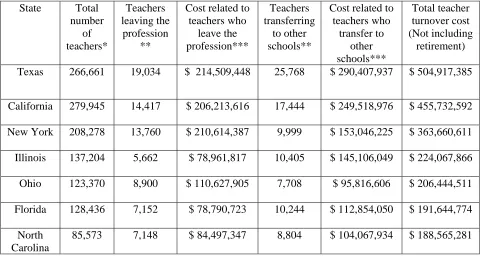
The following table provides information on teacher attrition and teacher migration including costs:
TABLE 2. Teacher attrition and teacher migration, 1999-2001. State Total number of teachers* Teachers leaving the profession **
Cost related to teachers who leave the profession*** Teachers transferring to other schools**
Cost related to teachers who transfer to other schools*** Total teacher turnover cost (Not including retirement) Texas 266,661 19,034 $ 214,509,448 25,768 $ 290,407,937 $ 504,917,385
California 279,945 14,417 $ 206,213,616 17,444 $ 249,518,976 $ 455,732,592 New York 208,278 13,760 $ 210,614,387 9,999 $ 153,046,225 $ 363,660,611 Illinois 137,204 5,662 $ 78,961,817 10,405 $ 145,106,049 $ 224,067,866 Ohio 123,370 8,900 $ 110,627,905 7,708 $ 95,816,606 $ 206,444,511 Florida 128,436 7,152 $ 78,790,723 10,244 $ 112,854,050 $ 191,644,774
North Carolina
85,573 7,148 $ 84,497,347 8,804 $ 104,067,934 $ 188,565,281
___________________________________________________________________________ SOURCE. *U.S. Department of Education, National Center for Education, Statistics. Schools and Staffing Survey, 1999-2000 (“Public School Teacher Questionnaire,” “Private School Teacher Questionnaire,” and “Public Charter School Teacher Questionnaire”), and 2000-01 Teacher Follow-up Survey (“Questionnaire for Current Teachers” and “Questionnaire for Former Teachers,” Table 1.01). Washington D.C.
***The Department of Labor conservatively estimates that attrition costs an employer 30 percent of the leaving employee’s salary. Teacher salary data taken from the National Education Association’s Estimates of School Statistics, 1969-70 through 2002-03, and prepared August 2003.
A conservative estimate of the cost incurred for replacing public school teachers who have migrated to other schools or districts is $2.7 billion a year, compared to $2.2 billion for teachers leaving the profession (Alliance for Excellent Education, 2005). The range for migration alone extends from $3.5 million in North Dakota to $214.5 million dollars in Texas annually (NCES, 1999-2000). North Carolina spent $20 million more in teacher transfers or migration ($104 million) than in replacing teachers leaving the profession ($84 million) (NCES, 1999-2000). A cursory response to why the teacher turnover rate is so high would focus on retirement with the “graying” of America and professionals now in their 50s and early 60s. Retirement, in fact, is not a primary factor in teacher turnover numbers. Job dissatisfaction or to pursue another job were reported as having higher frequencies for teacher turnover. Some of the reasons for the reported dissatisfaction were:
• Lack of planning time (65%)
• Too heavy a workload (60%)
• Problematic student behavior (53%)
• A lack of influence over school policy (52%) (Provasnik & Dorfman, 2005).
Nearly half of all new teachers in urban public schools quit within five years
The following shows annual teacher turnover rates for the nation in percentages: Table 3. Annual Teacher Turnover (United States) in percentages.
Attrition Migration Total
1988-89 6.5% 8.0% 14.5%
1991-92 6.2% 7.0% 13.2%
1994-95 7.3% 7.0% 14.3%
2000-01 8.2% 7.5% 15.7%
Note. From “Is There Really a Teacher Shortage?” by R. M. Ingersoll, 2003. Center for the Study of Teaching and Policy, September 2003, p. 8.
Since 1984, student enrollment and teacher retirements in the nation’s public school systems have simultaneously increased (Snyder, Hoffman, & Geddes, 1997). However, these are not the primary reason for the nationwide demand for new teachers and staffing
challenges. Teacher attrition, the loss of so many teachers, including beginning teachers, is the primary factor (Ingersoll & Smith, 2003). The ability for a healthy organization to
Ingersoll (2003), using the Schools and Staffing Survey (SASS) and its supplement, the Teacher Follow up Survey (TFS), conducted by the National Center for Education Statistics, discovered that the two primary reasons beginning teachers left the profession were pursuit of another job (39%) and dissatisfaction (29%). SASS/TFS represents the largest comprehensive data source available on teachers, staffing, occupational, and organizational aspects of school (Ingersoll, 2003). An interesting finding in the Ingersoll study is that the dissatisfaction expressed by the teachers did not result from student demographics or other external factors but rather from organizational factors, such as
questions of leadership and teacher decision-making. With even relatively successful schools showing a steady turnover rate, the problem points to the school organization itself and a lack of congruence between teachers’ perceptions and administrative perceptions (Ingersoll, 2003).
The high turnover rate affects beginning teachers more than others. Traditionally, the teaching profession has lost many teachers early in their careers, well before retirement (Johnson & Birkeland, in press; Lortie, 1975; Murnane, Singer, Willett, Kemple, & Olsen, 1991). A survey conducted by the National Center for Education Statistics (1994-1995) revealed that 29 percent of the teacher attrition rate was due to job dissatisfaction as a major reason for leaving. More than three-fourths of the respondents cited the following reasons for their departure: school working conditions; student discipline problems; lack of support from the PLC Middle Schooldministration; poor student motivation; and lack of teacher influence over school wide and classroom decision making (Ingersoll, 2003). Thus, simply hiring new teachers as replacements is a reaction to the problem not a prescription for further
Beginning teachers may be receiving all the requisites of organizational mentoring, peer support, and adequate resources but their sustained professional growth begins to lessen after the first few years. For instance, the district requires each school to assign a mentor to each initially licensed teacher yet that teacher teaches the same workload and same amount of students as a veteran teacher. New teachers are “thrown into” their experiences and
provided support while they are undergoing the stress and anxiety of learning how to stand in front of one hundred or more young students every day to deliver a quality presentation. Sharon Feiman-Nemser (2003, p. 25) reinforces the notion that beginning teachers need constant support; “Keeping new teachers in teaching is not the same as helping them become good teachers.” Moreover, most beginning teachers need three or more years to achieve competence and several more to reach proficiency (Feiman-Nemser, 2003 p.27).
If middle school administrators do not see beyond the pretense of a fleeting social recognition for teachers, they run the risk of losing potentially excellent teachers to other professions or other schools. Also, different schools in a school system as large as Wake County’s (more than 100 schools), may look radically different on a daily basis regarding “best practices” and curricular and leadership modeling. Beginning teachers may become discouraged if their particular school does not have a clear vision and a supportive
infrastructure. These teachers may either leave the profession or become part of the migration to another school.
New teachers coming to the school must learn the existing culture and successful adaptation skills. This is not enough though, for a beginning teacher needs to develop
high-stakes’ testing and rigorous accountability. The message from the federal government (i.e. No Child Left Behind legislation) is clear that a strong focus falls on standardized testing and subsequent categorical assessment of subgroups. For instance, schools in Wake County are required to assess and evaluate ten different subgroups of students (i.e. African-American, Hispanic, White, Native American, Asian, Free and Reduced Lunch, Students with
disabilities, etc.) according to End of Grade (elementary and middle schools) and End of Course (high school) standardized test results (Wake County Public School System, 2004). These standards are an integral part of the federal government’s No Child Left Behind legislation and are called AYP (Adequate Yearly Progress). While establishing a worthy goal, the attainment of equity for all public school students, testing becomes a driving force at the expense of a more concentrated curriculum and instructional agenda. All teachers, especially beginning teachers, must be provided professional training to successfully confront the dramatic changes to school organization such as No Child Left Behind or any other significant legislation mandates.
What follows are a few of the basic obstacles that teachers encounter in a professional demanding more accountability and exacting standards.
The challenges facing beginning teachers: the surfacing of attitudes
of a greater whole? This is particularly germane at the middle school level whose
organization and design is team-oriented due to the necessity of working with fellow team members on a daily basis.
At the local level, another potential challenge for beginning teachers in Wake County is the management of documentation and observation data required by the state for licensure and certification. Beginning teachers are required to have four formal observations, to develop a professional growth plan, and undergo a summative evaluation (Department of Human Resources, Wake County Public School System, 2004). Ongoing staff development classes, monthly mentor/mentee meetings, and a regular teaching load of some 125 students in five or more different classes prevail in most middle school organizations. Lesson plan writing, parent/teacher conferences, grading papers and presentations, IEP (Individualized Education Plan) meetings for special programs’ students, private student/teacher conferences, standardized test preparation, and perhaps the most time-consuming task of all in some schools, discipline, complete some of the overwhelming tasks required of beginning teachers. Where is the teacher’s “voice” in all of this?
The idea of representation as participation (Cotton et al., 1988) in no way reveals the level of participation of beginning teachers and their validation by more experienced
The overly bureaucratic organization, replete with rules and regulations, limits
beginning teachers’ autonomy and ability to be a successful practitioner (Conger & Kanungo, 1988). Neumann (1989) cited three categories why people are reluctant to participate in decision-making: (1) structural (the real decisions are made outside the participatory setting), (2) relational (precedence of hierarchical rank and status on the committee), (3) societal (employee socialization, ideology, or school history between teachers and administrators). Beginning teachers exhibit a professional vulnerability in the initial stages of teacher entry as their sense of self-efficacy is in question, their belief in their ability to perform the task of teaching. While self-efficacy increases during the preservice years, it declines during the student teaching phase (Hoy & Woolfok, 1990; Spector, 1990). Therefore, beginning teachers may be susceptible to the level of support provided by other teachers or
administrators in the initial stages of teaching. Self-efficacy displays a resistance to change once it has become established (Woolfolk Hoy, 2000). Thus early experiences set the tone for teachers’ beliefs in their personal capabilities as effective teachers
The stronger the belief in the group’s efficacy to mobilize more participation needed to succeed in proposed changes, along with the greater the expected share benefits, the higher the participation rate (Kerr, 1996). One of the keys to organizational success is linking diverse self-interests to a common goal which serves as a key motivational device (Alinsky, 1971). This can be a formidable challenge to site-based administrators. What is a powerful ‘common goal’ that is not too general, vague and still compelling? When teacher challenges and dilemmas become overwhelming, the diminished belief in making a
School Climate
Hoy and Miskel (1996) define school climate as a “relatively enduring quality of school environment that is experienced by participants, affects their behaviors, and is based on their collective perceptions of behavior in schools” (p. 141). School climate differs from school culture in that culture consists of shared assumptions and ideologies, whereas climate is defined by shared perceptions of behavior (Ashforth, 1985). As beginning teachers enter into a unique organizational climate to begin teaching, they become immersed in a unique and distinctive school environment, a school climate (Hoy & Miskel, 1996). Each school has a climate and when one enters the building there is a certain “feel” that is produced by cleanliness, student behaviors, front office approachability, staff attitudes, posters, bulletin boards, etc. All of these are parts of what would constitute this school “climate.”
On July 30, 2004, less than two weeks before the opening of the traditional school year, during a county wide administrative “kick off,” hundreds of Wake County
administrators watched an overhead entitled, School Climate. Under the title were the following categories: dress code, intimidation/disrespect, and inappropriate language. The message focused on the importance of a strong school climate and strict enforcement of the cited categories. I believe an important point was missed that day as the administrators went back to their schools with a very limited perspective of school climate. The county focused on student behavior, an important feature of school climate but only one part of it, a
management function. No mention was made of teacher support, collaboration, reflective practices, etc. as part of a school’s “climate.” A school climate is wider and more
encompassing than management issues if a site-based organization is to experience
significant difference in student achievement between schools with a good school climate and those with a poor school climate. Hirase (2000) and Erpelding (1999) also found that schools with a positive climate had higher academic achievement.
A School of Excellence, or a high-performing middle school according to the North Carolina Department of Public Instruction, may operate with low organizational efficacy (i.e. poor morale, low success with particular subgroups consistently, etc.) yet still produce noteworthy numbers on the standardized test assessment tool. The teachers may be doing their job and doing it well but organizational health and growth is not being sustained. The important distinction here is the term, organizational group growth. Group growth among teachers can only take place when the organizational efficacy is high. Pockets of effective growth may take place but existing power structures within the school may have an adverse effect on the true growth of the middle school and adversely affect both self and
organizational efficacy.
When beginning teachers cannot solely find assistance from other team members or other teachers, they resort to the school administrators. One example is the behavioral component that may take a significant amount of a teacher’s time and resources to address, including talks with students, discipline referrals, calls to parents and e-mails to
administrators. Communication is essential to facilitate this flow of information.
Open communication between teachers and administration
One salient example of an external constraint for beginning teachers is the lack of relevant information provided by management, or in the case of the school, the
management, and operations, yet if the organizational climate does not support leadership dissemination, many of those decisions are simply “passed on” to the rest of the staff from the principal via memos or e-mails. At times, beginning teachers are not sure that a particular task is done thoroughly because from their perception, adequate information is not provided by administration. Maintaining a “full, open, and decentralized communication system” (Pacanowsky 1988, p.374) is essential for organizational efficacy. The larger the school, the more insignificant the individual effort of the teacher may appear (Kerr, 1996). Beginning teachers need to be heard and acknowledged for the rich experiences that they already bring to the organization, not for the existing paradigm that they must “pay their dues” and only with experience will they be able to contribute worthily to the ongoing educational narrative.
Beginning teachers may have a strong sense of self-efficacy in the area of
competence but not in the area of authority. This is because the teacher already is aware of the level of competence and simply needs more time and experience to support that belief. On the contrary, authority is “granted” by the higher powers within the organizational structure and therefore is somewhat out of the direct control of the beginning teacher. The limited power entrusted in beginning teachers recognizes that they are lower in the teaching hierarchy. Recognition of teachers needs to come from fellow teachers and administrators in a way that will support constant growth.
Social recognition of teachers
that social recognition is “one of the most neglected, taken for granted and poorly performed management functions” (p.115). The effectiveness of social recognition for beginning
teachers lies in its motivation potential, its sense of predictive value (Bandura, 1986; Luthans & Stajkovic, 2000). Predictive value lends more importance to desired behaviors and
validation of beginning teachers as active agents in the organization. Teachers need social recognition but not in an arbitrary, isolated manner which proves ineffective, an empty reward that does not sustain motivation. Beginning teachers need genuine appreciation with specific tangible benefits. For example, providing praise for a beginning teacher after an excellent class (on the part of an administrator or other formal evaluator) is appropriate and appreciated but not sufficient enough to sustain motivation over a longer period of time.
challenged to adequately foster this systematic support so badly needed by beginning
teachers. The absence of this crucial component systematically in a school climate may have an adverse effect on beginning teachers’ attitudes.
As individual teachers confront organizational challenges and obstacles, a healthy school climate also encounters obstacles in a collective setting. The following cites the major challenges in a school climate, the area referred to in this research as organizational efficacy, or collective efficacy.
Obstacles to a healthy school climate
Although more and more public schools are designated as site-based institutions with certain control over curricular and administrative policies, in fact, their autonomy and
efficiency are impeded by centralized mandates and policies, some imperative, some “good practices.” One of the greatest obstacles is “time” (Ceperley 1991, p.8). An average
instructional day in the Wake County Public School System for middle schools is 400-430 minutes (Wake County Public School System, 2005).
The following is an estimate of the breakdown of time allotted in a typical middle school schedule in Wake County. It follows a teacher’s daily schedule and although
The changes to the middle school schedules started to take place around 2003 with most schools (NC Standard Course of Study, 2005):
270 minutes for classroom instruction 67% of school
day
90 minutes for a planning period 22% of school day
30 minutes for lunch
7% of school day
20 minutes for hallway transitions, supervisory duties, etc. 4% of school day
Typical middle school teachers will most likely not be able to employ 90 minutes for planning instruction since administrative and management necessities such as IEP
(Individualized Education Plans) meetings for special programs’ students, parent/teacher conferences and planning for fieldtrips and special events may take precedence and reduce actual time for instruction. If middle school teachers were to employ 30 minutes daily for these noninstructional priorities, that would leave 60 minutes for planning or 15% of the day for instructional purposes.
Site-based or school-based management: the transfer of power
uniform treatment of clients, standardization of products and services, and to prevent
arbitrary or capricious decision-making” (Darling-Hammond 1988, p. 11), the mid-1970s and early 1980s witnessed a significant return to federal and state centralization. However, the paradox is that presently, in what is supposed to be site-based management, the individual schools take on the external weight of mandates and legislation from the centralized agencies. This diluted form of site-based operations makes it more difficult for a staff to identify, address, and implement its own unique needs with those of outside bureaucratic forces.
One of the main problems of centralized decision-making is that it does not provide the desired outcomes. As is typical of all large bureaucracies, they are “impersonal and maddeningly slow moving” (Cotton, 1992, p.7). The move towards site-based management was an effort to counter the sluggishness of the bureaucratic movement and invest the individual schools with more control over their own decisions. In theory, administrators and teachers become more involved with decision making at a much broader level.
Some of the features of site-based management that affect school climate are (Cotton, 1992, p.5):
Increased autonomy of the school Increased school-site accountability
The power to establish local policy Areas of decision-making
Distribution of authority
initiate true school reform?
Professional Learning Communities
PLC Middle School was embarking on a course to fully implement a
Professional Learning Community (PLC) model according to the design of Richard DuFour (1998). The primary focus of DuFour’s model shifted from teaching to learning, and not simply learning among students but also among teachers. Aside from the collaborative structure of the PLC, three crucial questions served to drive the staff according to DuFour:
1. What do we want each student to learn?
2. How will we know when each student has learned it?
3. How will we respond when a student experiences difficulty in learning? Any attempt at school organizational reform that did not address these three questions directly was by definition a professional learning community. The PLC model became results-oriented, with assessment integrated into instruction, rather than after instruction via quizzes or tests. The principal’s leadership and determination became central to the success of the community along with a “critical mass of teacher leaders” (Hipp & Huffman, 2003, p. 19).
According to Fullan (2000), the change process would take place slowly. In fact, it takes several years before determining whether implementation of the model is going to be successful. Predictable barriers may surface with the PLC model (Hipp & Huffman, 2003). These barriers could possibly consist of:
• Financial limitations
• Possible teacher resistance
• Lack of internal communication
• Stress
• Overload
• Lack of positive reinforcement
A key point regarding professional learning communities cited by Michael Fullan (1993) was how well the teachers would handle dissent in their ranks when disagreements arose. He spoke of the “uncritical conformity to the group, unthinking acceptance of the latest solution, suppression of individual dissent” (p. 34).
Professional learning communities became one example of school
Self-efficacy: The teacher as believer
In 1986 the Stanford psychologist, Albert Bandura, proposed a unique theory of social learning, called self-efficacy. It emerged from social cognition theory which viewed behavior not as a stimulus and response but rather as a collection of cognitive interpretations which placed a central focus on the human’s view of their own capabilities rather than the achievement itself. The key difference between this social learning theory model and traditional behaviorism or reinforcement theory, is that performance in itself does not cause the change in self-efficacy, but rather how the educator processes the experience based on the performance. Cognition becomes a mediating agent of paramount importance in the learning experience.
In an educational world where beginning teachers are required to do so much to comply with both state and local standards and with a high teacher turnover rate, this social learning theory bears significance because Bandura (1997) stated that the critical elements regarding human behavior and motivation are the “beliefs in one’s capabilities to organize and execute the courses of action required to produce given attainments” (Bandura, 1997, p. 3).
Since Bandura’s theoretical framework links behavior and self-influence, the
educator becomes an integral part or agent of the performance process. Much research in the area of self-efficacy has already taken place with employee training (Martocchio, 1994; Quinones, 1995; Silver, Mitchell & Gist, 1995). However, Bandura’s theory has seldom been tested in job environments that contain work-related performance outcomes such as school systems.
• Enactive mastery (mastery learning)
• Vicarious experience
• Verbal persuasion
• Affective input
It is important to note that the four areas above do not, of themselves, provide us with valuable information about the learning process. It is only through the cognitive processing of efficacy information and reflective thought, that these experiences become instructive (Bandura 2000). Organizational constraints, largely time and management issues, impede reflective thought on the part of the teachers in any systematic way.
The strongest category for enhancing efficacy beliefs, enactive mastery or mastery learning, is repeated successful performance. Educators could perform a task, receive
Resources, WCPSS 2005). This is hardly the consistent evaluation needed by beginning teachers who are beset with the same demands of more senior teachers.
A second means of enhancing self-efficacy is vicarious learning, which includes primarily observing other competent individuals perform a similar task and then gaining reinforcement from it. This sort of learning is common for beginning teachers since the district allows them two to three days a year to go in another teacher’s classroom to observe instruction. The closer the modeling of the observed teacher to the beginning teacher’s style, the greater the self-efficacy. Efficacy expectations decline with poor vicarious modeling.
Verbal persuasion is a third way of enhancing self-efficacy. The purpose of verbal persuasion is not necessarily to increase skill or ability levels of the beginning teacher but rather to encourage the teacher to feel confident that they can do the job. Falling back on the teacher’s ability is particularly important during the early years when personal performance efficacy is questioned. Verbal persuasion may take the form of direct feedback from a supervisor or colleague or may even involve other teachers simply talking admirably about a beginning teacher’s performance. The capacity for the feedback to make an enduring
difference for the beginning teacher depends on the credibility, trustworthiness, and expertise of the teacher doing the modeling (Bandura, 1986).