Article
Synthesis, APPI Mass-Spectrometric Characterization
and Polymerization Studies of Group 4 Dinuclear
Bis(ansa-metallocene) Complexes
Gilles Schnee,
1Mathilde Farenc,
2,3,4Leslie Bitard,
1Aurelien Vantomme,
5Alexandre
Welle,
5Jean-Michel Brusson,
6Carlos Afonso,
2,4Pierre Giusti,
3,4Jean-François
Carpentier,
1,*Evgueni Kirillov
1,*1 Univ Rennes, CNRS, ISCR (Institut des Sciences Chimiques de Rennes), UMR 6226, F-35000 Rennes, France.
2 Univ Rouen, CNRS, COBRA, UMR 6014, F-76821 Mont Saint Aignan, France.
3 Total Research and Technologies Gonfreville, BP 27, F-76700 Harfleur, France
4 Univ Pau, Univ Rouen, CNRS, Total Raffinage Chimie, Joint Laboratory C2MC (Complex Matrices Molecular Characterization), France
5 Total Research and Technologies Feluy, Zone Industrielle C, B-7181 Feluy, Belgium 6 Total SA, Direction scientifique, F-92069 Paris La Défense, France
*Correspondence: [email protected]; [email protected]. Tel.: +33-223-236-118
Abstract: New ligand platforms of the type p- or m-Ph{-CR(3,6-tBu2Flu)(Cp)}2 (para-, R = Me (2a), H
(2b); meta-, R = Me (2c)) were synthesized via nucleophilic addition of the 3,6-tBu2-fluorenyl-anion
onto the parent phenylene-bridged difulvenes (1a‒c). The corresponding discrete homodinuclear zirconium and hafnium bis(dichloro ansa-metallocene) complexes, Ph[{-CR(3,6-tBu2Flu)(Cp)}MCl2]2
(p-, R = Me (3a-Zr2, 3a-Hf2), R = H (3b-Zr2); m-, R = Me (3c-Zr2) were prepared by salt metathesis
reactions. An attempt to generate in situ a heterodinuclear complex 3a-Zr-Hf was also undertaken. For the first time, Atmospheric Pressure PhotoIonization (APPI) mass-spectrometric data were obtained for all dinuclear compounds and found to be in excellent agreement with the simulated ones. Preliminary studies on the catalytic performances of these dinuclear complexes, upon activation with MAO, in ethylene homopolymerization and ethylene/1-hexene copolymerization revealed a few differences as compared to those of the monometallic analogues. In particular, slightly lower molecular weights and greater formation of short methyl and ethyl branches were obtained with the dinuclear systems.
Keywords: metallocene catalysts; mass-spectroscopy; olefin polymerization
1. Introduction
Development and applications of multinuclear group 4 metal α-olefin polymerization catalysts has increased dramatically in the past decade.[1] The interest in this area is primarily driven by the potential to exploit intermetallic cooperativity/synergism between the two or more proximal metal centers, to eventually enhance performances of polymerization systems. For instance, several studies on dinuclear catalysts suggested that catalyst activity,[2] and molecular weight,[2a,2f,2h,3] tacticity,[2k,3,4] or comonomerincorporation[2f, 5] of/in the resulting polymers can be greater than those of the corresponding mononuclear analogues having isostructural catalytic sites.
Group 4 metal catalysts based on one-carbon-bridged ansa-cyclopentadienyl-fluorenyl platforms, {R2C(Cp/Flu)}2‒, hold a unique position in α-olefin polymerization thanks to their high
catalytic activity, excellent control, and remarkable stereospecificity,[6,7] Yet, only a few examples of dinuclear systems of this type have been reported in literature (Scheme 1).[8,9]
Scheme 1. Examples of group 4 dinuclear bis(dichloro ansa-metallocene) complexes incorporating {R2C(Cp/Flu)} ligand platforms.[8,9]
We herein report on the synthesis of dinuclear group 4 bis(Cp/Flu-metallocene) complexes, linked at the C1-bridge by a para- or meta-phenylene moiety,[10] as well as their characterization by
NMR spectroscopy and advanced Atmospheric Pressure PhotoIonization (APPI)
mass-spectrometric methods. The catalytic performances of the synthesized complexes, after their
activation with MAO, were preliminarily investigated in homogeneous ethylene
homopolymerization and ethylene/1-hexene copolymerization, and compared to those of the mononuclear ansa-metallocene complexes as reference.
2. Results and Discussion
Synthesis of Proligands. An efficient and scalable synthesis via nucleophilic addition of the (3,6-di-tert-butyl)fluorenyl anion onto fulvenes is regularly utilized to prepare one-carbon-bridged R2C{Cp/Flu}H2 proligands.[6] This methodology was here extended to three different bis(fulvene)
platforms (1a−c) that were prepared from cyclopentadiene and the corresponding aromatic diketones or dialdehydes (Scheme 2) and isolated in good yields as yellow or orange solids.
Scheme 2. Synthesis of para- and meta-phenylene-bridged bis(fulvenes) 1a−c.
To prepare the targeted p- and m-Ph{-CR(3,6-tBu2FluH)(CpH)}2 proligands 2a−c, bis(fulvenes)
workup, the corresponding para-bridged proligands 2a,b were isolated in good yields; synthesis/recovery of the meta-bridged proligand 2c proved somehow more difficult (22% isolated yield).
These proligands are stable at room temperature in solution and in the solid state, and their structures were authenticated by 1H and 13C NMR spectroscopy (Fig. S9, S10, S12, S13, S15 and S16)
and ESI-mass spectrometry (Fig. S11, S14 and S17). The NMR data for these compounds appeared to be complicated by the presence of two stereogenic centers in the molecules, resulting in the existence of pairs of diastereoisomers in each case, and also of their different tautomers (i.e., isomers of C=C bonds within the CpH rings). The ESI-MS measurements data showed clearly the expected molecular [M+H]+ ions at m/z 815.55, 787.52 for 2a,b and at 853.51 ([M+K]+) for 2c.
Scheme 3. Synthesis of proligands 2a−c.
Synthesis of group 4 dinuclear bis(dichloro ansa-metallocene) complexes. In order to prepare the corresponding group 4 bis(dichloro ansa-metallocene) complexes, standard salt-metathesis reactions between the ligand tetraanions, generated in situ in Et2O, and MCl4 salts (2
equiv) were used (Scheme 4). Thus, the homodinuclear bis(dichloro ansa-zirconocenes) 3a-c-Zr2
and bis(dichloro-ansa-hafnocene) 3a-Hf2 were isolated in good yields as red and yellow solids,
Scheme 4. Synthesis of group 4 homodinuclear bis(dichloro-ansa-metallocene) complexes.
Scheme 5. Possible diastereoisomers of the phenylene-bridged bis(dichloro-ansa-metallocene) complexes.
As 3a−c-Zr2 and 3a-Hf2 were derived from diastereomeric mixtures of proligands, two
diastereomers for each of these compounds were anticipated, featuring Cs-/Ci-symmetries for the
para-phenylene-bridged complexes 3a,b-M2 and Cs-/C1-symmetries for the meta-phenylene-bridged
complex 3c-Zr2 (Scheme 5). Accordingly, the 1H and 13C NMR spectra of the crude 3a-Zr2 (Fig.
S24‒S26), 3a-Hf2 (Fig. S28 and S29, respectively) and 3c-Zr2 (Fig. S35 and S36, respectively)
complexes displayed two sets of resonances corresponding to the two diastereomers.11 Unexpectedly, only one set of resonances assigned to as single diastereoisomer of either Cs- or
isolated in lower yield than the other ones, one cannot discard that only one diastereoisomer was recovered in the work-up.
Unfortunately, all attempts to grow single-crystals of these complexes suitable for X-ray diffraction studies failed so far. However, the identity of these bis(dichloro-ansa-metallocene) compounds was confirmed unambiguously by mass spectrometry (vide infra).
In an attempt to synthesize a hetero-bis(metallocene) incorporating both zirconium and hafnium metals, a similar salt-metathesis protocol as that utilized for the synthesis of homo-bis(dichloro ansa-metallocenes) 3a-Zr2 and 3a-Hf2 was probed using 1 equiv of each metal
precursors ZrCl4 and HfCl4 (Scheme 6). In this case, as anticipated, a statistical 1:1:2 mixture of
homodinuclear 3a-Zr2, 3a-Hf2 and heterodinuclear 3a-Zr/Hf complexes was obtained, as revealed by 1H NMR spectroscopy of the crude sample. No single-crystal suitable for X-ray diffraction studies
could be grown thus far. Due to the complexity of the mixture and obvious difficulties associated with regular elemental and spectroscopic analyses, only its mass-spectrometric characterization was performed (vide infra).
Scheme 6. Attempted synthesis of heterodinuclear bis(metallocene) 3a-Zr/Hf.
Synthesis of mononuclear ansa-metallocene analogues. For comparative studies of mass-spectrometric analyses and of catalytic properties of the bis(metallocene)s in α-olefin polymerization, their mononuclear analogues were also synthesized (Scheme 7). Complexes 3a’,b’-Zr and 3b’-Hf were isolated in good yields and characterized by 1H and 13C NMR
spectroscopic studies, X-ray diffraction (for 3a’-Zr; Fig. S67) and APPI mass-spectrometry (vide infra).
Scheme 7. Synthesis of mononuclear metallocene analogues.
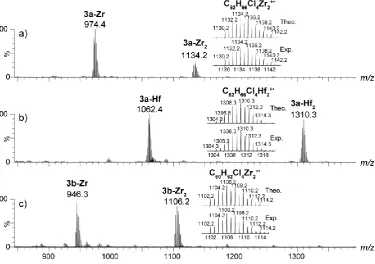
By analogy, the M+• molecular ions were identified fordinuclear bis(zirconocene) 3a-b-Zr2 and
dinuclear bis(hafnocene) 3a-Hf2 compounds (Figure 2). The accurate masses and isotopic
distributions (m/z 1130.2074, 1102.1754 and 1310.2865, respectively) are in a very good agreement (< 5 ppm) to those expected theoretically based on the corresponding ions molecular formula (m/z
1130.2013, 1102.1700 and 1310.2850 respectively). In addition to the dinuclear species 3a,b-Zr2 and
3a-Hf2, molecular ions derived from the monometallated fragments, i.e. 3a,b-Zr and 3a-Hf, were
detected in each case at m/z 972.3776, 944.3398 and 1062.4139, respectively. These ions were most likely not generated by gas phase fragmentation as they were not produced by collision-induced dissociation of the dinuclear molecular ions. They, however, may have been produced by partial degradation (e.g. hydrolysis) during the sample handling or in the atmosphere source that may contain traces of water.
Figure 2. APPI(+) mass spectra of dinuclear bis(metallocene) 3a-Zr2 (a), 3a-Hf2 (b) and 3b-Zr2 (c) complexes. The zoomed areas showcase the theoretical and experimental isotopic clusters. For each isotopic distribution, only the most intense isotope peak is labelled.
For the mixture containing the heterodinuclear bis(dichloro ansa-metallocene) compound
3a-Zr/Hf and its homodinuclear counterparts 3a-Zr2 and 3a-Hf2, a set of five isotopic distributions
was observed in the APPI mass-spectrum (Figure 3). Besides the distributions corresponding to the homodinuclear 3a-Zr2 and 3a-Hf2 and their monometallated versions, i.e. 3a-Zr and 3a-Hf,
respectively, an isotopic distribution at m/z 1222.2463 was identified and unequivocally assigned to
Figure 3. (a) APPI(+) mass spectrum of the crude reaction mixture resulting from metallation of proligand 3a by a 1:1 mixture of ZrCl4 and HfCl4. (b) The enlargement of the m/z 900-1350 area. The zoomed areas showcase the theoretical and experimental isotopic clusters of dinuclear bis(dichloro ansa-metallocene) complexes 3a-Zr-Hf. For each isotopic distribution, only the most intense isotope peak is labelled.
Polymerization catalysis. Dinuclear bis(dichloro ansa-metallocene) complexes 3a-M2, 3b-Zr2
and 3c-Zr2 and their mononuclear analogues 3a,b’-Zr and 3b’-Hf, in combination with MAO, were
evaluated in homogeneous ethylene polymerization (Table 1) and ethylene/1-hexene copolymerization (Table 2). Each polymerization experiment was repeated independently twice under the same conditions (toluene, 5.5 bar of ethylene, 60 °C), which revealed good reproducibility in terms of productivity (polymer yield) and physicochemical properties (Tm, Mw, PDI) of the
isolated polymer.
Table 1. Homopolymerization of ethylene.a
Entry Comp. mPE
[g]
Prod. [kg·mol−1·h−1]
Mwb
[kg.mol−1] Mw/Mn
b Tm c
[°C]
%Me d [wt%]
%Et d [wt%]
%nBu d [wt%]
1 3a-Zr2 6.20 24,800 175.1 3.2 132.3 0.0 0.1 0.0
2 3a-Zr2 5.62 22,500 196.6 3.4 132.2 0.0 0.2 0.0
3 3a’-Zr 5.64 22,600 260.4 3.6 132.1 0.0 0.1 0.0
4 3a’-Zr 6.14 24,600 307.9 4.1 131.8 0.0 0.0 0.0
6 3b-Zr2 5.20 20,800 189.2 3.5 129.0 0.9 0.2 0.0
7 3b’-Zr 6.79 27,160 180.9 3.4 132.1 0.0 0.1 0.0
8 3b’-Zr 5.27 21,080 272.6 4.3 133.2 0.0 0.1 0.0
9 3c-Zr2 4.96 19,800 85.0 3.3 nd 0.0 0.2 0.0
10 3a-Hf2 1.53 6,100 - f - f 132.7 0.0 0.0 0.0
11e 3a-Hf2 1.63 6,500 - f - f 133.6 0.0 0.0 0.0
12 3b’-Hf 1.38 5,500 1,146.3 4,1 nd 0.0 0.0 0.0
a General conditions: toluene (100 mL), Tpol = 60 °C, [Zr]0 = 10.1 µmol·L‒1, Pethylene = 5.5 bar, [Al]0/[Zr]0 = 1000, polymerization time = 15 min, nd = not determined. b Determined by SEC at 135 °C in 1,2,4-trichlorobenzene. c Determined by DSC from second heating run. d Determined by 13C NMR spectroscopy. e BHT (300 equiv vs [Hf] was added to scavenge M3Al of MAO). f Insoluble polymer was recovered, preventing SEC analysis.
In general, no significant or limited difference was observed for the experiments involving dinuclear bis(metallocene) with respect to those using the corresponding mononuclear analogues (Table 1; compare entries 1-2/3-4, 5-6/7-8 and 10-11/12, respectively). Indeed, all the systems produced with similar productivities polyethylene samples exhibiting quite similar molecular weight distributions and Tm values. A slight drop in productivity was observed for the
meta-bridged system 3c-Zr2 (entry 9), also yielding a lower molecular weight PE as compared to the
para-bridged congeners 3a,b-Zr2. Interestingly yet, as established by 13C NMR spectroscopy, 3b-Zr2
induced the formation of short branches (methyl and, to a lesser extent, ethyl), significantly higher than its mononuclear analogue and any other dinuclear system; the same observation was made in ethylene/1-hexene copolymerization (vide infra). This may presumably arise from a chain-walking mechanism.
The Hf-based systems 3a-Hf2 and 3b’-Hf appeared to be ca. 3 fold less productive (entries
10−12) than their Zr-based counterparts while affording much higher molecular weight PEs.
Addition of BHT (entry 11) to scavenge excess of the “free” AlMe3 [13] present in MAO did not affect
productivity of this system and also resulted in an insoluble polymer (likely due to formation of HMWPE because of absence of transfer to AlMe3).
Also, no strikingly different results were obtained upon using the different mono- and dinuclear compounds in ethylene/1-hexene copolymerization (Table 2). The Zr-based systems, both di- and mononuclear, afforded a very narrow range of productivities. Of note yet, in the
para-bridged series 3a,b-Zr2 and 3a’b’-Zr, the dinuclear bis(metallocenes) gave slightly but
significantly lower molecular weight copolymers and narrower dispersities (compare entries 1-2/3-4 and 5-6/7-8, respectively) than their respective mononuclear analogues. Conversely, the
meta-bridged system 3c-Zr2 afforded a higher molecular weight copolymer than its mononuclear
analogue (compare entries 3/4 and 9). Again, higher molecular weight copolymers were obtained with Hf-based catalysts, but with lower productivities than their Zr-counterparts (entries 10-12). Also, somewhat higher incorporation of 1-hexene in copolymers was achieved with the latter Hf catalysts.
Table 2. Ethylene/1-hexene copolymerization. a
Entry Comp. mPE
[g]
Prod. [kg·mol−1·h−1]
Mwb
[kg.mol-1] Mw/Mn
b Tm c
[°C]
%Me d [wt%]
%Et d [wt%]
%nBu d [wt%]
1 3a-Zr2 6.20 24,800 70.6 2.6 122.5 0.0 0.1 15.7
2 3a-Zr2 5.62 22,500 84.3 3.0 123.8 0.0 0.0 23.2
4 3a’-Zr 6.77 27,100 132.1 3.3 118.2 0.0 0.0 21.3
5 3b-Zr2 7.74 31,000 75.8 2.8 111.4 0.9 0.1 22.5
6 3b-Zr2 6.70 26,800 64.0 2.7 112.2 0.4 0.1 19.4
7 3b’-Zr 7.57 30,300 89.9 2.7 113.9 0.0 0.0 21.1
8 3b’-Zr 7.30 29,200 96.9 2.9 108.2 0.0 0.0 22.7
9 3c-Zr2 7.75 31,000 190.6 3.5 116.0 0.0 0.0 21.3
10 3a-Hf2 3.78 15,100 447.1 3.1 nd 0.0 0.0 28.1
11 e 3a-Hf2 4.34 17,400 581.5 4.0 nd 0.0 0.0 29.6
12 3b’-Hf 1.66 6,600 - f - f nd 0.0 0.0 28.5
a General conditions: toluene (100 mL), Tpol = 60 °C, [Zr] = 10.1 µmol·L‒1, Pethylene = 5.5 bar, [Al]/[Zr] = 1000, [1-hexene]0 = 0.2 M, polymerization time = 15 min, nd = not determined. b Determined by SEC at 135 °C in 1,2,4-trichlorobenzene. c Determined by DSC from second run. d Determined by 13C NMR spectroscopy. e BHT (300 equiv vs Hf) was added to scavenge M3Al of MAO. f Insoluble polymer was recovered, preventing SEC analysis.
3. Materials and Methods
General considerations. All experiments were performed under a dry argon atmosphere, using a glovebox or standard Schlenk techniques. THF and Et2O were distilled prior to use from
sodium benzophenone ketyl. Hexane and heptane were distilled from CaH2and stored over 3 Ǻ
molecular sieves. Deuterated solvents (benzene-d6, toluene-d8 > 99.5% D; Euriso-top) were distilled
from Na/K alloy or CaH2 (for CD2Cl2) and stored over 3Ǻ molecular sieves. CDCl3 (99.8% D,
Euriso-top) was used as received. 3,6-Di-tert-butyl-fluorene and MAO were generously provided
by Total Raffinage-Chimie. The fulvene precursors,
(1-(cyclopenta-2,4-dien-1-ylidene)ethyl)benzene and (cyclopenta-2,4-dien-1-ylidenemethyl)benzene
[14] were prepared following protocols published in the literature. ZrCl4 and HfCl4 were used as
received (anhydrous, Strem Chemicals). 1-Hexene (Fisher Chemical) was distilled and stored over 3 Ǻ molecular sieves under argon. Ethylene (Air Liquide, N35) was used without further purification.
Instruments and measurements. NMR spectra of air- and moisture- sensitive compounds were recorded on Bruker AM-400 and AM-500 spectrometers in Teflon-valved NMR tubes at room temperature. 1H and 13C chemical shifts are reported in ppm vs. SiMe4 and were determined using
residual solvent signal. Coupling constants are given in Hertz. Assignments of signals were carried out using 1D (1H, 13C{1H}, JMOD) and 2D (COSY, HMBC, HMQC) NMR experiments.
Elemental analyses were performed on a Carlo Erba 1108 Elemental Analyzer instrument at the London Metropolitan University by Stephen Boyer or on a Flash EA1112 CHNS Thermo Electron apparatus at CRMPO, Rennes, and were the average of a minimum of two independent measurements.
13C{1H} NMR and GPC analyses of polymer samples were performed in the research center of
Total Research & Technologies in Feluy (Belgium). The 13C{1H} NMR analyses were run on a 500
MHz Bruker Avance III with a 10 mm cryoprobe HTDUL in trichlorobenzene/C6D6 (2 mL/0.5 mL).
The GPC analyses were performed in 1,2,4-trichlorobenzene at 135 °C using PS standards for calibration. Differential scanning calorimetry (DSC) analyses were performed on a Setaram DSC 131 apparatus, under continuous flow of helium and using aluminum capsules. Glass transition and melting temperatures were measured during the second heating (10 °C·min−1).
ESI (ElectroSpray Ionization) mass spectra of organic compounds, including proligands, were recorded at the CRMPO-Scanmat (Rennes, France) on an Orbitrap Thermo Fisher Scientific Q-Exactive instrument with an ESI source in positive mode by direct introduction at 5‒10 µg.mL−1.
Samples were prepared in CH2Cl2 at 10 µg.mL−1.
APPI mass spectrometric characterization of metal complexes. Mass spectra of metal complexes were recorded on a hybrid quadrupole time-of-flight instrument (Waters, Synapt G2, Manchester) equipped with an APPI source. The instrument was operated in the positive ion mode. The ionization experimental conditions were set as follows: desolvation gas flow, 700 L h−1;
source temperature, 120 °C; probe temperature, 400 °C; sampling cone, 20 V; extraction cone, 3 V. The time-of-flight was operated in the ‘resolution mode’ yielding a resolving power of about 20,000.
The samples were prepared in a glove box using dried toluene in 1.5 mL glass vials with a final concentration of 20 µM. For analysis, the sample was taken with a dry syringe stored in an oven. The solution was directly infused into the source using a syringe pump at a flow rate of 200 µL h−1.
Data were acquired over the m/z 50–2000 range for 2‒5 min. Note that the given accurate masses are given with Water Mass Lynx 4.1 that do not take into account the mass of the electron removed during ionization. All given masses are monoisotopic values. In the mass spectra, only the highest abundant isotope is labeled.
1,4-Bis(1-(cyclopenta-2,4-dien-1-ylidene)ethyl)benzene (1a). In a 250 mL round bottom flask equipped with a magnetic stirring bar and an argon inlet freshly cracked cyclopentadiene (12.36 mL, 148.0 mmol) and 1,4-diacetylbenzene (4.82 g, 30.0 mmol) were dissolved in methanol (200 mL). To this solution, pyrrolidine (7.5 mL, 89.0 mmol) was added at 0 °C. The reaction mixture was stirred at room temperature for 7 days. After neutralization with glacial acetic acid (7.5 mL) and separation of the organic phase, volatiles were evaporated under vacuum to give a yellow powder (5.51 g, 21.3 mmol, 72%). 1H NMR (CDCl3, 400 MHz, 25 °C): 7.35 (s, 4H, CH-Ar), 6.59 (dt, 3J = 5.2, 4J = 1.6, 2H, CH-Cp), 6.51 (dt, 3J = 5.2, 4J = 1.6, 2H, CH-Cp), 6.43 (dt, 3J = 5.2, 4J = 1.6, 2H, CH-Cp), 6.16
(dt, 3J = 5.2, 4J = 1.6, 2H, CH-Cp), 2.50 (s, 6H, CH3). 13C NMR (CDCl3, 125 MHz, 25 °C): 149.0,
143.8, 142.0 (Cq), 132.1, 131.9 (CH-Cp), 129.0 (CH-Ar), 123.7, 121.2 (CH-Cp), 22.6 (CH3). ESI-MS
(m/z):259.15 ([M + H]+), 258.15 ([M]). Anal. calcd. for C20H18 (258.36): C 92.98, H 7.02; found: C
93.27, H 6.53.
1,4-Bis(cyclopenta-2,4-dien-1-ylidenemethyl)benzene (1b). Using a protocol similar to that described above for 1a, 1b was prepared from cyclopentadiene (30.7 mL, 373.0 mmol), 1,3-terephthalaldehyde (10.0 g, 74.5 mmol) and pyrrolidine (9.3 mL, 112.0 mmol) and isolated as an orange powder (13.03 g, 56.7 mmol, 76%). 1H NMR (CDCl3, 400 MHz, 25 °C): δ 7.63 (s, 4H,
CH-Ar), 7.20 (s, 2H, CH-methine), 6.69 (m, 4H, CH-Cp), 6.52 (d, 3J = 5.0, 2H, CH-Cp), 6.32 (d, 3J = 5.0,
2H, CH-Cp). 13C NMR (CDCl3, 125 MHz, 25 °C): δ 146.2, 137.6, (Cq), 137.2, 136.1 (CH-Cp), 131.5
(=CH), 131.1 (CH-Ph), 127.4, 120.3 (CH-Cp). Anal. calcd. for C18H14 (230.30): C 93.87, H 6.13; found:
C 93.98, H 6.56.
1,3-Bis(1-(cyclopenta-2,4-dien-1-ylidene)ethyl)benzene (1c). Using a protocol similar to that described above for 1a, 1c was prepared from cyclopentadiene (30.0 mL, 363.0 mmol), 1,3-diacetylbenzene (11.0 g, 68.0 mmol) and pyrrolidine (17.0 mL, 204.0 mmol) and isolated as an orange powder (14.9 g, 51.0 mmol, 85%).1H NMR (CDCl3, 400 MHz, 25 °C): δ 7.41 (broad m, 4H,
CH-Ar), 6.66 (dt, 3J = 5.2, 4J = 1.8, 2H, CH-Cp), 6.60 (dt, 3J = 5.2, 4J = 1.6, 2H, CH-Cp), 6.51 (dt, 3J = 5.2, 4J = 1.6, 2H, CH-Cp), 6.21 (dt, 3J = 5.2, 4J = 1.6, 2H, CH-Cp), 2.58 (s, 6H, CH3). 13C NMR (CDCl3, 125
MHz, 25 °C): 149.2, 143.8, 141.9 (Cq), 132.2, 131.9 (CH-Cp), 129.8, 129.2, 127.6 (CH-Ar), 123.6, 121.2 (CH-Cp), 22.7 (CH3). ESI-MS (m/z): 259.15 ([M + H]+). Anal. calcd. for C20H18 (258.36): C 92.98, H
7.02; found: C 93.02, H 7.13.
1,4-Ph((Me)C-(3,6-tBu2FluH)(CpH))2 (2a). In a Schlenk flask, to a solution of
3,6-di-tert-butyl-fluorene (2.17 g, 7.8 mmol) in THF (100 mL) was added n-BuLi (3.13 mL of a 2.5 M solution in hexane, 7.8 mmol). This solution was added dropwise to a solution of 1a (1.00 g, 3.9 mmol) in THF (100 mL) at −10 °C over 10 min. After completion of the addition, the reaction mixture was stirred for 2 days at room temperature. The mixture was hydrolyzed with 10% aqueous hydrochloric acid (20 mL), the organic phase was dried over sodium sulfate, and volatiles were evaporated in vacuo. The solid residues was washed with pentane (200 mL) and dried under reduced in vacuo to afford a white powder (1.96 g, 2.4 mmol, 62%). 1H NMR (CDCl3, 400 MHz, 25
CH-Flu+CH-Cp), 6.18 (m, 1H, CH-Cp), 4.96 (s, 2H, H-Flu), 3.19-2.99 (m, 4H, CH2-Cp), 1.38 (m, 36H, CH3-tBu), 1.12-1.07 (m, 6H, CH3-bridge). 13C NMR (CDCl3, 125 MHz, 25 °C): δ 156.4, 156.3, 156.2
(Cq-Cbridge), 153.8 (Cq), 150.2, 150.2, 150.1, 150.1 (Cq-C-tBu), 145.5, 145.4 (Cq), 142.8, 142.8, 142.6,
142.5, 142.3, 142.2 (Cq), 134.5, 134.4, 134.3 (CH-Flu), 133.9, 133.8 (CH-Flu), 132.2, 131.9 (CH-Cp), 127.8, 127.8, 127.7, 127.5 (CH-Cp), 126.3 (CH-Cp), 125.7, 125.6, 125.5 (CH-Cp), 123.7, 123.6, 123.5, 123.4 (CH-Flu), 115.9, 115.9 (CH-Ph), 68.1 (Cq), 55.4, 55.4, 55.3 (CH), 54.0, 53.9 (CH), 47.5, 47.4 (Cq), 46.4, 46.3 (Cq), 42.1, 41.0 (CH2-Cp), 34.9, 34.8 (Cq), 31.8 (CH3-tBu). ESI-MS (m/z):815.55 ([M + H]+),
814.54 ([M]). Anal. calcd. for C62H70 (815.22): C 91.35, H 8.65; found: C 91.68, H 8.78.
1,4-Ph((H)C-(3,6-tBu2FluH)(CpH))2 (2b). Using a protocol similar to that described above for
2a, compound 2b was prepared from 3,6-di-tert-butyl-fluorene (4.83 g, 17.4 mmol), n-BuLi (7.0 mL of a 2.5 M solution in hexane, 17.4 mmol), 1b (2.00 g, 8.7 mmol) and isolated as a white powder (4.12 g, 5.2 mmol, 60%). 1H NMR (CDCl3, 400 MHz, 25 °C) (mixture of tautomers): δ 7.72 (m, 4H,
CH-Ar), 7.10 (m, 8H, CH-Cp), 7.02 (m, 1H, CH-Cp), 6.88 (m, 1H, CH-Cp), 6.7 (m, 3H, CH-Cp), 6.45 (m, 2H, CH-Cp), 6.33 (m, 1H, CH-Cp), 6.18 (m, 1H, CH-Cp), 5.96 (m, 1H, CH-Cp), 4.52 (m, 2H, CH-Flu), 4.03 (m, 2H, CH-bridge), 2.96 (m, 3H, CH2-Cp), 1.36 (s, 36H, CH3-tBu). 13C NMR (CDCl3,
125 MHz, 25 °C): 150.87, 150.69, 150.25, 150.21, 150.19, 150.17, 150.15, 150.13, 150.11, 150.09, 150.05 (Cq-C-tBu), 148.39, 148.34 (Cq), 143.57, 143.55, 143.44, 143.40, 143.37, 143.32 (Cq), 141.69, 141.65,
141.48, 141.45, 141.42, 141.39 (Cq), 140.67 (Cq), 134.50, 134.47, 134.41 (CH-Flu), 133.89, 133.81 (CH-Flu), 132.42, 131.43, 131.40, 131.37 (CH-Cp), 129.25, 129.22, 129.19, 129.16, 128.96 (CH-Cp), 128.90, 128.87, 128.82, 128.80, 128.72, 128.67, 128.62 (CH-Cp), 125.45, 125.33, 125.31, 125.28, 125.23, 125.19, 125.16 (CH-Cp), 123.64, 123.61, 123.57, 123.55, 123.51, 123.46, 123.41 (CH-Flu), 116.12, 116.07 (CH-Ph), 51.50, 51.46, 51.44, 51.22, 51.14, 51.12 (CH-bridge), 50.44, 50.39, 50.30, 50.20, 50.16 (CH), 43.15, 43.12, 41.14, 41.12 (CH2-Cp), 34.90, 34.88 (Cq), 31.80 (CH3-tBu). Mp: 240 °C. ESI-MS (m/z):
787.52 ([M + H]+), 786.51 ([M]). Anal. calcd. for C60H66 (787.17): C 91.55, H 8.45; found: C 91.68, H
8.90.
1,3-Ph(MeC-(3,6-tBu2FluH)(CpH))2 (2c). Using a protocol similar to that described above for
2a, compound 2c was prepared from 3,6-di-tert-butyl-fluorene (2.17 g, 7.8 mmol), n-BuLi (3.13 mL of a 2.5 M solution in hexane, 7.8 mmol) and 1c (1.00 g, 3.9 mmol). The final product 2c was isolated as a white powder (469 mg, 0.58 mmol, 15%). 1H NMR (CDCl3, 500 MHz, 25 °C): δ 7.80 (m, 1H,
CH-Flu), 7.72-7.64 (m, 4H, CH-Ph), 7.53-7.30 (m, 4H, CH-Flu), 7.11 (m, 2H, CH-Flu), 7.04-6.99 (m, 1H, CH-Flu), 6.92-6.70 (m, 4H, CH-Flu), 6.49-6.34 (m, 4H, CH-Cp), 6.26 (m, 1H, CH-Cp), 6.13-6.07 (m, 1H, CH-Cp), 4.84 (m, 2H, CH-Flu), 3.01 (m, 4H, CH2-Cp), 1.36-1.30 (s, 36H, CH3-tBu), 1.19-1.06 (m, 6H, CH3-bridge). 13C NMR (CDCl3, 125 MHz, 25 °C): δ 156.3, 156.2 (Cq-Cbridge), 153.9 (Cq),
150.2, 150.1, 150.0, 149.9 (Cq-C-tBu), 142.8, 142.4, 142.1, 142.1 (Cq), 134.5, 134.4, 134.3 (CH-Flu), 133.8,
133.6 (CH-Flu), 132.0, 131.9 (CH-Cp), 128.0, 127.9, 127.8 (CH-Cp), 126.4, 126.3 (CH-Cp), 125.9, 125.8, 125.7, 125.6, 125.5 (CH-Cp), 123.6, 123.6, 123.5, 123.4, 123.4 (CH-Flu), 115.9, 115.9, 115.8 (CH-Ph), 66.0 (Cq), 55.5, 55.4 (CH), 54.2, 54.1 (CH), 48.0, 47.9 (Cq), 47.1, 47.0 (Cq), 42.0, 41.9, 41.0 (CH2-Cp), 34.9,
34.8 (Cq), 31.7 (CH3-tBu). ESI-MS (m/z): 853.51 ([M + K]+), 837.54 ([M + Na]+), 815.55 ([M + H]+).
Anal. calcd. for C62H70 (815.22): C 91.35, H 8.65; found: C 91.55, H 8.69.
PhMeC-(3,6-tBu2FluH)(CpH) (2a’). Using a protocol similar to that described above for 2a,
compound 2a’ was prepared from 3,6-di-tert-butyl-fluorene (0.97 g, 3.5 mmol), n-BuLi (1.4 mL of a 2.5 M solution in hexane, 3.5 mmol) and (1-(cyclopenta-2,4-dien-1-ylidene)ethyl)benzene (0.59 g, 3.5 mmol), and isolated as a white powder (0.65 g, 1.4 mmol, 40%). 1H NMR (CDCl3, 500 MHz, 25 °C):
7.75 (dd, J = 7.1, 2.0, 1H, CH-Flu), 7.72 (t, J = 2.2, 1H, CH-Flu), 7.63 (d, J = 7.8, 2H, CH-Ph), 7.39 (td, J
= 7.5, 4.4, 2H, CH-Ph), 7.30 (tt, J = 7.2, 1.4, 1H, CH), 7.14 (ddd, J = 13.8, 8.1, 2.0, 1H, CH-Flu), 7.00–6.88 (m, 2H, CH-Flu), 6.71 (d, J = 8.2, 1H, CH-Cp), 6.55 6.48 (m, 2H, CH-Flu), 6.39 (dd, J = 5.3, 1.5, 1H, CH-Cp), 6.24–6.18 (m, 1H, CH-Cp), 6.00 (dd, J = 13.9, 8.1, 1H, CH-Cp), 4.91 (d, J = 3.5, 1H, CH-Flu), 3.06 (dd, J = 7.1, 1.6, 1H, CH2-Cp), 1.45–1.29 (m, 20H, CH3-tBu), 1.07 (m, 3H, CH3-bridge). 13C NMR (CDCl3, 125 MHz, 25 °C): 156.04 (Cq), 153.70 (Cq), 150.20, 150.14, 150.08, 150.06 (Cq), 147.74, 147.17
54.30 (CH-Flu), 47.73, 46.59, 42.01, 40.98 (CH2-Cp), 34.89, 34.87, 34.81, 31.93, 31.87, 31.77, 31.72, 31.62
(CH3-tBu), 18.48, 18.40 (CH3). ESI-MS (m/z): 447.30 ([M + H]+), 277.19 ([3,6-di-tert-butyl-fluorene]+).
Anal. calcd. for C34H38 (446.67): C 91.42, H 8.58; found: C 91.54, H 8.71.
Ph(H)C-(3,6-tBu2FluH)(CpH)(2b’). Using a protocol similar to that described above for 2a,
compound 2b’ was prepared from 3,6-di-tert-butyl-fluorene (4.70 g, 16.9 mmol), n-BuLi (6.8 mL of a 2.5 M solution in hexane, 16.9 mmol), and (cyclopenta-2,4-dien-1-ylidenemethyl)benzene (2.60 g, 16.9 mmol), and isolated as a white powder (0.70 g, 1.62 mmol, 10%). 1H NMR (CDCl3, 400 MHz,
25 °C): δ 7.71 (m, 2H, CH-Flu), 7.24–7.12 (m, 6H, CH-Ph + CH-Flu), 7.04 (m, 1H, CH-Flu), 6.89 (d, J = 8.1, 1H, CH-Flu), 6.68–6.01 (m, 4H, CH-Cp), 4.54 (m, 1H, CH-bridge), 4.06 (m, 1H, CH-Flu), 3.12–2.89 (m, 2H, CH2-Cp), 1.39–1.32 (m, 18H, CH3-tBu). 13C NMR (CDCl3, 125 MHz, 25 °C): 150.72, 150.22,
150.15, 150.09 (Cq), 148.38 (Cq), 143.51, 143.22, 142.76 (Cq), 141.45, 141.39 (Cq), 134.34, 134.04 (CH), 132.42, 131.47 (CH), 129.28, 129.09, 129.04, 128.64, 128.54, 128.28, 128.21 (CH), 126.52, 125.34, 125.28, 125.20, 125.13 (CH), 123.68, 123.62, 123.56 (CH), 116.13, 116.09, 116.06 (CH), 51.54, 51.48, 50.61, 50.40 (CH), 43.16, 41.18 (CH2-Cp), 34.91, 34.88, 31.88, 31.78, 31.76 (CH3-tBu). ESI-MS (m/z): 433.29 ([M +
H]+). Anal. calcd. for C33H36 (432.64): C 91.61, H 8.39; found: C 91.92, H 8.84.
1,4-Ph{MeC-(3,6-tBu2Flu)(Cp)ZrCl2}2 (3a-Zr). To a solution of 2a (0.500 g, 0.61 mmol) in
diethyl ether (50 mL) was added under stirring n-BuLi (0.98 mL of a 2.0 M solution in hexane, 2.45 mmol). The solution was kept overnight at room temperature. ZrCl4 (0.286 g, 1.23 mmol) was
added to the reaction mixture with a bent finger. The resulting red mixture was stirred at room temperature overnight. Then, the mixture was evaporated in vacuo and CH2Cl2 (20 mL) was
added. The resulting solution was filtered and volatiles were evaporated in vacuo to give a red powder (0.528 g, 0.46 mmol, 76%). 1H NMR (CD2Cl2, 500 MHz, 25 °C): δ 8.20-8.10 (m, 3H, CH-Flu),
8.01-7.88 (4H, CH-Flu), 7.87-7.66 (4H, CH-Flu + CH-Ph), 7.58-7.49 (2H, CH-Ph), 7.40-7.06 (4H, 2H, CH-Flu), 6.63-6.56 (1H, CH-Cp), 6.46-6.28 (4H, CH-Cp), 6.00-5.77 (3H, CH-Cp), 2.68-2.57 (m, 6H, CH3), 1.52-1.43 (d, 36H, CH3-tBu). 13C NMR (CD2Cl2, 125 MHz, 25 °C): 158.3 (Cq-tBu), 150.3
(Cq-tBu), 149.7 (Cq-Ph), 145.3 (Cq-Flu), 129.6-128.8 (CH-Ph), 128.1 (Cq-Flu), 127.1 (CH-Flu), 126.8 (CH-Flu), 126.2 (Cq-Flu), 126.4 (CH-Flu), 125.8 (CH-Flu), 123.2 (CH-Cp), 123.1 (CH-Cp), 122.7 (CH-Cp), 120.3 (CH-Cp), 119.8 (CH-Cp), 117.5 (CH-Cp), 112.4 (Cq-Cp), 103.7-103.5 (CH-Cp), 102.5 (CH-Cp), 102.4 (CH-Cp), 77.4 (C-Flu), 53.8-53.4 (CH3-bridge), 31.7-30.8 (CH3-tBu). APPI-MS (m/z):
1030.20 ([M]+), 970.36 ([M – ZrCl2]+), 810.51 ([M – Zr2Cl4]+). Anal. calcd for C62H66Cl4Zr2 (1135,45): C
65.58, H 5.86; found: C 65.42, H 6.00.
1,4-Ph{MeC-(3,6-tBu2Flu)(Cp)HfCl2}2 (3a-Hf). Using a protocol similar to that described
above for 3a-Zr, compound 3a-Hf was prepared from
1,4-bis(cyclopenta-2,4-dien-1-yl(3,6-di-tert-butyl-fluoren-9-yl)ethyl)benzene (0.500 g, 0.61 mmol),
n-BuLi (0.98 mL of a 2.5 M solution in hexane, 2.45 mmol) and HfCl4 (0.380 g, 1.23 mmol). The
compound was recovered as an orange-yellow powder (0.520 g, 0.38 mmol, 62%). 1H NMR
(toluene-d8, 500 MHz, 25 °C): 8.33–8.10 (m, 4H, CH-Flu), 8.00 (s, 2H, CH-Flu), 7.77–7.23 (m, 7H,
CH-Flu + CH-Ph), 6.79 (d, J = 9.2, 1H, CH-Flu), 6.34 (d, J = 9.3, 1H, CH-Flu), 6.17–5.85 (m, 4H, CH-Cp), 5.65–5.30 (m, 4H, CH-Cp), 2.30 (s, 6H, CH3), 1.70–1.17 (m, 36H, CH3-tBu). 13C NMR (C6D6,
125 MHz, 25 °C): 150.02, 149.75, 149.71, 146.71, 132.18 (Cq), 130.29, 129.93, 129.53, 129.40, 129.22, 128.76, 128.55, 128.45, 128.36, 128.25, 128.16, 128.06, 127.72, 127.43, 127.16, 126.79, 126.43, 125.25, 125.02, 123.49, 123.19, 122.97, 122.61, 122.47, 122.43, 122.34, 121.41, 121.20, 120.39, 120.16, 119.88, 119.74, 119.34, 116.98, 116.79, 115.48, 114.77, 101.70, 101.51, 100.27, 79.57, 78.89 (C-Flu), 49.95, 49.64 (CH3), 35.46, 35.42, 35.37, 35.32, 35.27, 35.11, 32.21, 32.18, 32.05, 32.02, 32.00, 31.97, 31.96, 31.47, 29.92,
29.78, 27.45 (CH3-tBu). APPI-MS (m/z): 1310.3046 ([M]+•), 1062.4287 ([M – HfCl2]+). Anal. calcd for
C62H66Cl4Hf2 (1310.2850): C 56.85, H 5.08; found: C 56.73, H 5.16.
1,4-Ph{(H)C-(3,6-tBu2Flu)(Cp)ZrCl2}2 (3b-Zr). Using a protocol similar to that described
above for 3a-Zr, compound 3b-Zr was prepared from 2b (0.660 g, 0.84 mmol), n-BuLi (1.37 mL of a 2.0 M solution in hexane, 3.37 mmol) and ZrCl4 (0.392 g, 1.68 mmol). The compound was isolated
as a red powder (0.350 g, 0.32 mmol, 38%). 1H NMR (CD2Cl2, 500 MHz, 25 °C): δ 8.16 (d, 3J = 4.0,
2H, CH-Flu), 7.98 (s, 4H, CH-Ph), 7.67 (m, 4H, CH-Flu), 7.27(dd, 3J = 9.0, 4J = 1.6, 2H, CH-Flu), 6.69
CH-Cp), 1.47 (d, 36H, CH3-tBu). 13C NMR (CD2Cl2, 125 MHz, 25 °C): δ 150.4 (C-Flu-tBu), 137.6 (Cq),
128.2 (CH-Ph), 127.8 (CH-Ph), 127.5 (CH-Flu), 122.8 (Cq), 121.9 (CH-Flu), 120.3 (Cq), 119.6 (CH-Flu), 119.6 (CH-Cp), 119.5 (CH-Cp), 117.6 (CH-Cp), 106.2 (Cq), 104.9 (CH-Cp), 101.9 (CH-Cp), 73.9 (C-Flu), 41.7 (CH-bridge), 31.2 (CH3-tBu). APPI-MS (m/z): 1102.1766 ([M]+•), 942.3300 ([M –
ZrCl2]+), 782.8 ([M – Zr2Cl4]+). Anal. calcd. for C60H62Cl4Zr2 (1102.16997): C 65.08, H 5.64; found: C
65.75, H 6.01.
1,3-Ph{MeC-(3,6-tBu2Flu)(Cp)ZrCl2}2 (3c-Zr). Using a protocol similar to that described above
for 3a-Zr, compound 3c-Zr was prepared from 2c (0.520 g, 0.64 mmol), n-BuLi (1.0 mL of a 2.5 M solution in hexane, 2.55 mmol) and ZrCl4 (0.300 g, 1.27 mmol). The product was isolated as a red
powder (0.630 g, 0.56 mmol, 87%). 1H NMR (C6D6, 500 MHz, 25 °C): δ 8.43–8.23 (m, 4H, CH-Flu),
8.05 (m, 2H, CH-Flu), 7.70 (dt, J = 7.8, 1.4, 1H, CH-Flu), 7.63–7.25 (m, 6H, CH-Flu + CH-Ph), 7.06–6.90 (m, 2H, CH-Ph), 6.47 (d, J = 9.1, 1H, CH-Ph), 6.28 – 6.23 (m, 1H, CH-Flu), 6.23–6.15 (m, 1H, CH-Cp), 6.13–6.04 (m, 1H, CH-Cp), 5.90–5.84 (m, 1H, CH-Cp), 5.74 (m, 1H, CH-Cp), 5.67–5.57 (m, 2H, CH-Cp), 5.55–5.36 (m, 1H, CH-Cp), 5.14 (d, J = 2.7, 1H, CH-Cp), 2.55–2.13 (m, 6H, CH3), 1.51–1.29 (m,
36H, CH3-tBu). 13C NMR (C6D6, 125 MHz, 25 °C): 150.36, 150.10, 150.00, 149.79, 148.63, 148.55
(Cq), 131.99, 130.20, 129.34, 129.25, 129.19, 127.55, 127.27, 127.05, 126.53, 124.83, 124.53, 124.50, 123.91, 123.86, 123.84, 123.60, 123.52, 123.27, 123.22, 123.19, 123.00, 122.88, 122.85, 122.77, 122.60, 122.56, 120.56, 120.31, 120.21, 120.13, 120.10, 120.05, 119.90, 119.73, 117.86, 117.77, 117.30, 112.98, 112.63, 112.46, 104.92, 103.75, 103.57, 102.37, 101.31, 101.26, 79.19, 78.67, 78.63 (C-Flu), 50.49, 50.18, 50.09 (CH3-bridge), 35.22, 35.18, 35.16, 35.08, 32.00, 31.97, 31.95, 31.92, 31.85, 31.78, 31.73, 31.70, 31.36,
30.95, 29.73 (CH3-tBu), 18.14. APPI-MS (m/z):1130.2240. Anal. calcd for C62H66Cl4Zr2 (1130.2013):
C 65.53, H 5.94; found: C 66.03, H 6.64.
{Ph(Me)C-(3,6-tBu2Flu)(Cp)}ZrCl2(3a’-Zr). Using a protocol similar to that described above
for 3a-Zr, compound 3b-Zr was prepared from 2a’ (0.400 g 0.89 mmol), n-BuLi (0.72 mL of a 2.5 M solution in hexane, 1.79 mmol) and ZrCl4 (0.209 g, 0.89 mmol). The compound was isolated as a
red powder (0.410 g, 0.67 mmol, 76%). 1H NMR (toluene-d8, 500 MHz, 25 °C): δ 8.07 (ddd, J = 7.0,
1.9, 0.7, 2H, CH-Flu), 7.43 (dt, J = 7.8, 1.7, 1H, CH-Ph), 7.39 (dd, J = 9.3, 0.8, 1H, CH-Flu), 7.24 (dt, J = 7.8, 1.7, 1H, CH-Ph), 7.22–7.16 (m, 2H, CH-Ph), 7.08–6.96 (m, 3H, CH-Flu), 6.88 (m, 1H, CH-Cp), 6.65 (m, 1H, CH-Cp), 6.12–5.76 (m, 2H, CH-Cp), 5.32 (t, J = 2.7, 2H), 2.01 (s, 3H, CH3-bridge), 1.25 (m,
18H, CH3-tBu). 13C NMR (toluene-d8, 125 MHz, 25 °C): 150.05 (C-Flu-tBu), 149.74 (C-Flu-tBu),
147.28 (Cq-Ph), 129.45, 129.19 (CH-Ph), 128.25 (CH-Flu), 127.29 (CH-Ph), 127.23 (CH-Flu), 125.72 (CH-Cp), 125.41 (CH-Cp), 123.65, 123.55, 123.25 (CH-Cp), 122.93, 122.68 (CH-Cp), 120.25 (CH-Cp), 119.94, 119.39, 117.46 (CH-Flu), 112.95 (Cq-Cp), 103.58, 102.30 (CH-Cp), 78.99 (C-Flu), 49.94 (Cq-tBu), 35.15, 35.10 (Cq-tBu), 31.77, 31.07 (CH3-tBu). APPI-MS(m/z): 604.1239 ([M]+•), 444.2664
([M – ZrCl2]+. Anal. calcd for C34H36Cl2Zr (604.1241): C 67.30, H 5.98; found: C 67.82, H 6.09.
{Ph(H)C-(3,6-tBu2Flu)(Cp)}ZrCl2 (3b’-Zr). Using a protocol similar to that described above for
3a-Zr, compound 3b’-Zr was prepared from 2b’ (0.430 g, 0.99 mmol), n-BuLi (0.81 mL of a 2.5 M solution in hexane, 1.99 mmol) and ZrCl4 (0.230 g, 0.99 mmol). The product was isolated as a red
powder (0.540 g, 0.86 mmol, 87%). 1H NMR (C6D6, 500 MHz, 25 °C): δ 8.24 (s, 2H, CH-Flu), 7.55 (d,
J = 7.4, 2H, CH-Ph), 7.42 (d, J = 9.0, 1H, CH-Ph), 7.24 (m, 3H, CH-Ph), 6.99 (d, J = 8.8, 1H, CH-Flu), 6.92 (d, J = 9.1, 1H, CH-Flu), 6.51 (d, J = 9.0, 1H, CH-Flu), 6.17–6.05 (m, 2H, CH-Flu), 5.80 (s, 1H, CH), 5.48 (t, J = 2.8, 1H, CH-Cp), 5.29 (t, J = 2.8, 1H, CH-Cp), 1.39 (s, 18H, CH3-tBu). 13C NMR (C6D6, 125
MHz, 25 °C): δ 150.08 (C-Flu-tBu), 149.89 (C-Flu-tBu), 138.64 (C-Flu), 128.78, 128.38 (C-tBu), 127.96, 127.21 (CH-Flu), 122.77, 122.31, 122.24, 121.54 (CH-Cp), 119.95, 119.76, 119.74, 119.51, 117.01 (CH-Flu), 106.86, 105.16, 101.87 (CH-Cp), 73.63 (C-Flu), 41.81 (Cq), 34.98, 34.85 (Cq), 31.57, 31.49 (CH3-tBu). APPI-MS (m/z): 590.1115 ([M]+•), 430.2659 ([M – ZrCl2]+. Anal. calcd for C33H34Cl2Zr
(590.1085): C 66.87, H 5.78; found: C 67.11, H 5.97.
{Ph(H)C-(3,6-tBu2Flu)(Cp)}HfCl2 (3b’-Hf). This compound was prepared as described above
for 3a starting from 2b’ (0.090 g, 0.20 mmol), n-BuLi (0.16 mL of a 2.5 M solution in hexane, 0.41 mmol) and HfCl4 (0.060 g, 0.2 mmol). The product was isolated as an orange powder (0.076 g, 0.86
mmol, 56%). 1H NMR (C6D6, 500 MHz, 25 °C): δ 8.22 (dt, J = 9.0, 1.9, 2H, CH-Flu), 7.56 (dt, J = 8.0,
6.91 (dd, J = 9.1, 1.8, 1H, CH-Ph), 6.57 (dd, J = 9.1, 1.8, 1H, CH-Ph), 6.09–6.00 (m, 2H, CH-Flu), 5.85 (s, 1H, CH-Cp), 5.44 (q, J = 2.7, 1H, CH-Cp), 5.25 (q, J = 2.8, 1H, CH-Cp), 1.39 (s, 18H, CH3-tBu). 13C NMR (C6D6, 125 MHz, 25 °C): δ 149.80, 149.60 (Cq), 139.28, 122.45, 121.64, 121.52, 120.32, 119.96,
119.92, 119.42, 118.78, 116.70, 116.43, 110.06, 103.15, 99.85, 74.22 (C-Flu), 42.10, 35.32, 35.18, 34.90, 34.84, 31.94, 31.85, 31.83, 31.79, 31.74, 31.70, 31.64, 31.52 (CH3-tBu). APPI-MS (m/z): 680.1497
([M]+•), 430.2659 ([M – HfCl2]+), 278.2035 (C21H26, [3,6-di-tert-butyl-fluorene + H]+•). Anal. calcd. for
C33H34Cl2Hf (680.1503): C 58.29, H 5.04; found: C 58.55, H 5.26.
Ethylene homopolymerization and ethylene/1-hexene copolymerization. Polymerization experiments were performed in a 300 mL high-pressure glass reactor equipped with a mechanical stirrer (Pelton turbine) and externally heated with a double mantle with a circulating water bath. The reactor was filled with toluene (100 mL), 1-hexene comonomer (when relevant; typically 2.5 mL) and MAO (0.20 mL of a 30 wt-% solution in toluene) and pressurized at 5.5 bar of ethylene (Air Liquide, 99.99%). The reactor was thermally equilibrated at the desired temperature for 30 min, the ethylene pressure was decreased to 1 bar, and a solution of the catalyst precursor in toluene (ca. 2 mL) was added by syringe. The ethylene pressure was immediately increased to 5.5 bar (kept constant with a back regulator) and the solution was stirred for the desired time (typically 15 min). The temperature inside the reactor (typically 60 °C) was monitored using a thermocouple. The polymerization was stopped by venting the vessel and quenching with a 10% HCl solution in methanol (ca. 2 mL). The polymer was precipitated in methanol (ca. 200 mL), and 35% aqueous HCl (ca. 1 mL) was added to dissolve possible catalyst residues. The polymer was collected by filtration, washed with methanol (ca. 200 mL), and dried under vacuum overnight.
Crystal structure determination of 3a’-Zr. Diffraction data were collected at 150 K using a Bruker APEX CCD diffractometer with graphite-monochromated MoKα radiation ( = 0.71073 Ǻ). A combination of ω- and φ-scans was carried out to obtain at least a unique data set. The crystal structures were solved by direct methods, remaining atoms were located from difference Fourier synthesis followed by full-matrix least-squares refinement based on F2 (programs SIR97 and SHELXL-97). Hydrogen atoms were placed at calculated positions and forced to ride on the attached atom. All non-hydrogen atoms were refined with anisotropic displacement parameters. The locations of the largest peaks in the final difference Fourier map calculation as well as the magnitude of the residual electron densities were of no chemical significance. Main crystal and refinement data are summarized in Table S1. Crystal data, details of data collection and structure refinement for compound 3a’-Zr (CCDC 1863222) can be obtained from the Cambridge Crystallographic Data Centre via www.ccdc.cam.ac.uk/data_request/cif.
4. Conclusions
The synthesis of original bis(Cp/Flu) ligand systems linked at the C1-bridge through a phenylene group was developed starting from difulvene precursors. These ligand platforms were utilized for the preparation of homodinuclear zirconium and hafnium bis(dichloro ansa-metallocene) complexes via a regular salt-metathesis metallation protocol. The synthesis of a heterodinuclear zirconium / hafnium bis(dichloro ansa-metallocene) was also performed, although the desired product was generated as a statistical mixture with the corresponding homodinuclear complexes. For the first time, an advanced APPI mass-spectrometric method was applied to the characterization of dinuclear bis(ansa-metallocene) complexes and their mononuclear ansa-metallocene analogues, and relevant data were obtained.
Supplementary Materials: The following are available online at www.mdpi.com/xxx/s1, Figure S1: title, Figure S1: 1H NMR spectrum of 1a; Figure S2: 13C NMR spectrum of 1a; Figure S3: ASAP mass spectrum of 1a; Figure S4: 1H NMR spectrum of 1b; Figure S5: 13C NMR spectrum of 1b; Figure S6: 1H NMR spectrum of 1c; Figure S7: 13C NMR spectrum of 1c; Figure S8: ASAP mass spectrum of 1c; Figure S9: 1H NMR spectrum of 2a; Figure S10: 13C NMR spectrum of 2a; Figure S11: ASAP mass spectrum of 2a; Figure S12: 1H NMR spectrum of 2b; Figure S13: 13C NMR spectrum of 2b; Figure S14: ASAP mass spectrum of 2b; Figure S15: 1H NMR spectrum of 2c; Figure S16: 13C NMR spectrum of 2c; Figure S17: ASAP mass spectrum of 2c; Figure S18: 1H NMR spectrum of
2a’; Figure S19: 13C NMR spectrum of 2a’; Figure S20: ASAP mass spectrum of 2a’; Figure S21: 1H NMR spectrum of 2b’; Figure S22: 13C NMR spectrum of 2b’; Figure S23: ASAP mass spectrum of 2b’; Figure S24: 1H NMR spectrum of 3a-Zr2; Figure S25: HMBC spectrum of 3a-Zr2; Figure S26: HSQC spectrum of 3a-Zr2; Figure S27: APPI-IMMS of 3a-Zr2; Figure S28: 1H NMR spectrumof 3a-Hf2; Figure S29: 13C NMR spectrum of 3a-Hf2; Figure S30: APPI-IMMS of 3a-Hf2; Figure S31: 1H NMR spectrum of 3b-Zr2; Figure S32: HMBC spectrum of 3b-Zr2; Figure S33: HSQC spectrum of 3b-Zr2; Figure S34: APPI-IMMS of 3b-Zr2; Figure S35: 1H NMR spectrum of 3c-Zr2; Figure S36: 13C NMR spectrum of 3c-Zr2; Figure S37: 1H NMR spectrum of 3a’-Zr; Figure S38: 13C NMR spectrum of 3a’-Zr; Figure S39: APPI-IMMS of 3a’-Zr; Figure S40: 1H NMR spectrum of 3b’-Zr; Figure S41: 13C NMR spectrum of 3b’-Zr; Figure S42: APPI-IMMS of 3b’-Zr; Figure S43: 1H NMR spectrum of 3b’-Hf; Figure S44: 13C NMR spectrum of 3b’-Hf; Figure S45: APPI-IMMS of 3b’-Hf; Figure S46: 13C NMR spectrum of PE (Table 1, run 1); Figure S47: GPC trace of PE (Table 1, run 1) obtained with 3a-Zr2; Figure S48: 13C NMR spectrum of PE (Table 1, run 3); Figure S49: 13C NMR spectrum of PE (Table 1, run 5); Figure S50: GPC trace of PE (Table 1, run 5) obtained with 3b-Zr2; Figure S51: GPC trace of PE (Table 1, run 6) obtained with 3b-Zr2; Figure S52: GPC trace of PE (Table 1, run 7) obtained with 3b’-Zr; Figure S53: GPC trace of PE (Table 1, run 8) obtained with 3b’-Zr; Figure S54. GPC trace of PE (Table 1, run 9) obtained with 3c-Zr2; Figure S55: GPC trace of PE (Table 1, run 12) obtained with 3b’-Hf; Figure S57: GPC trace of PE/PHex (Table 2, run 1) obtained with 3a-Zr2; Figure S58: 13C NMR spectrum of PE/PHex (Table 2, run 4); Figure S59: 13C NMR spectrum of PE/PHex (Table 2, run 5); Figure S60: GPC trace of PE/PHex (Table 2, run 5) obtained with 3b-Zr2; Figure S61: GPC trace of PE/PHex (Table 2, run 6) obtained with 3b-Zr2; Figure S62. GPC trace of PE/PHex (Table 2, run 7) obtained with 3b’-Zr; Figure S63: GPC trace of PE/PHex (Table 2, run 8) obtained with 3b’-Zr; Figure S64: GPC trace of PE/PHex (Table 2, run 9) obtained with 3c-Zr2; Figure S65: GPC trace of PE/PHex (Table 2, run 10) obtained with 3a-Hf2; Figure S66: GPC trace of PE/PHex (Table 2, run 11) obtained with 3a-Hf2; Figure S67: Molecular structure of 3a’-Zr; Table S1: Summary of Crystal and Refinement Data for Compound 3a’-Zr.
Author Contributions: G. S. (investigation), M. F. (investigation), L. B. (investigation), A. V. (conceptiualization, project administration), A. W. (conceptiualization), J.-M. B. (project administration), C. A. (data analysis), P. G. (data analysis), J.-F. C. (conceptualization, supervision, writing—review and editing), E. K. (conceptualization, investigation, supervision, writing—original draft preparation, review and editing).
Funding: Please add: “This research received no external funding”.
Acknowledgments: This work was supported by Total S. A. and Total Research and Technologies Feluy and Gonfreville (postdoctoral and PhD grants, respectively, to GS and MF).
Conflicts of Interest: Declare conflicts of interest or state “The authors declare no conflict of interest.”
References
1. (a) Delferro, M.; Marks, T. J. Chem. Rev. 2011, 111, 2450. (b) McInnis, J. P.; Delferro, M.; Marks, T. J. Acc. Chem. Res. 2014, 47, 2545−2557.
2. (a) Lee, M. H.; Kim, S. K.; Do, Y. Organometallics 2005, 24, 3618. (b) Soga, K.; Ban, H. T.; Uozumi, T. J. Mol. Catal. A: Chem. 1998, 128, 273. (c) Deckers, P. J. W.; Hessen, B.; Teuben, J. H. Organometallics 2002, 21, 5122. (d) Lee, H. W.; Ahn, A. H.; Park, Y. H. J. Mol. Catal. A: Chem. 2003, 194, 19. (e) Noh, S. K.; Kim, J.; Jung, J.; Ra, C. S.; Lee, D. H.; Lee, H. B.; Lee, S. W.; Huh, W. S. J. Organomet. Chem. 1999, 580, 90. (f) Noh, S. K.; Kim, S.; Yang, Y.; Lyoo, W. S.; Lee, D. H. Eur. Polym. J.2004, 40, 227. (g) Kuwabara, J.; Takeuchi, D.; Osakada, K. Organometallics2005, 24, 2705. (h) Xiao, X.; Sun, J.; Li, X.; Li, H.; Wang, Y. J. Mol. Catal. A: Chem. 2007, 267, 86. (i) Li, H.; Stern, C. L.; Marks, T. J. Macromolecules 2005, 38, 9015. (j) Li, L.; Metz, M. V.; Li, H.; Chen, M.-C.; Marks, T. J.; LiableSands, L.; Rheingold, A. L. J. Am. Chem. Soc. 2002, 124, 12725. (k) Salata, M. R.; Marks, T. J. Macromolecules 2009, 42, 1920.
5. (a) Noh, S. K.; Byun, G. G.; Lee, C. S.; Lee, D.; Yoon, K. B.; Kang, K. S. J. Organomet. Chem. 1996, 518, 1. (b) Lee, D. H.; Yoon, K. B.; Lee, E. H.; Noh, S. K.; Byun, G. G.; Lee, C. S. Macromol. Rapid Commun. 1995, 16, 265. (c) Linh, N. T. B.; Huyen, N. T. D.; Noh, S. K.; Lyoo, W. S.; Lee, D. H.; Kim, Y. J. Organomet. Chem. 2009, 694, 3438. (d) Noh, S. K.; Jung, W.; Oh, H.; Lee, Y. R.; Lyoo, W. S. J. (e) Liu, X.; Sun, J.; Zhang, H.; Xiao, X.; Lin, F. Eur. Polym. J. 2005, 41, 1519.
6. (a) Alt, H.; Samuel, E. Chem. Soc. Rev. 1998, 323. (b) Alt, H. Macromol. Chem. Symp. 2001, 173, 65. (c) Razavi, A. Coord. Chem. Rev. 2006, 250, 155. (d) Alt, H. G.; Köppl, A. Chem. Rev.2000, 100, 1205. (e) Coates, G. W. Chem. Rev. 2000, 100, 1223. (f) Resconi, L.; Cavallo, L.; Falt, A.; Piemontesi, F. Chem. Rev.
2000, 100, 1253. (g) Gladysz, J. A. Special issue: Frontiers in Metal-Catalyzed Polymerization Chem. Rev. 2000, 100, 1167. (h) Price, C. J.; Irwin, L. J.; Aubry, D. A.; Miller, S. A. Fluorenyl Containing Catalysts for Stereoselective Propylene Polymerization. In Stereoselective Polymerization with Single Site Catalysts; Baugh, L. S.; Canich, J. A. M., Eds.; CRC Press, 2000.
7. (a) Kirillov, E.; Marquet, N.; Razavi, A.; Belia, V.; Hampel, F.; Roisnel, T.; Gladysz, J. A.; Carpentier, J.-F.
Organometallics 2010, 29, 5073. (b) Kirillov, E.; Marquet, N.; Bader, M.; Razavi, A.; Belia, V.; Hampel, F.; Roisnel, T.; Gladysz, J. A.; Carpentier, J.-F. Organometallics 2011, 30, 263. (c) Bader, M.; Marquet, N.; Kirillov, E.; Roisnel, T.; Razavi, A.; Lhost, O.; Carpentier, J.-F. Organometallics2013, 32, 8375–8387. (d) Castro, L.; Kirillov, E.; Miserque, O.; Welle, A.; Haspeslagh, L.; Carpentier, J.-F.; Maron, L. ACS Catal. 2015,
5, 416−425. (e) Castro, L. ; Therukauff, G. ; Vantomme, A. ; Welle, A. ; Haspeslagh, L. ; Brusson, J.-M.;
Maron, L.; Carpentier, J.-F.; Kirillov, E. Chem. Eur. J. 2018, 24, 10784‒10792.
8. (a) Murray, R. E.; Jayaratne, K. C.; Yang, Q. Martin, J. L. (to Chevron Phillips Chemical Company) U.S. Pat. Appl. Publ. 2009, US 20090170690 A1 20090702. (b) Murray, R. E.; Martin, J. L.; Jayaratne, K. C.; Yang, Q. (to Chevron Phillips Chemical Company) PCT Int. Appl. 2009, WO 2009085124 A1 20090709. (c) Inoue, Y.; Shiomura, T.; Kuono, M.; Sonobe, Y.; Mizutani, K. (to Mitsui Toatsu Chemicals Company), U.S. Pat. Appl. Publ. 1995, US 005439994A.
9. (a) Peifer, B.; Milius, W.; Alt, H. G. J. Organomet. Chem.1998, 553, 205. (b) Kuwabara, J.; Takeuchi, D.; Osakada, K. Organometallics, 2005, 24, 2705.
10. (a) Jüngling, S.; Mülhaupt, R. J. Organomet. Chem., 1993, 460, 191. (b) Lee, M. H.; Kim, S. K.; Do, Y.
Organometallics, 2005, 24, 3618. (c) Liu, X.; Sun, J.; Zhang, H.; Xiao, X.; Lin, F. Eur. Polym. J., 2005, 41, 1519. (d) Noh, S. K.; Jung, W.; Oh, H.; Lee, Y. R.; Lyoo, W. S. J. Organomet. Chem., 2006, 691, 5000. (e) Linh, N. T. B.; Huyen, N. T. D.; Noh, S. K.; Lyoo, W. S.; Lee, D. H.; Kim, Y. J. Organomet. Chem. 2009, 694, 3438. 11. Due to the complexity of the system and the NMR data the molar ratio between two diastereomers could
hardly be determined.
12. (a) Farenc, M.; Assumani, B.; Afonso, C.; Giusti, P. in Proceeding of the 64th ASMS conference on Mass Spectrometry and Allied Topics, San Atonio, TX, 2015. (b) Farenc, M.; Corilo, Y. E.; Lalli, P. M.; Riches, E.; Rodgers, R. P.; Afonso, C.; Giusti., P. Energy Fuels 2016, 30, 8896.