INFLUENCE OF INNOVATION ON THE PERFORMANCE OF SMALL
AND MEDIUM-SCALE ENTERPRISES IN KOGI STATE
Onogwu Eneojo Ernest1+
Ja'afaru Garba Sule2
1,2Department of Business Administration, Kogi State University, Anyigba, Nigeria.
(+ Corresponding author)
ABSTRACT
Article History
Received: 24 December 2019 Revised: 27 January 2020 Accepted: 4 March 2020 Published: 7 April 2020
Keyword
s
Innovation Sale growth Performance Competitive business Environment Employment generation.The main aim of the study was to investigate the influence of innovation on the performance of Small and Medium-Scale Enterprises in Kogi State, Nigeria. The study examined the significant effects of the dimensions of innovation on the sales growth of SMEs in Kogi State. The study used survey research design. The sample size of 384 was drawn. All data collected were analyzed using descriptive statistics and Multiple Regression Model. Finding shows that market and process innovations have weak linear effects on the sales growth of SMEs in Kogi State. Only product innovation has strong effect on the sales growth of SMEs in Kogi State. The study concluded that innovation is a necessary obligation for SMEs existence today. The study recommended that SME owners should undertake or invest more in market innovation rather than process innovation and product innovation to achieve sales growth in Kogi State.
Contribution/ Originality:
This study is the first to investigate the dimensions of innovation against the performance of SMEs in Kogi State, Nigeria.1. INTRODUCTION
It is no doubt that the SME sector of Kogi State is affected by a number of factors. Some of the factors are harsh economic policies (tax increase, inflation and monetary policies), government policies (border closure and ban on import items), social-cultural factor and security decay (kidnapping, terrorism, banditry and assassin). Studies
(Kiraka, 2009; Nafula, 2017) added that technology advancement, globalization, global standards demand,
consumer‟s changing taste/needs and short-lived product lifecycles are few other factors affecting SMEs. Ukpabio,
Oyebisi, and Siyanbola (2018) added that “Nigerian SMEs are faced with numerous challenges such as inadequate
and non-functional infrastructural facilities, bureaucratic bottlenecks and inefficiency in the administration of incentives and support facilities, lack of easy access to funds/credits, uneven competition arising from import tariffs, lack of access to appropriate technology, absence of R&D, high dependence on imported raw materials, lack of scientific and technological knowledge, lack of appropriate managerial and entrepreneurial skills and lack of suitable training and development, fluctuating value of the Naira, government policies and political consideration”. These among others are great challenges for SMEs in Kogi State. It thus becomes very significant for SMEs to achieve increased performance to remain a going concern in the business environment of Kogi State.
Journal of Asian Business Strategy
ISSN(e): 2225-4226 ISSN(p): 2309-8295
DOI: 10.18488/journal.1006.2020.101.122.132 Vol. 10, No. 1, 122-132.
Nafula (2017) expressed that for “enterprises to remain relevant in national development, they need to develop strategies that will help them develop and sustain their competitiveness”. Innovation is a strategic issue among SMEs in Kogi State, and it would have been a reaction to its competitive business environment. Innovation is a cardinal factor in enterprise‟s performance- relative to sales growth (Kiraka, 2009). There is a growing need for SMEs to be innovative to withstand domestic and global competitive forces through superior performance. There is very high pressure on enterprises to innovate today. Studies (such as (Aziz & Samad, 2016; Man, 2009)) advocated that SMEs need to be committed to high level of innovation for sustainability of their competitive position since the resource base of the SMEs is low compared to the large enterprises. SMEs due to their flexibility and ability to promptly and effectively integrate inventions are more innovative than large firms (Li, 2003).
The ability of SMEs to innovate can facilitate their improved performance. Innovation has the potential to enhance the performance of SMEs in Kogi State. Westerberg (2008) argued that the rationale behind SMEs‟ engagement in innovation is to facilitate their performances. Studies have been conducted to investigate the relationship between innovation and enterprise‟s performance. It was ascertained that there is a significant relationship between innovation and enterprise‟s performance. Boachie-Mensah and Acquah (2015) found a significant relationship between innovation and competitiveness and firm performance. The study of Ukpabio et al.
(2018) shows that all dimensions of innovation (product, process, market, and organizational) had significant
positive relationship with firm performance including the control variable „firm size‟. They also confirmed that process innovation and organizational innovation influences SMEs performance significantly. Meanwhile, the study conducted by Olughor (2015) revealed that innovation has no significant effects on performance. These are mixed findings, and may be misleading. The fact remains these studies were conducted in different areas and regions.
It is seen that gap exists considering research into the effects of the dimensions of innovation on the performance parameters in Kogi State. There is observed cleavage in the findings of previous studies. Also, many studies did not proxy performance as the dependent variable. Some studies only investigated innovation and competitive advantage. Sales growth can be used as a good parameter to test if the innovation of a firm is welcome in the marketplace. Sales growth may speak well of how an enterprise‟s innovative is. This study bridged the gap.
1.1. Objectives of the Study
The main objective of the study was to investigate the influence of innovation on the performance of SMEs in Kogi State. The specific objective was to determine the significant effect of innovation on the sales growth of SMEs in Kogi State.
2. LITERATURE REVIEW
2.1. Conceptual Framework
SMEs are the foundation of mainstream economic life and are regarded as the driving force for economic growth and job creation (Hafeez, Shariff, Noor, & Mad Lazim, 2012; Hajipour & Ghanavati, 2012). SMEs play a key role in the state economy's system of business development and progress (Hajipour & Ghanavati, 2012; Idar &
Mahmood, 2011; Man, 2009; Neagu, 2016; Opeda, Jaiyeoba, & Donatus, 2011). It is expected that the potential of
SMEs in job creation can transform the economic position of Kogi State. Studies (such as (Abdullah & Mustapha,
2009; Ismail, 2013)) among others have reiterated the pivot roles of SMEs in the economy, particularly in the aspect
customers”. This may also be attributed to the ability of SMEs to be competitive. SMEs in Kogi State are found to have little tendency of future growth due to the aggressive competition that is militating against them in the business environment. The competitiveness in the context of this study implies the ability of SMEs to be known or distinguished for their ability to take ample opportunities and convert them in such a way that give edge against other competitors. Susanto (2017) added that “competitiveness explains the ability of small industries (SSIs) to generate output revenue and maintain employment levels in the face of domestic and global competition”. Importantly, the provisional ground for SMEs to be competitive is to win the heart of the costumers. This will create an avenue for customers to be loyal to SMEs‟ brands in the market. The first means of being competitive is to establish confidence regarding a brand; this increases the tendency of the customers being satisfied with the value they get for their money.
There is no doubt that sales growth rate has made SME owners to know their enterprise‟s success and failure.
Susanto (2017) attributes SMEs‟ success and failure to corporate innovation. Gunday, Ulusoy, Kilic, and Alpkan
(2011) buttressed that innovation is one of the basic instruments (for new growth strategies to enter the market, to
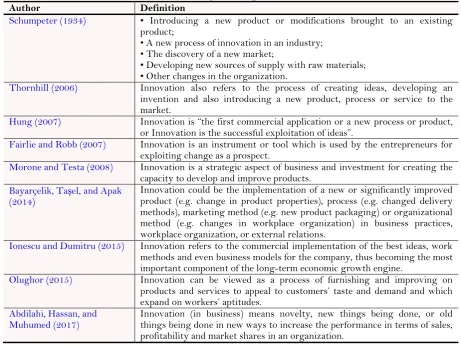
increase existing market share and provide enterprises to be competitive). Aziz and Samad (2016) stated that “SMEs should be involved in innovation; this will enhance sales growth and competitive advantage in marketplace”. This implies that innovation is a must engage activity for SMEs. Olughor (2015) observed that “the significance of innovation as firms‟ resources has been shown in the literature by a wide range of definitions”. Table 1 present some definitions among many others.
Table-1. Conceptual meaning of innovation.
Author Definition
Schumpeter (1934) • Introducing a new product or modifications brought to an existing
product;
• A new process of innovation in an industry; • The discovery of a new market;
• Developing new sources of supply with raw materials; • Other changes in the organization.
Thornhill (2006) Innovation also refers to the process of creating ideas, developing an
invention and also introducing a new product, process or service to the market.
Hung (2007) Innovation is “the first commercial application or a new process or product,
or Innovation is the successful exploitation of ideas”.
Fairlie and Robb (2007) Innovation is an instrument or tool which is used by the entrepreneurs for
exploiting change as a prospect.
Morone and Testa (2008) Innovation is a strategic aspect of business and investment for creating the
capacity to develop and improve products.
Bayarçelik, Taşel, and Apak
(2014)
Innovation could be the implementation of a new or significantly improved product (e.g. change in product properties), process (e.g. changed delivery methods), marketing method (e.g. new product packaging) or organizational method (e.g. changes in workplace organization) in business practices, workplace organization, or external relations.
Ionescu and Dumitru (2015) Innovation refers to the commercial implementation of the best ideas, work
methods and even business models for the company, thus becoming the most important component of the long-term economic growth engine.
Olughor (2015) Innovation can be viewed as a process of furnishing and improving on
products and services to appeal to customers‟ taste and demand and which expand on workers‟ aptitudes.
Abdilahi, Hassan, and
Muhumed (2017) Innovation (in business) means novelty, new things being done, or old things being done in new ways to increase the performance in terms of sales, profitability and market shares in an organization.
process, marketing and operations at the forefront of competition in the marketplace. This definition is based on the fact that innovation is classified into product, process, organizational and marketing innovation (OECD, 2009).
Walobwa, Ngugi, and Chepkulei (2013) opined that there has been confronting bottleneck on the choice of the
most appropriate kind of innovation for SMEs. Wanjiku (2011) suggested the need for SME owner to adopt effective approaches that can facilitate the adoption of a specific type of innovation. Importantly, adoption of the best innovation type may translate into favourable outcomes in terms of sales growth. Kaplan and Warren (2007) argued in favour of the position that innovation type is associated with sales growth and survival. They assume that there is no way SMEs can achieve enterprise‟s survival and growth without making reference to innovation. Enterprise‟s sales growth interconnects with other performance outcomes to enhance the strategic positioning of SMEs in the business environment. Al-Sulaiti et al. (2010) added that innovations position SMEs strategically to embattle likely challenges that may affect the achievement of sustainability of the enterprise‟s product among other competing brands.
Few studies according to Spithoven, Bart, and Mirjam (2010) have conducted research into the relationship between innovation and enterprise‟s performance. Based on the review of Ntiamoah, Li, and Sarpong (2019) it was discovered that the attention of some empirical studies was majorly on the relationship between the dimensions (product, process, organizational and marketing innovation) of innovation and performance. Several studies (such as
(Bakar & Ahmad, 2010); (Chong, Chan, Ooi, & Sim, 2011); (Njogu, 2014); (Olughor, 2015); (Gu & Shao, 2015);
(Ndesaulwa & Kikula, 2016); (Canh, Liem, Thu, & Khuong, 2019)) are aware of the significance of innovation and
have conducted an empirical investigation to unveil the impact of innovation on enterprise‟s performance. But most of the previous studies focused on either one or two dimensions of innovation (Ar & Baki, 2011; Bakar & Ahmad,
2010; Medina & Rufin, 2009; Zhang & Duan, 2010). This study focused on the effects of three dimensions of
innovation dimensions on the sales growth perspectives of SMEs.
3. METHODOLOGY
A survey research design was used for this study. The population of the study consists of Micro, Small and Medium Enterprises in Kogi State. The SMEDAN and National Bureau of Statistics in 2013 provided that the population of MSMEs in Kogi State is 968,275 representing 16.69% of the total population in the Northcentral. Kogi State is a case for innovation among MSME. This is the reason why Kogi State was selected for the study. Meanwhile, only the MSME owner/managers were considered for the survey. The sampling technique used for this study is multi-stage sampling technique. This involved classifying SMEs based on their size, industry and clusters. Furthermore, respondents were classified based on their common characteristics. For instance, the classification was based on age, sex, experience and so on. The sample size of the study for Kogi State was 384. This cuts across gender, age, marital status, educational qualification and work experience. The research adopted Salant and Dillman
(1994)method to determine the sample size. Below is the formula:
Where:
Ns= completed sample size required. Np= Sample population.
P= proportion expected to answer in a certain way (50% or 0.5 is most conservative). B= acceptable level of sampling error (0.05 = +5%; 0.03 = + 3%).
C= Z statistic associated with the confidence interval (1.645=90% confidence level; 1.960=95% confidence level; 2.576=99% confidence level).
Where:
Ns= 384.0080499 (Approximately 384) Np=
P= 50% or 0.5 B= 0.05 or +5% C= 1.960
To determine the instrument‟s reliability, the Cronbach Coefficient alpha (α) was used. The coefficient alpha is the most commonly applied estimate of a multiple-item scale‟s reliability with a coefficient of 0.70 and above considered to have good reliability.
Table-2. Test of reliability.
Variables Construct Cronbach’s Alpha Items
Innovation Product innovation .874 3
Process innovation .714 3
Market innovation .864 3
Performance Sales growth .708 2
Source: Field survey (2019).
Table 2 shows that product innovation has the reliability of 0.874 with three items; process innovation has the
reliability of 0.714 with three items; and market innovation has the reliability of 0.864 with three items. Sales growth has the reliability of 0.708 with two items. All the constructs are seen to be reliable. All data collected was presented and analyzed using frequency distribution table. Multiple Regression analysis was adopted to facilitate inferences which led to drawing of conclusions. The model (1) is specified below to explain the dependent and independent variables of the study:
Y = β0 + β1X1 + β2X2 + β3X3 + β4X4 + β5X5 + β6X6 + e (1)
Where X= The independent variable. X1 = Product innovation.
X2 = Process innovation.
X3 = Market innovation.
Y= The dependent variable (sales growth of SMEs). β = independent variable coefficients.
e = Error margin.
4. DATA PRESENTATION AND ANALYSIS
Table-3. Questionnaire administration.
Questionnaire Frequency Percentage
Administered 384 100
Returned 224 58.3
Unreturned 160 41.7
Source: Field survey, 2019.
Table 3 shows that 384 questionnaires (100%) were administered; 224 questionnaires (58.3%) were returned
Table-4. Showing the demographic variables of respondents.
Variables Responses Frequency Percent
Gender Male 143 63.8
Female 81 36.2
Total 224 100.0
Age bracket Below 20 Years 21 9.4
21-25 Years 29 12.9
26- 30 Years 76 33.9
31-35 Years 42 18.8
36- 40 Years 34 15.2
41- 50 Years 15 6.7
Above 50 Years 7 3.1
Total 224 100.0
Marital status Single 38 17.0
Married 94 42.0
Widow 28 12.5
Separated 40 17.9
Divorced 24 10.7
Total 224 100.0
Academic qualification Primary 28 12.5
Secondary 36 16.1
College of Education 102 45.5
University 58 25.9
Total 224 100.0
Business experience Below 1 Year 18 8.0
1-2 Years 26 11.6
2-4 Years 32 14.3
4-6 Years 71 31.7
6-10 Years 44 19.6
10-15 Years 21 9.4
Above 15 Years 12 5.4
Total 224 100.0
Source: Field survey, 2019.
Table 4 above shows the gender of respondents. It is observed that 143 respondents (63.8%) were male; and 81
respondents (36.2%) were female. This indicates that majority of the respondents in the study area were male.
The Table 4 above shows the age bracket of respondents. It is observed that 21 respondents (9.4%) were below
20 years; 29 respondents (12.9%) were 21 to 25 years; 76 respondents (33.9%) were 26 to 30 years; 42 respondents (18.8%) were 31 to 35 years; 34 respondents (15.2%) were 36 to 40 years; 15 respondents (6.7%) were 41 to 50 years and 7 respondents (3.1%) were above 50 years. The implication of this is that majority of respondents in the study area were 26 to 30 years.
Table 4 shows marital status of respondents. It is observed that 38 respondents (17.0%) were single; 94
respondents (42.0%) were married; 28 respondents (12.5%) were widow(er); 40 respondents (17.9%) were separated; and 24 respondents (10.7%) were divorced. The implication of this is that majority of respondents in the study area were married.
Table 4 above shows the academic qualification of respondents. It is depicted that 28 respondents (12.5%) were
primary school certificate holders; 36 respondents (16.1%) were secondary school certificate holder; 102 respondents (45.5%) were holders of college of education certificate; and 58 respondents (25.9%) were holders of university certificate. This shows that the majority of respondents in the study area were holders of college of education certificate.
Table 4 above shows business experience. It is observed that 18 respondents (8.0%) have below 1 year of
years. The implication of this is that majority of respondents in the study area have 4 to 6 years of business experience.
Table-5a. Regression model summary of innovation dimensions and sales growth.
Model R R square Adjusted R square Std. Error of the estimate
1 .493a .243 .240 .95033
2 .675b .456 .451 .80786
3 .732c .536 .530 .74718
Note: Predictors: Market, Process and Product innovation. Dependent Variable: Sales Growth.
Table 5ashows the R2 for the first variable to be 0.243 given the standard error of the estimate to be 0.95033.
This implies that 24.3% change in the sales growth of SMEs in Kogi State is determined by their market innovation. The linear effect of this is that market innovation has the predictive power of 24.3% over the sales growth of SMEs in Kogi State. This appears to be below 50%; it is thus a weak predictor. The remaining 75.7% unexplained variation shows that there are other essential predictors that can determine the sales growth of SMEs.
The table also shows the R2 for the second variable to be 0.451 given the standard error of the estimate to be
0.80786. The implication of this is that 45.1% variation in the sales growth of SMEs in Kogi State is explained by process innovation. The predictive power of process innovation is below average (50%). Meanwhile, the remaining 54.9 unexplained variation signifies that there are other variables that can predict the sales growth of SMEs in Kogi State apart from process innovation.
The table also shows the R2 for the third variable to be 0.536 given the standard error of the estimate to be
0.74718. The table shows that product innovation accounts for 53.6% variation in the sales growth of SMEs. Other variables may account for the remaining 46.4% unexplained variation in the sales growth of SMEs. Product innovation however predicts well with the strength which is a little above average (50%). This shows that product innovation has a strong predictor over the sales growth of SMEs in Kogi State.
Table-5b. ANOVA of innovation dimensions and sales growth.
Model Sum of Squares df Mean Square F Sig.
1 Regression 64.465 1 64.465 71.379 .000b
Residual 200.495 222 .903
Total 264.960 223
2 Regression 120.728 2 60.364 92.493 .000c
Residual 144.232 221 .653
Total 264.960 223
3 Regression 142.140 3 47.380 84.869 .000d
Residual 122.820 220 .558
Total 264.960 223
Note: Predictors: Market, Process and Product innovations. Dependent Variable: Sales Growth.
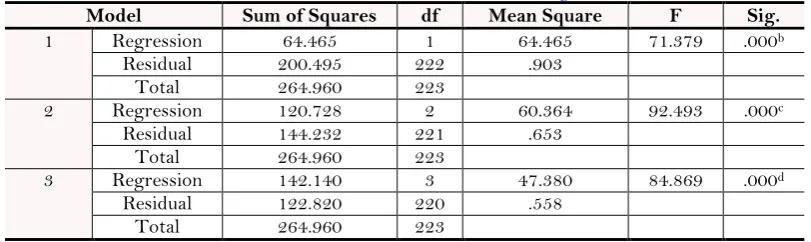
From the Table 5b, the significance of variables is tested and the degree of variability within the regression models is determined. The ANOVA table depicts that there is no guess work in the model. The mean square residual values (0.903 for market innovation, 0.653 for process innovation and 0.558 for product innovation) are smaller, indicating less deviation between the observed and fitted values. The P-value for the F test statistic (71.379 for market innovation, 92.493 for process innovation and 84.869 for product innovation) are less than 0.001. The coefficient of determination in Table 5a for market innovation (R2= 0.243), process innovation (R2= 0.456) and
product innovation (R2= 0.536) reveals the significant effects of the dimensions of innovation on the sales growth of
Table-5c. Coefficients of innovation dimensions and sales growth.
Model Unstandardized
Coefficients Standardized Coefficients t Sig.
B Std. Error Beta
1 (Constant) 1.106 .122 9.068 .000
Market Innovation .418 .049 .493 8.449 .000
2 (Constant) 1.911 .135 14.139 .000
Market Innovation .549 .044 .648 12.380 .000
Process Innovation -.451 .049 -.486 -9.285 .000
3 (Constant) 2.067 .128 16.209 .000
Market Innovation .647 .044 .764 14.717 .000
Process Innovation -.332 .049 -.358 -6.794 .000
Product Innovation -.282 .045 -.347 -6.193 .000
Source: Field survey, 2019.
4.1. Dependent Variable: Sales Growth
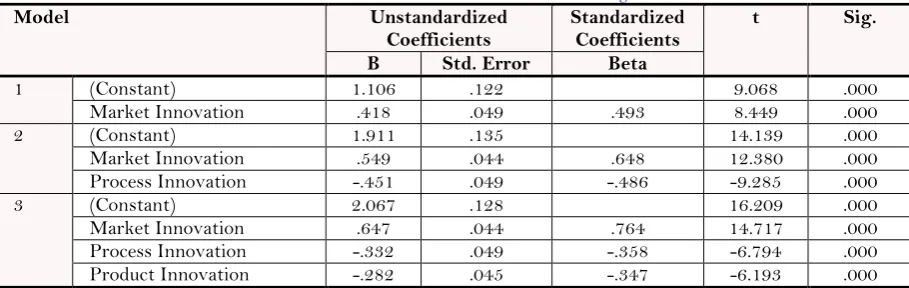
Table 5c shows three variables against the dependent variable (sales growth of SMEs in Kogi State). The
coefficient of market innovation (unstandardized beta- 0.418) shows a positive relationship with the sales growth of SMEs in Kogi State. The coefficient for market innovation (standardized beta- 0.493; p-value = 0.01) shows about average contribution to the sales growth of SMEs. Comparing market innovation and process innovation; the former entered the model with positive sign and the later entered with negative sign. The market innovation has average coefficient of 54.9% for unstandardized beta. The standardized beta appears to be 64.8% showing very strong contribution to sales growth of SMEs when process innovation is included in the model. Meanwhile, process innovation shows negative 45.1% coefficient for unstandardized beta below average. Its contribution (48.6%) to sales growth of SMEs is negative but below average. Thus, the contribution of process innovation to sales growth of SMEs is negative with an inclusion of market innovation. The coefficient for product innovation (unstandardized beta) is -0.282, showing 28.2% when it is also included to market and process innovation. The coefficient for product innovation (standardized beta) is -0.347. This implies that product innovation has negative contribution to sales growth of SMEs in Kogi State. The inclusion of product innovation made the strength of market innovation to increase. It is however observed that the three variables have significant contributions to the sales growth of SMEs in Kogi State given their p-values equal to 0.01.
5. DISCUSSION OF FINDINGS
Finding shows that market and process innovations have weak linear effects on the sales growth of SMEs in Kogi State. Only product innovation has strong effect on the sales growth of SMEs in Kogi State. However, the effects of theses variables were determined on individual basis. From the result of the study, it was revealed that product innovation accounts for 53.6% variation in the sales growth of SMEs. On the ground of combination of innovation strategies, market innovation shows the highest positive contribution to the sales growth of SMEs. This aligns with the finding of Walobwa et al. (2013) that among the types of innovation analyzed, marketing innovation contributed most to the growth of garment SMEs in Jericho market, Nairobi. The contributions of process innovation and product innovation to sales growth of SMEs was found negative. Process innovation has more negative contribution to sales growth of SMEs in Kogi State. The finding of this study advances the study of
Kaplan and Warren (2007) which discovered that innovation type is associated with business growth. This is
because this study is able to associate each of the innovation type with sales growth of SMEs in Kogi State.
6. CONCLUSION AND RECOMMENDATION
panacea for effective and efficient SMEs. Since innovation has been conceived as strategic point for enterprises, this study empirically investigated its effects on sales growth.
The empirical position of the sales growth of SMEs can be achieved with one or more dimensions of innovation. Finding proved that market and process innovations have weak linear effects on the sales growth of SMEs in Kogi State. This means that market and process innovations can only influence the sales growth of SMEs in Kogi State to a low extent. On the contrary, product innovation was found to have strong linear effect on the sales growth of SMEs in Kogi State. By implication, product innovation can influence the sales growth of SMEs in Kogi State to a great extent. The study recommends that SME owners should undertake or invest more in market innovation rather than process innovation and product innovation to achieve sales growth in Kogi State. This is because market innovation contributes to the sales growth of SMEs positively, and process innovation and product innovation contribute to sales growth of SMEs negatively.
Funding: This study received no specific financial support.
Competing Interests: The authors declare that they have no competing interests.
Acknowledgement: Both authors contributed equally to the conception and design of the study.
REFERENCES
Abdilahi, M. H., Hassan, A. A., & Muhumed, M. M. (2017). The impact of innovation on small and medium enterprises
performance: Empirical evidence from Hargeisa, Somaliland. International Journal of Academic Research in Business and
Social Sciences, 7(8), 14-28.Available at: https://doi.org/10.6007/ijarbss/v7-i8/3202.
Abdullah, N. C., & Mustapha, R. (2009). A case study of SMI Bumiputera agropreneurs in Terengganu (A Case Study of SMI
Bumiputera agropreneurs in Terengganu). Malaysian Journal of Education (Malaysian Journal of Education), 34(2),
143-165.
Al-Sulaiti, K. I., Michael, J. B., Alan, B., Michael, J. B., Lorna, B., Warren, J. B., & Erik, N. (2010). Research methods for business
students. International Marketing Review, 14(2), 73–89.
Ar, I. M., & Baki, B. (2011). Antecedents and performance impacts of product versus process innovation: Empirical evidence from
SMEs located in Turkish science and technology parks. European Journal of Innovation Management, 14(2),
172-206.Available at: https://doi.org/10.1108/14601061111124885.
Aziz, N. N. A., & Samad, S. (2016). Innovation and competitive advantage: Moderating effects of firm age in foods manufacturing
SMEs in Malaysia. Procedia Economics and Finance, 35(2016), 256-266.Available at:
https://doi.org/10.1016/s2212-5671(16)00032-0.
Bakar, L. J. A., & Ahmad, H. (2010). Assessing the relationship between firm resources and product innovation performance.
Business Process Management Journal, 16(3), 420-435.
Bayarçelik, E. B., Taşel, F., & Apak, S. (2014). A research on determining innovation factors for SMEs. Procedia-Social and
Behavioral Sciences, 150, 202-211.Available at: https://doi.org/10.1016/j.sbspro.2014.09.032.
Boachie-Mensah, F. B., & Acquah, I. S. (2015). The effect of innovation types on the performance of small and medium sized
enterprises in the Sekondi-Takoradi metropolis. Archives of Business Research, 3(3), 77-98.Available at:
https://doi.org/10.14738/abr.33.1240.
Canh, N. T., Liem, N. T., Thu, P. A., & Khuong, N. V. (2019). The impact of innovation on the firm performance and corporate
social responsibility of Vietnamese manufacturing firms. Sustainability, 11(13), 1-14.Available at:
https://doi.org/10.3390/su11133666.
Chong, A. Y. L., Chan, F. T. S., Ooi, K. B., & Sim, J. J. (2011). Can Malaysian firms improve organizational/ innovation
performance via SCM. Industrial Management and Data System, 111(3), 410-431.
Fairlie, R. W., & Robb, A. (2007). Families, human capital, and small business: Evidence from the characteristics of business
Gu, L. Z., & Shao, Y. F. (2015). The empirical study of SMEs innovation and performance factors in Sichuan. Studies in Sociology of Science, 6(1), 40-47.Available at: http://dx.doi.org/10.3968/6012.
Gunday, G., Ulusoy, G., Kilic, K., & Alpkan, L. (2011). Effects of innovation types on firm performance. International Journal of
production economics, 133(2), 662-676.
Hafeez, H. M., Shariff, M., Noor, M., & Mad Lazim, H. (2012). Relationship between entrepreneurial orientation, firm resources,
SME branding and firm‟s performance: Is innovation the missing link? American Journal of Industrial and Business
Management, 2(04), 153-159.Available at: https://doi.org/10.4236/ajibm.2012.24020.
Hajipour, B., & Ghanavati, M. (2012). The impact of market orientation and organizational culture on the performance: Case
study of SMEs. Journal of Contemporary Management, 9(1), 83-95.
Hinson, R., & Mahmoud, M. (2011). Qualitative insights into market orientation in small Ghanaian businesses. International
Journal of Marketing Studies, 3(1), 35-44.
Hung, H.-M. (2007). Influence of the environment on innovation performance of TQM. Total Quality Management & Business
Excellence, 18(7), 715-730.Available at: https://doi.org/10.1080/14783360701349666.
Idar, R., & Mahmood, R. (2011). Entrepreneurial and marketing orientation relationship to performance: The SME perspective.
Interdisciplinary Review of Economics and Management, 1(2), 1-8.
Ionescu, A., & Dumitru, N. R. (2015). The role of innovation in creating the company‟s competitive advantage. Eco Forum, 4(1),
1-14.
Ismail, M. D. (2013). Learning orientation and trust in small and medium enterprise (SME) export competitive. Asian Academy of
Management Journal, 18(2), 153–179.
Kaplan, M. J., & Warren, A. C. (2007). Patterns of entrepreneurship (2nd ed.). USA: John Wiley and Sons Inc.
Kiraka, R. (2009). Innovative private sector development instruments – an African perspective for investing in the development
of small and medium enterprises. Working Paper No. 01/2009, ICEP.
Li, Q. (2003). Profitability of small and medium-sized enterprises in high-tech industries: The case for biotechnology industry.
Strategic Management Journal, 24(9), 881-887.Available at: https://doi.org/10.1002/smj.344.
Man, M. K. (2009). The relationship between distinctive capabilities, innovativeness, strategy types and the performance of small
and medium-size enterprises (SMEs) of Malaysian manufacturing sector. International Business & Economics Research
Journal, 8(11), 21-33.Available at: https://doi.org/10.19030/iber.v8i11.3182.
Medina, C., & Rufin, R. (2009). The mediating effect of innovation in the relationship between retailers, strategic orientations
and performance. International Journal of Retail and Distribution Management, 37(7), 629-655.Available at:
https://doi.org/10.1108/09590550910964639.
Morone, P., & Testa, G. (2008). Firms growth, size and innovation An investigation into the Italian manufacturing sector.
Economics of Innovation and New Technology, 17(4), 311-329.Available at: https://doi.org/10.1080/10438590701231160.
Nafula, K. M. (2017). Effect of innovation on firm competitiveness: A study of small and medium enterprises in the manufacturing sector in
Nairobi City County, Kenya. A Thesis: Kenyatta University.
Ndesaulwa, A. P., & Kikula, J. (2016). The impact of innovation on performance of small and medium enterprises (SMEs) in
Tanzania: A review of empirical evidence. Journal of Business and Management Sciences, 4(1), 1-6.
Neagu, C. (2016). The importance and role of small and medium-sized businesses. Theoretical & Applied Economics, 23(3),
331-338.
Njogu, T. W. (2014). The effect of innovation on the financial performance of small and medium enterprises in Nairobi County, Kenya: A research project (pp. 1-20). Nairobi: University of Nairobi.
Ntiamoah, E. B., Li, D., & Sarpong, D. B. (2019). The effect of innovation practices on agribusiness performance: A structural
equation modelling (SEM) approach. African Journal of Science, Technology, Innovation and Development, 11(6),
1-12.Available at: https://doi.org/10.1080/20421338.2019.1573958.
OECD. (2009). Innovation in firms: A microeconomic perspective. Paris: OECD.
Opeda, F., Jaiyeoba, O., & Donatus, A. (2011). Market orientation: Journey from antecedents to business performance in a
developing economy: A case-study of Botswana‟s small and medium size manufacturing firms. International Journal of
Business Administration, 2(4), 61-68.Available at: https://doi.org/10.5430/ijba.v2n4p61.
Salant, P., & Dillman, D. A. (1994). How to conduct your own survey. New York: John Wiley and Sons.
Schumpeter, J. A. (1934). The theory of economic development: An inquiry into profits, capital, credit, interest and the business cycle. Cambridge Mass: Harvard University Press.
Spithoven, A., Bart, C., & Mirjam, K. (2010). Building absorptive capacity to organise inbound open innovation in traditional
industries. Technovation, 31(1), 10–21.Available at: https://doi.org/10.1016/j.technovation.2009.08.004.
Susanto, A. B. (2017). Improve the performance of SMES through innovation strategies in developing countries. International
Journal of Scientific and Technology Research, 6(10), 282-285.
Thornhill, S. (2006). Knowledge, innovation and firm performance in high-and low-technology regimes. Journal of Business
Venturing, 21(5), 687-703.Available at: https://doi.org/10.1016/j.jbusvent.2005.06.001.
Ukpabio, M. G., Oyebisi, T. O., & Siyanbola, O. W. (2018). Effects of innovation on performance of manufacturing SMEs in
Nigeria: An empirical study. Retrieved from
http://liee.ntua.gr/wp-content/uploads/2018/02/879-Effects-of-Innovation-on-Performance-of-Manufacturing-SMEs-.pdf. [Accessed 21/09/2019].
Walobwa, N. D., Ngugi, J. K., & Chepkulei, B. (2013). Effect of the type of innovation on the growth of small and medium
enterprises in Kenya: A case of garment enterprises in Jericho, Nairobi. European Journal of Management Sciences and
Economics, 1(2), 49-57.
Wanjiku, C. G. (2011). Industrial Innovation in the face of stiff competition from Chinese imports; A study of small and medium scale garment firms in Nairobi. Unpublished Dissertation, Nairobi University.
Westerberg, R. (2008). Entrepreneur characteristics and Management control. In: M.G. Ukpabio, T.O. Oyebisi and O.W. Siyanbola (Eds.), Effects of Innovation on Performance of Manufacturing SMEs in Nigeria: An empirical study.
Retrieved from
http://liee.ntua.gr/wp-content/uploads/2018/02/879-Effects-of-Innovation-on-Performance-of-Manufacturing-SMEs-.pdf. [Accessed 21/09/2019].
Zhang, J., & Duan, Y. (2010). The impact of different types of market orientation on product innovation performance: Evidence
from Chinese manufacturers. Management Decision, 48(6), 849-867.Available at:
https://doi.org/10.1108/00251741011053433.