The nucleon localization function in static and time-dependent DFT
BastianSchuetrumpf1,and ChunliZhang1,
1NSCL/FRIB Laboratory, Michigan State University, East Lansing, Michigan 48824, USA
Abstract.Static and time-dependent density functional theory (DFT) calculations are often used to predict fission fragment distributions or fusion cross sections with great success. However, nuclear shell structure and
clusterization effects are usually studied using the density distribution of the nucleons which is a poor indicator
of these phenomena. In this work, we employ a measure called the localization function, which was first introduced in chemistry to visualize electronic bonds and recently applied to nuclear physics for light nuclei to
revealα-clustering. We show, that the localization function reveals the shell structure of the fragments in fission
long before the scission point and also illustrates the shell structure of intermediate states in time-dependent DFT calculations.
1 Introduction
The emergence of cluster states in atomic nuclei is a uni-versal phenomenon with many implications for both nu-clear physics and astrophysics [1–3]. Several factors are contributing to clustering, a complete microscopic under-standing has still not been achieved. Cluster configura-tions are often energetically favorable due to the large binding energy per nucleon in constituent clusters, such as α particles and this argument has often been used to explain properties ofα-conjugate nuclei [4], cluster emis-sion [5, 6] and fisemis-sion [7]. Clusters are also coupled to de-cay channels, which explains [8, 9] the occurrence of clus-ter states at low excitation energies around clusclus-ter-decay thresholds [10]. Clustering is of special relevance in the dynamics of the tripple-αreaction [11].
A microscopic description of cluster states requires the use of an advanced many-body framework. A good start-ing point is density functional theory (DFT) based on a realistic nuclear energy density functional [12]. Within DFT, cluster states have a simple interpretation in terms of quasimolecular states.
The degree of clustering in nuclei is difficult to assess quantitatively in DFT as the single particle wave functions are spread throughout the nuclear volume. Furthermore the single particle states in the Slater determinant are not fixed since the Slater determinant is invariant under unitary transformations. Therefore, in this study, we utilize a mea-sure - dependent on s.p. orbitals, yet invariant under uni-tary transformation - called localization, originally intro-duced for the identification of electronic bonds in atomic and molecular systems (see e.g. [13–15]) and has recently been applied to characterize clusters in light nuclei [16].
In this contribution we introduce the localization mea-sure in Sec. 2. In Sec. 3 we show results for heavy nuclei,
e-mail: [email protected] e-mail: [email protected]
in Sec. 4 we review findings for fissioning nuclei and in Sec. 5 we show first results for time-dependent calcula-tions.
2 Method
2.1 The nucleon localization function
A localization measure in the DFT framework was first introduced for electronic systems to visualize electronic bonds in [13], referred to as the electronic localization function (ELF). For nuclear systems the localization was first utilized in [16] for light nuclei. For nuclear matter the nucleon localization function (NLF) is based on the inverse conditional probability of finding a nucleon with same spin and isospin in the vicinity of another knowing with certainty that this one is located at r. The measure can be expressed through densities and a natural choice for the normalization is the Thomas-Fermi kinetic energy. The resulting dimensionless NLF reads
Cqσ(r)= 1+
τqσρqσ−14|∇ρqσ|2−j2qσ ρqστTFqσ
2
−1
(1)
and contains the densities ρqσ(r) =
α∈q
v2α|ψα(rσ)|2, (2a)
τqσ(r) =
α∈q
v2α|∇ψα(rσ)|2, (2b)
jqσ(r) =
α∈q
v2αIm[ψ∗α(rσ)∇ψα(rσ)], (2c)
∇ρqσ(r) = 2
α∈q
v2αRe[ψ∗α(rσ)∇ψα(rσ)] (2d)
τTFqσ = 3 5(6π2)2
/3ρ5/3
wherev2αis the canonical occupation probability,q∈ {p,n} labels the isospin andσ ∈ {↑,↓}labels the spin or signa-ture symmetry. For the time-independent calculations pre-sented here, time-reversal symmetry is conserved; hence, jqσvanishes. For time-dependent calculations, the spin is in general not a conserved quantity and the signature sym-metry has to be taken into account. However, since we are only interested in the total localization of neutrons and protons, we show in this case the localizationsCq for
av-erage densitiesρqav=(ρq↑(r)+ρq↓(r))/2 and for the other
densities respectively.
Two important values for the localization should be mentioned at this point:
Cqσ=0.5: Due to the normalization with the Thomas-Fermi kinetic energy a localization of 0.5 indicates a lo-calization as in a Fermi gas of nuclei.
Cqσ=1.0: A localization of one indicates perfect local-ization, i.e. that the probability of finding another nucleon with same spin and isospin is zero. Perfect localization can be found in anα-particle, where only one particle of each spin and isospin combination is present.
In practice especially for light nuclei we found, that if the numerical value the wave function is very small far out-side a nucleus, the value of the localization is poorly de-termined and depends strongly on numerical effects. Since we are only interested in the localization inside a nucleus, we utilize a masking function to suppress the localization outside a nucleus as
C(r)→ C(r)ρqσ(r)/max[ρqσ(r)] . (3)
2.2 DFT engines
The model of choice for this study is the Skyrme EDF method. In particular we are using the UNEDF1 inter-action [17], which was optimized for fission calculations and largely deformed nuclei.
We use two well established EDF solvers for the calcu-lations. For the ground state calculations and constrained fission calculations in Sec. 3 and Sec. 4 we employ the solver HFBTHO [18], based on a deformed harmonic os-cillator basis expansion for the wave functions solving the Hartree-Fock-Bogolyubov (HFB) equations including the pairing effect self-consistently.
For the time-dependent calculations in Sec. 5, we em-ploy the solver Sky3D [19] which operates on a cartesian 3d grid employing the fast Fourier transform for deriva-tives. It solves the time-dependent Hartree-Fock equations and includes the pairing effect in the BCS limit with frozen occupations.
3 Localization in heavy nuclei
In [16] it has been shown, that the NLF reveals α -clustering in light nuclei very clearly. Here, the NLF for heavier nuclei shall be studied.
In Fig. 1 the neutron and proton densities (left panels) as well as the NLF (right panels) of132Sn are displayed.
While the number densities show no structure, except for a small dip in the center of the proton density, the NLF
-4 0 4
132Sn
(a)
ρn Cn↑ (b)
-4 0 4
-4 0 4
(c) ρp
-4 0 4
(d)
Cp↑
0 0.03 0.06 0.09
0 0.3 0.6
0 0.03 0.06
0 0.3 0.6
r (fm)
z
(fm
)
Figure 1: Nucleonic number densities (in fm−3) and spatial
localizations for the ground state of132Sn. This Figure is
taken from [20].
-4 0 4
100Zr
(a)
ρn Cn↑ (b)
-4 0 4
-4 0 4
(c) ρp
-4 0 4
(d)
Cp↑
0 0.03 0.06 0.09
0 0.3 0.6
0 0.03 0.06
0 0.3 0.6
r (fm)
z
(fm
)
Figure 2: Nucleonic number densities (in fm−3) and spatial
localizations for the ground state of100Zr. This Figure is
taken from [20].
show concentric rings of enhanced localization. The case of132Sn is particularly interesting, because it is a doubly
magic nuclei with one more closed shell for the neutrons. This also manifests in the NLF with an additional enhance-ment at the center of the neutron NLF. In contrast to elec-tronic systems, the number of closed shells cannot be de-termined by the number of radial NLF enhancements. The difference is, that in electronic systems the length scale of the shells is proportional to∼n2 wherenis the principal
quantum number and in nuclear systems it is proportional to∼ √n and also dependent on the angular momentum. Therefore the shells overlap and cannot be clearly distin-guished. However, the imprint on the NLF of one more closed shell is clearly visible.
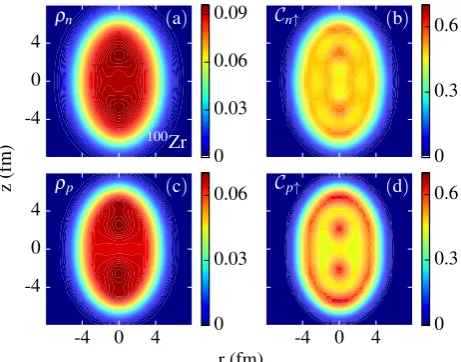
For a second example100Zr is shown in Fig. 2. This
wherev2αis the canonical occupation probability,q∈ {p,n} labels the isospin andσ ∈ {↑,↓}labels the spin or signa-ture symmetry. For the time-independent calculations pre-sented here, time-reversal symmetry is conserved; hence, jqσvanishes. For time-dependent calculations, the spin is in general not a conserved quantity and the signature sym-metry has to be taken into account. However, since we are only interested in the total localization of neutrons and protons, we show in this case the localizationsCqfor
av-erage densitiesρqav=(ρq↑(r)+ρq↓(r))/2 and for the other
densities respectively.
Two important values for the localization should be mentioned at this point:
Cqσ=0.5: Due to the normalization with the Thomas-Fermi kinetic energy a localization of 0.5 indicates a lo-calization as in a Fermi gas of nuclei.
Cqσ=1.0: A localization of one indicates perfect local-ization, i.e. that the probability of finding another nucleon with same spin and isospin is zero. Perfect localization can be found in anα-particle, where only one particle of each spin and isospin combination is present.
In practice especially for light nuclei we found, that if the numerical value the wave function is very small far out-side a nucleus, the value of the localization is poorly de-termined and depends strongly on numerical effects. Since we are only interested in the localization inside a nucleus, we utilize a masking function to suppress the localization outside a nucleus as
C(r)→ C(r)ρqσ(r)/max[ρqσ(r)] . (3)
2.2 DFT engines
The model of choice for this study is the Skyrme EDF method. In particular we are using the UNEDF1 inter-action [17], which was optimized for fission calculations and largely deformed nuclei.
We use two well established EDF solvers for the calcu-lations. For the ground state calculations and constrained fission calculations in Sec. 3 and Sec. 4 we employ the solver HFBTHO [18], based on a deformed harmonic os-cillator basis expansion for the wave functions solving the Hartree-Fock-Bogolyubov (HFB) equations including the pairing effect self-consistently.
For the time-dependent calculations in Sec. 5, we em-ploy the solver Sky3D [19] which operates on a cartesian 3d grid employing the fast Fourier transform for deriva-tives. It solves the time-dependent Hartree-Fock equations and includes the pairing effect in the BCS limit with frozen occupations.
3 Localization in heavy nuclei
In [16] it has been shown, that the NLF reveals α -clustering in light nuclei very clearly. Here, the NLF for heavier nuclei shall be studied.
In Fig. 1 the neutron and proton densities (left panels) as well as the NLF (right panels) of132Sn are displayed.
While the number densities show no structure, except for a small dip in the center of the proton density, the NLF
-4 0 4
132Sn
(a)
ρn Cn↑ (b)
-4 0 4
-4 0 4
(c) ρp
-4 0 4
(d)
Cp↑
0 0.03 0.06 0.09 0 0.3 0.6 0 0.03 0.06 0 0.3 0.6 r (fm) z (fm )
Figure 1: Nucleonic number densities (in fm−3) and spatial
localizations for the ground state of132Sn. This Figure is
taken from [20].
-4 0 4
100Zr
(a)
ρn Cn↑ (b)
-4 0 4
-4 0 4
(c) ρp
-4 0 4
(d)
Cp↑
0 0.03 0.06 0.09 0 0.3 0.6 0 0.03 0.06 0 0.3 0.6 r (fm) z (fm )
Figure 2: Nucleonic number densities (in fm−3) and spatial
localizations for the ground state of100Zr. This Figure is
taken from [20].
show concentric rings of enhanced localization. The case of 132Sn is particularly interesting, because it is a doubly
magic nuclei with one more closed shell for the neutrons. This also manifests in the NLF with an additional enhance-ment at the center of the neutron NLF. In contrast to elec-tronic systems, the number of closed shells cannot be de-termined by the number of radial NLF enhancements. The difference is, that in electronic systems the length scale of the shells is proportional to∼n2 wherenis the principal
quantum number and in nuclear systems it is proportional to∼ √n and also dependent on the angular momentum. Therefore the shells overlap and cannot be clearly distin-guished. However, the imprint on the NLF of one more closed shell is clearly visible.
For a second example100Zr is shown in Fig. 2. This
nucleus does not have a magic number of either nucleons and is prolately deformed. The proton NLF reveals two
-10 0 10
(24,0)
ρn
(83,0) (165,17) (300,37) (330,41)
-10 0 10 Cn↑
-10 0 10 ρp
-5 0 5 -10
0 10 Cp↑
-5 0 5 -5 0 5 -5 0 5 -5 0 5 0 0.05 0.10 0 0.25 0.50 0 0.03 0.06 0 0.25 0.50 r (fm) z (fm )
(Q20, Q30)=(24,0) (83,0) (165,17) (300,37) (330,42)
Figure 3: Nucleonic number densities (in fm−3) and
spa-tial localizations for232Th for five configurations along the
fission pathway. This Figure is taken from [20]. The de-formations are marked at the top of each column with in units of b and b3/2, respectively.
centers and one ring of enhanced localization, whereas the neutron NLF exhibits a two ring structure. Also here the 20 additional neutrons leave a strong imprint on the local-ization.
4 Localization for fission calculations
As a next step we study the localization during fission in heavy nuclei. As an example we take the asymmetric fis-sion of232Th. We consider the fission pathway which hasbeen calculated in [21] and plot the densities and NLF for five points on this pathway in Fig 3. This pathway leads to the two fragments132Sn and100Zr which were discussed in
Sec. 3. This will make it possible to compare the NLFs of the compound nucleus to those of the fragments. For that purpose we performed static calculations with constraints on the quadrupole momentQ20which quantifies the
elon-gation and the octupole momentQ30which quantifies the
mass asymmetry as marked at the top of the figure. Ro-tational symmetry along the z-axis is assumed. The state which is displayed in the left column corresponds to the ground state. The next state is the metastable fission iso-mer. The third state is a state across the barrier which has already a non-zero mass asymmetry deformed. The fourth state is around the scission point and the fifth state shows already separated fragments.
While the first two compact configurations have a very distinct structure in the NLF, they do not resemble the frag-ments. In contrast, the first configuration on the asymmet-ric part of the path shows already the structure of the frag-ments. It is also worth to notice, that in the neck region,
t= 0 -| | | | | | 0 -5 5
t= 48 fm/c -| | | | | |
t= 96 fm/c -| | | | | | 0 -5 5 z (fm )
t= 144 fm/c -| | | | | |
t= 192 fm/c -| | | | | | 0 -5 5 0 -5 5
t= 240 fm/c -| | | | | | 0 -5 5 x(fm)
Figure 4: Snapshots of the time evolution of the nucleonic number densities (in fm−3) of the central collision of two 16O nuclei withEcm=40 MeV.
where both fragments overlap, the NLF has values around 0.5. This indicates, that in this region there is not a dis-tinct shell structure dominant and the structure is similar to a Fermi gas. The density however does not show any resemblance to a specific fragment and the neck contains still a large number of nucleons which makes it impossible to predict the fragments.
The fourth configuration shows even more clearly the NLF of the fragments. The neck is already very small and especially for the neutrons an enhanced localization is vis-ible. This enhancement is the result of very few particles which are present in the neck so the possibility of find-ing a second with same spin and isospin is very small. The fifth configuration finally exhibits the exact structure of the fragments.
5 Localization in time-dependent DFT
In this section we focus on first time-dependent results for the NLF. As a test case we picked the symmetric collision between two16O nuclei. First we consider a central
colli-sion with a center-of-mass energy of 40 MeV.
(a)t=192 fm/c
(b)t=240 fm/c
Figure 5: Snapshots of the time-dependent evolution of the neutron NLF of the central collision of two16O nuclei
withEcm=40 MeV.
and the two oxygen are again visible in the density. Af-terwards the compound oscillates between two configura-tions which are shown in the lower panels att=192 fm/c andt=240 fm/c.
In the evolution of the NLF much more structure is vis-ible. In Fig 5 two configurations of the neutron NLF are shown, corresponding to the configurations in the lower panel of Fig. 4. Here, we only show the neutron NLF, since for light isospin symmetric nuclei the difference be-tween the neutron and proton NLF stemming from the small Coulomb contribution is neglectable for our pur-pose.
In the configuration att=192 fm/c large NLF values at the tips of the compound are visible. These are strong indicators ofα-clusters. The rings of enhanced localiza-tion in between are often indicators for a 12C-like shell
structure. It can be regarded as an16O nucleus without
one of the p-shells which create a hole in the spherical NLF in one direction. The particle content of the regions where the rings are present confirms this fact. The NLF ring-like configuration is not the ground state of a12C
nu-cleus but an excited state. We interpret this state of the
32S compound nucleus as aα-12C-12C-α. Such a ring can
also be found in the ground states of nuclei as e.g. in20Ne.
In [16]20Ne was interpreted as a quasi-molecularα-12C-α
configuration.
t= 0
-| | |
| | |
0
-5 5
t= 32 fm/c
-| | |
| | |
t= 64 fm/c
-| | |
| | |
0
-5 5
z
(fm
)
t= 96 fm/c
-| | |
| | |
t= 128 fm/c
-| | |
| | |
0
-5 5
0
-5 5
t= 160 fm/c
-| | |
| | | 0
-5 5
x(fm)
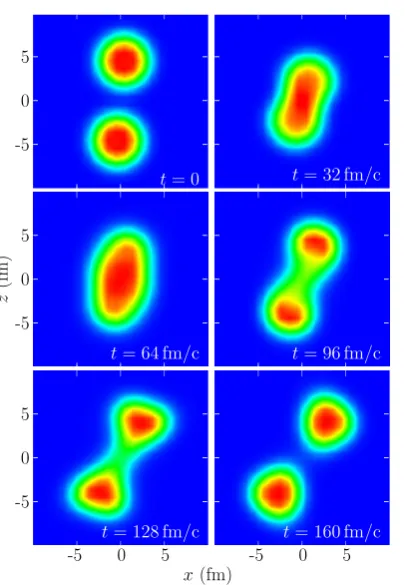
Figure 6: Same as Fig. 4 but for Ecm = 100 MeV and b=2 fm
Figure 7: Same as Fig. 5 but for Ecm = 100 MeV and b=2 fm at timet=96 fm/c.
In the second configuration at t = 240 fm/c the en-hancements at the tips have vanished. The separation of the two rings however increased. This suggests, that the structure has changed to two12C-like clusters at the tips.
The remaining nuclei have been shifted into the interior. They do not appear asα-clusters, but the nucleons are de-localized between the rings and therefore do not show an enhancement in the localization.
(a)t=192 fm/c
(b)t=240 fm/c
Figure 5: Snapshots of the time-dependent evolution of the neutron NLF of the central collision of two16O nuclei
withEcm=40 MeV.
and the two oxygen are again visible in the density. Af-terwards the compound oscillates between two configura-tions which are shown in the lower panels att=192 fm/c andt=240 fm/c.
In the evolution of the NLF much more structure is vis-ible. In Fig 5 two configurations of the neutron NLF are shown, corresponding to the configurations in the lower panel of Fig. 4. Here, we only show the neutron NLF, since for light isospin symmetric nuclei the difference be-tween the neutron and proton NLF stemming from the small Coulomb contribution is neglectable for our pur-pose.
In the configuration att =192 fm/c large NLF values at the tips of the compound are visible. These are strong indicators of α-clusters. The rings of enhanced localiza-tion in between are often indicators for a 12C-like shell
structure. It can be regarded as an16O nucleus without
one of the p-shells which create a hole in the spherical NLF in one direction. The particle content of the regions where the rings are present confirms this fact. The NLF ring-like configuration is not the ground state of a12C
nu-cleus but an excited state. We interpret this state of the
32S compound nucleus as aα-12C-12C-α. Such a ring can
also be found in the ground states of nuclei as e.g. in20Ne.
In [16]20Ne was interpreted as a quasi-molecularα-12C-α
configuration.
t= 0
-| | |
| | |
0
-5 5
t= 32 fm/c
-| | |
| | |
t= 64 fm/c
-| | |
| | |
0
-5 5
z
(fm
)
t= 96 fm/c
-| | |
| | |
t= 128 fm/c
-| | |
| | |
0
-5 5
0
-5 5
t= 160 fm/c
-| | |
| | | 0
-5 5
x(fm)
Figure 6: Same as Fig. 4 but for Ecm = 100 MeV and b=2 fm
Figure 7: Same as Fig. 5 but for Ecm = 100 MeV and b=2 fm at timet=96 fm/c.
In the second configuration at t = 240 fm/c the en-hancements at the tips have vanished. The separation of the two rings however increased. This suggests, that the structure has changed to two12C-like clusters at the tips.
The remaining nuclei have been shifted into the interior. They do not appear asα-clusters, but the nucleons are de-localized between the rings and therefore do not show an enhancement in the localization.
Figure 6 displays the time evolution of the density dis-tribution of a noncentral collision with an impact param-eter of b = 2 fm and a center-of-mass energy of Ecm = 100 MeV. After the two fragments form a compound nu-cleus the two fragments rotate connected with a neck and then separate aroundt=160 fm/c.
The most interesting configuration for the NLF is here the configuration att=96 fm/c shown in Fig. 7. The two
12C rings are present, similar to the central case, but an
en-hancement inside the neck is also present. This enhance-ment results again from the small possibility of finding a second particle with same spin and isospin inside the small neck region. Afterwards, the spherical enhancement of the
16O fragments appear again when the neck vanishes.
6 Conclusion
In our work, we expand the use of the localization from light nuclei, where mainlyα-clusters can be exhibited, to heavy nuclei, where imprints of the shell structure can be observed. We show at the example of132Sn, that the
im-print of closed shells are clearly visible in the NLF, al-though the length scale of the shells in a nucleus is propor-tional to∼ √nand also dependent on the angular momen-tum and thus can overlap. The example of100Zr
demon-strates the impact of open shells.
Furthermore we expose the usefulness of the NLF for fission calculations. The NLF in the asymmetric decay of 232Th illustrates, that the structure of the fragments is
visible in the calculations long before the scission point. We suggest, that this method can therefore be used in such fission calculations for an earlier identification.
The NLF in time-dependent calculations reveals, that a strong imprint of the shell structure is still visible in highly excited systems. The study of the central collision of two
16O nuclei demonstrates, that the states of the 32S
com-pound nucleus which are occupied are of the nature ofα
-12C-12C-αand another state with12C at the tips and the
re-maining nucleons in the center. It shows clearly, that quan-tum calculations as performed in this work exhibit much more information than a liquid drop picture and that the shell structure is immensely important. The non-central fusion fission reaction suggests, that intermediate states in reactions can be very important and the NLF provides a powerful access.
With the case of the collision between two16O nuclei
the study of the NLF is at the very beginning. We intend to expand the study to a variety of medium mass nuclei. The effect of isospin asymmetry has still to be investigated. We also plan to perform time-dependent calculations with pairing in the BCS limit.
Useful discussions with P.-G. Reinhard, N. Schunck, and A.S. Umar are gratefully acknowledged. This work was supported by
the U.S. Department of Energy, Office of Science under Award
Numbers DOE-DE-NA0002847 (the Stewardship Science Aca-demic Alliances program), DE-SC0013365 (Michigan State Uni-versity), and DE-SC0008511 (NUCLEI SciDAC-3 collabora-tion). An award of computer time was provided by the Institute for Cyber-Enabled Research at Michigan State University. We
also used computational resource provided by the National En-ergy Research Scientific Computing Center (NERSC).
References
[1] C. Beck, ed.,Clusters in Nuclei, vol 1, Vol. 818 of Lecture Notes in Physics(Springer, Berlin, Heidel-berg, 2010)
[2] C. Beck, ed.,Clusters in Nuclei, vol 2, Vol. 848 of Lecture Notes in Physics(Springer, Berlin, Heidel-berg, 2012)
[3] C. Beck, ed.,Clusters in Nuclei, vol 3, Vol. 875 of Lecture Notes in Physics(Springer, Berlin, Heidel-berg, 2014)
[4] L.R. Hafstad, E. Teller, Phys. Rev.54, 681 (1938) [5] H.J. Rose, G.A. Jones, Nature307, 245 (1984) [6] D. Aleksandrov, A. Belyatskiˇi, Y. Glukhov,
E. Nikol’Skiˇi, B. Novatskiˇi, A. Ogloblin, D. Stepanov, ZhETF Pisma Redaktsiiu 40, 152 (1984)
[7] S. Bjørnholm, J.E. Lynn, Rev. Mod. Phys.52, 725 (1980)
[8] J. Okołowicz, M. Płoszajczak, W. Nazarewicz, Prog. Theor. Phys. Suppl.196, 230 (2012)
[9] J. Okołowicz, W. Nazarewicz, M. Płoszajczak, Fortschr. Phys.61, 66 (2013)
[10] K. Ikeda, N. Takigawa, H. Horiuchi, Prog. Theor. Phys. Suppl.E68, 464 (1968)
[11] A.S. Umar, J.A. Maruhn, N. Itagaki, V.E. Oberacker, Phys. Rev. Lett.104, 212503 (2010)
[12] M. Bender, P.-H. Heenen, P.-G. Reinhard, Rev. Mod. Phys.75, 121 (2003)
[13] A.D. Becke, K.E. Edgecombe, J Chem. Phys. 92, 5397 (1990)
[14] M. Kohout, Int. J. Quantum Chem.97, 651 (2004) [15] J. Poater, D. M., M. Solà, B. Silvi, Chem. Rev.105,
3911 (2005)
[16] P.-G. Reinhard, J.A. Maruhn, A.S. Umar, V.E. Ober-acker, Phys. Rev. C83, 34312 (2011)
[17] M. Kortelainen, J. McDonnell, W. Nazarewicz, P.-G. Reinhard, J. Sarich, N. Schunck, M.V. Stoitsov, S.M. Wild, Physical Review C85, 024304 (2012) [18] M.V. Stoitsov, N. Schunck, M. Kortelainen,
N. Michel, H. Nam, E. Olsen, J. Sarich, S. Wild, Computer Physics Communications 184, 1592 (2013)
[19] J.A. Maruhn, P.-G. Reinhard, P.D. Stevenson, A.S. Umar, Comput. Phys. Commun.185, 2195 (2014) [20] C.L. Zhang, B. Schuetrumpf, W. Nazarewicz,
Physi-cal Review C94, 064323 (2016)