
Article
1
Kinetic Resolution of Racemic 2-Hydroxyamides
2
Using a Diphenylacetyl Component as an Acyl Source
3
and a Chiral Acyl-Transfer Catalyst
4
Takatsugu Murata 1, Tatsuya Kawanishi 1, Akihiro Sekiguchi 1, Keisuke Ono 1, Kenya Nakata 2,*
5
and Isamu Shiina 1,*
6
1 Department of Applied Chemistry, Faculty of Science, Tokyo University of Science, 1-3 Kagurazaka,
7
Shinjuku-ku, Tokyo 162-8601, Japan; [email protected] (T. M.); [email protected] (T.
8
K.); [email protected] (A. S.); [email protected] (K. O.); [email protected] (I.
9
S.)
10
2 Graduate School of Natural Science and Technology, Shimane University, Matsue, Shimane 690-8504,
11
Japan; [email protected]
12
* Correspondence: [email protected] (K. N.); [email protected] (I. S.); Tel.: +81-852-32-6424
13
(K. N.); +81-3-3260-4271 (I. S.)
14
15
Abstract: Various optically active 2-hydroxyamide derivatives are produced based on the kinetic resolution
16
of racemic 2-hydroxyamides with a diphenylacetyl component and (R)-benzotetramisole [(R)-BTM], a chiral
17
acyl-transfer catalyst, via asymmetric esterification and acylation. It was revealed that a tertiary amide can be
18
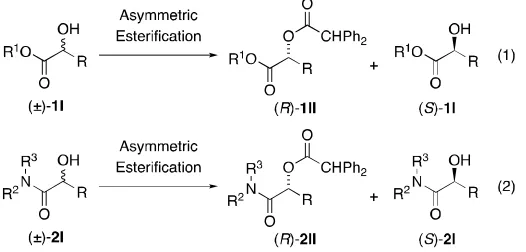
used with this novel protocol to achieve high selectivity [22 examples; s-value reaching over 250]. The
19
resulting chiral compounds could be transformed into other useful structures while maintaining their chirality.
20
Keywords: kinetic resolution; 2-hydroxyamide; organocatalysis; Weinreb amide; esterification;
21
carboxylic anhydride
22
23
1. Introduction
24
Optically active 2-hydroxyamide derivatives are frequently utilized as chiral building blocks
25
not only for synthesizing biologically active compounds [1–4] but also for preparing asymmetric
26
catalysts and chiral auxiliaries [5–6]. Consequently, considerable effort has been devoted toward
27
developing efficient methods for synthesizing these compounds, including enzymatic [7] and
28
chemical transformations [8–10]. However, to the best of our knowledge, a general method for the
29
kinetic resolution (KR) of racemic 2-hydroxyamide derivatives has not been reported to date. We
30
recently accomplished the first KR of racemic alcohols with achiral carboxylic acids and of racemic
31
carboxylic acids with achiral alcohols by asymmetric esterification [11–23] via the in situ formation
32
of a mixed anhydride using carboxylic anhydrides as coupling reagents combined with chiral
33
acyl-transfer catalysts. Furthermore, KR of racemic 2-hydroxyalkanoates with diphenylacetic acid
34
was achieved using pivalic anhydride in the presence of (R)-benzotetramisole [24,25] [(R)-BTM;
35
Scheme 1; Eq. 1].Therefore, it was hypothesized that this KR protocol could be similarly applied to
36
2-hydroxyamide derivatives (Scheme 1; Eq. 2). In this communication, we report the novel KR of
37
various racemic 2-hydroxyamide derivatives using a diphenylacetyl component as an acyl source,
38
catalyzed by (R)-BTM.
39
40
41
42
43
44
Scheme 1. Our previous result (eq. 1) and working hypothesis for the present study (eq. 2).
45
2. Results and Discussion
46
To determine suitable structures for the amide moiety, the KR reactions of a variety of racemic
47
2-hydroxyamides were initially examined using diphenylacetyl sources derived from Ph2CHCO2H
48
or (Ph2CHCO)2O (DPHAA) [26],catalyzed by (R)-BTM in Et2O at room temperature for 12 h, which
49
were reaction conditions similar to those established in the previous study (Table 1). We first
50
performed the KR of the secondary N-alkyl amide with methyl (±)-1a or benzyl (±)-1b and N-phenyl
51
amide (±)-1c via asymmetric esterification. These substrates were found to be unsuitable for the
52
reaction (Entries 1–3). Conversely, it was found that the tertiary amide yielded high s-values under
53
the reaction conditions [27].The KR of (±)-1d smoothly proceeded, affording the corresponding ester
54
(R)-2d (48%; 92% ee) and the recovered alcohol (S)-1d (46%; >99% ee) with a high s-value (Entry 4; s =
55
254). It is noteworthy that N-methoxy-N-methylamide (±)-1e (known as Weinreb amide) [28–30] was
56
successfully applied to this protocol with high synthetic utility (Entry 5; s = 156). As the tertiary
57
amide was recognized as a suitable structure for attaining high selectivity, we subsequently
58
performed the KR via asymmetric acylation and not via asymmetric esterification for the same
59
reaction. As expected, high selectivity was also achieved by the reaction of (±)-1d and 1e using the
60
asymmetric acylation protocol (Entries 6 and 7).
61
Table 1. Kinetic resolution (KR) of various racemic 2-hydroxyamides ((±)-1a–1e).
62
63
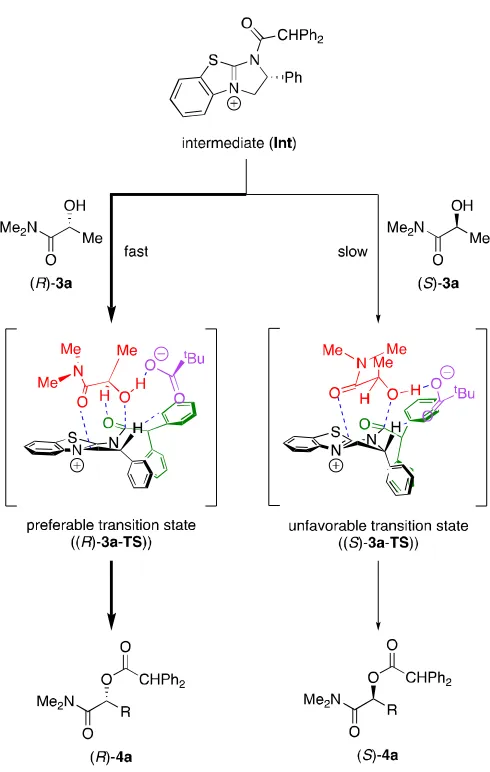
Entry R1, R2 Yield (2; 1) [%] ee (2; 1) [%] s
1 Me, H (a) 42; 52 12; 14 1
2 Bn, H (b) 50; 50 17; 15 2
3 Ph, H (c) 55; 45 79; 73 18
4 a Me, Me (d) 48; 46 92; >99 254
5 a Me, OMe (e) 50; 50 94; 99 156
6 b Me, Me (f) 47; 50 91; 98 95
7 c Me, OMe (g) 47; 42 94; 98 157
a Ph2CHCO2H (0.75 eq.), Piv2O (0.9 eq.), and i-Pr2NEt (1.2 eq.) were used.
64
b (Ph2CHCO)2O (DPHAA; 0.60 eq.) and i-Pr2NEt (0.60 eq.) were used.
65
c (Ph2CHCO)2O (DPHAA; 0.75 eq.) and i-Pr2NEt (0.75 eq.) were used.
66
To assess the generality of this novel method, various racemic 2-hydroxy-N,N-dimethylamides
67
(±)-3a–3k with different substituted forms (Table 2) were subjected to asymmetric esterification
68
normal aliphatic alkyl chains at the C-2 positions, was performed under the conditions A1 and B1,
70
the reaction successfully proceeded with high s-values in all cases. Asymmetric esterification
71
(condition A1) tended to show better results than asymmetric acylation (condition B1); however, it
72
was revealed that the chiral acylation protocol was also useful for obtaining good s-values. In
73
contrast, the reaction of (±)-3d and 3g, bearing branched aliphatic alkyl chains (R = i-Pr and c-Hex) at
74
the C-2 positions, showed a slight decrease in selectivity, while the reaction of 3f (R = i-Bu) yielded a
75
good s-value. We also examined several racemic
76
-(tert-butyldimethylsiloxy)-2-hydroxy-N,N-dimethylamide derivatives (±)-3i–3k, having different
77
methylene lengths, as shown in Entries 17–22.It was found that the selectivity of the KR of (±)-3i was
78
somewhat lowered by the influence of the siloxygroup at the C-3 position (Entries 17 and 18). Other
79
reactions yielded high s-values, regardless of the length of the alkyl chains possessing
80
tert-butyldimethylsiloxy groups under the conditions A1 and B1 (Entries 19–22).
81
82
83
84
85
86
87
88
89
90
91
92
93
94
95
96
97
98
99
100
101
102
Table 2. KR of 2-hydroxy dimethylamide [(±)-3a–3k].
104
105
Entry Substrate Conditions a,b Yield (4; 3) [%] ee (4; 3) [%] s
1 A1 52; 46 89; 82 42
2 B1 37; 56 88; 57 27
3 A1 40; 53 93; 54 45
4 B1 37; 54 88; 62 29
5 A1 41; 57 94; 65 65
6 B1 45; 47 93; 74 63
7 A1 13; 76 82; 14 12
8 B1 25; 75 63; 21 5
9 A1 41; 56 95; 69 75
10 B1 36; 60 95; 74 63
11 A1 47; 52 95; 78 92
12 B1 48; 45 97; 94 208
13 A1 7; 83 66; 6 5
14 B1 43; 49 74; 68 13
15 A1 58; 46 92; >99 254
16 B1 47; 50 91; 98 95
17 A1 34; 66 82; 41 15
18 B1 45; 49 80; 69 18
19 A1 46; 50 93; 95 103
20 B1 44; 51 94; 79 81
21 A1 48; 51 94; 99 151
22 B1 47; 46 96; 92 176
a Conditions A1; Ph2CHCO2H (0.75 eq.), Piv2O (0.9 eq.), and i-Pr2NEt (1.2 eq.).
106
b Conditions B1; (Ph2CHCO)2O (DPHAA; 0.60 eq.) and i-Pr2NEt (0.60 eq.).
107
Furthermore, we performed the KR of various racemic 2-hydroxy-Weinreb amides (±)-5a–5k
108
with substitution patterns corresponding to the N,N-dimethylamides (±)-3a–3k using a similar
109
protocol (Table 3). Consequently, the same tendency was observed. The KR of 2-hydroxy-Weinreb
110
amides 5a–5c, 5e, 5f, 5h, 5j, and 5k, bearing normal aliphatic alkyl chains at the C-2 positions,
111
exhibited high s-values in all cases under the conditions A1 and B2. Conversely, the reactions of
112
2-hydroxy-Weinreb amides (±)-5d, 5g, and 5i, bearing branched aliphatic alkyl chains at the C-2
113
Table 3. KR of 2-hydroxy-Weinreb amide [(±)-5a–5k].
115
116
Entry Substrate Conditions a,b Yield (6; 5) [%] ee (6; 5) [%] s
1 A1 51; 44 93; 99 130
2 B2 50; 50 85; 98 57
3 A1 46; 51 96; 85 118
4 B2 46; 49 90; 89 57
5 A1 45; 55 96; 94 176
6 B2 45; 42 94; 96 118
7 A1 9; 91 66; 7 5
8 B2 27; 65 67; 31 7
9 A1 43; 56 96; 69 113
10 B2 49; 50 91; 97 89
11 A1 46; 49 97; 89 168
12 B2 46; 44 94; 99 168
13 A1 4; 91 59; 5 4
14 B2 35; 61 42; 24 3
15 A1 50; 50 94; 99 156
16 B2 47; 42 94; 98 157
17 A1 40; 60 86; 51 22
18 B2 50; 46 73; 84 16
19 A1 47; 50 95; 91 115
20 B2 49; 48 90; 99 106
21 A1 54; 46 94; 99 118
22 B2 48; 41 87; 99 76
a Conditions A1; Ph2CHCO2H (0.75 eq.), Piv2O (0.9 eq.), and i-Pr2NEt (1.2 eq.).
117
b Conditions B2; (Ph2CHCO)2O (DPHAA; 0.75 eq.) and i-Pr2NEt (0.75 eq.).
118
To support the results of the experimental data, we calculated the transition state of each
119
enantiomer in the KR. This was performed using density functional theory (DFT) calculations at the
120
B3LYP/6-31G*//B3LYP/6-31G* level according to a previously reported method [20,24,25]. Initially,
121
Scheme 2. Calculated transition states with a kinetic resolution (KR) of (±)-3.
123
The most stable transition state that affords (R)- or (S)-2-acyloxy-dimethylamides is shown in
124
Figure 1. It was found that the high selectivity attained in the present KR can be explained by the
125
rapid transformation of (R)-3 into (R)-4 through the stabilized transition state (R)-3-TS, which
126
consists of (R)-3 and the isothiouronium salt derived from the mixed anhydride and (R)-BTM. The
127
formation of a C–O bond (between carbonyl carbon of the acid component and oxygen of the
128
hydroxy group) at a distance of 2.086 Å is accompanied by the coordination of oxygen in the
129
carbonyl moiety to hydrogen at the C-2 position of the 2-hydroxydimethylamide at a distance of
130
2.342 Å, as shown in Figure 1. It was further observed that the length of the cleaved O–H bond
131
(between oxygen and hydrogen in the hydroxyl group) was 1.356 Å. A frequency analysis of
132
(R)-3-TS revealed that the nucleophilic attack of the alcohol to the carbonyl group and the
133
deprotonation of the hydroxyl group with the pivalate anion proceeded via a concerted reaction
134
mechanism because the C–O bond-forming step and the O–H bond-cleaving process occurred
135
simultaneously.
136
An attractive interaction occurred between oxygen in the amide carbonyl group and the
137
positive electronic charge on the surface of the thiouronium salt, together with coordination of
138
oxygen in the pivalate anion to hydrogen in the hydroxyl group (1.109 Å) and hydrogen at the C-2
139
position of the dihydroimidazolium salt (2.964 Å).However, complexation of the thiouronium salt
140
with (R)-2-hydroxydimethylamide [(R)-3a], an enantiomer of (S)-2-hydroxydimethylamide [(S)-3a],
141
produced an unstable structure, i.e., (S)-3a-TS; thus, the formation of (S)-3a-TS proceeded slowly
142
Preferable transition structure [(R)-3a-TS] Erel = 0.00 kcal/mol
Unfavorable transition state structure [(S)-3a-TS] Erel = 4.02 kcal/mol
Figure 1. Three-dimensional structures of the calculated transition states [(R)-3a-TS and (S)-3a-TS]
144
We performed further calculations on the KR of 2-hydroxy-Weinreb amides (Scheme 3). The most
145
stable transition state that affords (R)- or (S)-2-acyloxy-Weinreb amides is shown in Figure 2 [31].It
146
was found that the high selectivity attained in the present KR can be explained by the rapid
147
transformation of (R)-5 to (R)-6 through the stabilized transition state (R)-5-TS, which consists of
148
(R)-5 and the isothiouronium salt derived from the mixed anhydride and (R)-BTM. The formation of
149
a C–O bond (between carbonyl carbon of the acid component and oxygen of the hydroxy group) at a
150
distance of 2.080 Å is accompanied by the coordination of oxygen in the carbonyl moiety to
151
hydrogen at the C-2 position of the 2-hydroxy-Weinreb amide at a distance of 2.311 Å, as shown in
152
Figure 2. It was further observed that the length of the cleaved O–H bond (between oxygen and
153
hydrogen in the hydroxy group) was 1.396 Å. A frequency analysis of (R)-5-TS revealed that the
154
nucleophilic attack of the alcohol to the carbonyl group and the deprotonation of the hydroxyl group
155
with the pivalate anion proceeded via a concerted reaction mechanism as for the reaction with the
156
2-hydroxy dimethylamide.
157
An attractive interaction occurred between oxygen in the amide carbonyl group and the
158
positive electronic charge on the surface of the thiouronium salt, together with coordination of
159
oxygen in the pivalate anion to hydrogen in the hydroxyl group (1.088 Å) and hydrogen at the C-2
160
position of the dihydroimidazolium salt (2.928 Å). However, complexation of the thiouronium salt
161
with (R)-2-hydroxy-Weinreb amide ((R)-5a), an enantiomer of (S)-2-hydroxy-Weinreb amide
162
[(S)-5a], produced an unstable structure, i.e., (S)-5a-TS; thus, the formation of (S)-5a-TS proceeded
163
Scheme 3. Calculated transition states with a KR of (±)-5.
165
Unfavorable transition structure [(S)-5a-TS] Erel = 3.24 kcal/mol
Figure 2. Three-dimensional structures of the calculated transition states [(R)-5a-TS and (S)-5a-TS]
166
Finally, we attempted to transform the obtained chiral 2-hydroxyamides and their esters based
167
on the KR to demonstrate the synthetic utility of this method (Scheme 4). Reduction of chiral
168
2-hydroxy-N,N-dimethylamide (S)-1d with BH3·SMe2 in THF afforded amino alcohol (S)-7 in good
169
yield with no loss of chirality (Eq. 1). When 2-acyloxy-N,N-dimethylamide (R)-2d was subjected to
170
solvolysis with K2CO3 in MeOH, 2-hydroxyamide (R)-1d was produced in good yield (Eq. 2).
171
Treatment of 2-hydroxy-Weinreb amide (S)-5a and 2-acyloxy-Weinreb amide (R)-6a with PhMgBr
172
afforded the corresponding 2-hydroxyketone 8 with opposite stereochemistry (Eqs. 3 and 4,
173
respectively).
174
Scheme 4. Transformation of chiral 2-hydroxyamides and their esters.
175
3. Materials and Methods
176
1. Typical Procedure for the Preparation of Optically Active 2-Hydroxy-dimethylamides 2d and
177
4a-4k:
178
Condition A; Asymmetric esterification of racemic 2-hydroxy-dimethylamide ((±)-1d) with
179
solution of racemic 2-hyroxy-dimethylamide ((±)-1d) (41.5 mg, 0.20 mmol) in Et2O (1.0 mL, 0.20 M) at
181
room temperature were successively added diphenylacetic acid (31.8 mg, 0.15 mmol), Piv2O (36.5
182
μL, 0.18 mmol), i-Pr2NEt (62.7 μL, 0.36 mmol) and (R)-BTM (2.5 mg, 0.01 mmol). The reaction
183
mixture was stirred for 24 h at the same temperature and then it was quenched with saturated
184
aqueous NaHCO3. The organic layer was separated and the aqueous layer was extracted with
185
EtOAc. The combined organic layer was dried over Na2SO4. After filtration of the mixture and
186
evaporation of the solvent, the crude product was purified by preparative thin layer
187
chromatography on silica to afford the corresponding optically active ester (R)-2d (38.2 mg, 48%
188
yield, 92% ee) and the recovered optically active alcohol (S)-1d (19.1 mg, 46% yield, 99% ee) [s = 254,
189
Table 1, Entry 4].
190
Condition B; Asymmetric esterification of racemic 2-hydroxy-dimethylamide ((±)-1d) with
191
diphenylacetic anhydride in the presence of (R)-BTM was described (Table 1, entry 6): To a solution
192
of racemic 2-hydroxy-dimethylamide ((±)-1d) (41.5 mg, 0.20 mmol) in Et2O (1.0 mL, 0.2 M) at room
193
temperature were successively added diphenylacetic anhydride (48.8 mg, 0.12 mmol), i-Pr2NEt (20.9
194
μL, 0.12 mmol) and (R)-BTM (2.5 mg, 0.011 mmol). The reaction mixture was stirred for 24 h at the
195
same temperature and then it was quenched with saturated aqueous NaHCO3. The organic layer
196
was separated and the aqueous layer was extracted with EtOAc. The combined organic layer was
197
dried over Na2SO4. After filtration of the mixture and evaporation of the solvent, the crude product
198
was purified by preparative thin layer chromatography on silica to afford the corresponding
199
optically active ester (R)-2d (37.4 mg, 47% yield, 91% ee) and the recovered optically active alcohol
200
(S)-1d (20.7 mg, 50% yield, 98% ee) [s = 95, Table 1, Entry 6].
201
202
(S)-2-Hydroxy-N-methyl-4-phenylbutanamide ((S)-1a)
203
HPLC (CHIRALPAK IC, i-PrOH/hexane = 1/20, flow rate = 1.0 mL/min): tR = 47.2 min (57.2%), tR =
204
54.5 min (42.8%); IR (neat): 3309, 1643, 1619, 1550 cm–1; 1H NMR (CDCl3): δ 7.33-7.22 (m, 5H, Ph), 6.85
205
(brs, 1H, NH), 4.15 (m, 1H, 2-H), 3.92 (d, J = 5.5 Hz, 1H, OH), 2.86 (s, 3H, NMe), 2.86-2.79 (m, 2H,
206
4-H), 2.24-2.12 (m, 1H, 3-H), 2.02-1.95 (m, 1H, 3-H); 13C NMR (CDCl3): δ 174.8, 141.2, 128.4, 126.0,
207
71.4, 36.3, 31.2, 25.7;HR MS: calcd for C12H17NO2Na [M+Na]+ 216.0995, found 216.1004.
208
209
(S)-N-Benzyl-2-hydroxy-4-phenylbutanamide ((S)-1b)
210
HPLC (CHIRALPAK IC, i-PrOH/hexane = 1/9, flow rate = 1.0 mL/min): tR = 12.3 min (42.8%), tR =
211
14.6 min (57.2%); IR (KBr): 3366, 3252, 1621, 1538, 1496, 1454, 732, 699 cm–1; 1H NMR (CDCl3): δ
212
7.37-7.18 (m, 10H, Ph), 7.02 (brs, 1H, NH), 4.46 (dd, J = 15.0, 6.0 Hz, 1H, Bn), 4.42 (dd, J = 15.0, 6.0 Hz,
213
1H, Bn), 4.16 (ddd, J = 8.0, 5.0, 3.5 Hz, 1H, 2-H), 3.47 (brs, 1H, OH), 2.83-2.73 (m, 2H, 4-H), 2.25-2.15
214
(m, 1H, 3-H), 2.04-1.94 (m, 1H, 3-H); 13C NMR (CDCl3): δ 173.8, 141.1, 137.8, 128.7, 128.4, 127.6, 127.5,
215
126.0, 71.5, 43.1, 36.4, 31.2; HR MS: calcd for C17H19NO2Na [M+Na]+ 292.1308, found 292.1312.
216
217
(S)-2-Hydroxy-N,4-diphenylbutanamide ((S)-1c)
218
HPLC (CHIRALPAK IC, i-PrOH/hexane = 1/9, flow rate = 1.0 mL/min): tR = 8.2 min (86.6%), tR = 11.4
219
min (13.4%); IR (KBr): 3332, 3230, 1656, 1496, 1445, 755, 702 cm–1; 1H NMR (CDCl3): δ 8.42 (s, 1H, NH),
220
7.57-7.48 (m, 2H, Ph), 7.31-7.09 (m, 8H, Ph), 4.24 (ddd, J = 8.3, 4.8, 4.0 Hz, 1H, 2-H), 2.89 (brd, J = 4.0
221
Hz, 1H, OH), 2.82 (d, J = 8.0 Hz, 1H, 4-H), 2.81 (d, J = 9.5 Hz, 1H, 4-H) 2.32-2.22 (m, 1H, 3-H), 2.11-2.01
222
(m, 1H, 3-H); 13C NMR (CDCl3): δ 171.6, 140.9, 137.1, 129.1, 128.6, 128.5, 126.2, 124.6, 119.8, 72.1, 36.2,
223
31.3; HR MS: calcd for C16H17NO2Na [M+Na]+ 278.1151, found 278.1153.
224
225
(S)-2-Hydroxy-N,N-dimethyl-4-phenylbutanamide ((S)-1d)
226
HPLC (CHIRALPAK IC, i-PrOH/hexane = 1/4, flow rate = 1.0 mL/min): tR = 29.2 min (100.0%); IR
227
(neat): 3457, 1738, 1498, 1456, 1045, 752, 698 cm–1; 1H NMR (CDCl3): δ 7.31-7.16 (m, 5H, Ph), 4.30 (ddd,
228
J = 9.0, 7.5, 3.0 Hz, 1H, 2-H), 3.78 (dd, J = 7.5, 1.5 Hz, 1H, OH), 2.96 (s, 3H, OMe), 2.87-2.75 (m, 2H,
229
4-H), 2.80 (s, 3H, NMe), 1.91 (dddd, J = 13.5, 9.0, 8.0, 3.0 Hz, 1H, 3-H), 1.78 (dddd, J = 13.5, 9.0, 8.5, 5.0
230
Hz, 1H, 3-H); 13C NMR (CDCl3): δ 174.2, 141.3, 128.6, 128.4, 126.0, 66.9, 36.4, 36.1, 35.8, 31.2; HR MS:
231
calcd for C12H17NO2Na [M+Na]+ 230.1151, found 230.1150.
232
233
HPLC (CHIRALPAK IC, i-PrOH/hexane = 1/9, flow rate = 1.0 mL/min): tR = 26.7 min (0.8%), tR = 29.6
235
min (99.2%); IR (neat): 3439, 1657, 1487, 1450, 753, 707 cm–1; 1H NMR (CDCl3): δ 7.36-7.19 (m, 5H, Ph),
236
4.38 (dd, J = 7.0, 7.0 Hz, 1H, 2-H), 3.59 (s, 3H, OMe), 3.40 (d, J = 7.0 Hz, 1H, OH), 3.24 (s, 3H, NMe),
237
2.88 (ddd, J = 14.0, 9.0, 5.0 Hz, 1H, 4-H), 2.83 (ddd, J = 14.0, 8.5, 8.5 Hz, 1H, 4-H), 2.16-2.05 (m, 1H,
238
3-H), 1.90-1.83 (m, 1H, 3-H); 13C NMR (CDCl3): δ 175.0, 141.4, 128.6, 128.3, 125.8, 67.7, 61.1, 36.1, 32.4,
239
31.2; HR MS: calcd for C12H17NO3Na [M+Na]+ 246.1101, found 246.1106.
240
241
(R)-2-(Diphenylacetyloxy)-N-methyl-4-phenylbutanamide ((R)-2a)
242
HPLC (CHIRALPAK IC, i-PrOH/hexane = 2/3, flow rate = 0.5 mL/min): tR = 23.6 min (55.9%), tR =
243
39.3 min (44.1%); IR (neat): 3424, 3309, 1743, 1673, 1542, 748, 709 cm–1;1H NMR (CDCl3): δ 7.32-7.20
244
(m, 10H, Ph), 7.17-7.07 (m, 3H, Ph), 6.99-6.97 (m, 2H, Ph), 5.41 (brs, 1H, NH), 5.23 (dd, J = 7.0, 4.0 Hz,
245
1H, 2-H), 4.99 (s, 1H, CHPh2), 2.52-2.45 (m, 2H, 3-H), 2.49 (s, 3H, NMe), 2.18-2.00 (m, 1H, 4-H); 13C
246
NMR (CDCl3): δ 170.7, 169.8, 140.6, 137.8, 137.6, 128.9, 128.7, 128.6, 128.6, 128.4, 128.3, 127.7, 127.6,
247
126.0, 73.9, 57.1, 33.3, 31.0, 25.7; HR MS: calcd for C26H27NO3Na [M+Na]+ 410.1727, found 410.1717.
248
249
(R)-N-Benzyl-2-(diphenylacetyloxy)-4-phenylbutanamide ((R)-2b)
250
HPLC (CHIRALPAK AD-H, i-PrOH/hexane = 1/9, flow rate = 1.0 mL/min): tR = 23.1 min (58.6%), tR
251
= 25.7 min (41.4%); IR (neat): 3308, 1744, 1677, 1496, 1451, 747, 697 cm–1; 1H NMR (CDCl3): δ 7.36-7.18
252
(m, 16H, Ph), 7.14-7.07 (m, 4H, Ph), 5.88 (t, J = 5.5 Hz, 1H, NH), 5.40 (dd, J = 7.3, 4.3 Hz, 1H, 2-H), 5.05
253
(s, 1H, 2’-H), 4.32 (dd, J = 14.8, 5.5 Hz, 1H, Bn), 4.24 (dd, J = 14.8, 5.5 Hz, 1H, Bn), 2.62 (t, J = 8.3 Hz, 2H,
254
4-H), 2.32-2.17 (m, 2H, 3-H); 13C NMR (CDCl3): δ 170.7, 169.2, 140.6, 137.7, 137.6, 137.6, 128.9, 128.7,
255
128.6, 128.6, 128.4, 128.4, 128.3, 127.7, 127.6, 127.6, 127.5, 126.1, 73.9, 57.1, 43.0, 33.4, 31.0; HR MS:
256
calcd for C31H29NO3Na [M+Na]+ 486.2040, found 486.2031.
257
258
(R)-2-(Diphenylacetyloxy)-N,4-diphenylbutanamide ((R)-2c)
259
HPLC (CHIRALPAK IC, i-PrOH/hexane = 1/9, flow rate = 1.0 mL/min): tR = 11.5 min (10.7%), tR =
260
25.6 min (89.3%); IR (neat): 3312, 1750, 1670, 1494, 1447, 754, 695 cm–1; 1H NMR (CDCl3): δ 7.34-7.00
261
(m, 21H,Ph, NH), 5.40 (dd, J = 6.8, 4.5 Hz, 1H, 2-H), 5.03 (s, 1H, 2’-H), 2.60 (t, J = 8.0 Hz, 2H, 4-H), 2.23
262
(m, 2H, 3-H); 13C NMR (CDCl3): δ 170.6, 167.3, 140.5, 137.7, 137.7, 136.6, 129.2, 128.8, 128.8, 128.7,
263
128.5, 128.5, 128.3, 127.8, 127.7, 126.1, 124.7, 119.9, 73.9, 57.2, 33.3, 31.0; HR MS: calcd for
264
C30H27NO3Na [M+Na]+ 472.1883, found 472.1874.
265
266
(R)-2-(Diphenylacetyloxy)-N,N-dimethyl-4-phenylbutanamide ((R)-2d)
267
HPLC (CHIRALPAK IC, i-PrOH/hexane = 1/9, flow rate = 1.0 mL/min): tR = 17.9 min (4.3%), tR = 40.2
268
min (95.7%); IR (neat): 1737, 1663, 1496, 744, 697 cm–1; 1H NMR (CDCl3): δ 7.38-7.07 (m, 13H, Ph),
269
6.92-6.85 (m, 2H, Ph), 5.13 (s, 1H, 2’-H), 5.08 (dd, J = 10.0, 3.5 Hz, 1H, 2-H), 2.84 (s, 3H, OMe), 2.73 (s,
270
3H, NMe), 2.59 (ddd, J = 14.0, 8.5, 5.0 Hz, 1H, 4-H), 2.41 (ddd, J = 14.0, 8.5, 8.5 Hz, 1H, 4-H), 2.11
271
(dddd, J = 14.5, 10.0, 8.5, 5.0 Hz, 1H, 3-H), 1.88 (dddd, J = 14.5, 8.5, 8.5, 3.5 Hz, 1H, 3-H); 13C NMR
272
(CDCl3): δ 172.3, 169.4, 140.3, 138.5, 138.4, 128.8, 128.7, 128.5, 128.4, 128.3, 127.4, 127.2, 126.2, 70.1,
273
56.7, 36.5, 35.9, 32.4, 31.0; HR MS: calcd for C26H27NO3Na [M+Na]+ 424.1883, found 424.1901.
274
275
(R)-2-(Diphenylacetyloxy)-N-methoxy-N-methyl-4-phenylbutanamide ((R)-2e) (= (R)-6h)
276
HPLC (CHIRALPAK IC, i-PrOH/hexane = 1/9, flow rate = 1.0 mL/min): tR = 14.8 min (3.0%), tR = 41.3
277
min (97.0%); IR (neat): 1736, 1674, 1496, 1450, 741, 702 cm–1; 1H NMR (CDCl3): δ 7.51-7.19 (m, J = 13H,
278
Ph), 7.05-6.99 (m, 2H, Ph), 5.27 (s, 1H, 2’-H), 5.19 (dd, J = 9.5, 3.5 Hz, 1H, 2-H), 3.61 (s, 3H, OMe), 3.21
279
(s, 3H, NMe), 2.74 (ddd, J = 14.0, 8.0, 5.0 Hz, 1H, 4-H), 2.53 (ddd, J = 14.0, 8.5, 8.5 Hz, 1H, 4-H),
280
2.22-2.07 (m, 2H, 3-H); 13C NMR (CDCl3): δ 172.5, 170.0, 140.3, 138.5, 138.4, 128.8, 128.8, 128.6, 128.4,
281
128.4, 128.3, 127.3, 127.1, 126.0, 70.8, 61.1, 56.8, 32.1, 31.7, 31.1; HR MS: calcd for C26H27NO4Na
282
[M+Na]+ 440.1832, found 440.1852.
283
284
(S)-2-Hydroxy-N,N-dimethylpropanamide ((S)-3a)
285
HPLC (CHIRALPAK IC, i-PrOH/hexane = 1/4, flow rate = 1.0 mL/min): tR = 17.3 min (5.7%), tR = 26.6
286
min (93.3%); IR (neat): 3417, 1643 cm1; 1H NMR (500 MHz, CDCl3): δ 4.41 (q, J = 6.5 Hz, 1H, 2-H),
287
MHz, CDCl3): δ 174.9, 64.0, 36.2, 35.8, 20.8; HR MS: calcd for C5H11NO2Na [M+Na]+ 140.0682, found
289
140.0684.
290
291
(S)-2-Hydroxy-N,N-dimethylbutanamide ((S)-3b)
292
HPLC (CHIRALPAK IC, i-PrOH/hexane = 1/4, flow rate = 1.0 mL/min): tR = 15.6 min (3.7%), tR = 28.2
293
min (96.3%); IR (neat): 3425, 1642 cm1; 1H NMR (500 MHz, CDCl3): δ 4.27 (m, 1H, 2-H), 3.68 (d, J =
294
7.5 Hz, 1H, OH), 2.96 (s, 3H, NMe), 2.94 (s, 3H, NMe), 1.67 (m, 1H, 3-H), 1.46 (m, 1H, 3-H), 0.94 (dd, J
295
= 7.0, 7.0 Hz, 3H, 4-H); 13C NMR (125 MHz, CDCl3): δ 174.2, 68.9, 36,3, 35,7, 27,5, 9.1; HR MS: calcd for
296
C6H13NO2Na [M+Na]+ 154.0838, found 154.0845.
297
298
(S)-2-Hydroxy-N,N-dimethylpentanamide ((S)-3c)
299
HPLC (CHIRALPAK IC, i-PrOH/hexane = 1/4, flow rate = 1.0 mL/min): tR = 17.4 min (82.5%), tR =
300
36.2 min (17.5%); IR (neat): 3425, 1643 cm1; 1H NMR (500 MHz, CDCl3): δ 4.26 (m, 1H, 2-H), 3.64 (d, J
301
= 7.0 Hz, 1H, OH), 2.90 (s, 3H, NMe), 2.89 (s, 3H, NMe), 1.52-1.47 (m, 1H, 3-H), 1.43-1.32 (m, 3H, 3-H,
302
4-H), 0.84 (dd, J = 7.5, 7.5 Hz, 3H, 5-H); 13C NMR (125 MHz, CDCl3): δ 174.4, 67.6, 36.7, 36.2, 35.7, 18.2,
303
13.6; HR MS: calcd for C7H15NO2Na [M+Na]+ 168.0995, found 168.1000.
304
305
(S)-2-Hydroxy-N,N,3-trimethylbutanamide ((S)-3d)
306
HPLC (CHIRALPAK ID, i-PrOH/hexane = 1/4, flow rate = 1.0 mL/min): tR = 8.7 min (42.8%), tR = 17.4
307
min (57.2%); IR (neat): 3425, 1643 cm1; 1H NMR (500 MHz, CDCl3): δ 4.23 (dd, J = 7.5, 2.5 Hz, 1H,
308
2-H), 3.56 (d, J = 7.0 Hz, 1H, OH), 2.98 (s, 3H, NMe), 2.97 (s, 3H, NMe), 1.91-1.82 (m, 1H, 3-H), 1.04 (d,
309
J = 7.5 Hz, 3H, 4-H), 0.77 (d, J = 7.5 Hz, 3H, 4-H); 13C NMR (125 MHz, CDCl3): δ 173.9, 72.1, 36.5, 35.8,
310
31.2, 19.7, 15.0; HR MS: calcd for C7H15NO2Na [M+Na]+ 168.0995, found 168.0994.
311
312
(S)-2-Hydroxy-N,N-dimethylhexanamide ((S)-3e)
313
HPLC (CHIRALPAK IC, i-PrOH/hexane = 1/4, flow rate = 1.0 mL/min): tR = 13.7 min (84.7%), tR =
314
31.2 min (15.3%); IR (neat): 3425, 1643 cm1; 1H NMR (500 MHz, CDCl3): δ 4.32 (ddd, J = 7.5, 7.5, 3.5
315
Hz, 1H, 2-H), 3.67 (d, J = 7.5 Hz, 1H, OH), 2.98 (s, 3H, NMe), 2.96 (s, 3H, NMe), 1.64-1.56 (m, 1H, 3-H),
316
1.48-1.24 (m, 5H, 3-H, 4-H, 5-H), 0.88 (dd, J = 7.5, 7.0 Hz, 3H, 6-H); 13C NMR (125 MHz, CDCl3): δ
317
174.5, 67.9, 36.3, 35.8, 34.3, 27.1, 22.4, 13.9; HR MS: calcd for C8H17NO2Na [M+Na]+ 182.1151, found
318
182.1149.
319
320
(S)-2-Hydroxy-N,N,4-trimethylpentanamide ((S)-3f)
321
HPLC (CHIRALPAK IC, i-PrOH/hexane = 1/4, flow rate = 1.0 mL/min): tR = 14.6 min (89.2%), tR =
322
31.2 min (10.8%); IR (neat): 3425, 1642 cm1; 1H NMR (500 MHz, CDCl3): δ 4.35 (ddd, J = 7.0, 2.5 Hz,
323
1H, 2-H), 3.59 (d, J = 7.0 Hz, 1H, OH), 2.96 (s, 3H, NMe), 2.93 (s, 3H, NMe), 1.94 (ddqq, J = 2.5, 4.0, 6.0,
324
7.0 Hz, 1H, 4-H), 1.38 (ddd, J = 14.0, 10.0, 4.0 Hz, 1H, 3-H), 1.27 (ddd, J = 14.0, 10.0, 2.5 Hz, 1H, 3-H),
325
0.95 (d, J = 6.0 Hz, 3H, 5-H), 0.91 (d, J = 7.0 Hz, 3H, 5-H); 13C NMR (125 MHz, CDCl3): δ 174.9, 66.4,
326
43.9, 36.2, 35.8, 24.5, 23.5, 21.2; HR MS: calcd for C8H17NO2Na [M+Na]+ 182.1151, found 182.1152.
327
328
(S)-2-Cyclohexyl-2-Hydroxy-N,N-dimethylacetamide ((S)-3g)
329
HPLC (CHIRALPAK IC, i-PrOH/hexane = 1/9, flow rate = 1.0 mL/min): tR = 11.0 min (53.2%), tR =
330
32.8 min (46.8%); IR (KBr): 3363, 1628 cm1; 1H NMR (500 MHz, CDCl3): δ 4.19 (d, J = 1.5 Hz, 1H,
331
2-H), 3.54 (br s, 1H, OH), 2.98 (s, 3H, NMe), 2.97 (s, 3H, NMe), 1.77-1.72 (m, 2H, c-Hex), 1.62-1.60 (m,
332
2H, c-Hex), 1.50-1.37 (m, 3H, c-Hex), 1.26-1.05 (m, 4H, c-Hex); 13C NMR (125 MHz, CDCl3): δ 173.8,
333
72.0, 41.4, 36.6, 35.8, 29.8, 26.4, 26.0, 25.9, 25.5; HR MS: calcd for C10H19NO2Na [M+Na]+ 208.1308,
334
found 208.1311.
335
336
(S)-3-(tert-Butyldimethylsiloxy)-2-hydroxy-N,N-dimethylpropanamide ((S)-3i)
337
HPLC (CHIRALPAK IC, i-PrOH/hexane = 1/9, flow rate = 1.0 mL/min): tR = 9.0 min (70.6%), tR = 13.3
338
min (29.4%); IR (neat): 3278, 1635 cm1; 1H NMR (500 MHz, CDCl3): δ 4.49 (ddd, J = 9.5, 6.0, 2.0 Hz,
339
1H, 2-H), 3.78 (dd, J = 10.0, 5.0 Hz, 1H, 3-H), 3.65 (d, J = 7.5 Hz, 1H, OH), 3.63 (dd, J = 10.0, 7.5 Hz, 1H,
340
NMR (125 MHz, CDCl3): δ 172.8, 68.7, 66.3, 36.8, 35.9, 25.8, 18.3, 5.5; HR MS: calcd for
342
C11H25NO3SiNa [M+Na]+ 270.1496, found 270.1509.
343
344
(S)-4-(tert-Butyldimethylsiloxy)-2-hydroxy-N,N-dimethylbutanamide ((S)-3j)
345
HPLC (CHIRALPAK IC, i-PrOH/hexane = 1/4, flow rate = 1.0 mL/min): tR = 11.4 min (3.5%), tR = 25.0
346
min (96.5%); IR (neat): 3363, 1643 cm1; 1H NMR (500 MHz, CDCl3): δ 4.55-4.51 (m, 1H, 2-H), 3.85
347
(ddd, J = 10.0, 10.0, 3.5 Hz, 1H, 4-H), 3.75 (ddd, J = 10.0, 10.0, 3.5 Hz, 1H, 4-H), 3.65 (d, J = 7.5 Hz, 1H,
348
OH), 2.98 (s, 6H, NMe), 1.85-1.80 (m, 1H, 3-H), 1.58-1.51 (m, 1H, 3-H), 0.88 (s, 9H, TBS), 0.06 (s, 3H,
349
TBS), 0.05 (s, 3H, TBS); 13C NMR (125 MHz, CDCl3): δ 174.6, 64.9, 59.2, 38.3, 36.1, 35.8, 25.8, 18.2,
350
5.5; HR MS: calcd for C
12H27NO3SiNa [M+Na]+ 284.1652, found 284.1645.
351
352
(S)-5-(tert-Butyldimethylsiloxy)-2-hydroxy-N,N-dimethylpentanamide ((S)-3k)
353
HPLC (CHIRALPAK IC, i-PrOH/hexane = 1/9, flow rate = 1.0 mL/min): tR = 12.2 min (97.2%), tR =
354
30.3 min (2.8%); IR (neat): 3425, 1643 cm1; 1H NMR (500 MHz, CDCl3): δ 4.36 (m, 1H, 2-H), 3.71 (d, J
355
= 7.0 Hz, 1H, OH), 3.69-3.59 (m, 2H, 5-H), 2.98 (s, 3H, NMe), 2.96 (s, 3H. NMe), 1.80-1.73 (m, 1H, 3-H),
356
1.68-1.62 (m, 2H, 4-H), 1.52-1.44 (m, 1H, 3-H), 0.86 (s, 9H, TBS), 0.01 (s, 6H, TBS); 13C NMR (125 MHz,
357
CDCl3): δ 174.4, 67.6, 62.3, 36.3, 35.8, 30.9, 28.0, 25.8, 18.2, 5.4; HR MS: calcd for C13H29NO3SiNa
358
[M+Na]+ 298.1809 found 298.1805.
359
360
(R)-2-(Diphenylaceloxy)-N,N-dimethylpropanamide ((R)-4a)
361
HPLC (CHIRALPAK IC, i-PrOH /hexane = 20/80, flow rate = 1.0 ml/min): tR = 17.3 min (5.7%), tR =
362
24.0 min (94.3%); IR (neat): 1736, 1666, 1496, 1458, 741, 702 cm1; 1H NMR (500 MHz, CDCl3): δ
363
7.35-7.21 (m, 10H, Ph), 5.43 (q, J = 6.0 Hz, 1H, 2-H), 5.12 (s, 1H, 2’-H), 2.93 (s, 6H, NMe2), 1.41 (d, J =
364
6.0 Hz, 3H, 3-H); 13C NMR (125 MHz, CDCl3): δ 172.1, 169.7, 138.4, 138.3, 128.7, 128.6, 128.5, 128.4,
365
127.2, 127.1, 67.7, 56.6, 36.6, 35.6, 16.5; HR MS: calcd for C19H21NO3Na [M+Na]+ 334.1414, found
366
334.1407.
367
368
(R)-2-(Diphenylacetyloxy)-N,N-dimethylbutanamide ((R)-4b)
369
HPLC (CHIRALPAK IC, i-PrOH /hexane = 20/80, flow rate = 1.0 ml/min): tR = 15.6 min (3.7%), tR =
370
28.2 min (96.3%); IR (neat): 1736, 1658, 1496, 1458, 741, 702 cm1; 1H NMR (500 MHz, CDCl3): δ
371
7.34-7.18 (m, 10H, Ph), 5.21 (dd, J = 7.5, 5.5 Hz, 1H, 2-H), 5.11 (s, 1H, 2’-H), 2.96 (s, 3H, NMe), 2.91 (s,
372
3H, NMe) 1.79-1.71 (m, 2H, 3-H), 0.84 (t, J = 7.5 Hz, 3H, 4-H); 13C NMR (125 MHz, CDCl3): δ 172.4,
373
169.3, 138.5, 128.7, 128.6, 128.5, 128.4, 127.2, 127.1, 72.5, 56.7, 36.7, 35.8, 24.3, 9.6; HR MS: calcd for
374
C20H23NO3Na [M+Na]+ 348.1570, found 348.1577.
375
376
(R)-2-(Diphenylacetyloxy)-N,N-dimethylpentanamide ((R)-4c)
377
HPLC (CHIRALPAK IC, i-PrOH /hexane = 20/80, flow rate = 1.0 ml/min): tR = 13.8 min (2.9%), tR =
378
27.6 min (97.1%); IR (neat): 1736, 1666, 1496, 1458, 741, 702 cm-1; 1H NMR (500 MHz, CDCl3): δ
379
7.36-7.21 (m, 10H, Ph), 5.31 (dd, J = 8.5, 4.5 Hz, 1H, 2-H), 5.14 (s, 1H, 2’-H), 3.00 (s, 3H, NMe), 2.94 (s,
380
3H, NMe), 1.82-1.76 (m, 1H, 3-H), 1.70-1.64 (m, 1H, 3-H), 1.38-1.22 (m, 2H, 4-H), 0.85 (t, J = 7.5 Hz, 3H,
381
5-H); 13C NMR (125 MHz, CDCl3): δ 172.4, 169.5, 138.5, 138.5, 128.7, 128.6, 128.5, 128.4, 127.2, 127.1,
382
71.0, 56.6, 36.7, 35.9, 32.9, 18.4, 13.5; HR MS: calcd for C21H25NO3Na [M+Na]+ 362.1727, found
383
362.1733.
384
385
(R)-2-(Diphenylacetyloxy)-N,N,3-trimethylbutanamide ((R)-4d)
386
HPLC (CHIRALPAK ID, i-PrOH /hexane = 20/80, flow rate = 1.0 ml/min): tR = 8.7 min (90.9%), tR =
387
18.4 min (9.1%); IR (neat): 1736, 1658, 1496, 1458, 748, 702 cm-1; 1H NMR (500 MHz, CDCl3): δ
388
7.31-7.14 (m, 10H, Ph), 5.08 (s, 1H, 2’-H), 4.99 (d, J = 7.5 Hz, 1H, 2-H), 3.00 (s, 3H, NMe), 2.89 (s, 3H,
389
NMe), 2.08 (m, 1H, 3-H), 0.80 (d, J = 7.5 Hz, 3H, 4-H), 0.78 (d, J = 6.0 Hz, 3H, 4-H); 13C NMR (125
390
MHz, CDCl3): δ 172.5, 169.1, 138.5, 138.5, 128.7, 128.7, 128.5, 128.3, 127.2, 127.1, 75.6, 56.8, 37.0, 35.9,
391
30.1, 18.4, 17.7; HR MS: calcd for C21H25NO3Na [M+Na]+ 362.1727, found 362.1710.
392
393
HPLC (CHIRALPAK IC, i-PrOH/hexane = 20/80, flow rate = 1.0 ml/min): tR = 13.4 min (2.7%), tR = 30.0
395
min (97.3%); IR (neat): 1736, 1666, 1496, 1458, 741, 702 cm-1; 1H NMR (500 MHz, CDCl3): δ 7.37-7.21
396
(m, 10H, Ph), 5.30 (dd, J = 5.0, 5.0 Hz, 1H, 2-H), 5.14 (s, 1H, 2’-H), 3.00 (s, 3H, NMe), 2.94 (s, 3H, NMe),
397
1.80 (m, 1H, 3-H), 1.70 (m, 1H, 3-H), 1.27-1.20 (m, 4H, 4-H, 5-H), 0.77 (t, J = 6.5, 6.0 Hz, 3H, 3-H); 13C
398
NMR (125 MHz, CDCl3): δ 172.4, 169.6, 138.5, 138.5, 128.7, 128.7, 128.6, 128.4, 127.2, 127.1, 71.2, 56.7,
399
36.7, 35.9, 30.6, 27.2, 22.1, 13.7; HR MS: calcd for C22H27NO3Na [M+Na]+ 376.1883, found 376.1898.
400
401
(R)-2-(Diphenylacetyloxy)-N,N,4-trimethylpentanamide ((R)-4f)
402
HPLC (CHIRALPAK IC, i-PrOH/hexane = 20/80, flow rate = 1.0 ml/min): tR = 14.8 min (2.5%), tR = 31.3
403
min (97.5%); IR (neat): 1736, 1666, 1496, 1458, 741, 702 cm-1; 1H NMR (500 MHz, CDCl3): δ 7.33-7.18
404
(m, 10H, Ph), 5.32 (dd, J = 10.4, 3.4 Hz, 1H, 2-H), 5.12 (s, 1H, 2’-H), 2.98 (s, 3H, NMe), 2.91 (s, 3H,
405
NMe), 1.79 (ddd, J = 14.6, 10.4, 4.6, 1H, 3-H), 1.54-1.51 (m, 1H, 4-H), 1.38 (ddd, J = 14.0, 9.2, 3.4 Hz, 1H,
406
3-H), 0.81 (d, J = 6.7 Hz, 3H, 5-H), 0.79 (d, J = 6.4 Hz, 3H, 5-H); 13C NMR (125 MHz, CDCl3): δ 172.5,
407
169.8, 138.5, 138.4, 128.7, 128.7, 128.5, 128.4, 127.2, 127.1, 69.9, 56.7, 39.6, 36.6, 35.9, 24.4, 23.0, 21.3; HR
408
MS: calcd for C22H27NO3Na [M+Na]+ 376.1883, found 376.1873.
409
410
(R)-2-Cyclohexyl-2-(diphenylacetyloxy)-N,N-dimethylacetamide ((R)-4g)
411
HPLC (CHIRALPAK IC, i-PrOH/hexane = 40/60, flow rate = 0.75 ml/min): tR = 11.2 min (16.8%), tR =
412
31.3 min (83.2%); IR (neat): 1736, 1658, 1496, 1450, 748, 702 cm-1; 1H NMR (500 MHz, CDCl3): δ
413
7.29-7.13 (m, 10H, Ph), 5.06 (s, 1H, 2’-H), 5.00 (d, J = 7.3 Hz, 1H, 2-H), 3.00 (s, 3H, NMe), 2.88 (s, 3H,
414
NMe), 1.77 (m, 1H, 3-H), 1.58-1.45 (m, 5H, c-Hex), 1.17-0.80 (m, 5H, c-Hex); 13C NMR (125 MHz,
415
CDCl3): δ 172.5, 169.1, 138.6, 138.5, 128.8, 128.8, 128.6, 128.4, 127.2, 127.1, 75.0, 56.7, 39.5, 37.1, 35.9,
416
28.5, 28.2, 26.0, 25.8, 25.5; HR MS: calcd for C24H29NO3Na [M+Na]+ 402.2040, found 402.2047.
417
418
(R)-3-(tert-Butyldimethylsiloxy)-2-(diphenylacetyloxy)-N,N-dimethylpropanamide ((R)-4i)
419
HPLC (CHIRALPAK IC, i-PrOH/hexane = 20/80, flow rate = 1.0 ml/min): tR = 11.4 min (9.0%), tR = 13.3
420
min (91.0%); IR (neat): 1743, 1658, 1496, 1458, 741, 702 cm-1; 1H NMR (500 MHz, CDCl3): δ 7.36-7.23
421
(m, 10H, Ph), 5.49 (t, J = 6.0 Hz, 1H, 2-H), 5.15 (s, 1H, 2’-H), 3.90 (m, 2H, 3-H), 3.10 (s, 3H, NMe), 2.97
422
(s, 3H, NMe), 0.85 (s, 9H, TBS), 0.02 (s, 3H, TBS), 0.00 (s, 3H, TBS); 13C NMR (125 MHz, CDCl3): δ
423
172.2, 168.1, 138.4, 138.4, 128.7, 128.6, 128.5, 127.3, 127.2, 71.6, 62.9, 56.6, 37.0, 36.0, 25.7, 18.1, 5.6,
424
5.7; HR MS: calcd for C
25H35NO4SiNa [M+Na]+ 464.2228, found 464.2222.
425
426
(R)-4-(tert-Butyldimethylsiloxy)-2-(diphenylacetyloxy)-N,N-dimethylbutanamide ((R)-4j)
427
HPLC (CHIRALPAK IC, i-PrOH/hexane = 20/80, flow rate = 1.0 ml/min): tR = 11.4 min (3.5%), tR = 25.0
428
min (96.5%); IR (neat): 1743, 1666, 1496, 1466, 748, 717 cm1; 1H NMR (500 MHz, CDCl3): δ 7.38-7.22
429
(m, 10H, Ph), 5.54 (dd, J = 9.5, 3.0 Hz, 1H, 2-H), 5.17 (s, 1H, 2’-H), 3.60 (dt, J = 10.0, 5.0 Hz, 1H, 4-H),
430
3.48 (dt, J = 10.0, 3.5 Hz, 1H, 4-H), 3.08 (s, 3H, NMe), 2.98 (s, 3H, NMe), 1.98 (m, 1H, 3-H), 1.89 (m, 1H,
431
3-H) 0.86 (s, 9H, TBS), 0.02 (s, 3H, TBS), 0.06 (s, 3H, TBS); 13C NMR (125 MHz, CDCl3): δ 172.3,
432
169.8, 138.6, 138.5, 128.8, 128.7, 128.6, 128.4, 127.2, 127.1, 68.0, 58.4, 56.7, 36.6, 35.8, 34.2, 25.8, 18.1,
433
5.6, 5.7; HR MS: calcd f
or C26H37NO4SiNa [M+Na]+ 478.2384, found 478.2386.
434
435
(R)-5-(tert-Butyldimethylsiloxy)-2-(Diphenylacetyloxy)-N,N-dimethylpentanamide ((R)-4k)
436
HPLC (CHIRALPAK IC, i-PrOH/hexane = 20/80, flow rate = 1.0 ml/min): tR = 12.2 min (2.4%), tR = 29.7
437
min (97.6%); IR (neat): 1751, 1666, 1496, 1458, 748, 702 cm1; 1H NMR (500 MHz, CDCl3): δ 7.37-7.22
438
(m, 10H, Ph), 5.35 (t, J = 6.5 Hz, 1H, 2-H), 5.15 (s, 1H, 2’-H), 3.54 (t, J = 6.0 Hz, 2H, 5-H), 3.02 (s, 3H,
439
NMe), 2.95 (s, 3H, NMe), 1.84 (dt, J = 6.5, 6.5 Hz, 2H, 3-H), 1.55-1.39 (m, 2H, 4-H), 0.87 (s, 9H, TBS),
440
0.01 (s, 6H, TBS); 13C NMR (125 MHz, CDCl3): δ 172.4, 169.5, 138.5, 138.5, 128.8, 128.7, 128.6, 128.4,
441
127.2, 127.1, 71.1, 62.0, 56.7, 36.7, 35.9, 28.0, 27.3, 25.9, 18.2, 5.4; HR MS: calcd for C27H39NO4SiNa
442
[M+Na]+ 492.2541, found 492.2554.
443
444
(S)-2-Hydroxy-N-methoxy-N-methylpropanamide ((S)-5a)
445
HPLC (CHIRALPAK IC, i-PrOH/hexane = 1/9, flow rate = 0.5 mL/min): tR = 16.6 min (99.2%), tR =
446
27.3 min (0.8%); IR (neat): 3443, 1662 cm–1; 1H NMR (CDCl3): δ 4.42 (dq, J = 7.0, 7.0 Hz, 1H, 2-H), 3.65
447
(CDCl3): δ 175.6, 64.8, 61.1, 32.2, 20.8; HR MS: calcd for C5H11NO3Na [M+Na]+ 156.0631, found
449
156.0634.
450
451
(S)-2-Hydroxy-N-methoxy-N-methylbutanamide ((S)-5b)
452
HPLC (CHIRALPAK IC, i-PrOH/hexane = 1/9, flow rate = 1.0 mL/min): tR = 13.6 min (92.4%), tR =
453
41.3 min (7.6%); IR (neat): 3448, 1658 cm–1; 1H NMR (CDCl3): δ 4.33 (ddd, J = 7.5, 7.5, 3.5 Hz, 1H, 2-H),
454
3.69 (s, 3H, OMe), 3.24 (d, J = 7.5 Hz, 1H, OH), 3.22 (s, 3H, NMe), 1.76 (dqd, J = 14.5, 7.5, 3.5 Hz, 1H,
455
3-H), 1.55 (ddq, J = 14.5, 7.5, 7.5 Hz, 1H, 3-H), 0.95 (dd, J = 7.5, 7.5 Hz, 3H, 4-H); 13C NMR (CDCl3): δ
456
175.0, 69.6, 61.2, 32.3, 27.6, 9.1; HR MS: calcd for C6H13NO3Na [M+Na]+ 170.0788, found 170.0793.
457
458
(S)-2-Hydroxy-N-methoxy-N-methylpentanamide ((S)-5c)
459
HPLC (CHIRALPAK IC, i-PrOH/hexane = 1/9, flow rate = 1.0 mL/min): tR = 13.1 min (96.8%), tR =
460
33.4 min (3.2%); IR (neat): 3464, 1658 cm–1; 1H NMR (CDCl3): δ 4.43-4.24 (m, 1H, 2-H), 3.66 (dd, J =
461
14.0, 14.0 Hz, 3H, OMe), 3.28-3.20 (m, 1H, OH), 3.19(dd, J = 14.0, 14.0 Hz, 3H, NMe), 1.71-1.57 (m,
462
1H, 3-H), 1.53-1.35 (m, 3H, 3-H, 4-H), 0.89 (dddd, J = 15.0, 15.0, 7.5, 7.5 Hz, 3H, 5-H); 13C NMR
463
(CDCl3): δ 175.2, 68.3, 61.1, 36.8, 36.7, 32.3, 18.2, 18.1, 13.6; HR MS: calcd for C7H15NO3Na [M+Na]+
464
184.0944, found 184.0941.
465
466
(S)-2-Hydroxy-N-methoxy-N,3-dimethylbutanamide ((S)-5d)
467
HPLC (CHIRALPAK IC, i-PrOH/hexane = 1/9, flow rate = 1.0 mL/min): tR = 11.1 min (53.4%), tR =
468
31.8 min (46.6%); IR (neat): 3455, 1656 cm–1; 1H NMR (CDCl3): δ 4.23 (dd, J = 8.0, 2.5 Hz, 1H, 2-H), 3.67
469
(s, 3H, OMe), 3.21 (s, 3H, NMe), 3.13 (d, J = 8.0 Hz, 1H, OH), 2.05-1.93 (m, 1H, 3-H), 1.00 (d, J = 7.0 Hz,
470
3H, 4-H), 0.78 (d, J = 7.0 Hz, 3H, 4-H); 13C NMR (CDCl3): δ 174.6, 72.8, 32.3, 31.3, 19.6, 15.2; HR MS:
471
calcd for C7H15NO3Na [M+Na]+ 184.0944, found 184.0949.
472
473
(S)-2-Hydroxy-N-methoxy-N-methylhexanamide ((S)-5e)
474
HPLC (CHIRALPAK IC, i-PrOH/hexane = 1/9, flow rate = 1.0 mL/min): tR = 10.3 min (84.3%), tR =
475
26.1 min (15.7%); IR (neat): 3449, 1658 cm–1; 1H NMR (CDCl3): δ 4.37-4.34 (m, 1H, 2-H), 3.68 (s, 3H,
476
OMe), 3.23 (s, 1H, OH), 3.21 (s, 3H, NMe), 1.75-1.64 (m, 1H, 3-H), 1.55-1.21 (m, 3H, 3-H, 4-H), 0.88
477
(dd, J = 7.5, 7.5 Hz, 3H, 5-H); 13C NMR (CDCl3): δ 175.3, 68.6, 61.2, 34.3, 32.3, 27.0, 22.3, 13.8; HR MS:
478
calcd for C8H17NO3Na [M+Na]+ 198.1101, found 198.1110.
479
480
(S)-2-Hydroxy-N-methoxy-N,4-dimethylpentanamide ((S)-5f)
481
HPLC (CHIRALPAK IC, i-PrOH/hexane = 1/9, flow rate = 0.5 mL/min): tR = 20.0 min (82.3%), tR =
482
50.9 min (4.8%); IR (neat): 3447, 1660 cm–1; 1H NMR (CDCl3): δ 4.39 (dd, J = 8.0, 8.0 Hz, 1H, 2-H), 3.68
483
(s, 3H, OMe), 3.20 (s, 3H, NMe), 3.15 (d, J = 8.0 Hz, 1H, OH), 1.95-1.84 (m, 1H, 4-H), 1.48-1.33 (m, 2H,
484
3-H), 0.93 (d, J = 7.0 Hz, 3H, 5-H), 0.91 (d, J = 6.5 Hz, 3H, 5-H); 13C NMR (CDCl3): δ 175.7, 67.2, 61.1,
485
43.9, 32.4, 24.5, 23.5, 21.2; HR MS: calcd for C8H17NO3Na [M+Na]+ 198.1101, found 198.1097.
486
487
(S)-2-Cyclohexyl-2-hydroxy-N-methoxy-N-methylacetamide ((S)-5h)
488
HPLC (CHIRALPAK IC, i-PrOH/hexane = 1/9, flow rate = 1.0 mL/min): tR = 10.2 min (52.5%), tR =
489
40.4 min (47.5%); IR (neat): 3451, 1656 cm–1; 1H NMR (CDCl3): δ 4.20 (d, J = 4.0 Hz, 1H, 2-H), 3.67 (s,
490
3H, OMe), 3.21 (s, 3H, NMe), 3.13 (d, J = 8.0 Hz, 1H, OH), 1.76-1.53 (m, 5H, c-Hex), 1.47-1.30 (m, 2H,
491
c-Hex), 1.26-1.03 (m, 4H, c-Hex); 13C NMR (CDCl3): δ 174.4, 72.6, 61.1, 41.4, 32.2, 29.6, 26.3, 26.0, 25.9;
492
HR MS: calcd for C10H19NO3Na [M+Na]+ 224.1257, found 224.1248.
493
494
(S)- 3-(tert-Butyldimethylsiloxy)-2-hydroxy-N-methoxy-N-methylpropanamide ((S)-5i)
495
HPLC (CHIRALPAK IC, i-PrOH/hexane = 1/9, flow rate = 0.5 mL/min): tR = 13.7 min (75.4%), tR =
496
20.2 min (24.6%); IR (neat): 3447, 1665 cm–1; 1H NMR (CDCl3): δ 4.52-4.35 (m, 1H, 2-H), 3.86 (dd, J =
497
10.0, 3.5 Hz, 1H, 3-H), 3.81 (dd, J = 10.0, 3.5 Hz, 1H, 3-H), 3.70 (dd, J = 15.0, 15.0 Hz, 3H, OMe), 3.48
498
(ddd, J = 15.0, 15.0, 8.5 Hz, 1H, OH), 3.23 (dd, J = 15.0, 15.0 Hz, 3H, NMe), 0.86 (dd, J = 15.0, 15.0 Hz,
499
9H, TBS), 0.04 (dd, J = 15.0, 15.0 Hz, 3H, TBS), 0.03 (s, 3H, TBS); 13C NMR (CDCl3): δ 172.3, 70.2, 65.2,
500
61.2, 32.4, 25.8, 18.3, -5.4, -5.5; HR MS: calcd for C11H25NO4SiNa [M+Na]+ 286.1445, found 286.1431.
501
(S)-4-(tert-Butyldimethylsiloxy)-2-hydroxy-N-methoxy-N-methylbutanamide ((S)-5j)
503
HPLC (CHIRALPAK IC, i-PrOH/hexane = 1/9, flow rate = 1.0 mL/min): tR = 9.6 min (95.2%), tR = 23.1
504
min (4.8%); IR (neat): 3451, 1662, cm–1; 1H NMR (CDCl3): δ 4.62-4.48 (m, 1H, 2-H), 3.90-3.74 (m, 2H,
505
4-H), 3.70 (dd, J = 15.0, 15.0 Hz, 3H, OMe), 3.28 (d, J = 7.0 Hz, 1H, OH), 3.23 (ddd, J = 14.5, 14.5, 5.0 Hz,
506
3H, NMe), 2.05-1.88 (m, 1H, 3-H), 1.68-1.55 (m, 1H, 3-H), 0.89 (dd, J = 15.0, 15.0 Hz, 9H, TBS), 0.06
507
(ddd, J = 14.5, 14.5, 5.0 Hz, 3H, TBS), 0.05 (s, 3H, TBS); 13C NMR (CDCl3): δ 175.3, 65.9, 61.3, 59.2, 37.6,
508
32.5, 25.9, 18.2, -5.4, -5.5; HR MS: calcd for C12H27NO4SiNa [M+Na]+ 300.1602, found 300.1607.
509
510
(S)-4-(tert-Butyldimethylsiloxy)-2-hydroxy-N-methoxy-N-methylpentanamide ((S)-5k)
511
HPLC (CHIRALPAK IC, i-PrOH/hexane = 1/9, flow rate = 1.0 mL/min): tR = 8.7 min (99.6%), tR = 21.7
512
min (0.4%); IR (neat): 3464, 1658 cm–1; 1H NMR (CDCl3): δ 4.47-4.33 (m, 1H, 2-H), 3.70 (s, 3H, OMe),
513
3.64 (td, J = 6.0, 2.5 Hz, 1H, 5-H), 3.30 (d, J = 8.0 Hz, 1H, OH), 3.23 (s, 3H, NMe), 1.87-1.78 (m, 1H,
514
3-H), 1.70-1.51 (m, 3H, 3-H, 4-H), 0.87 (s, 9H, TBS), 0.03 (s, 6H, TBS); 13C NMR (CDCl3): δ 175.1, 68.5,
515
62.7, 61.2, 32.4, 31.2, 28.3, 25.9, 18.3, 5.3; HR MS: cal cd for C13H29NO4SiNa [M+Na]+ 314.1758, found
516
314.1748.
517
518
(R)-2-(Diphenylacetyloxy)-N-methoxy-N-methylpropanamide ((R)-6a)
519
HPLC (CHIRALPAK IC, i-PrOH/hexane = 1/4, flow rate = 1.0 mL/min): tR = 18.9 min (26.5%), tR =
520
26.5 in (96.4%); IR (neat): 1736, 1673, 1489, 1458, 741, 702 cm–1; 1H NMR (CDCl3): δ 7.36-7.19 (m, 10H,
521
Ph), 5.39 (q, J = 6.8 Hz, 1H, 2-H), 5.13 (s, 1H, 2’-H), 3.73 (s, 3H, OMe), 3.18 (s, 3H, NMe), 1.41 (d, J = 6.8
522
Hz, 3H, 3-H); 13C NMR (CDCl3): δ 172.5, 170.6, 138.6, 138.5, 128.8, 128.7, 128.6, 128.4, 127.2, 127.1, 68.3,
523
56.6, 32.1, 16.3; HR MS: calcd for C19H21NO4Na [M+Na]+ 350.1363, found 350.1350.
524
525
(R)-2-(Diphenylacetyloxy)-N-methoxy-N-methylbutanamide ((R)-6b)
526
HPLC (CHIRALPAK IC, i-PrOH/hexane = 1/4, flow rate = 1.0 mL/min): tR = 13.6 min (2.2%), tR = 30.8
527
min (97.8%); IR (neat): 1736, 1676, 1486, 1454, 749, 699 cm–1; 1H NMR (CDCl3): δ 7.39-7.19 (m, 10H,
528
Ph), 5.25 (t, J = 7.0 Hz, 1H, 2-H), 5.16 (s, 1H, 2’-H), 3.76 (s, 3H, OMe), 3.20 (s, 3H, NMe), 1.85-1.76 (m,
529
2H, 3-H), 0.88 (t, J = 7.0 Hz, 3H, 4-H); 13C NMR (CDCl3): δ 172.7, 170.0, 138.6, 138.5, 128.8, 128.8, 128.6,
530
128.4, 127.2, 127.1, 73.0, 61.2, 56.7, 32.0, 24.1, 9.7; HR MS: calcd for C20H23NO4Na [M+Na]+ 364.1519,
531
found 364.1537.
532
533
(R)-2-(Diphenylacetyloxy)-N-methoxy-N-methylpentanamide ((R)-6c)
534
HPLC (CHIRALPAK IC, i-PrOH/hexane = 1/9, flow rate = 1.0 mL/min): tR = 13.2 min (1.9%), tR = 32.7
535
min (98.1%); IR (neat): 1736, 1678, 1602, 1497, 1459, 740, 698 cm–1; 1H NMR (CDCl3): δ 7.35-7.16 (m,
536
10H, Ph), 5.28 (dd, J = 9.0, 3.5 Hz, 1H, 2-H), 5.12 (s, 1H, 2’-H), 3.73 (s, 3H, OMe), 3.16 (s, 3H, NMe),
537
1.80-1.61 (m, 2H, 3-H), 1.39-1.16 (m, 2H, 4-H), 0.81 (dd, J = 7.5, 7.5 Hz, 3H, 5-H); 13C NMR (CDCl3): δ
538
172.7, 170.2, 138.6, 138.5, 128.8, 128.8, 128.5, 128.4, 127.2, 127.1, 71.6, 61.2, 56.7, 32.6, 32.1, 18.5, 13.4;
539
HR MS: calcd for C21H25NO4Na [M+Na]+ 378.1676, found 378.1689.
540
541
(R)-2-(Diphenylacetyloxy)-N-methoxy-N,3-dimethylbutanamide ((R)-6d)
542
HPLC (CHIRALPAK IC, i-PrOH/hexane = 1/9, flow rate = 1.0 mL/min): tR = 11.3 min (17.1%), tR =
543
32.5 min (82.9%); IR (neat): 1735, 1674, 1496, 750, 700 cm–1; 1H NMR (CDCl3): δ 7.42-7.21 (m, 10H, Ph),
544
5.17 (s, 1H, 2’-H), 5.17 (d, J = 6.5 Hz, 1H, 2-H), 3.79 (s, 3H, OMe), 3.22 (s, 3H, NMe), 2.17 (dqq, J = 7.0,
545
6.5, 6.5 Hz, 1H, 3-H), 0.88 (d, J = 6.5 Hz, 3H, 4-H), 0.87 (d, J = 6.5 Hz, 3H, 4-H); 13C NMR (CDCl3): δ
546
172.6, 169.5, 138.6, 138.5, 128.8, 128.8, 128.6, 128.3, 127.2, 127.0, 75.8, 61.1, 56.9, 32.0, 29.9, 18.7, 17.3;
547
HR MS: calcd for C21H25NO4Na [M+Na]+ 378.1676, found 378.1686.
548
549
(R)-2-(Diphenylacetyloxy)-N-methoxy-N-methylhexanamide ((R)-6e)
550
HPLC (CHIRALPAK IC, i-PrOH/hexane = 1/9, flow rate = 1.0 mL/min): tR = 10.4 min (1.8%), tR = 25.4
551
min (98.2%); IR (neat): 1736, 1678, 1498, 1445, 743, 704 cm–1; 1H NMR (CDCl3): δ 7.35-7.17 (m, 10H,
552
Ph), 5.27 (dd, J = 8.5, 4.0 Hz, 1H, 2-H), 5.13 (s, 1H, 2-H), 3.73 (s, 3H, OMe), 3.16 (s, 3H, NMe), 1.80-1.67
553
(m, 2H, 3-H), 1.29-1.13 (m, 4H, 4-H, 5-H), 0.79 (ddd, J = 7.0, 7.0, 2.5 Hz, 3H, 6-H); 13C NMR (CDCl3): δ
554
172.6, 170.2, 138.6, 138.5, 128.8, 128.8, 128.6, 128.4, 127.2, 127.1, 71.7, 61.2, 56.7, 21.1, 30.2, 27.2, 22.0,
555
557
(R)-2-(Diphenylacetyloxy)-N-methoxy-N,4-dimethylpentanamide ((R)-6f)
558
HPLC (CHIRALPAK IC, i-PrOH/hexane = 1/9, flow rate = 1.0 mL/min): tR = 10.1 min (1.8%), tR = 24.7
559
min (98.2%); IR (neat): 1733, 1678, 1491, 752, 702 cm–1; 1H NMR (CDCl3): δ 7.34-7.17 (m, 10H, Ph), 5.31
560
(dd, J = 10.3, 3.0 Hz, 1H, 2-H), 5.12 (s, 1H, 2’-H), 3.74 (s, 3H, OMe), 3.15 (s, 3H, NMe), 1.73 (ddd, J =
561
14.0, 10.0, 4.0 Hz, 1H, 3-H), 1.58-1.48 (m, 1H, 4-H), 1.45 (ddd, J = 14.0, 9.5, 3.5 Hz, 1H, 3-H), 0.80 (d, J =
562
6.0 Hz, 3H, 5-H), 0.76 (d, J = 6.5 Hz, 5-H); 13C NMR (CDCl3): δ 172.7, 170.6, 138.5, 138.5, 128.8, 128.8,
563
128.6, 128.4, 127.2, 127.1, 70.6, 61.2, 56.7, 39.2, 32.2, 24.5, 23.1, 21.1; HR MS: calcd for C22H27NO4Na
564
[M+Na]+ 392.1832, found 392.1847.
565
566
(R)-2-Cyclohexyl-2-(diphenylacetyloxy)-N-methoxy-N-methylacetamide ((R)-6g)
567
HPLC (CHIRALPAK IC, i-PrOH/hexane = 1/9, flow rate = 1.0 mL/min): tR = 10.3 min (20.4%), tR =
568
40.0 min (79.6%); IR (neat): 1736, 1672, 1495, 1451, 752, 700 cm–1; 1H NMR (CDCl3): δ 7.35-7.16 (m,
569
10H, Ph), 5.13 (d, J = 6.5 Hz, 1H, 2-H), 5.11 (s, 1H, 2’-H), 3.75 (s, 3H, OMe), 3.17 (s, 3H, NMe), 1.84-1.75
570
(m, 1H, c-Hex), 1.68-1.41 (m, 5H, c-Hex), 1.24-0.92 (m, 5H, c-Hex); 13C NMR (CDCl3): δ 172.6, 169.5,
571
138.6, 138.5, 128.8, 128.6, 128.3, 127.2, 127.0, 75.4, 61.1, 56.9, 39.3, 31.9, 28.7, 27.8, 26.0, 25.7; HR MS:
572
calcd for C24H29NO4Na [M+Na]+ 418.1989, found 418.2003.
573
574
(R)-3-(tert-Butyldimethylsiloxy)-2-(diphenylacetyloxy)-N-methoxy-N-methylpropanamide
575
((R)-6i)
576
HPLC (CHIRALPAK IC, i-PrOH/hexane = 1/9, flow rate = 0.5 mL/min): tR = 13.7 min (93.0%), tR =
577
21.2 min (7.0%); IR (neat): 1741, 1670, 1496, 1469, 737, 699 cm–1; 1H NMR (CDCl3): δ 7.36-7.21 (m, 10H,
578
Ph), 5.48 (dd, J = 7.0, 4.0 Hz, 1H, 2-H), 5.17 (s, 1H, 2’-H), 3.91 (dd, J = 11.0, 4.0 Hz, 1H, 3-H), 3.88 (dd, J
579
= 11.0, 7.0 Hz, 1H, 3-H), 3.80 (s, 3H, OMe), 3.20 (s, 3H, NMe), 0.83 (s, 9H, TBS), -0.00 (s, 3H, TBS), -0.03
580
(s, 3H, TBS); 13C NMR (CDCl3): δ 172.6, 167.7, 138.5, 138.4, 128.8, 128.8, 128.6, 128.4, 127.2, 127.1, 73.3,
581
62.0, 61.3, 56.7, 32.1, 25.7, 18.2, -5.5, -5.6; HR MS: calcd for C25H35NO5SiNa [M+Na]+ 480.2177, found
582
480.2174.
583
584
(R)-4-(tert-Butyldimethylsiloxy)-2-(diphenylacetyloxy)-N-methoxy-N-methylbutanamide ((R)-6j)
585
HPLC (CHIRALPAK IC, i-PrOH/hexane = 1/9, flow rate = 1.0 mL/min): tR = 9.8 min (2.7%), tR = 23.4
586
min (97.3%); IR (neat): 1738, 1673, 1496, 1469, 762, 701 cm–1; 1H NMR (CDCl3): δ 7.38-7.21 (m, 10H,
587
Ph), 5.25 (d, J = 8.5 Hz, 1H, 2-H), 5.16 (s, 1H, 2’-H), 3.78 (s, 3H, OMe), 3.59 (ddd, J = 10.0, 6.0, 4.0 Hz,
588
1H, 4-H), 3.50 (ddd, 10.0, 10.0, 5.0 Hz, 1H, 4’-H), 3.21 (s, 3H, NMe), 2.04-1.84 (m, 2H, 3-H), 0.85 (s, 9H,
589
TBS), -0.03 (s, 3H, TBS), -0.07 (s, 3H, TBS); 13C NMR (CDCl3): δ 172.5, 170.4, 138.6, 138.5, 128.8, 128.8,
590
128.6, 128.4, 127.2, 127.1, 68.7, 61.2, 58.3, 56.8, 33.6, 32.2, 25.8, 18.1, -5.5, -5.6; HR MS: calcd for
591
C26H37NO5SiNa (M+Na+) 494.2333, found 494.2321.
592
593
(R)-4-(tert-Butyldimethylsiloxy)-2-(diphenylacetyloxy)-N-methoxy-N-methylpentanamide
594
((R)-6k)
595
HPLC (CHIRALPAK IC, i-PrOH/hexane = 1/9, flow rate = 1.0 mL/min): tR = 8.8 min (3.0%), tR = 21.4
596
min (97.0%); IR (neat): 1739, 1680, 1496, 1469, 735, 701 cm–1; 1H NMR (CDCl3): δ 7.39-7.20 (m, 10H,
597
Ph), 5.34 (dd, J = 8.5, 4.5 Hz, 1H, 2-H), 5.16 (s, 1H, 2’-H), 3.77 (s, 3H, OMe), 3.54 (t, J = 6.0 Hz, 2H, 5-H),
598
3.20 (s, 3H, NMe), 1.93-1.77 (m, 2H, 3-H), 1.58-1.42 (m, 2H, 4-H), 0.87 (s, 9H, TBS), 0.01 (s, 6H, TBS);
599
13C NMR (CDCl3): δ 172.6, 170.1, 138.6, 138.5, 128.8, 128.8, 128.6, 128.4, 127.2, 127.1, 71.8, 62.3, 61.2,
600
56.7, 32.1, 28.4, 27.2, 25.9, 18.2, -5.4; HR MS: calcd for C27H39NO5SiNa [M+Na]+ 508.2490, found
601
508.2514.
602
603
(Cartesian Coordinates of (S)-3a-TS, (R)-3a-TS, (S)-5a-TS and (R)-5a-TS)
604
All calculations were performed with the program package Spartan '10 1.1.0 of Wavefunction Inc.
605
(http://www.wavefun.com). All structures were optimized and subjected to frequency analysis with
606
the B3LYP/6-31G* method, followed by single point calculations to provide the thermodynamic
607
properties.
608
Preferable transition structure ((R)-3a-TS)
610
E(B3LYP/6-31G*) = –2450.63466 au
611
νTS = 258i cm–1
612
---
613
Cartesian Coordinates (Angstroms)
614
Atom X Y Z
615
---
616
C 0.276033 0.407742 1.269097
617
C 1.797699 0.498867 1.156432
618
H 2.073283 0.217362 0.138101
619
O -0.340336 0.410035 2.333515
620
N -0.466607 0.949403 0.123524
621
C -1.782791 1.092369 0.208050
622
N -2.395278 1.122479 -0.984420
623
C -1.458850 0.670358 -2.026805
624
C -0.080252 0.885098 -1.323416
625
C 0.643398 2.130599 -1.804712
626
C 1.693502 1.979696 -2.719048
627
C 2.328325 3.103160 -3.251763
628
C 1.927775 4.383752 -2.869534
629
C 0.892555 4.538368 -1.944933
630
C 0.252535 3.418201 -1.416885
631
H -0.534512 3.549662 -0.679294
632
H 0.587800 5.532156 -1.627942
633
H 2.426533 5.257955 -3.279673
634
H 3.145241 2.973968 -3.956839
635
H 2.026439 0.980438 -2.986031
636
H 0.554396 0.012257 -1.467842
637
H -1.653258 -0.387735 -2.221687
638
H -1.553505 1.272820 -2.931429
639
O 0.165337 -1.522964 0.492982
640
C -0.644206 -2.320415 1.283339
641
C -2.116792 -2.266667 0.784289
642
N -3.110375 -2.782827 1.583094
643
O -2.390759 -1.761886 -0.309324
644
H -0.630343 -1.914090 2.308680
645
C -0.113202 -3.771634 1.313511
646
H 0.926691 -3.747488 1.652302
647
H -0.682650 -4.425860 1.982661
648
H -0.135502 -4.203962 0.308213
649
H 0.427653 -2.083652 -0.713887
650
O 0.636715 -2.642349 -1.648839
651
C 1.710637 -2.232619 -2.274664
652
C 2.161429 -3.169965 -3.412358
653
N
S
N
O
H O
H
H
O
tBu
O
Me
N
O
Me
Me
2.342 Å
1.109 Å
2.202 Å 2.964 Å
1.356 Å
O 2.319666 -1.191281 -2.001109
654
S -2.853343 1.238951 1.558084
655
C -3.781397 1.211298 -0.921692
656
C -4.219366 1.330363 0.410049
657
C -5.573899 1.456824 0.701878
658
H -5.916015 1.547375 1.728597
659
C -4.685780 1.212470 -1.981923
660
H -4.341315 1.114814 -3.006311
661
C -6.042179 1.334824 -1.681714
662
H -6.766176 1.333523 -2.490921
663
C -6.483135 1.459960 -0.358167
664
H -7.544180 1.559102 -0.150565
665
C 0.981571 -3.383419 -4.384091
666
H 1.271236 -4.079454 -5.180921
667
H 0.681809 -2.439659 -4.856739
668
H 0.114615 -3.792886 -3.858752
669
C 2.561830 -4.524257 -2.786373
670
H 2.864607 -5.227632 -3.571798
671
H 1.726096 -4.959964 -2.231533
672
H 3.405674 -4.404022 -2.096685
673
C 3.358132 -2.559301 -4.155701
674
H 3.702225 -3.242651 -4.941638
675
H 4.190775 -2.365761 -3.473066
676
H 3.089496 -1.606814 -4.624459
677
C 2.500581 -0.484685 2.091980
678
C 3.862480 -2.302976 3.748426
679
C 3.267759 -1.517163 1.538466
680
C 2.427051 -0.370359 3.485626
681
C 3.099686 -1.276013 4.307132
682
C 3.946288 -2.418667 2.359794
683
H 3.319091 -1.615476 0.457726
684
H 1.839422 0.424631 3.931618
685
H 3.029076 -1.175444 5.387566
686
H 4.539211 -3.212964 1.912678
687
H 4.389818 -3.004799 4.389814
688
C 2.275377 1.939352 1.392772
689
C 3.298100 4.528971 1.819554
690
C 1.647588 2.818403 2.285653
691
C 3.420627 2.380852 0.714756
692
C 3.930128 3.660568 0.926995
693
C 2.155107 4.102856 2.495282
694
H 0.757227 2.497192 2.817003
695
H 3.917334 1.712497 0.016082
696
H 4.819545 3.980679 0.390276
697
H 1.653018 4.769634 3.192204
698
H 3.692964 5.528109 1.984812
699
C -2.934946 -3.291896 2.933649
700
H -1.949331 -3.048055 3.323924
701
H -3.069249 -4.382279 2.972372
702
H -3.683212 -2.836106 3.595484
703
C -4.480166 -2.800593 1.092722
704
H -5.121220 -2.148197 1.703320
705
H -4.888960 -3.819170 1.134579
![Table 2. KR of 2-hydroxy dimethylamide [(±)-3a–3k].](https://thumb-us.123doks.com/thumbv2/123dok_us/7903093.1312033/4.595.64.507.103.636/table-kr-of-hydroxy-dimethylamide-a-k.webp)
![Table 3. KR of 2-hydroxy-Weinreb amide [(±)-5a–5k].](https://thumb-us.123doks.com/thumbv2/123dok_us/7903093.1312033/5.595.57.509.103.637/table-kr-of-hydroxy-weinreb-amide-a-k.webp)
![Figure 1. Three-dimensional structures of the calculated transition states [(R)-3a-TS and (S)-3a-TS]](https://thumb-us.123doks.com/thumbv2/123dok_us/7903093.1312033/7.595.105.312.81.441/figure-dimensional-structures-calculated-transition-states-ts-ts.webp)
![Figure 2. Three-dimensional structures of the calculated transition states [(R)-5a-TS and (S)-5a-TS]](https://thumb-us.123doks.com/thumbv2/123dok_us/7903093.1312033/9.595.78.358.399.674/figure-dimensional-structures-calculated-transition-states-ts-ts.webp)
