Design and Implementation of an Android
Application for Post Disaster Relief in DTN
using Dual Connectivity Mode
Indrajit Bhattacharya1, Amit Kumar Gupta2, Piushi Aggrawal3, Shrabani Kundu4
Dept. of Computer Application, Kalyani Govt. Engineering College, Kalyani, Nadia
ABSTRACT: Establishment of communication in disaster hit area is the primary challenge. Sources of conventional communication such as GSM technology get down or break out completely. Even the rescue team members or relief workers face communication challenges in such scenario. Effective information exchange among rescue workers being a primary requirement for efficient coordination during disaster management and recovery efforts, we propose Smartphone based Delay Tolerant Network (DTN) as an alternative to such crippled communication network. Here, messages may be buffered and carried physically several times before ultimately being received. Network devices exchange buffered messages when they come into communication range. Android based Smart Phones, owing to their immense penetration into the masses recently, present the best candidate for being nodes of such DTN networks. Disaster Management Service has been implemented as a light weight Smartphone application. The service uses dual mode of wireless communication technology including Bluetooth and Wi-Fi Direct for the message communication. Appropriate mode gets selected automatically based on predefined criteria. Primarily automated query or request gets packed into an efficient single string and is transferred. The application with dual communication mode has been successfully implemented and tested using different smart phones to prove its scalability and generality.
KEYWORDS: Post Disaster Relief, Android Application, Bluetooth, Wi-Fi Direct, Delay Tolerant Network, Dual Connectivity Mode.
I. INTRODUCTION
Disaster responses are severely hindered due to the destruction or non-availability of the communication network. When struck by a catastrophic natural disaster, emergency rescue operation is very critical to many lives and property. Many people trapped in the disaster areas under collapsed buildings or landslides may have a large chance to survive if they are rescued in next few hours. In order to support disaster rescue and recovery efforts after any disaster, effective communication among the diverse rescue workers, as well as providing communication connectivity to survivors is a primary requirement. However, disasters, whether natural or man-made, have severe impact on communication infrastructure. Services that are relied on for everyday communications (e.g., cell phone / Internet connectivity) immediately become nonfunctional in disaster situations due to the failure of the supporting infrastructure through both system damage and system overuse. The crippled communication systems make the rescue operation extremely difficult. Many live could be saved if proper communication is established in such scenario in quick time.
These kinds of networks are formed by exploiting the mobility of cell phone users as an opportunity for communication. In a disaster-hit region where cellular connectivity has been hampered, a smart-phone [3] based Delay Tolerant Network (DTN) can be installed utilizing the devices being carried by local people or rescue teams.
DTN is an approach to computer network architecture that seeks to address the technical issues in heterogeneous networks lacking continuous network connectivity [2]. An opportunistic network [3] is a subclass of DTN where communication opportunities in between contacts are intermittent; hence an end-to-end path between the source and the destination may never exist. The opportunistic network is defined as one type of challenged networks where link performance is highly variable or extreme. In such a network, a complete path from source to destination cannot be guaranteed. In addition, the path can be highly unstable and may change or break quickly. Therefore, the intermediate nodes take custody of data during blackout and forward it when the connectivity resumes. Data is stored and carried by taking advantage of node mobility and forwarded during opportunistic contacts. Here messages are transferred from one node to another node along a path that is expected to reach the destination i.e., peer to peer mode of communication.
The main objective of our work is to develop a Smartphone based Android application which establishes a connection between different nodes through wireless mode involving Bluetooth and Wi-Fi direct. The final output is a messaging application with consisting of several fields, most of which are auto-generated along with some manual inputs. Hardly, a few clicks or minimum typing is needed. This is done to provide the user, who is usually in a distress situation, with quick and easy information generation and further forwarding. A single string of message will be generated and forwarded to next peer whenever opportunistic contact is available. Using GPS technology location is retrieved and forwarded along with the message so that the exact location of the personnel is identified.
Bluetooth [4] is one of the standards for wireless communication. Bluetooth technology allows one to share voice, data, music, photos, videos and other information wirelessly between paired devices. Bluetooth technology is designed to have very low power consumption. Bluetooth low energy technology, optimized for devices requiring maximum battery life instead of a high data transfer rate, consumes between 1/2 and 1/100 the power of classic Bluetooth technology. Bluetooth technology [5] is useful when transferring information between two or more devices that are near each other and when speed is not an issue, such as telephones, printers, modems and headsets. It is best suited to low-bandwidth applications like transferring audio data with telephones (with a Bluetooth headset) or byte data with hand-held computers (transferring files) or keyboard and mice.
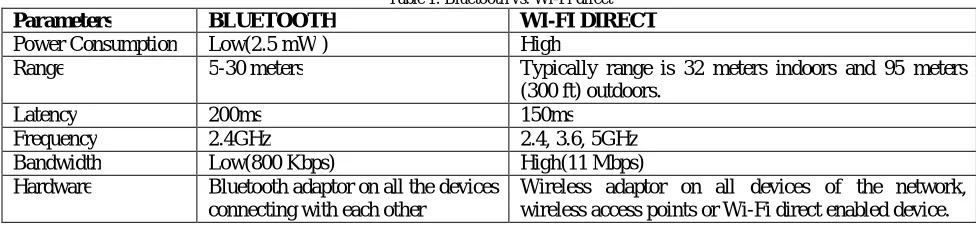
On the other hand, Wi-Fi Direct [6] is a new technology developed by the Wi-Fi Alliance to enhance direct device to device communications in Wi-Fi. Wi-Fi peer-to-peer (P2P) allows nodes to connect directly to each other via Wi-Fi without any intermediate access point. One of the paired devices becomes an access point to establish communication. Using Fi Direct, one can communicate over a speedy connection across distances much longer than Bluetooth. Wi-Fi [7] is better suited for operating full-scale networks because it enables a faster connection, better range from the base station, and better security (if configured properly) than Bluetooth. A detailed comparison between Bluetooth and Wi-Fi direct technology is presented in Table 1.
Table 1: Bluetooth vs. Wi-Fi direct Parameters BLUETOOTH WI-FI DIRECT
Power Consumption Low(2.5 mW ) High
Range 5-30 meters Typically range is 32 meters indoors and 95 meters
(300 ft) outdoors.
Latency 200ms 150ms
Frequency 2.4GHz 2.4, 3.6, 5GHz
Bandwidth Low(800 Kbps) High(11 Mbps)
Hardware Bluetooth adaptor on all the devices
connecting with each other
Wireless adaptor on all devices of the network, wireless access points or Wi-Fi direct enabled device.
technology is also available named Bluetooth Low Energy (BLE). It consumes lesser power compared to Classic Bluetooth. But there is a limitation of Bluetooth Low Energy technique. It can only transfer text messages and is unable to deal with audio or video messages. Communication range of Wi-Fi is also more than BLE protocol. So, we use classic Bluetooth and Wi-Fi Direct technologies for our purposes.
The rest of the paper is arranged as follows: in section 2, existing related work is discussed. Section 3 describes the design of the proposed work in detail. It is followed by section 4 where experimental setup and implementation details are discussed. Section 5 summarizes the results obtained by a simulation run. We finally conclude the paper in section 6 followed by future scope of the current work.
II. RELATED WORK
There has been an increased interest in the area of post disaster relief in recent years. Some Smartphone based applications have already been developed to aid in such relief work that is discussed below.
A. FEDERAL EMERGENCY MANAGEMENT AGENCY (FEMA)
The FEMA [8] application contains preparedness information for different types of disasters, an interactive checklist for emergency kits, a section to plan emergency meeting locations, information on how to stay safe and recover after a disaster, a map with FEMA Disaster Recovery Center locations and Shelters, general ways the public can get involved before and after a disaster. This application uses GSM technology for message sending. Thus this application is not useful in disaster area where existing infrastructure is completely or partially broken.
B. DISASTER MANAGEMENT SERVICE
This is an Android application which provides data storage options (documents, pictures, videos and audio), and lets one view, compress and send data to another phone. This application uses Bluetooth technology for communication which is suitable for short range only. Wi-Fi is not used here, thus this application doesn’t work for large areas [9].
C. LIFE 360 FAMILY LOCATOR
Family Locator by Life360 [10] uses GPS tracking technology. Family Locator lets one create groups, called “Circles”, of family & friends so that one can find help such as: find family & friend locations on a private Map, know when the family needs help, chat one-to-one or with everyone within each of your Circles, or get alerts when a Circle member reaches a destination. For transferring messages this application uses internet service and is, thus, less useful in disaster area as there may be no internet.
D. DISASTER ALERT
This application allows viewing active hazards such as tsunamis, earthquakes, volcanic activity, storms, floods, and more on a map. We can also view these hazards in an alert list. The application sends updates every five minutes. But this does not help in sending information about the needs of disaster hit area and about the current situation [10]. Also, communication relies on Internet connectivity.
E. STICK AND FIND
III.DESIGN OF THE PROPOSED WORK
The purpose of the current work is to develop an Android based application capable of sending messages consisting of text, audio, video or image to some destination device through uncertain paths without using GSM system. In order to achieve the goal, we have used peer to peer DTN network where source node transfers data to intermediate nodes and the process continues till data is transferred to destination node. The technology used for communication is Bluetooth and/or Wi-Fi Direct, selected on the basis of availability and predefined criteria.
The developed system is configured to transfer data automatically to connected devices whenever it is within communication range. The preferred communication mode is Wi-Fi Direct, so if both modes are available, data transfer is done using Wi-Fi automatically. In the absence of Wi-Fi, devices switch to Bluetooth communication. A single string is generated combining different fields of information like message source, destination, message type, priority, message text. The location information of source node is fetched using GPS and is converted to current address (i.e. place name, city, dist., pin code etc.), such that the exact location of disaster hit area or the location where relief help is required, is known to the destination node (control station) for helping the relief coordination. Android is nowadays the most widely used Smartphone operating system. Almost 83 percent of the smart phones used worldwide run on Android. The penetration and growth is still increasing into the masses. This has been the reason of our selection of developing an Android based application. It’s easy availability and user friendliness approach makes it the best candidate for developing applications that have social impact.
The basic steps of the working of the application have been summed up in algorithm 3.1 below.
A. BASIC PROCEDURE
Step 1: Initial set up of Bluetooth and Wi-Fi Direct.
Step 2: Message Generation (some fields being auto-generated, some are manually fed). Step 3: Message Sending.
Step 4: Message aggregation, using Timestamp-based data aggregation technique. Step 5: End.
The steps involved in the message generation and sending those messages to destination in peer-to-peer way of communication are mentioned in algorithm 3.2.
B. ALGORITHM FOR MESSAGE SENDING
Step 1: If Registered
Login to interface. Else
Register & then login.
Step 2: Set up initial connections (Bluetooth and Wi-Fi). [Message Generation]
Step 3: If no internet connection
Set up GPS connection (for location tracking). Else
Insert required fields.
[Choose Connection to send message] Step 4: If Wi-Fi connection is chosen
Send messages using Wi-Fi . Else
Next, we present the algorithm for message aggregation using Timestamp-based data aggregation technique in algorithm 3.3.
C. ALGORITHM FOR MESSAGE AGGREGATION
[Let (Ti, Tj), (Di, Dj), (Si, Sj), (Pi, Pj) be type, destination, source and priority of messagei & messagej respectively] Step 1: If Si = Sj and Ti = Tj and Di = Dj
If messagei.timestamp < messagej.timestamp Delete messagei
Else
Delete messagej Else
If Pi > Pj
Keep messagei before messagej in the queue Else
Keep messagej before messagei in the queue Step 2: Start processing the messages in queue
Step 3: End
IV.EXPERIMENTAL SETUP AND IMPLEMENTATION
The developed application has been tested in a simulated environment consisting of different smart phones. Emulator is avoided as it lacks appropriate hardware adapters. The specific software technologies that have been used for the development are:
Android version 4.2 (API 17)
Java Development Kit 1.7.0
Android Development Tools 22.6.2
Eclipse Kepler
SDK Tools r22.6.2
Backward compatibility to these technologies has not been verified, but higher versions to these are sure to support the developed application.
The specific hardware devices that we have used for our application development are:
Smartphone: Samsung Galaxy Grand 2 (running on Android 4.4)
Smartphone: Xolo q1000 (running on Android 4.2.1)
It must again be noted that the developed application is capable of running on any device that runs on the Android 4.2 or higher version of the operating system. Lower compatibility is not tested, so we do not claim any compliance for the same.
Getting deeper into the development stages, we mention below the files in the Android ADT 22.6.2 that we have particularly modified for implementing the desired changes and to get the required output.
In Login & Registration file extension of Activity class and modification of onCreate, onBackPressed methods
BTchat,ChatServices,Devices List, these three classes have been used for Bluetooth setting and Message sending through Bluetooth. We have used these classes of existing sample demo with few modification.
Register_Data is an Interface and Db_Handler is a class where we have extended SQLiteOpenHelper. These two classes have been used for saving data in SQLite Database.
In Setting class, initial Bluetooth and Wi-Fi set up has been done.
V. RESULTS
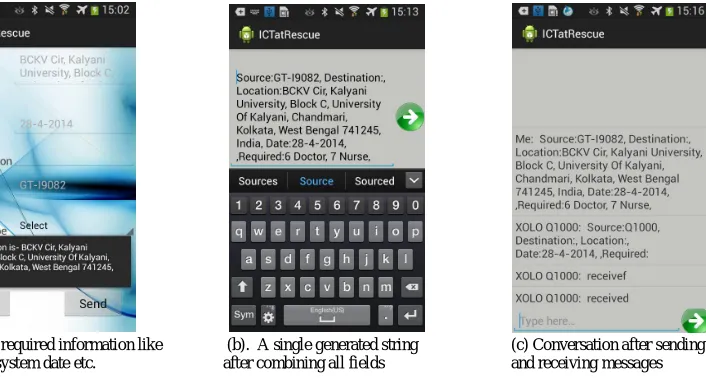
The developed application has been named ICTatRescue. It has been tested in a simulated environment that has been created using eight smart phones moving randomly inside a large room of size 20 m by30 m. The smart phones that have been used are of different makes namely, Samsung, Xolo, and Karbonn. Some of the screenshots taken while the system has been executing are presented in Fig. 1.
VI. CONCLUSION AND FUTURE WORK
In this work we have developed an android based Smartphone application for use in post disaster relief work. GSM and internet that are most common way to communicate are not available in those situations. Our application works on wireless technologies Bluetooth and Wi-Fi Direct which do not depend on any fixed infrastructure but on device’s hardware adapters. The technology provides a low-cost and scalable solution to situations like a post disaster relief. This application is of great utility for sending messages in ad-hoc mode and enabling communication in post disaster areas, but it also involves various security issues. Security issues arising in such communication need to be taken care of in future. One more vital issue is smart phone battery. As these technologies consumes much power and in disaster hit area there may be no power supply, the application remains of no use if battery goes down. So, we need to find ways to minimize energy requirement for communication in such challenged environments.
REFERENCES
[1] Debanjan Das Deb, Sagar Bose, Somprakash Bandyopadhyay, Coordinated Relief Operation using Smart Phone based Opportunistic network with Static Shelter Points in a Decentralized Disaster Management Environment, International Journal of Wireless & Mobile Networks (IJWMN) Vol. 4, No. 6, December 2012.
[2] Omar Mukhtar , Jörg Ott, Backup and bypass: introducing DTN-based ad-hoc networking to mobile phones, Proceedings of the 2nd international workshop on Multi-hop ad hoc networks: from theory to reality, May 26-26, 2006, Florence, Italy.
[3] Kevin Fall, “A Delay-Tolerant Network Architecture for Challenged Internets,” Proceedings of ACM SIGCOMM 2003, Computer Communications Review, Vol 33, No 4, August 2003.
[4] Jiradett Kerdsri, Komwut Wipusitwarkun, DORSI: Data-wise Opportunistic Routing with Spatial Information, Journal of Convergence Information Technology (JCIT), Volume8, Number13, August 2013.
[5] Specification of Bluetooth System,Core,V1.0 B (1999-2012) Special Interest Group: http://www.bluetooth.org/ [6] Bluetooth in Android: http://developer.android.com/guide/topics/connectivity/bluetooth-le.html
[7] Wi-Fi Direct: http://www.wi-fi.org/files/faq_20101021_Wi-Fi_Direct_FAQ.pdf
[8] He Shouchun, Meepnakshi Harikumar, Naga Tulsi Soujanya Vadrevu: Development of a new service using Wi-Fi Direct, COMPUTER NETWORKS COEN233
: (a). Some required information like (b). A single generated string (c) Conversation after sending
location, system date etc. after combining all fields and receiving messages
[9] D Camps-Mur, A Garcia-Saavedra, P Serrano: Device-to-device communications with Wi-Fi Direct: overview and experimentation Wireless Communications, IEEE, 2013
[10] FEMA Android Application: www.fema.gov/app.
[11] Post-Disaster Situation Analysis and Resource Management using Delay-Tolerant Peer-to-Peer Wireless Networks: http://cse.iitkgp.ac.in/resgrp/cnerg/disaster_dtn
[12] Family Locator by Life360: https://www.life360.com/family-locator/