ISSN(Online): 2320-9801
ISSN (Print): 2320-9798
International Journal of Innovative Research in Computer
and Communication Engineering
(An ISO 3297: 2007 Certified Organization)
Vol. 3, Issue 4, April 2015
Improved Writing Capabilities Using LMS
Premanand Edward Malyakkal
Associate Professor, Dept. of English, Malabar Christian College, Calicut University, Kerala, India
ABSTRACT: Writing has undergone a paradigm shift from the humble pen, pencil and paper to keyboard and computer. Tactile keyboards that input texts are being replaced with touch-enabled glass screens. Writing styles too are witnessing dramatic changes from long essays with flowery language to shorter descriptions supplemented with graphical emoticons. Socially too, writing is seen as an authoritative means of communication with blogs, social networking sites and websites. This research focuses on a sample 30 tertiary learners sourced from 900 candidates. A questionnaire was used to collect data which included a set of standardized questions and information about demographics, opinions, attitudes, or behaviors. The target group was administered with a LMS (Learning Management System) that focused on improving their writing capabilities. The results were computed using SPSS. There was a marked increase in learning objectives as is relevant from the statements of participants. The experiment was conducted by the research scholar as part of his doctoral research.
KEYWORDS: Technology in Education, LMS, English Language Teaching, Mobile communication devices.
I. INTRODUCTION
Language essentially binds each and every one of us in a common platform that can be shared and used as a medium of communication to discover and bring out thoughts and ideas. It is through the medium of language that we learned how to read and write. Information, ideas and concepts transmitted from one individual to another through pictures soon evolved to narrate a “story”. Writing evolved in order to document that „story‟ with primary inscriptions and symbols etched in clay to represent land, grain or cattle. It also served as a communication link between heaven and earth, which soon became a way to extend the memory, serving also as a tool for the elite to justify their rule upon the common, illiterate people. (Lohr et al, 1995) With the advent of the modern times, being literate meant to be able to read and write and no other individual was suited for this role than the „teacher‟ who could encourage their wards to write essays, paragraphs, reports, stories and scripts.
Digital literacy or the use of technology in writing engages learners in a dynamic relationship. The rapidly evolving technology makes it almost nearly impossible to keep up with the latest technological advances. For a tertiary learner, writing essentially requires only basic word-processing software. All other essentials, basically add-ons can be additionally installed on certain specific computers so as to reduce costs. Vocabulary builders, plagiarism checkers, grammar software, style checkers and visual organizers form part of the add-ons that fine-tune writing capabilities.
Writing has become an essential and key component of daily routine, although the mode of writing has undergone a paradigm shift from the humble pen, pencil and paper to keyboard and computer. Tactile keyboards that can input texts are being replaced with soft-touch and presently, touch-enabled glass screens are very much in vogue. Very soon, words would soon be able to flow from memory directly onto the screen. Writing styles too have also witnessed dramatic changes from long essays with flowery language to colloquial written styles; writings have even become shorter and graphical with emoticons. Socially too, writing is seen as an authoritative means of communication with new writing media such as blogs, social networking sites and websites. Armed with technology and handheld devices, writing is further being condensed with 140-character limits, forcing the writer to find a focus and make every single word count.
ISSN(Online): 2320-9801
ISSN (Print): 2320-9798
International Journal of Innovative Research in Computer
and Communication Engineering
(An ISO 3297: 2007 Certified Organization)
Vol. 3, Issue 4, April 2015
a slight edge mainly due to compulsion from authorities to speak only in English As a result, the college classroom is a mixture of learners who are competent in English but at varying levels.
II. PURPOSEOFTHESTUDY
The present study focused on improving the written skills of students at the tertiary level. The purpose of pursuing the study was to:
To identify the potentials of writing in English Language Teaching through Information Computer
Technology ( ICT).
To evaluate the effectiveness of ICT applied ELT in developing written communication skills.
To find out the attitudes and perceptions of the learners to improving written communication in
English through ICT.
III.LITERATUREREVIEW
Noiwan et al., (2005), in their studies on the relationship between computer attitudes and computer adoption found out that students, who perceived the usefulness of computer and felt more confident in using it, appeared to be more positive in their attitudes toward ICT. They tended to use computers more. Godwin-Jones explored the trends in the use of the Internet, particularly with Web 2.0, which has precipitated changes in modes and uses of writing online. Blogs and social networking sites provided new opportunities and incentives for personal writing. The challenge for language teachers was to extend students' Internet world beyond their first language, to leverage participation in the read-write Web as a learning opportunity for language self-development, and to find means to link informal and recreational writing with formal and academic writing. Mueller et al., (2008) in their study found that secondary school instructors were becoming more comfortable and confident in their integration of computer technology in their classrooms and course content. Increasingly stable, dedicated pedagogical software and hardware, excellent support from technology personnel, and full-time access to computer labs with a 1:1 student-computer ratio created an ideal support system. Malyakkal, (2014) experimented with videos in the classroom. The results showed that the learners were more confident of speaking themselves and writing with more persuasion and determination. Around 74% of the learners felt that their confidence to understand and speak English increased.
IV.OBJECTIVEOFTHESTUDY
The study was mainly concerned with the written communication skills of tertiary level students in Kerala using information communication technology. It also dealt with the following specific objectives
The study attempted to create an ICT environment (ICT user interface) that taught written communication
skills in an Internet facilitated multimedia language laboratory.
It further focused on the language acquisition that took place through different writing tasks that were
undertaken by students.
It also reviewed the impact of ICT in language teaching and learning process.
It also provided a few suggestions for the improvement and further investigation apart from
recommendations.
V. LIMITATIONSOFTHESTUDY
The study had the following limitations in spite of the benefits it was bestowed with.
As it is still a newly developing concept, the investigation was constrained by the availability of time and
financial resources and could not be carried out on a large scale.
The area of study was confined to the teaching of written communication skills.
The Internet facilitated multimedia laboratory and Learning Management Systems (LMS) was still in its
ISSN(Online): 2320-9801
ISSN (Print): 2320-9798
International Journal of Innovative Research in Computer
and Communication Engineering
(An ISO 3297: 2007 Certified Organization)
Vol. 3, Issue 4, April 2015
VI.SUMMARYOFTHEPROGRAMME
A detailed survey of the available sources was carried out find out the level of research done in English language teaching and writing through the use of information and communications technology
A survey among the target group (General sample) consisting of 900 tertiary learners from various
Government, Aided, Private colleges in Calicut District, Kerala was conducted to find out their ICT skills, attitude to English language learning in general and writing in particular.
A sample (Sub sample) of 30 students was selected from this target group and were taught written
communication skills using ICT
A user interface ICT in ELT was designed to teach written communication skills in English using ESL
websites and different ICT applications and tools
An entry test was conducted for the 30 selected participants to ascertain their proficiency of English in general and writing in particular.
The students were taught through writing activities, creation of info graphs and collaborative learning using
Edmodo. A total number of 540 pieces of writing were evaluated using narrative, descriptive, expository and argumentative forms of writing. An average of 22 writings was done per student apart from the daily grammar and vocabulary routine.
A post- test was conducted for the students to find out their proficiency after the ICT intervention.
A feedback questionnaire was administered to students to record the perception, attitude and feelings of the
students towards writing using ICT.
The test results and questionnaires were analyzed and compared to find out the students‟ behavior before
and after the administration of tests.
All the data were analyzed using SPSS software, interpreted and findings recorded.The simulation results
showed that the proposed algorithm performs better with the total transmission energy metric than the maximum number of hops metric. The proposed algorithm provides energy efficient path for data transmission and maximizes the lifetime of entire network.As the performance of the proposed algorithm is analyzed between two metrics in future with some modifications in design considerations the performance of the proposed algorithm can be compared with other energy efficient algorithm. We have used very small network of 5 nodes, as number of nodes increases the complexity will increase. We can increase the number of nodes and analyze the performance.
VII. EDMODOINTHECLASSROOM
Edomodo is a powerful social learning platform that helps learners get excited about learning. Social Networking Sites (SNS) are very much in vogue. Most of them have accounts on Facebook, Orkut and the likes. The familiar blue and white has been maintained with Edmodo. On Edmodo (Fig. 1), teachers can continue classroom discussions online, give polls to check for student understanding, and award badges for individual students based on performance or behaviour. Teachers are at the centre of a powerful network that connects them to students, administrators, parents, and publishers. This network brings out resources and tools from all over the world, providing the building blocks of a high quality education.
ISSN(Online): 2320-9801
ISSN (Print): 2320-9798
International Journal of Innovative Research in Computer
and Communication Engineering
(An ISO 3297: 2007 Certified Organization)
Vol. 3, Issue 4, April 2015
Edmodo makes it simple to track student progress. All grades and badges assigned or awarded through Edmodo are stored and easily accessible. Teachers can get the pulse of their classrooms through student reactions to quizzes, assignments, and discussion posts that capture understanding, confusion, or frustration. Edmodo makes it simple to assign and receive assignments, assess students, and communicate both in and out of the classroom. Edmodo makes teaching really fun, and students truly enjoy doing their work. It is easy to give students feedback on their schoolwork. Edmodo is a platform to connect with other teachers by joining and creating teacher groups. Work becomes more streamlined as the technology becomes integrated with the educational practice.
The investigator took an interest in this particular learning management software due to its ease of use and installation. The application was also available across platforms. Students were given a unique ID in relation to their Gmail accounts. The teacher‟s dashboard consisted of tools required for monitoring the outcome of the students. Although the software had the capabilities of connecting with parents directly, the facility was not put into use. Quiz applications, question-and-answer sessions were tested and tried. Assignments were given specific dates for completion. The advantage with Edmodo was that the learner could complete his assignments from anyplace. The teacher too was able to check the answers, grade them accordingly and send back the results without having to be fixed in a particular place.
VIII. RESULTS
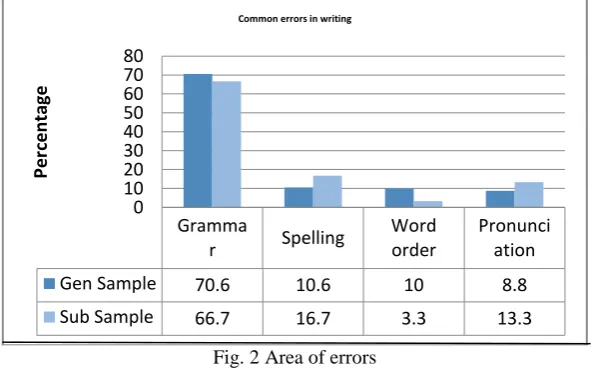
The most common errors committed in Writing were observed both in the General sample and sub-sample. It was observed that 70.6% in the General and 66.7% in the sample committed errors in Grammar. 16.7% in the sub-sample made mistakes in spelling. This is elucidated in Fig.2. In order to reduce these, the experimental group was
subject to ICT intervention using www.vocabulary.com and grammar worksheets made available on the website
www.premclt.com
Fig. 2 Area of errors
IX.WRITING IN ICT ENVIRONMENTS
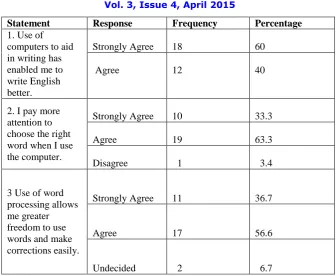
Statements were recorded by the researcher to find out the general perception and attitude of learners using ICT in writing. The experimental group unanimously agreed that learning becomes more creative using ICT methods. Table1 shows the Responses about Writing in ICT Environments. The results showed that 96.7% of the participants preferred ICT enabled classes. This also was evident in their attention to classroom lectures. 96.7% participants agreed that they were more focused.
Gramma
r Spelling
Word order
Pronunci ation
Gen Sample 70.6 10.6 10 8.8
Sub Sample 66.7 16.7 3.3 13.3
0 10 20 30 40 50 60 70 80
Per
ce
n
tage
ISSN(Online): 2320-9801
ISSN (Print): 2320-9798
International Journal of Innovative Research in Computer
and Communication Engineering
(An ISO 3297: 2007 Certified Organization)
Vol. 3, Issue 4, April 2015
Statement Response Frequency Percentage
1. Use of computers to aid in writing has enabled me to write English better.
Strongly Agree 18 60
Agree 12 40
2. I pay more attention to choose the right word when I use the computer.
Strongly Agree 10 33.3
Agree 19 63.3
Disagree 1 3.4
3 Use of word processing allows me greater freedom to use words and make corrections easily.
Strongly Agree 11 36.7
Agree 17 56.6
Undecided 2 6.7
Table1.Responses about Writing in ICT Environments
Almost all the students were confident that searching for English educational websites would help them to read, write and speak much better. This was also evidenced by the fact that social network writing using Edmodo helped them to complete their assignments on time. It was also observed that 97% of students admitted that submitting assignments on an LMS platform like Edmodo was very easy. The highly positive attitude of the participants shows that such a programme will be appreciated by most of the students when implemented on a larger scale. Table 2 indicates the general perception and attitude of the learners.
1. Edmodo helped me to complete assignments on time.
Strongly agree
14 46.7
Agree 16 53.3
2. Submitting assignments on Edmodo is very easy.
Strongly agree
11 36.7
Agree 18 60.0
Undecided 1 3.3
Table 2. General perception and attitude
IX.FEEDBACK
ISSN(Online): 2320-9801
ISSN (Print): 2320-9798
International Journal of Innovative Research in Computer
and Communication Engineering
(An ISO 3297: 2007 Certified Organization)
Vol. 3, Issue 4, April 2015
The questions in the feedback questionnaire incorporated many dimensions. The dimensions related to the different ICT components used like word processing, online dictionaries and vocabulary enhancers, social network writing using Edmodo and creation of infographs. It also analysed the students‟ perception and attitudes towards writing using ICT components and their assessment of the same. The first part of the questionnaire enquired the number of writings they had done as part of the project and the assessments received upon which they had to improve their writing. This gave an idea of the involvement of the students in the program, how the learner went through the course. A few of them are outlined below (unedited):
o My vocabulary increased with the use of computer especially Edmodo. The writing tasks also were best for me
to increase my efficiency in English.
I have decided to study the word meaning every day at least 3 words. I would use EDMODO and use of the
internet gives a lot of information. Then I use to improve my vocabulary through newspaper reading I must read a lot of English books to improve my vocabulary.
X. CONCLUSION
The study concentrated on the new vistas and directions available due to the explosion of information communication technology in the area of writing. However, there were a few limitations. The main reason was that new technological advances were sudden and hardware and software quickly become obsolete. Technical problems too, like server breakdown, PC glitches and compatibility with other operating systems could also hinder the participation of students. Since most of the activities are related to Internet, slow internet connection would often make students impatient, distracted and sometimes disinterested.
With improved Learning Management capabilities, it is hoped that students will learn better and be better prepared to face the future in a more positive and determined approach.
ACKNOWLEDGEMENT
The researcher wishes to thank God Almighty, parents, Prof. Edward Augustus and Mrs. Prasanna Augustus; wife, Preethy and daughter, Darsana for all support. Sister, Dr. Shobha M E and family, brother, Vijayan M. E and family for the laptop, Dr. Sreedevi B for guidance, Principal, Prof. Gladys P E Isaac and Manager, Mr. Ernest Edapally for the computer lab provided to conduct survey and experiments related to the research.
REFERENCES
1. Fanon, F., „The Wretched of the Earth‟, Grove, 1991.
2. Godwin-Jones and Robert, „Emerging Technologies: Tag Clouds in the Blogosphere: Electronic Literacy and Social Networking‟,
Language, Learning & Technology,Vol. 10.2, 2006.
3. Kellogg, R. T., Olive, T., & Piolat, A, „Verbal, Visual, and Spatial Working Memory in Written Language Production‟, Ada
Psychologica, No.124, pp.382-397, 2007.
4. Lohr, Linda, Steven M. Ross and Gary R., „Using a Hypertext Environment for Teaching Process Writing: An Evaluation Study of Three
Student Groups‟, Educational Technology Research and Development, 43.2, pp. 33-51. 2013.
5. Malyakkal, P. E, „Songs That Enliven General Knowledge, Conversation and IT Skills‟, ELT Vistas, Vol.5.1, pp.139, 2013.
6. Noiwan, J., T. Piyawat and A.F. Norcio, „Computer Attitude and Computer self-efficacy: A Case Study of Thai Undergraduate Students‟,
Maryland; University of Maryland, Baltimore County, 2005.
BIOGRAPHY