Design an Access Control Scheme for the
WBANs Using the Given Signcryption
S.Santhiya 1, N.Satheeskumar2
Research Scholar, Dept. of Computer Science, PGP College of Arts and Science, Namakkal, India 1
Asst.Professor, Dept. of Computer Science, PGP College of Arts and Science, Namakkal, India 2
ABSTRACT: Certificate less cryptography achieves the higher of the two worlds: it inherits from identification-based totally strategies a strategy to the certificates control hassle in public-key encryption, even as putting off the name of the game key escrow capability inherent to the identity-primarily based setting. Signcryption schemes acquire confidentiality and authentication concurrently by way of combining public-key encryption and virtual signatures, imparting higher normal overall performance and security. On this project, we introduce the belief of certificate less signcryption and gift an efficient construction which ensures protection underneath insider assaults, and consequently gives forward secrecy and non-repudiation. The scheme is shown to be comfortable the usage of random oracles under a version of the bilinear Die- Hellman assumption. To cope with the dynamic surroundings of emergency reaction, an elliptic curve cryptography (ECC)-primarily based public key encryption scheme is used for authentication. However, there are no similarly mechanisms to protect the safety of the saved information and control get right of entry to it.
KEYWORDS: Certificateless signcryption (CLSC), Wireless body area networks (WBANs), Certificate less
Cryptography, Signcryption, Insider Security, Non-Repudiation, Forward Secrecy.
I. INTRODUCTION
Certificate less cryptography achieves the most effective of 2 worlds. It inherits from identity-based techniques an answer to the certificate management drawback in public-key secret writing, however it eliminates the necessity for a sure authority with key escrow capabilities.
In identity-based cryptography, AN discretional bit-string representing a user's identity are often used because the secret writing or verification public key. This means that public key certificate don't seem to be needed. This feature, however, comes at the value of introducing A powerful secret key provision authority, which authenticates users and provides secret keys through a secure channel. the matter is that, not solely should this authority be sure to evidence the users, but also to not cash in of possessing the user's secret keys. this is often called the key written agreement property of identity-based cryptosystems and it are often given as a feature or a security drawback, looking on the applying state of affairs. In certificate less cryptography key written agreement is seen as AN undesirable property, and user secret writing ANd verification keys contain each a user identity and an unauthenticated public key. Similarly, user secret keys area unit made from 2 partial secrets: one returning from AN identity-based sure authority known as the Key Generation Centre (KGC) and another one generated by the user.
Certificate less security models capture situations wherever the offender are often a system user or the KGC itself. To account for the very fact that user public keys don't seem to be authenticated, attackers area unit allowed to switch users' public keys to try impersonation. Since certificate less cryptography was introduced by Al-Ryiami and Pater- son [1], various certificate less secret writing and signature schemes, and variants thereof, are planned. However, the equivalent of public-key signcryption has not been thought-about within the certificate less setting. Signcryption may be a cryptographically primitive that captures a standard sensible scenario wherever one at the same time needs confidentiality and non-repudiation of transmitted information. Ideally, this could provide enhancements within the overall security and efficiency of the ensuing cryptosystems.
originating from another user. In less common situations one may need forward secrecy, wherever a message sent by a legitimate user, can't be decrypted even by AN opponent that later is able to line up of the sender's secret key. This primitive has been extensively studied within the public-key and identity-based settings wherever several efficient and secure schemes are planned.
Existing system
Wireless body space networks (WBANs) are expected to act as a crucial role in observance the health data and making a extremely reliable omnipresent tending system. Since the information collected by the WBANs are wont to diagnose and treat, solely licensed users will access these knowledge. Therefore, it's vital to style associate access management theme which will authorize, demonstrate, and revoke a user to access the WBANs. During this paper, we tend to 1st offer associate economical certificate less signcryption theme so style associate access management theme for the WBANs exploitation the given signcryption. Our theme achieves confidentiality, integrity, authentication, non-repudiation, public verifiability, and cipher text legitimacy. Compared with existing 3 access management schemes exploitation signcryption, our theme has the smallest amount procedure value and energy consumption for the controller. Additionally, our theme has neither key written agreement nor public key certificates, since it's supported certificate less cryptography.
Drawbacks of Existing System
Leakage of privacy information due to WBAN's unique characteristics, such as Open medium channel.
Signal noise. Mobile terminals. Flexible infrastructure.
II. PROPOSED SYSTEM
In certificate less cryptography key written agreement is seen as AN undesirable property and user encoding and verification keys contain each a user identity and an unauthenticated public key user secret key area unit made from 2 partial secrets: one coming back from an identity-based trusty authority referred to as the Key Generation Centre (KGC) and another one generated by the user. Certificate less security models capture situations wherever the wrongdoer may be a system user or the KGC itself. AN elliptic curve cryptography(ECC)-based public key encoding theme is employed for authentication. To account for the very fact that user public keys don't seem to be genuine , attackers area unit allowed to exchange users' public keys to try impersonation.
Advantages of Proposed System
• Cost-effective, efficient, and provably secure against existential forgery.
• The protocols use an anonymous account index instead of a WBAN client’s real identity to access WBAN service.
• Examining the soundness and performance of the similar designs
III. CONTRIBUTION
and energy consumption for the controller.In addition, our theme has neither key written agreement nor public key certificates, since it's supported certificateless cryptography.
Design associate efficient certificateless access management theme for the WBANs supported identity-based access management (IBAC) model that associates access privilege with specific users. Our methodology uses CLSC with public verifiability and ciphertext believability. Such style has the subsequent advantages: (1) it's neither key written agreement downside nor public key certificates. (2) It permits the controller to visualize the valid of question messages while not coding. Such style saves the process price and energy consumption. currently describe a concrete access management theme victimization the modified BDCPS theme. This access management theme consists of 4 parts: the low-level formatting phase, the registration part, the authentication and authorization part, and therefore the revocation part.
System Design
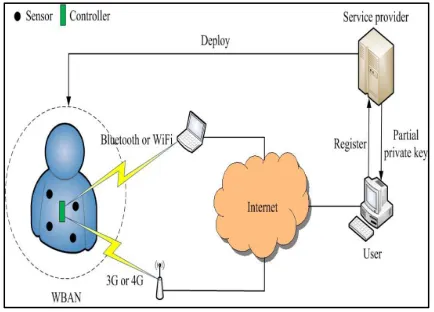
Fig 1: System Design
IV. IMPLEMENTATION
WBAN
Service supplier User
Certificate less Access management
MODULES DESCRIPTION WBAN
A typical WBAN consists of variety of implantable or wearable detector nodes and a controller. The detector nodes square measure accountable for observation a patient’s very important signs (e.g. ECG, heart rate, respiration rate and BP) and environmental parameter (e.g. temperature, wetness and light). The detector nodes communicate with the controller and also the controller acts as a entree that sends the collected health information to the attention staffs and network servers. The WBANs increase the potency of attention since a patient isn't any longer needed to go to the hospital oft. The clinical identification and a few emergency medical response also can be accomplished by the WBANs. Therefore, the WBANs act as a very important role in making a extremely reliable omnipresent attention system.
Service Supplier
WBAN. That is, the SP plays the KGC within the CLC. we tend to suppose that the SP is honest and curious (the SP follows the protocol however hopes to understand the transmitted messages). That is, we tend to don't ought to totally trust the SP since it solely is aware of the partial non-public key of the user.
User
Once a user hopes to access the observation information of the WBAN, it initial sends a question message to the WBAN. Then controller checks if the user has been licensed to access the WBAN. If yes, the controller sends collected information to the user during a secure manner. Otherwise, the controller refuses the question request.
Certificate Less Access Management
In this Module, we tend to style associate access management theme for the WBANs victimization the CLSC with public verifiability and ciphertext legitimacy. additionally, the planned theme has neither key written agreement downside nor public key certificates. The controller will verify the validity of a ciphertext while not secret writing. Compared with existing 3 access management schemes victimization signcryption, our theme has the smallest amount procedure price and energy consumption for the controller.
V. RESULT AND DISCUSSION
The security proof for the certicateless signcryption theme bestowed within the previous section has many fascinating aspects that we are going to currently discuss. Full Domain Hash: For the sake of clarity within the proof presentation, we chose not to adopt Coron's technique to get tighter security reductions within the analysis of legitimacy. Adaptation of this method to the certicateless sign- cryption case are often achieved following the strategy introduced by Libert et al.
For identity-based signature schemes. However, it's necessary to empha- sise a difficulty specic to the certicateless setting that renders this adaptation less easy. The adaptational power of a sort I wrongdoer as dened in [1] permits the wrongdoer to decide whether or not it replaces the general public key for the challenge identity or it extracts the associated partial secret key. this suggests that an immediate adaptation of the proof in [16], that embeds the onerous drawback instance in a very fraction of the partial secret keys that arise within the security game, is empty for sort I adversaries that extract the partial secret key for the challenge identity. This observation actuated the definition of the sort I0 attack model in this paper, and therefore the lemmas relating sort I and sort II security with this new variant.
The restricted adaptational behaviour of sort I0 attackers permits applying Coron's technique directly within the certicateless situation. As associate example of why this is a relevant contribution, we tend to discuss with the certicateless signature planned in [19], that is claimed to be secure against sort I attackers. The proof that is bestowed for this theme is awed, and truly establishes security against more restricted sort I0 adversaries. Randomness Reuse: The planned signcryption theme is structured internally as associate Encrypt-then-Sign construction mistreatment algorithms from [8] and [19] and sharing randomness between the 2 schemes. The coding algorithmic program can be shown to be IND-CPA secure, whereas the signature algorithmic program is sUF- CMA secure. The expected security of our construction, that follows from the work of associate et al. [2], is thus IND-CCA security against outsider adversaries and full corporate executive sUF-CMA security. it's fascinating to notice, however, that our scheme presents full corporate executive security for condentiality. This is often thanks to the employ of randomness between the coding and signature elements that intuitively prevents associate corporate executive opposer from having the ability to forge a sound signcryption from another one that it doesn't apprehend the implicit randomness.
Self-Signcryption: We note that, though our security models command attacks targeting signcryptions wherever the sender and receiver identities square measure constant, it is possible to change our proof of security to account for this sort of attacks. However, one would wish less normal versions of the underlying onerous issues to construct the protection reduction. it's controversial whether or not this type of security property has relevancy in follow, though specific applications like protective one's les or antecedently sent encrypted e-mails is also wont to justify it. Malicious KGCs: Malicious KGC attacks haven't been thought-about during this paper. However, the planned theme withstands the restricted attacks represented in [3], that encompass permitting a malicious KGC to get the (Msk; params) pair itself as long because it provides these to the rival. We tend to believe that a additional realistic and stronger malicious KGC security model would solely need that the adversary outputs the general public parameters. We tend to leave it as associate open drawback to and a certicateless signcryption theme which might be well-tried secure during this stronger security model.
VI. CONCLUSION
In this paper, we have a tendency to projected a changed certificate less signcryption theme that satisfies public verifiability and cipher text credibility. We have a tendency to additionally gave a certificate less access management theme for the WBANs exploitation the changed signcryption. Compared with existing four access management schemes exploitation signcryption, our theme has the smallest amount process time and energy consumption. Additionally, our theme is predicated on the CLC that has neither key written agreement downside nor public key certificates.
REFERENCES
[1] T. Y. Wu and C. H. Lin, “Low-SAR path discovery by particle swarm optimization algorithm in wireless body area networks,” IEEE Sensors J., vol. 15, no. 2, pp. 928–936, Feb. 2015.
[2] C. Yi, L. Wang, and Y. Li, “Energy efficient transmission approach for WBAN based on threshold distance,” IEEE Sensors J., vol. 15, no. 9,
pp. 5133–5141, Sep. 2015.
[3] J. He, Y. Geng, Y. Wan, S. Li, and K. Pahlavan, “A cyber physical test-bed for virtualization of RF access environment for body sensor network,” IEEE Sensors J., vol. 13, no. 10, pp. 3826–3836, Oct. 2013.
[4] D. Liu, Y. Geng, G. Liu, M. Zhou, and K. Pahlavan, “WBANs-Spa: An energy efficient relay algorithm for wireless capsule endoscopy,” in
Proc. IEEE 82nd Veh. Technol. Conf. (VTC-Fall), Boston, MA, USA, Sep. 2015, pp. 1–5.
[5] D. He, S. Chan, and S. Tang, “A novel and lightweight system to secure wireless medical sensor networks,” IEEE J. Biomed. Health Inform., vol. 18, no. 1, pp. 316–326, Jan. 2014.
[6] S. Movassaghi, M. Abolhasan, J. Lipman, D. Smith, and A. Jamalipour, “Wireless body area networks: A survey,” IEEE Commun. Surveys Tuts., vol. 16, no. 3, pp. 1658–1686, Jan. 2014.
[7] M. Li, W. Lou, and K. Ren, “Data security and privacy in wireless body area networks,” IEEE Wireless Commun., vol. 17, no. 1, pp. 51–58, Feb. 2010.
[8] C. Hu, F. Zhang, X. Cheng, X. Liao, and D. Chen, “Securing communications between external users and wireless body area networks,” in Proc. 2nd ACM Workshop Hot Topics Wireless Netw. Secur. Privacy (HotWiSec), Budapest, Hungary, 2013, pp. 31–35.
[9] J. Lai, R. H. Deng, C. Guan, and J. Weng, “Attribute-based encryption with verifiable outsourced decryption,” IEEE Trans. Inf. Forensics
Security, vol. 8, no. 8, pp. 1343–1354, Aug. 2013.
[10] R. Lu, X. Lin, and X. Shen, “SPOC: A secure and privacy-preserving opportunistic computing framework for mobile-healthcare emergency,” IEEE Trans. Parallel Distrib. Syst., vol. 24, no. 3, pp. 614–624, Mar. 2013.
[11] H. Zhao, J. Qin, and J. Hu, “An energy efficient key management scheme for body sensor networks,” IEEE Trans. Parallel Distrib. Syst., vol. 24, no. 11, pp. 2202–2210, Nov. 2013.
[12] D. He, S. Chan, Y. Zhang, and H. Yang, “Lightweight and confidential data discovery and dissemination for wireless body area networks,” IEEE J. Biomed. Health Inform., vol. 18, no. 2, pp. 440–448, Mar. 2014.
[13] C. C. Tan, H. Wang, S. Zhong, and Q. Li, “IBE-Lite: A lightweight identity-based cryptography for body sensor networks,” IEEE Trans. Inf. Technol. Biomed., vol. 13, no. 6, pp. 926–932, Nov. 2009.
[14] D. Boneh and M. Franklin, “Identity-based encryption from the Weil pairing,” SIAM J. Comput., vol. 32, no. 3, pp. 586–615, 2003.
[15] J. Liu, Z. Zhang, X. Chen, and K. S. Kwak, “Certificateless remote anonymous authentication schemes for wireless body area networks,” IEEE Trans. Parallel Distrib. Syst., vol. 25, no. 2, pp. 332–342, Feb. 2014.
[16] S. S. Al-Riyami and K. G. Paterson, “Certificateless public key cryptography,” in Advances in Cryptology (Lecture Notes in Computer
Science), vol. 2894. New York, NY, USA: Springer-Verlag, 2003, pp. 452–474.
[17] G. Cagalaban and S. Kim, “Towards a secure patient information access control in ubiquitous healthcare systems using identity-based signcryption,” in Proc. 13th Int. Conf. Adv. Commun. Technol. (ICACT), Seoul, Korea, Feb. 2011, pp. 863–867.
[19] Y. Zheng, “Digital signcryption or how to achieve cost(signature & encryption) cost(signature) + cost(encryption),” in Advances in Cryptology (Lecture Notes in Computer Science), vol. 1294. New York, NY, USA: Springer-Verlag, 1997, pp. 165–179.
[20] C. Hu, N. Zhang, H. Li, X. Cheng, and X. Liao, “Body area network security: A fuzzy attribute-based signcryption scheme,” IEEE J. Sel. Areas Commun., vol. 31, no. 9, pp. 37–46, Sep. 2013.
[21] C. Ma, K. Xue, and P. Hong, “Distributed access control with adaptive privacy preserving property for wireless sensor networks,” Secur. Commun. Netw., vol. 7, no. 4, pp. 759–773, Apr. 2014.