and Auger electron spectroscopy features in plasma-deposited
zirconium silicate alloy thin films
G. B. Rayner, Jr., D. Kang, Y. Zhang, and G. Lucovsky
Department of Physics, North Carolina State University, Raleigh, North Carolina 27695-8202 共Received 31 January 2002; accepted 13 May 2002兲
The local bonding of Zr, Si, and O atoms in plasma-deposited, and post-deposition annealed Zr silicate pseudobinary alloys关(ZrO2)x(SiO2)1⫺x兴 was studied by x-ray photoelectron spectroscopy
共XPS兲and Auger electron spectroscopy共AES兲. Systematic decreases in XPS binding energies, and increases in AES kinetic energies with alloy composition x are consistent with an empirical chemical bonding model based on electronegativity equalization; however, there are significant departures from the predicted linear composition dependencies of that model. Deviations from linearity in the XPS compositional dependencies are correlated with dipolar network atom fields as determined from ab initio calculations. The nonlinearities in the x dependence of ZrM VVand OKVV
AES spectral features are determined primarily by oxygen–atom coordination dependent shifts in valence band offset energies. The energy spread in the compositional dependence of binding energies (⬃1.85 eV) for the XPS Zr 3d5/2 and Si 2 p features combined with x-ray absorption spectroscopy data indicates that the conduction band offset energies between the Si substrate and Zr silicate dielectrics are alloy composition independent. Changes in O 1s XPS features in alloys with x⬃0.3 to 0.6 as function of annealing temperature are consistent with a previously identified chemical phase separation that occurs after 60 s anneals at 900 °C in a nonoxidizing ambient, Ar. © 2002 American Vacuum Society. 关DOI: 10.1116/1.1493788兴
I. INTRODUCTION
Interest in noncrystalline dielectrics for advanced silicon microelectronic devices with increased dielectric constants (k) relative to amorphous (a-) SiO2 (k⬃3.9) and Si oxyni-tride alloys (k⬃5 – 7) has focused on transition metal共TM兲 oxides, and TM silicate and aluminate alloys.1 Increases in the relative dielectric constants of these high-k dielectrics compared to a-SiO2 allow use of physically thicker films to obtain the same effective capacitance and equivalent oxide thickness共EOT兲as devices with physically thinner a-SiO2. This provides for the possibility for many order of magnitude reductions in direct tunneling current. However, decreases in tunneling anticipated from increases in physical thickness are in part mitigated by reductions in effective conduction band offset energies that define the tunneling barrier between the Si substrate and the high-k dielectric.2– 4
The local bonding in a TM silicate alloy, where the ratios of each constituent oxide are fixed, can vary substantially depending on the deposition process and subsequent post-deposition heat treatments. This article presents the results of an XPS/AES investigation of the local bonding in pseudobi-nary Zr silicate alloys 关(ZrO2)x(SiO2)1⫺x兴 prepared by re-mote plasma processing.5–7This processing approach mini-mizes OH and C impurities, and ensures complete oxidation of Si and Zr. Local bonding in SiO2-rich alloys (x⬍0.5) approximately 2000 Å thick has been previously investigated by x-ray diffraction 共XRD兲 and infrared共IR兲spectroscopy.6 Results from that investigation indicated that films, as-deposited at 300 °C and annealed in a nonoxidizing ambient such as Ar at temperatures up to 800 °C, are amorphous and
pseudobinary in character with Si–O and Zr–O bonds, but not Zr–Si, Si–Si, or Zr–Zr bonds. Similar IR studies have also been conducted on ZrO2-rich alloys and indicate a pseudobinary character as well. In addition, it has also been shown that a chemical phase separation into ZrO2and either SiO2 or a low ZrO2 concentration alloy (x⬍0.1) occurs in these pseudobinary alloys when they are annealed at 900 °C for 60 s in a nonoxidizing ambient such as Ar.6The XPS and AES results of this article provide additional insights to local bonding that are complementary to what has been previously revealed in the IR studies, and in addition confirm directly the chemical phase separation that occurs for annealing in inert ambients at temperatures greater than 900 °C.
The compositional dependence of the XPS and AES spec-tral features will be interpreted in terms of a bonding model that has previously been used to共i兲interpret the results of IR experiments6 and共ii兲 describe systematic changes in amor-phous morphology and bonding coordination 共a兲 from SiO2 with a continuous random network共crn兲,共b兲to silicate alloys in which the crn is disrupted and modified by alloying tran-sition metal oxides, and finally to 共c兲 amorphous transition metal oxides in which the bonding is ionic.8 It was noted in Ref. 8 that these changes in morphology were accompanied by a continuous increase in the average bonding coordination of O atoms. For the Zr silicate alloys of this study, this in-crease in O-atom coordination derives from the different co-ordinations of the Si and Zr atoms in the respective end-member oxides, four for Si in SiO2and eight for Zr in ZrO2, and an assumption in Ref. 8, supported by experiment, that these coordinations are maintained throughout the entire al-loy regime. Based on the bonding model of Ref. 8, the
dination of O atoms increases from two in SiO2 to between two to three in the SiO2-rich Zr silicate regime up to x
⫽0.5, and then further increases from three to four in the ZrO2-rich alloy regime from x⫽0.5 to 1.0.
8
In the SiO2-rich regime there are four different bonding environments for O atoms 共see Fig. 1兲: 共i兲 twofold coordi-nated O atoms bonded only to Si atoms, the so-called bridg-ing O atoms of the crn structure of SiO2;
9共
ii兲twofold coor-dinated O atoms bonded to one Si and one Zr atom, the so-called terminal O atoms that result from network disrup-tion by the ionic bonding of the Zr atoms;9 共iii兲 threefold coordinated O atoms that are covalently bonded to two Si atoms of the crn, and additionally make one donor–acceptor pair or dative bond with one Zr atom;10 and 共iv兲 threefold coordinated O atoms that make共a兲one bond to a Si atom and two terminal O atom bonds to Zr atoms. The donor–acceptor pair bonds of these alloys are qualitatively the same as the bonding of sixfold coordinated Al atoms in noncrystalline Al2O3.10 As the concentration of ZrO2 increases and net-work disruption becomes more prevalent, donor–acceptor bonds as in共iii兲are replaced by the second type of threefold coordinated O atom bond as in共iv兲. At the compound silicate composition, ZrSiO4, 关(ZrO2)0.5(SiO2)0.5)] network disrup-tion is effectively complete, and all O atoms are threefold coordinated to one Si atom of a silicate ion, SiO44⫺, and two Zr4⫹ions.
In the ZrO2-rich regime there are threefold coordinated O atoms in the same bonding arrangement as in the compound silicate phase, as well as fourfold coordinated O atoms bonded only to Zr atoms. As x is increased from 0.5 to 1.0, the silicate ions are replaced by O2⫺ions, and the coordina-tion of O increases to four. This bonding model serves as a basis for the interpretation of the XPS and AES results. It differs from previous attempts to analyze XPS spectra from bulk silicate glasses11with respect to the specific inclusion of the donor–acceptor pair bonds that are required to satisfy the coordination requirements of the strongly electropositive ions. For example, in Ref. 11, the O 1s core level spectral
features were analyzed solely in terms of bridging and non-bridging O atoms designated as BO and NBO, respectively, neglecting other O atom bonding arrangements which would increase the O atom coordination to levels consistent with the ionic bonding of the metal atoms of the silicate alloy glasses.
II. EXPERIMENTAL PROCEDURES
Films approximately 20–50 nm thick were deposited onto Si共100兲substrates at 300 °C by a remote plasma process de-scribed in detail elsewhere.7The respective Si and Zr source gases, 2% SiH4 in He, and Zr共IV兲 t-butoxide, Zr关OC(CH3)兴4, were delivered directly into the substrate region of a remote plasma reactor through two different shower-head injectors. The Zr:Si ratio in the deposited films is determined by the relative flow rates of the respective Zr and Si source gases. An O2/He共20:1兲mixture was subjected to remote plasma excitation, 15 W at 13.56 MHz, and used to initiate the remote plasma enhanced chemical vapor deposi-tion 共RPECVD兲 process. Substrates were treated in a H2O/HF 共100:1兲solution prior to film deposition to remove the superficial native oxide. Prior to the Zr silicate alloy deposition, an a-SiO2 layer approximately 3 nm thick, was deposited on the Si substrate by RPECVD to provide a chemical buffer layer between the deposited plasma-deposited Zr silicate alloys and the Si substrate to suppress Zr source gas reactions with the Si substrate. The alloy com-position共Zr:Si:O ratio兲was determined by Rutherford back-scattering spectrometry 共RBS兲 and indicated that the (ZrO2)x(SiO2)1⫺xalloy films were homogeneous, and fully
oxidized with an uncertainty in composition, ␦x⫽⫾0.03.6 The RBS results were used to calibrate on-line AES results where a linear dependence was demonstrated between the ratio of the derivative spectrum peak–peak heights for OKVV(KLL) and ZrM VV( M NN) features共see Fig. 2兲. Films were
annealed ex situ in an inert Ar ambient utilizing an AG minipulse 310 rapid thermal annealing共RTA兲apparatus with an uncertainty in annealing temperature of ⫾15 °C. XPS measurements of O 1s, C 1s, Zr 3d, and Si 2 p core levels FIG. 1. Local bonding arrangements of O atoms in共a兲SiO2-rich (x⬍0.5)
and共b兲ZrO2-rich alloys (x⬎0.5). The respective coordinations of Si and Zr atoms are four and eight for all x, while the coordination of O atoms in-creases from two to three for x⬍0.5, and then from three to four for x
⬎0.5 over the entire Zr silicate alloy regime.
FIG. 2. Peak height ratio from derivative ZrM NN/OKVVAES as a function of
were made using a Riber LAS-3000 spectrometer with non-monochromatic Mg K␣ radiation共1253.6 eV兲and a pass en-ergy of 20 eV. The system base pressure for XPS measure-ments was 3⫻10⫺10Torr. Data were corrected for charging effects using the C 1s peak at 284.6 eV from adventitious carbon contamination on the film surface. The repeatability of measuring peak spectral positions was found to be
⬍0.2 eV. The as-deposited films were also characterized on-line by AES using a Phi system at a base pressure of 8
⫻10⫺10Torr with a 10–30 A electron beam at 3 keV which was defocused to prevent damage to the film structure. OKVV and ZrM VV transitions were measured as a function of film composition and the repeatability of peak kinetic energy determinations was ⬍0.2 eV.
III. EXPERIMENTAL RESULTS
XPS measurements of O 1s, Zr 3d, and Si 2 p core levels were made on the end-member oxides, SiO2 and ZrO2, and for 13 pseudobinary oxide alloy compositions distributed over the entire composition range共see Table I兲. XPS spectra of the end-member oxides annealed at 900 °C for 60 s in an Ar ambient are shown in Fig. 3. The measured peak binding energies of the O 1s and Si 2 p core level features of a-SiO2 are 532.9⫾0.1 and 103.1⫾0.1 eV, respectively. The peak binding energies of the Zr 3d5/2and O 1s features in c-ZrO2 are 181.9⫾0.1 and 530.1⫾0.1 eV, respectively. The spectral line shapes of the Si 2 p and Zr 3d5/2features are symmetric, whereas the O 1s features are asymmetric as indicated in the derivative spectrum in Fig. 3共b兲. There is broadening on the high energy side of this feature in c-ZrO2, and on the low energy side in a-SiO2. XRD and transmission electron mi-croscopy 共TEM兲 results have shown that plasma deposited ZrO2films annealed at 900 °C are in a polycrystalline mono-clinic phase, c-ZrO2.
6
XPS spectra of the as-deposited (ZrO2)x(SiO2)1⫺xalloys
are shown in Fig. 4. XPS films annealed at 500 °C were also analyzed by XPS, and the spectral results were essentially the same as those of the as-deposited films at a substrate
temperature 300 °C; therefore, only the spectra of the as-deposited samples are addressed below. The derivatives of the O 1s spectra in Fig. 4共b兲, obtained by numerical differ-entiation of the spectra in Fig. 4共a兲, reveal significant asym-metries in the alloy spectra. The Zr 3d and Si 2 p features are more symmetric and show no evidence of multiple features or significant asymmetries in the respective derivative spec-tra, and hence these are not included in Fig. 4.
XPS core level O 1s spectra of the pseudobinary oxides annealed at 900 °C for 60 s in Ar, and the associated deriva-tive spectra, are shown in Fig. 5. The O 1s spectra in Fig. 5共a兲 were fit using a two-component Gaussian model, and the results of the best fit are shown in Fig. 6 as a function of composition x. Based on the bonding in the end-member oxides, ionic in c-ZrO2, and covalent in SiO2, the low en-ergy peak is correlated with non-network-bonded O atoms, primarily O2⫺ ions, and the high energy peak with twofold and threefold coordinated bridging, and/or network-bonded O atoms.
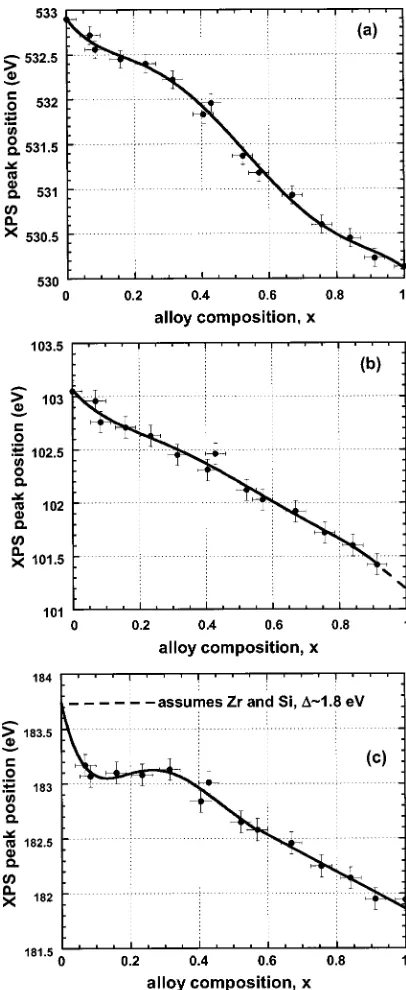
The measured binding energies of O 1s, Zr 3d5/2, and Si 2 p core levels from Table I are presented in Fig. 7 as a function of composition x. The binding energies of all three of these features decrease with increasing x, but with differ-ent degrees of nonlinearity as indicated by the fifth order polynomial fits to the experimental data points. The nonlin-earity for low x is greatest for the Zr 3d5/2data. It is weaker, but clearly evident in the O 1s data, and much weaker in the Si 2 p data.
AES measurements on the as-deposited films were per-formed on-line immediately following film deposition and are displayed in Fig. 8. The kinetic energies shown are de-rived from the highest energy peak in the derivative spectra. AES chemical shifts of OKVV and ZrM VV transitions as a
function of composition in Fig. 9 and also in Table II show nearly identical nonlinear behavior that is different and there-fore complementary to the XPS chemical shifts of the Zr 3d5/2and Si 2 p core levels. These data display a sigmoi-dal character. The compositional dependence of the peak ki-netic energy values displays a similar sigmoidal nonlinear dependence; however, for the OKVV data the spread in ener-gies between the end-member compounds at x⫽0.0 and x
⫽1.0 is about 1 eV less due to the compositional dependence of the spectral linewidth关see Fig. 9共c兲兴.
Finally, due to spectral overlap between the ZrM VV and
SiLVVfeatures in the AES spectra, it was not possible to track
the compositional dependence of the AES SiLVV feature.
IV. DISCUSSION
This section addresses the following issues:共i兲the relative XPS binding energy shifts of O, Zr, and Si as a function of alloy composition, as displayed in Figs. 7共a兲–共c兲; 共ii兲 the asymmetry of the O 2 p features in as-deposited 300 °C films; 共iii兲 the nonlinearity of the Zr 3d5/2 and Si 2 p XPS binding energy shifts of Figs. 7共b兲and 7共c兲;共iv兲the chemical phase separation in the 900 °C annealed films;共v兲the origin of the differences between the nonlinear behaviors in the Zr 3d5/2 and Si 3 p XPS features, and the AES ZrM VV and TABLEI. XPS core level binding energies.
Alloy composition x (⫾0.03)
O 1s core level binding energy (eV⫾0.15)
Zr 3d core level binding energy
(eV⫾0.15)
Si 1s core level binding energy (eV⫾0.15)
0.000 532.90 103.05
OKVV features; and 共vi兲 the compositional dependence of
band offset energies between the conduction and valence bands of c-Si and the Zr silicate alloys, including the rela-tionships between these band offset energies, and the band gaps of Zr silicate alloys.
A. Trends in binding energies with increasing ZrO2
composition„x…
Based on core level chemical shifts measured by XPS in other pseudobinary metal oxide alloys an empirical rule has been developed which describes the relationship between core level energy and the alloy local bonding environments.12,13 In general, a pseudobinary (MaOb)x(NmOn)1⫺x alloy formed by mixing two elemental
oxides, MaOb and NmOn, displays M–O, and N–O bonds,
and includes M – O – N bonding arrangements as well. Note
that the existence of M – O – N bonding arrangements does not restrict the bonding coordination of O atoms to being twofold. If M and N are metals, or more generally a metal and a semiconductor atom such as Si, the bonding coordina-tions of O atoms in the alloys can be as high as four- or sixfold.
been investigated theoretically in c-ZrSiO4 共zircon兲, and its crystalline constituent oxides, c-SiO2 and c-ZrO2. Bonding charges on each atomic species were calculated using density functional theory 共DFT兲 in the local density approximation
共LDA兲.16These charges were determined by calculating the net charge contained within a Wigner–Seitz cell centered about the nucleus of each atomic species. Observed core electron binding energy shifts from XPS were consistent with the empirical rule of Refs. 14 and 15, as well as the calculated results of Ref. 6 that also take into account both final state and Coulomb effects.
In this article, another approach to charge transfer in pseudobinary oxides is presented. It is based on a self-consistent, empirical chemical bonding model previously ap-plied to IR active vibrations of Si–H groups in Si suboxide alloys.14The method is based on the principle of
electrone-gativity equalization developed by Sanderson that states that an intermediate value of electronegativity results when atoms chemically combine to form a compound, or an alloy.15This same concept is implicit in the definition of electronegativity as originally proposed by Pauling as discussed in Ref. 8. The intermediate value of electronegativity is assumed by Sand-erson to be the geometric mean of the electronegatvities of the individual atoms appropriately weighted for their relative compositions.15 This model treats each atom in an average way and does not take into account distributions of inequiva-lent bonding sites of the same atom.
tween partial charge and changes in electronegativity due to charge transfer in forming chemical bonds. Based on these two assumptions an empirical model has been developed to calculate partial atomic charges␦A;
␦A共x兲⫽关共SA
x"S
B
y"S
C
z兲1/(x⫹y⫹z)⫺S
A兴/共2.08"冑SA兲, 共1兲
where AxByCz represents the alloy composition, SA, SB, and SC are the electronegativities of the constituent atoms atom and (SAx"SBy"SCz)1/(x⫹y⫹z)is the compositionally average
electronegativity of the alloy or compound. Finally, 2.08"冑SA is a electronegativity that corresponds to an effective partial charge of ⫹ or ⫺ one on atom A. In this model, charge is transferred between the atoms A, B, and C until each atom attains the same value of electronegativity. For example, the electronegativities of Si and Zr 共or N and M, respectively兲 increase, and the electronegativity of O decreases in a pseudobinary alloy. Following the model of Sanderson, par-tial charges for Si, Zr, and O atoms in ZrxSi1⫺xO2 pseudo-FIG. 5. XPS core level共a兲O 1s spectra of (ZrO2)x(SiO2)1⫺xalloys with
x⫽0.35, 0.45, and 0.60 annealed in Ar at 900 °C for 60 s and共b兲 the corresponding derivative spectra.
FIG. 6. Results of fitting XPS core level O 1s spectra of binary alloys an-nealed in Ar at 900 °C共Fig. 5兲. A two peak Gaussian fit was used, and results displayed are the relative intensity of the O atoms共fourfold coordi-nated O2⫺ions兲associated with the ZrO2phase.
FIG. 7. XPS chemical shifts of共a兲O 1s, 共b兲Si 2 p and共c兲Zr 3d5/2core levels from as-deposited (300 °C) (ZrO2)x(SiO2)1⫺xalloys as a function of
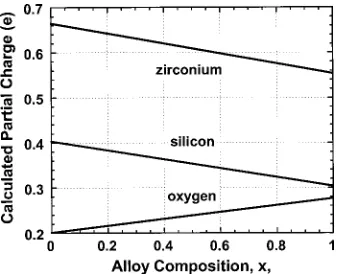
binary alloys were calculated using Eq.共1兲and are presented in Fig. 10. The magnitude of each partial charge changes linearly with composition共increasing x兲and decreases for Si and Zr 共i.e., it becomes less positive兲 and increases for O
共i.e., it becomes less negative兲. These variations of partial charge predict that the binding energies of the Si 2 p, Zr 3d5/2, and O 1s features will each decrease with increas-ing x, in agreement with results summarized in Table I, and presented in Figs. 7共a兲–7共c兲. The relative asymmetries in the O 1s spectral features for thermal treatments below 900 °C
关see Figs. 4共a兲 and 4共b兲兴indicate that bonding coordination as well as average bond chemistry must be taken into ac-count to explain the XPS spectral features and their compo-sitional dependence. For example, as discussed in the Intro-duction, there are two arrangements in SiO2-rich alloys in which O atoms are threefold coordinated, and be represented
schematically by Si2– O– Zr and Si– O– Zr2 and these are assumed to contribute to broadening and asymmetry in the O 1s XPS feature. Similar considerations apply as well to asymmetries in the O 1s line shape in the Zr-rich alloy re-gime.
FIG. 8. AES data: 共a兲 OKVV and 共b兲 ZrM VV transitions in as-deposited
(ZrO2)x(SiO2)1⫺x alloys with x⫽0.23, 0.32, 0.43, 0.53, 0.67, and 0.76.
Also included are the corresponding AES spectra for the end-member oxides SiO2(x⫽0.0) and ZrO2(x⫽1.0).
FIG. 9. AES chemical shifts of共a兲OKVVand共b兲ZrM VVkinetic energies in
as-deposited (ZrO2)x(SiO2)1⫺x alloys as a function of composition. The
plots in共a兲and共b兲are for the highest energy peaks in the respective AES derivative spectra. 共c兲AES chemical shift of spectral peak in the OKVV
undifferentiated spectrum. The solid lines are polynomial fits that are
B. Asymmetries in O 1s XPS spectral features in the as-deposited films
Based on the nearly linear scaling of the O 1s feature with alloy composition, the spectral peaks for the alloy samples in Fig. 4共a兲are assumed to reflect an average alloy coordination for that composition. Since the O 1s XPS features of the end-members are broad and also show some asymmetry, no attempt has been made to fit the alloy spectra as a simple superposition of spectral peaks associated with the specific bonding arrangements of O that have been displayed in Fig. 1. The respective asymmetries in the spectra of the alloy atom O 1s XPS reflect the details of the distribution of O-atom coordinations, and include final state and Coulomb contributions, as well as bond charge that correlates with coordination.
C. Nonlinearities in Zr 3d5Õ2, O 1s, and Si 2p XPS binding energies„Fig. 7…
The coordination of Zr has been assumed to be eight in-dependent of alloy composition; however, each of these eight
modeled in ab initio calculations as components of a dipolar electrostatic field, and alternatively, and equivalently can also be described as donor–acceptor pair or dative bonds.17 The donor–acceptor bonds are replaced by Si–O–Zr ionic bonding arrangements as x increases, and the network dis-ruption increases. At a composition of x⫽0.5, network dis-ruption is essentially complete, and the O-atom coordination is three, and the bond order of the Zr atoms is formally one-half with all bonds between eightfold coordinated Zr4⫹ ions and terminal O atoms of silicate ions, SiO44⫺. Each of the terminal O atoms of a silicate ion makes bonds with two Zr4⫹ions.
Figures 11共a兲and 11共b兲indicate the results of the model ab initio calculation used to identify the effects of the donor–acceptor pair bonds. In this model calculation, the Zr atom has four OH groups in a tetrahedral arrangement to emulate the ionic bonds, and four tetrahedrally grouped wa-ter molecules with the O atom nonbonding p electron pair aligned in the direction of the Zr atom to emulate the donor– acceptor pair bonding interaction. Figure 11共a兲indicates that bonding is optimized at an effective interatomic spacing of
⬃0.26 to 0.28 nm between the Zr atoms and the bridging O atoms of the network. The minimum is broad and shallow opening up the possibility of a spread in interatomic spacing where bond-strain and configurational entropy are likely to also be contributing factors in determining a statistical dis-tribution of these bonding arrangements in a noncrystalline solid.
Figure 11共b兲indicates a positive shift in the Zr 1s bonding energy as a function of the interatom spacing between Zr and bridging O atoms. The results in Fig. 11共b兲also indicate the effects the donor–acceptor pair bond on Zr core levels is equivalent to a dipole field. The effect of the donor–acceptor pair bonds or dipole field is to reduce the binding energy of the Zr 1s core state. Since all of the core states move rigidly with respect to the Zr 1s state, this calculation explains the direction of the nonlinearity of the Zr 3d5/2core state in Fig. 7共c兲. A more detailed calculation which substitutes OH-terminated Si–O–Si groups for the water molecules is in progress and will be used to make more quantitative com-parisons between shifts in binding energies in Fig. 7共c兲and ab initio calculations. However, scaling the values for core shifts in the H–O–H model with the ratio of dielectric con-stants and relative electronegativities of Si–O–Si groups predicts shifts of the order of 0.15 to 0.2 eV comparable to FIG. 10. Partial charges for O, Zr, and Si in (ZrO2)x(SiO2)1⫺xas a function
of x from Eq.共1兲. The magnitude of each partial charge varies linearly with composition x in a direction which implies a decrease in the respective XPS binding energies as x increases, and a complementary increase in the respec-tive AES kinetic energies as x increases.
0.669 511.30 140.85
0.756 511.82 141.39
0.840 512.05 141.50
0.912 512.23 141.85
what has been found in the analysis of the XPS results. Finally, the same ab initio calculations also explain the low concentration nonlinearity differences between the Zr 3d5/2, O 1s, and Si 2 p core state compositional depen-dences. Since the dipole field or donor–acceptor pair bond involves the Zr and O atoms, it is reasonable to assume that the nonlinearity will be greater for these two atomic species of the alloy than for Si. This is indeed the case.
D. Chemical phase separation in the 900 °C annealed films
A comparison between the spectral dependence of O 1s binding energies and associated derivate spectra of Figs. 4共a兲 and 4共b兲for as-deposited films, and Figs. 5共a兲and 5共b兲 for 900 °C annealing, indicates evidence for chemical phase separation at the alloy compositions displayed, x⫽0.35, 0.45, and 0.60. The separated species have binding energies that are close to, but not exactly equal to, those of SiO2 and ZrO2. Comparing the XPS results in Figs. 4共a兲and 4共b兲with the IR and XRD results for x⫽0.23 and x⫽0.50 samples of Ref. 6, the XPS study confirms chemical phase separation at
the x⫽0.23 and 0.50 concentrations, even though the x
⫽0.23 sample does not show any evidence for crystallization of the ZrO2 phase.
E. Differences between the nonlinear behaviors in the Zr 3d5Õ2 and Si 3p XPS features, and the AES
ZrMVVand OKVVfeatures
The chemical shifts of the Auger electron kinetic energies for OKVV and ZrM VVtransitions in the as-deposited films are consistent with changes in the calculated partial charges and their effects on the O and Zr core state energies, i.e., the kinetic energies of the Auger electrons increase with increas-ing x reflectincreas-ing the decreases in the negative XPS bindincreas-ing energies, i.e., shifts to less negative values. However, the spectral nonlinearities displayed in Figs. 9共a兲 and 9共b兲 are listed in Table II are qualitatively different than the corre-sponding XPS features in Figs. 7共a兲and 7共c兲. In particular, the compositional dependence of the O 1s in Fig. 7共a兲 is shows the smallest nonlinearity among the XPS features, whereas the compositional dependence of the OKVV is
sig-moidal and markedly nonlinear and similar to that of the ZrM VVfeature. Similarly, the compositional nonlinearities of
the Zr 3d5/2 XPS and ZrM VVAES are also markedly
differ-ent. The differences between the XPS and AES spectral fea-tures derive from differences between the XPS and AES pro-cesses. Following Ref. 18, the AES electrons of Fig. 8 originate in the valence band, whereas the XPS electrons of Fig. 6 originate in the respective core states with no valence band participation. This is addressed below where the non-linear AES behaviors reflect systematic shifts in valence band energy with increasing O-atom coordination.
V. COMPOSITIONAL DEPENDENCE OF BAND OFFSET ENERGIES BETWEEN THE CONDUCTION AND VALENCE BANDS OFc-Si AND THE Zr SILICATE ALLOYS, INCLUDING RELATIONSHIPS BETWEEN BAND OFFSET ENERGIES AND Zr SILICATE BAND GAPS
The chemical shifts of SiLVV transitions could not be
de-termined because of an overlap between SiLVV and ZrM VV
peaks关see Fig. 8共b兲兴; therefore, no attempt was made to ana-lyze these transitions by a deconvolution of the AES spectra. As noted above, the AES results for Zr and O are comple-mentary to the XPS results and provide information about valence band structure as well, since the ejected Auger elec-trons in both cases originate from the highest lying valence band.
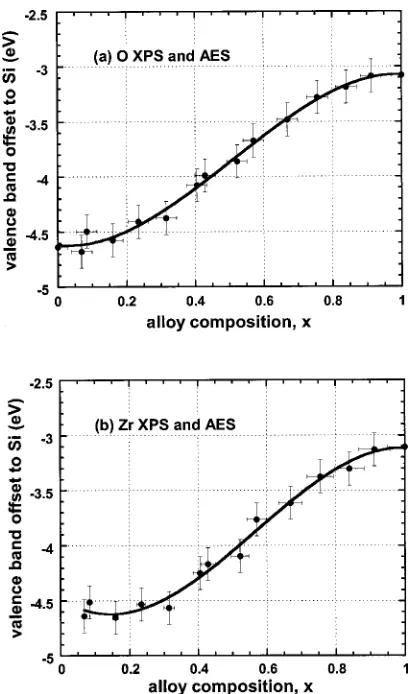
The OKVVtransition in a-SiO2has been investigated theo-retically and it has been demonstrated that the main peak is associated with two electrons being released from the non-bonding O 2 p states at top of the valence band.18Based on this assignment, and combined with the XPS and AES results from this study, a model has been developed in Eq. 共2兲that provides an estimate of the valence band offsets of the Zr silicate alloys with Si as a function of composition x. EBE(O 1s) is the magnitude of the XPS binding energy, and EKE(OKVV) is the average kinetic energy of the Auger
tron at the valence band edge. As note above, this model assumes that a core hole in the O atom 1s state is filed by an electron near the top of the valence band, and that the Auger electron is also emitted from the top of the valence band as well. Under these conditions,
Voffset共x兲⬃⫺A"0.5"关EBE共O 1s兲⫺EKE共OKVV兲兴⫹B, 共2兲
where EBE(O 1s) is the binding energy determined from the XPS spectra 共see Fig. 7兲, EKE(OKVV) is the average kinetic
energy near the top of the valence band共e.g., the average of the kinetic energies that correspond to the spectral peak, and highest energy peak in the derivative spectra兲and A and B are constants, 0.44 and 1.2, respectively, which adjust the respective values of Voffset(0) and Voffset(1) to 4.6 eV for SiO2 and 3.1 eV for ZrO2.
19,20
This model is presented in Fig. 12共a兲. The sigmoidal shape of the polynomial fit in Fig. 12共a兲is determined by the relative compositional dependen-cies of the XPS (O 1s) and AES (OKVV) data in Figs. 7 and
9, respectively.
Figure 12共b兲 applied the same model to the ZrM LL AES
and Zr 3d XPS results of Figs. 7 and 9, respectively. The
the zirconium atom calculation they are deeper in the valence band 共see Ref. 22兲. However, the important point with re-spect to the band offset composition dependence derived from the Zr XPS and AES is that the sigmoidal dependence is a manifestation of the differences between in the compo-sitional dependence of respective XPS and AES data 共see Figs. 7 and 9 and Tables I and II兲.
The alloy dependence of the band gap of Zr silicate alloys is addressed by combining the XPS results of this article with Eq. 共2兲. The total peak shift for Zr 3d and Si 2 p XPS core levels over the alloy Zr silicate alloy regime in Figs. 7共b兲 and 7共c兲 is 1.8 eV. The aspect of the core level shifts means that the conduction band offset energies with Si, com-bined with XAS results in Ref. 21 and 22 are independent of alloy composition.
Since the band gap of a Zr silicate alloy at any composi-tion x is the sum of the conduccomposi-tion and valence band offset energies with respect to Si, plus the electrical band gap of Si,
⬃1.15 eV, the sigmoidal dependence in Fig. 12, combined with the XPS results discussed above means that band gap variation is also expected to be sigmoidal. The effective band gaps also correlate with changes in the O-atom bonding co-ordination. When twofold coordination dominates the band gap, referenced either to the Zr 3d*, Zr 4s*, or Si 3s*
states,23,24is the largest, and these band gaps decrease as the coordination increases from two to three, and then from three to four.
VI. CONCLUSIONS
An empirical bonding model has been presented and par-tial charges for pseudobinary (ZrO2)x(SiO2)1⫺x alloys have
been calculated as a function of x. Since core levels are a linear function of partial charge, this model predicts linear shifts in O 1s, Zr 3d, and Si 2 p core level binding energies as measured by XPS, and Auger electron kinetic energies of OKVVand ZrM VVAES transitions provided that final state and
Coulomb effects do not contribute significantly. The direc-tion of the composidirec-tional dependence in XPS binding ener-gies, and in AES kinetic energies are in agreement with the model, but significant departures from linearity have been shown to derive from different mechanisms:共i兲dipolar field effects in the XPS and共ii兲valence band offset energy varia-tions in the AES.
Systematic changes in XPS O 1s core level peak shapes are observed for Zr silicate alloys annealed in Ar at 900 °C for 60 s. These changes are due to a chemical phase separa-tion into a-SiO2 or a low concentration Zr silicate noncrys-talline phase (x⬍0.1), and either crystalline or noncrystal-line ZrO2. These observations of chemical phase separation are complementary to other characterizations, IR and XRD, which have previously revealed chemical separation after an-nealing at 900 °C.7
Finally, the predictions of XPS and AES results for band gap and band offset energies can be tested by both experi-ment and theory. The prediction is that the threshold for in-ternal photoemission 共IPE兲 from Si valence band states, or from a given metal electrode should be independent of alloy composition x while, the band gap, as determined by photo-conductivity共PC兲, should vary sigmoidally with alloy com-position. IPE and PC determinations indicate that the thresh-old for IPE from the Si valence band, and PC are consistent with both of these transitions terminating in Zr共or Hf兲 anti-bonding d states.21,22
ACKNOWLEDGMENTS
The authors wish to acknowledge support for this research from ONR, AFSOR, DOE, SRC, and the SEMATECH/SRC Front End Processes Center. They also acknowledge prelimi-nary measurements of phase separation by monochromatic XPS by Professor R. Wallace’s group and the University of North Texas.
1G. Wilk, R. W. Wallace, and J. M. Anthony, J. Appl. Phys. 89, 5243
共2001兲. 2
J. Robertson and C. W. Chen, Appl. Phys. Lett. 74, 1168共1999兲.
3J. Robertson, J. Vac. Sci. Technol. B 18, 1785共2000兲.
4G. Lucovsky, J. L. Whitten, and Y. Zhang, Microelectron. Eng. 59, 329
共2001兲.
5G. Lucovsky and G. B. Rayner, Jr., Appl. Phys. Lett. 77, 2912共2000兲. 6G. B. Rayner, Jr., R. Therrien, and G. Lucovsky, Mater. Res. Soc. Symp.
Proc. 611, c13.1共2001兲.
7D. M. Wolfe, K. Flock, R. Therrien, R. Johnson, B. Rayner, L. Gu¨nther,
N. Brown, B. Claflin, and G. Lucovsky, Mater. Res. Soc. Symp. Proc. 567, 343共1999兲.
8G. Lucovsky, J. Vac. Sci. Technol. A 19, 1553共2001兲.
9R. Zallen, The Physics of Amorphous Solids共Wiley, New York, 1983兲, Chap. 2.
10B. Rayner, H. Niimi, R. Johnson, R. Therrien, G. Lucovsky, and F. L.
Galeener, AIP Conf. Proc. 550, 149共2001兲. 11
A. Mekki, D. Holland, C. F. McConville, and M. Salim, J. Non-Cryst. Solids 208, 267共1996兲.
12F. Liebau, Structural Chemistry of Silicates共Springer, New York, 1985兲. 13
T. L. Barr, J. Vac. Sci. Technol. A 9, 1793共1991兲.
14D. V. Tsu, G. Lucovsky, and B. N. Davidson, Phys. Rev. B 40, 1795
共1989兲. 15
R. T. Sanderson, Chemical Bonds and Bond Energy 共Academic, New York, 1971兲.
16
M. J. Guittet, J. P. Crocombette, and M. Gautier-Soyer, Phys. Rev. B 63, 125117共2001兲.
17Y. Zhang, G. Lucovsky, and J. L. Whitten共unpublished兲.
18D. E. Ramaker, J. S. Murday, and N. H. Turner, in The Physics of SiO
2 and its Interfaces, edited by S. T. Pantelides 共Pergamon, New York, 1978兲, p. 99.
19S. Miyazaki and M. Hirose, AIP Conf. Proc. 550, 89共2000兲.
20S. Miyazaki, M. Narasaki, M. Ogasawaga, and M. Hirose, Microelectron.
Eng. 59, 373共2001兲.
21G. Lucovsky, G. B. Rayner, Jr., D. Kang, G. Appel, R. S. Johnson, Y.
Zhang, D. E. Sayers, H. Ade, and J. L. Whitten, Appl. Phys. Lett. 79, 1775共2001兲.
22
G. Lucovsky et al., J. Vac. Sci. Technol. B, these proceedings. 23C. J. Ballhausen and H. B. Gray, Molecular Orbital Theory共Benjamin,
New York, 1964兲, Chap. 8.
24L. A. Grunes, R. D. Leapman, C. D. Walker, R. Hoffman, and A. B. Kunz,