Cloud Load Balance on the Basis of Free
Space on Cloud and Packet Size
Bhushan D. Patil 1, Prof. R. B. Wagh 2
M.E, Student, Department of Computer Engineering, R. C. Patel Institute of Technology, Shirpur, India 1
Asst. Professor, Dept Department of Computer Engineering, R. C. Patel Institute of Technology, Shirpur, India 2
ABSTRACT:Cloud computing is mainly used to share data and also provide many resources to users. Users can pay
only for those resources as much they used. The aim of cloud computing is to stores the data and distributed resources in the open environmentover the network, where the users can get data easily.The goals of cloud computing is to use the resources efficiently and effectively to gain maximum profit.Multiple users request for information at a time. Due to such a huge amount of data request from users, problem of load balancing is arises which becomes the main challenge in field of cloud computing.Tohandle such requests efficiently and effectively, various load balancing approaches have been proposed in the past years. There is big problem of scheduling the incoming users request in cloud computing, because a cloud provider has to serve many users in cloud computing.There is need of scheduling technique for proper and efficient utilization of the resources.This system designed with better scheduling technique. Here we also use the VMs for handling the user’s requests. Scheduling is performed on the basis of available disk space and file size to be processed.
KEYWORDS:Virtual machines (VMs)
I. INTRODUCTION
Cloud computing is a new technology which provides online resources and online storage to the user’s. Cloud computing provide all the data at a lower cost. In cloud computing users can access resources at any time through internet. They need to pay only for those resources as much they use. Cloud computing is easy way to share processing power, storage space, bandwidth, memory and software over the internet. Cloud computing have a several characteristics which are, on demand service, Broad Network Access, Resource Pooling, Rapid Elasticity [1].
Cloud computing is nothing but an outsourcing of computer program in which users can access the software and applications from wherever they are; the computer programs are being hosted by an outside party and reside in the cloud.
It is used to provides shared resources, information, software packages and other resources as per client requirements at specific time. Due to rapid growth in cloud computing and more users are attracted towards utility computing, better and fast service needs to be provided [2].
Cloud computing gives a flexible and easy way to keep and retrieve data and files. Especially for making large data sets and files available for the spreading number of users around the world. Handling such large data sets require several techniques to optimize and streamline operations andprovide satisfactory levels of performance for the users [3].
Load balancing is used to improve the performance and reliability of applications, databases and other services. It distributes the workload across multiple servers instead of single one. There are thousands of users which have accessed a website at a particular time, so it’s challenging for applications to manage the load that comes from all these requests at a time. Sometimes, it may result in a breakdown of entire system.Because of load balancing, workload is divided among two or more servers, network interfaces, hard drives and other and system response time. Load balancing allows enterprises to manage workload or application demands by allocating resources among multiplecomputers, networks or servers. Cloud load balancing involves hosting the distribution of workload traffic and demands that reside over the Internet. Due to use of load balancing technique work load is distributed among resources in such a way that no one resource should be overloaded and each resource can have improved performance [4][5].
Load balancing performs two main tasks, first is to make resources easily available on demand and second isResources are competently utilized under condition of high/low load. Load balancing have a many challenges like Throughput, Associated Overhead,Fault tolerant, Migration time, Response time,Resource Utilization, Scalability etc. [6]
This paper is based on dynamic load balancing algorithm which will serve heterogeneous environments and will consider the resource specific demands of the tasks by using virtual machines. Here we designed the task scheduling process which handles the user requests and file processing the users demand efficiently and improves the performance of system by good utilization of disk space and file size.
II. RECENTCONTRIBUTIONS
This section have includes some recent contribution in the field of cloud computing. Many researchers usethe differentload balancing algorithmto solve the problems in area of cloud computing.
Radhika Pathak have presentsa Survey of Load Balancing in Cloud Computing Challenges and Algorithms. Cloud computing provides shared resources, information, software packages and other resources as per client requirements at specific time. Load balancing is one of the main issues in cloud computing. The load can be a memory, CPU capacity,network or delay load. Load balancing have many challenges in field of cloud computing. Throughput is the total number of tasks that have completed execution. Associated Overheadis amount of overhead during the implementation of the load balancing algorithm. Fault tolerant defines ability to perform load balancing by the appropriate algorithm without arbitrary link or node failure. Migration time, response time, resource utilization, scalability, and performance are the challenges of load balancing [2].
KundanPagar, SachinPatilet.al.presentsa Survey on Load Balancing Techniques in Cloud Computing. This paper includes the concept of load balancing which is the process of apportioning the load among various nodes of a distributed system to improve both resource utilization and job response time. Cloud computing have different environment i.e. static or dynamic environment. On basis of cloud environment load balancing algorithm is used in which traffic is separated evenly among the servers. In dynamic algorithm the lightest server in the whole network or system is searched and preferred for balancing a load. [6].
conclude that, DDFTP(dual direction downloading algorithm from FTP servers) algorithm is more suitable for Cloud environments and more efficient in terms of storage utilization [7].
Surbhi Kapoor, ChetnaDabas et.al. have proposed Cluster Based Load Balancing in Cloud Computing. In cloud datacenter handling the billions of requests coming dynamically from the end users is the big problem. There are already existing the many traditional load balancing algorithm but they are work well with homogeneous VMs environment. In this paper the author have proposed the cluster based load balancing algorithm which works well in heterogeneous nodes environment, by considering resource specific demands of the tasks and reduces scanning overhead by dividing the machines into clusters. This algorithm divides VMs into with similar capacities into groups. This algorithm uses K-meansclustering approach to divide VMs into cluster. Experimental results shows that, this clustering approach gives better results than throttled and modified throttled algorithms when
compared on the basis of waiting time, execution time, turnaround time and throughput [8].
Sonia Sindhu et.al.have given approach of Task Scheduling in Cloud Computing. Author have introduced the scheduling is a critical problem in Cloud computing, because a cloud provider has to serve many users in Cloud computing system. So scheduling is the major problem while establishing Cloud computing systems. In this paper author have studying various scheduling methods. This paper includes task scheduling algorithm like Min-Min Algorithm, Max-Min Algorithm, Particle Swarm Optimization (PSO) Algorithm, Round Robin Algorithm, Genetic Algorithm, Priority based Job Scheduling Algorithm.Cloud computing is in infancy state, so the scheduling framework should be implemented to improve the user acquiescence along with the service providers. The scheduling metrics can be coupled to prepare a framework for scheduling and recourse allocation in cloud computing [9].
Gajender Pal, Kuldeep Kumaret.al.have introduced A Review Paper on Cloud Computing. This paper provides the information about cloud computing and security architecture Of cloud computing. Web-based email clients like Gmail, Wikipedia and YouTube, Skype or Bit Torrent are the application of cloud computing. Security architecture contains Data Center Layer, Virtualization Layer, Service Provider Layer and User Layer.In this paper author havebeen addressed key security issues like Virtual Machine Security,Network Security, Data Security, Data Privacy, Data Integrity, Data Location etc. Cloud computing provides a large array of benefits, many challenges including automatic resource positioning, energy management, information security [4] .
III.METHODOLOGY
As we studied the many load balancing algorithm in which incoming request is distributed evenly without considering current state of nodes which will process the user request and hence node is get overloaded or under loaded. This will affect the system performance.
In this system model we have used virtual machine to process the file. This system model evenly distributes the file across the processing nodes so that files are evenly distributed and overloading condition can be avoided.
The goal of thissystem is as follow:
i) Assign the users request to VM node.
ii) Check the file size to be processed.
This system uses the virtual machine to which particular request to be assigned. Virtualization provides everything like real though it is not exist in real. A virtual machine is actually an abstraction layer between hardware components and the end-user of system. It has an ability to run any operating systems on them.
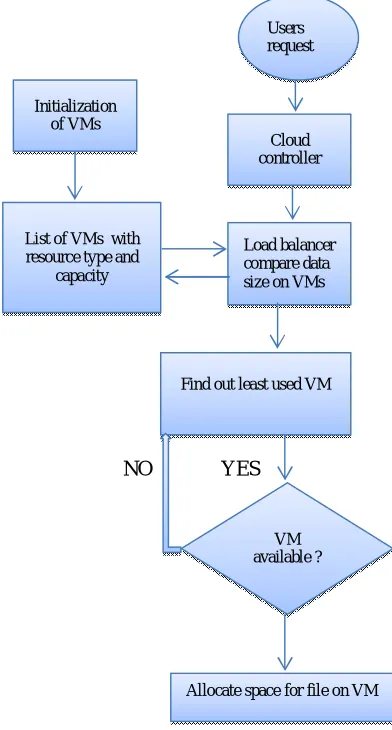
the status of VM then compare the data size that was allocated to VM. Load balancer select the VM that is least used means it has a suitable available space to process the file. When it found the VM which can process the file then that VM is selected for further processing and space on VM is allocated on VM. Database is maintained for indexing files with respect to location and size.The Figure 1 shows execution flow of system.
NO YES
Fig 1: MOSFET based solar converter main circuit
The step-wise procedure of the algorithm is given as follows: Step 1: Initialization of VMs with resource type and capacity. Step 2:User request for file handling.
Step 3:Get available resource information from all VMs with allotted data on it. Step 4: Compare allotted data size on VMs.
Step 5: Select least used VM for storage Step 6: Allocate space for file on selected VM.
Step7:Maintain database for indexing files with respect to location and size. Initialization
of VMs
List of VMs with resource type and
capacity
Users request
Cloud controller
Load balancer compare data size on VMs
Find out least used VM
VM available ?
IV.EXPERIMENTALRESULTS
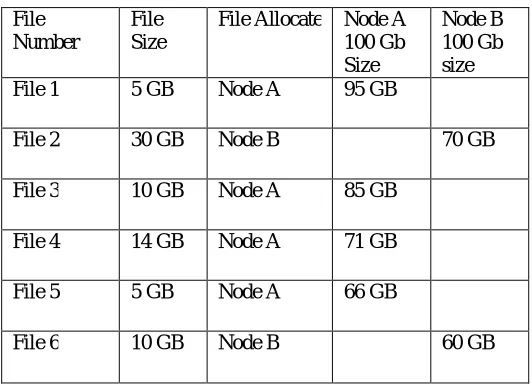
Following table 1 shows the experimental results with existing system and table 2 gives the result with our propose approach. We can see that in existing system files are allocated to Node A and Node B without considering the file size and space on VM, where in proposed system while allocating the file on VM node file size is considered.
.
Table 1: Experimental Results on Existing Approach File
Number
File Size
File Allocate
Node A 100 Gb Size
Node B 100 Gb size
File 1 5 GB Node A 95 GB
File 2 30 GB Node B 70 GB
File 3 10 GB Node A 85 GB
File 4 14 GB Node B 56 GB
File 5 5 GB Node A 80 GB
File 6 10 GB Node B 46 GB
Table 2: Experimental Results on Propose Approach File
Number
File Size
File Allocate Node A 100 Gb Size
Node B 100 Gb size
File 1 5 GB Node A 95 GB
File 2 30 GB Node B 70 GB
File 3 10 GB Node A 85 GB
File 4 14 GB Node A 71 GB
File 5 5 GB Node A 66 GB
V. CONCLUSION
This system model uses the VMs in order to maintain the load on all the VMs. There are many load balancing algorithm but they are not suitable for heterogeneous VMs environment and also have additional overhead of scanning the entire list of VMs. This system is makes good utilization of disk space. Files are also allocated to VMs which have enough space for file processing so overload condition can be avoided. So, this system improves the performance of system by making better use of resources.
REFERENCES
1. Rajwinder Kaur and Pawan Luthra, “Load Balancing in Cloud Computingt”,Proc. of Int. Conf. on Recent Trends in Information, Telecommunication and Computing, ITC.
2. Radhika Pathak, “A Survey of Load Balancing in CloudComputing: Challenges and Algorithms”, International Journal of Innovative Research in Computer and Communication Engineering,Vol. 5, January 2017.
3. Nuaimi K.A., Mohamed N., Nuaimi M.A.,"A Survey of Load Balancing in Cloud Computing: Challenges and Algorithms”,Network Cloud Computing and Applications (NCCA), 2012 Second Symposium on , pp.13 7 -142, 3-4 Dec. 2012.
4. Gajender Pal, Kuldeep Kumar Barala, Manish Kumar,“ A Review Paper on Cloud Computing”, International Journal for Research in Applied Science and Engineering Technology (IJRASET), vol.2, Sep. 2014.
5. Mohammadreza Mesbahi, Amir Masoud Rahmani, “Load Balancing in Cloud Computing: A State of the Art Survey”, in I.J. Modern Education and Computer Science, vol. 3, pp.64-78, March 2016.
6. Kundan Pagar, Sachin Patil,“A Servey onLoad BalancingTechniques in Cloud Computing”,International Journal of Science and Research (IJSR)vol.3, no.12, Dec. 2014.
7. Aarti Vig, Rajendra Sing, “An Efficient Distributed Approach for Load Balancing in Cloud Computing”,2015 International Conference on Computational Intelligence and Communication Networks, 2015.
8. Surbhi Kapoor , Dr. Chetna Dabas, “Cluster Based Load Balancing in Cloud Computing”, 2015.
9. Sonia Sindhu, “Task Scheduling in Cloud Computing”,International Journal of Advanced Research in Computer Engineering & Technology (IJARCET), Vol. 4 , Issue 6, June 2015.
10. Santosh Kumar and R. H. Goudar, “Cloud Computing – Research Issues, Challenges, Architecture, Platforms and Applications: A Survey”,International Journal of Future Computer and Communication, vol.1, no.4, Dec. 2012.
11. Xu, Gaochao, Pang, Junjie, Fu, Xiaodong,“ A Load Balancing Model Based on Cloud Partitioning for the Public Cloud”,Tsinghua Science and Technology , vol.18, no.l, pp.34-39, Feb. 2013.
12. Sharada Ramesh Geete and Mandre B. R,. “Optimization of Task Scheduler in Cloud Computing”,International Journal of Computer Applications,Vol.172,no. 1,Aug.2017.
13. Joseph Doyle, Robert Shorten, “Stratus: Load Balancing the Cloud for Carbon Emissions Control ”,Cloud Computing, IEEE Transactions on , vol.1, no. 1, pp.1-1, Jan.-June 2013.
14. Shridhar G.Domanal and G. Ram Mohana Reddy, “Load Balancing in Cloud Environment using a NovelHybrid Scheduling Algorithm”, 2015 IEEE International Conference on Cloud Computing in Emerging Markets.
15. M.Bourguiba, K. Haddadou, EI Korbi, “Improving Network VO Virtualization for Cloud Computing”,Parallel and Distributed Systems, IEEE Transactions on, vo1.25, no.3, pp.673-681, March 2014.
16. S. B. Shaw, A. K.Singh, “A survey on scheduling and load balancingtechniques in cloud computing environment”,Computer andCommunication Technology (ICCCT), 2014 International Conference, on , vol. 4, pp.87-95, 26-28 Sept. 2014.