A Study on Highway Safety
Sandra Marianne Anand1, M.Murugalingam 2
PG Student, Southern Methodist University, Bobby. B Lyle School of Engineering, USA1
Assistant Professor, civil department, Loyola Institute of Technology, Chennai, India2
ABSTRACT: Highways are being designed for our need and comfort purpose, and it is also mandatory to study on highway safety and reduce the accidents occurring all over the world and enhance a safe and secure environment for all the passengers. Fatalities and injuries resulting from road traffic crashes remain a major public health concern in the United States, with more than 43,000 people killed and 2.6 million injured in 2006 and this keeps rising every year. The National Safety Council of America (NSC) says that from recent and past researches, 2016 may have been the deadliest year on U.S. roads since 2006. As of our understanding of road safety, it is seen moving today towards a more scientific basis, as opposed to conventional wisdom and observation of practice, numerous research opportunities have been identified, some of which could yield cost-effective safety improvements. Thus in this report, a detailed study on the management of the highway safety and the improvements being done is discussed.
KEYWORDS: Fatality , Highway safety
I. INTRODUCTION
Highway safety focuses on the initiative that is designed to reduce traffic accidents and deaths, injuries, and property damage. It also focuses on improving driver performance, pedestrian performance and bicycle safety. We know that for a human being both the eyes play a vital role, so comparing the eyes to the highway, we can say that, just like the designing of the highway is important so is the safety aspects. For a safer highway will provide a greater economy for a country.
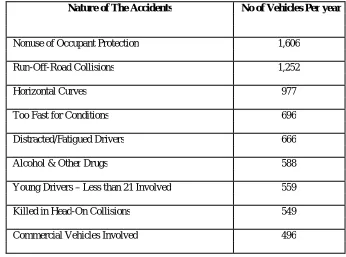
Table 1.1
Nature of The Accidents No of Vehicles Per year
Nonuse of Occupant Protection 1,606
Run-Off-Road Collisions 1,252
Horizontal Curves 977
Too Fast for Conditions 696
Distracted/Fatigued Drivers 666
Alcohol & Other Drugs 588
Young Drivers – Less than 21 Involved 559
Killed in Head-On Collisions 549
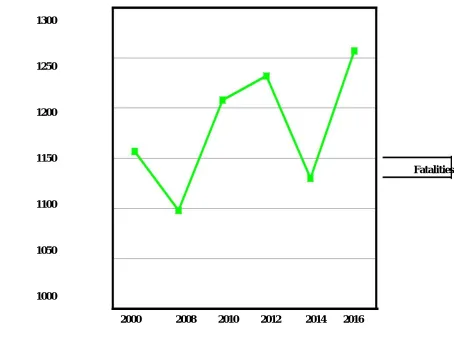
This Road safety is typically defined in terms of the injuries and fatalities that occur on the roadway system. Therefore, definitions of road safety are often based on crash outcomes such as the number of accidents (crashes) or accident consequences, by kind and severity, expected to occur on the entity during a particular period”. Fig 1.1 illustrates the number of accidents taking place over the years.
1300
1250
1200
1150
Fatalities
1100
1050
1000
2000 2008 2010 2012 2014 2016
Fig 1.1 graphical representation of accidents taking place over the years
II. HIGHWAY SAFETY MANAGEMENT
Main Purpose
a) Identify research, keep priorities, and correct the dangerous or potentially hazardous roadway locations and features.
b) Make sure that early consideration of safety improvements in all highway projects is given
c) Maintain and constantly keep upgrading safety hardware, highway elements and operational features and
N
o
of
ac
c
id
e
n
d) Identify safety needs of special user groups such as commercial motor vehicles, older drivers, pedestrians, bicycles, motorcycles and small passenger vehicles in the planning, design, construction and operation of the highway system.
Scope
• The management approach to highway safety is designed to make sure that safety aspects of highway decisions are timely and appropriate.
• This approach could serve both the national and localized highway agencies as a model for developing an SMS.
• Consideration should be given to the safety needs of small passenger cars, pedestrians, bicycles, motorcycles, older drivers, rail-highway crossings, commercial vehicles and work zone traffic control.
III. TOOLS USED
In order to check the various errors on a highway design certain tools are used for analyzing and rectifying errors due to improper alignment, curves, grade separations etc which leads to accidents.
Some of the tools used are mentioned below,
V. APPLICATIONS
The highway safety management is being done in every step of the roadway design process as per the AASHTO (American Association of State Highway and Transportation Officials) manual.
SYSTEM PLANNING
-It identifies needs and program projects.
-Identifies sites most likely to benefit from safety improvement.
-Identifies targeted crash patterns for the network.
-Prioritize expenditures for efficiency
PROJECT PLANNING & PRELIMINARY
OPERATIONS AND MAINTENANCE
ENGINEERING
-Modifies existing conditions to maintain and
-Identifies alternatives and chooses the preferred
solution improve safe and efficient operation
-Identifies targeted crash patterns for the project.
DESIGN AND CONSTRUCTION
- Develops design plans and build projects
¬ Evaluates how performance measures are impacted by design changes and constructions
V. VARIOUS TECHNIQUES UNDER MANAGEMENT .
A schedule for identifying, investigating, setting priorities and correcting hazardous or potentially hazardous highways
Planning Implementation Evaluation
A process to consider safety needs and priorities in the development and construction of all highway facilities.
a) Pre-Design Here the responsibilities include identifying safety needs, analyzing potential enhancements and allocating resources.
a. Identify Safety Needs
▪ Analyze accident history
▪ Compare current standards with existing conditions
▪ Analyze road needs, design exceptions and environmental constraints
▪ Identify and consider needs of all user groups
b. Select Safety Improvements
o Identify alternative countermeasures
o Estimate and compare costs and benefits
c. Prepare preliminary plans for traffic control in construction areas
o Allocate resources to assure the estimate that is sufficiently needed for the safety work.
o Develop necessary state vice and or area vice plans to address special user needs, for example such as national truck network, hazardous materials routing and bicycle or pedestrian facility plans.
b) Design Design provides consistent and effective application of safety enhancements. Activities initiated in the pre-design phase can be expanded to include subsequently identified safety needs.Standards and Policies
c) Construction. During the construction phase, adequate and proper measures should be taken to provide for the protection of the workers and the highway users. This includes the proper location and installation of safety and operational features
A Process for Maintaining and Upgrading Existing Safety Hardware, Highway Elements and Operations Features.
Maintenance. To make the necessary decisions, maintenance personnel should have certain information.
VI. HIGHWAY SAFETY IMPROVEMENT PROGRAM
6.1. HSIP Purpose
The purpose of the Highway Safety Improvement Program (HSIP) is to give an overview of the HSIP and present the state and local agencies of Usa with tools and resources to make improvements in the highway safety process.
6.2 Working of HSIP
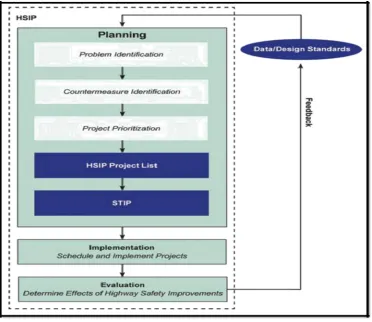
Figure 4.1 shows the various components of the HSIP process with planning, implementation and evaluation. The planning component consists of procedures for problem identification, countermeasure identification, and project order. Once projects are found and funding is allotted, HSIP projects are designed and constructed as part of the implementation component. Finally, the projects and programs are evaluated to determine the effectiveness of highway safety improvements.
Figure 6.1 Highway Safety Improvement Program Process
6.3 Implementation:
6.4 Evaluation:
Under this information for conducting project evaluations and the importance of inputting evaluation results back into the HSIP and Strategic Highway Safety Plan (SHSP) planning processes to aid in the future decision-making.
OTHER METHODS TO IMPROVE HIGHWAY ROAD SAFETY
Fig 6.2 traffic calming Fig 6.3 lane narrowing Fig 6.4 Intersection safety
Fig 6.5 traffic sign replacement
Fig 6.6 sign retro reflectivity Fig 6.7 road diet
Fig 6.8 combination of horizontal and vertical
alignment
6.5 Measures taken by the government
The government of USA introduced the highway safety program to bring awareness to the road users and enhance a safe environment. The following are safety measures facilitated,
1. Reducing injuries and deaths resulting from motor vehicles being driven in excess of posted speed limits
2. Encouraging the proper use of occupant protection devices by occupants of motor vehicles
3. Reducing deaths and injuries resulting from intoxicated/drunken driving
4. Preventing accidents and reducing deaths and injuries resulting from accidents involving motor vehicles and motorcycles
5. Reducing injuries and deaths resulting from accidents involving school buses
6. Reducing accidents resulting from unsafe driving behavior
7. Improving law enforcement services in motor vehicle accident prevention, traffic supervision, and post-accident procedures.
VII. CONCLUSIONS
From the study it is concluded that,
1. Roadway and highway safety is very essential as a part of the design and as people of the world we have to put in our own efforts to abide to the road safety rules and provide a safer environment around us.
2. We must implement specific actions to prevent road traffic crashes, minimize injuries and their consequences and evaluate the impact of these actions also.
So as the younger generation let us follow safety rules and make the world a better place.
REFERENCES
1) American Association of State Highway and Transport Officials (AASHTO), Highway Safety Manual.
2) An optimization model for improving highway safety, 2016, Journal of Traffic and Transportation Engineering.
3) Committee for a Study for a Future Strategic Highway Research Program, 2001, Strategic Highway Research saving lives reducing congestion,
improving quality of life.
4) Federal Highway Administration, Highway safety improvement program manual.
5) Federal Highway Administration, Management Approach to highway safety.