ISSN(Online): 2320-9801
ISSN (Print): 2320-9798
I
nternational
J
ournal of
I
nnovative
R
esearch in
C
omputer
and
C
ommunication
E
ngineering
(An ISO 3297: 2007 Certified Organization)
Vol. 4, Issue 2, February 2016
An EPQ Model for Deteriorating Items with
Time Dependent Demand with Reliability and
Flexibility in a Fuzzy Environment
P.Anitha1, P. Parvathi2
Assistant Professor, Department of Mathematics, Quaid- E -Millath Government College for Women, Chennai, Tamil Nadu, India
Head & Associate Professor, Department of Mathematics, Quaid- E -Millath Government College for Women, Chennai, Tamil Nadu, India
ABSTRACT: An EPQ model is formulated for deteriorating items with time dependent demand rate and time dependent production rate. To retain the confidence of the buyers the machine reliability, flexibility and packaging cost are considered. Shortages are allowed and it is completely backlogged. Mathematical model has been presented to find the optimal order quantity and total cost. The holding cost, setup cost, deterioration cost, labour cost for packing, material cost for packing, shortage cost, production cost involved in this model are taken as triangular fuzzy numbers. To validate the optimal solution, numerical example is provided. To analyze the effect of variations in the optimal solution with respect to the change in one parameter at a time, sensitivity analysis is carried out.
KEYWORDS: Production, inventory, optimality, time dependent production rate, time dependent demand rate.
I. INTRODUCTION
Maximize the total inventory profit or to minimize the total inventory cost is the aim of the inventory management. The EOQ (Economic Order Quantity) and EPQ (Economic Production Quantity) are used for finding the optimal order quantity. In this paper demand rate and production rate both considered to be time-dependent. Shortages are considered which are completely backlogged an d the holding cost, setup cost, deterioration cost, labour cost for packing, material cost for packing, shortage cost, production cost involved in this model are taken as triangular fuzzy numbers. Promoting the production of the product serves as the ultimate target of the manufacturer. To make the rate of production fast, the machines are subjected to continuous wear and tear which results in depreciation. To withstand these circumstances the manufacturers have to maintain high degree of reliability and flexibility. This paper elucidates about packaging, comprises the formulation of an EPQ model with the inclusion of package cost. Objective of this work is to investigate the effect of total cost and optimal order quantity with the variation of setup cost, holding cost and production cost.
II. LITERATURE REVIEW
Harries [1]studied EOQ (Economic Order Quantity) model and derived some useful results. After that Taft[2]presented EPQ (Economic Production Quantity) formula. Many inventory models in the inventory literature were presented considering time-dependent demand. Silver and Meal[3] were first presented an EOQ model for the case of the time varying demand. Donaldson[4] developed an inventory model with linearly time dependent demand. Tenget al.[5]established inventory model under trade credit financing with increasing demand. Khanraetal.[6]presented an inventory model for deteriorating item with time-dependent demand. Tengetal. [7] developed an EOQ model for increasing demand in asupply chain with trade credits. Large number of research papers presented by authors like Daveand Patel [8],Jalanand Chauduri[9], Jalanet al. [10], Mitraet al.[11]in this direction.
ISSN(Online): 2320-9801
ISSN (Print): 2320-9798
I
nternational
J
ournal of
I
nnovative
R
esearch in
C
omputer
and
C
ommunication
E
ngineering
(An ISO 3297: 2007 Certified Organization)
Vol. 4, Issue 2, February 2016
prefixed level. Hou[13]established an EPQ model with imperfectproduction process ,inwhich thesetup costisafunction ofcapitalexpenditure. Cardenas-Barron[14]presentedanEconomicProductionQuantity(EPQ)inventorymodel withplannedbackordersfordeterioratingtheEconomicProductionQuantity forasingle product. Cardenas-Barron [15]
established an EPQ model with production capacity
limitationandbreakdownwithimmediaterework.Krishnamoorthietal.[16]established a single stage productionprocesswhere defectiveitemproduced arereworkedandtwomodels of rework processareconsidered,anEOQmodelfor withandwithoutshortages.
Recently, Liuetal. [17]establishedthe problemof a productionsystemthatcanproduce multiple productsbutalsosubjecttopreventivemaintenanceatthesetuptimes ofsomeproducts. Taleizadehetal.[18]developedavendormanagedinventory fortwolevelsupplychain comprisedofonevendorandseveralnon-competing retailers,inwhichboththerawmaterial andthefinished producthavedifferentdeteriorationrates.Ghiamiand Williams [19] establishedaproduction-inventory modelinwhichamanufacturerisdeliveringa deterioratingproduct to retailers. Dr.NeerajAgarwal [19] has developed an EPQ model with time dependent demand and reduction delivery policy. Parvathi et al [20] have developed EPQ model with reliability and flexibility under fuzzy environment. This paper is based on [19] and [20] along with packaging cost under fuzzy environment. We have taken holding cost, setup cost, shortage cost, production cost, deterioration cost, labour cost for packing material cost for pack as triangular fuzzy number. We defuzzify the above cost using signed distance method.
III. PRELIMINARYCONCEPTS 3.1Fuzzy Numbers
Any fuzzy subset of the real line R, whose membership function µA satisfied the following conditions, is a generalized
fuzzy numberA~.
(i) µA is a continuous mapping from R to the closed interval [0, 1],
(ii) µA = 0,
x
a
1(iii) µA = L(x) is strictly increasing on [ , ]
(iv) µA = wA,
a
2
x
a
3(v) µA = R(x) is strictly decreasing on [ , ]
(vi) µA = 0,
a
4
x
Where 0 <wA≤ 1 and a1, a2, a3 and a4 are real numbers. Also this type of generalized fuzzy number be denoted as
;
)
;
,
,
,
(
~
4 3 2
1
a
a
a
w
A LRa
A
when wA = 1, it can be simplified as(
,
,
,
;
)
.
~
4 3 2
1
a
a
a
w
A LRa
A
3.2 Triangular fuzzy number
The fuzzy set
A
~
(
a
1,
a
2,
a
3)
where a1 < a2< a3 and defined onR, is called the triangular fuzzy number, if the membership function of
A
~ is given by
otherwise
a x a a a
x a
a x a a a
a x
A
, 0
, ,
3 2
2 3
3
2 1
1 2
1
3. 3 The Function Principle
The function principle was introduced by Chen [6] to treat fuzzy arithmetical operations. This principle is used for addition, subtraction, multiplication and division of fuzzy numbers.
Suppose ~A(a1,a2,a3) and ( , , )
~
3 2 1 b b
b
B are two triangular fuzzy numbers. Then
ISSN(Online): 2320-9801
ISSN (Print): 2320-9798
I
nternational
J
ournal of
I
nnovative
R
esearch in
C
omputer
and
C
ommunication
E
ngineering
(An ISO 3297: 2007 Certified Organization)
Vol. 4, Issue 2, February 2016
(ii) The multiplication of
A
~ and B~ is ~AB~(c1,c2,c3)whereT (a1b1,a1b3,a3b1,a3b3),T
c
b
a
c
T
c
1
min
,
2
2 2,
3
max
if a1, a2, a3, b1, b2, b3 are all non zero positive real numbers, then). , , ( ~ ~
3 3 2 2 1
1b ab ab
a B A
(iii) B~(b3,b2,b1) then the subtraction of B
~
from ~
A
isA
~
B
~
(
a
1
b
3,
a
2
b
2,
a
3
b
1)
where a1, a2,a3, b1, b2, b3 are any real numbers.
(iv) 1~ ~ (1,1,1)
1 2 3 1
b b b B
B
where b1, b2, b3 are all non-zero positive real numbers, then the division of
~
A
and B~ is) , , ( ~ ~
1 3 2 2 3 1
b a b a b a B A
(v) For any real number K,
0 ) , , ( ~
0 ) , , ( ~
1 2 3
3 2 1
ifK Ka Ka Ka A K
ifK Ka Ka Ka A K
3.4. Signed Distance Method
Defuzzificationof ~
A
can be found by signed distance method. If ~A
is a triangular fuzzy number and is fullydetermined by (a1, a2, a3), the signed distance from~
A
to 0 is defined as
4 ) 4
( 0
~ , ) ( ), ( )
0 ~ , ~
( 1 2 3
1 0
a a a d A
A d A
d
L
R
IV. NOTATIONS AND ASSUMPTIONS
The following notations and assumptions have been used to develop the fuzzy mathematical model.
4.1 NOTATIONS
I(t) inventorylevel at anytime ‘t’
)
(
1t
I
Inventory during the interval (0,T1))
(
2t
I
Inventory during the interval (T1,T2))
(
3t
I
Inventory during the interval (T2,T)P production rate in units perunittime
D demand rate in units perunittime
X Demand during shortage period per unit per unit time
Q1 on hand inventorylevel during[0,T1]
Q production quantity
Q* optimal production quantity
T cycletime
T1 production time per unit per unit time
T2 The time at which the shortage begins
~
Production cost per unit per unit time ℎ Fuzzy Holdingcost perunit per unit timeFuzzy Setup cost per unit per unit time
pi Proportion of cost of the machine mi, i=1,2,…n.
i
c
Cost of the machine mi i= 1,2,…n.ISSN(Online): 2320-9801
ISSN (Print): 2320-9798
I
nternational
J
ournal of
I
nnovative
R
esearch in
C
omputer
and
C
ommunication
E
ngineering
(An ISO 3297: 2007 Certified Organization)
Vol. 4, Issue 2, February 2016
Deterioration rate
~
Fuzzy deterioration cost per unit per unit timei
M
Volume of investment in marketing method i=1,2,…k per unit per unit time Fuzzy Labour cost for packing per parcelFuzzy Cost of material used for packing per packing
s
~
Fuzzy Shortage cost per unit per unit time r Number of parcelsFuzzy Total cost ∗ Fuzzy Optimal total cost
DG
TC
Defuzzified value of the total cost *
DG
Q
Defuzzified value of optimal production cost4.2 ASSUMPTIONS
The following assumptions are made throughout the manuscript: 1. Items are produced and added to the inventory.
2. Shortages are allowed and completely backlogged. 3. Production rate is proportional to demand rate.
4. The demand rate is time dependent. D(t)=a+bt+ct2where > 0, 0 < < 1, < 0 < < 1.
5. The packing cost per parcel includes the labour cost and material cost used for packaging.
V. MODEL DEVELOPMENT
The production starts from O and finished at C. During t=0 to t=T1, production rate is P and demand rate is D.
Inventory reduces due to demand and deterioration. In between t=0 to t=T1 the inventory accumulates at a rate P-D .
The consumption starts from t=T1 and finished at t=T2 and the shortage starts at t=T2. During the shortage period there
will be some demand and it may be assumed as X.
The rate of change of inventory between [0, T] is given by
( ) =
− − ( ), 0 ≤ ≤ − , ≤ ≤
− , ≤ ≤
………(I) Here D= D(t)= a+bt+c t2, P= D and>1
Solve (I) with the condition I(0) = 0, I(T1) = Q1, I(T2) = 0 I( T ) = 0 and it is given by
( ) =(−1)[ + −2 ]
= (−1) (T − ) + (T − )
2 +
(T − )
3
ISSN(Online): 2320-9801
ISSN (Print): 2320-9798
I
nternational
J
ournal of
I
nnovative
R
esearch in
C
omputer
and
C
ommunication
E
ngineering
(An ISO 3297: 2007 Certified Organization)
Vol. 4, Issue 2, February 2016
At t=0 the order quantity is
3 2
2 2
cT bT aT
Q
I3(t) = X (T - t)
The total cost is calculated by considering setup cost, production cost, inventory holding cost ,Depreciation cost, Maintaining cost, Marketing cost, deterioration cost, packaging cost and shortage cost.
5.1 The Depreciation cost per cycle
Suppose that the manufacturers owns machine mi(i=1,....n) to execute sequentially the various tasks involved
in the production process. It is quite naturals for the machine to get degraded due to continuous wear and tear, so the value of the machines gets depreciated .The proportion (pi) of costs of machine mi(i=1,....n) depreciated is determined
by various methods and it varies from one machine to another. The depreciated cost per cycle is i
n
i i
c
p
1
5.2The Maintenance cost per cycle
To maintain the degree of reliability and to prevent machine break down the machine have to be properly taken care. Since each machine serves purposes the pattern of its maintenance also differs.
The maintenance per cycle is
n
i i
f
15.3 The Marketing cost per cycle
To propagate the product in the marker rapidly the manufacturers may prefer one or more marketing strategies, (i.e) for example the manufacturer may advertise his products via two modes viz. Newspaper and Television for which separate cost are incurred. The marketing cost per cycle is
k
i i
M
15.4 Packaging cost
Packing cost per parcel includes both the labour costs and the material costs. Packaging cost per cycle =( + )r
5.5 Setup cost
a bQ a
A b T
A C S
2 ~ ~
~
2
5.6 Productioncost
a bQ a
bQ C
P
2 ~ ~
2
2 2
2
2 2 ~
a bQ a
a bQ a
bQ
= ( 2 )
2 ~
2
bQ a
a
5.7Inventory holding cost
1 2
1
0
3 3 2 2 2 2 2
2 2
3 2
2 1
~
~ T T
T
dt t T c t T b t T a dt ct t c t b T
h C
H
ISSN(Online): 2320-9801
ISSN (Print): 2320-9798
I
nternational
J
ournal of
I
nnovative
R
esearch in
C
omputer
and
C
ommunication
E
ngineering
(An ISO 3297: 2007 Certified Organization)
Vol. 4, Issue 2, February 2016
4 3 3 2 2 4 3 2 3 2 ) 1 ( 2 ~ 4 2 2 2 2 3 1 1 2 2 2 1 1 2 4 2 3 2 2 2 2 1 3 1 2 1 2 2 T T T c T T T b T T T a cT bT aT cT T c T b a bQ a b h 5.8Shortage cost
X
T
t
dt
T
s
C
H
S
T T2~
~
~
2 2 2 ~ 2 2 ~ 2 2 2 2 2 2 2 2 2 T TT T a bQ a Xb s T TT T T X s5.9 Deterioration cost
dt t I a bQ a b C T D T ) ( 2 ~ ~ 1 0 1 2
12
3 1 2
1
2 2 2 3
) 1 ( ~ cT T c T b a bQ a
b
Total cost
T
C
~
S
C
~
P
C
~
H
C
~
SH
C
~
+D
T
~
C
+ Depreciation cost + Maintenance cost + Marketing cost + Packaging costISSN(Online): 2320-9801
ISSN (Print): 2320-9798
I
nternational
J
ournal of
I
nnovative
R
esearch in
C
omputer
and
C
ommunication
E
ngineering
(An ISO 3297: 2007 Certified Organization)
Vol. 4, Issue 2, February 2016
5.10 Defuzzification of the Total cost
) , , ( ~ 3 2 1 A A
A
A h~ (h1,h2,h3),
s
~
(
s
1,
s
2,
s
3)
,
~
(
1,
2,
3)
L~ (L1,L2,L3),K~ (K1,K2,K3) ) , , ( ~ 3 2 1 ) 2 ( 2 r K) + (L 3 2 ) 1 ( 2 2 4 3 3 2 2 4 3 2 3 2 ) 1 ( 2 2 1 1 1 2 1 3 1 2 1 2 2 2 2 4 2 2 2 2 3 1 1 2 2 2 1 1 2 4 2 3 2 2 2 2 1 3 1 2 1 2 2 bQ a a M f c p cT T c T b T TT T sX T T T c T T T b T T T a cT bT aT cT T c T b h A a bQ a b TC k i i n i i n i i i DG
5.11 Optimal solution
The optimal solution is obtained by differentiating TC with respect to Q, we get
bQ a b M f C p cT T c T b T TT T X s T T T c T T T b T T T a cT bT aT cT T c T b h A bQ a a bQ a b dQ dTC k i i n i i n i i i 2 2 ~ r ) K~ + L ~ ( 3 2 ) 1 ( ~ 2 2 ~ 4 3 3 2 2 4 3 2 3 2 ) 1 ( ~ ~ ) 2 ( ) 2 ( 2 2 1 1 1 2 1 3 1 2 1 2 2 2 2 2 4 2 2 2 2 3 1 1 2 2 2 1 1 2 4 2 3 2 2 2 2 1 3 1 2 1 2 2 1 2 2 3 2 2
And 2 2
dQ
TC
d
0
The optimal (minimum) production quantity Q=Q* is obtained by solving
0
dQ
dTC
ISSN(Online): 2320-9801
ISSN (Print): 2320-9798
I
nternational
J
ournal of
I
nnovative
R
esearch in
C
omputer
and
C
ommunication
E
ngineering
(An ISO 3297: 2007 Certified Organization)
Vol. 4, Issue 2, February 2016
b a a M f c p cT T c T b T TT T X s T T T c T T T b T T T a cT bT aT cT T c T b h A b Q Q k i i n i i n i i i 2 r ) K~ + L ~ ( 3 2 ) 1 ( ~ 2 2 ~ 4 3 3 2 2 4 3 2 3 2 ) 1 ( ~ ~ ~ 1 2 1 2 2 3 2 1 1 1 2 1 3 1 2 1 2 2 2 2 4 2 2 2 2 3 1 1 2 2 2 1 1 2 4 2 3 2 2 2 2 1 3 1 2 1 2 3 2 *
5.12Defuzzification of the optimal production quantity
)
,
,
(
~
3 2 1A
A
A
A
h
~
(
h
1,
h
2,
h
3)
,(
,
,
)
~
3 2 1
s
s
s
s
,(
,
,
)
~
3 2 1
L
~
(
L
1,
L
2,
L
3)
,
)
,
,
(
~
3 2 1K
K
K
K
b a a M f c p cT T c T b T TT T sX T T T c T T T b T T T a cT bT aT cT T c T b h A b Q k i i n i i n i i i DG 2 r K) + (L 3 2 ) 1 ( 2 2 4 3 3 2 2 4 3 2 3 2 ) 1 ( 1 2 1 2 2 3 2 1 1 1 2 1 3 1 2 1 2 2 2 2 4 2 2 2 2 3 1 1 2 2 2 1 1 2 4 2 3 2 2 2 2 1 3 1 2 1 2 3 2 *
VI. NUMERICAL ILLUSTRATIONS
Example1: To illustrate the model a particular EPQ problem is taken,
175
.
1
,
1
,
56
.
0
,
08
.
0
04
.
0
,
02
.
0
,
60
),
50
,
40
,
30
(
~
,
8
.
0
),
8
.
0
,
6
.
0
,
5
.
0
(
~
),
3
,
2
,
1
(
~
,
03
.
0
2
.
0
,
250
),
70
,
60
,
50
(
~
),
2
,
5
.
1
,
1
(
~
),
110
,
100
,
90
(
~
,
/
/
40
/
/
50
,
/
/
10
,
/
/
20
,
/
/
50
%,
1
%,
3
.
0
%,
5
.
0
,
000
,
20
,
000
,
15
,
000
,
10
,
3
,
3
3 2 1 2 1 3 2 1 3 2 1 3 2 1
r
T
T
T
X
s
K
L
c
b
a
h
A
unittime
unit
M
unittime
unit
M
unittime
unit
f
unittime
unit
f
unittime
unit
f
p
p
p
C
C
C
k
n
In this case
Q
*DG
6471
,TC
DG= 22,771VII. SENSITIVITY ANALYSIS
ISSN(Online): 2320-9801
ISSN (Print): 2320-9798
I
nternational
J
ournal of
I
nnovative
R
esearch in
C
omputer
and
C
ommunication
E
ngineering
(An ISO 3297: 2007 Certified Organization)
Vol. 4, Issue 2, February 2016
Table 1: Variation of production cost
, setup cost A, and holding cost h on the optimal solution.A
TC
DG* DG
Q
γTC
DG* DG
Q
hTC
DGQ
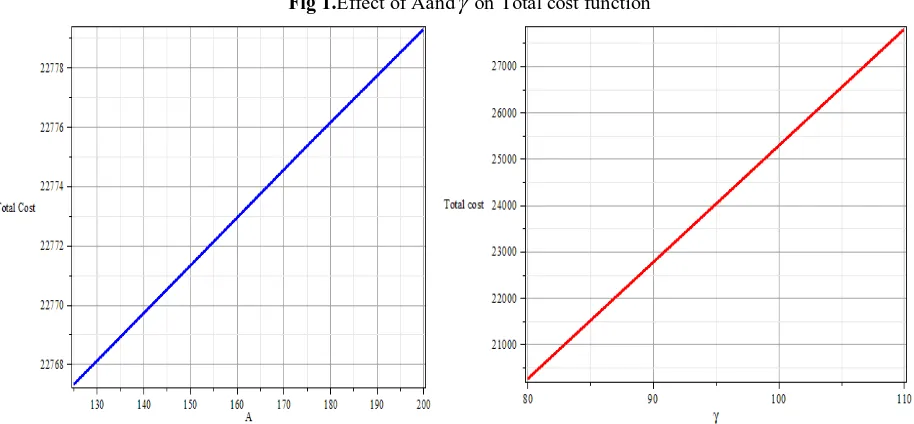
DG*125 22767.32 6366.29 80 20259.39 7005.45 2.25 22771.34 6471.05 150 22771.34 6471.05 90 22771.34 6471.05 3.75 22771.35 6473.36 175 22775.33 6575.01 100 25282.55 6027.97 5.25 22771.36 6487.68
200 22779.29 6678.19 110 27793.13 5653.57 6.75 22771.38 65014.99 All the above observations can be sum up as follows:
Increase in setup cost leads increase in total cost and increase in production quantity.
Increase in production cost leads increase in total cost and decrease in production quantity.
Increase in holding cost leads slight increase in total cost and increase in production quantity. We can also represent this situation pictorially.
ISSN(Online): 2320-9801
ISSN (Print): 2320-9798
I
nternational
J
ournal of
I
nnovative
R
esearch in
C
omputer
and
C
ommunication
E
ngineering
(An ISO 3297: 2007 Certified Organization)
Vol. 4, Issue 2, February 2016
Fig3. Effect of h on Total cost function
VIII. CONCLUSIONS
Anfuzzy inventory model with time dependent demand is developed in this paper. This model is highly beneficial to the manufactures as the EPQ model is focused on quantity, reliability and flexibility. Mathematical formulation is presented for finding optimal order quantity and total cost. The total cost is convex function with respect to order quantity. The applicability of the proposed model is demonstrated by a numerical example. A sensitivity analysis shows that the changes are quiet sensitive with the change of parameters.
REFERENCES
[1]. Harris (1913). How many parts to make at once. The magazing of management, 10(2),pp. 135-136. [2]. Taft, E. W. (1918). The most economic production lot. The iron age, 101, (may 30), pp. 1410-1412.
[3]. Silver, E. A., and Meal, H. C. (1969). A simple modification of the EOQ for the case of a varying demand rate. Production and inventory management, 10(4),pp. 52-65.
[4]. Donaldson, W. A, (1977), Inventory replenishment policy for a linear trend in demand – an analytical solution. Operational research quarterly, 28, pp, 663-670.
[5]. Teng, J. T. Min, J. and Pan. Q. (2012). Economic order quantity model with trade credit financing for non – decreasing demand. Omega, 40, pp. 328-335.
[6]. Khanra,. S. Ghosh, S. K. and Chaudhuri, K. S. (2011). An EOQ model for a deteriorating item with time dependent quadratic demand under permissible delay in payment. Applied mathematics and computation, 218, pp. 1-9.
[7]. Teng, J. T. Yang, H. L, and Chern, M. S, (2013). An inventory model for increasing demand under two levels of trade credit linked to order quantity. Applied Mathematical Modelling, 37, pp. 7624 – 7632.
[8]. Dave. U, and Patel, L. K. (1981). (T, S) policy inventory model for deteriorating items with time proportion demand. Journal of operational research society, 32, pp. 137-142.
[9]. Jalan, A. K and Chaudhri, K. S (1999). Structural proportion of an inventory system with deterioration and trended demand. Interntaional journal of system science, pp 627-633.
[10].Jalan, A. K. Giri, R. R and Chaudhri, K. S. (1996). EOQ model for item with weibull distribution deterioration, shortages and trended demand. Interntaional journal of system science, pp 851-855.
[11].Mitra, A. Fox, J.F. and Jessejr, R. R (1984). A note on determining order qunatities with a linear trend in demand. Journal of operational research society, pp. 141-144.
[12].Samantha, Roy. A, (2004), A deterministic inventory model for deteriorating item with two rates of production and shortages. Tamsui oxford journal of Mathematical sciences,pp.205-218.
[13].Hou. (2007). An EPQ model with setup cost and process quantity as functions of capital expenditure. Applied Mathematical modeling, pp. 10-17.
[14].Cardenas-Barron (2008). Optimal manufacturing batch size with rework process at a single stage production system. Computer and Industrial engineering, pp. 758-765.
ISSN(Online): 2320-9801
ISSN (Print): 2320-9798
I
nternational
J
ournal of
I
nnovative
R
esearch in
C
omputer
and
C
ommunication
E
ngineering
(An ISO 3297: 2007 Certified Organization)
Vol. 4, Issue 2, February 2016
[16].Krishnamoorthy. C and Panayappan. S, (2013). An EPQ model for an imperfect production system with rework and shortages. International journal of Operations Research, pp. 104-124.
[17].Liu, X. Wang, W (2015). An integrated production an inventory and preventive maintenancemodel for a multi-product production system. Reliability Engineering and safety, pp. 76-86.
[18].Taleizadeh, A. A., Daryan, M. N and Baron, (2015) Joint optimization of price, replenishment cycle and production retain vendor management inventory system with deteriorating items. International journal of production economics, pp. 285-299.
[19].NeerajAgarwal , 2015, Economic production quantity model with time dependent demand and reduction delivery policy, International Journal of Multidisciplinary approach, Volume2 (3).