ISSN(Online): 2320-9801
ISSN (Print): 2320-9798
I
nternational
J
ournal of
I
nnovative
R
esearch in
C
omputer
and
C
ommunication
E
ngineering
(An ISO 3297: 2007 Certified Organization)
Vol. 3, Issue 6, June 2015
Social Spider Cloud Web Algorithm
(SSCWA): a new Meta-Heuristic for Avoiding
Premature Convergence in Cloud
Preeti Abrol, Dr. Savita Gupta, Karanpreet Kaur
Software Technology Division, CDAC, Chandigarh, India
Software Technology Division, UIET, Chandigarh, India
Software Technology Division, CDAC, Chandigarh, India
ABSTRACT: The increase in the complexity of load balancing problems has encouraged researchers to find some effective solutions. A load balancing method helps to optimally utilize the available resources, therefore reducing response time and improvising the resource utilization. Nature inspired Evolutionary Meta-heuristics and Algorithms for load balancing perform better as compared to the conventional optimization algorithms. In this paper, a novel swarm intelligence based meta-heuristic named as Social Spider Cloud Web Algorithm (SSCWA) for Resource Placement in cloud environment is proposed that helps in reducing the premature convergence and local minima problem considerably. The algorithm is inspired from the foraging behavior of social spiders in their colony, which interact through the vibrations that propagate over the spider web so as to determine the position of prey.
When simulated, SSCWA outperforms in comparison to the Ant Colony Optimization and its other variant algorithms and demonstrates the stability, effectiveness and efficiency of the proposed method.
KEYWORDS: Social Spider Cloud Web Algorithm, Load balancing, Swarm Intelligence, Ant Colony Optimization, Evolutionary Computation, meta-heuristic.
I. INTRODUCTION
Cloud Computing is a parallel and distributed computing system consisting of a collection of inter-connected and virtualized computers that are dynamically provisioned and presented as one or more unified computing resources through negotiation between the service provider and consumers[16]. Cloud computing facilitates its consumers by providing virtual resources via internet [18].
Most of the data centers today comprise of high capacity multi-core servers with high speed processing capabilities. These servers are not exploited fully and the resources remain underutilized. To keep the performance within acceptable limits uneven distribution of load should be avoided by distributing/redistributing the load taking care of underutilized and over utilized resources.
Load balancing distributes loads across various computing resources that focus on the optimization of the resource usage, maximization of throughput and therefore avoiding overloading of any resource. It focuses on the objectives to meet optimized solution i.e. related to the completion time of the tasks and utilization of the resources [17].
ISSN(Online): 2320-9801
ISSN (Print): 2320-9798
I
nternational
J
ournal of
I
nnovative
R
esearch in
C
omputer
and
C
ommunication
E
ngineering
(An ISO 3297: 2007 Certified Organization)
Vol. 3, Issue 6, June 2015
are constantly changing as the customers have varying needs. Secondly, time and market oriented resource allocation, as any delay incurred in waiting for a resource placement is perceived as an overhead.
The layout of paper is as follows. Background focuses on the related work in section 2. A Scheduling Meta-heuristic SSCWA is proposed in section 3. Section 4 includes discussions and comparisons of ACO and its variants MACO and MACOLB. In section 5, simulation results are followed by conclusion and section 6 gives the future scope.
II. RELATED WORK
Swarm intelligence algorithms mimic nature’s way to search the optimal solution. The foraging behavior and the mating technique in Social Spider algorithm is implemented for the optimization purpose in mechanical and civil engineering in [10,20]. Ant colony optimization (ACO) is considered as one of the major Swarm Intelligence Algorithm [4]. ACO is inspired from the ants foraging behavior, which aims to find a shortest path from nest to food. When an ant finds a food, it releases certain amount of pheromone along the path. Many variants of ACO algorithms i.e. Ant Colony System (ACS) [4], Max-Min Ant System (MMAS), Rank-based Ant System (RAS) [4], Fast Ant System (FANT) [9] and Elitist Ant System (EAS), MACO and MACOLB have been explored on ACO.
III.PROPOSED ALGORITHM
A. Description of the Proposed Algorithm:
We can mimic the behavior of social spider in the cloud environment also, such that artificial spiders will act as the agents carrying tasks and their fitness will denote the QoS requirements of the tasks. The prey or the food acts as the Resources of the cloud and the preys' fitness corresponds to the utilization capacity of the resources. The Spider agents carrying task with higher QoS requirements have more fitness in comparison to the other spiders and hence it vibrates more. According to the intensity of vibration, the tasks are scheduled (output of the Resource Management) which will be allocated to the corresponding resource i.e. the prey at the Resource Placement level. The task scheduling done at the Resource Management level will be discussed in the following papers to come.
Spider and Vibration
In the beginning of the Social Spider Cloud Web Algorithm (SSCWA), population of the spiders is initialized with the position, fitness (QoS requirements) and its vibration (more the number of QoS parameters increase in the vibration intensity) in the previous iteration. Vibration is a major characteristic that differentiates SSCWA from other algorithms. Here let P be the current position of the prey which is the source of vibration whose intensity is I(P , P,) which is
sensed by any spider x at position P at time t. Hence the intensity of the vibration at the source position is directly proportional to the fitness function of the prey f(P), i.e. the capacity of the resource, that can be defined as follows:
I , (t) =
1
U – f P for maximum utilization(1) 1/(f P −U for minimum utilization
Where U is a constant such that the resource is being used to its fullest and U is a constant such that the resource is in its idle state. Here the upper and the lower range of the resource utilization is marked that ensures the possible vibration intensity always be a positive value.
Intensity Attenuation
ISSN(Online): 2320-9801
ISSN (Print): 2320-9798
I
nternational
J
ournal of
I
nnovative
R
esearch in
C
omputer
and
C
ommunication
E
ngineering
(An ISO 3297: 2007 Certified Organization)
Vol. 3, Issue 6, June 2015
1) Attenuation over Distance
Vibration Attenuation over distance is defined as the distance between spider x and prey P as , which can be
calculated using Euclidean distance method as follows:
D, = |x | + ||p ||−2. x. p (2)
where x and p represent two positions of the spider x and prey p at any instant of time t. So, the vibration attenuation over distance is shown below:
I , (t) = I , (t). e
,
(3)
A user-controlled parameter R∊ (0, 1) which controls the intensity attenuation rate over distance such that attenuation and R are inversely proportional to each other.
2) Attenuation over Time: The vibration attenuation over time is calculated as:
I , ( t + 1) = I , . R (4)
All the vibrations generated in the previous iteration are attenuated by the factor R. At time t + 1, there can be the change in the position of spider from P (t) toP (t + 1), but the prey position of the vibration remains at .
Prey Search Pattern
For the accomplishment of the resource placement of the task, task requires a proper search pattern that may lead to the placement of the task at a particular resource for its execution. Three phases of SSCWA that are sequentially executed are as follows:
Initialization
In this phase, the objective function and its solution space is defined in the algorithm. The algorithm proceeds to create an initial population of spiders i.e. population pop of the tasks set are created. The population of the prey i.e. prey pop is also created and initialized. The client requests the CSP for the resource placement of the tasks, carried by the spider agent. The adaptive parameters are initialized. The positions are acquired by the spider in the web, in accordance to their fitness values calculated. Initially the vibration intensity on the web is zero.
Iteration
The Resource Placement technique is followed in this phase. The artificial spiders created perform the prey search i.e. the task looks for the resource to get executed. A number of iterations are performed such that in each iteration, all spiders evaluate their fitness values on the web i.e. the QoS requirement of the Task set is evaluated. Then the Prey caught in the web will generate vibrations V using vibration equation i.e. the resource will display its capability to handle the tasks. The spider agent having the task with maximum QoS requirement will be stored in the memory as
v . All the artificial spiders will sense vibrations V in accordance to the attenuation in the intensity of the vibration due to distance and time on the web and will compare the intensity of vibration V of the prey with the intensity of the maximum vibration v of the spiders stored in its memory. The received information from the vibration includes the source position of the vibration and its attenuated intensity.
If the intensity of v is larger, the task having v is allocated along with other tasks otherwise another resource with the vibration more than the v will be find from the prey pop and tasks will be allocated to it. The algorithm then manipulates x to perform a random walk towardsv . Then the spider’s random walk is conducted using the following equation and the task carried by them will be allocated to the resources for execution where⦿denotes element-wise multiplication. P is the vibration source position of the target vibration V . S is a vector of random numbers generated from zero to one uniformly. The algorithm repeats this process for all the spiders in pop.
P (t + 1) = P + (P −P )⦿ (1−S⦿S) (5)
ISSN(Online): 2320-9801
ISSN (Print): 2320-9798
I
nternational
J
ournal of
I
nnovative
R
esearch in
C
omputer
and
C
ommunication
E
ngineering
(An ISO 3297: 2007 Certified Organization)
Vol. 3, Issue 6, June 2015
Termination
After the iteration phase, the algorithm outputs the best solution by the resource placement of the tasks in accordance to its QoS requirement i.e. their fitness.
IV.PSEUDO CODE
Step 1: Create the population of spiders as agents carrying tasks pop and prey pop as resources and assign memory for them that contain the QoS requirements.
Step 2: while stopping criteria not met do Step 3: for each spider x in pop do Step 4: Evaluate the fitness value of s. Step 5: end for
Step 6: for each Prey serving as resource in prey pop
Step 7: do generate vibration V according to the capacity of the resource to execute task. Step 8: for each spider x in pop do
Step 9: Compare the intensity of the target vibration V and V . Step 10: if the intensity of V is smaller than V
Step 11: allocate the task onV .
Step 12: Else find a new resource in prey pop having V > V such thatV = V + (V −V ). Step 13: go to step 9.
Step 14: Attenuate the intensity ofV . Step 15: end if
Step 16: end for Step 17: end while
Step 18: Output the best solution found.
V. SIMULATION RESULTS
The simulation studies involve the deterministic small network topology with 5 nodes as shown in Fig.1. The proposed energy efficient algorithm is implemented with MATLAB. We transmitted same size of data packets through source node 1 to destination node 5. Proposed algorithm is compared between two metrics Total Transmission Energy and Maximum Number of Hops on the basis of total number of packets transmitted, network lifetime and energy consumed by each node. We considered the simulation time as a network lifetime and network lifetime is a time when no route is available to transmit the packet. Simulation time is calculated through the CPUTIME function of MATLAB. Our results shows that the metric total transmission energy performs better than the maximum number of hops in terms of network lifetime, energy consumption and total number of packets transmitted through the network.
The network showed in Fig. 1 is able to transmit 22 packets if total transmission energy metric is used and 17 packets if used maximum number of hops metric. And the network lifetime is also more for total transmission energy. It clearly shows in Fig. 2 that the metric total transmission energy consumes less energy than maximum number of hops. As the network is MANET means nodes are mobile and they change their locations. After nodes have changed their location the new topology is shown in Fig .3 and energy consumption of each node is shown in Fig. 4. Our results shows that the metric total transmission energy performs better than the maximum number of hops in terms of network lifetime, energy consumption and total number of packets transmitted through the network. The SSCWA is simulated and is compared with the existing meta-heuristics ACO, and its variants MACO and MACOLB as shown in Fig. 1. These algorithms are simulated using CloudSim.
ISSN(Online): 2320-9801
ISSN (Print): 2320-9798
I
nternational
J
ournal of
I
nnovative
R
esearch in
C
omputer
and
C
ommunication
E
ngineering
(An ISO 3297: 2007 Certified Organization)
Vol. 3, Issue 6, June 2015
Fig. 1. Simulation of SSCWA, ACO, MACOLB and MACO in CloudSim
The experiment is performed with 5 Datacenters accommodating 10 VMs and (100-500) tasks in the simulation environment. The task length is from 1000 MI (Million Instructions) to 2000MI. The degree of imbalance (DI) can be defined as the measure of imbalance in VMs.
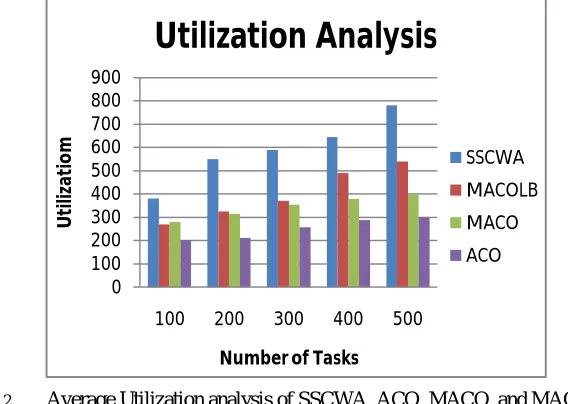
Fig. 2. Average Utilization analysis of SSCWA, ACO, MACO, and MACOLB
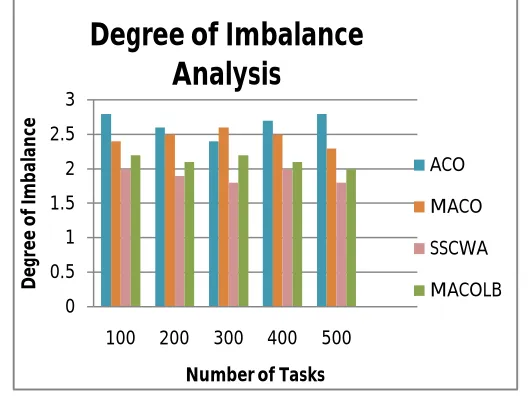
As seen in Fig.2 and 3, the Utilization of SSCWA is maximum in comparison to ACO, MACO and MACOLB whereas the degree of imbalance is the least in the case of SSCWA. Thereby we can say that the implementation of this proposed algorithm in cloud Resource Placement leads to improving the performance, resulting high cost effectiveness and hence less energy consumption also.
0 100 200 300 400 500 600 700 800 900
100 200 300 400 500
U
ti
liz
a
ti
o
m
Number of Tasks
Utilization Analysis
SSCWA
MACOLB MACO
ISSN(Online): 2320-9801
ISSN (Print): 2320-9798
I
nternational
J
ournal of
I
nnovative
R
esearch in
C
omputer
and
C
ommunication
E
ngineering
(An ISO 3297: 2007 Certified Organization)
Vol. 3, Issue 6, June 2015
Fig. 3. Average DI analysis of SSCWA, ACO, MACO, and MACOLB
VI.CONCLUSION AND FUTURE WORK
In this paper we proposed a novel social spider algorithm to solve global optimum problem of premature convergence faced by other swarm intelligent algorithm for resource placement in the PaaS layer of the Cloud. This algorithm is based on the foraging behavior of social spiders and the information sharing foraging strategy. SSCWA is conceptually simple and relatively easy to implement. SSCWA can tackle a wide range of different continuous optimization problems and has the potential to be employed to solve these problems. The output of this algorithm shows the superior performance of SSCWA.
For future research, the proposed algorithm can be channelized for the more effective and efficient resource placement and hence improve the utilization of the Resources. Last but not least, it would be interesting to implement it on the other layers of the cloud for the real-world applications which can be addressed using SSCWA.
REFERENCES
1. Wiley, Metaheuristics: From Design to Implementation, 2009.
2. E.-G. Talbi, Metaheuristics: From Design to Implementation. Wiley, 2009. M. Dorigo, “Optimization, learning and natural algorithms,” Ph.D.
dissertation, Politecnico di Milano, Italie, 1990.
3. Yang, X. S., Engineering optimization: An introduction with metaheuristic applications. John Wiley & Sons. 2010..
4. Y.S.Sheeja, S. Jayalekshmi,”Cost effective load balancing based on honey bee behaviour in cloud environment”,international Conference on
Computational Systems and Communications (ICCSC), IEEE, ISBN: 978-1-4799-6012-5, INSPEC Accession Number: 14931694, Pp. 214 – 219, 17-18 Dec. 2014.
5. Y. KeSSCWAci, N. Melab, E.-G.Talbi,"A pareto-based GA for scheduling HPC applications on distributed cloud infrastructures," IEEE
International Conference on High Performance Computing and Simulation (HPCS), IISN. 1573-7543 Vol. 16, issue. 3, 2011, pp 451-468, 2010.
6. Vadivel, R and V. Murali Bhaskaran,’Energy Efficient with Secured Reliable Routing Protocol (EESRRP) for Mobile Ad-Hoc Networks’,
Procedia Technology 4,pp. 703- 707, 2012.
7. W.-N. Chen, J. Zhang, Y. Lin, N. Chen, Z.-H. Zhan, H. S. Chung, Y. Li, and Y.-H. Shi, “Particle swarm optimization with an aging leader and
challengers,” IEEE Trans. Evol. Comput., vol. 17, issue. 2, pp. 241– 258, Apr 2013.
8. Arabi E. keshk, Ashraf El-Sisi, Medhat A. Tawfeek, F. A. Torkey,” Intelligent Strategy of Task Scheduling in Cloud Computing for Load
Balancing”, International Journal of Emerging Trends & Technology in Computer Science (IJETTCS), ISSN 2278-6856, vol. 2, issue. 6, November – December 2013, pp. 12-22 , 2014.
9. Laiping Zhao, Yizhi Ren, Yang Xiang, K.Sakurai, "Fault-tolerant scheduling with dynamic number of replicas in heterogeneous systems",
IEEE International Conference on High Performance Computing and Communications (HPCC),ISSN. 978-1-4244-8335-8, 2010, pp. 434 – 441, 2010.
10. M.D.Mulani ,” Applications and Future Insight of Swarm Intelligence Based Optimization Algorithms”, International Journal of Advance
Engineering and Research Development (IJAERD), ETCEE-2014 Issue, , e-ISSN: 2348 - 4470 , print-ISSN:2348-6406 ,pp.1-7, March 2014.
0 0.5 1 1.5 2 2.5 3
100 200 300 400 500
D
e
gr
ee
o
f
Im
b
al
a
n
ce
Number of Tasks
Degree of Imbalance
Analysis
ACO
MACO
SSCWA
ISSN(Online): 2320-9801
ISSN (Print): 2320-9798
I
nternational
J
ournal of
I
nnovative
R
esearch in
C
omputer
and
C
ommunication
E
ngineering
(An ISO 3297: 2007 Certified Organization)
Vol. 3, Issue 6, June 2015
11. K. Boloor, R. Chirkova, , T. Salo, Y. Viniotis, "Heuristic-Based Request Scheduling Subject to a Percentile Response Time SLA in a
Distributed Cloud", IEEE International Conference on Global Telecommunications Conference (GLOBECOM), ISSN 1930-529X, 2010, pp.1-6 , 2010
12. A.Hossein, & A.Hossein-Alavi, ,” Krill herd: A new bio-inspired optimization algorithm.”, Communications in Nonlinear Science and
Numerical Simulation, vol 17, Issue 12, 2012, pp. 4831–4845, 2012.
13. R. Cocroft, “The public world of insect vibrational communication,” Molecular Ecology, vol 20, Issue 10, May 2011, pp. 2041–2043, 2011.
14. Y. KeSSCWAci, N. Melab, E.-G.Talbi,"A pareto-based GA for scheduling HPC applications on distributed cloud infrastructures," IEEE
International Conference on High Performance Computing and Simulation (HPCS), IISN. 1573-7543 Vol. 16, issue. 3, 2011, pp 451-468, 2012.
15. R.A.M Razali, Shah Alam, R.A Rahman, N. Zaini, M.Samad, ” Virtual machine migration implementation in load balancing for Cloud
computing”, Print ISBN:978-1-4799-4654-9, INSPEC Accession Number:14501937, IEEE conference, June 2014, pp.1 – 4, Kuala Lumpur,2014.
16. F.B. Shaikh, S. Haider,”Security threats in cloud computing”, 6th International conference for internet technology and secured
transaction(ICIST), ISBN:978-1-4577-0884-8, pp. 214 - 219, 11-14 Dec. 2011
17. M. Dorigo, L.M. Gambardella, “Ant colony system: A cooperative learning approach to the traveling salesman problem”, IEEE Transactions on
Evolutionary Computation,vol.1, Issue.1, pp. 53–66, 1997
18. S. Lenhart, W. Schiffmann, P. Eitschberger, J. Keller,”Power effiecient server utilization in compute clouds”, third berkley
third berkley symposium on Energy Efficient Electronic Systems (E3S), INSPEC Accession Number:14029814, 28-29 Oct. 2013, pp. 1-2, 2013
19. B. Bullnheimer, R.F. Hartl, C. Strauss, “A new rank-based version of the ant system: A computational study,” Central European Journal for
Operations Research and Economics vol. 7, issue 1, 1999, pp. 25–38, 2014.
20. Erik Cuevas, Miguel Cienfuegos, “A new algorithm inspired in the behavior of the social-spider for constrained optimization”, Expert Systems
with Applications, ISSN:0957-4174, Volume 41, Issue 2, 2013 Elsevier. , pp. 412-425, 2013
21. J.Q. Yu James, O.K. Li Victor, “A Social Spider Algorithm for Global Optimization”, Technical Report No. TR-2003-004, Dept. of Electrical
& Electronic Engineering, the University of Hong Kong, pp.1-16, Oct 2013
BIOGRAPHY
Preeti Abrol is Principal Engineer, Head, Software Technology Division, CDAC, Chandigarh, India. She received Masters (Computer Science and Engineering) from Punjab Engineering College, Panjab University, Chandigarh in 2005. Her research interests are Grid/ Cloud Computing, Networks, Vulnerabilities Assessments
Dr. Savita Gupta is Professor in Computer Science department, UIET, Panjab University, Chandigarh, India. Her research interests are Image Processing, Image Compression & Denoising and Wavelet application.