ISSN 2286-4822 www.euacademic.org
Impact Factor: 3.1 (UIF) DRJI Value: 5.9 (B+)
Chronological and an Inside Layer Analysis of Tiger
Landscape Complex in India
BHANWAR VISHVENDRA RAJ SINGH Research Scholar Department of Geography Delhi School of Economics, University of Delhi New Delhi, India Dr. ANJAN SEN Assistant Professor Department of Geography Delhi School of Economics, University of Delhi New Delhi, India
Abstract:
main umpire of food web or food chain of our ecosystem. But India and as well as the world If these trends continue, the wild tiger may evolve from being an endangered species and off the endangered species list to become an extinct species.
Key words: Tiger habitat, Tiger land, Tiger landscape complex, Tiger
hotspot, Tiger supports livelihood, Tiger population, Tiger mortality rate, Tiger Resorts.
ABBREVIATION
1. NTCA- The National Tiger Conservation Authority 2. MoEF- The Ministry of Environment and Forests 3. WWF- World wild life fund,
4. WPSI- Wildlife protection society of India 5. TB- Tiger tribe
Introduction:-
Nature can be seen as beautiful and harmonious but it also inspires fear in man who has had to fight it in order to survive. Now, nature is threatened by man who has become detached from it. Technology has endowed humans with the power of a major geological agency, which may act on a continental or even planetary scale (e.g. acid rain, photochemical smog, radioactive contamination, stratospheric ozone depletion, climate change).
Ph. Bourdeau, (2004).
but he acts upon it, thereby emancipating himself of it. He is part and apart of nature.
Recently Animal Planet is surveyed, the tiger was voted the world's favourite animal, narrowly beating the dog. More than 50,000 viewers from 73 countries voted in the poll. Tigers received 21% of the vote, dogs 20%, dolphins 13%, horses 10%, lions 9%, and snakes 8%, followed by elephants, chimpanzees, orangutans and whales. (Animal Planet, 2011)
Therefore why we are doing million dollars investment for this wild animal? Because of, there are many advantageous through this species for flora–fauna. Such as, Tiger Supports Livelihood: - Tourism is the world’s biggest industry. On the Eco tour front, the tiger is a star attraction for ecotourism. The look in the eyes of a canter that has just come out of a National Park after sighting a tiger is very different from the look and feel of a canter that could not sight any. This eventually impacts the tourist influx thus impacting everyone from the tour companies to the local tour guides. A healthy tiger population thus supports livelihoods. Second one Tiger
tigers we can save, the healthier reserves we have, and larger is our national carbon sink. A tiger should therefore be entitled to carbon credits in the form of protection. Fifth one Tiger is a symbol of our National Pride.
The tiger, one of the most magnificent animals in the world, is also one of the most endangered species in the world. Tigers (Panthera tigris) were once widely distributed across the riverine grasslands and forests of Asia. As human populations converted the rich alluvial plains to agricultural lands, tigers gradually became confined to the forests of the region. There were, however, still an estimated 40,000 tigers on the Indian subcontinent in the early 1900s (Gee 1964). A cat of beauty, strength, and majesty, the tiger is master of all and subject to none except humans. Of the eight original subspecies of tigers, three have become extinct within the last 60 years and there are less than 50 South China tigers left on this planet few and possibly none survive in the wild.
At this range of population sizes, stochastic genetic, demographic, and ecological events can have a strong effect on population dynamics (Shaffer 1981; Frankel & Soule1981).
Tigers increasingly compete with expanding human population and industry for land and food, and many are killed by poachers who sell their skins and body parts as ingredients for traditional Chinese medicines. If these trends continue, the wild tiger may evolve from being an endangered species and off the endangered species list to become an extinct species.
The global population in the wild is estimated to number between 3,062 and 3,948 individuals, down from around 100,000 at the start of the 20th century, with most remaining populations occurring in small pockets isolated from each other. Major reasons for population decline include habitat destruction, habitat fragmentation and poaching. Since 1990 an additional factor, the significant Asia-wide increase in tiger poaching (Jackson 1993; Miquelle et al. 1993), has seriously threatened the survival of already small populations (Kenney et al.1995). The extent of area occupied by tigers is estimated at less than 1,184,911km2 (457,497sq mi), a 41% decline from the area estimated in the mid-1990s.
In India, the Royal Bengal tiger is found practically throughout the country, from the Himalayas to Cape Comorin, except in Punjab, Kutch and the deserts of Rajasthan. In the northeast, its range extends into Burma. Tigers occupy a variety of habitats including tropical evergreen forests, deciduous forests, mangrove swamps, thorn forests and grass jungles.
The Royal Bengal tiger (Panthera tigris), the national animal of India is an incredible sight. The Bengal tiger (Royal Bengal tiger) is a subspecies of tiger, found across the Indian subcontinent. The Royal Bengal Tiger is a super predator and important member of the carnivores that once roamed and dominated all of South East Asia.
Today, due to habitat loss caused by deforestation, and hunting by human poachers, the Bengal tiger is considered to be an endangered species. Despite being the most common of all the tiger species, there are thought to be around 2,000 Bengal tigers left in the world.
Project Tiger was launched in India in 1973, with the goal of saving the tiger and its habitat in India. With an initial list of 9 Tiger Reserves, this Project went on to cover 28 Tiger Reserves across the country, incorporating an area of 37,761 sq. km. The Project Tiger seeks to ensure a viable population of tiger in India for “scientific, economic, aesthetic, cultural and ecological values and to preserve for all time, areas of biological importance as a natural heritage for the benefit, education and enjoyment of the people”. Though this Project tackled various issues over the past 20 years, it had not been able to keep pace with the rapid changes that have changed the tiger landscape and increased human pressures.
In 2006, it was replaced by the National Tiger Conservation Authority (NTCA). Despite all these problems, India still holds the best chance for saving the tiger in the wild. Tigers occur in 18 States within the Republic of India, with 10 States reportedly having populations in excess of 100 tigers. There are still areas with relatively large tiger populations and extensive tracts of protected habitat. We need to make a concerted effort to combat poaching and habitat loss, if this magnificent animal is to survive into the future.
Recently, Bor wildlife sanctuary (Maharashtra) which is include for tiger conservation. Therefore there are 47th tiger reserves in India (2014), which are governed by National Tiger Conservation Authority.
World’s first tiger census in 1932, the world’s first tiger census was carried out in the Palamau forests. It was based on a pug mark count.
The Tiger Census report had classified the tiger occupied forests in India into 6 landscape complexes, namely as the Shivalik-Gangetic Plains, Central Indian Landscape Complex Eastern Ghats, Western Ghats, North-Eastern Hills and Bhramaputra Plains, Sunderbans Landscape Complex.
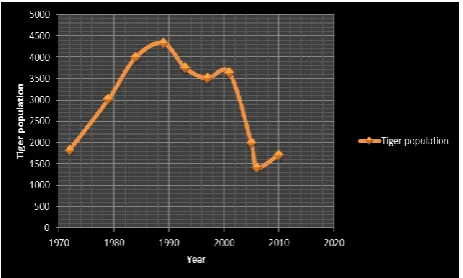
of tiger population since 1972 to 2010? (Figure1.) When we talked about 1972 that time we found only 1872 tigers left in India due to lots of pouching and illegal trafficking. After Indian government take a prominent action against poachers and tiger traders for illegal trafficking. So that is why the wild life protection act came in to force in 1972. After 1972 highest tiger population (1989) found in India. After every year was declining, while 2006 to 2010 tiger population 20 % increased. The main growth in tiger numbers between the last two censuses exercises (1411 tigers in 2006 and 1706 in 2010).
Figure -1, Source- National tiger conservation authority (NTCA)
Study Area:-
The Shivalik-Gangetic plain landscape has an estimated population of 297 tigers in six separate populations and they occupy approximately 5080 sq. km of forested area. It is comprises Uttrakhand, Himachal Pradesh, Utter Pradesh and Bihar.
The Central Indian Landscape has an estimated population of 451 striped cats distributed in 17 populations occupying 47,122 sq. km (11.6 %) of forests. It is comprises Rajasthan, Madhya Pradesh, Chhattisgarh, and Jharkhand.
The Eastern Ghat Landscape contains 53 tigers that are occupying 7,772 sq. km of forested habitats, however, there is about 15,000 sq. km of potential tiger habitat in this part. It is comprises Odisha, Andhra Pradesh and Tamil Nadu.
The Western Ghat Landscape has an estimated population of 366 tigers that are living in 21,435 sq. km (21%) of forests. It is comprises Maharashtra, Karnataka and Kerala.
Figure-2. Source- National tiger conservation authority, (NTCA).
The Sunderbans Tiger landscape complex is the smallest isolated landscape that likely has a single population of tigers with tiger occupancy in 1,586km2.
Methodology: -
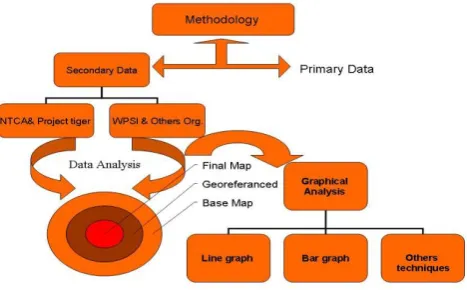
Temporal analysis of tiger landscape complex in India paper is bases on secondary data, which is provided by Project tiger and National tiger conservation authority, (NTCA) regulated by The Ministry of Environment and Forests (MoEF), and also some special data collection through such as world wild life fund, (WWF) Wildlife protection society of India (WPSI), Tiger tribe, and others organisation. In the present paper of methodologies, we address the application of spatial temporal analysis for tiger landscape complexes in India. The tiger population for a survey by pug mark method in every four year.
for tiger habitat. Establishing study objectives is the, first step is what is crisis is going on tiger population.
Remote sensing, geographic information systems, and rapid assessment techniques to determine the presence of tigers and the abundance of tiger prey are critical tools for analysis and planning at landscape- and populationlevel scales. These technologies provide a means of (1) mapping the distribution of tigers at a resolution needed to determine the extent of individual tiger populations and (2) monitoring these populations to evaluate the success of conservation efforts. Dinerstein et al. (1996)
Figure 3, chart of database and data analysis.
Result and Discussion:-
The total strength of tiger in Shivalik Gangetic is 297 in the year 2006 & 353 in the year 2010. (Figure-4.1)
Conclusion: Over the years extra care has been taken to save the tiger, as a result frequency of tiger has increased over the year due to anti-poaching campaign, increase of forestation Awareness for tiger save, strict law and order and public participation (Figure-4.1).
On the basis of above graph, it could easily be observed that the strength of tiger is maximum in Madhya Pradesh which is located in the central India followed by Maharashtra and Andhra Pradesh, Orissa, Rajasthan. Number of tiger in the other state like Chhattisgarh and Jharkhand is negligible
(Figure-4.2)
Conclusion: The above statement concludes that the central India has more tiger population compare to eastern coast hence, The Central India has more favourable climate, forest, land-use and land-cover and condition for the growth of tiger. (Figure-4.2)
Tiger population in Tiger landscape complex wise, (2006-2010).
Figure-4.1
Shivalik-Gangetic plain landscape Complex
Figure-4.2
Central Indian Landscape Complex and Eastern Ghats Landscape Complex
Figure-4.3
Western Ghats Landscape Complex
Figure-4.4
North eastern Hills and Brahmaputra Flood Plains complex
Population of tiger in north eastern hill has increased drastically over the year Assam is leading the other states of north east in tiger population followed by Arunachal Pradesh and north- west Bengal. In the last four year the number of tiger has increased drastically. It is a jump of 75+ from 70 to 145+ on the other hand, The Sunder Ban has also gained a good population of tiger in the last four year (Figure-4.4).
Conclusion: - Finally we get healthy increment for tiger population in all land scape in our country. Because of, there are so many efforts such as Anti poaching campaign, increase of forest cover area and awareness of save the tigers. Meanwhile The Wastern Ghat tiger population was decreased due to poaching illegal trafficking and decrease of forest cover. It
means, tiger conservation and regulatory bodies have implemented good efforts.
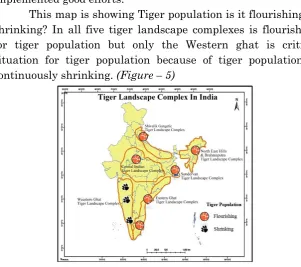
This map is showing Tiger population is it flourishing or shrinking? In all five tiger landscape complexes is flourishing for tiger population but only the Western ghat is critical situation for tiger population because of tiger population is continuously shrinking. (Figure – 5)
Figure - 5. Source- National tiger conservation authority (NTCA).
Tiger area (km2) in Tiger landscape complex wise,
(2006-2010).
Figure-6.1
Shivalik-Gangetic plain landscape Complex
Figure-6.2
Central Indian Landscape Complex
and Eastern Ghats Landscape
Complex
0 1000 2000 3000 4000 5000 6000 7000 8000
2006 2010
0 10000 20000 30000 40000 50000 60000
Figure-6.3
Western Ghats Landscape Complex
Figure-6.4
North eastern Hills and Brahmaputra Flood Plains
In the above bar Graph blue shaded region shows the area of tiger habitat during 2006 & Red shaded region shows area of the tiger habitat in the year 2010, (Figure –6). In Uttrakhand tiger habitat area was a 1901km2 in 2006 and in the year 2010 tiger habitat area goes to level 3,476 km2. And for the same in Uttar Pradesh in the year 2006 area was 2,766km2, it was reduced and dip to 2,511km2. Another region in Bihar, it was 510 km2 in the year 2006 and goes to 750 km2 which shows rise in the year 2010. In totality we can say Shivalik- Gangatic tiger complex, tiger habitat area in 2006 was 5,177 goes to 6,712 km2 this level. Overall, Shivalik- Gngatic tiger landscape complex has much better potential for tiger conservation with the help of efforts put by regulatory bodies.
The above graph shows that the tiger habitat in km square during the year 2006 was more. Represented with the blue colour where the area has decreased over the period in the year 2010 that can be seen through the region with red colour .Hence we can conclude that the wild life area has been decreasing since the year, causing danger to the animals and number of species, the root cause behind this could be poaching, illegal trafficking, deforestation, over grazing etc.
The above figure shows that the total area reserved for the tiger habitat in the Karnataka is more than the area reserved for the tiger in the Kerala and Tamil Nadu. The efforts
0 5000 10000 15000 20000 25000 30000 35000 40000
2006
2010 0
1000 2000 3000 4000 5000 6000
and policies of the government are taking care of the need of maintaining the balance in ecosystem as well as food chain.
Tiger habitat area of north eastern hill has increased drastically over the year. Assam is leading the other states of north east in tiger habitat area followed by Arunachal Pradesh, North- West Bengal and Mizoram. It is showing current situation in North East and Brahmaputra region. It is good indication for tiger population and tiger habitat in our country. Conclusion: - We know deforestation is major problem of forest area in our country. So in tiger landscape it is not good growth for tiger habitat due to some causes such as natural and anthropogenic activates. In shivalik- Gangetic and North East hill area & Brahmaputra region forest area is increasing day by day. But on the other side Central India & Eastern Ghat and Western Ghat Tiger habitat is continuously decreasing. It is shocking news for tiger population because forest area are very necessary for tiger prey and as well as tiger species. If forest area is increasing then automatically tiger population will be increasing thus showing direct relation between tiger population and forest area.
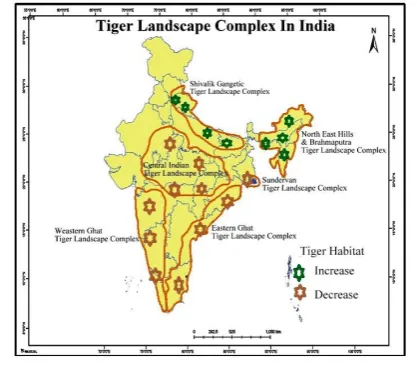
This map is showing Tiger habitat, is it increasing or decreasing in all landscape complexes. Shivalik- Gangatic and North eastern hills and Brahmaputra flood Plains (Tiger K.m.²) tiger habitat is increasing otherwise rest of tiger complexes all is going on deforestation condition. Therefore tiger habitat is decreasing in these complexes, (Figure – 7).
In India last three years 2011, 2012, and 2013 tiger population is going on very drastically change due to Poaching, illegal trafficking and others causes. And as well as a new find out case study for tiger decreasing in India.
Recently this is best example for tiger death in India. Because pat dogs virus threatens India's dwindling tiger population. Canine distemper virus, common in dogs and deadly to other carnivores, has killed at least four tigers in past year. India is scrambling to protect its beleaguered tiger population after several big cats tested positive for a virus common among dogs but deadly to other carnivores. (Times of
India)
In this graph is showing last three years records tiger mortality rate due to poaching, seizure, Road accident, Infighting, outfighting, during rescue, electrocuting, In the main cause of don’t know about how did tiger death. But infighting is second one after following poaching, seizures etc.
(Figure-8)
Tiger mortality rate is showing through different causes as....
Conclusion:-
Tigers are very prominent species for food chain. But nowadays human population is increasing day by day as well as anthropogenic activity so tiger habitat is very critical situation in going on. Therefore it has been or will be hit of food chain. Tigers gradually compete with expanding human population and industry for land and food, and many are killed by poachers who sell their skins and body parts as ingredients for traditional Chinese medicines as well as whole world.
Once distribution data are known, this information can be used to (1) devise land-use strategies, (2) calculate population size, (3) predict changes in tiger distribution, and (4) devise ecosystem- and landscape-scale biodiversity strategies. If these trends continue, the wild tiger may evolve from being an endangered species and off the endangered species list to become an extinct species.
Although, temporally my study is limited from 2006 to 2010 time frame still it presents a vast diversity as far as tiger population and tiger habitat is concerned. The given paper shows a healthy account of tiger population from 2006 to 2010.As in 2006 tiger population was 1411 which jumped to 1706 in 2010, thus presenting an upward trend.
from the overall figure. Among the present tiger habitats in the country Central India and eastern and western ghats are portraying shrinkage while Shiwallik -Gangetic and North Eastern region is showing a healthy increase. Above all these figures about tiger habitat one area is presenting a regressive declining that is Sunder ban, Though this condition is really demising but some good efforts are being made by National Tiger Conservation Authority (NTCA), for the conservation of tigers and their habitats in which conducting census every four year is involved. At present there are 47 tiger resorts in the country in which the Bor in Maharashtra and Dihang in Arunachal Pradesh are the latest one.
REFERENCES:-
1. Annual Report (2010-11), Ministry of Environment and Forest, Govt. of India-2010.
2. Annual Report (2011), India Tiger Estimate 2010, Ministry of environment and forests government of India.
3. Annual Report (2011-12), Ministry of Tourism, Government of India-2011.
4. Annual Report, (2012) National Tiger Conservation Authority, (MEoF).
5. Annual Report, (2012), WWF-India
6. Bhardwaj, D. (1998) Domestic Tourism in India. New Delhi: Indus Publishers
7. Bhattacharya A.K, (2005). Eco-Tourism and Livelihoods: Capacity Building for Local Authorities, Concept Publishing 8. Dinerstein, E., E. Wikramanayake, J. Robinson, U. Karanth, A. Rabinowitz, D. Olson, T. Mathew, P. Hedao, and M. Connor. 1996. A framework for identifying high priority areas for the conservation of freeranging tigers. Report to National Fish and Wildlife Foundation.
9. Frankel, 0. H., and M. E. Soule. 1981. Conservation and evolution.Cambridge University Press, Cambridge, United Kingdom
10. Gee, E. P. 1964. The wildlife of India. Collins, London. 11. Jackson, P. 1993. The status of tiger and threats to its future. Cat news. World Conservation Union Cat Specialist Group, Gland, Switzerland
12. Kenney, J. S., J. L. D. Smith, A. M. Starfield, and C. W. McDougal. 1995. The long-term effects of tiger poaching on population viability. Conservation Biology 9:1127-1133.
13..Ph. Bourdeau / J. Environ. Radioactivity 72 (2004) 9–15
Web-sources:-
http://www.moef.nic.in/ http://projecttiger.nic.in/ http://www.wpsi-india.org/ http://tigertribe.net/ http://en.wikipedia.org/