A Novel Concept for Achieving Group Data Sharing Using
Key Aggregate Searchable Encryption
N. Jyothi & S.M. Ali
CVR College of Engineering/CSE, Hyderabad, India
Email:
[email protected]
CVR College of Engineering/CSE, Hyderabad, India
Email:
[email protected]
Abstract A productive cryptographic approach for data sharing where data is shared among a gathering of users as Data sharing is a vital usefulness in cloud storage. Step by step instructions to safely and productively share a gathering of data identified with any branches of knowledge with others in cloud storage. Improvement of new novel idea of Key-Aggregate Searchable Encryption (KASE). This idea is executed through improvement of a solid key-total searchable encryption structure plot. This plan is portrayed as where an data proprietor just needs to produce and appropriate a solitary total key to an data user for sharing an expansive number of archives and on the opposite side user just needs to present a solitary total trapdoor to the cloud server, with the goal that he/she can inquiry over the common records by the assistance of created single total trapdoor. This proposed conspire is flawlessly more secure and for all intents and purposes productive. It is a powerful strategy which is considered as best answer for fabricate a pragmatic data sharing framework in view of open cloud storage. A point by point survey of different techniques utilized for data get to controls and encryption is displayed and a concise correlation among the examined strategies is given.
Index Terms— Cloud Storage Provider, Outsourcing,
Attribute based Encryption, Key-Aggregate
Cryptosystem.
1. INTRODUCTION
Cloud storage is an answer for sharing and accessing to a lot of data, which is shared for different users by methods for web. Today, various users are mostly sharing an expansive number of different sorts of reports, which are thought to be under different classes like photographs, recordings and archives by means of different informal communication construct applications with respect to regular schedule. There are enormous advantages of utilizing cloud storage like lower cost, more prominent nimbleness and better asset usage has include more fascination from bounty number of business users toward utilizing the cloud storage. Cloud computing which is based on parallel, disseminated figuring, utility registering and administration situated design. By and large, talking about
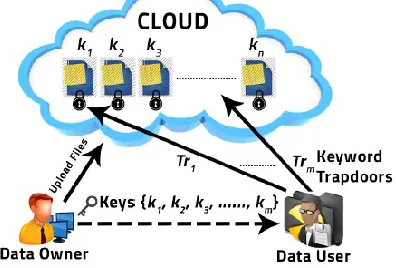
among the different sort of users. In this way, needs to play out the seeking and decoding over the arrangement of archives. These keys must be send to a user utilizing a protected correspondence channel, additionally in what capacity can a user store and deal with these keys in their gadgets like cell phones, PCs, portable PCs, removable gadgets and so on. Talking about the customary technique for data sharing through different cloud storage suppliers, in Fig.1 it comprises of two sorts of users: Data proprietor and Data user. Data proprietor is transferring n quantities of reports to cloud server which are imparted to the data user. By and large, each record is encoded with a different key, i.e. on the off chance that n reports are to be encoded than n keys are required to perform encryption utilizing them. The key produced is send to the data user by means of a safe correspondence channel by the data proprietor.
Fig. 1. Traditional Approach of data sharing
Various techniques have been proposed for data sharing via cloud storage, their efficiency is to be increased by means of development of new concepts and schemes.
2. LITERATURE SURVEY
Cloud storage has developed to end up noticeably prevalent and is received by numerous people and associations. The broadly appropriation of cloud storage raised a few security worries about the outsourced data, for example, classification, uprightness and access control of the data. Both scholarly and modern world are attempting endeavors to keep up the security of the outsourced data.
2.1 Access controls
Works have been done as to move and adjust the develop conventional approval administration to cloud computing. Other than that, a progression of new access control plans and arrangements have been examined and formulated for cloud condition in view of the general access control arrangements.
2.1.1 Identity-Based Encryption (IBE)
IBE of all the entrance control structures, Attribute-Based Encryption (ABE) plans are the most famous ones because
of its adaptability and security. Dissimilar to Access Control List (ACL) just characterizes which elements have the entrance right, ABE plans encode the data under the entrance arrangement which just guarantee the qualified substances to do unscrambling. A recognized work Fuzzy Identity-Based Encryption (IBE) was presented by Sahai and Waters in 2005. In Fuzzy IBE conspire, a private key for a character set! , can be utilized to unscramble a figure content encoded with a marginally unique personality set! '. Fluffy IBE acknowledges blunder resistance by setting the edge estimation of root hub littler than the extent of personality set.
2.1.2 Key Policy Attribute-Based Encryption
In view of Fuzzy IBE, Goyal et al. introduce Keypolicy-Attribute Based Encryption (KP-ABE) in which ciphertexts are marked with sets of properties and private keys are related with get to structures that control which cipher texts a user can decode. In this plan when a user made a mystery ask for, the trusted expert figured out which blend of qualities must show up in the ciphertext for the user to unscramble.
2.1.3 Ciphertext Policy Attribute Based Encryption Bethencourt et al. acquainted a reciprocal plan with KP-ABE, called Ciphertext Policy-Attribute Based Encryption (CP-ABE). In this ciphertext strategy quality based encryption framework, a user's private key is related with an arrangement of characteristics and scrambled figure content will determine an entrance approach over traits. A user will have the capacity to decode if and just if his characteristics fulfill the figure content's arrangement. A standout amongst the most difficult issues in data sharing frameworks is the authorization of access arrangements and the help of approaches refreshes. CP-ABE is turning into a promising cryptographic answer for this issue. It empowers data proprietors to characterize their own entrance arrangements over user traits and uphold the strategies on the data to be disseminated.
2.2 Literature Survey on Related Works
access control which depends on catchphrase looking. In any case, in the event of MUSE there are two noteworthy issues which are not considered are: (1) How to check whether a user has the privilege to get to the archive? (2) How to diminish the quantity of trapdoor created and adds up to number of shared keys?
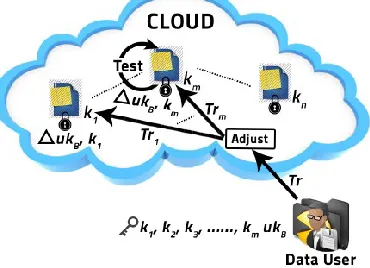
2.2.2 Multi-Key Searchable Encryption (MKSE) Considering the multi user based applications, the proportion of number of trapdoors is straightforwardly comparable to the quantity of sought archives. MKSE was produced and exhibited in the year 2013. This algorithm is clarified as a data user to give a solitary trapdoor which comprises of a solitary watchword to the cloud server. Yet, on other hand, the cloud server offers arrangement to look over the catchphrase trapdoor by utilizing distinctive keys. In Fig.2, it comprises of a Multi-Key Searchable Encryption (MKSE) which demonstrates that an data user is presenting his/her created trapdoor(Tr) to cloud server and the cloud server playing out the change and test algorithm on the report accumulation.
Fig. 2. Multi-Key Searchable Encryption
The primary objectives of both i.e. KASE and MKSE are totally unique thoughts. Objective of MKSE: when watchword seek is performed by the cloud server with just a single trapdoor on various sorts of user claimed reports, that of KASE: by for the most part giving the created single total key to data users in a gathering sharing based framework. Talking more about the MKSE, data user can store open information data which is known as Delta on cloud server. This open data is applicable to data user key and utilized encryption key. Data user can perform looking for a word on every one of the archives, for doing this he/she needs the data user key to figure the trapdoor for the word and straightforwardly present this created trapdoor incentive to cloud server. Cloud server utilizes this data to change over got watchword trapdoor on the key searchable with the data user. This procedure is known as modify. Thusly, cloud server can perform conventional looking by methods for single-key with the recently produced trapdoor.
2.2.3 Key-Aggregate Encryption (KAE)
As of late more consideration has been made around the cloud storage, which depends on data sharing frameworks. By considering the paper which indicates out that how diminish the quantity of keys utilized for data encryption. In customary approach, all utilized encryption keys must be disseminated among the concerned approved users. This test is unraveled by KAE, where it produces a total key which will be utilized by the user to unscramble every one of the reports imparted to him/her. Idea of KAE is to get the first report by decoding with a solitary total key, which was scrambled with various keys. To play out this data proprietor, needs people in general key as well as the personality of each report. This is idea is adjusted from the communicated encryption conspire. Being developed of KAE plot, the data proprietor is outlined as supporter. Supporter will be having people in general key and ace mystery key. Data user is planned as the beneficiaries, who are tuning in to this safe communicate channel. By and large, talking about open data which comprises of different significant data like data proprietor's lord mystery key and encryption key. Here, data encryption is performed utilizing the symmetric encryption in communicate encryption. In any case, the key total and data unscrambling is finished by the algorithms like BE.Encrypt and BE.Decrypt individually. By utilizing plan, this assigns all the decoding rights to the data users. The issue with KAE, we can't perform seeking over the encoded records.
3. KEY-AGGREGATE SEARCHABLE ENCRYPTION (KASE)
Improvement of KASE plot thoughts is adjusted from papers like key-total cryptosystem conspires for versatile data sharing and Multi-key searchable encryption conspire. This was done to create a solitary total encryption enter in substitution of many quantities of individual free keys for every archive transferred by the data proprietor. Characterizing this plan each key which is utilized for looking is associated with a specific record of transferred archive. Formation of total key is finished by utilizing the data proprietor's lord mystery key with result of his/her open keys utilized for encryption. Watchword based seeking is performed by era of total trapdoor component. This is actualized by altering process. Than cloud server can utilize single balanced accumulated trapdoor which was made for each arrangement of report. 3.0.4 KASE Scheme Description. KASE Framework was portrayed in the above segment, this KASE conspire comprises of seven algorithms:
work. Cloud server communicates the produced framework parameter and open key.
(2) Keygen: This algorithm is controlled by data proprietor to produce his/her key combine which will be utilized for archive encryption by the Encrypt algorithm. In this stage, we have open key and ace mystery key alongside the created key match.
(3) Encrypt: This algorithm is controlled by data proprietor to perform data encryption and furthermore create relating cipher texts for every one of the records which will be transferred. For the making the watchword cipher texts, it takes the record list, arbitrarily picks a searchable encryption key for each archive and creates a delta data. It will deliver a ciphertext for a catchphrase, this created cipher texts are put away under cloud server.
(4) Extract: This algorithm is controlled by data proprietor and producing a total searchable encryption key and this key is send to every single approved user by means of a safe correspondence channel. This algorithm takes contribution as ace mystery key and produces a total key as yield. Data proprietor than send this total key to data users, with the goal that they can perform watchword looking over the common records.
(5) Trapdoor: This algorithm is controlled by data user and performs watchword looking by producing trapdoor. On account of hunting down coordinating applicable reports by utilization of single total searchable key. Just a single total trapdoor is created for a solitary watchword which is utilized for looking. Than data user sends this create single trapdoor and subset of coordinated reports.
(6) Adjust: This algorithm is controlled by cloud server and making right arrangement of trapdoor. It acknowledges contribution as framework freely searchable parameters, all records file in the set and furthermore single total trapdoor. It performs changing procedure on the single total trapdoor and yields another correct single trapdoor. This created trapdoor will be utilized for next Test algorithm for performing watchword look over the mutual gathering of archives.
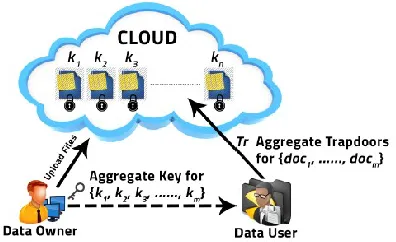
(7) Test: This algorithm is controlled by the cloud server. Cloud server does a progression of watchword looking by utilizing the data, which is balanced trapdoor and makes the delta data which is important to subset by utilizing searchable encryption key. Yield delivered will be parallel, i.e. genuine or false esteems subsequent to performing different algorithms. Key-total searchable encryption (KASE) technique for data sharing, in Fig.3 it comprises of two sorts of users: Data proprietor and Data user. Data proprietor is transferring n quantities of records to cloud server which are imparted to the data user. By and large, here archives is encoded by a key combine, this got enter match is changed into single total key by utilizing data proprietor open key and ace mystery key.
Fig. 3. Key-Aggregate Searchable Encryption
Structure of Key-total searchable encryption (KASE), in Fig.4 it comprises of a data proprietor produces a solitary total key which was made by utilizing data proprietor open key and ace mystery key for scrambling the common archives. This single total key created is send to the data user through a protected correspondence channel. At that point, data user can perform looking over the common reports by producing single total trapdoor, presented this trapdoor to the cloud server. Cloud server plays out the modifying algorithm/process by utilizing the total trapdoor over the accumulation of reports. At that point, test algorithm is performed to guarantee that the individual requester has the privilege to get to them. On the off chance that a match happens, than cloud server will restore all the common records to the separate data user.
Fig. 4. Framework of key-aggregate searchable encryption
4. EXPERIMENTAL RESULTS AND ANALYSIS
4.1 Performance Evaluation
Considering the investigations of different cryptographic operations in view of blending algorithm. Which can be effectively executed and be tried on both computers(Intel(R) Core(TM)i5-3337U CPU @ 1.80GHZ with OS as Windows7) and portable devices(Samsung G3502U telephone) is appeared as under in Table-1
Usage of this framework is done, by methods for two libraries: jpbc (for cell phones) and pbc library (for PC). If there should be an occurrence of cell phones, it takes around 5 seconds for blending algorithms. Be that as it may, the sensor hubs and Personal Digital Assistant (PDA) requires just 1.5 and 0.5 seconds individually. The above delineates the normal time required by cell phone and PC for performing blending based algorithms. PCs have speedier normal time for matching when contrasted with cell phones.
4.2 KASE Algorithm Evaluation
Considering every one of the algorithms (Setup, Keygen, Encrypt, Extract, Trapdoor, Adjust, Test) which were available in KASE plan and this plan is assessed on both cell phones and PCs.
(1) KASE Setup: Generally setup algorithm requires a direct execution time against the most extreme number of archives which were having a place with a specific data proprietor. At the point when the greatest number of reports achieves an estimation of 20000, the KASE Setup algorithms requires 259 seconds (PCs).
(2) KASE Encrypt: Execution time of this is additionally straight against the quantity of watchwords created. Considering the situation when the quantity of catchphrases achieves an estimation of 10000, the KASE Encrypt algorithms require 206 seconds in PCs, while in cell phones it takes 10018 seconds.
(3) KASE Extract: Execution time against the quantity of shared records is likewise straight. At the point when the quantity of catchphrases achieves an estimation of 10000, the KASE Extract algorithms require 132 seconds in PCs, while in cell phones it takes 2430 seconds.
(4) KASE Trapdoor: Execution time is a steady an incentive for both the cell phones and PCs. Considering the qualities, for example, 0.01 seconds in PCs, while in cell phones it takes 0.25 seconds. Considering the above qualities, catchphrase seeking should be possible all the more proficiently in both cell phones and PCs. Likewise contrasting and other searchable plans, KASE conspire is having considerable enhancements in trapdoor era.
(5) KASE Adjust: It likewise gives a straight connection, when plotted execution time against the quantity of reports searchable to perform modifying operation. It can be enhanced in useful applications all the more proficiently. (6) KASE Test: Execution time cost against the quantity of watchword cipher texts is additionally direct. Considering the execution of KASE Test algorithm is double the execution of blending based algorithms. At the point when the quantity of watchword cipher texts develops to an estimation of 20000, PCs takes 467 seconds for execution.
4.3 Group Data Sharing System Based Evaluation Speaking about the gathering data sharing framework where execution straight forwardly relies upon the KASE algorithms. To enhance the current framework, the reserving based enhanced method should be utilized to perform more effective method for catchphrase seeking. Preparing of KASE algorithm: when a total single trapdoor is gotten, the cloud server executes the KASE.Adjust and KASE.Test catchphrase seeking can be done. Considering the time assessment cost of Adjust algorithm is direct when plotted against the quantity of reports. Keeping in mind the end goal to dodge the current framework issue, for example, the rehashed number of count and enhancing the execution, the arrangement that a cloud server can give is to do some store algorithm of the outcomes acquired. Since, the info and computation handling are same for all arrangement of users. This operation will wipe out the time utilized for computation. Next consider the situation when user inquiries the archives accumulation for the second arrangement of time, KASE.Adjust can run considerably speedier in view of searchable pre-ascertained outcome. KASE.Test execution time is a straight organized diagram when plotted against the quantity of cipher texts created. To improve and increment the proficiency, strategies like parallel and dispersed registering, multi-string, hadoop might be utilized as a part of different situations at whatever point required. In our current framework case, multi-string strategies are utilized to play out every one of the tests. Next is play out the execution testing by setting the quantity of catchphrase cipher texts to 10000. Execution time of KASE.Test will decrease when the quantity of strings increments. Considering the number develops to an estimation of 200, KASE.Test requires just 1 second to totally playing out the catchphrase based seeking over the 10000 watchword cipher texts. At the point when the quantity of strings increments in expansive numbers, existing framework will set aside greater opportunity to produce these strings.
5. CONCLUSION
proprietor creates a solitary total key which will be utilized for encryption process and send this key to the whole approved user. On the flip side, data user makes and question through created single total trapdoor, this trapdoor delivered is utilized to inquiry over gathering of records shared by similar data proprietor. Examination of different approaches is done and performed matching algorithm investigation on framework and cell phone. In any case, future work of this is worried over the data shared under numerous proprietors and how to diminish the quantity of trapdoor era.
REFERENCES
[1] P. Van,S. Sedghi, JM. Doumen. “Computationally efficient searchable symmetric encryption”, Secure Data Management, pp. 87-100, 2010.
[2] S. Kamara, C. Papamanthou, T. Roeder. “Dynamic searchable symmetric encryption”, Proceedings of the 2012 ACM conference on Computer and communications security (CCS), ACM, pp. 965-976, 2012.
[3] D. Boneh, C. G, R. Ostrovsky, G. Persiano. “Public Key Encryption with Keyword Search”, EUROCRYPT 2004, pp. 506C522, 2004.
[4] Y. Hwang, P. Lee. “Public Key Encryption with Conjunctive Keyword Search and Its Extension to a Multi-user System”, In: Pairing-Based Cryptography C Pairing 2007, LNCS, pp.2-22, 2007.
[5] J. Li, Q. Wang, C. Wang. “Fuzzy keyword search over encrypted data in cloud computing”, Proc. IEEE INFOCOM, pp. 1-5, 2010.
[6] C. Chu, S. Chow,W. Tzeng, et al. “Key-Aggregate Cryptosystem for Scalable Data Sharing in Cloud Storage”, IEEE Transactions on Parallel and Cloud Systems, 2014, 25(2): 468- 477.
[7] X. Song, D. Wagner, A. Perrig. “Practical techniques for searches on encrypted data”, IEEE Symposium on Security and Privacy, IEEE Press, pp. 44C55, 2000. [8] R. Curtmola, J. Garay, S. Kamara, R. Ostrovsky. “Searchable symmetric encryption: improved definitions and efficient constructions”, In: Proceedings of the 13th ACM conference on Computer and Communications Security, ACM Press, pp. 79- 88, 2006.
[9] Cloud-Storage, http://www.thetop10best onlinebackup.com/cloudstorage.
[10]Amazon Web Services (AWS), http://aws.amazon.com. [11]GoogleApp Engine, http://code.google.com/appengine/. [12] Microsoft Azure, http://www.microsoft.com/azure/. [13] S. Yu, C. Wang, K. Ren, and W. Lou, “Achieving Secure, Scalable, and Fine-Grained Data Access Control in Cloud Computing”, Proc. IEEE INFOCOM, pp. 534-542, 2010.
[14] X. Liu, Y. Zhang, B. Wang, and J. Yan. “Mona: secure multi-owner data sharing for dynamic groups in the cloud”,
IEEE Transactions on Parallel and Cloud Systems, 2013, 24(6): 1182-1191.
ABOUT AUTHORS:
N.Jyothi is currently pursuing his M.Tech (CSE) in Computer Science and Engineering, CVR College of Engineering , Hyderabad, Telangana. She received her B.E in Computer Science and Engineering Department from MVSR College of Engineering, Hyderabad.