© 2014, IJCSMC All Rights Reserved
170
Available Online atwww.ijcsmc.com
International Journal of Computer Science and Mobile Computing
A Monthly Journal of Computer Science and Information Technology
ISSN 2320–088X
IJCSMC, Vol. 3, Issue. 11, November 2014, pg.170 – 174
RESEARCH ARTICLE
Effective Test Case Prioritization Technique in
Web Application for Regression Test Suite
Hari Sankar Chaini
1, Dr. Sateesh Kumar Pradhan
2¹Research Scholar, Dept. of computer Sc. And Application Utkal University, Vani Vihar, INDIA ²HOD, Dept. of computer Sc. And Application Utkal University, Vani Vihar, INDIA
1 [email protected]; 2 [email protected]
Abstract— Regression testing is retesting of a software system that has been modified to ensure that any bugs have been fixed and that no other previously working functions have failed as a result of the fixes and that newly added features have not created problems with previous versions of the software. Test case prioritization techniques, which are used to improve the cost-effectiveness of regression testing, order test cases in such a way that those cases that are expected to outperform others in detecting software fault are run earlier in the testing phase. In this paper we are describing the test suite prioritization through fault exposed. As a result, this will help us to prioritize the test suite for execution and coverage.
Keywords— Regression Testing, APFD, Regression Test Selection, Test Case prioritization
I. INTRODUCTION
Regression testing objective is to identify newly introduced defects in an existing application or functionality after system changes. The changes could be a major code changes, bug fixes, enhancements or configuration modifications. Software systems are tightly integrated together so that they are meet the intended results and satisfy business objectives. So there is a high probability of existing functionality not working because of the integration of the code changes, bug fixes, etc. with the existing code. This adverse change will result in either a newly introduced defect or a re-emergence of an existing broken code.
© 2014, IJCSMC All Rights Reserved
171
II. REGRESSION TESTING TECHNIQUESLet P be a program [3], let P′ be a modified version of P, and let T be a test suite for P. Regression testing consists of reusing T on P′, and determining where the new test cases are needed to effectively test code or functionality added to or changed in producing P′.
There is various regression testing techniques. Figure 1 shows various regression testing techniques.
Retest all
Regression Test Selection
Prioritization of Test cases
Figure1. Regression Testing Techniques
Retest All: - Retest all method is one of the conventional methods for regression testing in which all the tests in the existing test suite is reran. So the retest all technique is very expensive as compared to other techniques [3]. This method is costly to execute in full as it require more time and budget.
Regression Test Selection (RTS): - We first-rate a part of test suite to replay if the cost of ranking a part of test suite is less than the cost of running the tests that Regression Test selection allows us to ignore. RTS splits the existing test suite into below test cases.
Reusable test cases: - The test cases should be design in such a manner with fact and figure so that whenever same functionalities appear fully or partially, they can be used without any modification. Reusable test cases need not be run because they will give the same result as previous tests.
Re-testable test cases:- This includes both types of test cases which should be repeated because the program constructs being tested are modified, although the specification for the program constructs are not modified, observe that although these test cases specify the correct input/output relations, they may not be testing the same program constructs as before the modification.
Obsolete test cases: - This test includes both types of test cases that can no longer be used.
There are three ways that a test case may become obsolete
1. If a test case specifies an incorrect input-output relation due to a modification to the problem specification, then it can no longer be used.
2. If the targeted program component has been modified, some test cases may correctly specify the input-output relation but may not be testing the same construct
© 2014, IJCSMC All Rights Reserved
172
III. TEST CASE PRIORITIZATIONThis technique of regression testing prioritize the test cases so as to increase a test suite„s rate of fault detection that is how quickly a test suite detects faults in the modified program to increase reliability. This is of two types:
General prioritization which attempts to select an order of the test case that will be effective on average subsequent versions of software [6].
Version Specific prioritization which is concerned with particular version of the software.
Test Case Prioritization can be classified further as given below:
Comparator techniques: These involve of random ordering and optimal ordering.
Statement level techniques: These methods are also known as Fine Granularity. They involve of total statement coverage prioritization, additional statement coverage prioritization, total fault-exposing-potential (FEP) prioritization an additional FEP prioritization.
Function level techniques: These techniques are also known as Coarse Granularity. They consist of total function coverage prioritization, additional function coverage, total FEP prioritization, and additional FEP prioritization, and total fault index (FI) prioritization, additional Fault Index (FI) prioritization, total FI with FEP coverage prioritization and additional FI with FEP coverage prioritization.
IV. TEST SUITE IDENTIFICATION THROUGH AVERAGE OF THE PERCENTAGE OF FAULT DETECTED (APFD) As described in [9], a typical regression testing procedure can be elaborated as:
Step 1:- Involves the regression test selection i.e. selecting a subset T‟ of T in order to test P‟
Step 2:- Involves test suite execution i.e. test P‟ with T‟ means executing the test suites and checking test results to measure the correctness of P‟
Step 3:- Involves the identification of code coverage i.e. to determine whether P‟ has new functionality which requires to create new test cases for P‟
Step 4:- Involves executing new test cases to test P‟, establishing correctness
Step 5:- Involves the test suite maintenance i.e. updating and storing test information means maintaining test execution profile for P‟
When the user is selecting test suite for the regression testing, it has to be prioritized. We can validate through the APFD. APFD, which measures the weighted average of the percentage of faults detected over the life of the suite. APFD values range from 0 to 100; higher numbers imply faster (better) fault detection rates [3].
Let T be a test suite containing n test cases, Let F be a set of m faults revealed by T.
Let TFi be the 1st test case in ordering T‟ of T which reveals fault i. The APFD for test suite T0 is given by the equation:
APFD = 1 – (TF1 + TF2 + TF3 + TF4………. + TFn) + 1 nm 2n
© 2014, IJCSMC All Rights Reserved
173
TABLEIMODULES AND SCENARIOS MATRIX
1 2 3 4 5 6 7 8 9 10
A X X X
B X X X X X X X
C X X X
D X X X
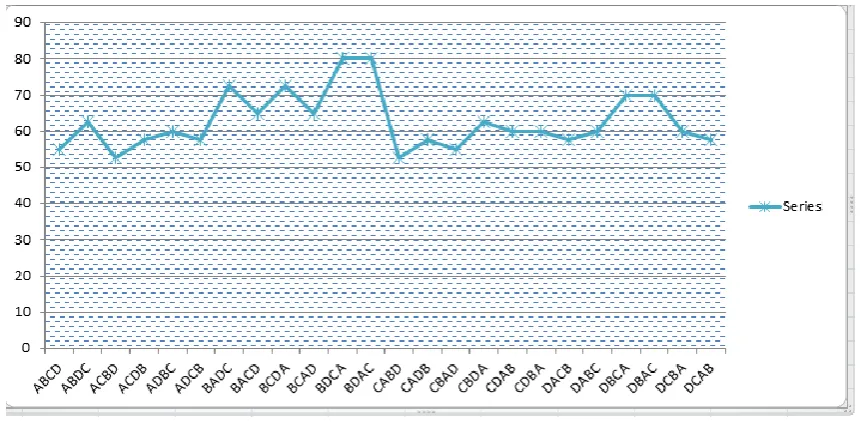
Considering the above mentioned table (Table-I), we can get the below APFD (Table-II) result. Which show the test suite “BDCA” and “BDAC” have APFD “80%”, has capability of fastest fault detecting capabilities than other test suite.
TABLEIII
PERMUTATION OF MODULES WITH APFD CALCULATED VALUES
Test Suite APFD Test Suite APFD Test Suite APFD Test Suite APFD
ABCD 55 BADC 72.5 CABD 52.5 DACB 57.5
ABDC 62.5 BACD 65 CADB 57.5 DABC 60
ACBD 52.5 BCDA 72.5 CBAD 55 DBCA 70
ACDB 57.5 BCAD 65 CBDA 62.5 DBAC 70
ADBC 60 BDCA 80 CDAB 60 DCBA 60
ADCB 57.5 BDAC 80 CDBA 60 DCAB 57.5
From analysis of the above result, we reach to the below APFD Graph (Figure-2), where the user will able to know the coverage of the test cases for a particular test suit and choose the suit as and when it is suitable for the different build or releases.
© 2014, IJCSMC All Rights Reserved
174
There are several prioritization techniques available for identification of regression suite, but we must to find out prioritization technique which is best applicable for specified application. It contains the analysis of the below mention points. How do techniques differ in terms of their ability to reduce regression testing costs?
How do techniques differ in terms of their ability to detect faults?
What trade-offs exist between test suite size reduction and fault detection ability?
When is one technique more cost-effective than another?
How do factors such as program design, location and type of modifications, and test suite design affect the efficiency and effectiveness of test selection techniques?
V. CONCLUSION
The greatest persistent need for future work, involves additional studies of prioritization applied to a wider variety of applications, modified applications, test suites, and faults. More over data will help us better understand the characteristics inducing cost-effectiveness, and help us further distinguish techniques through additional metrics. We can extend our analysis to multiple types of faults; develop time-series-based models, capturing notions of amortized analysis and non-constant fault densities, rerun these experiments using larger programs with more complex fault distributions to find an efficient and effective regression suite.
R
EFERENCES[1] Shin Yoo, Mark Harman, Paolo Tonella and Angelo Susi, "Clustering Test Cases to Achieve Effective & Scalable Prioritisation Incorporating Expert Knowledge," In.Proc.of the eighteenth international symposium on Software testing and analysis, pp. 201 - 211, 2009.
[2] Renee Bryce, Sreedevi Sampath, Jan B. Pedersen and Schuyler Manchester, "Test Suite Prioritization by Cost-based Combinatorial Interaction Coverage," International Journal of Systems Assurance Engineering and Management, Vol.2, No.2, pp.126-134, Apr 2011.
[3] Sebastian Elbaum, Praveen Kallakuri, Alexey G. Malishevsky, Gregg Rothermel, Satya Kanduri, “Understanding the Effects of Changes on the Cost-Effectiveness of Regression Testing Techniques,” Journal of Software Testing, Verification, and Reliability, 13(2) pages:65-83, June 2003.
[4] H. Leung and L. White, “Insights into regression testing,” In Proceedings of the Conference on Software Maintenance, pages 60-69, Oct. 1989.
[5] K.K.Aggarwal & Yogesh Singh, “Software Engineering Programs Documentation, Operating Procedures,” New Age International Publishers, Revised Second Edition – 2005.
[6] G. Rothermel, R.H. Untch, C. Chu, and M.J. Harrold, “Prioritizing Test Cases for Regression Testing,” IEEE Trans. Software Eng., vol. 27, no. 10, pages 929-948, Oct. 2001.m1014047
[7] Allent Kent, James G. Wllllams, “Encyclopedia of Computer science and Technology”, page 311
[8] Sachin Kumar, Vipin Kumar, “Introduction of Software Maintenance Testing”, International Journal of Advanced Research in Computer Science and Software Engineering, Volume 4, Issue 5, May 2014. [9] G. Rothermel and M. J. Harrold, Analyzing Regression Test Selection Techniques, IEEE Transactions on