Fast Root-MUSIC Algorithm Based on Nystr¨
om Method
and Spectral Factorization
Xiaoyu Liu*, Junli Chen, and Lveqiu Xu
Abstract—A fast Root-MUSIC algorithm based on Nystr¨om method and spectral factorization is proposed. By using Nystr¨om method, only two sub-matrices of the sample covariance matrix are calculated, which avoids complete calculation and has the advantage of low computational complexity. At the same time, the polynomial coefficients of the Root-MUSIC based on the Nystr¨om method are conjugated, and the order of the polynomial is reduced by half when using iterative operations. Finally, the root algorithm is used to estimate the DOA. The performance of the proposed algorithm is demonstrated by simulation results.
1. INTRODUCTION
Direction-of-arrival (DOA) estimation is an important part of array signal processing. Due to the demand for real-time processing of signals, fast DOA estimation has been a hot topic for DOA estimation. Multiple signal classification (MUSIC) algorithm [1] is one of the classical algorithms. This algorithm obtains a covariance matrix from the received signal, which uses the orthogonal nature of subspace to perform eigenvalue decomposition on the covariance matrix, then it can obtain the signal subspace and noise subspace, because they are orthogonal to each other. The DOA estimation is achieved by a needle-like spatial spectrum search. Later, the Root-MUSIC algorithm [2] was proposed. This algorithm replaces the peak search in the MUSIC algorithm with finding the roots of a polynomial, which reduces the computational complexity. However, when dealing with large arrays or large samples, the computational complexity is still large because they involve the process of sample covariance matrices and eigenvalue decomposition. For this reason, new algorithms that can guarantee the accuracy of algorithms and reduce the computational complexity are still being developed.
In order to achieve rapid DOA estimation, researchers have proposed a series of improvements. For example, by introducing a unitary matrix [3], the information of DOA estimation is transformed from the complex field to the real domain, which accelerates the operation of the algorithm. There are other algorithms that can reduce the computational complexity such as Fast Root-MUSIC [4] and Fourier domain Root-MUSIC (FD-Root-MUSIC) [5]. Although these algorithms accelerate the operation of the algorithm, they also sacrifice a certain degree of estimation accuracy. With the developments of these algorithms, subspace-based algorithms are also developing rapidly. In the 1990s [6], it had been proposed to use the propagation method (PM) to find the noise subspace, and then use the MUSIC algorithm to perform DOA estimation. This algorithm has no eigenvalue decomposition, but its essence still depends on the calculation of the sample covariance matrix. When the array number or the sample number is large, the performance of the algorithm will become worse. Later, Nystr¨om method was proposed, which was first exploited by Williams and Seeger [9] for sparsifying kernel matrices through approximating their entries. It was developed for spectral methods such as grouping problems [10]. Recently, the Nystr¨om method has been widely used in electromagnetic scattering [7] and acceleration
Received 3 June 2018, Accepted 9 August 2018, Scheduled 7 September 2018 * Corresponding author: Xiaoyu Liu ([email protected]).
algorithms [8]. The Nystr¨om method already has a preliminary model for DOA estimation in [11]. It can avoid calculating the sample covariance matrix and its eigenvalue decomposition. The ESPRIT algorithm based on the Nystr¨om method [12] and MUSIC algorithm based on the Nystr¨om method were proposed [13]. In [14], a way is mentioned to reduce the order of polynomials by using the conjugate of the root. This method is based on the Laurent polynomial structure [15]. Recently, a spectral factorization [16] algorithm has been proposed, which accelerates the running time of the algorithm while keeping the accuracy of the algorithm almost unchanged.
This paper proposes a fast Root-MUSIC algorithm based on Nystr¨om method and spectral factorization. First, we find the approximate noise subspace through the Nystr¨om method. Then by using the the approximate noise subspace, we can get the polynomial of the Root-MUSIC algorithm based on the Nystr¨om method. Finally, spectral factorization is used to reduce the polynomial order of the Root-MUSIC algorithm based on the Nystr¨om method. The computational complexity is reduced compared to the original algorithm, and the accuracy of the algorithm does not decrease. Computer simulation results prove the effectiveness of the algorithm.
2. PROBLEM FORMULATION
We considerP narrowband signals incident on a uniform linear array (ULA). The ULA is composed of
M sensors, and array elements are independent of each other. Let the signal DOA beθ1, θ2 . . . , θp. The
number of snapshots isN, and the distance between adjacent array elements is d. The received signal from array element can be expressed as:
X(t) =A(θ)S(t) +N(t), t= 1, . . . , N (1) where X(t) is a M ×1 array observation vector, S(t) a P ×1 signal vector, N(t) a M ×1 Gaussian white noise vector, andA(θ) aM×P steering matrix, it can expressed as:
A(θ) = [a(θ1), a(θ2), . . ., a(θP)] (2)
The steering vector a(θi) is defined as:
a(θP) =
1, ej2πsinθPd/λ, . . . , ej2π(M−1) sinθPd/λT (3)
The covariance matrix of X(t) is defined as: R=E
X(t)X(t)H
=ARSAH +σn2IM (4)
whereRS is the sources covariance matrix,σ2n the noise power, IM the M×M identity matrix, andd
isλ/2.
3. THE PROPOSED ALGORITHM
3.1. Root-MUSIC Algorithm Based on Nystr¨om Method
In order to use the Nystr¨om method for DOA estimation, we need to decompose the received signal matrixX into the following form:
X=
X1
X2
(5)
where X1 is a K ×N matrix, and X2 is a (M −K)×N matrix. They represent the information
received by the firstK sensors and the remaining (M −K) sensors. Here we define the range ofK as (1,2, . . . , M) and then define:
R11 = E
X1XH1
=A1RSAH1 +σ2nIK (6)
R21 = E
X2XH1
where A1 = A(1 : K,:), represents the first K row vectors of the matrix A. A2 = A(K + 1 : M,:),
represents the last (M −K) row vector of the matrix A. We must ensure that R11 is of full-rank and
K must satisfy the following relationship:
P ≤K≤min(M, N) (8)
In the algorithm, the choice ofK does not need to be too large. When the number ofM increases, we only need to select a relatively smallK value to ensure the estimation accuracy if the SNR is large. This helps to reduce the time complexity of the algorithm, and here are the main steps of the algorithm.
R11=U11Λ11UH11 (9)
whereU11Λ11UH11is the eigenvalue decomposition of matrixR11, andΛ11is the corresponding diagonal
matrix with eigenvalue in descending order. In addition, R21, U11 and Λ11 satisfy the following
relationship:
R21U11=U21Λ11 (10)
It can be further expressed as:
R21=U21U11Λ−111 (11)
where U21 is the corresponding eigenvector matrix of R21. Construct a new matrix based on formula
(11):
U=
U11
U21
(12)
The following steps are taken to avoid the process of eigenvalue decomposition of the received signal covariance, and the noise subspace required by the MUSIC algorithm will be obtained.
G=UΛ1/211 (13)
GHG=Q (14)
UGΛGUHG=Q (15)
F=GUG (16)
˜
Un=F(:, P+ 1 :K) (17)
In formula (15), UGΛGUHG is the eigenvalue decomposition of Q, where UG represents the eigenvector matrix, and ΛGis the corresponding diagonal matrix with eigenvalues in descending order.
˜
Un is the approximate noise subspace of Nystr¨om algorithm.
The MUSIC algorithm needs spatial traversal peak search. When using Root-MUSIC algorithm, the spatial traversal peak search is replaced by finding roots of the polynomial, which reduces the computational complexity. For ULA, the polynomial of Nystr¨om algorithm can be expressed as:
f1(z) =aH(z) ˜UnU˜Hna(z) (18)
where a(z) = [1, z, . . . , zM−1]T and z = ej2πsinθPd/λ. DOA can be estimated by finding the roots of
polynomial f1(z). Because f1(z) contains z∗ terms, it can be expressed to this form:
f2(z) =aT
z−1 U˜nU˜Hna(z) (19) wheref2(z) is a 2(M−1) order polynomial, and there are (M−1) pairs of conjugated roots. The DOA
estimation information can be obtained by the following formula:
θi = arcsin
1
2πdarg{zi}
3.2. Spectral Factorization Algorithm
Because there are (M −1) pairs of conjugate roots in f1(z), it can be defined that it has (M −1)
independent roots. By using the conclusion, we can reduce its computational complexity again. Letf1(z) be expressed in the following formula:
f1(z) =
(M−1)
−(M−1)biz i, b
i =b∗−i (21)
In formula (21),bi is the coefficient of zi, and b−i is the coefficient of z−i. Because of the Hermite
matrix properties of ˜UnU˜Hn, bi and b−i are conjugated. According to the literature [15], f1(z) can be
represented as:
f1(z) = Lb(z)rbL∗bz−∗ (22)
Lb(z) =
(M−1)
i=1 (1−aiz
−1) (23)
rb =
b(M−1)
(−1)(M−1)(M−1)
i=1 ai
(24)
Ifz1 is a root off1(z) then using the conjugate relationship of the root, we know thatz1−∗ is also
a root of f1(z). These two roots are conjugate symmetrical about the unit circle. It can be explained
that when there are (M−1) roots in the unit circle or on the unit circle, the other (M−1) roots exist on the outside of the unit circle or on the unit circle. We only need to calculate the root in the unit circle to know all DOA information.
Complete the spectral factorization according to the following steps:
(1) A (M×2) matrixB0 is established, the elements inB0 are the coefficients of the formula (21) and
bi is a coefficient ofzi
B0 =
b0 −b−1 . . . b−(M−2) b−(M−1)
b−1 b−2 . . . b−(M−1) 0
T
(25)
(2) The following steps make ˜b1,k −˜b1,k−1 converge. ˜b1,k is defined as the first column of Bk and
˜b1,k−1 is the first column ofBk−1.
I: BkBk−1, and Uk satisfy the following relationship:
Bk = Bk−1Uk (26)
Uk = 1 1− γ2
1 −γ
−γ∗ 1
(27)
Uk is a (2×2) matrix,γ = [Bk−1]1,2/[Bk−1]1,1,γ is the ratio of two elements in the first row
of matrix Bk−1.
II: The first column of the matrix Bk calculated in step (1) remains unchanged, and the second column shifts one element up.
III: Set the threshold. Check the convergence of˜b1,k−˜b1,k−1, when˜b1,k−˜b1,k−1<threshold, it
satisfies the convergence condition. If not, return to step (1) until˜b1,k−˜b1,k−1<threshold.
The (M−1) order polynomial can be obtained by iterative calculation. fp(z) =p0+p−1z−1+
. . .+p−(M−2)z−(M−2)+p−(M−1)z−(M−1). Its coefficient is the first column element ˜b1,k ofBk.
3.3. Computational Complexity
In the traditional Root-MUISC algorithmthe estimated array covariance matrix (EACM) [17] computation requiresO(M2N) flops, EVD/SVD requiresO(M3) flops. Here, flops stands for complex-valued floating point operations. The purposed algorithm only needs to compute R11 and R21 which
require O(K2N) flops and O(M N K−K2N) flops, respectively. In the purposed algorithm, we need
O(M K2) flops to construct noise subspace, therefore, before polynomial rooting, the traditional Root-MUISC algorithm needs O(M3+M2N) flops. The purposed algorithm needs O(M K2+M N K) flops.
It can be obtained by formula 8 that the purposed algorithm requires O(M K2+M N K) flops, which is less than O(M3+M2N) flops. Then the spectral factorization is used to reduce the 2(M −1) order polynomial to the (M −1) order polynomial, in the traditional Root-MUISC algorithm, polynomial rooting requires 4×O(M3) [17], but in the spectral factorization it only needs O(M3), and it can be obtained from the above analysis that the computational complexity of the purposed algorithm is less than traditional Root-MUISC algorithm.
4. SIMULATION
All the following experiments are running on MATLAB. This experiment is used to compare the root mean square error (RMSE) between the proposed algorithm and the traditional Root-MUSIC algorithm. In this simulation, the experiment uses a ULA structure. The distance between adjacent array elements isd=λ/2, and two narrow-band Gaussian signals are assumed to impinge upon the ULA from directions
θ1 = 40◦ and θ2 = 60◦. The added noise is zero-mean Gaussian white noise. The SNR is defined as
the ratio of the power of the source signals to that of the additive noise. The number of Monte Carlo experiments is 500, and the root mean squared error (RMSE) of signal DOA estimation by each algorithm is defined as:
RMSE =
1
500
500
1
(ˆθi−θ) 2
(28)
where ˆθi is the ith estimation ofθ.
In the simulation experiment of Figure 1, we explore the influence of the spectral factorization threshold on the RMSE of the proposed algorithm. Assume that the K value is M/2 (the specific K
value will be further determined in the following experiment). The results in Figure 1 show that the threshold will have an impact on the RMSE of the proposed algorithm. When the threshold is larger, the RMSE is also larger. When the threshold is 0.01, its RMSE is almost equal to 0.005, indicating
0.4
0.2
0
RMSE (degree)
-14 -12 -10 -8 -6 -4 -2 0 2 4 6 8 10 12 SNR/dB
Figure 1. RMSE of the DOA estimation varies with Iterative threshold.
Sensor number
Running time (second)
40 45 50 55 60 65 70 2.4
2.2
2
1.8
1.6
1.4
1.2
1
0.8
Figure 3. RMSE of the DOA estimation varies with SNR (M = 20).
Figure 4. RMSE of the DOA estimation varies with SNR (M = 30).
that when the threshold reaches a certain value, it is almost meaningless to select a smaller threshold. This result can be proved by the simulation experiment in Figure 2.
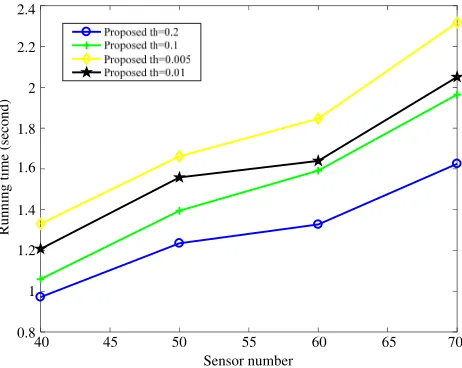
In the simulation experiment of Figure 2, we explore the effect of the spectral factorization threshold on the running time of the algorithm as the number of array elements changes. The results in Figure 2 show that when the threshold is larger, the algorithm needs less time to run Combined with the results of Figure 1, we can determine that when the selection of threshold is 0.01, the algorithm’s running time is relatively short, and the RMSE is also almost minimal. Therefore, in the following simulation experiments, the spectral factorization threshold was selected as 0.01.
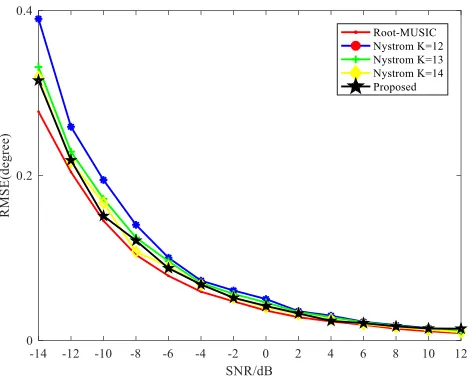
In the simulation experiment of Figure 3, we set the number of array elements M to 20 and the value of SNR to be−14 dB to 12 dB. The choices ofK of the Nystr¨om method are 12, 13 and 14. Kis set to 14 in the proposed algorithm. From Figure 2, we can see that with the increase ofK, the performance of the algorithm becomes better. However, when K increases to a certain degree, the performance of the Nystr¨om algorithm and the traditional Root-MUSIC algorithm is almost the same under a larger SNR. The performance of the algorithm based on Nystr¨om method and spectral factorization proposed in this paper has almost the same accuracy as that of the Root-MUSIC.
In the simulation experiment in Figure 4, we set the number of array elementsM to 30 and SNR values to be −14 dB to 12 dB. The choice ofK of the Nystr¨om method is 16, 17 and 18. K is set to 18 in the proposed algorithm. As can be seen from Figure 3, with the number of elements M increasing,
K also needs to be increased to achieve better estimation accuracy. WhenK is 18, it can be seen that under the larger SNR, the estimation accuracy of the Nystr¨om method is almost the same as Root-MUSIC algorithm. In this paper the spectral factorization algorithm K based on the Nystr¨om method proposed is chosen as 18, and its performance is almost the same as that of Root-MUSIC.
In the simulation experiment of Figure 5, we get the result that the running time of each algorithm varies with the increasing ofKvalue. Running time is the average time for 500 experiments. The choice of K in the Nystr¨om algorithm is 20 and 25. The K chosen for the proposed algorithm is 25. It can be seen from Figure 4 that the smaller the value ofK is, the faster the algorithm runs. The reasonable choice of K value in DOA estimation is to reduce the algorithm running time while ensuring higher estimation accuracy. The proposed algorithm greatly reduces the algorithm’s computation time while ensuring the accuracy. When the number of array elements is large, the proposed algorithm is more effective.
In the simulation experiment in Figure 6, with the increase of the signal source based on the large array (M = 100), we explore the variation of the RMSE of the proposed algorithm and the traditional Root-MUSIC algorithm. It can be seen from the results in Figure 6 that as the signal sources continue to increase, the purposed algorithm still runs with high precision, which proves its effectiveness in the actual situation.
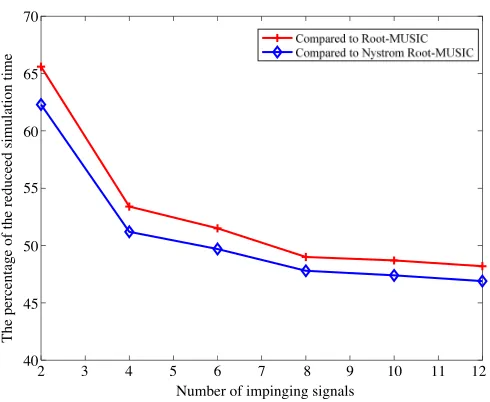
In the simulation experiment in Figure 7, with the increase of the signal source, in order to explore the change of the running time of the proposed algorithm compared with the traditional algorithm, the reduced running time of Monte Carlo simulations (denoted byTr) is involved and defined as:
Tr = Ttrad−Tprop
Tprop ×
100% (29)
whereTtradandTproprespectively represent the averaged Monte Carlo simulations time of the traditional
method and the proposed algorithm. It can be seen from the results in Figure 7 that the reduced simulation time decreases as the signal source continues to increase, but it still stays at a high value, and the decreasing trend is gradually slower. The results show the effectiveness and superiority of the proposed algorithm in practical applications.
Sensor number
Running time (second)
Figure 5. Running time of the DOA estimation varies with sensor number.
0.01
0.005
0
RMSE (degree)
Number of impinging signals
2 3 4 5 6 7 8 9 10 11 12
Figure 6. RMSE of the DOA estimation varies with the number of impinging signals (M = 100).
Number of impinging signals
2 3 4 5 6 7 8 9 10 11 12
The percentage of the reduceed simulation time
70
65
60
55
50
45
40
5. CONCLUSION
In this paper, a fast Root-MUSIC algorithm based on Nystr¨om method and spectral factorization is proposed. This algorithm uses the Nystr¨om Root-MUSIC algorithm on the basis of maintaining accuracy, and then using spectral factorization, the algorithm time is optimized again compared to the traditional Root-MUSIC algorithm. Through multiple experiments, it is concluded that the K
value should be between (M/2−M), and the threshold should be between (0.005–0.1). Simulation experiments show that this algorithm requires reasonable selections of threshold and K value, which ensures the algorithm not only guaranteeing the estimation accuracy under higher SNR, but also making the algorithm run faster.
REFERENCES
1. Schmidt, R. O., “Multiple emitter location and signal parameter estimation,” IEEE Transactions on Antennas and Propagation, Vol. 34, No. 3, 276–280, 1986.
2. Rao, B. D. and K. V. S. Hari, “Performance analysis of root-MUSIC,” IEEE Transactions on Acoustics Speech & Signal Processing, Vol. 37, No. 12, 1939–1949, 1989.
3. Qian, C., L. Huang, and H. C. So, “Improved unitary root-MUSIC for DOA estimation based on pseudo-noise resampling,”IEEE Signal Processing Letters, Vol. 21, No. 2, 140–144, 2013.
4. Ren, Q. S. and A. J. Willis, “Fast root MUSIC algorithm,” Electronics Letters, Vol. 33, No. 6, 450–451, 1997.
5. R¨u, B. M. and A. B. Gershman, “Direction-of-arrival estimation for nonuniform sensor arrays: From manifold separation to fourier domain MUSIC methods,”IEEE Transactions on Signal Processing, Vol. 57, No. 2, 588–599, 2009.
6. Marcos, S., A. Marsal, and M. Benidir, “The propagator method for source bearing estimation,” Signal Processing, Vol. 42, No. 2, 121–138, 1995.
7. Tong, M.-S. and C. C. Weng, “Nystr¨om method with edge condition for electromagnetic scattering by 2D open structures,” Progress In Electromagnetics Research, Vol. 62, 49–68, 2006.
8. Drineas, P. and M. W. Mahoney, “On the Nystr¨om method for approximating a gram matrix for improved kernel-based learning,”Journal of Machine Learning Research, Vol. 6, No. 12, 2153–2175, 2005.
9. Williams, C. K. I. and M. Seeger, “Using the Nystr¨om method to speed up kernel machines,” International Conference on Neural Information Processing Systems, 661–667, 2000.
10. Fowlkes, C., S. Belongie, F. Chung, and J. Malik, “Spectral grouping using the Nystr¨om method,” IEEE Transactions on Pattern Analysis &Machine Intelligence, Vol. 26, No. 2, 214–225, 2004. 11. Qian, C. and L. Huang, “A low-complexity Nystr¨om-based algorithm for array subspace
estimation,” Second International Conference on Instrumentation, Measurement, Computer, Communication and Control, 112–114, 2012.
12. Qian, C., L. Huang, and H. C. So, “Computationally efficient ESPRIT algorithm for direction-of-arrival estimation based on Nystr¨om method,”Signal Processing, Vol. 94, No. 1, 74–80, 2014. 13. Liu, G., H. Chen, X. Sun, and R. C. Qiu, “Modified music algorithm for doa estimation with
Nystr¨om approximation,” IEEE Sensors Journal, Vol. 16, No. 12, 4673–4674, 2016.
14. Yan, F. G., Y. Shen, and M. Jin, “Fast DOA estimation based on a split subspace decomposition on the array covariance matrix,” Signal Processing, Vol. 115, No. 10, 1–8, 2015.
15. Sayed, A. H. and T. Kailath, “A survey of spectral factorization methods,” Numerical Linear Algebra with Applications, Vol. 8, No. 8, 467–496, 2001.
16. Yan, F. G., Y. Shen, M. Jin, and X. Qiao, “Computationally efficient direction finding using polynomial rooting with reduced-order and real-valued computations,” Journal of Systems Engineering &Electronics, Vol. 27, No. 4, 739–745, 2016.