ISSN 2286-4822
www.euacademic.org DRJI Value: 5.9 (B+)
Modeling and Forecasting Foreign Trade of the
Philippines Using Time Series
SARIMA Model
JACKIE D. URRUTIA ELIZA MAE D. ALANO PRECIOUS MARJON R. ANINIPOT KHRISTINE A. GUMAPAC JOCELYN Q. QUINTO
Polytechnic University of the Philippines The Philippines
Abstract:
Foreign Trade plays an important role in economic development of a country. It encourages local investment and increases foreign investments by providing incentives to foreign investors. Foreign Trade also brings price stability and increases national income of the country. Therefore, it is very essential to monitor the trend of Foreign Trade of the Philippines. The researchers identified the determinants of Imports and Exports using Stepwise Regression Analysis and forecasted Foreign Trade of the Philippines using time series statistical forecasting process, Seasonal Autoregressive Integrated Moving Average (SARIMA). Correspondingly, Pairwise Granger Causality was utilized in order to verify the causal relationship between the different economic variables. The study examined twenty three years monthly data from 1990 up to 2013. The bases of gathered data were from National Statistical Coordination Board, Department of Labor and Employment, and Banko Sentral ng Pilipinas. The study showed that all of the Independent variables:
Exchange Rate ( ), Monthly Domestic Crude Oil Prices ( ), Inflation
predict Imports (y1). On the other hand, there are only three significant factors in dependent variable – Exports (y2). These are: Exchange Rate ( ), Monthly Domestic Crude Oil Prices ( ) and Inflation Rate ( ). In addition, Pairwise Granger Causality Test indicated that Domestic Crude Oil have uni- directional Granger causal relationship with Import and Export. The best fitted models used in generating a 7- year forecast of Imports and Exports are SARIMA (5, 0, 8) x (0, 1, 1)12 and
SARIMA (7, 2, 3) x (0, 1, 1)12 respectively for it achieved 95.63% and
88.34% variability. And to test the significance of the actual and predicted value, Paired t- test was used, signifying that there is no significant difference between actual and predicted value. This study will be of significance in estimating future Foreign Trade of the Philippines in order to prepare for the expected changes and to bring accurate and realistic decisions.
Key words: Imports, Exports, SARIMA, Stepwise Regression Analysis, Forecasting
Introduction
Gross Domestic Product (GDP) is one way to measure the economic performance of a country. According to expenditure method, it constitutes Consumer Spending, Capital Investment, Government Spending and Net Exports which represents Exports minus Imports. Foreign trade has a big impact in the development of the economy of every country as can be gauged in the components of GDP
funds from a country. Imports contribute to the economic growth of a country if these will improve long run economic productivity thus enhancing Exports.
There are several factors which affects Imports and Exports. The researchers consider four (4) explanatory variables. These are: Exchange Rate ( ), Monthly Domestic Crude Oil Prices ( ), Inflation Rate ( ) and Interest Rate ( ). This study will be of significance in determining significant factors of both Imports and Exports and estimating future Imports and Exports of the Philippines. Accuracy of estimated imports and exports is very much important in order to prepare for the expected changes and to bring accurate and realistic decisions. Fluctuations of exports introduce uncertainties in an economy which influence economic behavior by adversely affecting the level and efficiency of investment and in turn have a negative effect on growth. Instability of exports also leads to raising borrowing costs and Inflation. On the other hand, Rising Imports also have a negative effect on the level of domestic currency versus foreign currency, or the exchange rate.
Objective of the Study
they should focus on. Moreover, Pairwise Granger Causality Test has been used to test causation between variables.
Statement of the Problem
The study aims to forecast the Import and Export of the Philippines for the next 7 years (2014-2020) using SARIMA time series model and identify its determinants by means of Stepwise Multiple Regression with the application of Eviews software. The purpose of the study is to answer the following questions:
1. What is the behavior of graph of the following variables?
1.1 Current Exchange Rate (x1)
1.2 Domestic Crude Oil Prices (x2)
1.3 Inflation Rate (x3)
1.4 Interest Rate (x4)
1.5 Import y1
1.6 Export y2
2. Is there a significant relationship between the Dependent and the Independent variable?
3. What are the significant factor(s) that can actually predict the Import and Export?
4. What will be the best fitted SARIMA model for Import and Export?
5. What are the Forecasted Values for the Year 2014- 2020?
5.1 Import 5.2 Export
6. Is there a significant difference between the Actual and Predicted value?
7.1 Current Exchange Rate (x1)
7.2 Domestic Crude Oil Prices (x2)
7.3 Inflation Rate (x3)
7.4 Interest Rate (x4)
7.5 Import y1
7.6 Export y2
Significance of the Study
This research focuses on further monitoring foreign trade of the Philippines through forecasting and identifies its determinants using regression analysis. The results of this study may be used by the decision makers of the country to maintain and/or improve the status quo of the balance of trade. It could also influence the investors to increase their investments if the foreign trade of the Philippines shows a very favorable result, therefore may increase the production of goods and services which may affect unemployment, price stability, national income and the development of the country.
Scope and Delimitation
The researchers limit this study for 23 years. It considered years from 1990 up to 2013 for a total of 256 observations. The data were gathered from National Statistical Coordination Board, Department of Labor and Employment, and Banko Sentral ng Pilipinas. The researchers applied multiple linear regression using stepwise in order to determine the significant factors (independent variables) that can affect the dependent variables. Those variables are Current Exchange Rate (x1),
Domestic Crude Oil Prices (x2), Inflation Rate (x3), Interest Rate
Framework
Research Paradigm
Review of Related Literature
This area presents a review of related literatures that would be beneficial to the study summarized from previous writings and studies, revealing facts stated by people and pioneer in this field of study.
Tatiporn Pattranurakyothin and Kanchana Kumnungkit (2012), consider that in practice, many time series data contain a seasonal periodic component, which repeat every observation. To deal with seasonality, the ARIMA model is extended to a general multiplicative seasonal ARIMA (p ,d ,q )(P ,D ,Q )s
model. This paper attempts to find the best mathematical model to predict monthly export values of para rubber in thailand [2]
According to Chinn (2008) “AN INVESTIGATION ON THE EFFECT OF REAL EXCHANGE RATE MOVEMENTS ON OECD BILATERAL EXPORTS" uses US data and investigates the effect of three measures of the real effective exchange rate on real aggregate exports for goods and services. Results indicate that the real appreciation of the domestic currency against other major currencies has a strong negative effect on export volumes, with elasticity close to minus 2.This empirical literature relies on the use of real effective exchange rates, which provide less information than bilateral real exchange rate, and do not enable to determine whether country pair characteristics can distort the effect of the real exchange rate movements on bilateral exports. According to Baldwin and Krugman, the study also shows that the existence of a sunk entry cost into the export market generates a persistent effect of real exchange rate movements on bilateral exports. The model also suggests that a larger sunk entry cost generates a more persistent effect, or equivalently a lower reaction of exports to real exchange rate movements. [3]
Willem Thorbecke and Atsuyuki Kato (2011) “The Effect of Exchange Rate Changes on Japanese Consumption Exports” find out a 10% appreciation of the yen would reduce Japan’s consumption goods exports by 9%. These results indicate that the large swings in the value of the yen over the last decade have caused large swings in the volume of Japanese exports. [27]
ElnurAslanov et al. (2010)”Analysis of Economic Factors Affecting Export and Import in the Countries of the South Caucasus” In our preliminary findings, the results at this stage indicate that the relationship between GDP, inflation and the exports and imports were highly significant for three South Caucasus countries. The analysis of the relationship between inflation and exports revealed the following: in Azerbaijan and Georgia inflation has an influence to exports. It means that Azerbaijan and Georgia export goods are very sensitive to prices changes in the world market, as increase of inflation enables them to be sold cheaper in the international markets while strong AZN and Lari causes the lost of interest in exporters. [6]
Akira YANAGISAWA (2012) “Impact of Rising Oil Prices on the Macro Economy” Given oil’s strong characteristic as a vital commodity, demand, particularly in the short term, is inelastic versus price. This is why, when oil prices rise, the value of oil imports by importing nations will increase at about the same rate as the rise in price. In oil exporting nations, a rise in oil prices has the opposite effect of a rise for importing nations, working to expand the economy. In other words, an increase in the value of exports brings increased profits and wages. And, because domestic oil prices in oil exporting nations are typically heavily subsidized, a rise in international prices has only a limited impact. [7]
relative prices, interest rate movements tend to reduce exports. [8]
Methodology
Monthly data of Foreign Trade of the Philippines from 1990- 2013 were gathered to formulate a mathematical model using Seasonal Autoregressive Integrated Moving Average. And to determine the factors affecting import and export of the Philippines using Stepwise Multiple Linear Regression, monthly data of Inflation Rate, Interest Rate, Exchange Rate and Oil Price were collected. Also, the researchers made use of Pairwise Granger Causality Test to distinguish whether the variables Granger cause each other.
Research Design
Historical research design is used for this study for the purpose of collecting and verifying data. Also it is commonly suited for trend analysis because historical records help to fully understand and interpret research problems. [9]
Materials and Methods
Statistical Treatment
Box Jenkins Methodology [10]
Box-Jenkins is an important forecasting method that can generate more accurate forecasts than other time series methods for certain types of data.
The Box Jenkins Methodology consists of four steps: [11]
The first step is the Model Identification. Checking for stationarity in data series is the foremost step in modelling process. And to check whether to difference a data, Augmented Dickey Fuller was utilized. The null hypothesis for ADF test is (Ho: δ = 0) time series has unit root that is non- stationary then data is need to be differenced versus the alternative hypothesis
Hα: δ ≠ 0 which is the time series has no unit root and
stationary and doesn’t need to be differenced. [16] It takes the equation: [17]
where: t: the time index
α: an intercept constant
βt: the coefficient on a time trend
γ: the coefficient presenting process root
et: the residual term.
The next step in identification process is Model Estimation. Possible models were identified and the parameter values were estimated to come up with the best fitted model. By using the seasonal autoregressive notation (P) and a seasonal moving average notation (Q) the model will form the multiplicative process of SARIMA as
(p,d,q) x (P,D,Q)s. [13]
Where :(p , d, q) :non-seasonal part of the model (P, D, Q) :seasonal part of the model
s :number of periods per season [13]
The general form of seasonal model SARIMA (p, d, q)(P, D, Q)s
is formulated as: [14]
where: wt : non-stationary time series
s : period of time series
ɸ(B) : ordinary autoregressive component (p)
θ (B) : ordinary moving average component (q)
: seasonal autoregressive component (P)
: seasonal moving average component : ordinary difference
: seasonal difference
Model Estimation is the third step in process of modeling. To ensure the variability of the model, the following tests were used:
a. R- squared - To determine how well the regression line fits the data.
b. Durbin Watson Stat –to determine if residuals are uncorrelated.
c. Normality Test- to check if the data are normally distributed.
d. Heteroskedasticity Test (White Test) – to test if the variance of the error terms differ across observations
After checking the goodness-of-fit and forecasting ability of the model you can now use the model to forecast over a future time horizon. Using the data obtained from January-1990 to December 2013, best fitted SARIMA model was used to forecast monthly Imports and Exports for Jan.- 2014 to Dec.-2020.Forecasting Performance of the chosen SARIMA model is measured using Paired T-test. Paired T- test compares the means between two related samples on the same continuous dependent variable in order to determine whether they vary from each other in a significant way under the assumptions that the paired differences are independent and identically normally distributed. [22]
It takes the equation:
, df = n – 1
where: : the mean of the paired difference : the hypothesized difference
Sd: the standard deviation of the paired difference,
In order to determine different factors affecting Imports and Exports of the Philippines, Stepwise Multiple Linear Regression was used and monthly data of Exchange Rate, Oil Price , Inflation Rate and Interest Rate were collected.
Multiple Linear Regressions (MLR) is a statistical technique that uses several explanatory variables to predict the outcome of a response variable. It is often used to determine how many explanatory variables influence the response variable. [24] The method of research used by the researchers in Multiple Linear Regression using stepwise is the t-statistics probability to have statistical evidence that the coefficients are significant.
yi = 0 + 1xi1 + 2xi2 + ... pxip + i for i = 1,2, ... n. [25]
The researchers also used Pairwise Granger Causality test to determine if one time series is useful in forecasting another. It claims to move beyond correlation to test for causation. [26] Before conducting Pairwise Granger Causality test, it is necessary to verify that time series data is co-integrated by the use of Johansen Co integration Test. Also to test if all the variables are stationary by means of Unit Root Test using Augmented Dickey Fuller method. Lag Structure using Akaike Information Criterion (AIC) is used to identify the best lag length to include. Therefore a lag length of 2 was used. Pairwise causality test was used to verify that when time series data are co-integrated, there should be either bi-directional or uni- directional granger causality among them.
Results and Discussion
of December 1990 to January 1991 at around 29%, because the margins for spot buying and selling rates for commercial reference transactions around the official reference rate were eliminated. It was also increased by approximately 25% between December 1997 and January 1998, because the authorities allowed the Peso to float more freely against the dollar by lifting the volatility bank system. Conversely, in year 2000, Exchange rate decreased at about 12% from May to June.
The graph of Domestic crude Oil Price (see Appendices Figure 2) illustrates that Domestic Crude Oil Price fell by 40% in year 2000 from November to December and by 88% from August to September 2002 then rose between May and June 2008 at about 13%.Domestic Crude Oil Price reached its peak at approximately $250 per barrel on July 2008 then fell down to $77.71 per barrel at the end of year. It goes up in a faster pace in year 2009 and reached its second highest level of $222.03 per barrel on 3rd month of 2012.
Inflation Rate (see Appendices Figure 3) on the other hand reached a peak of 21.1% on 8th month of 1991.It remained
decreasing from August 1991 up to April 1992. Inflation Rate also had a major decreased of 65% from last month of 1993 to January of the following year. Higher inflation rate was also experienced in 2008 because of global economic crisis. During that time, almost all countries suffered due to the economic problems that struck the US and other big economies in the world. It touched the bottom rate of 1.7 on the 8th month in year
2009.[4]
The graph of Imports (see Appendices Figure 5) illustrates that Imports started at its lowest level. Imports increased in year 1995 from the month of May to June at around 14% while an increase of 35% from February to March of 2002. It reached its highest level of 5,882,357,556 pesos in July 2008 then decreased at about 12% from May to June of the year 2010.
Exports begun at its lowest level like Imports. It goes up from February to March of the year 1992 at approximately 26% then followed by a decrease of the same rate on the next month. Exports went up again from February to March of the year 2006 at about 21%. Exports reached its peak in September 2010. (see Appendices Figure 6)
Relationships of the Independent and Dependent Variable(s)
The relationships of the Independent Variables to Imports (y1)
and Exports (y2) using original data (see Appendices Table 18
and 19) were ascertained by Pearson’s coefficient of correlation, as shown in the table below.
Exchange Rate (X1)
Domestic
Crude Oil
Price (X2)
Inflation Rate (X3)
Interest Rate (X4)
Import (y1) 0.600870 0.862964 -0.580180 -0.662250
p-value 0.000000 0.000000 0.000000 0.000000
Export (y2) 0.726617 0.786668 -0.568310 -0.659330
p-value 0.000000 0.000000 0.000000 0.000000
The scatter diagram (see Appendices Figure 20) shows that there is a strong positive relationship between Imports (y1) and
Independent Variables: Current Exchange Rate (x1) and
Domestic Crude Oil Prices(x2) given that as Current Exchange
Rate (x1) and Domestic Crude Oil Prices(x2) increases, Imports
(y1) also increases. Conversely, there is a strong negative
Inflation Rate ( ) and Interest Rate ( ) because as Inflation and Interest rate increases, Imports (y1) also decreases whereas
in the scatter diagram (see Appendices Figure 21) shows that there is a Very strong positive relationship between Exports (y2)
and Independent Variables: Current Exchange Rate (x1) and
Domestic Crude Oil Prices(x2) given a very high positive
Pearson coefficient. On the contrary, there is a strong negative relationship between Exports (y2) and Independent Variables:
Inflation Rate ( ) and Interest Rate ( ).
On the other hand, Exchange Rate ( ) has a p-value of 0.0000, Monthly Crude Oil Price ( with value of 0.0000, p-value of 0.0000 for Inflation Rate ( ) and 0.0098 for Interest Rate ( ). Thus, all of the Independent variables are significant. (see Appendices Table 18) While in Table 19 (see Appendices Table 19) , Exchange Rate ( ) has a p-value of 0.0000, Monthly Crude Oil Price ( with p-value of 0.0000, p-value of 0.0000 for Inflation Rate ( ) and 0.1732 for Interest Rate ( ). Thus, there are three Independent Variables which are significant.
Furthermore, in developing a SARIMA model, the first step is to determine if the data is stationary and have seasonality. To verify the assumption, Augmented Dickey Fuller (ADF) was used. In this case, both Imports and Export have seasonality hence, seasonal differencing is required. Having the data deseasonalized, its unit root was checked confirming that only Exports have unit root thus regular differencing should be applied. And after satisfying all the assumptions, proceed to model estimation. (see Appendices Table 1-4)
MA(6) MA(7) MA(11) SMA(132) is the chosen best fitted model and most significant because it satisfied all the assumption of a SARIMA model and it has R-squared value and p- value of 0.956291 and 0.00000 respectively. On the other hand, 23 out of 3000 verified SARIMA models for Export were candidate (see Appendices Table 6) and AR(1) AR(2) AR(3) AR(6) AR(7) AR(10)
AR(99) MA(1) MA(2) MA(58) SMA(12) is the chosen best fitted
model and most significant since it satisfied all the assumption of a SARIMA model and it has R-squared value and p- value of 0.883599 and 0.000000 respectively. Correspondingly, the coefficients were obtained using Eviews. Therefore, Imports and Exports can be computed using the SARIMA equation:
1. Import
Yt = α0 + α1 Yt- 1 + α2 Yt- 2 + α3 Yt- 5 + α4 Yt- 10 + α5 Yt- 25+ Φ1 ε t- 12 + β1 ε t-1+ β2 ε t-2+ β3 ε t-3+ β4 ε t-4+ β5 ε t-5+ β6 ε t-6+ β7 ε t-7+ β8 ε t-11
Yt = 3395201357.19438 - 0.2836804616898548 Yt- 1 + 0.5312589976742118 Yt- 2 + 0.4100712871377718 Yt- 5 + 0.3398521273394901 Yt- 10 + 0.0193362881114014 Yt- 25 + 0.4431598216088257 ε t- 12 + 1.063597153785007 ε t-1+ 0.3274250545092606 ε t-2+ 0.4204370511522189 ε t-3 + 0.6040428131079669 ε t-4 - 0.2354392400690822 ε t-5 - 0.06695447240005347 ε t-6 + 0.3281767055927076 ε t-7 - 0.01335832897242762 ε t-11
2. Export
Yt = α0 + α1 Yt- 1 + α2 Yt- 2 + α3 Yt- 3 + α4 Yt- 6 + α5 Yt- 7 + α6 Yt- 10 + α7 Yt- 99 + Φ1 ε t- 12 + β1 ε t-1+ β2 ε t-2+ β3 ε t-58
Yt = 5164862723.497082 + 0.9991305197412358 Yt- 1 - 0.8921015645195819 Yt- 2 + 0.6395868714107652 Yt- 3 - 0.09717721183546884 Yt- 6 - 0.142446067776473 Yt- 7 + 0.07027030666694535 Yt- 10 + 0.218296809345612 Yt- 99 + 0.2645361597602994 ε t- 12 - 0.3470275319750756 ε t-1 + 1.132424022781886 ε t-2 - 0.2599279320552618 ε t-58
The selected models SARIMA (5, 0, 8) x (0, 1, 1) 12 for Import
and SARIMA (7, 2, 3) x (0, 1, 1) 12 for Export were used to
since it resulted to a p- value of 0.1287 for Import and 0.8906 for Export. (see Appendices Table 11 & 12)
In addition, to verify the causal relationship between the different economic variables, Granger Causality Test was utilized (see Appendices Table 16). It was validated that only Domestic Crude Oil has uni- directional Granger causal relationship with Import and Export and No causality exists between the other economic variables such as Current Exchange Rate, Inflation Rate and Interest Rate.
Conclusion and Recommendation
The researchers were able to develop a SARIMA Model for a 7- year forecast of import and export of the Philippines after considering all the assumptions in SARIMA modeling. The following models are SARIMA (5, 0, 8) x (0, 1, 1) 12 for import
and SARIMA (7, 2, 3) x (0, 1, 1) 12 for export. Moreover, Paired
t-test was used to test the forecasting performance of the model and it shows that there’s no significant difference between the Actual and Predicted value signifying that the models can actually predict Foreign Trade of the Philippines. On the other hand, Stepwise Multiple Linear Regression was utilized and the researchers identified the determinants of foreign trade of the Philippines. Based on the results gathered, there are four significant factors that can actually predict the Imports (y1).
more independent variables such as: Foreign Direct Investment (FDI), Tariff Rate, Transportation costs, and Number of Employed in Electronic Industry.
BIBLIOGRAPHY
[1] Ranjit Kumar Paul, et. al (2013). Modelling and Forecasting of Meat Exports from India. Agricultural Economics Research Review Vol. 26 (No.2) July-December 2013 pp 249-255
[2] Tatiporn Pattranurakyothin and Kanchana Kumnungkit (2012). Forecasting Model for Para Rubber’s Export Sales.
KMITL Sci. Tech. J. Vol. 12 No. 2 Jul.- Dec. 2012
[3] http://www.ecb.europa.eu/pub/pdf/scpwps/ecbwp920.pdF
[4]http://learninterestrates.com/inflation-rate-in-the-philippines-from-2007-to-2011/
[5] http://www.reservebank.gov.fj/docs/wp2000-03.pdf
[6]http://www.iset.ge/files/submission_aslanov__isayeva__gasim ova.pdf
[7] https://eneken.ieej.or.jp/data/4338.pdf
[8] George Alessandria et al (n.d.). Export Dynamics in Large
Devaluations. Retrieved from
http://www.decon.edu.uy/lacea/papersaceptadosLACEA/ALESS ANDRIA_Export%20dynamics%20in%20large%20devaluations. pdf
[9] University of Southern California. (n.d.). Types of Research
Design. Retrieved from
http://libguides.usc.edu/content.php?pid=83009&sid=818072 [10] Hepsen A., & Vatansever M. (2011). Forecasting future trends in Dubai housing market by using Box-Jenkins autoregressive integrated moving average. International
Journal of Housing Markets and Analysis, 4(3), 210 – 223.
Retrieved from
[11] Sävås , F. N. (2013). Forecast Comparison of Models Based
on SARIMA and the Kalman Filter for Inflation. Independent
Thesis Advanced Level, Uppsala University, Uppsala, Sweden.
Retrieved from
http://www.diva-portal.org/smash/get/diva2:631413/FULLTEXT01.pdf
[12] Mečiarová, Z. (2007). Modeling and Forecasting Seasonal Time Series. Journal of Information, Control and Management
Systems, 5. 73-80.Retrieved from
http://kifri.fri.uniza.sk/ojs/index.php/JICMS /article/download/ 982/362
[13] Mina Mahbub Hossain and Mehdi Rajeb. Toward Bracketing The Seasonal Export-Import Of Bangladesh: A Time Series Analytical Approach. Daffodil International University, University of Liberal Arts Bangladesh, Dhaka, Bangladesh.
[14] Xinghua, C., Meng, G., Yan, W., & Xiyong, H. (2012). SEASONAL AUTOREGRESSIVE INTEGRATED MOVING AVERAGE MODEL FOR PRECIPITATION TIME SERIES.
Journal of Mathematics and Statistics, 8(4), 500-505.
doi:10.3844/jmssp.2012.500.505
[15]http://economics.about.com/cs/economicsglossary/g/augment ed.htm
[16] Adhistya Erna Permanasari, et. al (2009). Prediction of Zoonosis Incidence in Human using Seasonal Auto Regressive Integrated Moving Average (SARIMA). (IJCSIS) International Journal of Computer Science and Information Security, Vol. 5, No. 1, 2009
[17] FinMath User Guide. (n.d.). Augmented Dickey-Fuller
(ADF) Test. Retrieved from
https://www.rtmath.net/help/html/93a7b7b9-e3c3-4f19-8a57-49c3938d607d.htm
[18]http://www.wright.edu/~thaddeus.tarpey/ES714timeseries.p df
[20] IBM Knowledge Center. (n.d.). Autocorrelation and Partial
Autocorrelation Functions. Retrieved from
http://pic.dhe.ibm.com/infocenter/spssmodl/v15r0m0/index.jsp?t opic=%2Fcom.ibm.spss.modeler.help%2Ftimeseries_acf_pacf.ht m
[21] Correlogram. (n.d). Retrieved from http://www.zaitunsoftware.com/book/export/html/46
[22] https://statistics.laerd.com/spss-tutorials/dependent-t-test-using-spss-statistics.php
[23] Paired t-testing. (n.d.). Retrieved from
http://mips.stanford.edu/courses/stats_data_analsys/lesson_5/23 4_7_e.html
[24] http://www.investopedia.com/terms/m/mlr.asp
[25] http://www.stat.yale.edu/Courses/1997-98/101/linmult.htm [26]http://yct.ncku.edu.tw/site2/ocwCoursePPT/125Group%20N o%207%20Mid%20Term%20Presentation.pdf
APPENDICES
APPENDIX A
Table 1 DATA
Consumer's Spending (in millions) Government Spending (in millions) Capital Formation (in millions)
Exports (in millions)
Imports (in millions)
Real GDP (in millions)
402,636 88,276 170,539 215,451 222,047 640,657
442,681 87,532 170,033 219,969 251,103 657,625
445,842 88,029 136,211 227,459 249,934 648,652
510,200 89,122 190,807 214,004 225,084 753,139
418,806 86,931 152,160 221,565 218,074 639,777
456,533 85,797 123,804 237,066 233,188 649,349
456,701 86,223 120,434 225,061 240,752 636,349
514,333 87,292 157,055 249,439 247,747 758,983
438,275 86,855 152,480 240,071 235,807 653,942
470,674 85,972 140,009 224,839 261,586 647,652
471,543 83,048 137,888 242,659 263,542 638,728
525,643 87,261 166,300 272,987 260,296 753,199
446,891 89,115 149,798 242,057 245,122 658,266
482,971 92,367 142,818 245,362 279,546 664,062
485,128 88,887 160,817 256,070 299,304 655,804
539,332 92,090 187,015 295,355 309,053 772,392
458,686 93,091 165,101 279,158 306,092 682,285
496,760 96,644 173,970 299,054 329,205 694,873
499,815 94,292 143,880 316,903 307,831 689,118
556,031 97,643 207,527 338,848 344,156 804,930
477,228 97,947 181,783 289,468 327,022 715,108
511,308 101,727 164,475 321,301 387,221 724,721
509,669 99,265 151,051 368,664 368,662 730,559
573,136 100,748 211,668 392,178 398,652 835,153
493,084 101,073 197,034 331,761 385,676 752,187
531,363 106,382 191,154 362,873 435,087 772,415
528,503 101,714 183,965 429,071 446,002 774,943
597,523 103,824 219,012 447,281 449,497 881,696
513,584 104,801 224,370 406,303 428,259 790,341
555,945 113,667 203,715 424,723 468,030 819,144
549,565 107,013 199,115 475,960 518,392 811,693
624,555 103,946 250,962 526,240 520,915 925,022
548,077 101,289 222,600 416,873 476,147 804,896
595,195 115,013 187,903 344,223 436,412 812,225
574,956 108,466 199,193 363,507 440,492 813,517
644,163 103,798 138,649 343,551 327,503 896,264
568,126 103,883 150,457 414,655 421,324 809,236
619,240 110,281 194,114 377,943 457,528 837,649
597,066 102,486 172,777 431,078 468,877 842,740
673,123 96,356 133,210 393,746 361,377 939,809
650,216 109,067 163,795 430,439 477,232 874,688
628,112 105,034 166,303 484,257 503,317 889,137
710,376 98,092 152,179 467,547 454,228 974,474
620,394 96,380 168,807 470,922 484,730 863,259
674,991 109,856 250,376 402,181 537,675 900,956
654,713 102,187 209,552 444,955 501,354 913,039
740,777 94,073 186,640 391,361 410,064 1,007,086
649,260 90,358 195,147 449,557 489,534 890,693
707,495 109,021 268,382 434,919 592,408 936,709
689,143 100,649 216,971 487,675 556,661 937,391
782,442 86,480 262,587 416,965 489,780 1,053,874
684,183 95,267 246,836 470,199 562,947 933,194
745,670 106,066 274,570 440,666 594,917 981,777
726,129 106,922 183,824 499,212 526,288 986,863
827,758 92,187 233,635 459,741 500,243 1,106,635
726,539 100,922 239,870 521,996 584,475 1,001,203
794,140 107,851 284,709 505,922 639,902 1,057,384
766,488 105,721 169,042 576,579 563,212 1,044,249
874,724 93,974 224,254 503,908 532,108 1,174,104
759,157 101,503 237,872 532,960 576,928 1,045,576
832,560 121,375 291,090 520,478 665,134 1,111,438
795,184 101,614 184,024 620,421 611,016 1,089,848
914,889 92,378 232,037 538,964 542,147 1,234,417
790,939 111,283 192,376 598,785 600,758 1,101,758
863,715 131,401 241,991 642,284 702,859 1,169,901
826,002 116,677 152,083 680,453 622,243 1,143,289
959,219 101,748 215,663 570,062 552,593 1,301,183
831,284 125,198 185,713 663,818 625,955 1,171,255
896,897 143,697 204,703 678,885 675,435 1,258,385
864,485 113,988 159,226 714,363 629,951 1,215,811
1,005,778 110,065 248,687 602,645 589,800 1,382,837
871,347 122,357 216,406 606,672 602,789 1,217,869
921,752 139,480 226,417 712,068 675,907 1,313,024
895,037 122,567 205,072 731,958 674,035 1,280,042
1,042,724 109,965 336,915 537,850 608,758 1,426,165
887,468 129,416 185,960 560,147 525,059 1,229,618
959,004 155,725 211,258 629,440 621,545 1,334,449
900,681 137,504 178,709 678,236 606,541 1,286,674
1,070,755 125,652 323,405 517,988 600,965 1,446,499
923,065 157,087 245,325 665,317 652,376 1,333,040
977,453 167,182 291,433 780,446 758,904 1,453,390
922,575 128,518 240,350 835,162 740,657 1,380,231
1,122,734 117,421 406,541 605,208 732,342 1,534,877
969,538 133,653 315,939 700,348 715,160 1,393,979
1,025,090 179,168 254,757 778,938 744,283 1,499,915
985,430 141,539 281,487 744,719 719,921 1,422,219
1,188,852 127,739 354,579 581,411 674,823 1,592,887
1,035,983 162,111 216,940 768,687 701,245 1,484,821
1,092,699 192,079 263,980 863,274 806,318 1,594,682
1,051,037 159,013 299,035 790,719 770,330 1,526,622
1,262,804 139,865 388,432 631,391 728,483 1,705,545
1,092,750 183,505 313,499 710,211 715,220 1,599,239
1,148,368 226,647 311,522 804,289 782,592 1,716,269
1,333,896 132,623 410,555 671,827 742,175 1,815,972
APPENDIX B
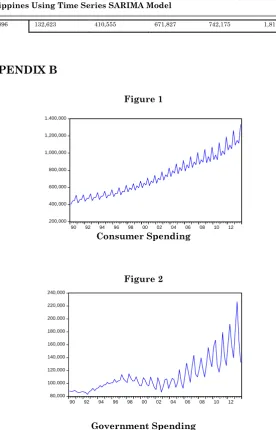
Figure 1
Consumer Spending
Figure 2
Government Spending
200,000 400,000 600,000 800,000 1,000,000 1,200,000 1,400,000
90 92 94 96 98 00 02 04 06 08 10 12
Consumer Spending (in milions)
80,000 100,000 120,000 140,000 160,000 180,000 200,000 220,000 240,000
90 92 94 96 98 00 02 04 06 08 10 12
Figure 3
Capital Formation
Figure 4
Exports
Figure 5
Imports
200,000 300,000 400,000 500,000 600,000 700,000 800,000 900,000 1,000,000
90 92 94 96 98 00 02 04 06 08 10 12
Imports (in milions)
200,000 300,000 400,000 500,000 600,000 700,000 800,000 900,000
90 92 94 96 98 00 02 04 06 08 10 12
Exports (in milions)
100,000 150,000 200,000 250,000 300,000 350,000 400,000 450,000
90 92 94 96 98 00 02 04 06 08 10 12
Figure 6
Real Gross Domestic Product
APPPENDIX C
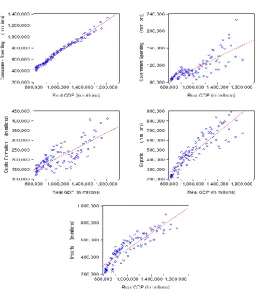
Figure 7
Scatter Diagram of Independent Variable
600,000 800,000 1,000,000 1,200,000 1,400,000 1,600,000 1,800,000 2,000,000
90 92 94 96 98 00 02 04 06 08 10 12
Figure 7 displays the scatter plots between Dependent Variable Real Gross Domestic Product (y) and Independent variables: Government Spending ( and Capital Formation ( .
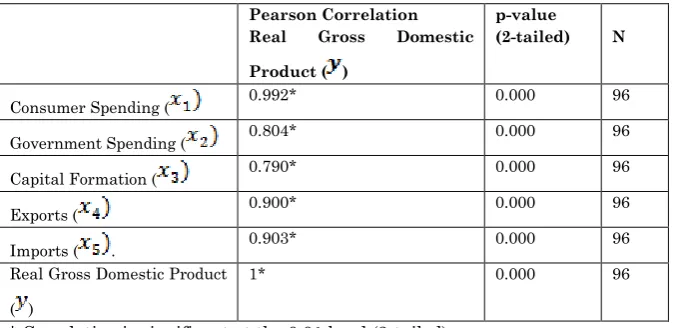
Table 2 Correlation Table
Pearson Correlation
Real Gross Domestic
Product ( )
p-value
(2-tailed) N
Consumer Spending ( 0.992* 0.000 96
Government Spending ( 0.804* 0.000 96
Capital Formation ( 0.790* 0.000 96
Exports ( 0.900* 0.000 96
Imports ( . 0.903* 0.000 96
Real Gross Domestic Product ( )
1* 0.000 96
* Correlation is significant at the 0.01 level (2-tailed)
APPENDIX D
Table 3 Augmented-Dickey Fuller Test of Deseasonalised Time Series
At Intercept:
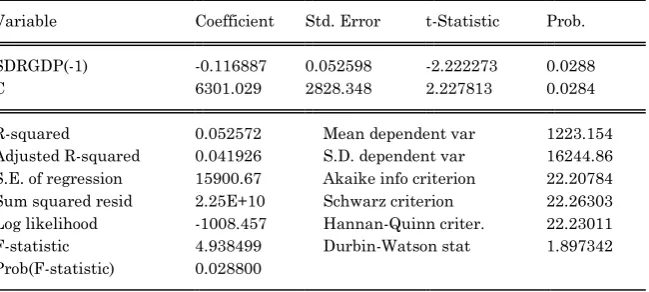
Null Hypothesis: SDRGDP has a unit root Exogenous: Constant
Lag Length: 0 (Automatic - based on SIC, maxlag=11)
t-Statistic Prob.*
Augmented Dickey-Fuller test statistic -2.222273 0.2000
Test critical values: 1% level -3.503879
5% level -2.893589
10% level -2.583931
*MacKinnon (1996) one-sided p-values.
Augmented Dickey-Fuller Test Equation Dependent Variable: D(SDRGDP) Method: Least Squares
Date: 08/27/14 Time: 13:53 Sample (adjusted): 1991Q2 2013Q4 Included observations: 91 after adjustments
Variable Coefficient Std. Error t-Statistic Prob.
SDRGDP(-1) -0.116887 0.052598 -2.222273 0.0288
C 6301.029 2828.348 2.227813 0.0284
R-squared 0.052572 Mean dependent var 1223.154
At Trend and Intercept:
Null Hypothesis: SDRGDP has a unit root Exogenous: Constant, Linear Trend
Lag Length: 0 (Automatic - based on SIC, maxlag=11)
t-Statistic Prob.*
Augmented Dickey-Fuller test statistic -3.728176 0.0253
Test critical values: 1% level -4.062040
5% level -3.459950
10% level -3.156109
*MacKinnon (1996) one-sided p-values.
Augmented Dickey-Fuller Test Equation Dependent Variable: D(SDRGDP) Method: Least Squares
Date: 08/27/14 Time: 13:57 Sample (adjusted): 1991Q2 2013Q4 Included observations: 91 after adjustments
Variable Coefficient Std. Error t-Statistic Prob.
SDRGDP(-1) -0.280213 0.075161 -3.728176 0.0003
C 97.56068 3441.310 0.028350 0.9774
@TREND(1990Q1) 265.9746 90.67590 2.933245 0.0043
R-squared 0.136953 Mean dependent var 1223.154
At None:
Null Hypothesis: SDRGDP has a unit root Exogenous: None
Lag Length: 0 (Automatic - based on SIC, maxlag=11)
t-Statistic Prob.*
Augmented Dickey-Fuller test statistic -0.701542 0.4103
Test critical values: 1% level -2.590622
5% level -1.944404
10% level -1.614417
*MacKinnon (1996) one-sided p-values.
Augmented Dickey-Fuller Test Equation Dependent Variable: D(SDRGDP) Method: Least Squares
Date: 08/27/14 Time: 13:58 Sample (adjusted): 1991Q2 2013Q4 Included observations: 91 after adjustments
Variable Coefficient Std. Error t-Statistic Prob.
SDRGDP(-1) -0.022220 0.031673 -0.701542 0.4848
Table 4 Augmented-Dickey Fuller Test of Deseasonalised Time Series at Second Differencing
At Intercept:
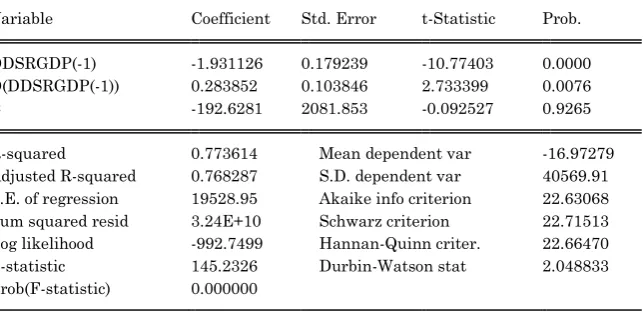
Null Hypothesis: DDSRGDP has a unit root Exogenous: Constant
Lag Length: 1 (Automatic - based on SIC, maxlag=11)
t-Statistic Prob.*
Augmented Dickey-Fuller test statistic -10.77403 0.0001
Test critical values: 1% level -3.506484
5% level -2.894716
10% level -2.584529
*MacKinnon (1996) one-sided p-values.
Augmented Dickey-Fuller Test Equation Dependent Variable: D(DDSRGDP) Method: Least Squares
Date: 08/17/14 Time: 14:40 Sample (adjusted): 1992Q1 2013Q4 Included observations: 88 after adjustments
Variable Coefficient Std. Error t-Statistic Prob.
DDSRGDP(-1) -1.931126 0.179239 -10.77403 0.0000
D(DDSRGDP(-1)) 0.283852 0.103846 2.733399 0.0076
C -192.6281 2081.853 -0.092527 0.9265
R-squared 0.773614 Mean dependent var -16.97279
At Trend and Intercept:
Null Hypothesis: DDSRGDP has a unit root Exogenous: Constant, Linear Trend
Lag Length: 1 (Automatic - based on SIC, maxlag=11)
t-Statistic Prob.*
Augmented Dickey-Fuller test statistic -10.70708 0.0000
Test critical values: 1% level -4.065702
5% level -3.461686
10% level -3.157121
*MacKinnon (1996) one-sided p-values.
Augmented Dickey-Fuller Test Equation Dependent Variable: D(DDSRGDP) Method: Least Squares
Date: 08/17/14 Time: 14:43 Sample (adjusted): 1992Q1 2013Q4 Included observations: 88 after adjustments
Variable Coefficient Std. Error t-Statistic Prob.
DDSRGDP(-1) -1.930949 0.180343 -10.70708 0.0000
D(DDSRGDP(-1)) 0.283786 0.104471 2.716406 0.0080
C -383.8847 4735.053 -0.081073 0.9356
@TREND(1990Q1) 3.713801 82.46346 0.045036 0.9642
R-squared 0.773620 Mean dependent var -16.97279
At None:
Null Hypothesis: DDSRGDP has a unit root Exogenous: Constant, Linear Trend
Lag Length: 1 (Automatic - based on SIC, maxlag=11)
t-Statistic Prob.*
Augmented Dickey-Fuller test statistic -10.70708 0.0000
Test critical values: 1% level -4.065702
5% level -3.461686
10% level -3.157121
*MacKinnon (1996) one-sided p-values.
Augmented Dickey-Fuller Test Equation Dependent Variable: D(DDSRGDP) Method: Least Squares
Date: 08/17/14 Time: 14:43 Sample (adjusted): 1992Q1 2013Q4 Included observations: 88 after adjustments
Variable Coefficient Std. Error t-Statistic Prob.
DDSRGDP(-1) -1.930949 0.180343 -10.70708 0.0000
D(DDSRGDP(-1)) 0.283786 0.104471 2.716406 0.0080
C -383.8847 4735.053 -0.081073 0.9356
@TREND(1990Q1) 3.713801 82.46346 0.045036 0.9642
R-squared 0.773620 Mean dependent var -16.97279
Decision:
The asterisk (*) indicates the best fitted model formulated through SARIMA.
Decision:
The asterisk (*) indicates that the variable is a significant factor of the
Dependent Variable:Real Gross Domestic Product ( ) at 1 percent level of
significance.
Table 5 Candidate Models
MODELS R- Squared Durbin Coeeficient p-value
ar(1) ar(2) ar(5) ar(9) ar(11) ma(1) ma(12) sma(12) 0.986966 1.967861 0.000 ar(1) ar(2) ar(5) ar(9) ma(12) ma(45) sma(12) 0.982866 2.077189 0.000 ar(1) ar(2) ar(5) ar(9) ar(11) ma(1) sma(12) 0.989052 2.165376 0.000 ar(1) ar(2) ar(5) ar(9) ar(11) ma(1) sma(12) 0.989052 2.165376 0.000* ar(1) ar(2) ar(5) ar(9) ar(11) ma(1) sma(12) 0.989052 2.165376 0.000 ar(2) ar(11) ma(1) ma(12) ma(45) sma(12) 0.988182 1.693115 0.000 ar(2) ar(5) ma(1) ma(12) ma(45) sma(12) 0.985764 2.136904 0.000 ar(2) ar(5) ar(9) ma(12) ma(45) sma(12) 0.979557 1.683147 0.000
ar(2) ar(5) ma(1) sma(12) 0.990974 2.097179 0.000
ar(2) ar(11) ma(1) sma(12) 0.989147 2.010003 0.000
ar(1) ar(5) ma(1) sma(12) 0.985615 2.426297 0.000
ar(2) ar(5) ar(9) ma(1) sma(12) 0.989994 2.139506 0.000
ar(1) ar(2) ar(9) ma(1) ma(12) 0.985726 2.006929 0.000
ar(1) ar(2) ar(9) ma(1) 0.978045 1.933547 0.000
ar(1) ar(2) ar(9) ma(12) 0.985624 2.031256 0.000
ar(2) ar(9) ma(1) sma(12) 0.990258 1.993462 0.000
ar(1) ar(2) ar(9) ma(1) sma(12) 0.987795 1.641806 0.000
ar(2) ma(1) sma(12) 0.990289 1.974515 0.000
APPENDIX E
Table 6 Result of Regression Analysis
T-statistics p-value
Constant -6.252 0.000
Consumer Spending ( 71.901 0.000*
Government Spending ( 13.913 0.000*
Capital Formation ( 20.973 0.000*
Exports ( -19.485 0.000*
Imports ( . 16.684 0.000*
Variables: Consumer Spending (x1) , Government Spending (x2),
Capital Formation (x3) , Exports (x4) and Imports (x5) are
significant factors of Dependent Variable Real Gross Domestic Product(y).
APPENDIX F
Table 7 Actual and Predicted Values of RGDP
Actual Value Predicted Value Actual Value Predicted Value Actual Value Predicted Value Actual Value Predicted Value
693325.4 753198.5 859337.5 804895.9 962236.8 986863 1418875 1426165
708606.6 658265.7 852926.9 812225.4 1056274 1106635 1281921 1229618
670339.2 664061.7 777462.1 813516.5 1039671 1001203 1352611 1334449
629938.7 655804.4 862485.2 896264.1 1093012 1057384 1248329 1286674
745659 772391.9 855178.2 809235.9 1029249 1044249 1425178 1446499
759161.7 682284.5 831798.9 837649.2 1125910 1174104 1319447 1333040
700668.6 694873 806320.4 842739.8 1092561 1045576 1475060 1453390
671743.4 689118.4 909875.9 842436 1114980 1111438 1369819 1380231
772110.2 804930.4 877560.1 874688 1067838 1089848 1525502 1534877
732376.3 715107.7 842185.4 889137 1209086 1234417 1393034 1393979
755744.1 724721.5 969737.1 974474 1163071 1101758 1517613 1499915
703767.5 730558.6 878571.2 863259 1179242 1169901 1429233 1422219
839220.6 835153.5 896946.7 900956 1116805 1143289 1568756 1592887
737341.6 752186.9 877937.9 913039 1279617 1301183 1437808 1484821
818627.6 772414.6 1000219 1007086 1193163 1171255 1617696 1594682
743629.2 774943.5 916717.9 890693 1254579 1258385 1523183 1526622
855237.2 881696.4 969359.6 936709 1191028 1215811 1685378 1705545
760887.5 790341 910096 937391 1364870 1382837 1614337 1599239
859732.4 819144.2 1015627 1053874 1259096 1217869 1737400 1716269
782789.1 811692.9 940025.1 933194 1344430 1313024 1626625 1632288
Table 8 Result of Paired T-Test
Table 8 displays the result of Paired T-Test that shows the value and probability of the t-statistics.
Figure 11 Actual and Forecasted Values of the Real Gross Domestic
Product
Figure 11 displays the line graph for the actual and forecasted values of the Real Gross Domestic Product (RGDP). The red line indicates the actual values of the RGDP from the First Quarter of 1990 to Fourth Quarter of 2013 while the blue line indicates the forecasted value of the RGDP from the First Quarter of 2014 to Fourth Quarter of 2020. Both of the actual and predicted values exhibit an increasing trend and seasonal pattern.
Method Value Probability
APPENDIX G
Table 9 Result of Johansen’s Cointegration Test – Trace Test
Decision:
The asterisk (*) denote the rejection of the null hypothesis.
TABLE 10 Result of Johansen’s Cointegration Test – Maximum Eigenvalue
Decision:
The asterisk (*) denote the rejection of the null hypothesis.
Unrestricted Cointegration Rank Test (Trace)
Hypothesized No. of Cointegration Equation(s) Prob. **
None * 0.0017
At most 1 0.1005
At most 2 0.1594
At most 3 0.2695
At most 4 0.2178
At most 5 0.1876
Unrestricted Cointegration Rank Test (Maximum Eigenvalue)
Hypothesized No. of Cointegration Equation(s) Prob. **
None * 0.0055
At most 1 0.4694
At most 2 0.3814
At most 3 0.5835
At most 4 0.2729
APPENDIX H
Table 11 Pairwise Granger Causality Test
Null Hypothesis: F-Statistics Probability
CONSUMER SPENDING does not Granger Cause REALGDP
REALGDP does not Granger Cause CONSUMER SPENDING
2.18810
2.05239
0.0776
0.0947
GOVERNMENT SPENDING does not Granger Cause REALGDP
REALGDP does not Granger Cause GOVERNMENT SPENDING
1.13869
4.73502
0.3443
0.0017*
CAPITAL does not Granger Cause REALGDP REALGDP does not Granger Cause CAPITAL
1.21874 2.48473
0.3093 0.0500 EXPORTS does not Granger Cause REALGDP
REALGDP does not Granger Cause EXPORTS
3.13354 2.83662
0.0189 0.0295 IMPORTS does not Granger Cause REALGDP
REALGDP does not Granger Cause IMPORTS
1.83110 4.19692
0.1308 0.0039*
Decision: