Analysis of Minute Features in Speckled Imagery
with Maximum Likelihood Estimation
Alejandro C. Frery
Departamento de Tecnologia da Informac¸˜ao, Universidade Federal de Alagoas, Campus A. C. Sim˜oes, BR 104 Norte km 14, Bloco 12, Tabuleiro dos Martins, 57072-970 Macei´o, Brazil
Email:[email protected]
Francisco Cribari-Neto
Departamento de Estat´ıstica, CCEN, Universidade Federal de Pernambuco, Cidade Universit´aria, 50740-540 Recife, Brazil
Email:[email protected]
Marcelo O. de Souza
Departamento de Estat´ıstica, CCEN, Universidade Federal de Pernambuco, Cidade Universit´aria, 50740-540 Recife, Brazil
Email:[email protected]
Received 21 August 2003; Revised 18 June 2004
This paper deals with numerical problems arising when performing maximum likelihood parameter estimation in speckled im-agery using small samples. The noise that appears in images obtained with coherent illumination, as is the case of sonar, laser, ultrasound-B, and synthetic aperture radar, is calledspeckle, and it can be assumed neither Gaussian nor additive. The proper-ties of speckle noise are well described by the multiplicative model, a statistical framework from which stem several important distributions. Amongst these distributions, one is regarded as the universal model for speckled data, namely, theG0law. This paper deals with amplitude data, so theG0
Adistribution will be used. The literature reports that techniques for obtaining estimates
(maximum likelihood, based on moments and on order statistics) of the parameters of theG0
Adistribution require samples of
hundreds, even thousands, of observations in order to obtain sensible values. This is verified for maximum likelihood estimation, and a proposal based on alternate optimization is made to alleviate this situation. The proposal is assessed with real and simulated data, showing that the convergence problems are no longer present. A Monte Carlo experiment is devised to estimate the quality of maximum likelihood estimators in small samples, and real data is successfully analyzed with the proposed alternated procedure. Stylized empirical influence functions are computed and used to choose a strategy for computing maximum likelihood estimates that is resistant to outliers.
Keywords and phrases:image analysis, inference, likelihood, computation, optimization.
1. INTRODUCTION
Remote sensing by microwaves can be used to obtain in-formation about inaccessible and/or unobservable scenes. The surface of Venus, remote and invisible due to constant cloud cover, was mapped using radar sensors. Similar sen-sors, namely, synthetic aperture radars (SARs) are used to monitor inaccessible earth regions, such as the Amazon, the poles, and so forth. Ultrasound-B imagery is employed to di-agnose without invading the body. Sonar images are used to map the bottom of the sea, lakes, and deep or dark rivers, and laser illumination can be used to trace profiles of microscopic entities.
These images are formed by active sensors (since they carry their own source of illumination) that send and retrieve signals whose phase is recorded. The imagery is formed de-tecting the echo from the target, and in this process a noise is introduced due to interference phenomena. This noise, called speckle, departs from classical hypotheses: it is not Gaussian in most cases, and it is not added to the true signal. Classical techniques derived from the assumption of addi-tive noise with Gaussian distribution may lead to suboptimal procedures, or to the complete failure of the processing and analysis of the data [1].
andG0
Adistributions being the more successful ones. These
are parametric models, so inference takes on a central role. In many applications inference based on sample moments is used but, whenever possible, maximum likelihood (ML) estimators are preferred due to their optimal asymptotic properties. The reader is referred to [1] for an introduc-tion to the subject of SAR image processing and analysis, and to [2] for applications of parameter estimation to image classification.
Since the family of G0A laws is regarded as a universal model for speckled imagery, this work concentrates on ML inference of the parameters of this distribution. The liter-ature reports severe numerical problems when estimating these parameters, and the solution proposed consists of us-ing large samples, in spite of small samples beus-ing desirable for minute feature analysis and for techniques that do not introduce unacceptable blurring.
This paper evaluates the performance of several classical techniques for ML parameter estimation in theG0A model, showing that none of them is reliable for practical applica-tions with small samples. A proposal based on alternate opti-mization of the reduced log-likelihood is made and assessed with real and simulated data. ML estimation for an other model for SAR data was treated in [3].
Dependable implementations of classical algorithms fail to converge in almost 9000 out of 80 000 samples (around 11% of failure) when performing ML estimation for theG0
A
model. With the same samples, the proposed algorithm does not fail in any situation. When using data extracted from an SAR image with squared windows of size 3 (samples of size 9), classical approaches fail to produce sensible results in up to 69.2% of the samples, while our proposal always yields es-timates. When the sample size increases, the number of sit-uations for which classical approaches fail is reduced, as ex-pected. Numerical issues of the estimation for theK model were treated by [4].
The considerable rates of nonconvergence associated with classical numerical optimization algorithms stem from the occurence of flat regions in the reduced log-likelihood function. It could be argued that, in such situations, the accuracy of the ML estimator has to be poor. Nonethe-less, in order to evaluate the precision of ML estimates, either by constructing confidence intervals or by evaluat-ing Fisher’s information matrix at them, one first needs to have a point estimate. Our algorithm provides sensible es-timates in a wide variety of situations, thus allowing the one to evaluate their precision and to construct confidence intervals.
The rest of the paper unfolds as follows. Section 2 presents the main properties of the G0
A model, our main
object of interest. Section 3recalls the main algorithms in-volved in ML inference for theG0Amodel, with special em-phasis on their availability in the Ox platform. Once ver-ified that these algorithms fail to produce acceptable esti-mators, Section 4 describes and assesses the proposal that overcomes this problem, and applications are discussed in Section 5. Conclusions and future research directions are listed inSection 6.
2. THE UNIVERSAL MODEL
As proposed and assessed in [5, 6], G0 distributions can
be successfully used to describe the data contaminated by speckle noise. This family of distributions stems from mak-ing the followmak-ing assumptions about the signal formation in every image coordinate.
(1) The observed data (return) can be described by the random variable Z = XY, where the independent random variablesXandY describe the (unobserved) ground truth and the speckle noise, respectively. The ground truth is related to the scattering properties of the Earth’s surface including, among other character-istics, the complex reflectivity of the soil [1] and the system point spread function.
(2) The random variableX:Ω → R+ follows the square
root of reciprocal ofγlaw, characterized by the density
fX(x)=
function of the setA, andΓis the gamma function. (3) When linear detection is used, the random variableY
obeys the square root of gamma distribution, whose density is
fY(y)= L L
Γ(L)y
2L−1exp−Ly2IR+(y), (2)
whereL≥1 is the (equivalent) number of looks, a pa-rameter that can be controlled in the image generation process and, therefore, will be considered known. This parameter is related to the signal-to-noise ratio and to the spatial accuracy of the image.
The distribution characterized by (1) describes proper-ties of the terrain, while the one in (2) models the speckle noise.
Under these assumptions, the density ofZis given by
fZ(z)=
where−α,γare the (unknown) parameters. The main prop-erties of this distribution, denotedG0
A(α,γ,L), are presented
in [5,6]. In particular, moments of orderrwill be useful in this work. They are given by
6
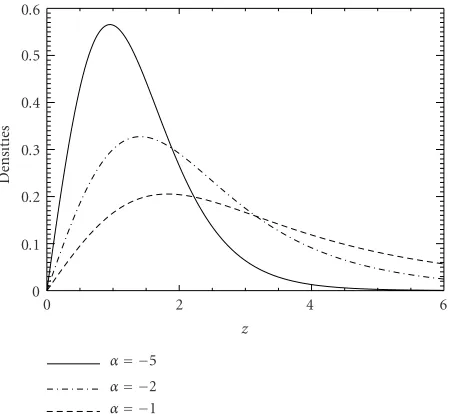
Figure 1: Densities of the G0
A(α, 10, 1) distribution, with α ∈
{−5,−2,−1}.
computed using (4), yielding
µZ= viously said, in many applications estimators for (α,γ) are derived using moment equations. When the first and second moments are used, besides the severe numerical instabilities that often appear, only samples from laws withα < −1 can be analyzed.
The dependence of this distribution on the parameter
α <0 can be seen inFigure 1. It is noticeable that the larger the value ofα, the more asymmetric and the heavier-tailed the density; relationships between the parameters of theG0A law and the skewness and kurtosis of the distribution are pre-sented in [2].
IfZfollows theG0
A(α,γ,L) distribution, then its
cumula-tive distribution function is given by
FZ(z)=L
is the hypergeometric function. Equation (6) can also be written as
FZ(z)=Υ2L,−2α
−αz2
γ , (8)
whereΥ2L,−2αis the cumulative distribution function of the
Snedecor’sF law with 2Land−2αdegrees of freedom. This form is useful for the following reasons.
(1) The cumulative distribution function of aG0
A(α,γ,L)
random variable, needed to perform the Kolmogorov-Smirnov test and to work with order statistics, can be computed using relation (8) and theΥ·,·function, available in most statistical software platforms. (2) Since the functionΥ−1
·,· is also available in most sta-tistical platforms, the outcomes of Z ∼ G0
A(α,γ,L)
can be obtained using this inverse function and returning outcomes of the random variable Z =
(−γΥ−1
2L,−2α(U)/α)1/2, withUuniformly distributed on
(0, 1). This was the method employed in the forthcom-ing Monte Carlo simulation.
A crucial feature of the distribution characterized by (3) is that its parameters are interpretable:γis a scale parame-ter, while αis related to the roughness of the target. Small values of α (say α < −10) describe smooth regions, for instance, crops and burnt fields. When α is close to zero (say α > −5), the observed target is extremely rough, as is the case of urban spots. Intermediate situations (−10 < α < −5) are usually related to rough areas, for instance, forests. The equivalent number of looks L is known be-forehand or is estimated for the whole image using ex-tended targets, that is, very large samples. This parame-ter can be related to the number of (ideally independent and identically distributed) samples of the return that are used to form the image. Note that estimating (α,γ) amounts to making inference about the unobservable ground truth
X.
Figure 2shows the densities of two distributions with the same mean and variance: theG0
A(−2.5, 7.0686/π, 1) and the
Gaussian distributionN(1, 4(1.1781−π/4)/π) in semiloga-rithmic scale, along with their mean value (in dashed dotted line). The different decays of their tails are evident: the for-mer decays logarithmically, while the latter decays quadrati-cally. This behavior ensures the ability of theG0
Adistribution
to model data with extreme variability but, at the same time, the slow decay is prone to producing problems when per-forming parameter estimation.
Systems that employ coherent illumination are used to survey inaccessible and/or unobservable regions (the sur-face of Venus, the interior of the human body, the bottom of the sea, areas under cloud cover, etc.). It is, therefore, of paramount importance to be able to make reliable inference about the kind of target under analysis, since visual informa-tion is seldom available.
This inference can be performed through the estima-tion of the parameter (α,γ) ∈ Θ = (R−×R+) from
sam-ples z = (z1,. . .,zn) taken from homogenous areas in
6
Figure 2: Densities of the G0
A(−2.5, 7.0686/π, 1) and the
N(1, 4(1.1781−π/4)/π) distributions in semilogarithmic scale.
[7,8], as is the case of filtering based on distributional prop-erties, large samples obtained with large windows usually cause heavy blurring. Inference with small samples is gain-ing attention in the specialized literature [9], and reliable in-ference using small samples is the core contribution of this work.
2.1. Inference techniques
Usual inference techniques include methods based on the analogy principle (moment and order statistics estima-tors being the most popular members of this class) and on ML [10]. Moment estimators are favored in applica-tions, since they are easy to derive and are, usually, com-putationally attractive. An estimator based on the median and on the first moment was successfully used in [7] as the starting point for computing ML estimates. ML esti-mators will be considered in this work since they exhibit well-known optimal properties (consistency, asymptotic ef-ficiency, asymptotic normality, etc.). These estimators were used for the analysis of SAR imagery under the K model [3,11].
Given the sample z = (z1,. . .,zn), and assuming that
these observations are outcomes of independent and iden-tically distributed random variables with common distribu-tionD(θ), withθ∈Θ⊂Rp,p≥1, an ML estimator ofθis
given by
θ=arg max
θ∈ΘL(θ;z), (9)
where L is the likelihood of the sample zunder the pa-rameterθ. Under very mild conditions it is equivalent (and many times easier) to work with the reduced log-likelihood
(θ;z)∝lnL(θ;z), where all the terms that do not depend onθare ignored.
−2
Figure3: Log-likelihood function of a sample of sizen=9 of the G0
A(−8,γ∗, 3) law.
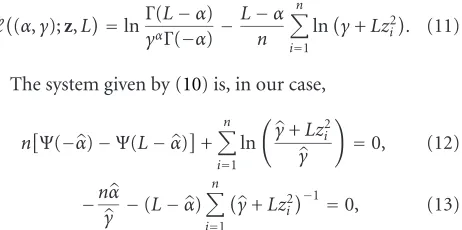
Though direct maximization of (9) is possible (either an-alytically or using numerical tools), and oftentimes desirable, one quite often finds ML estimates by solving the system of (usually nonlinear)pequations given by
∇(θ)=0, (10)
where ∇ denotes the gradient. This system is referred to as likelihood equations. The choice between solving ei-ther (9) or (10) heavily relies on computational issues: availability of reliable algorithms, computational effort re-quired to implement and/or to obtain the solution, and so forth. These equations, in general, have no explicit solu-tion.
In our case, the likelihood function is L((α,γ);z) = n
i=1 fZ(zi), with fZgiven in (3). Therefore, the reduced
log-likelihood can be written as
(α,γ);z,L=lnΓ(L−α) explicit solution for this system is available in general and, therefore, numerical routines have to be used. The single-look case (L=1) is an important special situation for which a deeper analytical analysis is performed and presented in Section 2.2.
Figure 3 shows a typical situation. A sample from the G0
A(−8,γ∗, 3) of size n = 9 was generated, and the
γ∗is chosen such that the expected value is one:
It is noticeable that finding the maximum of this function (provided it exists) is not an easy task due to the almost flat area it presents around the candidates. The ML estimates for this sample were (α,γ)=(−1.84, 1.44). The same sample is revisited inSection 4, when analyzing the proposed estima-tion procedure.
2.2. Stylized empirical influence functions
Two sets of solutions can be obtained from the system formed by (12) and (13). The choice between them will be made studying the behavior of estimates ofαwhen a single observation varies inR+. In order to perform an analytical
analysis, the single-look case, that is, the situationL=1, will be discussed.
As presented in [9], under very general conditions, a con-venient tool for assessing the robustness of an estimator θ
based on n independent samples is its empirical influence function (EIF). This quantity describes the behavior of the estimator when a single observation varies freely. For the uni-variate samplez=(z1,. . .,zn−1), the EIF of the estimatorθis
given by
EIF(z;z)=θ(z,z), (15)
wherezranges over the whole support of the underlying dis-tribution.
In order to avoid the dependence of (15) on the n−1 observations z, an artificial and “typical” sample can be formed with the n−1 quantiles of the distribution of in-terest. The sample zi will be then replaced by the quantile
z∗i =F−((i−1/3)/(n−2/3)) for every 1≤i≤n−1, where
F−(t) = inf{x ∈ R:F(x) ≥ t}is the generalized inverse cumulative distribution function. This yields the stylised em-pirical influence function (SEIF). Denoting the vector ofn−1 quantiles asz∗=(z∗i )1≤i≤n−1, one has
SEIFz;z∗=θz∗,z, (16)
withzranging over the whole support of the underlying dis-tribution. If the random variable is continuous, F− is re-placed byF−1, the inverse cumulative distribution function.
For the single-look case, the cumulative distribution function of aG0A(α,γ, 1)-distributed random variable reduces toFZ(t) = 1−(1 +t2/γ)α(see (6)), with inverseF−Z1(t) =
(γ((1−t)1/α−1))1/2.
The likelihood equations for a sample of sizen, assuming G0
A(α,γ, 1) independent and identically distributed random
variables, are
We can form two systems of estimation equations. The first is obtained takingαout of (18), of the roughness parameter is of paramount importance, in what follows only results regarding inference onαwill be as-sessed.
The SEIF will be computed for the estimators given in (19) and (20), assumingγ=1. As previously stated, the esti-mation ofαis of paramount importance, and hence we chose to fix the value ofγand assess the behavior of two forms of the ML estimator for α. These stylized empirical influence functions will be referred to as “SEIF1” and “SEIF2,” respec-tively. They are given by
SEIF1(z)
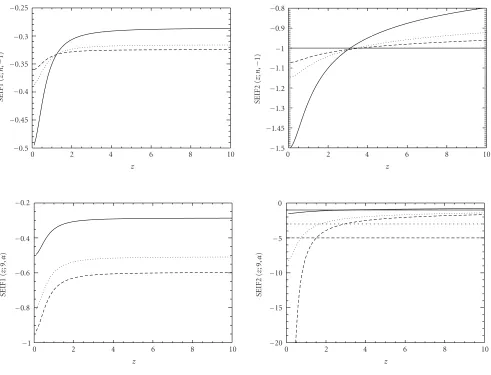
Figure 4shows the functions SEIF1 and SEIF2 (first and second columns, respectively) forα= −1 with varying sam-ple size (first row) and for samsam-ples of size 9 and varying α
(second row). In the first row n = 9 is seen in solid line,
n=25 in dashes andn=49 in dots. The second row depicts the situationsα = −1 in solid line, α = −3 in dashes and
α = −5 in dots. It is readily seen that SEIF1 is less sensitive than SEIF2 to variations of the observationz∈R+.
This behavior is consistent when bothαand the sample sizenvary, and it was also observed with other values ofL
and ofγ.Figure 5, for instance, shows the SEIFs for the same aforementioned situations andγ=1/2. It is noteworthy that, for presentation purposes, the vertical axes in this figure are not adjusted to the same interval.
It was then chosen to work with the system of equations formed by takingαout of (13), and then plugging this into (12) to computeγ.
This procedure can be employed whenever there are al-ternatives for implementing ML estimators, and reduced sensitivity to influent observations is desired.
3. ALGORITHMS FOR INFERENCE
10
language with excellent numerical capabilities. This platform is available for a variety of operational systems at [12].
Two categories of routines were tested: those de-voted to direct maximization (or minimization), referred to as optimization procedures, and those that look for the solution of systems of equations. In the first cate-gory, the Simplex Downhill, the Newton-Raphson, and the Broyden-Fletcher-Goldfarb-Shanno (generally referred to as “the BFGS method”) algorithms were used to maximize (11). In the second category, the Broyden algorithm was used to find the roots of the system given in (12) and (13).
These routines impose different requirements for their use. The Newton-Raphson algorithm uses first and second derivatives, the BFGS method only uses first derivatives, and the Simplex method is derivative-free. Numerical results not presented here showed that the BFGS method outperformed the Newton-Raphson and Simplex method, especially when the initial values of the iterative scheme were not close to the
true parameter values. In what follows, we report results ob-tained using the BFGS (with analytical first derivatives) and Simplex methods.
Since the main goal of this work is to find suitable solu-tions, all routines were tested following the guidelines pro-vided with the Ox platform: a variety of tuning parame-ters, starting points, steps, and convergence criteria were em-ployed. The results confirmed what is commented in the literature, namely, that inference for the G0A law requires hugesamples in order to converge and deliver sensible esti-mates.
The analysis was performed using samples of sizen∈ {9, 25, 49, 81, 121}, roughness parameters α ∈ {−1,−3,−5,
−15}, and looksL∈ {1, 2, 3, 8}withγ=γ∗(see (14)). The sample sizes considered reflect the fact that most im-age processing techniques employ estimation in squared win-dows of sides, even integer, and, therefore, samples are of size
n = s2. Windows of sides 3, 5, 7, 9, and 11 are commonly
10
In our simulations, the roughness parameter describes regions with a wide range of smoothness, as discussed in Section 2. The number of looks also reflects situations of practical interest, ranging from raw images (L = 1) to smoothed out data withL=8. It is convenient to note here that the bigger the number of looks the smoother the image, at the expense of less spatial resolution. The target roughness is measured byα, independently of the number of looksL, as can be seen in [1].
One thousand replications were performed for each of these eighty situations, generating samples with the specified parameters and, then, applying the four algorithms for esti-mating bothαandγ. Success (convergence to a point and numerical evidence of convergence to either a maximum or a root) or failure to converge was recorded, and specific situ-ations of both outcomes were traced out.
Table 1 shows the percentage of times (in 1 000 independent trials) that the BFGS and Simplex algorithms failed to converge in each of the eighty aforementioned
situations. The larger the sample size the better the perfor-mance, and the smoother the target the worse the conver-gence rate. In an overall of almost 9000 out of 80 000 situa-tions, the algorithms did not converge, and in the worst case (n=9,α= −15, andL=1), about sixty percent of the sam-ples were left unanalyzed, that is, no sensible estimate was obtained. Similar (mostly worse) behavior is observed using the other algorithms, and it is noteworthy that all of them were fine-tuned for the problem at hand.
The overall behaviour of these algorithms falls into one of three situations, namely,
(1) all of them converge to the same (sensible) estimate, (2) all of them converge, but not to the same value, (3) at least one algorithm fails to converge.
In order to illustrate this behavior, twoG0Asamples were chosen, one leading to situation (1) above (denotedz1), and
the other to situation (2) (denotedz2). For each sample, the
Table1: Percentage of situations for which BFGS and Simplex fail to converge in 1 000 replications.
Figure6: Log-likelihood function forz1.
and analyze the behavior of the algorithms, level curves of the likelihood and of the ML equations were studied.
Situation (1) is illustrated inFigure 6, where it is notice-able that the point of convergence of the Broyden algorithm (denoted as “∗”) is in the interior of the highest level curve.
−86
Figure7: Log-likelihood function forz2.
This point coincides with the intersection of the curves corre-sponding to∂/∂α=∂/∂γ=0 and, regardless the precision of the estimation procedure, is an acceptable estimate.
10
is outside the highest level curve and, thus, does not corre-spond to the maximum of the likelihood function.
The Broyden algorithmseemed to have the best perfor-mance, since it often reported convergence. But when at least two of the other algorithms converged, most of the time they did it to the same point, whereas Broyden frequently stopped very far from it. When checking the value of the likelihood in the solutions, the one computed by Broyden was orders of times smaller than the one found by maximization tech-niques. In a typical situation, for instance, the value of re-duced likelihood at the estimates prore-duced by Broyden was
−152.64, whereas the other algorithms converged to a solu-tion that yields−86.05. For this reason, though Broyden al-legedly outperformed optimization procedures in terms of convergence, it was considered unreliable for the application at hand.
This behavior motivated the proposal of an algorithm able to converge to sensible estimates. This will be done in the next section.
4. PROPOSAL: ALTERNATE OPTIMIZATION
Simultaneous optimization was found undependable since the usual optimization algorithms tend to not converge when they enter a flat region of the log-likelihood function. An analysis of the marginal functions showed that they can be easily maximized even when the reduced log-likelihood con-tains flat regions. This fact motivated the proposal of an al-ternatedalgorithm that consists of writing two equations out of (11): one depending onα, givenγfixed, and the other de-pending onγ, given a fixedα. Provided a starting point forγ, sayγ(0), one maximizes the first equation onαto findα(0).
One can now use this crude estimate ofα, solve again the first equation onγ, and continue until evidence of convergence is achieved. The equations to be maximized are
1α;γ(j),z
In practice, (22) always showed excellent behaviour, while (23) presented flat areas in a few situations (in 6 out of the 80 000 samples analyzed inTable 1). In these situations, though, varying the value of α(j) led to well-behaved and easy-to-optimize functions.Figure 8shows the functions1
and2for the same three sample looks used inFigure 3, and a variety of values ofγandα((a) and (b), respectively).
Algorithm 1. Alternate optimization for parameter estima-tion.
(1) Fix the smallest acceptable variation to proceed (typ-ically = 10−4) and the maximum number of
itera-tions (typicallyM=103).
(2) Compute an initial estimate ofγ, for example,
30 20
10 0
Iteration
−56
−55
−54
−53
−52
−51
R
educ
ed
log-lik
elihood
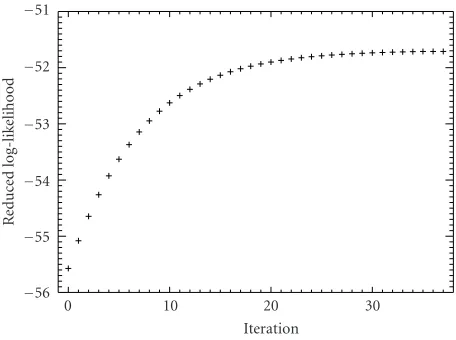
Figure9: Function evaluation at iterations of the alternated algorithm.
(3) Set the values needed to execute step (4)(c) for the first timeε=103andα(0)= −106, and start the counter
j=1.
(4) Whileε≥andj≤Mdo the following.
(a) Findα(j)=arg maxα∈R−1(α;γ(j−1),z) given in (22).
(b) Find γ(j) = arg maxγ∈R2(γ;α(j),z) given in
(23), withR⊂ R+ a compact set, typicallyR =
[10−2, 102]·γ(0).
(c) Compute
ε=α(j+ 1)−α(j)
α(j+ 1)
+
γ
(j+ 1)−γ(j)
γ(j+ 1)
, (25)
the absolute value of the relative interiteration variation.
(d) Update the counterj←j+ 1.
(5) Ifε >, return anything with a message of error, else return the estimate (α(j−1),γ(j−1)) and a message of success.
Equation (24) is derived usingr =1 and discarding the dependence ofαon (4). In this manner, it is a crude estima-tor ofγbased on the first sample momentm1. Other start-ing points, even the true parameter values, were checked, and their effect on the algorithm convergence was negligible.
Step (4)(b) seeks the estimate ofγin a compact set rather than inR+due to the aforementioned behavior of the
func-tion2. This restriction is seldom needed in practice. If there is no attainable maximum inR, a new value ofα(j) will be used in the next iteration and, ultimately, convergence will be achieved.
It was chosen to work with the BFGS algorithm in steps (4)(a) and (4)(b) since, for the considered univariate equa-tions, it outperformed the other methods in terms of speed and convergence. The BFGS is generally regarded as the best performing method [13] for multivariate nonlinear opti-mization. In our case, the explicit analytical derivatives of
the objective function were provided, a desirable informa-tion whenever available.
This alternated algorithm can be easily generalized to ob-tain parameters with as many components as desired, and its implementation in any computational platform is immedi-ate, provided reliable univariate optimization routines exist.
Using this algorithm, there was convergence in all the 80 000 samples analyzed inTable 1, while classical procedures failed in about 9000 situations. This represents a noteworthy improvement with respect to classical algorithms since they failed in about 11% of the samples (considering both good and bad situations). With real data, where most of the sam-ples are “bad,” our proposal also outperforms classical algo-rithms, as will be seen in the next section.
Figure 9shows a sequence of 37 values of the reduced log-likelihood function evaluated at the points provided by the alternated algorithm in a typical situation. It is clear that these estimates provide an increasing sequence of function values. The sample used to compute these values is the same one considered inSection 2.1.
5. APPLICATION
UsingAlgorithm 1, it was possible to conduct a Monte Carlo simulation in order to evaluate the bias and mean square er-ror of the ML estimator in a variety of situations that re-mained unexplored when using classical procedures. These results on the bias of α are shown in Figure 10, assuming
γ = γ∗, so the expected value equals one for every α. The bias can be huge, confirming previous results [2,6,14]. Ef-forts to reduce this undesirable behavior of ML estimators are reported in [14].
Two applications were devised to show the applicability of the alternated algorithm: one with simulated data and the other with a real SAR image. The former consists of generat-ing samples from theG0A(α,γ∗, 1) law.
Two hundred and fifty samples of size n = 121 were generated, being fifty from theG0
−1
−3
−5
−15
α
−250
−200
−150
−100
−50
B
(
α
)
n=9 n=25 n=49
n=81 n=121
Figure10: Estimated bias of the ML estimator ofαfor one look.
Table2: Situations where BFGS failed to converge.
n 121 81 49 25 9
% 1.6 4.8 10.8 19.2 41.2
G0
A(−1,γ∗, 1), fifty from theG0A(−15,γ∗, 1), and the
remain-ing 100 samples from theG0A(αj,γ∗, 1), whereαj=0.14j−15
and 1≤ j≤100 is the integer index. For each of these sam-ples, two algorithms were employed to obtain the ML esti-mates, namely, the BFGS and alternated algorithms. The pro-cedure was repeated for each sample, but using 81, 49, 25, and 9 observations out of the complete dataset.
In every situation, the alternated algorithm achieved con-vergence, and the same did not hold for the BFGS algorithm. The percentage of situations for which BFGS did not con-verge is presented inTable 2. Again, the classical procedure is unreliable.
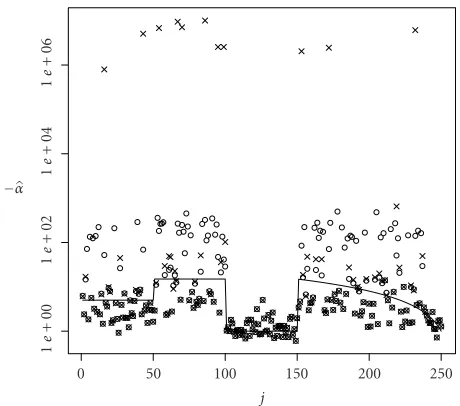
Figure 11shows, for n = 25, the true value of −α (in semilogarithmic scale) along with the estimates “×” for the alternated algorithm and “◦” for the one obtained with the BFGS procedure. Note that there are many situations for which only a cross is plotted; the missing circles correspond to situations where BFGS failed to converge (roughly 20% of the samples). It can be checked that when both of them converge, they converge to similar values, and that there are many situations for which the BFGS was unable to return an estimate. Similar behaviour is exhibited for other sample sizes, the smaller the sample the less reliable the BFGS.
Figure 12shows an SAR image obtained by the sensor E-SAR, managed by the German Aerospace Center DLR. This is an airborne sensor with polarimetric and high spatial res-olution capabilities. The scene was taken over the surround-ings of M¨unchen, Germany, and typical classes are marked
250 200
150 100
50 0
j
1
e
+0
0
1
e
+0
2
1
e
+0
4
1
e
+0
6
−α
Figure11: Estimates ofαwithn=25 andL=1.
as “U” (Urban), “F” (Forest), and “C” (Crops). A hypoth-esized flight track is marked with the NW-SE white arrow, where small samples are being collected at every passage point.
Figure12: E-SAR synthetic aperture image withL=1.
250 200
150 100
50 0
Sample
−15
−10
−5
α
(a)
250 200
150 100
50 0
Sample
−15
−10
−5
α
(b)
250 200
150 100
50 0
Sample
−15
−10
−5
0
α
(c)
250 200
150 100
50 0
Sample
−20
−15
−10
−5
0
α
(d)
250 200
150 100
50 0
Site
−12
−10
−8
−6
−4
−2
α
(a)
250 200
150 100
50 0
Site
−15
−10
−5
0
α
(b)
250 200
150 100
50 0
Site
−15
−10
−5
0
α
(c)
250 200
150 100
50 0
Site
−20
−15
−10
−5
0
α
(d)
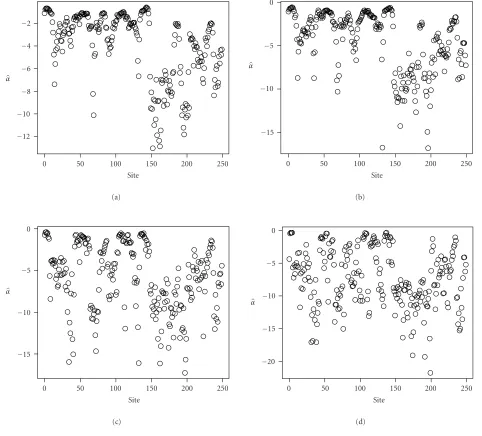
Figure14: Estimates ofαin 250 sites with different window sizes: group 2. (a)n=121, (b)n=81, (c)n=25, and (d)n=9.
Table3: Percentage of samples for which BFGS failed to converge in the four groups of real data using samples of sizen.
n Group
G1 G2 G3 G4
121 20.8 21.2 39.2 32.0
81 22.4 28.8 42.8 36.4
49 32.4 34.8 53.6 48.0
25 42.0 46.4 55.6 54.0
9 52.4 65.4 69.2 65.6
Figures 13,14,15, and 16show the values of αin two hundred and fifty sites usingn = 121, 49, 25, and 9 obser-vations, corresponding to groups 1, 2, 3, and 4, respectively.
It can be seen that the larger the window the smoother the analysis, leading to the conclusion that most sites correspond to heterogeneous or extremely heterogeneous spots (since
α > −7). When the window is small, more heterogeneous areas appear (α < −10). The sensed area is suburban, and typical spots consist of scattered houses and small buildings (extremely heterogeneous return) with trees and gardens in between, where SAR will return heterogeneous and homo-geneous clutters, respectively. The only exception is group 3 (Figure 15), for which the estimated roughness at all window sizes is consistent.
The ground resolution of this sensor can be of less than one meter, so minute features of about two meters of side can be detected with the use of the alternated algorithm and the G0
250 200
150 100
50 0
Sample
−15
−10
−5
0
α
(a)
250 200
150 100
50 0
Sample
−14
−12
−10
−8
−6
−4
−2
0
α
(b)
250 200
150 100
50 0
Sample
−25
−20
−15
−10
−5
0
α
(c)
250 200
150 100
50 0
Sample
−40
−30
−20
−10
0
α
(d)
Figure15: Estimates ofαin 250 sites with different window sizes: group 3. (a)n=121, (b)n=81, (c)n=25, and (d)n=9.
6. CONCLUSIONS AND FUTURE WORK
Different numerical approaches for obtaining ML estimates of the parameters that index the universal model of speckled imagery were analyzed by means of stylized empirical influ-ence functions.
The numerical problems that arise when estimating the parameters of the universal model for speckled data using ML are alleviated by the use of an alternate optimization pro-cedure.
The small sample performance of ML estimates for the G0
A distribution computed using different numerical
ap-proaches was analyzed. Conventional techniques failed to converge and/or to provide sensible estimates in as many as
60% of the situations, whereas the alternated algorithm al-ways produced sensible results.
The proposed algorithm was employed in the analysis of both simulated and real data. In the latter case, sound in-formation about minute ground features was retrieved in an SAR image.
250 200
150 100
50 0
Sample
−14
−12
−10
−8
−6
−4
−2
α
(a)
250 200
150 100
50 0
Sample
−15
−10
−5
α
(b)
250 200
150 100
50 0
Sample
−20
−15
−10
−5
α
(c)
250 200
150 100
50 0
Sample
−25
−20
−15
−10
−5
0
α
(d)
Figure16: Estimates ofαin 250 sites with different window sizes: group 4. (a)n=121, (b)n=81, (c)n=25, and (d)n=9.
ACKNOWLEDGMENT
The authors are grateful to CNPq (National Council for Sci-entific and Technological Development) for the partial sup-port of this research.
REFERENCES
[1] C. Oliver and S. Quegan, Understanding Synthetic Aperture Radar Images, Artech House, Boston, Mass, USA, 1998. [2] M. E. Mejail, J. Jacobo-Berlles, A. C. Frery, and O. H. Bustos,
“Classification of SAR images using a general and tractable multiplicative model,” International Journal of Remote Sens-ing, vol. 24, no. 18, pp. 3565–3582, 2003.
[3] I. R. Joughin, D. B. Percival, and D. P. Winebrenner, “Maxi-mum likelihood estimation of K distribution parameters for
SAR data,”IEEE Transactions on Geoscience and Remote Sens-ing, vol. 31, no. 5, pp. 989–999, 1993.
[4] S. D. Gordon and J. A. Ritcey, “Calculating the K-distribution by saddlepoint integration,” IEE Proceedings - Radar, Sonar and Navigation, vol. 142, no. 4, pp. 162–166, 1995.
[5] A. C. Frery, H.-J. M¨uller, C. C. F. Yanasse, and S. J. S. Sant’Anna, “A model for extremely heterogeneous clutter,” IEEE Transactions on Geoscience and Remote Sensing, vol. 35, no. 3, pp. 648–659, 1997.
[6] M. E. Mejail, A. C. Frery, J. Jacobo-Berlles, and O. H. Bus-tos, “Approximation of distributions for SAR images: pro-posal, evaluation and practical consequences,”Latin American Applied Research, vol. 31, no. 2, pp. 83–92, 2001.
[7] O. H. Bustos, M. M. Lucini, and A. C. Frery, “M-estimators of roughness and scale for G0
A-modelled SAR imagery,”
[8] J. Polzehl and V. Spokoiny, “Image denoising: pointwise adap-tive approach,”The Annals of Statistics, vol. 31, no. 1, pp. 30– 57, 2003.
[9] P. J. Rousseeuw and S. Verboven, “Robust estimation in very small samples,” Computational Statistics and Data Analysis, vol. 40, no. 4, pp. 741–758, 2002.
[10] P. J. Bickel and K. A. Doksum, Mathematical Statistics: Basic Ideas and Selected Topics, vol. 1, Prentice Hall, Upper Saddle River, NJ, USA, 2nd edition, 2001.
[11] O. H. Bustos, A. G. Flesia, and A. C. Frery,
“General-ized method for sampling spatially correlated heterogeneous speckled imagery,” EURASIP Journal on Applied Signal Pro-cessing, vol. 2001, no. 2, pp. 89–99, 2001.
[12] J. A. Doornik, Ox: An Object-Oriented Matrix Programing Language, Timberlake Consultants Press, London, UK, 4th edition, 2001.
[13] R. C. Mittelhammer, G. G. Judge, and D. J. Miller, Economet-ric Foundations, Cambridge University Press, New York, NY, USA, 2000.
[14] F. Cribari-Neto, A. C. Frery, and M. F. Silva, “Improved esti-mation of clutter properties in speckled imagery,” Computa-tional Statistics and Data Analysis, vol. 40, no. 4, pp. 801–824, 2002.
Alejandro C. Freryobtained the Ph.D.
de-gree in computer science from the National Institute of Space Research, Brazil, in 1993. He is a Professor at the Federal University of Alagoas, Brazil. His research interest ar-eas include image processing and computa-tional statistics.
Francisco Cribari-Neto obtained a Ph.D.
degree in econometrics from the University of Illinois, USA, in 1994. He is a Professor of statistics and Director of the graduate stud-ies at the Federal University of Pernambuco, Brazil. He has published over sixty papers in refereed journals.
Marcelo O. de Souzaobtained the M.S.