Automatic Image Enhancement by Content Dependent
Exposure Correction
S. Battiato
University of Catania, Department of Mathematic and Informatics, 95125 Catania, Italy Email:[email protected]
A. Bosco
STMicroelectronics, M6 Site, Zona Industriale, 95121 Catania, Italy Email:[email protected]
A. Castorina
STMicroelectronics, M6 Site, Zona Industriale, 95121 Catania, Italy Email:[email protected]
G. Messina
STMicroelectronics, M6 Site, Zona Industriale, 95121 Catania, Italy Email:[email protected]
Received 7 August 2003; Revised 8 March 2004
We describe an automatic image enhancement technique based on features extraction methods. The approach takes into account images in Bayer data format, captured using a CCD/CMOS sensor and/or 24-bit color images; after identifying the visually signif-icant features, the algorithm adjusts the exposure level using a “camera response”-like function; then a final HUE reconstruction is achieved. This method is suitable for handset devices acquisition systems (e.g., mobile phones, PDA, etc.). The process is also suitable to solve some of the typical drawbacks due to several factors such as poor optics, absence of flashgun, and so forth.
Keywords and phrases:Bayer pattern, skin recognition, features extraction, contrast, focus, exposure correction.
1. INTRODUCTION
Reduction of processing time and quality enhancement of ac-quired images is becoming much more significant. The use of sensors with greater resolution combined with advanced solutions [1,2,3,4] aims to improve the quality of result-ing images. One of the main problems affecting image qual-ity, leading to unpleasant pictures, comes from improper ex-posure to light. Beside the sophisticated features incorpo-rated in today’s cameras (i.e., automatic gain control algo-rithms), failures are not unlikely to occur. Some techniques are completely automatic, cases in point being represented by those based on “average/automatic exposure metering” or the more complex “matrix/intelligent exposure metering.” Others, again, accord the photographer a certain control over the selection of the exposure, thus allowing space for per-sonal taste or enabling him to satisfy particular needs.
Inspite of the great variety of methods [5,6], for regulat-ing the exposure and the complexity of some of them, it is
not rare for images to be acquired with a nonoptimal or in-correct exposure. This is particularly true for handset devices (e.g., mobile phones) where several factors contribute to ac-quire bad-exposed pictures: poor optics, absence of flashgun, not to talk about “difficult” input scene lighting conditions, and so forth.
There is no exact definition of what a correct exposure should be. It is possible to abstract a generalization and to define the best exposure that enables one to reproduce the most important regions (according to contextual or percep-tive criteria) with a level of gray or brightness, more or less in the middle of the possible range.
Average
Figure1: Bayer data subsampling generation.
distribution inside small regions are presented. In particular the method described in [9], splits the input image into two or more equal area subimages based on its gray-level prob-ability density function. After having equalized each subim-age, the enhanced image is built taking into account some local property, preserving the original image’s average lu-minance. In [10] point processing and spatial filtering are combined together while in [11] a fuzzy logic approach to contrast enhancement is presented. Recent approaches work in the compressed domain [12] or use advanced techniques such as curvelet transform [13], although both methods are not suited for real-time processing.
The new exposure correction technique described in this paper is designed essentially for mobile sensors applications. This new element, present in newest mobile devices, is partic-ularly harmed by “backlight” when the user utilizes a mobile device for video phoning. The detection of skin characteris-tics in captured images allows selection and proper enhance-ment and/or tracking of regions of interest (e.g., faces). If no skin is present in the scene the algorithm switches automat-ically to other features (such as contrast and focus) track-ing for visually relevant regions. This implementation differs from the algorithm described in [14] because the whole pro-cessing can also be performed directly on Bayer pattern im-ages [15], and simpler statistical measures were used to iden-tifyinformation carrying regions; furthermore the skin fea-ture has been added.
The paper is organized as follows. Section 2 describes the different features extraction approaches and the expo-sure correction technique used for automatic enhancement. The “arithmetic” complexity [16] of the whole process is es-timated inSection 3. InSection 4experimental results show the effectiveness of the proposed techniques. Also some com-parisons with other techniques [7,9] are reported.Section 5 closes the paper tracking directions for future works.
2. APPROACH DESCRIPTION
The proposed automatic exposure correction algorithm is defined as follows.
(1) Luminance extraction. If the algorithm is applied on Bayer data, in place of the three full color planes, a sub-sampled (quarter size) approximated input data (see Figure 1) is used.
(2) Using a suitable features extraction technique the algo-rithm fixes a value to each region. This operation per-mits to seek visually relevant regions (for contrast and focus the regions are block-based, for skin recognition the regions are associated to each pixel).
(3) Once the “visually important” pixels are identified (e.g., the pixels belonging to skin features) a global tone correction technique is applied using as main pa-rameter the mean gray levels of the relevant regions.
2.1. Features extraction: contrast and focus
To be able to identify regions of the image that contain more information, the luminance plane is subdivided inNblocks of equal dimensions (in our experiments we employedN =
64 for VGA images). For each block, statistical measures of “contrast” and “focus” are computed. Therefore it is assumed that well-focused or high-contrast blocks are more relevant compared to the others. Contrast refers to the range of tones present in the image. A high contrast leads to a higher num-ber of perceptual significance regions inside a block.
Focus characterizes the sharpness or edgeness of the block and is useful in identifying regions where high-frequency components (i.e., details) are present.
If the aforementioned measures were simply computed on highly underexposed images, then the regions having bet-ter exposure would always have higher contrast and edgeness compared to those that are obscured. In order to perform a visual analysis revealing the most important features regard-less of lighting conditions, a new “visibility image” is con-structed by pushing the mean gray level of the input green Bayer pattern plane (or the Y channel for color images) to 128. The push operation is performed using the same func-tion that is used to adjust the exposure level and it will be described later.
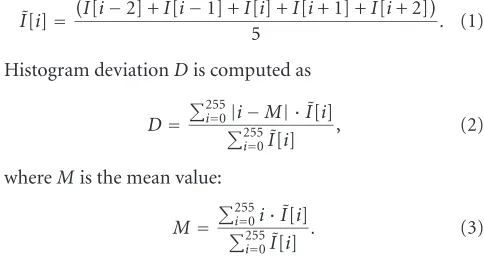
The contrast measure is computed by simply building a histogram for each block and then calculating its deviation (2) from the mean value (3). A high deviation value denotes good contrast and vice versa. In order to remove irrelevant peaks, the histogram is slightly smoothed by replacing each entry with its mean in a ray 2 neighborhood. Thus, the orig-inal histogram entry is replaced with the gray level ˜I[i]:
˜ I[i]=
I[i−2] +I[i−1] +I[i] +I[i+ 1] +I[i+ 2]
5 . (1)
Histogram deviationDis computed as
D=
whereMis the mean value:
M=
The focus measure is computed by convolving each block with a simple 3×3 Laplacian filter.
m1 m2 m3 m4 m5
m6 m7 m8 m9 m10
m11 m12 m13 m14 m15
m16 m17 m18 m19 m20
m21 m22 m23 m24 m25
(a) (b) (c) (d)
Figure2: Features extraction pipeline (for focus and contrast withN=25). Visual relevance of each luminance block (b) of the input image (a) is based on relevance measures (c) able to obtain a list of relevant blocks (d).
are thresholded. The mean focus value of each block is com-puted as
F=
N
i=1thresh[lapl(i), Noise]
N , (4)
whereNis the number of pixels and the thresh(·) operator discards values lower than a fixed threshold Noise. Once the valuesFandDare computed for all blocks, relevant regions will be classified using a linear combination of both values. Features extraction pipeline is illustrated inFigure 2.
2.2. Features extraction: skin recognition
As before a visibility image obtained by forcing the mean gray level of the luminance channel to be about 128 is built.
Most existing methods for skin color detection usually threshold some sort of measure of the likelihood of skin colors for each pixel and treat them independently. Human skin colors form a special category of colors, distinctive from the colors of most other natural objects. It has been found that human skin colors are clustered in various color spaces [17,18]. The skin color variations between people are mostly due to intensity differences. These variations can therefore be reduced by using chrominance components only.
Yang et al. [19] have demonstrated that the distribu-tion of human skin colors can be represented by a two-dimensional Gaussian function on the chrominance plane. The center of this distribution is determined by the mean vectorµand its shape is determined by the covariance matrix
Σ; both values can be estimated from an appropriate training data set. The conditional probability p(x|s) of a block be-longing to the skin color class, given its chrominance vector
xis then represented by
pxs= 1
2π|Σ|
−1/2exp
−d(x)2 2
, (5)
where d(x) is the so-called Mahalanobis distance from the vectorxto the mean vectorµand is defined as
d(x)2=(x−µ)Σ−1(x−µ). (6)
The valued(x) determines the probability that a given block belongs to the skin color class. The larger the dis-tanced(x), the lower the probability that the block belongs to the skin color classs. Such class has been experimentally
(a) (b) (c)
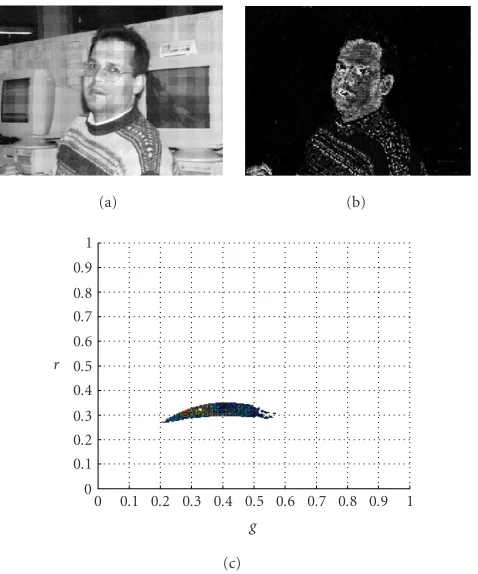
Figure3: Skin recognition examples on RGB images: (a) original images acquired by Nokia 7650 phone (first and second row) with VGA sensor and compressed in JPEG format; (b) simplest threshold method output; and (c) probabilistic threshold output. Third image (a) is a standard test image.
derived using a large data set of images acquired at diff er-ent conditions and resolution using CMOS-VGA sensor on “STV6500-E01” evaluation kit equipped with “502 VGA sen-sor” [20].
Due to the large quantity of color spaces, distance mea-sures, and two-dimensional distributions, many skin recog-nition algorithms can be used. The skin color algorithm is independent of exposure correction, thus we introduce two different alternative techniques aimed to recognize skin re-gions (as shown inFigure 3).
(a) (b)
Figure4: Skin recognition examples on Bayer pattern image: (a) original image in Bayer data; (b) recognized skin with probabilis-tic approach; and (c) threshold skin values onr−gbidirectional histogram (skin locus).
properly highlighted (Figure 3c). The higher the gray value the higher the probability to compute a reliable identification.
(2) By processing an input RGB image, a 2D chrominance distribution histogram (r,g) is computed, wherer =
R/(R+G+B) andg=G/(R+G+B). Chrominance val-ues representing skin are clustered in a specific area of the (r,g) plane, called “skin locus” (Figure 4c), as de-fined in [21]. Pixels having a chrominance value be-longing to the skin locus will be selected to correct ex-posure.
For Bayer data, the skin recognition algorithm works on the RGB image created by subsampling the original picture, as described inFigure 1.
2.3. Exposure correction
Once the visually relevant regions are identified, the expo-sure correction is carried out using the mean gray value of those regions as reference point. A simulated camera re-sponse curve is used for this purpose, which gives an esti-mate of how light values falling on the sensor become final pixel values (seeFigure 5). Thus it is a function:
f(q)=I, (7)
whereqrepresents the “light” quantity andI the final pixel
1
Figure5: Simulated camera response.
value [1]. This function can be expressed [14,22] by using a simple parametric closed form representation:
f(q)= 255
1 +e−(Aq)C, (8)
where parametersAandCcan be used to control the shape of the curve andqis supposed to be expressed in 2-based log-arithmic unit (usually referred as “stops”). These parameters could be estimated, depending on the specific image acquisi-tion device, using the techniques described in [22] or chosen experimentally. The offset from the ideal exposure is com-puted using the f curve and the average gray level of visually relevant regions avg as
∆= f−1(Trg)−f−1(avg), (9) where Trg is the desired target gray level. Trg should be around 128 but its value could be slightly changed especially when dealing with Bayer pattern data where some postpro-cessing is often applied.
The luminance valueY(x,y) of a pixel (x,y) is modified as follows:
Y(x,y)= ff−1Y(x,y)+∆. (10)
Note that all pixels are corrected. Basically the previ-ous step is implemented as a lookup table (LUT) transform (Figure 6shows two correction curves with differentA,C pa-rameters). Final color reconstruction is done using the same approach described in [23] to prevent relevant HUE shifts and/or color desaturation:
whereR,G, andBare the input color values.
300
Figure7: Automatic exposure correction pipeline: given a color image as input (for Bayer data image the pipeline is equivalent), the visibility image is extracted using a forced gray-level mean of about 128, then the skin percentage measure is achieved to seek if the input image contains skin features. In the case of skin feature existence (the value is more than the threshold T), the mean of selected skin pixel is achieved. If skin is not present the contrast and focus measures are computed and the mean of relevant blocks is performed. Finally, by fixing the correction curve, the exposure adjustment of luminance channel is accomplished.
3. COMPLEXITY ANALYSIS
The computational resources required by the algorithm de-scribed are negligible and indeed the whole process is well suited for real-time applications. Instead of the asymptotic complexity, the arithmetic complexity has been described to estimate the algorithm real-time execution [16]. More precisely, the sum of operations per pixel has been com-puted.
The following weights will be used:
(1) wafor basic arithmetic operations: additions, subtrac-tions, comparisons, and so forth;
(2) wm for semicomplex arithmetic operations: multipli-cations, and so forth;
(3) wlfor basic bits and logical operations: bits-shifts, log-ical operations, and so forth;
(4) wcfor complex arithmetic operations: divisions, expo-nentials, and so forth.
First the main functions of the algorithm will be analyzed; then the overallCcomplexity will be estimated.
scenario, when the algorithm is applied directly on the RGB image. The following assumptions are considered:
(1) the image consists inN×M=tot pixels andV×H=
num blocks;
(2) the inverse f−1 of the f function is stored in a
256-element LUT;
(3) the value calculated by the functionf (10) is estimated by scanning the curve bottom-up (if∆>0) searching for the first LUT indexI, where LUT[i] > LUT[y] +
∆, or top-down (if∆<0) searching for the first LUT indexiwhere LUT[i] < LUT[y] +∆. In both casesi becomes the value of gray-levelyafter correction.
By using the above-mentioned assumptions the correction of the Y channel can be done employing two 256-element LUTs, the first contains the f−1function and the second the
outputs of (10) for each of the 256 possible gray levels. The second LUT can be initialized with a linear search for each gray level.
Visibility image construction
The visibility image is obtained by computing the mean of the extractedYand the offset from desired exposure by ap-plying (9). Once the offset is known the visibility image is built using equations (10) to (13).
(1) Initialization step:
(a) mean computation: 1wa+ (1/tot)wc; (b) offset computation: (3/tot)wa;
(c) corrective curve uploading: (2k/tot)wa, where k has a mean value of about 70 in the worst case. (2) Color correction:
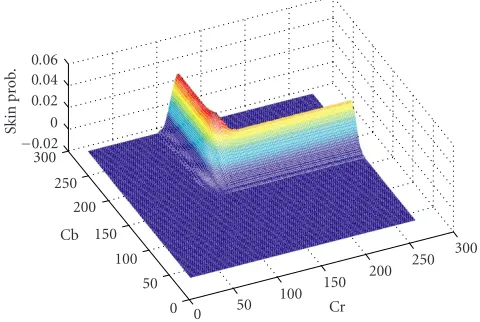
Since the skin probabilities are computed on Cr, Cb channels defined in the 0–255 range (after the 128-offset addition) the probabilities for each possible Cr, Cb pair can be precom-puted and stored in a 256×256 LUT. The dimensions of this LUT, due to its particular shape (Figure 8), can be reduced up to 136×86 discarding the pairs having zero value:
(1) lookup of skin probabilities (simple access to LUT): 1wa;
(2) thresholding of skin probabilities: 1wa;
(3) computation of skin mean gray value: 1wa+ (1/tot)wc.
Therefore
Figure8: Skin precomputed LUT.
Measures computation
The mean, focus, and contrast of each block are computed.
(1) Mean values of each block: (num×wc)/tot (since ac-cumulated gray levels inside each block can be ob-tained from the visibility image and only the divisions have to be done).
(2) Focus computation:
Once focus and contrast are obtained, blocks are selected us-ing their linear combination value:
(1) linear combination of focus and contrast: (num/ tot)(1wa+ 2wm);
(2) comparison between the linear combination and a se-lection value: (num/tot)wm.
Image correction
This step can be considered computationally equivalent to the visibility image construction since the only difference is the mean value used for corrective LUT loading, therefore:
C5=
The algorithm complexity is then obtained by adding all the above values:
The overall complexity is hence well suited for real-time ap-plications (note that the ratio num/tot will always be very small, since totnum). For example given a 640×480 VGA input image (tot =307 200), a fixed num =64 blocks, and the worstk=70, the complexity becomes
C=
That is cost-effective and suitable for real-time processing ap-plications.
4. EXPERIMENTAL RESULTS
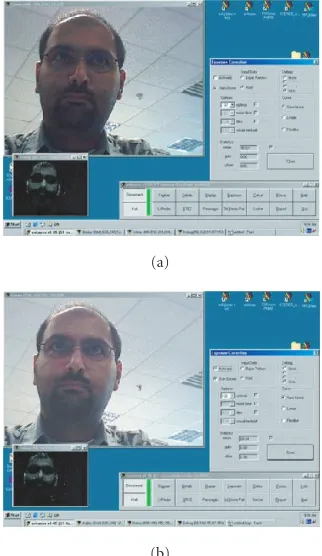
The proposed technique has been tested using a large database of images acquired at different resolutions, with dif-ferent acquisition devices, both in Bayer and RGB format. In Figure 7the exposure correction pipeline is illustrated. The whole process is organized as follows: the “visibility” image is extracted from the input image, and then the skin percent-age measure is achieved to determine if the input impercent-age con-tains skin features; once the type of features is known the ex-traction of the mean values is performed, and finally the cor-rection is accomplished. In the Bayer case the algorithm was inserted in a real-time framework, using a CMOS-VGA sen-sor on STV6500-E01 evaluation kit equipped with 502 VGA sensor [20]. InFigure 9screen shots of the working
environ-(a)
(b)
Figure 9: Framework interface for STV6500-E01 EVK 502 VGA sensor: (a) before and (b) during real-time skin dependent exposure correction. The small window with black background represents the detected skin.
ment are shown. Figure 10billustrates the visually relevant blocks found during the features extraction step. Examples of skin detection by using real-time processing are reported inFigure 11. In the RGB case the algorithm could be imple-mented as postprocessing step. Examples of skin and con-trast/focus exposure correction are respectively shown in Fig-ures10and12.
For sake of comparisons we have chosen both global and adaptive techniques, able to work in real-time processing: standard global histogram equalization and gamma correc-tion [7] and adaptive luminance preservation equalization technique [9]. The parameters of gamma correction have been manually fixed to the mean value computed by the pro-posed algorithm. Experiments and comparisons with exist-ing methods are shown in Figures13,14, and15.
(a) (b) (c)
Figure10: Experimental results by postprocessing: (a) original color input image, (b) contrast and focus visually significant blocks detected, and (c) exposure-corrected image obtained from RGB image.
(a) (b) (c)
(d) (e)
Figure11: Experimental results by real-time and postprocessing: (a) original Bayer input image, (b) Bayer skin detected in real-time, (c) color interpolated image from Bayer input, (d) RGB skin detected in postprocessing, and (e) exposure-corrected image obtained from RGB image.
has completely failed the objective due to the large amount of background lightness. The exclusion of the skin features extraction phase is evident looking at the enhancement dif-ference between Figures14eand14f. Finally,Figure 15shows
(a) (b)
(c) (d)
Figure12: Experimental results: (a) original images acquired by Nokia 7650 VGA sensor compressed in JPEG format, (b) corrected output, (c) image acquired with CCD sensor (4.1 megapixels) Olympus E-10 camera, and (d) corrected output image.
(a) (b) (c)
(d) (e)
(a) (b) (c)
(d) (e) (f)
Figure14: Experimental results with relative luminance histograms: (a) input image, (b) adaptive equalized image using the technique described in [9], (c) equalized image, (d) gamma correction output with fixed average value defined by the proposed method, (e) proposed algorithm forced without skin feature detection, and (f) proposed algorithm output. The selected image (a) has been captured by using an Olympus E10 camera.
(a) (b) (c)
(d) (e)
Figure15: Experimental results with relative luminance histograms: (a) input image, (b) equalized image, (c) adaptive equalized image using the technique described in [9], (d) gamma correction output with fixed average value computed by the proposed method, and (e) proposed algorithm output. The selected image (a) has been captured by using an Olympus C40Z camera.
Almost all gamma-corrected images in Figures13d,14d, and15dcontain excessive color desaturation.
Results show how often histogram equalization, that do not take into account images features, leads to excessive con-trast enhancement while simple gamma correction leads to excessive color desaturation. Therefore the features analysis capability of the proposed algorithm permits contrast
en-hancement taking into account some strong peculiarity of the input image.
5. CONCLUSIONS
The approach is able to analyze the Bayer data captured by a CCD/CMOS sensor, or the corresponding color gener-ated picture; once the skin key features have been identified, the algorithm adjusts the exposure level using a “camera re-sponse”-like function. The method can solve some of the typ-ical drawbacks featured by handset devices due to poor op-tics, absence of flashgun, difficult scene lighting conditions, and so forth. The overall computation time needed to apply the proposed algorithm, is negligible, thus it is well suited for real-time applications. Experiments show the effectiveness of the techniques in both cases. Future works will investigate the use of curvelet transform for enhanced exposure correction [13].
REFERENCES
[1] S. Battiato, A. Castorina, and M. Mancuso, “High dynamic range imaging for digital still camera: an overview,”Journal of Electronic Imaging, vol. 12, no. 3, pp. 459–469, 2003. [2] A. Bosco, M. Mancuso, S. Battiato, and G. Spampinato,
“Tem-poral noise reduction of Bayer matrixed video data,” inProc. IEEE International Conference on Multimedia and Expo (ICME ’02), vol. 1, pp. 681–684, Lausanne, Switzerland, August 2002. [3] M. Mancuso, A. Bosco, S. Battiato, and G. Spampinato, “Adaptive temporal filtering for CFA video sequences,” in Proc. IEEE Advanced Concepts for Intelligent Vision Systems (ACIVS ’02), pp. 19–24, Ghent University, Belgium, Septem-ber 2002.
[4] G. Messina, S. Battiato, M. Mancuso, and A. Buemi, “Improv-ing image resolution by adaptive back-projection correction techniques,” IEEE Transactions on Consumer Electronics, vol. 48, no. 3, pp. 409–416, 2002.
[5] J. Holm, I. Tastl, L. Hanlon, and P. Hubel, “Color process-ing for digital photography,” inColour Engineering: Achieving Device Independent Colour, P. Green and L. MacDonald, Eds., John Wiley & Sons, New York, NY, USA, June 2002.
[6] M. Mancuso and S. Battiato, “An introduction to the digital still camera technology,”ST Journal of System Research, vol. 2, no. 2, pp. 1–9, 2001.
[7] R. C. Gonzalez and R. E. Woods, Digital Image Processing, Addison-Wesley, Reading, Mass, USA, 1993.
[8] J. A. Stark, “Adaptive image contrast enhancement using gen-eralizations of histogram equalization,” IEEE Trans. Image Processing, vol. 9, no. 5, pp. 889–896, 2000.
[9] Y. Wang, Q. Chen, and B. Zhang, “Image enhancement based on equal area dualistic sub-image histogram equaliza-tion method,”IEEE Transactions on Consumer Electronics, vol. 45, no. 1, pp. 68–75, 1999.
[10] J. A. S. Centeno and V. Haertel, “An adaptive image enhance-ment algorithm,”Pattern Recognition, vol. 30, no. 7, pp. 1183– 1189, 1997.
[11] H. D. Cheng and H. Xu, “A novel fuzzy logic approach to contrast enhancement,” Pattern Recognition, vol. 33, no. 5, pp. 809–819, 2000.
[12] J. Tang, E. Peli, and S. Acton, “Image enhancement using a contrast measure in the compressed domain,” IEEE Signal Processing Letters, vol. 10, no. 10, pp. 289–292, 2003. [13] J.-L. Starck, F. Murtagh, E. Candes, and D. L. Donoho, “Gray
and color image contrast enhancement by the curvelet trans-form,” IEEE Trans. Image Processing, vol. 12, no. 6, pp. 706– 717, 2003.
[14] S. A. Bhukhanwala and T. V. Ramabadran, “Automated global enhancement of digitized photographs,”IEEE Transactions on Consumer Electronics, vol. 40, no. 1, pp. 1–10, 1994.
[15] B. E. Bayer, “Color imaging array,” US Patent 3 971 065,1976. [16] J. Reichel and M. J. Nadenau, “How to measure arithmetic complexity of compression algorithms: a simple solution,” in Proc. IEEE International Conference on Multimedia and Expo (ICME ’00), vol. 3, pp. 1743–1746, New York, NY, USA, July– August 2000.
[17] S. L. Phung, A. Bouzerdoum, and D. Chai, “A novel skin color model in YCbCr color space and its application to human face detection,” inProc. IEEE International Conference on Image Processing (ICIP ’02), vol. 1, pp. 289–292, Rochester, NY, USA, September 2002.
[18] B. D. Zarit, B. J. Super, and F. K. H. Quek, “Comparison of five color models in skin pixel classification,” inProc. IEEE International Workshop on Recognition, Analysis, and Tracking of Faces and Gestures in Real-Time Systems (RATFG-RTS ’99), pp. 58–63, Corfu, Greece, September 1999.
[19] J. Yang, W. Lu, and A. Waibel, “Skin-color modeling and adaptation,” Tech. Rep. CMU-CS-97-146, School of Com-puter Science, Carnegie Mellon University, Pittsburgh, Pa, USA, 1997.
[20] Colour Sensor Evaluation Kit VV6501, STMicroelectron-ics, Edinburgh,www.st.com/stonline/products/applications/ consumer/ cmos imaging/sensors/6501.htm.
[21] M. Soriano, B. Martinkauppi, S. Huovinen, and M. Laakso-nen, “Skin color modeling under varying illumination con-ditions using the skin locus for selecting training pixels,” in Proc. Workshop on Real-time Image Sequence Analysis (RISA ’00), pp. 43–49, Oulu, Finland, August-September 2000. [22] S. Mann, “Comparametric equations with practical
applica-tions in quantigraphic image processing,” IEEE Trans. Image Processing, vol. 9, no. 8, pp. 1389–1406, 2000.
[23] S. Sakaue, M. Nakayama, A. Tamura, and S. Maruno, “Adap-tive gamma processing of the video cameras for the expansion of the dynamic range,” IEEE Transactions on Consumer Elec-tronics, vol. 41, no. 3, pp. 555–562, 1995.
S. Battiato received the Ph.D. degree in 1999 in applied mathematics and computer science from Catania University. From 1999 to 2003 he was at STMicroelectronics in the Advanced System Technology (AST) Cata-nia Laboratory with the Imaging Group. He is currently a Researcher And Teaching As-sistant in the Department of Mathematic and Informatics at the University of Cata-nia. His current research interests lie in the
areas of digital image processing, pattern recognition, and com-puter vision. He acts as a reviewer for several leading international conferences and journals, and he is author of several papers and international patents.
A. Boscowas born in Catania, Italy, in 1972. He received the M.S. degree in computer science in 1997 from the University of Cata-nia with a thesis in the field of image pro-cessing about tracking vehicles in video se-quences. He joined STMicroelectronics in June 1999 as a System Engineer in the Dig-ital Still Camera and Mobile Multimedia Group. Since then, he has been working on distortion artifacts of CMOS imagers and
A. Castorina received his M.S. degree in computer science in 2000 from the Uni-versity of Catania. His thesis is about wa-termarking algorithms for digital images. Since September 2000 he has been work-ing in STMicroelectonics in the AST Digital Still Camera Group as System Engineer. His current activities include image enhance-ment and high dynamic range imaging.
G. Messinareceived his M.S. degree in com-puter science in 2000 from the Univer-sity of Catania. His thesis is about statis-tical methods for textures discrimination. Since March 2001 he has been working at STMicroelectronics in the Advanced System Technology (AST) Imaging Group as Sys-tem Engineer. His current research interests are in the area of image processing, resolu-tion enhancement, analysis-synthesis of