Don’t Annotate, but Validate: a Data-to-Text Method for Capturing Event Data
Piek Vossen, Filip Ilievski, Marten Postma, Roxane Segers
Vrije Universiteit AmsterdamDe Boelelaan 1105, 1081 HV Amsterdam The Netherlands
{piek.vossen, f.ilievski, m.c.postma, r.h.segers}@vu.nl
Abstract
In this paper, we present a new method to obtain large volumes of high-quality text corpora with event data for studying identity and reference relations. We report on the current methods to create event reference data by annotating texts and deriving the event data a posteriori. Our method starts from event registries in which event data is defined a priori. From this data, we extract so-called
Microworlds of referential data with the Reference Texts that report on these events. This makes it possible to easily establish
referential relations with high precision and at a large scale. In a pilot, we successfully obtained data from these resources with extreme ambiguity and variation, while maintaining the identity and reference relations and without having to annotate large quantities of texts word-by-word. The data from this pilot was annotated using an annotation tool created specifically in order to validate our method and
to enrich the reference texts with event coreference annotations. This annotation process resulted in theGun Violence Corpus, whose
development process and outcome are described in this paper.
Keywords:event coreference, text corpora, structured data
1.
Introduction
Events and entities are central to referential semantics. Se-mantic parsing of news articles not only concerns detect-ing the meandetect-ing of words and their relations, but especially establishing the referential relations to the outside world. For entities, it is straightforward what this referential world is. However, compared to entities, events are less tangi-ble (Guarino, 1999; Hovy et al., 2013) for various reasons: 1. we use a small vocabulary to name events, which results in large referential ambiguity 2. events are more open to in-terpretation and framing, which leads to more variation in making reference 3. events are less persistent in time than entities 4. each event has many idiosyncratic properties, e.g. unique participants playing different roles in a unique spa-tio-temporal context, making generalization harder. Due to these properties, textual data on events is more fragmented than textual data on entities. In news, events are mentioned during a very short period of time and they rapidly lose their news value (except for a few events like9/11), whereas pop-ular entities tend to be mentioned across different texts over longer periods of time. We thus do not find a typical Zipfian distribution for events, with a few events that dominate the news (the head) and a long tail of low-frequent events, but a more even low-frequent distribution.
Given this fragmented distribution, it is not surprising that NLP tasks on event detection, event relation detection, and event coreference are difficult, which is reflected by rel-atively low inter-annotator-agreements and small amounts of data with event annotations.
Most corpora with event annotations do not consider how they relate to the same or similar events in the world, e.g. PropBank (Kingsbury and Palmer, 2002), NomBank (Mey-ers et al., 2004), and FrameNet (Baker et al., 2003). In these corpora, syntactic structures are taken as the starting point and all predicates mark mentions of events. Simi-larity of events follows from the assigned event type, the meaning of the word or frame, and from having similar
ar-gument structures. These corpora, however, lack a notion of event reference and are not very well-suited for studying the different ways we describe the same or similar events. For the latter purpose, specific event coreference corpora have been created: ECB+ (Cybulska and Vossen, 2014), RED (O’Gorman et al., 2016), among others. Event coref-erence annotations have been created using what we call a
text-to-data (T2D)approach. In the T2D approach, anno-tators start from the text and first decide what phrases are labeled as event mentions after which different event men-tions are related to each other through an event coreference relation. The coreference relations establish event identity across event mentions a posteriori by chaining event men-tions that share coreference relamen-tions. Due to the complex-ity and labor-intenscomplex-ity of this T2D approach, only a limited amount of referential event data has been created so far (see Table 1).
The research on event coreference faces a data bottleneck because it is both too difficult and too costly to gather sufficient data following the traditional T2D method. We therefore present a novel semi-automatic method, called
structured-data-to-text (D2T) to address this data prob-lem. Instead of deriving event identity a posteriori after the text annotation, this approach starts from event registries (structured data on events) in which the events are defined a priori and the texts that report on these events are mapped to the event data. By preserving the relation between the world and texts reporting on it, D2T allows us to create large volumes of referential event data in a more efficient way, with high agreement, and capturing more variation in the language making reference.
cre-ate an event coreference corpus, called the Gun Violence Corpus (GVC), following this method. An annotation tool was specifically designed to pair structured data with ref-erence texts and annotate the event mentions per incident. We analyzed the annotation results and efforts in terms of volume, speed, agreement and variation of referring expres-sions. Finally, we conclude and discuss our future plans in Section 5.
2.
From text to data
In this Section, we first give an overview and the overall statistics of the most studied datasets for event coreference, which are all created using a T2D method. Next, we discuss their annotation process.
2.1.
State of T2D datasets
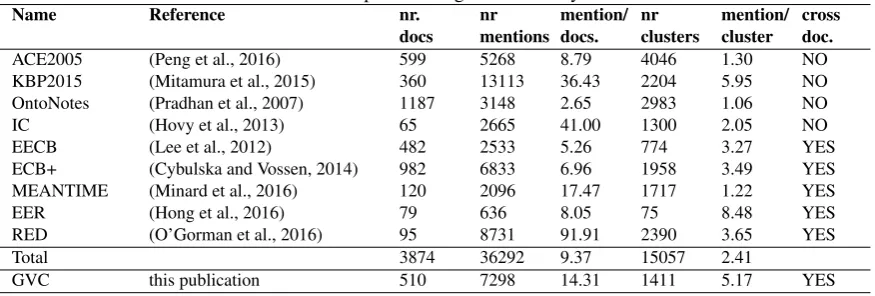
In Table 1, we present an overview of the text corpora that dominated the event coreference research in the last decade. The Table shows the number of documents in each dataset, the number of mentions of events, and the num-ber of so-called coreference clusters (groups of mentions that refer to the same event). The final column indicates if the coreference clusters span across documents (cross-document coreference) or only within a single (cross-document (within-document coreference). We observe that the num-ber of documents and mentions is small for both within-and cross-document relations: less than four thouswithin-and doc-uments and less than forty thousand mentions in total (10 mentions per document on average). The ratios between mentions and clusters vary considerably, which is due to the different ways in which the datasets have been compiled: either subsets of the sentences and/or event types were an-notated or all mentions in a full article.
Cross-document data is more sparse than within-document data, as can be seen in Table 1. ECB+ (Cybulska and Vossen, 2014) therefore extended the Event Coreference Bank (ECB) (Bejan and Harabagiu, 2008; Lee et al., 2012) from 482 articles to 982 articles by including more events of the same type. This slightly increased the referential ambiguity and variation, but, nevertheless, only a few sen-tences per article were annotated (1.8 sensen-tences per arti-cle on average in ECB+). The Rich Entities, Relations and Events corpus (Song et al., 2015) and the Richer Event De-scription corpus (O’Gorman et al., 2016) are two recent ini-tiatives to manually create similar annotations forall sen-tences in articles and also partially across documents, but the number of documents covered is small.
We analysed the referential annotations in a number of these datasets, revealing that they, despite efforts such as the creation of ECB+, hardly reflect referential ambiguity and show very little variation (Cybulska and Vossen, 2014; Ilievski et al., 2016). For example, ECB with 482 docu-ments contains 8 news articles on one specific murder, but since there are no other murders in the dataset, searching for the word “murder” results in almost all mentions of that specific incident with high accuracy: one-form-one-referent and one-one-form-one-referent-one-form. Cybulska and Vossen (2014) demonstrated that the so-called lemma baseline to establish coreference relations1scores already very high in
1
all occurrences of the same word, e.g. “murder”, mention a
this dataset and is difficult to beat by state-of-the-art sys-tems. From the perspective of a real-world situation and the many different ways in which events can be described and framed in language, these datasets are far too sparse and do not reflect true ambiguity and variation. Partly due to this lack of data and variation, automatic event corefer-ence detection has made little progress over the years, es-pecially across documents (Chen and Ji, 2009; Bejan and Harabagiu, 2010; Lee et al., 2012; Liu et al., 2014; Peng et al., 2016; Lu and Ng, 2016; Vossen and Cybulska, 2016). All data listed in Table 1 are created according to the T2D approach: a selection of text is made and interpreted by annotators who add an annotation layer. Creating data fol-lowing a T2D approach is expensive and labor-intense, as all mentions of events need to be cross-checked against all other mentions across documents for coreference relations. With the size of the data, the effort increases exponentially.
2.2.
State of text-to-data guidelines
Besides meta-level choices on what needs to be anno-tated, guidelines and annotations tend to differ in criteria for deciding on the text span to be annotated as a men-tion. In some cases, complete phrases (e.g. “inflicted a fatal gunshot wound”) or even whole sentences are anno-tated, whereas in other cases only semantic main verbs (“pull the trigger”) are annotated; implicit events (“mur-derer”, “killer”, “victim”) are included or excluded; coref-erence, subset and subevent relations are lumped together (“attack”, “pointing a weapon”, “shootings”, “5 shots”, “4 hits one fatal”, “3 injured, 1 killed, 1 died in the hospital”); quantification of events is or is not ignored (the phrase “the 2 earthquakes” refers to two different earthquake events) or generic events (“measles is a deadly disease”) are excluded; only realis events are annotated or also irrealis events; as-pectual verbs (“begin”, “stop”, “continue”, “happen”, “take place”) are sometimes seen as events and sometimes not; adjectival or adverbial modifiers (“fatal accident”) are not marked, etc. Such choices are based on a priori criteria regardless of the types of events annotated and they tend to vary depending on the specific task for which the data were annotated e.g. semantic role detection (Kingsbury and Palmer, 2002), detecting temporal and causal event re-lations (Boguraev et al., 2007; Pustejovsky and Verhagen, 2009; Bethard et al., 2015; Caselli and Morante, 2016), or event coreference relations (Hovy et al., 2013).
Besides the differences in guidelines, annotators following guidelines may also have different interpretations, which may lead to relatively low inter-annotator-agreement and conservative annotation strategies. Due to the complexity of the task, annotators may for example stay on the safe side and create identity relations only when the same word is used, hence eliminating variation. Such difficulties in defining events, event relations, and event coreference have led to the creation of the KBP2015 dataset (Mitamura et al., 2015) in which a weaker definition of an event has been applied, so-called Event Nuggets, to ease the annotation and the task for establishing coreference relations. In the KBP2015 dataset, “attack”, “shooting”, and “murder” do not represent separate event instances, but are considered
Table 1: Event coreference corpora for English created by a text-to-data method
Name Reference nr. nr mention/ nr mention/ cross
docs mentions docs. clusters cluster doc.
ACE2005 (Peng et al., 2016) 599 5268 8.79 4046 1.30 NO
KBP2015 (Mitamura et al., 2015) 360 13113 36.43 2204 5.95 NO
OntoNotes (Pradhan et al., 2007) 1187 3148 2.65 2983 1.06 NO
IC (Hovy et al., 2013) 65 2665 41.00 1300 2.05 NO
EECB (Lee et al., 2012) 482 2533 5.26 774 3.27 YES
ECB+ (Cybulska and Vossen, 2014) 982 6833 6.96 1958 3.49 YES
MEANTIME (Minard et al., 2016) 120 2096 17.47 1717 1.22 YES
EER (Hong et al., 2016) 79 636 8.05 75 8.48 YES
RED (O’Gorman et al., 2016) 95 8731 91.91 2390 3.65 YES
Total 3874 36292 9.37 15057 2.41
GVC this publication 510 7298 14.31 1411 5.17 YES
as mentions of the same underspecified event represented at a more coarse-grained level of granularity, so-called event-hoppers.
In all the T2D approaches described above, event reference is established a posteriori after annotating texts word-by-word and sentence-by-sentence to mark events and event relations. Figure 1 gives a schematic overview for the T2D approach that indirectly constructs a referential represen-tation from annotated mentions of events and participants. First, event and participant mentions need to be annotated in a single document and after that all these annotations need to be compared across all news articles to establish cross-document coreference. The more documents are in-cluded in the data set, the more comparisons need to be made. In the next section, we propose a new method that starts from registered events that are given a priori when annotating event references in texts so that we only need to compare mentions across relevant documents.
3.
From data to text
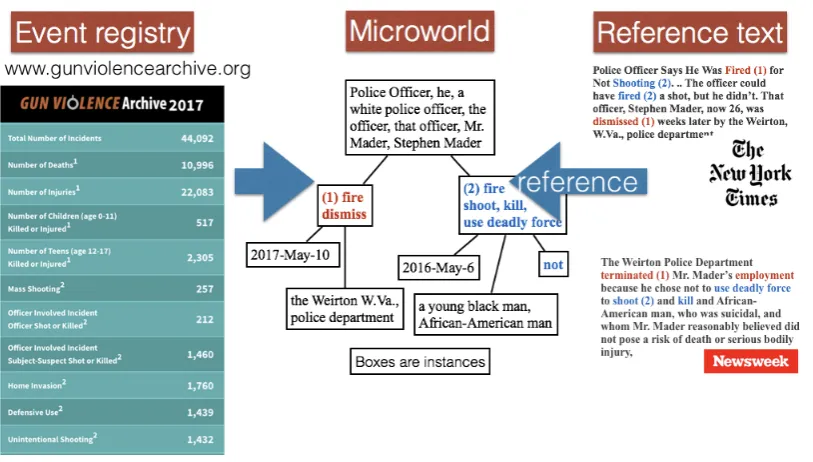
For the reasons discussed in the previous Section, T2D methods do not provide the means nor the datasets to study identity, reference and perspectives of events on a large scale, since they are too small and lack sufficient ambigu-ity and variation. We therefore propose a novel structured-data-to-text(D2T) methodology, based on the notions mi-croworldsandreference texts.Microworldsare structured representations of referents related to specific world events (e.g. human calamities or economic events). Reference texts are documents reporting on this data, e.g. news ar-ticles, blogs, and Wikipedia pages. In the D2T method, we start from some event registry that has been created by peo-ple a priori by hand and is publicly available as structured data. From these registries, we derive microworld repre-sentations of the unique event instances, their participants, location and date as a referential graph, as shown in Fig-ure 2. Assuming that reference texts mainly refer to the corresponding microworld and not to other events and par-ticipants, we can establish the referential relation relatively easily and partially automatically.
By combining microworlds for similar but different events with their paired reference texts, we increase the referen-tial ambiguity for systems that need to reconstruct the mi-croworld from the texts, hence approximating the complex-ity of reference relations in realcomplex-ity across large volumes of
text. By collecting news from different sources on the same or similar events, we approximate true variation in making reference from different perspectives. Furthermore, the fact that the data on events from which we start has been created from the perspective of general human interest (e.g. gun violence incident reports) avoids the never-ending discus-sion on what establishes an event in text. More practically, the D2T method is much less labor-intensive than T2D, be-cause a rich and consistent set of event properties and links to its supporting documents are often provided within a mi-croworld by the original data author. Finally, since the un-derlying data is often created manually, its quality is very high.
3.1.
Desiderata
Our method operates best on resources with: 1. links between structured data and reporting texts 2. disam-biguated/unique and consistently definedevents and event properties following Linked Data principles 3.open, avail-able data 4. high volume, since more data typically ex-hibits higher referential ambiguity and variation. If all four desiderata are fulfilled, the conversion of the data to mi-croworlds and reference texts is a matter of writing data manipulation scripts. In practice, resource properties are often not ideal, thus requiring some additional work - how-ever, the amount of annotation or retrieval needed is far lower/incomparable to the exhaustive annotation processes in T2D.
3.2.
Resource availability
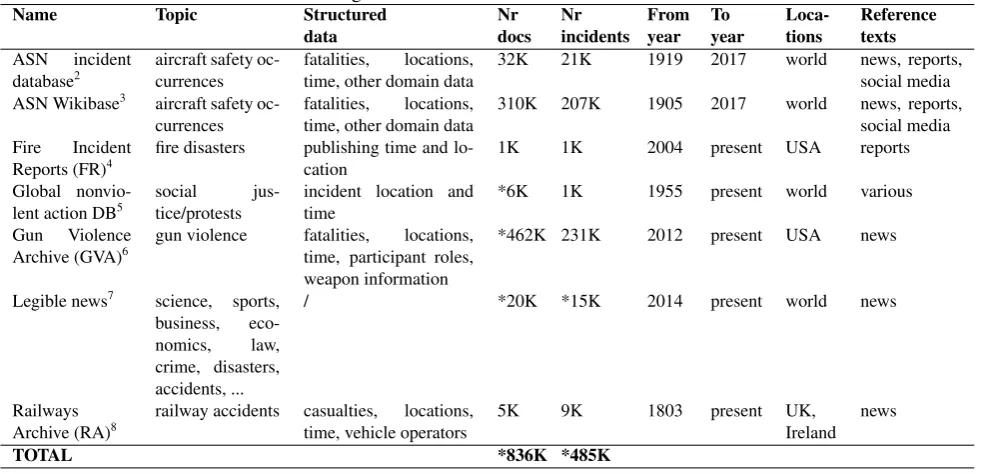
Table 2 provides description of several public resources that satisfy most of the desiderata. The resources register event incidents with rich properties such as participants, location, and incident time, and they provide pointers to one or more reference texts. The number of events and documents is usually high, for instance there are∼9K incidents in RA, and∼231K incidents in GVA.
Figure 1: Overview of the T2D method: deriving a referential graph from mentions across different news text.
Figure 2: Overview of the D2T method: representing structured event data first as microworlds and secondly pairing it with reference texts.
participants within highly ambiguous data covering a very long tail”, hosted at SemEval-2018.9
In addition to the resources presented in Table 2, data with similar properties can be obtained from Wikipedia and structured databases such as Wikidata10, Yago211, and DB-pedia12 with little effort. This can either be done through direct extraction, or through smart querying of the data (El-bassuoni et al., 2010; Knuth et al., 2015; Hewlett et al.,
9
https://competitions.codalab.org/ competitions/17285
10
https://query.wikidata.org
11
http://www.yago-knowledge.org
12http://events.dbpedia.org/ns/core#Event
Table 2: Potential event data for extracting microworlds and reference texts. Numbers marked with ‘*’ are estimates.
Name Topic Structured Nr Nr From To Loca- Reference
data docs incidents year year tions texts
ASN incident
32K 21K 1919 2017 world news, reports,
social media
ASN Wikibase3 aircraft safety
oc-currences
fatalities, locations,
time, other domain data
310K 207K 1905 2017 world news, reports,
social media
Fire Incident
Reports (FR)4
fire disasters publishing time and
lo-cation
1K 1K 2004 present USA reports
Global
nonvio-*6K 1K 1955 present world various
Gun Violence
Archive (GVA)6
gun violence fatalities, locations,
time, participant roles, weapon information
*462K 231K 2012 present USA news
Legible news7 science, sports,
business,
eco-nomics, law,
crime, disasters, accidents, ...
/ *20K *15K 2014 present world news
Railways
Archive (RA)8
railway accidents casualties, locations,
time, vehicle operators
5K 9K 1803 present UK,
Ireland news
TOTAL *836K *485K
4.
The Gun Violence Corpus
D2T resources provide a very valuable link between mi-croworlds and reference texts. We hypothesize that this link is also very useful for mention annotation of reference texts, because the microworld information provides a sum-mary of the incidents reported. Annotation of mentions can then be seen merely as a task of marking evidence for the incident and its characteristics in the supporting text docu-ments. Following this new view on the annotation process, we created the Gun Violence Corpus on top of our pilot data. This Section describes the details of its development.
4.1.
Annotation Task and Guidelines
The Gun Violence Corpus (GVC) consists of 241 unique incidents for which we have structured data on a) location, b) time c) the name, gender and age of the victims and d) the status of the victims after the incident: killed or injured. For these data, we gathered 510 news articles following the D2T approach. The structured data and articles report on a variety of gun violence incidents, such as drive-by shoot-ings, murder-suicides, hunting accidents, involuntary gun discharges, etcetera.
The documents have been manually annotated for all men-tions that make reference to the gun violence incident at hand. More specifically, the annotation process involved three basic steps:
• Annotating theevent typeof every mention that refers to a gun violence incident in the structured data;
• Annotating thevictim(s)involved in the mention refer-ring to a shooting in the structured data;
• Annotating every mention related to gun violence but NOT referring to the incident in the structured data (other incidents or generic mentions).
Based on these annotations, we can infer coreference re-lations: in case that two or more mentions have the same
annotations (event type and victims) AND they both relate to the same incident ID in the structured data, we can infer that these mentions are coreferential.
To further capture the referential complexity and diversity of event descriptions in text, we designed an event schema that captures subevent relations in addition to the above in-cident references, see Figure 3.
The main event (“the gun incident”) is basically a container that can be split into several more fine-grained events that stand in some implication relation to each other. In this case the bag of events consists of five events:Firing a gun, Hitting someoneorMissing someone. FromHitting some-onefollowsInjuringand in some casesDeath. Apart from these events, many articles also contain references to gun violence in a more general way or not related to the struc-tured data. These have been labeledGenericandOther.
Incident (B) (Bag of events)
(accident, incident, drama, shooting, act, tragedy, ...)
Firing a gun (S)
(fire, pull the trigger, shoot, gunshot, go
Figure 4: Annotation environment for annotating mentions in Reference Texts related to structured data.
4.1.1. The GVC Annotation Guidelines
We annotated all mentions denoting but also implying one of the predefined event classes. For example, afuneral, an autopsyor the process ofgrievingimply that someone died. Ashooterandkillerimply respectively the event types Fir-ing a gun and againDeathin the context of this domain. Besides annotating verbal and nominal expressions, we also annotated mentions of: other parts of speech (including ad-jectives and adverbs), idioms, multiword units, and collo-cations. In principle, we annotated the minimal span of a mention, usually the head, unless this would result in a meaningless annotation, e.g. we would annotate critical conditionas a multiword unit instead of just the head con-dition.
Additional specification of the annotation decisions, such as: how we handled negation, the irrealis, ellipsis, phrasal verbs, and various cases of implicit event mentions, can be found in the full guidelines of GVC.13
The annotation of events has similarities to the Entities Re-lations Events (ERE) (Song et al., 2015) and the Rich Event Description (RED) (O’Gorman et al., 2016), but also dif-ferences. The Bag of Event level annotation corresponds to the event hopper annotation in ERE, but we differentiate
13The full guidelines are available at https://goo.gl/
Yj1Hra
specific subevent and subset relations as well, as is done in RED. Our annotation is more restricted to the specific events of this database only. However, it can be extended to other domains by defining a different event schema.
4.2.
Annotation environment
To the best of our knowledge, there is no tool that starts from structured event data to annotate event mentions and event coreference relations. We therefore built our own en-vironment for annotating events in reference texts that are related to structured data on an incident.
The goal of the tool is to allow annotators to find evidence in the reference texts for the event properties in the struc-tured data. To support this goal, the tool reads the strucstruc-tured event data and presents the event properties, e.g. time, lo-cation, and participants, in a table. Annotators mark the event mentions, select the participants involved and select the type of event. The annotators only need to annotate the mentions of the predefined schema and not all other types of events.
annotations: event type and participants.
In addition, we have built in lexical support for the annota-tors, based on the set of already annotated event mentions. Reference text mentions which have been frequently anno-tated in other texts but not in the current one, are visually suggested to be also annotated. The annotators can then decide whether to accept this suggestion.
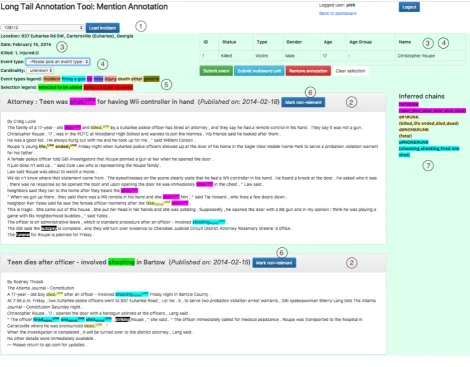
Figure 4 provides a screenshot of the mention annotation environment when the incident108112is loaded by the user piek. The incident selection menu is marked with (1) in the Figure. The selected incident is supported by two reference texts, rendered in the middle of the screen (marked with (2)). Annotators can select one or multiple mentions from this area for annotation. The top panel contains the struc-tured data about the current incident (marked with (3)), fol-lowed by menus and a table for annotations of properties for the selected mention (4). Mentions in colors have already been annotated by this user, and the event type is signaled by the color. The color scheme is explained in detail in the legend (5). Moreover, inversely colored mentions (e.g. “fu-neral” and “autopsy” in Figure 4) are the ones proposed by the tool to be annotated additionally. Annotators can also discard individual documents with the ‘Mark non-relevant’ button (6). Finally, the area on the right displays the coref-erential chains that the tool has inferred so far about the current incident (marked with (7) in the Figure).
The source code of the annotation software is publicly available on Github.14
4.3.
Annotation process
Two linguistic students were hired to perform the annota-tions. After completing the training phase, which resulted in some simplifications of the guidelines, the students started with the annotation of the Gun Violence Corpus. In six weeks, the students annotated the 510 documents that are part of the corpus. In addition, 25 documents were se-lected in order to compute the inter-annotator-agreement (IAA). The first annotator annotated 432 event mentions in this set, whereas the second one annotated 457 event mentions. The annotators provided the same annotation in 350 cases, resulting in a Cohen’s kappa coefficient (Cohen, 1960) of 0.72. According to Landis and Koch (1977), a score between 0.61 and 0.80 is consideredsubstantial, from which we conclude that there was high agreement between the annotators. For comparison, ECB+ reported a Cohen’s kappa coefficient of 0.68 for a similar size and agreement analysis to ours. ECB+ annotators only had to consider 2 incidents per topic with about 10 articles per incident and 1.8 sentences on average per article, whereas in our case, 510 documents need to be annotated for a few hundred inci-dents. In terms of speed, one annotator averaged 5 minutes per document, whereas the other took 4 minutes to annotate one document on average.
Unlike in T2D, our method scales only linearly instead of exponentially. Namely, to include documents that report on a new incident, one does not need to compare their men-tions to all other incidents, since the structured data already guarantees they are not coreferential. In Table 1, we report
14https://github.com/cltl/
LongTailAnnotation
statistics on the size of our corpus. Although our corpus annotated with mentions is currently smaller than existing datasets, the speed and the linear scalability of our method provide a promise that its size can increase up to the limit posed by the original structured data sources.
4.4.
Corpus description
The GVC15contains 7,298 mentions, referring to 241 inci-dents. In total, 510 documents contain at least one mention. Table 3 presents the annotation frequency for each event type.
Table 3: Mention frequency of each event type.
Most mentions in our Gun Violence Corpus refer to the event types Deathand Firing a gun, respectively. In ad-dition, about 4% of all mentions (i.e. 270 mentions), refer to generic uses of shooting and killings. Finally, it is not uncommon that the text refers to other incidents than the main incident of the article, which happens in about 8% of all mentions (i.e. 596). This means that systems can not fully rely on a one-incident-per-document heuristic to de-tect coreference chains.
Table 4 presents the most used expressions for each event type.
event type most common expressions
Death dead (305) died (285) killed (283) Firing a gun shooting (680) gunshot (247)
went off (72)
Hitting shot (801) shooting (83) struck (46) Bag of events shooting (247) incident (164) it (88) Injuring wound (175) injured (75) injuries (68) Other shot (105) shooting (70) killed (47) Generic accident (57) shooting (13) tragedy (11) Missing surgery (1) missed (1)
Table 4: Most common expressions used for event types
As presented in this Table, the most common expressions that are used to refer to event types are covered well in re-sources such as WordNet. For example, the most common expressions for the event type Deathcan be detected by correctly identifying the WordNet synsets kill.v.01(cause to die; put to death, usually intentionally or knowingly) and killing.n.02 (the act of terminating a life). However, this
15The corpus can be downloaded at: https://github.
is not the case for all expressions in the GVC. For exam-ple, expressions like mourn andautopsy that refer to the event typeDeathshow that manual and automatic annota-tors can not fully rely on resources to detect all event types correctly, but that additional reasoning is needed. We ana-lyze the referential potential of this corpus further in Vossen et al. (2018).
5.
Conclusions
We discussed the problems in collecting large scale and high-quality text corpora for event extraction, and specif-ically with respect to identity and reference. We con-cluded that most data has been created through a text-to-data method, which faces the obstacles of text-to-data size and scalability. To circumvent these, we propose a scalable data-to-text method to create far more data with high qual-ity, ambiguqual-ity, and variation. Following this method, we created the Gun Violence Corpus, whose development is reported in this paper. We present the specification and the guidelines of the annotation, as well as our annota-tion environment which was purposefully developed to sup-port mention annotation for data-to-text use cases. Finally, we show that we achieve high agreement and annotation speed, and report statistics of the resulting corpus. For fu-ture works, we aim to compare our annotation process to traditional annotation using text-to-data tools such as CAT (Lenzi et al., 2012) to annotate the same documents used in this study.
6.
Acknowledgements
The work presented in this paper was funded by the Nether-lands Organization for Scientific Research (NWO) via the Spinoza grant, awarded to Piek Vossen in the project “Un-derstanding Language by Machines”.
7.
Bibliographical References
Bejan, C. A. and Harabagiu, S. (2010). Unsupervised event coreference resolution with rich linguistic features. InProceedings of the 48th Annual Meeting of the Asso-ciation for Computational Linguistics, pages 1412–1422. Association for Computational Linguistics.
Chen, Z. and Ji, H. (2009). Graph-based event corefer-ence resolution. InProceedings of the 2009 Workshop on Graph-based Methods for Natural Language Processing, pages 54–57. Association for Computational Linguistics. Cohen, J. (1960). A coefficient of agreement for nomi-nal scales. Educational and psychological measurement, 20(1):37–46.
Cybulska, A. and Vossen, P. (2014). Using a sledge-hammer to crack a nut? Lexical diversity and event coreference resolution. In Proceedings of the Interna-tional Conference on Language Resources and Evalua-tion (LREC), pages 4545–4552.
Elbassuoni, S., Ramanath, M., Schenkel, R., and Weikum, G. (2010). Searching RDF graphs with SPARQL and keywords.
Guarino, N. (1999). The role of identity conditions in on-tology design. In International Conference on Spatial Information Theory, pages 221–234. Springer.
Hewlett, D., Lacoste, A., Jones, L., Polosukhin, I., Fan-drianto, A., Han, J., Kelcey, M., and Berthelot, D. (2016). Wikireading: A novel large-scale language un-derstanding task over wikipedia. InProceedings of the 54th Annual Meeting of the Association for Computa-tional Linguistics (Volume 1: Long Papers), pages 1535– 1545. Association for Computational Linguistics. Hovy, E., Mitamura, T., Verdejo, F., Araki, J., and Philpot,
A. (2013). Events are not simple: Identity, non-identity, and quasi-identity. InWorkshop on Events: Definition, Detection, Coreference, and Representation, pages 21– 28.
Ilievski, F., Postma, M., and Vossen, P. (2016). Semantic overfitting: what ‘world’ do we consider when evaluat-ing disambiguation of text? InProceedings of COLING 2016, the 26th International Conference on Computa-tional Linguistics: Technical Papers, pages 1180–1191. Knuth, M., Lehmann, J., Kontokostas, D., Steiner, T., and
Sack, H. (2015). The DBpedia Events Dataset. In Inter-national Semantic Web Conference (Posters & Demos). Landis, J. R. and Koch, G. G. (1977). The measurement
of observer agreement for categorical data. Biometrics, pages 159–174.
Lee, H., Recasens, M., Chang, A., Surdeanu, M., and Jurafsky, D. (2012). Joint entity and event corefer-ence resolution across documents. InProceedings of the 2012 Joint Conference on Empirical Methods in Natural Language Processing and Computational Natural Lan-guage Learning, pages 489–500. Association for Com-putational Linguistics.
Lenzi, V. B., Moretti, G., and Sprugnoli, R. (2012). CAT: the CELCT Annotation Tool. In Proceedings of the Eighth International Conference on Language Resources and Evaluation (LREC) 2012. European Language Re-sources Association (ELRA).
Liu, Z., Araki, J., Hovy, E. H., and Mitamura, T. (2014). Supervised withdocument event coreference using in-formation propagation. InLREC, pages 4539–4544. Lu, J. and Ng, V. (2016). Event Coreference Resolution
with Multi-Pass Sieves. In LREC 2016, pages 3996– 4003.
Peng, H., Song, Y., and Roth, D. (2016). Event detection and co-reference with minimal supervision. InEMNLP, pages 392–402.
Vossen, P. and Cybulska, A. (2016). Identity and granular-ity of events in text. Cicling 2016. Konya, Turkey. Vossen, P., Postma, M., and Ilievski, F. (2018).
Refer-enceNet: a semantic-pragmatic network for capturing reference relations. InGlobal Wordnet Conference 2018, Singapore.
8.
Language Resource References
Baker, C. F., Fillmore, C. J., and Cronin, B. (2003). Thestructure of the framenet database.International Journal of Lexicography, 16(3):281–296.
Bejan, C. A. and Harabagiu, S. M. (2008). A Linguistic Resource for Discovering Event Structures and Resolv-ing Event Coreference. InLREC.
and Verhagen, M. (2015). SemEval-2015 task 6: Clin-ical TempEval. InSemEval@ NAACL-HLT, pages 806– 814.
Boguraev, B., Pustejovsky, J., Ando, R., and Verhagen, M. (2007). TimeBank evolution as a community resource for timeml parsing. Language Resources and Evalua-tion, 41(1):91–115.
Caselli, T. and Morante, R. (2016). Vuacltl at semeval 2016 task 12: A crf pipeline to clinical tempeval. Pro-ceedings of SemEval, pages 1241–1247.
Cybulska, A. and Vossen, P. (2014). Using a sledge-hammer to crack a nut? Lexical diversity and event coreference resolution. In Proceedings of the Interna-tional Conference on Language Resources and Evalua-tion (LREC), pages 4545–4552.
Hong, Y., Zhang, T., O’Gorman, T., Horowit-Hendler, S., Ji, H., and Palmer, M. (2016). Building a cross-document event-event relation corpus.LAW X.
Hovy, E., Mitamura, T., Verdejo, F., Araki, J., and Philpot, A. (2013). Events are not simple: Identity, non-identity, and quasi-identity. InWorkshop on Events: Definition, Detection, Coreference, and Representation, pages 21– 28.
Kingsbury, P. and Palmer, M. (2002). From TreeBank to PropBank. InLREC, pages 1989–1993. Citeseer. Lee, H., Recasens, M., Chang, A., Surdeanu, M., and
Jurafsky, D. (2012). Joint entity and event corefer-ence resolution across documents. InProceedings of the 2012 Joint Conference on Empirical Methods in Natural Language Processing and Computational Natural Lan-guage Learning, pages 489–500. Association for Com-putational Linguistics.
Meyers, A., Reeves, R., Macleod, C., Szekely, R., Zielin-ska, V., Young, B., and Grishman, R. (2004). The NomBank project: An interim report. InProceedings of the Workshop Frontiers in Corpus Annotation at HLT-NAACL 2004.
Minard, A.-L., Speranza, M., Urizar, R., Altuna, B., van Erp, M., Schoen, A., and van Son, C. (2016). MEAN-TIME, the NewsReader Multilingual Event and Time Corpus. InProceedings of LREC 2016.
Mitamura, T., Yamakawa, Y., Holm, S., Song, Z., Bies, A., Kulick, S., and Strassel, S. (2015). Event nugget anno-tation: Processes and issues. InProceedings of the 3rd Workshop on EVENTS at the NAACL-HLT, pages 66–76. O’Gorman, T., Wright-Bettner, K., and Palmer, M. (2016). Richer Event Description: Integrating event coreference with temporal, causal and bridging annotation. In Pro-ceedings of the 2nd Workshop on Computing News Sto-rylines (CNS 2016), pages 47–56.
Peng, H., Song, Y., and Roth, D. (2016). Event detection and co-reference with minimal supervision. InEMNLP, pages 392–402.
Pradhan, S. S., Loper, E., Dligach, D., and Palmer, M. (2007). SemEval-2007 task 17: English lexical sample, SRL and all words. InProceedings of the 4th Interna-tional Workshop on Semantic Evaluations, pages 87–92. Association for Computational Linguistics.
Pustejovsky, J. and Verhagen, M. (2009). SemEval-2010
task 13: evaluating events, time expressions, and tempo-ral relations (TempEval-2). InProceedings of the Work-shop on Semantic Evaluations: Recent Achievements and Future Directions, pages 112–116. Association for Computational Linguistics.