WASA: A Web Application for Sequence Annotation
Fahad AlGhamdi, and Mona Diab
Department of Computer Science The George Washington UniversityWashington, DC
{fghamdi, mtdiab}@gwu.edu
Abstract
Data annotation is an important and necessary task for all NLP applications. Designing and implementing a web-based application that enables many annotators to annotate and enter their input into one central database is not a trivial task. These kinds of web-based applications require a consistent and robust backup for the underlying database and support to enhance the efficiency and speed of the annotation. Also, they need to ensure that the annotations are stored with a minimal amount of redundancy in order to take advantage of the available resources(e.g, storage space). In this paper, we introduce WASA, a web-based annotation system for managing large-scale multilingual Code Switching (CS) data annotation. Although WASA has the ability to perform the annotation for any token sequence with arbitrary tag sets, we will focus on how WASA is used for CS annotation. The system supports concurrent annotation, handles multiple encodings, allows for several levels of management control, and enables quality control measures while seamlessly reporting annotation statistics from various perspectives and at different levels of granularity. Moreover, the system is integrated with a robust language specific date prepossessing tool to enhance the speed and efficiency of the annotation. We describe the annotation and the administration interfaces as well as the backend engine.
Keywords:: Code Switching, Annotation, Web Application, Sociolinguistics
1.
Introduction
Code Switching (CS) is a phenomenon that occurs when multilingual speakers alternate between more than one lan-guage or dialect. This phenomenon can be observed in dif-ferent linguistic levels of representation for difdif-ferent lan-guage pairs: phonological, morphological, lexical, syntac-tic, semansyntac-tic, and discourse/pragmatics. CS presents seri-ous challenges for language technologies, including pars-ing, Machine Translation (MT), Information Retrieval (IR) and others. A major barrier to research on CS has been the lack of large multilingual, multi-genre CS-annotated corpora. Creating such corpora involves managing many annotators working on multiple tasks at different times, consistent and robust backups of the underlying database, quality control, etc. In this paper, we present our effort in building an annotation system, WASA, that can manage and facilitate large-scale CS data annotation. WASA dif-fers from other annotation systems in several respects. Our system has an option that can provide initial automatic tag-ging for specific tokens such as Latin words, URL, punc-tuation, digits, diacritics, emoticons, and speech effect to-kens. This option increases the quality and the speed of an-notation substantially. Moreover, the system is integrated with language-specific date preprocessing tool Smart Pre-processing (Quasi) Language Independent Tool (SPLIT) (Al-Badrashiny et al., 2016) to streamline raw data cleaning and preparation.
The remainder of this paper is organized as follows: Sec-tion 2 provides an overview of related work. SecSec-tion 3 describes the System Architecture. Types of users includ-ing permissions and users tasks are introduced in Section 4. The data preprocessing and cleaning are discussed in Section 5. We provide an overview of the database design in Section 6. Inter-annotator agreement, current status, and our conclusion and future work are discussed in sections
7,8 and 9, respectively.
2.
Related Works
instal-lation as it only requires a modern web browser and min-imum server-side requirements to get the tool work. The WebANNO tool is also a web-based tool that offers wide range of linguistic annotations tasks, e.g., named entity, dependency parsing, co-reference chain identification, and part-of speech annotation.
However, both systems SWAT and WebANNO lack of some functionalities and features that can simplify and speed up the annotation task for our purposes. In the SWAT system for example, there is no support for user roles. Therefore, some tasks such as managing the number of an-notators, monitoring the progress of the anan-notators, assign-ing tasks given to the annotators, and ensurassign-ing the quality of the submitted annotation are difficult to handle or man-age with only one user type. Moreover, both systems do not have the option that can provide initial automatic tag-ging for named entities (NE), Latin words, URL, punctu-ation, number, diacritics, emoticon, and speech effects to-kens. We noticed that tagging these tokens automatically increases the speed of the annotation substantially. Finally, unlike both systems, our system can seamlessly integrate with language specific data preprocessing tool to stream-line raw data cleaning and preparation.
3.
System Architecture
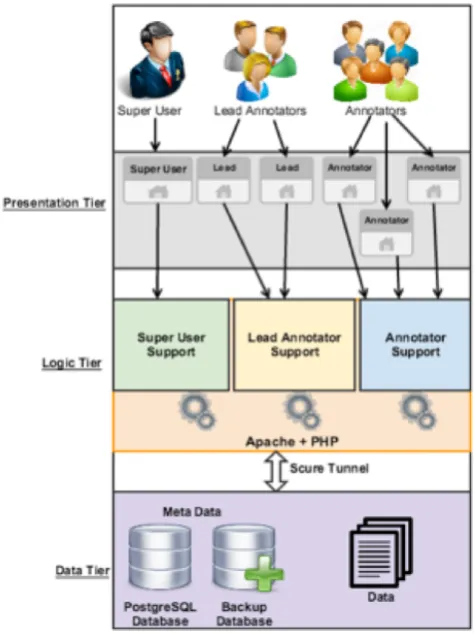
WASA is a typical three-tier web-based application. The platform is divided into three tiers, each with a specific function. The first tier is a data tier that saves all metadata in PostgreSql database in addition to both the annotated and raw data files. All this data is stored on a file server. The second tier is a logical tier. It contains PHP scripts that in-teract with an Apache web server. It is responsible for all functionalities provided by the system to the different types of users. All requests are sent by the web server to the Post-greSql database server through a secured tunnel. The third and last tier is the presentation tier. It is browser indepen-dent, which enables accessing the system from many dif-ferent clients. It provides an intuitive GUI tailored to each user type. This architecture design allows multiple annota-tors to work on various tasks simultaneously. On the other hand, WASA allows the admin user to manage and handle a single central database. The system can handle multiple encodings allowing for multilingual processing. Figure-1 gives a high level overview of the tool’s architecture.
4.
Types of Users
Three types of users have been considered in WASA de-sign: Annotator, Lead-Annotator, and Super-User. Each one of these user types is given and provided with differ-ent kinds of permissions, functionalities, and privileges in order to fulfill their tasks.
4.1.
Annotators
Annotators are provided the following functionalities: 1-access assigned tasks; 2-annotate the assigned tasks; 3-submit annotation;4-check the time needed to submit one unit, e.g., post, or tweets;5-check the grade of the submit-ted work;6-re-annotate the rejected tasks (by rejected we mean when the annotator received a ”No Pass” as a grade
Figure 1: System Architecture
on their annotation task); and,7-save work and continue it in a later session.
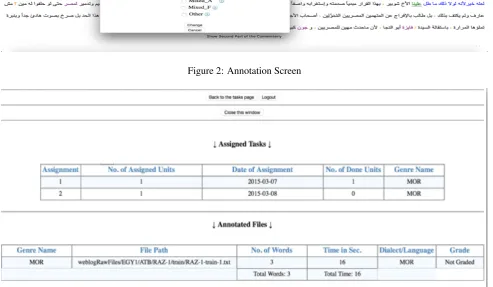
Figure-2 shows an example of the annotation screen. The words of the posts or tweets that need to be annotated will be displayed as clickable units. When clicked, a pop-up screen appears to allow the annotator to choose the proper tag. To increase the speed of the annotation process, some of the words, like Named Entities and punctuations, will have an initial tag assigned automatically as part of a pre-processing step. However, the annotator is allowed to change the initial tag if he/she finds words annotated with a wrong tag. The interface uses color-coding to reflect useful information and status. For example, ’named entities’ will be displayed in purple color, while Other tagged categories such as Latin, URL, punctuation, digits, diacritics, emoti-cons, sound effects will be displayed in the orange color. Words already annotated will be displayed in blue while words that are yet to be annotated appear in black. Figure-3 shows an example of some of the assigned tasks with in-formation about the tasks that have been already submitted (e.g, number of annotated words, speed of annotation, path of the raw file)
4.2.
Lead Annotator
5-Figure 2: Annotation Screen
Figure 3: An example of the annotator’s ”Check-Status” screen
Produce quality measures like inter-annotator agreement. The system enables lead annotators to reject submitted work that does not meet the assessment criteria and add comments and feedback for the annotators to re-annotate rejected work.
4.3.
Super User
There is only one Superuser account in WASA for all dialects/languages. The Superuser functions include: 1-Database management and maintenance; 2-Lead annota-tors management, 3-Annotators management,4- Monitor the overall performance of the system; and5-Manage an-notation data imports and exports.
5.
Data Preprocessing and Input and
Output Format
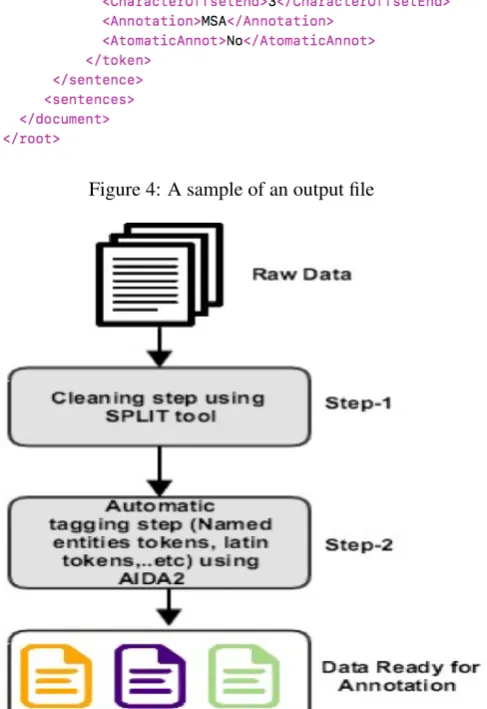
The system has the ability to integrate with language-specific date preprocessing scripts to streamline raw data cleaning and preparation. For example, for cleaning process (step-1) the system integrates the Smart Prepro-cessing (Quasi) Language Independent tool (SPLIT) (Al-Badrashiny et al., 2016) to handle the encoding issues (i.e,
Change the character encoding to UTF8). Moreover, for the Dialectal Arabic (DA) and Modern Standard Arabic (MSA) language pair (step-2), the system integrates with the Auto-matic Identification of Dialectal Arabic (AIDA2) tool (Al-Badrashiny et al., 2015) to provide initial automatic tag-ging for named entities (NE), Latin words, URL, punc-tuation, number, diacritics, emoticon, and speech effects tokens. Figure-2 illustrates an example of a commentary with some pre-annotated tokens. Named entities tokens are colored purple, while punctuation and numbers are colored with orange. Both preprocessing and cleaning steps are per-formed offline. The Super User is the user responsible for preparing the data for annotation. Figure-5 shows the clean-ing and preprocessclean-ing steps. The output file is written in a simple XML format as shown in Figure-4. The XML file includes all meta-data related to the annotation file such as the annotated, sentence id, task id, language, user id, word id, actual word, annotation tag, ...etc. The output XML is customizable. The superuser can choose what metadata to be included in the XML output file.
fo-rum data. Accordingly, WASA is quite robust as it is able to handle a variety of data genres and formats. For example, if the data comes from Twitter, then information like tweet id and user id needs to be preserved along with the annotation tags. If the genre of the data is discussion forums, infor-mation such as post order in the context of a conversation thread along with the names of the people who are involved in the conversation are maintained.
6.
Database Design
WASA system uses a relational database to manage, handle and store all meta-data. The data stored is categorized as follow:
6.1.
Profiling information
It saves information about all registered users of the sys-tem including their roles (i.e. annotator, lead annotator or superuser), login information as well as the dialect and languages for each one of them. Moreover, It contains information about different languages/dialects used in the project.
6.2.
Annotation Information
This is the core part of WASA’s database. It includes all meta-data related to the annotation tasks such as the num-ber of tasks assigned to each annotator, actual annotations completed by each annotator, and temporarily saved anno-tations.
6.3.
Assessment Information
This contains information about1)Task-Annotator assign-ment: it includes the tasks assigned to each annotator and the number of tasks that have already been anno-tated and submitted, the number of assigned units (tweets, posts) per each task, genre type, percentage of overlapping units (tweets, posts) shared among annotators to ease the process of calculating inter-annotator agreement, etc.; 2) Annotator-Units assignment: It includes information about each unit (post, tweet) that is assigned to the annotators such as post/tweet-id, user-id, genre-id, task-id, path of the assigned file; Finally3)Language-Unit assignment: It in-cludes information about the language/dialect id for each unit.
7.
Quality Control Measures
WASA has built-in functionalities that can help in manag-ing the inter-annotator agreement (IAA) measures for dif-ferent task and report performance statistics. The lead an-notator is able to specify the percentage of data annota-tion overlap between the annotators per task and the sys-tem manages to distribute the data and calculate the IAA. Moreover, WASA generates tag distribution, the number of annotated tokens, expected time needed to finish each as-signed task, and much other quality management crucial statistics.
8.
Current Status
We have tested the tool for annotation on Arabic MSA and dialectal data, Chinese-English, Spanish-English, and Hindi-English. The IAA for our the Arabic annotated data
Figure 4: A sample of an output file
Figure 5: Preprocessing and Cleaning Steps
is ranged between 92% and 97%. Moreover, a small por-tion of the Code-Switching data that was released in (Diab et al., 2016) was used to test the performance of WASA. We noticed that the annotators’ speed has increased sub-stantially when we assign initial tags to some tags auto-matically (e.g. punctuation, URL, emoticon, ...etc.). The average time for annotating a full tweet was∼40 seconds without using SPLIT tool (Al-Badrashiny et al., 2016), but after assigning the initial tags using the SPLIT tool, the av-erage time for annotating a full tweet became∼27 seconds. This results in saving much of the effort in annotating these tags.
9.
Conclusion
we have seen that using the SPLIT tool to annotate some specific tokens automatically has helped in saving the ef-fort and time spent by annotators. Moreover, the annotation quality of these tokens is very high. We will keep updating and modifying the current functionalities of the system as per different users type feedback. Also, we plan to add more functionality that can help in enhancing the speed, quality, and the efficiency of the CS annotation.
10.
Acknowledgements
We would like to thank Mahmoud Ghoneim for his invalu-able suggestions and support in the development of WASA. Also, We would like to acknowledge the useful comments by the three anonymous reviewers who helped in making this publication better presented.
11.
Bibliographical References
Al-Badrashiny, M., Elfardy, H., and Diab, M. T. (2015). Aida2: A hybrid approach for token and sentence level dialect identification in arabic. InCoNLL, pages 42–51. Al-Badrashiny, M., Pasha, A., Diab, M. T., Habash, N.,
Rambow, O., Salloum, W., and Eskander, R. (2016). Split: Smart preprocessing (quasi) language independent tool. InLREC.
Aswani, N. and Gaizauskas, R. (2009). Evolving a gen-eral framework for text alignment: Case studies with two south asian languages. In Proceedings of the Interna-tional Conference on Machine Translation: Twenty-Five Years On, Cranfield, Bedfordshire, UK, November. Aziz, W., Castilho, S., and Specia, L. (2012). Pet: a tool
for post-editing and assessing machine translation. In LREC, pages 3982–3987.
Benajiba, Y. and Diab, M. (2010). A web application for dialectal arabic text annotation. In Proceedings of the lrec workshop for language resources (lrs) and human language technologies (hlt) for semitic languages: Sta-tus, updates, and prospects.
Cunningham, H., Maynard, D., Bontcheva, K., Tablan, V., Ursu, C., Dimitrov, M., Dowman, M., Aswani, N., Roberts, I., Li, Y., et al. (2009). Developing Language Processing Components with Gate Version 5:(A User Guide). University of Sheffield.
Diab, M., Habash, N., Rambow, O., Altantawy, M., and Benajiba, Y. (2010). Colaba: Arabic dialect annotation and processing. In Lrec workshop on semitic language processing, pages 66–74.
Diab, M., Ghoneim, M., Hawwari, A., AlGhamdi, F., Al-Marwani, N., and Al-Badrashiny, M. (2016). Creating a large multi-layered representational repository of lin-guistic code switched arabic data. InProceedings of the Tenth International Conference on Language Resources and Evaluation (LREC 2016), Paris, France, may. Euro-pean Language Resources Association (ELRA).
Dickinson, M. and Ledbetter, S. (2012). Annotating errors in a hungarian learner corpus. In LREC, pages 1659– 1664.
Kahan, J., Koivunen, M.-R., Prud’Hommeaux, E., and Swick, R. R. (2002). Annotea: an open rdf infrastruc-ture for shared web annotations. Computer Networks, 39(5):589–608.
Obeid, O., Bouamor, H., Zaghouani, W., Ghoneim, M., Hawwari, A., Alqahtani, S., Diab, M., and Oflazer, K. (2016). Mandiac: A web-based annotation system for manual arabic diacritization. In The 2nd Workshop on Arabic Corpora and Processing Tools 2016 Theme: So-cial Media, page 16.
Samih, Y., Maier, W., and Kallmeyer, L. (2016). Sawt: Sequence annotation web tool. EMNLP 2016, page 65. Vargas-Vera, M., Motta, E., Domingue, J., Lanzoni, M.,
Stutt, A., and Ciravegna, F. (2002). Mnm: Ontology driven semi-automatic and automatic support for seman-tic markup. InInternational Conference on Knowledge Engineering and Knowledge Management, pages 379– 391. Springer.