Towards the Use of Deep Reinforcement Learning with Global Policy For
Query-based Extractive Summarisation
⇤Diego Moll´a Department of Computing
Macquarie University Sydney
Abstract
Supervised approaches for text summari-sation suffer from the problem of mis-match between the target labels/scores of individual sentences and the evaluation score of the final summary. Reinforcement learning can solve this problem by pro-viding a learning mechanism that uses the score of the final summary as a guide to determine the decisions made at the time of selection of each sentence. In this paper we present a proof-of-concept approach that applies a policy-gradient algorithm to learn a stochastic policy using an undis-counted reward. The method has been ap-plied to a policy consisting of a simple neural network and simple features. The resulting deep reinforcement learning sys-tem is able to learn a global policy and ob-tain encouraging results.
1 Introduction
Common supervised machine learning approaches to extractive summarisation attempt to label indi-vidual text extracts (usually sentences or phrases; in this paper we will use sentences). In a sub-sequent stage, a summary is generated based on the predicted labels of the individual sentences and other factors such as redundancy of information.
The process of obtaining the annotated data can be complex. Data sets often contain complete summaries written manually. Well-known exam-ples of data sets of this type are the DUC and TAC data sets (Dang,2006,2008). In such cases the task of labelling individual sentences is not straightforward and needs to be derived from the full summaries. Alternatively, annotations can be ⇤ Code available at https://github.com/
dmollaaliod/alta2017-rl
obtained through highlights made by the annota-tors (Woodsend and Lapata,2010, for example).
Regardless of the means used to annotate indi-vidual sentences, the final evaluation of the system compares the output summary with a set of target summaries, either by using human judges or auto-matically by using packages such as ROUGE (Lin,
2004). However, machine learning approaches de-signed to minimise the prediction error of individ-ual sentences would not necessarily minimise the prediction error of the final summary evaluation metric.
In this paper we propose a proof-of-concept method that uses reinforcement learning with global policy as a means to use the ROUGE L evaluation of the final summary directly in the training process. Section 2 introduces reinforce-ment learning and reinforce-mentions past work on the use of reinforcement learning for summarisation. Sec-tion 3 describes our proposal for the use of re-inforcement learning for query-based summarisa-tion. Section4presents the results of our experi-ments, and Section5concludes this paper.
2 Reinforcement Learning
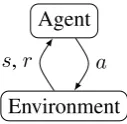
Reinforcement Learning (RL) is a machine learn-ing approach that is designed to train systems that aim to maximise a long-term goal, even when there is no knowledge (or little knowledge) of the impact of the individual decisions that are made to achieve the goal. A RL task (Figure1) consists of an environment that can be observed and can be acted on, and an agent that makes a sequence of actions. The effect of undertaking an action (a) on the environment will result in an observed state (s) and a reward (r). The agent then needs to learn the sequence of actions that maximises the cumulative reward.
Agent
[image:2.595.149.213.61.123.2]Environment s,r a
Figure 1: The reinforcement learning process.
reduced to a RL task by assigning null reward r = 0 to the decision of selecting each
individ-ual sentence or not, until the point at which a final summary has been extracted. At the moment that a final summary has been extracted, the reward r is the actual evaluation score of the full summary. The RL approach should learn a policy⇡such that the agent can determine how the individual deci-sions made at the time of selecting (or not) a sen-tence would impact on the evaluation score of the final summary.
Ryang and Abekawa (2012) and Rioux and Hasan(2014) propose the learning of a local pol-icy ⇡ that is specific to each summary. For this purpose, the rewardrof the entire summary is cal-culated based on measures of similarity between the summary and the source document. Thus,
Ryang and Abekawa(2012) uses information such as coverage, redundancy, length and position. Ri-oux and Hasan (2014) uses a reward system that is more similar to the ROUGE set of metrics, but again using only information from the source text and the generated summary. Effectively, these ap-proaches use RL as a means to search the space of possible selections of sentences by training a local policy that needs to be re-trained each time a new summary needs to be generated.
Ryang and Abekawa (2012) mentions the pos-sibility of training a global policy in the section of further work provided that there is a mean to pro-vide a feature representation of a summary. In this paper we show a simple way to represent the state of the environment, including the summary, such that the system can train a global policy. We use a training set annotated with target summaries to train a global policy that uses the direct ROUGE L score as the reward. Once a global policy has been learnt, it is applied to unseen text for evaluation. By using a global policy instead of a local policy, the system can use the direct ROUGE L score in-stead of an approximation, and the computational cost shifts to the training stage, enabling a faster generation of summaries after the system has been trained.
There is also research that use other mecha-nisms in order to train a summarisation system us-ing the direct ROUGE score (Aker et al., 2010) or an approximation (Peyrard and Eckle-Kohler,
2016).
3 Reinforcement Learning for Query-based Extractive Summarisation
This section describes our proposal for the adap-tation of query-based summarisation to RL with global policy.
3.1 Environment
After applying a decision whether sentenceiis to be selected as a summary or not, the environment records the decision and issues a reward r = 0.
After all decisions have been made, the environ-ment builds the summary by concatenating all se-lected sentences in linear order. Then, the environ-ment returns the ROUGE L score of the summary as the reward. More formally, and assuming that the total number of sentences in the input text isn, the reward is computed as follows:
r= (
0 if i < n ROUGE L if i=n
This process is inspired inRyang and Abekawa
(2012)’s framework, the difference being that, in our work, the reward returned wheni = nis the actual ROUGE L score of the summary instead of an approximation.
For the purposes of this paper, the environment is implemented as an object env that allows the
following operations:
• s env.reset(sample): reset to sample sampleand return an initial states.
• s, r,done env.step(a): perform actiona and return state s, reward r, and a Boolean valueT rue if all input sentences have been processed.
3.2 Action Space
At each step of the RL process, the agent will de-cide whether a particular sentence is to be selected (1) or not (0).
3.3 State
the information necessary to make the right deci-sion, including information about what sentences are yet to process. Since the agent uses a global policy, the state should be able to encode infor-mation about any number of input sentences, and any number of remaining sentences. We resolved this by building vectors that represent sequences of sentences. In this paper we usetf.idf, but other methods could be used, such as sentence embed-dings learnt by training deep neural networks.
In concrete, the environment provides the fol-lowing state:
1. tf.idf of the candidate sentencei.
2. tf.idf of the entire input text to summarise.
3. tf.idf of the summary generated so far.
4. tf.idf of the candidate sentences that are yet to be processed.
5. tf.idf of the question.
Information 2. and 3. would be useful to de-termine whether the current summary is represen-tative of the input text. Information 4. would be useful to determine whether there is still important information that could be added to the summary in future steps. The agent could then, in princi-ple, contrast 1. with 2., 3., 4. and 5. to determine whether sentenceishould be selected or not.
3.4 Global Policy
The global policy is implemented as a neural net-work that predicts the probability of each actiona available in the action space {0,1}. In practice,
the system only needs to predictP r(a= 0). As a
proof of concept, the neural network implemented in this paper is simply a multi-layer network with one hidden layer that uses a relu activation, and the output unit is a Bernoulli logistic unit. Thus, given a state s formed by concatenating all the items listed in Section 3.3, the network predicts P r(a= 0)as follows.
P r(a= 0) = (h·Wh+bh) h = max(0, s·Ws+bs)
In our experiments, the size of the hidden layer is 200.
3.5 Learning Algorithm
The learning algorithm for the global policy is a variant of the REINFORCE algorithm (Williams,
1992) that uses gradient descent with cross-entropy gradients that are multiplied with the re-ward (G´eron,2017, Chapter 16). This is shown in Algorithm1.
Data:train data
Result:✓
sample⇠U nif orm(train data); s env.reset(sample);
all gradients ;; episode 0; whileTruedo
⇠ ⇠Bernoulli⇣P r1+2(a=0)+⇥p p⌘; y 1 ⇠;
gradient r(cross entropyr✓ (y,P r(a=0)); all gradients.append(gradient); s, r, done env.step(⇠);
episode episode+ 1;
ifdonethen ✓
✓ ↵⇥r⇥mean(all gradients); sample⇠U nif orm(train data); s env.reset(sample);
all gradients ;;
end end
Algorithm 1: Training by Policy Gradient, where✓= (Wh, bh, Ws, bs).
In Algorithm1, the neural net predictsP r(a= 0). The action chosen during training is
sam-pled from a Bernoulli distribution with probabil-ityP r(a= 0)that has a perturbationp, such that p slowly decreases at each training episode. By adding this perturbation the system explores the two possible actions in the early stages of training and delays locking in possible local minima. In our implementation,pis computed with an initial value of 0.2 and decreasing using the formula:
p= 0.2⇥3000/(3000 +episode)
Thus,p= 0.1after 3000 episodes, and so on.
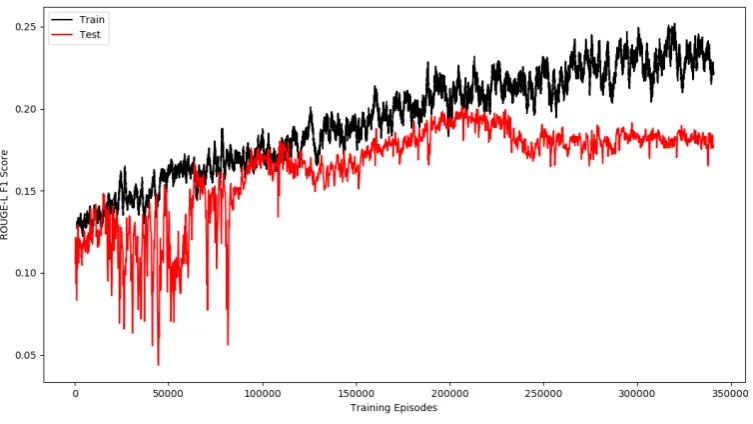
Figure 2: Results of the system. The results of training (black line) are the average ROUGE L of the last 1000 chosen training samples at every point. The results of testing (red line) are the average ROUGE L of the test set.
RL terminology, the method uses undiscounted re-ward.
At run time, the action achosen is simply the actionawith highest probability.
4 Experiments and Results
We have used the data provided by BioASQ 5b Phase B (Tsatsaronis et al.,2015). The dataset has 1799 questions together with input text and ideal answers. These ideal answers form the target sum-maries. We have split the data into a training an a test set.
Algorithm1updates the parameters✓by apply-ing standard gradient descent. In our experiments, we have used the Adam optimiser instead, which has been shown to converge rapidly in many appli-cations (Kingma and Ba,2015). Also, due to com-puting limitations, our implementation only pro-cesses the first 30 sentences of the input text.
Figure 2 shows the progress of training and evaluation. We can observe that the neural net learns a global policy that improves the ROUGE L results of the training data (black line). More im-portantly, it also improves the ROUGE L results when presented with the test data (red line). It ap-pears that the system starts overfitting after about 200,000 training steps.
Considering that the state does not have di-rect information about the sentence position or the length of the summary, and given the relatively small training data, these results are encouraging. It is well known that sentence position carries im-portant information for the task of summarisation. Also, preliminary experiments adding summary length to the state showed quicker convergence to better values. In this paper we chose not to incor-porate any of this information to test the capabili-ties of the use of reinforcement learning.
5 Conclusions
We have presented a reinforcement learning ap-proach that learns a global policy for the task of query-based summarisation. Our experiments used fairly simple features to represent the state of the environment. Also, the neural network imple-mented to model the global policy is fairly sim-ple. Yet, the system was able to effectively learn a global policy. In further work we will explore the use of more sophisticated features such as word or sentence embeddings, and more sophisticated neural networks.
References
Ahmet Aker, Trevor Cohn, and Robert Gaizauskas. 2010. Multi-document summarization using A* search and discriminative training. InEMNLP 2010. October, pages 482–491.
Hoa Trang Dang. 2006. Overview of DUC 2006. In Proc. Document Understanding Workshop. NIST.
Hoa Trang Dang. 2008. Overview of the TAC 2008 opinion question answering and summariza-tion tasks. InProc. TAC 2008.
Aur´elien G´eron. 2017. Hands-on Machine Learn-ing with Scikit-Learn and TensorFlow: Concepts, Tools, and Techniques to Build Intelligent Systems. O’Reilly Media.
Diederik P. Kingma and Jimmy Ba. 2015. Adam: A method for stochastic optimization. InICLR 2015. pages 1–15.
Chin-Yew Lin. 2004. ROUGE: A package for auto-matic evaluation of summaries. In ACL Workshop on Tech Summarisation Branches Out.
Maxime Peyrard and Judith Eckle-Kohler. 2016. Opti-mizing an approximation of ROUGE — a problem-reduction approach to extractive multi-document summarization. InProceedings of the 54th Annual Meeting of the Association for Computational Lin-guistics (Volume 1: Long Papers). pages 1825–1836. Cody Rioux and Sadid A Hasan. 2014. Fear the REAPER: A system for automatic multi-document summarization with reinforcement learning. In EMNLP 2014. 2010, pages 681–690.
Seonggi Ryang and Takeshi Abekawa. 2012. Frame-work of automatic text summarization using rein-forcement learning. In EMNLP 2012. July, pages 256–265.
George Tsatsaronis, Georgios Balikas, Prodromos Malakasiotis, Ioannis Partalas, Matthias Zschunke, Michael R Alvers, Dirk Weissenborn, Anastasia Krithara, Sergios Petridis, Dimitris Polychronopou-los, Yannis Almirantis, John PavlopouPolychronopou-los, Nico-las Baskiotis, Patrick Gallinari, Thierry Arti´eres, Axel-Cyrille Ngonga Ngomo, Norman Heino, Eric Gaussier, Liliana Barrio-Alvers, Michael Schroeder, Ion Androutsopoulos, and Georgios Paliouras. 2015. An overview of the BIOASQ large-scale biomedical semantic indexing and question answering competi-tion. BMC Bioinformatics16(1):138.
Ronald J. Williams. 1992. Simple statistical gradient-following algorithms for connectionist reinforce-ment learning. Machine Learning8:229–256.