A Recursive Statistical Translation Model
∗Juan Miguel Vilar Dpto. de Lenguajes y Sistemas
Inform´aticos Universitat Jaume I
Castell´on (Spain)
Enrique Vidal
Dpto. de Sistemas Inform´aticos y Computaci´on
Universidad Polit´ecnica de Valencia Instituto Tecnol´ogico de Inform´atica
Valencia (Spain)
Abstract
A new model for statistical translation is presented. A novel feature of this model is that the alignments it produces are hier-archically arranged. The generative pro-cess begins by splitting the input sen-tence in two parts. Each of the parts is translated by a recursive application of the model and the resulting translation are then concatenated. If the sentence is small enough, a simpler model (in our case IBM’s model 1) is applied.
The training of the model is explained. Fi-nally, the model is evaluated using the cor-pora from a large vocabulary shared task.
1 Introduction
Suppose you were to find an English translation for a Spanish sentence. One possible approach is to as-sume that every English sentence is a candidate but that different English sentences have different prob-abilities of being the correct translation. Then, the translation task can be divided in two parts: define an adequate probability distribution that answers to the question “given this English sentence, which is the probability that it is a good translation of that Spanish sentence?”; and use that distribution in or-der to find the most likely translation of your input sentence.
∗
Work partially supported by Bancaixa through the project “Sistemas Inductivos, Estad´ısticos y Estructurales, para la Tra-ducci´on Autom´atica (Siesta)”.
This approach is referred to as the statistical ap-proach to machine translation. The usual apap-proach is to define an statistical model and train its parame-ters from a training corpus consisting in pairs of sen-tences that are known to be translation of each other. Different models have been presented in the litera-ture, see for instance (Brown et al., 1993; Och and Ney, 2004; Vidal et al., 1993; Vogel et al., 1996). Most of them rely on the concept of alignment: a mapping from words or groups of words in a sen-tence into words or groups in the other (in the case of (Vidal et al., 1993) the mapping goes from rules in a grammar for a language into rules of a grammar for the other language). This concept of alignment has been also used for tasks like authomatic vocab-ulary derivation and corpus alignment (Dagan et al., 1993).
A new statistical model is proposed in this pa-per, which was initially introduced in (Vilar Torres, 1998). This model is designed so that the align-ment between two sentences can be seen in an struc-tured manner: each sentence is divided in two parts and they are put in correspondence; then each of those parts is similarly divided and related to its translation. This way, the alignment can be seen as a tree structure which aligns progressively smaller segments of the sentences. This recursive procedure gives its name to the model: MAR, which comes from “Modelo de Alineamiento Recursivo”, which is Spanish for “Recursive Alignment Model”.
The rest of the paper is structured as follows: af-ter a comment on previous works, we introduce the notation that we will use throughout the paper, then we briefly explain the model 1 from IBM, next we
introduce our model, then we explain the process of parameter estimation, and how to use the model to translate new test sentences. Finally, we present some experiments and results, together with conclu-sions.
2 Previous works
The initial formulation of the proposed model, including the training procedures, was presented in (Vilar Torres, 1998), along with preliminary ex-periments in a small translation task which provided encouraging results.
This model shares some similarities with the stochastic inversion transduction grammars (SITG) presented by Wu in (Wu, 1997). The main point in common is the type of possible alignments con-sidered in both models. Some of the properties of these alignments are studied in (Zens and Ney, 2003). However, the parametrizations of SITGs and the MAR are completely different. The generative process of SITGs produces simultaneously the in-put and outin-put sentences and the parameters of the model refer to the rules of the nonterminals. This provides a symmetry to both input and output sen-tences. In contrast, our model clearly distinguishes the input and output sentences and the parameters are based on observable properties of the strings (their lengths and the words composing them). On the other hand, the MAR idea of splitting the sen-tences until a simple structure is found, also ap-pears in the Divisive Clustering approach presented in (Deng et al., 2004). Again, the main difference lies in the probabilistic modeling of the alignments. In Divisive Clustering a uniform distribution on the alignments is assumed while MAR uses a explicit parametrization.
3 Some notation
In the rest of the paper, we use the following nota-tion. Sentences are taken as concatenations of sym-bols (words) and represented using a letter and a small bar, like in x¯. The individual words are de-signed by the name of the sentence and a subindex indicating the position, so x¯ = x1x2. . . xn. The
length of a sentence is indicated by |x¯|. Segments of a sentence are denoted byx¯ji =xi. . . xj. For the substrings of the formx¯|ix¯|we use the notationx¯.i.
Consistently, x¯denotes the input sentence andy¯
its translation and both are assumed to have at least one word. The input and output vocabularies areX
andY, respectively. Finally, we assume that we are presentend a setMfor training our models. The ele-ments of this set are pairs(¯x,y¯)wherey¯is a possible translation forx¯.
4 IBM’s model 1
IBM’s model 1 is the simplest of a hierarchy of five statistical models introduced in (Brown et al., 1993). Each model of the hierarchy can be seen as a refine-ment of the previous ones. Although model 1, which we study here, relies on the concept of alignment, its formulation allows an interpretation of it as a re-lationship between multisets of words (the order of the words is irrelevant in the final formula).
A word of warning is in order here. The model we are going to present has an important difference with the original: we do not use the empty word. This is a virtual word which does not belong to the vocabu-lary of the task and that is added to the beginning of each sentence in order to allow words in the output that cannot be justified by the words in the input. We have decided not to incorporate it because of the use we are going to make of the model. As we will see, model 1 is going to be used repeatedly over different substrings of the input sentence in order to analyze their contribution to the total translation. This means that we would have an empty word in each of these substrings. We have decided to avoid this “prolifer-ation” of empty words. Future work may introduce the concept in a more appropriate way.
The model 1 makes two assumptions. That a stochastic dictionary can be employed to model the probability that wordyis the translation of word x and that all the words in the input sentence have the same weight in producing a word in the output. This leads to:
pI(¯y|x¯) = ε(|x¯|,|y¯|) |x¯||y¯|
|y¯|
Y
j=1 |¯x|
X
i=1
t(yj |xi). (1)
the original formulation of the model, but we prefer to include it so that the probabilities are adequately normalized.
Clearly, this model is not adequate to describe complex translations in which complicated patterns and word order changes may appear. Nevertheless, this model can do a good job to describe the transla-tion of short segments of texts. For example, it can be adequate to model the translation of the Spanish “gracias” into the English “thank you”.
5 A Recursive Alignment Model
To overcome that limitation of the model we will take the following approach: if the sentence is com-plex enough, it will be divided in two and the two halves will be translated independently and joined later; if the sentence is simple, the model 1 will be used.
Let us formalize this intuition for the generative model. We are given an input sentencex¯and the first decission is whetherx¯ is going to be translated by IBM’s model 1 or it is complex enough to be trans-lated by MAR. In the second case, three steps are taken: a cut point ofx¯is defined, each of the result-ing parts are translated, and the correspondresult-ing trans-lations are concatenated. For the translation of the second step, the same process is recursively applied. The concatenation of the third step can be done in a “direct” way (the translation of the first part and then the translation of the second) or in an “inverse” way (the translation of the second part and then the translation of the first). The aim of this choice is to allow for the differences in word order between the input and ouput languages.
So, we are proposing an alignment model in which IBM’s model 1 will account for translation of elementary segments or individual words while translation of larger and more complex segments or whole sentences will rely on a hierarchical align-ment pattern in which model 1 alignalign-ments will be on the lowest level of the hierarchy.
Following this discussion, the model can be for-mally described through a series of four random ex-periments:
• The first is the selection of the model. It has two possible outcomes: IBM and MAR, with obvious meanings.
• The second is the choice ofb, a cut point ofx¯. The segmentx¯b1will be used to generate one of the parts of the translation, the segmentx¯.b+1
will generate the other. It takes values from1
to|x¯| −1.
• The third is the decision about the order of the concatenation. It has two possible outcomes: D(for direct) andI(for inverse).
• The fourth is the translation of each of the halves ofx¯. They take values inY+.
The translation probability can be approximated as follows:
pT(¯y|x¯) = Pr(M =IBM|x¯)pI(¯y|x¯)
+ Pr(M =MAR|x¯)pM(¯y|x¯).
The value of pI(¯y | x¯) corresponds to IBM’s model 1 (Equation 1). To derivepM(¯y |x¯), we ob-serve that:
pM(¯y|x¯) =
|x¯|−1
X
b=1
Pr(b|x¯)
X
d∈{D,I}
Pr(d|b,x¯)
X
¯
y1∈Y+
Pr(¯y1 |b, d,x¯)
X
¯
y2∈Y+
Pr(¯y2 |b, d,x,¯ y¯1) Pr(¯y|d, b,x,¯ y¯1,y¯2).
Note that the probability thaty¯is generated from a pair(¯y1,y¯2)is0ify¯6= ¯y1y¯2and1ify¯= ¯y1y¯2, so
the last two lines can be rewritten as:
X
¯
y1∈Y+
Pr(¯y1 |b, d,x¯)
X
¯
y2∈Y+
Pr(¯y2 |b, d,x,¯ y¯1) Pr(¯y|b, d,x,¯ y¯1,y¯2)
=X
¯ y1,y¯2∈Y+
¯ y= ¯y1 ¯y2
Pr(¯y1|b, d,x¯) Pr(¯y2|b, d,x,¯ y¯1)
=X
¯
y1∈pref(¯y)−y¯
Pr(¯y1|b, d,x¯) Pr(¯y1−1y¯|b, d,x,¯ y¯1)
= |y¯|−1
X
c=1
wherepref(¯y)is the set of prefixes ofy¯. And finally:
The number of parameters of this model is very large, so it is necessary to introduce some simplifi-cations in it. The first one relates to the decision of the translation model: we assume that it can be done just on the basis of the length of the input sentence. That is, we cat set up two tables,MI andMM, so possible to break a one word sentence, we define
MI(1) = 1. This restriction comes in the line men-tioned before: the translation of longer sentences will be structured whereas shorter ones can be trans-lated directly.
In order to decide the cut point, we will assume that the probability of cutting the input sentence at a given position bis most influenced by the words around it:xbandxb+1. We use a tableBsuch that:
Pr(b|x¯)≈ B(xb, xb+1)
P|x¯|−1
i=1 B(xi, xi+1)
.
This can be interpreted as having a weight for each pair of words and normalizing these weights in each sentence in order to obtaing a proper probability dis-tribution.
Two more tables,DDandDI, are used to store the probabilities that the alignment be direct or inverse. As before, we assume that the decission can be made on the basis of the symbols around the cut point:
Pr(d=D|b,x¯) =DD(xb, xb+1),
Pr(d=I |b,x¯) =DI(xb, xb+1).
Again, we haveDD(xb, xb+1) +DI(xb, xb+1) = 1
for every pair of words(xb, xb+1).
Finally, a probability must be assigned to the translation of the two halves. Assuming that they are independent we can apply the model in a recursive manner:
Finally, we can rewrite (2) as:
pM(¯y|x¯) =
The final form of the complete model is then:
pT(¯y|x¯) =
Once the model is defined, it is necessary to find a way of estimating its parameters given a training corpusM. We will use maximun likelihood estima-tion. In our case, the likelihood of the sample corpus is:
V = Y
(¯x,y¯)∈M
In order to maximize V, initial values are given to the parameters and they are reestimated using re-peatedly Baum-Eagon’s (Baum and Eagon, 1967) and Gopalakrishnan’s (Gopalakrishnan et al., 1991) inequalities. LetP be a parameter of the model (ex-cept for those inB) and letF(P)be its “family” (i.e. the set of parameters such thatP
Q∈F(P)Q = 1).
Then, a new value ofP can be computed as follows:
N(P) =
are the “counts” of parameterP. This is correct as long asV is a polynomial inP. However, we have a problem forBsinceV is a rational function of these parameters. We can solve it by assuming, without lose of generality, that P
x1,x2∈XB(x1, x2) = 1.
Then Gopalakrishnan’s inequality can be applied similarly and we get:
N(P) = XC+C(P)
Q∈F(P)
C+C(Q), (6)
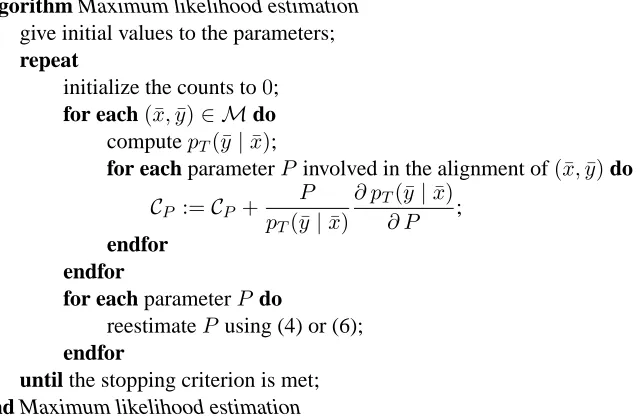
where C is an adequate constant. Now it is easy to design a reestimation algorithm. The algorithm gives arbitrary initial values to the parameters (typi-cally those corresponding to uniform probabilities), computes the counts of the parameters for the corpus and, using either (4) or (6), gets new values for the parameters. This cycle is repeated until a stopping criterion (in our case a prefixed number of iterations) is met. This algorithm can be seen in Figure 1
7 Some notes on efficiency
Estimating the parameters as discussed above entails high computational costs: computingpT(¯y |x¯) re-quires O(mn) arithmetic operations involving the values of pT(¯yji | x¯lk) for every possible value of i, j,kandl, which areO(m2n2). This results in a global cost ofO(m3n3). On the other hand, com-puting ∂ pT
∂ P costs as much as computingpT. So it is interesting to keep the number of computed deriva-tives low.
7.1 Reduction of the parameters to train
In the experiments we have followed some heuristics in order not to reestimate certain parameters:
• The values of MI —and, consequently, ofMM— for lengths higher than a threshold are assumed to be0 and therefore there is no need to estimate them.
• As a consequence, the values ofεfor lengths above the same threshold, need not be reesti-mated.
• The values oftfor pairs of words with counts under a certain threshold are not reestimated.
Furthermore, during the computation of counts, the recursion is cut on those substring pairs where the value of the probability for the translation is very small.
7.2 Efficient computation of model 1
AlgorithmMaximum likelihood estimation
give initial values to the parameters;
repeat
initialize the counts to0;
for each(¯x,y¯)∈ Mdo
computepT(¯y|x¯);
for each parameterP involved in the alignment of(¯x,y¯)do
CP :=CP + P pT(¯y|x¯)
∂ pT(¯y|x¯) ∂ P ;
endfor endfor
for each parameterP do
reestimatePusing (4) or (6);
endfor
until the stopping criterion is met; EndMaximum likelihood estimation
Figure 1: Algorithm for maximum likelihood estimation of the parameters of MAR
This leads to
I(ib, ie, ob, oe) =S(ib, ie, ob),
ifob=oe, and to
I(ib, ie, ob, oe) = I(ib, ie, ob, oe−1)S(ib, ie, ob) (ie−ib+ 1) ,
ifob6=oe.
So we can compute all values ofI with the algo-rithm in Figure 2.
7.3 Splitting the corpora
Another way of reducing the costs of training has been the use of a heuristic to split long sentences into smaller parts with a length less thanlwords.
Suppose we are to split sentences x¯ andy¯. We begin by aligning each word in y¯ to a word in x¯. Then, a score and a translation is assigned to each substringx¯ji with a length belowl. The translation is produced by looking for the substring ofy¯which has a length belowl and which has the largest number of words aligned to positions betweeniandj. The pair so obtained is given a score equal to sum of: (a) the square of the length ofx¯ji; (b) the square of the number of words in the output aligned to the input; and (c) minus ten times the sum of the square of the number of words aligned to a nonempty position out ofx¯ji and the number of words outside the segment chosen that are aligned tox¯ji.
After the segments ofx¯are so scored, the partition ofx¯ that maximizes the sum of scores is computed by dynamic programming.
8 Translating the test sentences
The MAR model can be used to obtain adequate bilingual templates which can be used to translate new test sentences using an appropriate template-based translation system. Here we have adopted the
pharaohprogram (Koehn, 2004).
8.1 Finding the templates
The parameters of the MAR were trained using the algorithm above: first ten IBM model 1 iterations were used for giving initial values to the dictionary probabilities and then five more iterations for re-training the dictionary together with the rest of the parameters.
Algorithm all IBM forob:= 1to|y¯|do
foroe:=obto|y¯|do forib:= 1to|x¯|do
S:= 0;
forie:=ibto|x¯|do
S:=S+t(yoe |xie);
I(ib, ie, ob, oe) :=
(
S/(ie−ib+ 1) ifob=oe,
I(ib, ie, ob, oe−1)×S/(ie−ib+ 1) otherwise;
End all IBM
Figure 2: Efficient computation of different values of IBM’s model 1.
Equipos a presión transportables Transportable pressure equipment
Equipos equipment
a presión transportables Transportable pressure
a presión pressure
transportables Transportable
Figure 3: A sample alignment represented as a tree.
Each template was assigned four weights1 in or-der to use thepharaohprogram. For the templates obtained from the alignments, the first weight was the probability assigned to it by MAR, the second weight was the count for the template, i.e., the num-ber of times that template was found in the corpus, the third weight was the normalized count, i.e., the number of times the template appeared in the corpus divided by the number of times the input part was present in the corpus, finally, the fourth weight was a small constant (10−30). The intention of this last weight was to ease the combination with the tem-plates from the dictionary. For these, the first three weights were assigned the same small constant and the fourth was the probability of the translation of the pair obtained from the stochastic dictionary. This weighting schema allowed to separate the influence of the dictionary in smoothing the templates.
1
They should have been probabilities, but in two of the cases there was no normalization and in one they were even greater than one!
Table 1: Statistics of the training corpora. The languages are German (De), English (En), Span-ish (Es), FinnSpan-ish (Fi) and French (Fr).
Languages Sentences Words (input/output)
De-En 751 088 15 257 871 / 16 052 702 Es-En 730 740 15 725 136 / 15 222 505 Fi-En 716 960 11 318 863 / 15 493 334 Fr-En 688 031 15 599 184 / 13 808 505
9 Experiments
In order to test the model, we have decided to par-ticipate in the shared task for this workshop.
9.1 The task
The aim of the task was to translate a set of 2,000 sentences from German, Spanish, Finnish and French into English. Those sentences were ex-tracted from the Europarl corpus (Koehn, Unpub-lished). As training material, four different corpora were provided, one for each language pair, compris-ing around700 000sentence pairs each. Some de-tails about these corpora can be seen in Table 1. An automatic alignment for each corpus was also pro-vided.
Table 2: Number of training pairs after splitting to a maximum length of ten. “Provided” refers to the alignment provided in the task, “GIZA++” to those obtained with GIZA++.
Sentence pairs Languages Provided GIZA++
De-En 2 351 121 2 282 316 Es-En 2 160 039 2 137 301 Fi-En 2 099 634 2 017 130 Fr-En 2 112 931 2 080 200
Table 3: Number of templates for each language pair: “Alignment” shows the number of templates derived from the alignments; “dictionary”, those ob-tained from the dictionary; and “total” is the sum.
(a) Using the alignments provided with the task.
Lang. Alignment Dictionary Total
De-En 2 660 745 1 840 582 4 501 327 Es-En 2 241 344 1 385 086 3 626 430 Fi-En 2 830 433 2 852 583 5 683 016 Fr-En 2 178 890 1 222 266 3 401 156
(b) Using GIZA++.
Lang. Alignment Dictionary Total
De-En 2 672 079 1 796 887 4 468 966 Es-En 2 220 533 1 350 526 3 571 059 Fi-En 2 823 769 2 769 929 5 593 698 Fr-En 2 140 041 1 181 990 3 322 031
number of pairs after splitting is roughly three times the original.
Templates were extracted as described in sec-tion 8.1. The number of templates we obtained can be seen in Table 3. Again, the influence of the type of alignment was small. Except for Finnish, the number of dictionary templates was roughly two thirds of the templates extracted from the align-ments.
9.2 Obtaining the translations
Once the templates were obtained, the development corpora were used to search for adequate values of
Table 4: Best weights for each language pair. The columns are for the probability given by the model, the counts of the templates, the normalized counts and the weight given to the dictionary.
(a) Using the alignments provided with the task.
Languages Model Count Norm Dict
De-En 0.0 3.0 0.0 0.3
Es-En 0.0 2.9 0.0 0.4
Fi-En 0.0 7.0 0.0 0.0
Fr-En 0.0 7.0 1.0 1.0
(b) Using GIZA++.
Languages Model Count Norm Dict
De-En 0.0 3.0 0.0 0.0
Es-En 0.0 2.9 0.0 0.4
Fi-En 0.0 3.0 1.5 0.0
Fr-En 0.0 3.0 1.0 0.4
Table 5: BLEU scores of the translations.
BLEU Languages Provided GIZA++
De-En 18.08 18.89 Es-En 21.65 21.48 Fi-En 13.31 13.79 Fr-En 21.25 19.86
the weights thatpharaoh uses for each template (these are the weights passed to optionweight-t, the other weights were not changed as an initial ex-ploration seemed to indicate that they had little im-pact). As expected, the best weights differed be-tween language pairs. The values can be seen in table 4.
10 Results and discussion
The results over the test sets can be seen in Table 5. It can be seen that, except for French, the influence of the initial alignment is very small. Also, the best results are obtained for Spanish and French, which are more similar to English that German or Finnish. There are still many open questions that deserve more experimentation. The first is the influence of the split of the original corpora. Although the simi-larity of results seem to indicate that it has little in-fluence, this has to be tested. Two more relevant as-pects are whether the weighting schema is the best for the decoder. In particular, it is surprising that the normalization of counts had so little effect.
Finally, the average number of words per template is below two, which probably is too low. It is inter-esting to find alternate ways of obtaining the tem-plates, for instance using internal nodes up to a given height or covering portions of the sentences up to a predefined number of words.
11 Conclusions
A new translation model has been presented. This model produces translations in a recursive way: the input sentence is divided in two parts, each is trans-lated using the same procedure recursively and the translations are concatenated. The model has been used for finding the templates in a large vocabulary translation task. This involved using several heuris-tics to improve training time, including a method for splitting the input before training the models. Fi-nally, the influence of using a stochastic dictionary together with the templates as a means of smoothing has been explored.
References
Leonard E. Baum and J. A. Eagon. 1967. An inequal-ity with applications to statistical estimation for prob-abilistic functions of Markov processes and to a model for ecology. Bulletin of the American Mathematical
Society, 73:360–363.
Peter F. Brown, Stephen A. Della Pietra, Vincent J. Della Pietra, and Robert L. Mercer. 1993. The mathemat-ics of statistical machine translation: Parameter
esti-mation. Computational Linguistics, 19(2):263–311,
June.
Ido Dagan, Kenneth W. Church, and William A. Gale. 1993. Robust bilingual word alignment for machine aided translation. In Proceedings of the Workshop on
Very Large Corpora, Columbus, Ohio (USA). ACL.
Yonggang Deng, Shankar Kumar, and William Byrne. 2004. Bitext chunk alignment for statistical machine translation. Research Note 50, CLSP Johns Hopkins University, April.
P. S. Gopalakrishnan, Dimitri Kanevsky, Arthur N´adas,
and David Nahamoo. 1991. An inequality for
ra-tional functions with applications to some statistical problems. IEEE Transactions on Information Theory, 37(1):107–113, January.
Philipp Koehn. 2004. Pharaoh: A beam search decoder for phrase-based statistical machine translation mod-els. In AMTA, pages 115–124.
Philipp Koehn. Unpublished. Europarl: A multilingual corpus for evaluation of machine translation. Draft.
Franz Josef Och and Hermann Ney. 2003. A system-atic comparison of various statistical alignment mod-els. Computational Linguistics, 29(1):19–51.
Franz Joseph Och and Hermann Ney. 2004. The align-ment template approach to statistical machine transla-tion. Computational Linguistics, 30(4):417–449, De-cember.
Enrique Vidal, Roberto Pieraccini, and Esther Levin. 1993. Learning associations between grammars: A new approach to natural language understanding. In
Proceedings of the EuroSpeech’93, pages 1187–1190,
Berlin (Germany).
Juan Miguel Vilar Torres. 1998. Aprendizaje de
Tra-ductores Subsecuenciales para su empleo en tareas de dominio restringido. Ph.D. thesis, Departamento
de Sistemas Inform´aticos y Computaci´on, Universidad Polit´ecnica de Valencia, Valencia (Spain). (in Span-ish).
Stephan Vogel, Hermann Ney, and Christoph Tillmann. 1996. HMM-based word alignment in statistical trans-lation. In Proceedings of the COLING’96, pages 836– 841, Copenhagen (Denmark), August.
Dekai Wu. 1997. Stochastic inversion transduction
grammars and bilingual parsing of parallel corpora.
Computational Linguistics, 23(3):377–403.
Richard Zens and Hermann Ney. 2003. A comparative study on reordering constraints in statistical machine translation. In Proceedings of the Annual Meeting of
the Association for Computational Linguistics, pages