Learning of Graph-based Question Answering Rules
Diego Moll´a
Department of Computing Macquarie University Sydney 2109, Australia [email protected]
Abstract
In this paper we present a graph-based approach to question answering. The method assumes a graph representation of question sentences and text sentences. Question answering rules are automati-cally learnt from a training corpus of ques-tions and answer sentences with the an-swer annotated. The method is indepen-dent from the graph representation formal-ism chosen. A particular example is pre-sented that uses a specific graph represen-tation of the logical contents of sentences.
1 Introduction
Text-based question answering (QA) is the process of automatically finding the answers to arbitrary questions in plain English by searching collections of text files. Recently there has been intensive re-search in this area, fostered by evaluation-based conferences such as the Text REtrieval Conference (TREC) (Voorhees, 2001b), the Cross-Lingual Eval-uation Forum (CLEF) (Vallin et al., 2005), and the NII-NACSIS Test Collection for Information Re-trieval Systems workshops (NTCIR) (Kando, 2005). Current research focuses on factoid question an-swering, whereby the answer is a short string that indicates a fact, usually a named entity. An exam-ple of a factoid question isWho won the 400m race in the 2000 Summer Olympic games?, which has a short answer:Cathy Freeman.
There are various approaches to question answer-ing. The focus of this paper is on rule-based
sys-tems. A rule could be, say, “if the question is of the formWho is the<position>of<country>” and a text sentence says <position> of <country> Y
and Y consists of two capitalised words, then Y is the answer”). Such a rule was used by Soubbotin (2001), who developed a system who obtained the best accuracy in the 2001 Text REtrieval Conference (Voorhees, 2001a). The system developed by Soub-botin (2001) relied on the development of a large set of patterns of potential answer expressions, and the allocation of those patterns to types of questions. The patterns were developed by hand by examining the data.
Soubbotin (2001)’s work shows that a rule-based QA system can produce good results if the rule set is comprehensive enough. Unfortunately, if the system is ported to a new domain the set of rules needs to be ported as well. It has not been proven that rules like the ones developed by Soubbotin (2001), which were designed for the TREC QA task, can be ported to other domains. Furthermore, the process of pro-ducing the rules was presumably very labour inten-sive. Consequently, the cost of manually producing new rules for a specialised domain could become too expensive for some domains.
as long as the representation is a graph. Section 4 presents a specific application using logical graphs. Finally, sections 5 and 6 focus on related research and final conclusions, respectively.
2 Question Answering Rules
In one form or another, a question answering rule must contain the following information:
1. a pattern that matches the question;
2. a pattern that matches the corresponding an-swer sentence; and
3. a pointer to the answer in the answer sentence
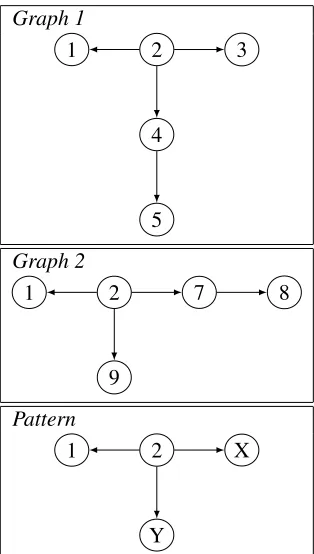
The patterns in our rules are expressed as graphs with vertices containing variables. A vertex with a variable can unify with a subgraph. For exam-ple, Figure 1 shows two graphs and a pattern that matches both graphs.
Graph 1
1 2 3
4
5
Graph 2
1 2 7 8
9
Pattern
1 2 X
Y
Figure 1: Two graphs and a pattern (variables in up-percase)
Such patterns are used to match the graph repre-sentation of the question. If a pattern defined in a rule matches a question sentence, then the rule ap-plies to the sentence.
Our rules specify the pattern of the answer sen-tence in an unusual way. Instead of keeping a pat-tern to match the answer sentence, our rules define anextensiongraph that will be added to the graph of the question. The rationale for this is that we want to reward answer sentences that have a high similarity with the question. Therefore, the larger the num-ber of vertices and edges that are shared between the question and the answer, the better. The extension graph contains information that simulates the dif-ference between a question sentence and a sentence containing an answer.
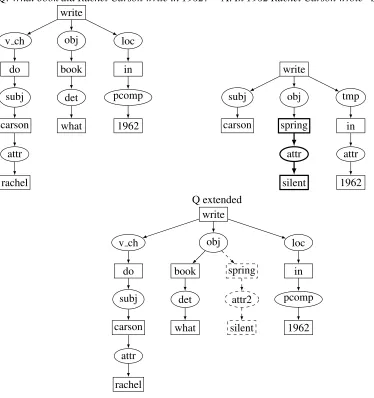
For example, lets us use graph representations of syntactic dependency structures. We will base our representation on the output of Connexor (Tapanainen and J¨arvinen, 1997), but the choice of parser is arbitrary. The same method applies to the output of any parser, as long as it can be represented as a graph. In our choice, the dependency structure is represented as a bipartite graph where the lexi-cal entries are the vertices represented in boxes and the dependency labels are the vertices represented in ovals. Figure 2 shows the graphs of a question and an answer sentence, and an extension of the question graph. The answer is shown in thick lines, and the extension is shown in dashed lines. This is what we aim to reproduce with our graph rules. In particular, the extension of the question graph is such that the graph of the answer sentence becomes a subgraph of the extended question graph.
The question and answer sentence of Figure 2 have an almost identical dependency graph and con-sequently the extension required to the question graph is very small. Sentence pairs with more dif-ferences would induce a more substantial extension graph.
Note that the extended graph still contains the rep-resentation of information that does not appear in the answer sentence, namely the question termwhat book. There is no need to remove any element from the question graph because, as we will see later, the criteria to score the answer extracted are based on the overlap between graphs.
In sum, a graph rule has the following compo-nents:
Rp a question pattern;
Q:What book did Rachel Carson write in 1962? A:In 1962 Rachel Carson wrote“Silent Spring” write
v ch obj loc
do book in
subj det pcomp
carson what 1962
attr
rachel
write
subj obj tmp
carson in
attr
1962 spring
attr
silent
Q extended write
v ch obj loc
do book in
subj det pcomp
carson what 1962
attr
rachel
spring
attr2
silent
to the question graph; and
Ra a pointer to the answer in the extension graph
An example of a rule is shown in Figure 3. This rule is derived from the pair of question and answer sentence shown in Figure 2.
X
obj
Y
det
what
ANSWER
Figure 3: Example of a QA rule.Rpis in solid lines,
Reis in dashed lines, andRais in thick lines.
The rule can be used with a fresh pair of question qi and answer sentenceasi. Let us use the notation
Gr(s)to denote the graph that represents the string s. Also, unless said explicitly, names starting with uppercase denote graphs, and names starting with lowercase denote strings. Informally, the process to find the answer is:
1. If Gr(qi) matches Rp then the rule applies.
Otherwise try a new rule.
2. ExtendGr(qi)withreto produce a new graph
ERe
qi .
3. Compute the overlap between ERe
qi and Gr(asi).
4. If a part ofRais in the resulting overlap, then
expand its projection onGr(asi).
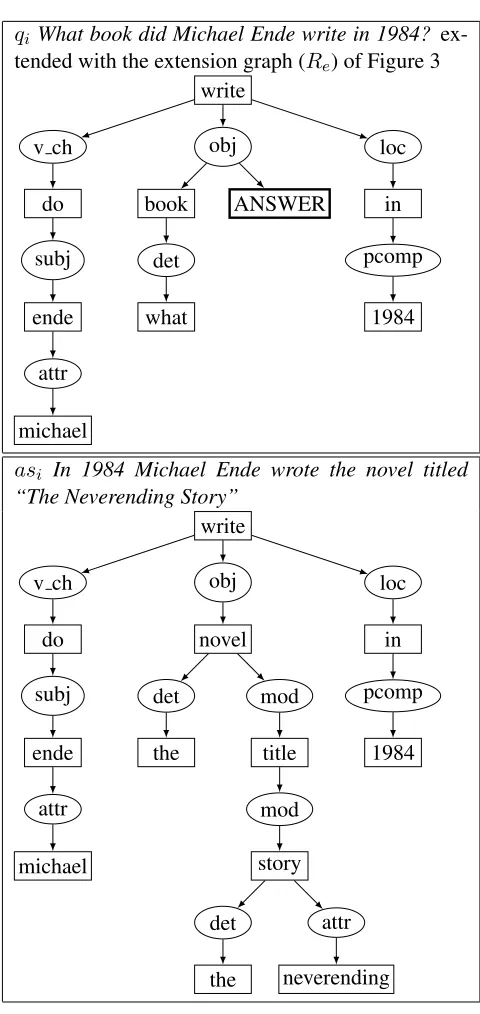
The crucial point in the process is to determine the projection of an overlap on the answer sentence, and then to extend it. Once the overlap is found in step 3, if this overlap includes part of the annotated answer, that is if it includesRa, then part of the
an-swer will be the string in the anan-swer sentence that corresponds to the overlap. The full answer can be retrieved by expanding the answer found in the over-lap by following the outgoing edges in the graph of
qi What book did Michael Ende write in 1984?
ex-tended with the extension graph (Re) of Figure 3
write
v ch obj loc
do book in
subj det pcomp
ende what 1984
attr
michael
ANSWER
asi In 1984 Michael Ende wrote the novel titled “The Neverending Story”
write
v ch obj loc
do novel in
subj det mod pcomp
ende the title 1984
attr mod
michael story
det attr
the neverending
write
v ch obj loc
do in
subj pcomp
ende 1984
attr
michael
novel
Figure 5: Overlap of the graphs of Figure 4
the answer. Part of the process is shown in Figures 4 and 5.
In Figure 5 the overlap between the extended question graph and the answer sentence graph con-tains the answer fragmentnovel. After expanding it we obtain the full answerthe novel titled “The Never Ending Story”.1
3 Learning of Graph Rules
To learn a QA rule we need to determine the in-formation that is common between a question and a sentence containing an answer. In terms of graphs, this is a variant of the well-known problem of find-ing the maximum common subgraph (MCS) of two graphs (Bunke et al., 2002).
The problem of finding the MCS of two graphs is known to be NP-complete, but there are implemen-tations that are fast enough for practical uses, espe-cially if the graphs are not particularly large (Bunke et al., 2002). Given that our graphs are used to repre-sent repre-sentences, their size would usually stay within a few tens of vertices. This size is acceptable.
There is an algorithm based on Conceptual Graphs (Myaeng and L´opez-L´opez, 1992) which is particularly efficient for our purposes.Their method follows the traditional procedure of building the as-sociation graph of the two input graphs. However, in
1
Note that this answer is not an exact answer according to the TREC definition since it contains the stringthe novel titled; one further step would be needed to extract the exact answer; this is work for further research.
contrast with the traditional approach, which finds the cliques of the association graph (and this is the part that is NP-complete), the method by Myaeng and L´opez-L´opez (1992) first simplifies the associa-tion graph by merging some of its vertices, and then it proceeds to searching the cliques. By so doing the algorithm is still exponential on the size of n, but nownis smaller than with the traditional approach for the same input graphs.
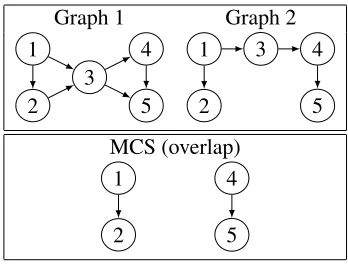
The method presented by Myaeng and L´opez-L´opez (1992) finds connected graphs but we also need to find overlaps that form unconnected graphs. For example, Figure 6 shows two graphs and their MCS. The resulting MCS is an unconnected graph, though Myaeng and L´opez-L´opez (1992)’s algo-rithm returns the two parts of the graph as indepen-dent MCSs. It is easy to modify the original algo-rithm to obtain the desired output, as we did.
Graph 1 Graph 2 1
2 3
4
5 1
2
3 4
5
MCS (overlap) 1
2
4
5
Figure 6: MCS of two graphs
Given two graphs G1 and G2, then their MCS is M CS(G1, G2). To simplify the notation, we will often refer to the MCS of two sentences as M CS(s1, s2). This is to be understood to be the MCS of the graphs of the two sentences M CS(Gr(s1), Gr(s2)).
Let us now assume that the graph ruleRis origi-nated from a pair (q,as) in the training corpus, where qis a question andasa sentence containing the an-swera. The rule components are built as follows:
Rp is the MCS ofqandas, that is,M CS(q, as).
Re is the path between the projection of Rp in
Gr(as)and the actual answerGr(a).
Note that this process defines Rp as the MCS of
question and answer sentence. Consequently, Rp
is a subgraph of both the question and the answer sentence. This constraint is stronger than that of a typical QA rule, where the pattern needs to match the question only. The resulting question pattern is therefore more general than it could be had one man-ually built the rule. Rp does not include
question-only elements in the question pattern because it is difficult to determine what components of the ques-tion are to be added to the pattern, and what compo-nents are idiosyncratic to the specific question used in the training set.
Rules learnt this way need to be generalised in or-der to form generic patterns. We currently use a sim-ple method of generalisation: convert a subset of the vertices into variables. To decide whether a vertex can be generalised a list of very common vertices is used. This is the list of “stop vertices”, in analogy to the concept of stop words in methods to detect key-words in a string. Thus, if a vertex is not in the list of stop vertices, then the vertex can be generalised. The list of stop vertices is fixed and depends on the graph formalism used.
For the question answering process it is useful to associate a weight to every rule learnt. The rule weight is computed by testing the accuracy of the rule in the training corpus. This way, rules that over-generalise acquire a low weight. The weightW(r) of a ruleris computed according to its precision on the training set:
W(r) = # correct answers found # answers found
4 Application: QA with Logical Graphs
The above method has been applied to graphs rep-resenting the logical contents of sentences. There has been a long tradition on the use of graphs for this kind of sentence representation, such as Sowa’s Conceptual Graphs (Sowa, 1979), and Quillian’s Se-mantic Nets (Quillian, 1968). In our particular ex-periment we have used a graph representation that can be built automatically and that can be used effi-ciently for QA (Moll´a and van Zaanen, 2006).
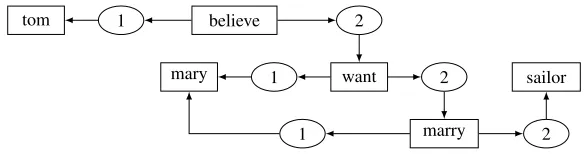
A Logical Graph (LG) is a directed, bipartite graph with two types of vertices, concepts and re-lations.
Concepts Examples of concepts are objectsdog, ta-ble, events and statesrun, love, and properties
red,quick.
Relations Relations act as links between concepts. To facilitate the production of the LGs we have decided to use relation labels that represent verb argument positions. Thus, the relation1
indicates the link to the first argument of a verb (that is, what is usually a subject). The re-lation 2indicates the link to the second argu-ment of a verb (usually the direct object), and so forth. Furthermore, relations introduced by prepositions are labelled with the prepositions themselves. Our relations are therefore close to the syntactic structure.
An example of a LG is shown in Figure 7, where the concepts are pictured in boxes and the relations are pictured in ovals.
The example in Figure 7 shows LG’s ability to provide the graph representation of sentences with embedded clauses. In contrast, other theories (such as Sowa (1979)’s Conceptual Graphs) would rep-resent the sentence as a graph containing vertices that are themselves graphs. This departs from the usual definition of a graph, and therefore standard Graph Theory algorithms would need to be adapted for Conceptual Graphs. An advantage of our LGs, therefore, is that they can be manipulated with stan-dard Graph Theory algorithms such as the ones de-scribed in this paper.
Using the LG as the graph representation of questions and answer sentences, we implemented a proof-of-concept QA system. The implementation and examples of graphs are described by Moll´a and van Zaanen (2005) and here we only describe the method to generalise rules and the decisions taken to choose the exact answer.
tom 1 believe 2
want 1
mary 2
marry
1 2
sailor
Tom believes that Mary wants to marry a sailor
Figure 7: Example of a Logical Graph
and, or, not, nor, if, otherwise, have, be, become, do, make
Every question/answer pair in the training corpus generates one rule (or more if we use a process of increasingly generalising the rules). Since the rule is based on deep linguistic information, it generalises over syntactic paraphrases. Consequently, a small training corpus suffices to produce a relatively large number of rules.
The QA system was trained with an annotated corpus of 560 pairs of TREC questions and answer sentences where the answers were manually anno-tated. We only tested the ability of the system to ex-tract the exact answers. Thus, the system accepted pairs of question and answer sentences (where the sentence is guaranteed to contain an answer), and returned the exact answer. Given a question and an-swer sentence pair, the anan-swer is found by applying all matching rules. All strings found as answers are ranked by multiplying the rule weights and the sizes of the overlaps. If an answer is found by several rules, its score is the sum of all scores of each indi-vidual sentence. Finally, if an answer occurs in the question it is ignored. The results of a five-fold cross validation on the annotated corpus gave an accuracy (percentage of questions where the correct answer was found) of 21.44%. Given that the QA system does not do any kind of question classification and it does not use any NE recogniser, the results are sat-isfactory.
5 Related Research
There have been other attempts to learn QA rules au-tomatically. For example, Ravichandran and Hovy (2002) learns rules based on simple surface patterns. Given that surface patterns ignore much linguistic information, it becomes necessary to gather a large
corpus of questions together with their answers and sentences containing the answers. To obtain such a corpus Ravichandran and Hovy (2002) mine the Web to gather the relevant data.
Other methods learn patterns based on syntactic information. For example, Shen et al. (2005) de-velop a method of extracting dependency paths con-necting answers with words found in the question. However we are not aware of any method that at-tempts to learn patterns based on logical informa-tion, other than our own.
There is recent interest on the use of graph methods for Natural Language Processing, such as document summarisation (Mihalcea, 2004) doc-ument retrieval (Montes-y-G´omez et al., 2000; Mishne, 2004), and recognition of textual entailment (Pazienza et al., 2005). The present very workshop shows the current interest on the area. However, we are not aware of any significant research about the use of conceptual graphs (or any other form of graph representation) for question answering other than our own.
6 Conclusions
We have presented a method to learn question an-swering rules by applying graph manipulation meth-ods on the representations of questions and answer sentences. The method is independent of the actual graph representation formalism.
Further research will also focus on developing methods to extend the question patternRp with
in-formation found in the question only. A possibility is to keep a database of question subgraphs that are allowed to be added toRp. This database could be
built by hand, but ideally it should be learnt auto-matically.
Additional research efforts will be allocated to de-termine degrees of word similarity or paraphrasing, such as the connection betweenwas born inand’s birthplace is. In particular, we will explore the use of nominalisations. We will also study paraphrasing methods to detect these connections.
Considering that text information as complex as syntactic information or even logic and semantic information can be expressed in graphs (Quillian, 1968; Schank, 1972; Sowa, 1979), we are convinced that the time is ripe to explore the use of graphs for question answering.
References
H. Bunke, P. Foggia, C. Guidobaldi, C. Sansone, and
M. Vento. 2002. A comparison of algorithms for
maximum common subgraph on randomly connected
graphs. InLecture Notes on Computer Science,
vol-ume 2396, pages 123–132. Springer-Verlag, Heidel-berg.
Noriko Kando. 2005. Overview of the fifth NTCIR
workshop. InProceedings NTCIR 2005.
Rada Mihalcea. 2004. Graph-based ranking algorithms for sentence extraction applied to text summarization. InProceedings of the 42nd Annual Meeting of the As-sociation for Computational Linguistics, companion volume (ACL 2004).
Gilad Mishne. 2004. Source code retrieval using concep-tual graphs. Master’s thesis, University of Amsterdam.
Diego Moll´a and Menno van Zaanen. 2005. Learning
of graph rules for question answering. InProc. ALTW
2005, Sydney.
Diego Moll´a and Menno van Zaanen. 2006.
An-swerfinder at TREC 2005. In Proceedings TREC
2005. NIST.
Manuel Montes-y-G´omez, Aurelio L´opez-L´opez, and Alexander Gelbukh. 2000. Information retrieval with
conceptual graph matching. In Proc. DEXA-2000,
number 1873 in Lecture Notes in Computer Science, pages 312–321. Springer-Verlag.
Sung H. Myaeng and Aurelio L´opez-L´opez. 1992. Con-ceptual graph matching: a flexible algorithm and
ex-periments. Journal of Experimentation and
Theoreti-cal Artificial Intelligence, 4:107–126.
Maria Teresa Pazienza, Marco Pennacchiotti, and
Fabio Massimo Zanzotto. 2005. Textual entailment as syntactic graph distance: a rule based and a SVM
based approach. In Proceedings PASCAL RTE
chal-lenge 2005.
Ross Quillian. 1968. Semantic memory. InSemantic
Information Processing, pages 216–270. MIT Press.
Deepak Ravichandran and Eduard Hovy. 2002. Learning surface text patterns for a question answering system. InProc. ACL2002.
Roger C. Schank. 1972. Conceptual dependency: A the-ory of natural language understanding. Cognitive Psy-chology, 3(4):532–631.
Dan Shen, Geert-Jan M. Kruijff, and Dietrich Klakow. 2005. Exploring syntactic relation patterns for ques-tion answering. In Robert Dale, Kam-Fai Wong, Jian
Su, and Oi Yee Kwong, editors, Natural Language
Processing IJCNLP 2005: Second International Joint Conference, Jeju Island, Korea, October 11-13, 2005. Proceedings.Springer-Verlag.
M. M. Soubbotin. 2001. Patterns of potential answer expression as clues to the right answers. In Voorhees and Harman (Voorhees and Harman, 2001).
John F. Sowa. 1979. Semantics of conceptual graphs. In
Proc. ACL 1979, pages 39–44.
Pasi Tapanainen and Timo J¨arvinen. 1997. A
non-projective dependency parser. In Proc. ANLP-97.
ACL.
Alessandro Vallin, Bernardo Magnini, Danilo Giampic-colo, Lili Aunimo, Christelle Ayache, Petya Osenova, Anselmo Pe nas, Maarten de Rijke, Bogdan Sacaleanu, Diana Santos, and Richard Sutcliffe. 2005. Overview of the CLEF 2005 multilingual question answering
track. InProceedings CLEF 2005. Working note.
Menno van Zaanen. 2002. Bootstrapping Structure into
Language: Alignment-Based Learning. Ph.D. thesis, University of Leeds, Leeds, UK.
Ellen M. Voorhees and Donna K. Harman, editors. 2001.
The Tenth Text REtrieval Conference (TREC 2001), number 500-250 in NIST Special Publication. NIST.
Ellen M. Voorhees. 2001a. Overview of the TREC 2001 question answering track. In Voorhees and Harman (Voorhees and Harman, 2001).
Ellen M. Voorhees. 2001b. The TREC question
answer-ing track. Natural Language Engineering, 7(4):361–