Chasing the ghost: recovering empty categories in the Chinese Treebank
Yaqin Yang
Computer Science Department Brandeis University
Nianwen Xue
Computer Science Department Brandeis University
Abstract
Empty categories represent an impor-tant source of information in syntactic parses annotated in the generative linguis-tic tradition, but empty category recovery has only started to receive serious atten-tion until very recently, after substantial progress in statistical parsing. This paper describes a unified framework in recover-ing empty categories in the Chinese Tree-bank. Our results show that given skele-tal gold standard parses, the empty cate-gories can be detected with very high ac-curacy. We report very promising results for empty category recovery for automatic parses as well.
1 Introduction
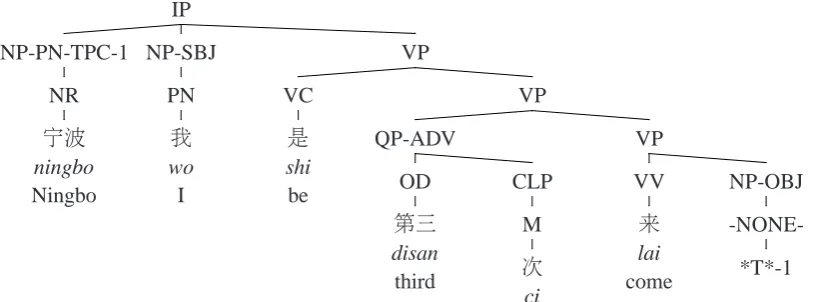
The use of empty categories to represent the syn-tactic structure of a sentence is the hallmark of the generative linguistics and they represent an im-portant source of information in treebanks anno-tated in this linguistic tradition. The use of empty categories in the annotation of treebanks started with the Penn Treebank (Marcus et al., 1993), and this practice is continued in the Chinese Treebank (CTB) (Xue et al., 2005) and the Arabic Tree-bank, the Penn series of treebanks. Empty cat-egories come in a few different varieties, serv-ing different purposes. One use of empty cate-gories is to mark the extraction site of an dislo-cated phrase, thus effectively reconstructing the canonical structure of a sentence, allowing easy extraction of its predicate-argument structure. For example, in Figure 1, the empty category
*T*-1 is coindexed with the dislocated topic NP 宁
波 (“Ningbo”), indicating that the canonical po-sition of this NP is next to the verb来 (“come”). The empty category effectively localizes the syn-tactic dependency between the verb and this NP, making it easier to detect and extract this relation. Marking the extraction site of a dislocated item is not the only use of empty categories. For lan-guages like Chinese, empty categories are also used to represent dropped pronouns. Chinese is a pro-drop language (Huang, 1989) and subject pronouns are routinely dropped. Recovering these elliptical elements is important to many natural language applications. When translated into an-other language, for example, these dropped pro-nouns may have to be made explicit and replaced with overt pronouns or noun phrases if the target language does not allow dropped pronouns.
IP
NP-PN-TPC-1 NP-SBJ VP
NR PN VC VP
宁波
ningbo
Ningbo
我
wo
I
是 shi
be
QP-ADV VP
OD CLP VV NP-OBJ
第三
disan
third
M 来
lai
come
-NONE-次 ci
*T*-1
“Ningbo, this is the third time I came here.”
Figure 1: A CTB tree with empty categories
a way to incorporate the empty category detection in the parsing process. In fact, the detection of empty categories relies heavily on the other com-ponents of the syntactic representation, and as a result, empty category recovery is often formu-lated as postprocessing problem after the skeletal structure of a syntactic parse has been determined. As work on English has demonstrated, empty cat-egory detection can be performed with high accu-racy given high-quality skeletal syntactic parses as input.
Because Chinese allows dropped pronouns and thus has more varieties of empty categories than languages like English, it can be argued that there is added importance in Chinese empty category detection. However, to our knowledge, there has been little work in this area, and the work we report here represents the first effort in Chinese empty category detection. Our results are promis-ing, but they also show that Chinese empty cat-egory detection is a very challenging problem mostly because Chinese syntactic parsing is dif-ficult and still lags significantly behind the state of the art in English parsing. We show that given skeletal gold-standard parses (with empty cate-gories pruned out), the empty detection can be performed with a fairly high accuracy of almost 89%. The performance drops significantly, to 63%, when the output of an automatic parser is used.
The rest of the paper is organized as follows. In Section 2, we formulate the empty category
de-tection as a binary classification problem where each word is labeled as either having a empty cat-egory before it or not. This makes it possible to use any standard machine learning technique to solve this problem. The key is to find the appro-priate set of features. Section 3 describes the fea-tures we use in our experiments. We present our experimental results in Section 4. There are two experimental conditions, one with gold standard treebank parses (stripped of empty categories) as input and the other with automatic parses. Section 5 describes related work and Section 6 conclude our paper.
2 Formulating the empty category detection as a tagging problem
EC Type count Description
*pro* 2024 small pro
*PRO* 2856 big pro
*T* 4486 trace for extraction
*RNR* 217 right node raising
*OP* 879 operator
* 132 trace for raising
Table 1: Empty categories in CTB.
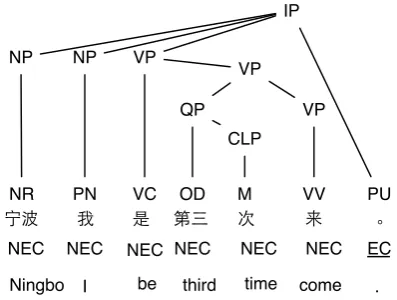
As a first step of learning an empty category model, we treat all the empty categories as a uni-fied type, and for each word in the sentence, we only try to decide if there is an empty category before it. This amounts to an empty category de-tection task, and the objective is to first locate the empty categories without attempting to determine the specific empty category type. Instead of pre-dicting the locations of the empty categories in a parse tree and having a separate classifier for each syntactic construction where an empty category is likely to occur, we adopt a linear view of the parse tree and treat empty categories, along with overt word tokens, as leaves in the tree. This allows us to identify the location of the empty categories in relation to overt word tokens in the same sentence, as illustrated in Example (1):
(1) 宁波 我 是 第三 次 来 *T*。
In this representation, the position of the empty category can be defined either in relation to the previous or the next word, or both. To make this even more amenable to machine learning ap-proaches, we further reformulate the problem as a tagging problem so that each overt word is labeled either with EC, indicating there is an empty cate-gory before this word, or NEC, indicating there is no empty category. This reformulated representa-tion is illustrated in Example (2):
(2) 宁 波/NEC 我/NEC 是/NEC 第三/NEC
次/NEC来/NEC。/EC
In (2), the EC label attached to the final period indicates that there is an empty category before this punctuation mark. There is a small price to pay with this representation: when there is more than one empty category before a word, it is indis-tinguishable from cases where there is only one
empty category. What we have gained is a sim-ple unified representation for all empty categories that lend itself naturally to machine learning ap-proaches. Another advantage is that for natural language applications that do not need the full parse trees but only need the empty categories, this representation provides an easy-to-use repre-sentation for those applications. Since this linear-lized representation is still aligned with its parse tree, we still have easy access to the full hierar-chical structure of this tree from which useful fea-tures can be extracted.
3 Features
Having modeled empty category detection as a machine learning task, feature selection is crucial to successfully finding a solution to this problem. The machine learning algorithm scans the words in a sentence from left to right one by one and determine if there is an empty category before it. When the sentence is paired with its parse tree, the feature space is all the surrounding words of the target word as well as the syntactic parse for the sentence. The machine learning algorithm also has access to the empty category labels (EC or NEC) of all the words before the current word. Figure 2 illustrates the feature space for the last word (a period) in the sentence.
NP VP
NR PN VC
VP
QP
OD CLP
M
VP
VV PU NP
IP
!" # $% & ' !
NEC NEC NEC NEC NEC NEC EC
Ningbo I be third time come . (
"Ningbo, this is the third time I came here."
Figure 2: Feature space of empty category detec-tion
lexical features are different combinations of the words and their parts of speech (POS), while syn-tactic features are the structural information gath-ered from the nonterminal phrasal labels and their syntactic relations.
3.1 Lexical features
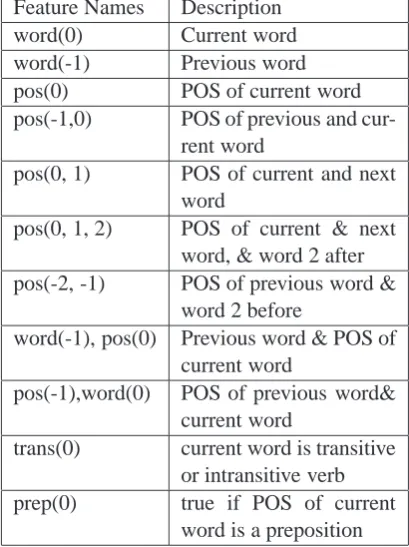
The lexical features are collected from a narrow window of five words and their POS tags. If the target word is a verb, the lexical features also in-clude transitivity information of this verb, which is gathered from the CTB. A transitivity lexicon is induced from the CTB by checking whether a verb has a right NP or IP sibling. Each time a verb is used as a transitive verb (having a right NP or IP sibling), its transitive count is incremented by one. Conversely, each time a verb is used as an intran-sitive verb (not having a right NP or IP sibling), its intransitive use is incremented by one. The result-ing transitivity lexicon after runnresult-ing through the entire Chinese Treebank consists of a list of verbs with frequencies of their transitive and intransitive uses. A verb is considered to be transitive if its in-transitive count in this lexicon is zero or if its tran-sitive use is more than three times as frequent as its intransitive use. Similarly, a verb is considered to be intransitive if its transitive count is zero or if its intransitive use is at least three times as fre-quent as its transitive use. The full list of lexical features is presented in Table 2.
3.2 Syntactic features
Syntactic features are gathered from the CTB parses stripped of function tags and empty cate-gories when the gold standard trees are used as input. The automatic parses used as input to our system are produced by the Berkeley parser. Like most parsers, the Berkeley parser does not repro-duce the function tags and empty categories in the original trees in the CTB. Syntactic features cap-ture the syntactic context of the target word, and as we shall show in Section 4, the syntactic fea-tures are crucial to the success of empty category detection. The list of syntactic features we use in our system include:
1. 1st-IP-child: True if the current word is the first word in the lowest IP dominating this word.
Feature Names Description
word(0) Current word
word(-1) Previous word pos(0) POS of current word pos(-1,0) POS of previous and
cur-rent word
pos(0, 1) POS of current and next word
pos(0, 1, 2) POS of current & next word, & word 2 after pos(-2, -1) POS of previous word &
word 2 before
word(-1), pos(0) Previous word & POS of current word
pos(-1),word(0) POS of previous word& current word
trans(0) current word is transitive or intransitive verb prep(0) true if POS of current
word is a preposition
Table 2: Feature set.
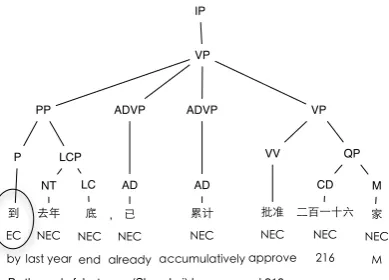
2. 1st-word-in-subjectless-IP: True if the cur-rent word starts an IP with no subject. Sub-ject is detected heuristically by looking at left sisters of a VP node. Figure 3 illustrates this feature for the first word in a sentence where the subject is a dropped pronoun.
3. 1st-word-in-subjectless-IP+POS: POS of the current word if it starts an IP with no sub-ject.
4. 1st-VP-child-after-PU: True if the current word is the first terminal child of a VP fol-lowing a punctuation mark.
5. NT-in-IP: True if POS of current word is NT, and it heads an NP that does not have a sub-ject NP as its right sister.
6. verb-in-NP/VP: True if the current word is a verb in an NP/VP.
7. parent-label: Phrasal label of the parent of the current node, with the current node al-ways corresponding to a terminal node in the parse tree.
!
By the end of last year, (Shanghai) has approved 216 ...
Figure 3: First word in a subject-less IP
Empty categories generally occur in clausal or phrasal boundaries, and most of the features are designed to capture such information. For exam-ple, the five feature types, 1st-IP-child,
word-in-subjectless-IP, word-word-in-subjectless-IP, 1st-VP-child-after-PU and NT-in-IP all represent the
left edge of a clause (IP) with some level of gran-ularity. parent label and verb-in-NP/VP represent phrases within which empty categories typically occur do not occur. The has-no-object feature is intended to capture transitive uses of a verb when the object is missing.
4 Experiments
Given that our approach is independent of specific machine learning techniques, many standard ma-chine learning algorithms can be applied to this task. For our experiment we built a Maximum En-tropy classifier with the Mallet toolkit1.
4.1 Data
In our experiments, we use a subset of the CTB 6.0. This subset is further divided into train-ing (files chtb 0081 thorough chtb 0900), devel-opment (files chtb 0041 through chtb 0080) and test sets (files chtb 0001 through chtb 0040, files chtb 0901 through chtb 0931). The reason for not using the entire Chinese Treebank is that the data in the CTB is from a variety of different sources and the automatic parsing accuracy is very uneven across these different sources.
1
http://mallet.cs.umass.edu
4.2 Experimental conditions
Two different kinds of data sets were used in the evaluation of our method: 1) gold standard parse trees from the CTB; and 2) automatic parses pro-duced by the Berkeley parser2.
4.2.1 Gold standard parses
There are two experimental conditions. In our first experiment, we use the gold standard parse trees from the CTB as input to our classifier. The version of the parse tree that we use as input to our classifier is stripped of the empty category information. What our system effectively does is to restore the empty categories given a skele-tal syntactic parse. The purpose of this experi-ment is to establish a topline and see how accu-rately the empty categories can be restored given a“correct”parse.
4.2.2 Automatic parses
To be used in realistic scenarios, the parse trees need to be produced automatically from raw text using an automatic parser. In our experiments we use the Berkeley Parser as a representative of the state-of-the-art automatic parsers. The input to the Berkeley parser is words that have already been segmented in the CTB. Obviously, to achieve fully automatic parsing, the raw text should be auto-matically segmented as well. The Berkeley parser comes with a fully trained model, and to make sure that none of our test and development data is included in the training data in the original model, we retrained the parser with our training set and used the resulting model to parse the documents in the development and test sets.
When training our empty category model using automatic parses, it is important that the quality of the parses match between the training and test sets. So the automatic parses in the training set are acquired by first training the parser with 4/5 of the data and using the resulting model to parse the remaining 1/5 of the data that has been held out. Measured by the ParsEval metric (Black et al., 1991), the parser accuracy stands at 80.3% (F-score), with a precision of 81.8% and a recall of 78.8% (recall).
2
4.3 Evaluation metrics
We use precision, recall and F-measure as our evaluation metrics for empty category detection. Precision is defined as the number of correctly identified Empty Categories (ECs) divided by the total number of ECs that our system produced. Recall is defined as the number of correctly iden-tified ECs divided by the total number of EC la-bels in the CTB gold standard data. F-measure is defined as the geometric mean of precision and recall.
R= # of correctly detected EC
# of EC tagged in corpus (1)
P = # of correctly detected EC
# of EC reported by the system (2)
F = 2
1/R+ 1/P (3)
4.4 Overall EC detection performance
We report our best result for the gold standard trees and the automatic parses produced by the Berkeley parser in Table 3. These results are achieved by using all lexical and syntactic features presented in Section 3.
Data Prec.(%) Rec.(%) F(%)
Gold 95.9 (75.3) 83.0 (70.5) 89.0 (72.8) Auto 80.3 (57.9) 52.1 (50.2) 63.2 (53.8)
Table 3: Best results on the gold tree.
As shown in Table 3, our feature set works well for the gold standard trees. Not surprisingly, the accuracy when using the automatic parses is lower, with the performance gap between using the gold standard trees and the Berkeley parser at 25.8% (F-score). When the automatic parser is used, although the precision is 80.3%, the re-call is only 52.1%. As there is no similar work in Chinese empty category detection using the same data set, for comparison purposes we established a baseline using a based approach. The rule-based algorithm captures two most frequent loca-tions of empty categories: the subject and the ob-ject positions. Our algorithm labels the first word within a VP with EC if the VP does not have a subject NP. Similarly, it assigns the EC label to the
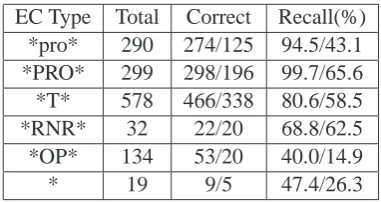
word immediately following a transitive verb if it does not have an NP or IP object. Since the miss-ing subjects and objects account for most of the empty categories in Chinese, this baseline covers most of the empty categories. The baseline results are also presented in Table 3 (in brackets). The baseline results using the gold standard trees are 75.3% (precision), 70.5% (recall), and 72.8% (F-score). Using the automatic parses, the results are 57.9% (precision), 50.2% (recall), and 53.8% (F-score) respectively. It is clear from our results that our machine learning model beats the rule-based baseline by a comfortable margin in both exper-imental conditions. Table 4 breaks down our re-sults by empty category types. Notice that we did not attempt to predict the specific empty category type. This only shows the percentage of empty categories our model is able to recover (recall) for each type. As our model does not predict the spe-cific empty category type, only whether there is an empty category before a particular word, we can-not compute the precision for each empty category type. Nevertheless, this breakdown gives us a sense of which empty category is easier to recover. For both experimental conditions, the empty cate-gory that can be recovered with the highest accu-racy is *PRO*, an empty category often used in subject/object control constructions. *pro* seems to be the category that is most affected by parsing accuracy. It has the widest gap between the two experimental conditions, at more than 50%.
EC Type Total Correct Recall(%) *pro* 290 274/125 94.5/43.1 *PRO* 299 298/196 99.7/65.6 *T* 578 466/338 80.6/58.5
*RNR* 32 22/20 68.8/62.5
*OP* 134 53/20 40.0/14.9
* 19 9/5 47.4/26.3
Table 4: Results of different types of empty cate-gories.
4.5 Comparison of feature types
pre-sented in Table 5. Our results show that when using only the lexical features, the drop in accu-racy is small when automatic parses are used in place of gold standard trees. However, when us-ing only the syntactic features, the drop in accu-racy is much more dramatic. In both experimental conditions, however, syntactic features are more effective than the lexical features, indicating the crucial importance of high-quality parses to suc-cessful empty category detection. This makes in-tuitive sense, given that all empty categories oc-cupy clausal and phrasal boundaries that can only defined in syntactic terms.
Data Prec.(%) Rec.(%) F(%) Lexical 79.7/77.3 47.6/39.9 59.6/52.7 Syntactic 95.9/78.0 70.0/44.5 81.0/56.7
Table 5: Comparison of lexical and syntactic fea-tures.
4.6 Comparison of individual features
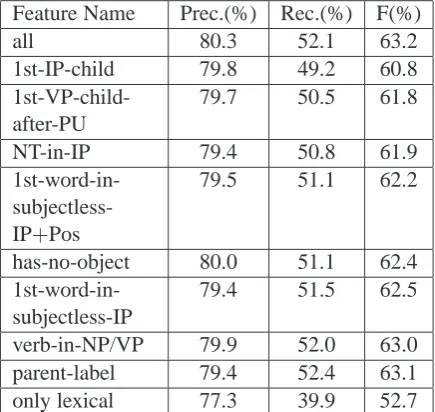
Given the importance of syntactic features, we conducted an experiment trying to evaluate the impact of each individual syntactic feature on the overall empty category detection performance. In this experiment, we kept the lexical feature set constant, and switched off the syntactic features one at a time. The performance of the different syntactic features is shown in Table 6. The re-sults here assume that automatic parses are used. The first row is the result of using all features (both syntactic and lexical) while the last row is the result of using only the lexical features. It can be seen that syntactic features contribute more than 10% to the overall accuracy. The results also show that features (e.g., 1st-IP-child) that capture clause boundary information tend to be more dis-criminative and they occupy the first few rows of a table that sorted based on feature performance.
5 Related work
The problem of empty category detection has been studied both in the context of reference resolution and syntactic parsing. In the reference resolution literature, empty category detection manifests it-self in the form of zero anaphora (or zero pronoun)
Feature Name Prec.(%) Rec.(%) F(%)
all 80.3 52.1 63.2
1st-IP-child 79.8 49.2 60.8
1st-VP-child-after-PU
79.7 50.5 61.8
NT-in-IP 79.4 50.8 61.9
1st-word-in- subjectless-IP+Pos
79.5 51.1 62.2
has-no-object 80.0 51.1 62.4
1st-word-in-subjectless-IP
79.4 51.5 62.5
verb-in-NP/VP 79.9 52.0 63.0
parent-label 79.4 52.4 63.1
only lexical 77.3 39.9 52.7
Table 6: Performance for individual syntactic fea-tures with automatic parses.
detection and resolution. Zero anaphora resolu-tion has been studied as a computaresolu-tional prob-lem for many different languages. For example, (Ferr´andez and Peral, 2000) describes an algo-rithm for detecting and resolving zero pronouns in Spanish texts. (Seki et al., 2002) and (Lida et al., 2007) reported work on zero pronoun detec-tion and resoludetec-tion in Japanese.
Zero anaphora detection and resolution for Chinese has been studied as well. Converse (2006) studied Chinese pronominal anaphora res-olution, including zero anaphora resres-olution, al-though there is no attempt to automatically de-tect the zero anaphors in text. Her work only deals with anaphora resolution, assuming the zero anaphors have already been detected. Chinese zero anaphora identification and resolution have been studied in a machine learning framework-ing in (Zhao and Ng, 2007) and (Peng and Araki, 2007).
al., 2006).
Johnson (2002) describes a pattern-matching algorithm for recovering empty nodes from phrase structure trees. The idea was to extract minimal connected tree fragments that contain an empty node and its antecedent(s), and to match the ex-tracted fragments against an input tree. He eval-uated his approach both on Penn Treebank gold standard trees stripped of the empty categories and on the output of the Charniak parser (Charniak, 2000).
(Dienes and Dubey, 2003) describes an empty detection method that is similar to ours in that it treats empty detection as a tagging problem. The difference is that the tagging is done without ac-cess to any syntactic information so that the iden-tified empty categories along with word tokens in the sentence can then be fed into a parser. The suc-cess of this approach depends on strong local cues such as infinitive markers and participles, which are non-existent in Chinese. Not surprisingly, our model yields low accuracy if only lexical features are used.
Cambell (2004) proposes an algorithm that uses linguistic principles in empty category recovery. He argues that a rule-based approach might per-form well for this problem because the locations of the empty categories, at least in English, are in-serted by annotators who follow explicit linguistic principles.
Yuqing(2007) extends (Cahill et al., 2004) ’s approach for recovering English non-local depen-dencies and applies it to Chinese. This paper pro-poses a method based on the Lexical-Functional Grammar f-structures, which differs from our ap-proach. Based on parser output trees including 610 files from the CTB, the authors of this pa-per claimed they have achieved 64.71% f-score for trace insertion and 54.71% for antecedent recov-ery.
(Gabbard et al., 2006) describes a more recent effort to fully parse the Penn Treebank, recovering both the function tags and the empty categories. Their approach is similar to ours in that they treat empty category recovery as a post-processing pro-cess and use a machine learning algorithm that has access to the skeletal information in the parse tree. Their approach is different from ours in that
they have different classifiers for different types of empty categories.
Although generally higher accuracies are ported in works on English empty category re-covery, cross-linguistic comparison is difficult be-cause both the types of empty categories and the linguistic cues that are accessible to machine learning algorithms are different. For example, there are no empty complementizers annotated in the CTB while English does not allow dropped pronouns.
6 Conclusion and future work
We describe a unified framework to recover empty categories for Chinese given skeletal parse trees as input. In this framework, empty detection is for-mulated as a tagging problem where each word in the sentence receives a tag indicating whether there is an empty category before it. This ad-vantage of this approach is that it is amenable to learning-based approaches and can be addressed with a variety of machine learning algorithms. Our results based on a Maximum Entropy model show that given skeletal gold standard parses, empty categories can be recovered with very high accuracy (close to 90%). We also report promis-ing results (over 63%). when automatic parses produced by an off-the-shelf parser is used as in-put.
Detecting empty categories is only the first step towards fully reproducing the syntactic represen-tation in the CTB, and the obvious next step is to also classify these empty categories into different types and wherever applicable, link the empty cat-egories to their antecedent. This is the line of re-search we intend to pursue in our future work.
Acknowledgment
References
Black, E., S. Abney, D. Flickinger, C. Gdaniec, R. Gr-ishman, P. Harrison, D. Hindle, R. Ingria, F. Jelinek, J. Klavans, M. Liberman, M. Marcus, S. Roukos, B. Santorini, and T. Strzalkowski. 1991. A proce-dure for quantitively comparing the syntactic cov-erage of English grammars. In Proceedings of the
DARPA Speech and Natural Language Workshop,
pages 306–311.
Cahill, Aoife, Michael Burke, Ruth O’Donovan, Josef van Genabith, and Andy Way. 2004. Long-Distance Dependency Resolution in Automatically Acquired Wide-Coverage PCFG-Based LFG Ap-proximations. In In Proceedings of the 42nd
An-nual Meeting of the Association for Computational Linguistics.
Campbell, Richard. 2004. Using linguistic principles to recover empty categories. In Proceedings of the
42nd Annual Meeting on Association For Computa-tional Linguistics.
Charniak, E. 2000. A Maximum-Entropy-Inspired Parser. In Proceedings of NAACL-2000, pages 132– 139, Seattle, Washington.
Collins, Michael. 1999. Head-driven Statistical
Mod-els for Natural Language Parsing. Ph.D. thesis, University of Pennsylvania.
Converse, Susan. 2006. Pronominal anaphora
resolu-tion for Chinese. Ph.D. thesis.
Dienes, P´eter and Amit Dubey. 2003. Deep syntac-tic processing by combining shallow methods. In
Proceedings of the 41st Annual Meeting of the As-sociation for Computational Linguistics, volume 1.
Ferr´andez, Antonio and Jes´us Peral. 2000. A compu-tational approach to zero-pronouns in Spanish. In
Proceedings of the 38th Annual Meeting on Associ-ation For ComputAssoci-ational Linguistics.
Gabbard, Ryan, Seth Kulick, and Mitchell Marcus. 2006. Fully parsing the penn treebank. In
Proceed-ings of HLT-NAACL 2006, pages 184–191, New
York City.
Guo, Yuqing, Haifeng Wang, and Josef van Genabith. 2007. Recovering Non-Local Dependencies for Chinese. In Proceedings of the 2007 Joint
Con-ference on Empirical Methods in Natural Language Processing and Computational Natural Language Learning.
Huang, James C.-T. 1989. Pro drop in Chinese, a generalized control approach. In O, Jaeggli and K. Safir, editors, The Null Subject Parameter. D. Reidel Dordrecht.
Johnson, Mark. 2002. A simple pattern-matching al-gorithm for recovering empty nodes and their an-tecedents. In Proceedings of the 40th Annual
Meet-ing of the Association for Computational LMeet-inguis- Linguis-tics.
Lida, Ryu, Kentaro Inui, and Yuji Matsumoto. 2007. Zero-anaphora resolution by learning rich syntactic pattern features. ACM Transactions on Asian
Lan-guage Information Processing, pages 1–22.
Marcus, Mitchell P., Beatrice Santorini, and Mary Ann Marcinkiewicz. 1993. Building a large annotated corpus of english: The penn treebank.
Computa-tional Linguistics, 19(2):313–330.
Peng, Jing and Kenji Araki. 2007. Zero-anaphora res-olution in chinese using maximum entropy. IEICE
- Trans. Inf. Syst., E90-D(7):1092–1102.
Seki, Kazuhiro, Atsushi Fujii, and Tetsuya Ishikawa. 2002. A probabilistic method for analyzing Japanese anaphora integrating zero pronoun detec-tion and resoludetec-tion. In Proceedings of the 19th
in-ternational Conference on Computational Linguis-tics, volume 1.
Xue, Nianwen and Fei Xia. 2000. The Bracket-ing Guidelines for Penn Chinese Treebank Project. Technical Report IRCS 00-08, University of Penn-sylvania.
Xue, Nianwen, Fei Xia, Fu dong Chiou, and Martha Palmer. 2005. The Penn Chinese TreeBank: Phrase Structure Annotation of a Large Corpus. Natural
Language Engineering, 11(2):207–238.
Zhao, Shanheng and Hwee Tou Ng. 2007. Identifi-cation and Resolution of Chinese Zero Pronouns: A Machine Learning Approach. In Proceedings of
EMNLP-CoNLL Joint Conference, Prague, Czech