Proceedings of the 27th International Conference on Computational Linguistics: System Demonstrations, pages 10–14 10
JESEME: A Website for Exploring Diachronic Changes
in Word Meaning and Emotion
Johannes Hellrich1,2 Sven Buechel2 Udo Hahn2
1 Graduate School ‘The Romantic Model’
modellromantik.uni-jena.de
2 Jena University Language & Information Engineering (JULIE) Lab
julielab.de
Friedrich-Schiller-Universit¨at Jena, Jena, Germany
Abstract
We here introduce a substantially extended version of JESEME, an interactive website for
visu-ally exploring computationvisu-ally derived time-variant information on word meanings and lexical
emotions assembled from five large diachronic text corpora. JESEME is designed for scholars in
the (digital) humanities as an alternative to consulting manually compiled, printed dictionaries for such information (if available at all). This tool uniquely combines state-of-the-art distribu-tional semantics with a nuanced model of human emotions, two information streams we deem beneficial for a data-driven interpretation of texts in the humanities.
1 Introduction
Historical, manually compiled dictionaries are central to many kinds of studies in the humanities, since they provide scholars with information about the lexical meaning of terms in former time periods. Yet, this traditional approach is limited in many ways, coverage being perhaps the most pressing issue: Is a dictionary for the specific time period a scholar is investigating really available and, if so, does it cover all of the lexical items of interest?
Word embeddings have been proposed as a technical vehicle to increase lexical coverage (Kim et al., 2014). However, they require locally installed software and time-consuming calculations, thus being ill-suited for mostly non-technical users in the humanities. As an alternative, we here present an extended
version of JESEME, a user-friendly open source website1for accessing embedding-derived diachronic
information on lexical meaning and emotion. The first release of JESEME (Hellrich and Hahn, 2017b)
mainly provided time-variant diachronic lexical semantic information. Its second version, the focus of
this paper, excels with the unique capability to additionally track the diachronicemotionalconnotation
of words in parallel with their lexical semantics. Such a functionality is widely considered beneficial for the data-driven interpretation of literary text genres (Kim et al., 2017).
Measuring affective information on the lexical level is an active field of research in computational lin-guistics (Liu, 2015). Yet, most contributions focus on contemporary language and are limited to shallow
representations of human emotions, mainly distinguishing betweenpositiveandnegativefeelings.
Cur-rent research in sentiment analysis either starts to include historical trends in word polarity (Hamilton et al., 2016a) or incorporates more nuanced models of emotions, such as Valence-Arousal-Dominance (Buechel and Hahn, 2018). This contribution integrates both lines of work in a unique way based on our prior research activities (Buechel et al., 2016; Buechel et al., 2017). To the best of our knowledge, only
few systems share similarities with JESEME. Alternative websites for tracking diachronic word meaning
yet offer far less diverse collections of corpora compared to JESEME and neither of them incorporates
emotion values attached to lexical entries. For example, Arendt and Volkova (2017) provide only short
term trends in word similarity in two social media corpora in their ESTEEM system.2 The system3 by
This work is licensed under a Creative Commons Attribution 4.0 International License. License details: http:// creativecommons.org/licenses/by/4.0/
1
Website available at:jeseme.org; sources available at:github.com/JULIELab/JeSemE
2
esteem.labworks.org/
Figure 1: JESEME’s text processing pipeline.
Heimerl and Gleicher (2018) is intended as a mere showcase for a novel visualization technique and re-uses SGNS embeddings trained on the English Google Books corpus by Hamilton et al. (2016b).
The DIACHRONICEXPLORER4which uses sparse vector representations instead of word embeddings to
calculate lexical similarity is limited to the Spanish Google Books corpus (Gamallo et al., 2018).
2 Architecture and Website
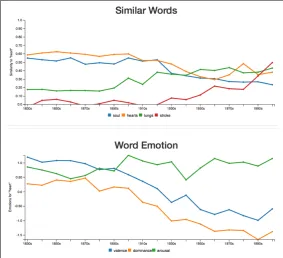
Figure 2: JESEME in operation I: Meaning change of “heart”
rel-ative to reference words since the 1830s in the COHA.
JESEME uses five diachronic
cor-pora: the Google Books N-Gram Corpus for German and its En-glish fiction register (Michel et al., 2011), the Corpus of Historical American English (COHA; Davies (2012)), the Deutsches Textarchiv [‘German Text Archive’] (Geyken, 2013) and the Royal Society Cor-pus (Kermes et al., 2016). To en-sure high embedding quality, these corpora are divided into temporal slices of similar size covering be-tween 10 to 50 years each.
JESEME’s processing pipeline
is depicted in Figure 1. It starts with orthographically normalizing the corpus slices, i.e., lower casing only for English and a historical spelling-aware lemmatization for German (Jurish, 2013). We then
use a modified version of HYPER
-WORDS5to calculate slice-specific
embedding models with SVDPPMI (Levy et al., 2015). This algorithm was chosen for its superior
re-liability which is essential for interpreting local neighborhoods in embedding spaces as is done in the remainder of this paper (Hellrich and Hahn, 2016; Hellrich and Hahn, 2017a). Apart from word vec-tors, we also calculate word-based co-occurrence statistics, frequency information and emotion values for each slice (see Section 3). All this information is stored in a relational database. Compared to Hell-rich and Hahn (2017b), our current version also reduces the database size from approximately 120GB to 40GB. This is achieved by storing word vectors instead of pre-computed similarity scores. Unlike the previous version, semantic similarity between most words will be computed on the fly. Only the most
4
tec.citius.usc.es/explorador-diacronico
similar ones for each word (automatically picked as references) are cached for fast retrieval.
JESEME’s website prompts a search form for selecting the word under scrutiny as well as one of
the five corpora we supply. Its result page then provides graphs depicting the development of semantic similarity to automatically chosen reference words over time as an indicator for semantic change, as well as information on diachronic affective meaning (see Figure 2). These two main sources of information are complemented with information on word co-occurrence and relative frequency, thus providing scholars with additional information to increase interpretability and rule out measurement artifacts. Users may
also add further reference words to the analysis on demand. Besides this graphical interface JESEME
also offers aRESTAPI.6
3 Representing and Computing Emotions
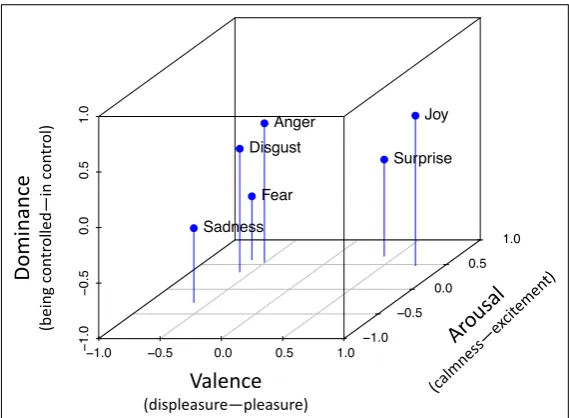
We represent emotions following the Valence-Arousal-Dominance (VAD) scheme (Bradley and Lang, 1994), one of the major models of emotion in psychology (for an illustration, see Figure 3). The VAD model describes affective states relative to three dimensions, namely, Valence (degree of displeasure vs. pleasure), Arousal (degree of calmness vs. excitement) and Dominance (degree of perceived control in a social situation).
NAACL 2018 New Orleans, Louisiana, USA, June 1–6, 2018
Sven Buechel & Udo Hahn Word Emotion Induction as a Multi-Task Learning Problem 5
Valence–Arousal–Dominance (VAD)
Figure 3: Affective space spanned by the
Valence-Arousal-Dominance (VAD) model, together with the position of six basic emotion categories. Adapted from Buechel and Hahn (2016). We used a modified version of
the emotion induction algorithm by Turney and Littman (2003) based on evidence that it outper-forms alternative methods for his-torical emotion lexicon creation (Buechel et al., 2017; Hellrich et
al., 2018). In this work, each
word’s predicted emotion value
ˆ
e(w) is calculated by averaging
the emotion values e(s) for each
For the emotion scores stored in
JESEME, we used the emotion
lex-icons by Warriner et al. (2013) and
Schmidtke et al. (2014) as seed sets for English and German corpora, respectively. Word emotions were induced independently for each temporal corpus slice, using the respective embedding model to retrieve similarity scores. Hence, the similarity between the seed words and the target word reflects word usage at a given language stage, thereby infusing historical emotion information into the resulting emotion ratings (Buechel et al., 2017).
4 Examples
The new insights provided by diachronic emotion models can be demonstrated by re-visiting the example of “heart” we used in Hellrich and Hahn (2017b) as shown in Figure 2. This lexeme is often used metaphorically or metonymically despite the fact that the heart’s anatomical function was already known for a long time. Results for our novel emotion tracking functionality match a move from metaphorical to anatomical usage we previously observed in the genre-balanced COHA. Around 1900, the similarity of “heart” to words such as “stroke” increases, while Dominance and Valence ratings drop sharply in
tandem (see Figure 2; y-axis values are centered and scaled). This simultaneous drop seems plausible, since we can “change our heart” in a metaphorical sense, yet have little control over our anatomical heart. Also, with its increasing anatomical usage, “heart” becomes less positive, since we are under mortal threat by cardiovascular diseases such as a “stroke”.
Figure 4: JESEME in operation II: Meaning of “woman” since the
1830s in the COHA. Changes in emotion can also be
traced for items with a more con-stant meaning, e.g., for “woman” as shown in Figure 4. Here ilarity scores for the most sim-ilar words—“man” and “girl”—
remain rather static. Yet,
emo-tion values are highly dynamic and seem to match turning points in women’s rights movement, e.g., women’s suffrage in the US is con-nected with an increase in all VAD dimensions for the 1920s.
5 Conclusion
We introduced a substantially
ex-tended version of JESEME, an
in-teractive website for tracking di-achronic changes in word meaning and, as a novel and unique feature, word emotion. To the best of our knowledge, no other system
com-bines these two traits. JESEME
al-lows users with a limited techni-cal background to interactively ex-plore semantic evolution based on
five large diachronic corpora for two languages, German and English. We believe that JESEME will be
most useful for diachronic linguists and scholars within the digital humanities. We see two major appli-cations: First, it can be used to generate hypotheses by querying words of interest to get a first impression of their semantic evolution. Second, scholars can first shape a hypothesis using traditional means and
then query JESEME for testing its plausibility based on diachronic statistical evidence.
Acknowledgements
This research was partially funded by grant GRK 2041/1 fromDeutsche Forschungsgemeinschaftwithin
the Graduate School“The Romantic Model. Variation–Scope–Relevance”.
References
Dustin Arendt and Svitlana Volkova. 2017. ESTEEM: A novel framework for qualitatively evaluating and visual-izing spatiotemporal embeddings in social media. InACL 2017: System Demonstrations, pages 25–30.
Margaret M. Bradley and Peter J. Lang. 1994. Measuring emotion: The self-assessment manikin and the semantic differential. Journal of Behavior Therapy and Experimental Psychiatry, 25(1):49–59.
Sven Buechel and Udo Hahn. 2016. Emotion analysis as a regression problem—Dimensional models and their implications on emotion representation and metrical evaluation. InECAI 2016, pages 1114–1122.
Sven Buechel, Johannes Hellrich, and Udo Hahn. 2016. Feelings from the past: Adapting affective lexicons for historical emotion analysis. InLT4DH @ COLING 2016, pages 54–61.
Sven Buechel, Johannes Hellrich, and Udo Hahn. 2017. The course of emotion in three centuries of German text: A methodological framework. InDigital Humanities 2017, pages 176–179.
Mark Davies. 2012. Expanding horizons in historical linguistics with the 400-million word Corpus of Historical American English. Corpora, 7:121–157.
Pablo Gamallo, Iv´an Rodr´ıguez-Torres, and Marcos Garcia. 2018. Distributional semantics for diachronic search.
Computers & Electrical Engineering, 65:438–448.
Alexander Geyken. 2013. Wege zu einem historischen Referenzkorpus des Deutschen: Das Projekt Deutsches Textarchiv. In Ingelore Hafemann, editor, Perspektiven einer corpusbasierten historischen Linguistik und Philologie, pages 221–234.
William L. Hamilton, Kevin Clark, Jure Leskovec, and Dan Jurafsky. 2016a. Inducing domain-specific sentiment lexicons from unlabeled corpora. InEMNLP 2016, pages 595–605.
William L. Hamilton, Jure Leskovec, and Daniel Jurafsky. 2016b. Diachronic word embeddings reveal statistical laws of semantic change. InACL 2016: Long Papers, pages 1489–1501.
F. Heimerl and M. Gleicher. 2018. Interactive analysis of word vector embeddings. InEuroVis 2018 — Eurograph-ics Conference on Visualization. [to appear]. Preprint:graphics.cs.wisc.edu/Papers/2018/HG18.
Johannes Hellrich and Udo Hahn. 2016. Bad company—Neighborhoods in neural embedding spaces considered harmful. InCOLING 2016: Technical Papers, pages 2785–2796.
Johannes Hellrich and Udo Hahn. 2017a. Don’t get fooled by word embeddings: Better watch their neighborhood. InDigital Humanities 2017, pages 250–252.
Johannes Hellrich and Udo Hahn. 2017b. Exploring diachronic lexical semantics with JESEME. InACL 2017: System Demonstrations, pages 31–36.
Johannes Hellrich, Sven Buechel, and Udo Hahn. 2018. Inducing affective lexical semantics in historical language.
arxiv.org/abs/1806.08115.
Bryan Jurish. 2013. Canonicalizing the Deutsches Textarchiv. In Ingelore Hafemann, editor,Perspektiven einer corpusbasierten historischen Linguistik und Philologie, pages 235–244.
Hannah Kermes, Stefania Degaetano-Ortlieb, Ashraf Khamis, J¨org Knappen, and Elke Teich. 2016. The Royal Society Corpus: From uncharted data to corpus. InLREC 2016, pages 1928–1931.
Yoon Kim, Yi-I Chiu, Kentaro Hanaki, Darshan Hegde, and Slav Petrov. 2014. Temporal analysis of language through neural language models. InLT-CSS 2014 @ ACL 2014, pages 61–65.
Evgeny Kim, Sebastian Pad´o, and Roman Klinger. 2017. Investigating the relationship between literary genres and emotional plot development. InLaTeCH-CLfL 2017 @ ACL 2017, pages 17–26.
Omer Levy, Yoav Goldberg, and Ido Dagan. 2015. Improving distributional similarity with lessons learned from word embeddings. Transactions of the Association of Computational Linguistics, 3:211–225.
Bing Liu. 2015. Sentiment Analysis: Mining Opinions, Sentiments, and Emotions. Cambridge University Press.
Jean-Baptiste Michel, Yuan Kui Shen, Aviva Presser Aiden, Adrian Veres, Matthew K. Gray, The Google Books Team, Joseph P. Pickett, Dale Hoiberg, Dan Clancy, Peter Norvig, Jon Orwant, Steven Pinker, Mar-tin A. Nowak, and Erez Lieberman Aiden. 2011. Quantitative analysis of culture using millions of digitized books. Science, 331(6014):176–182.
David S. Schmidtke, Tobias Schr¨oder, Arthur M. Jacobs, and Markus Conrad. 2014. ANGST: Affective norms for German sentiment terms, derived from the affective norms for English words. Behavior Research Methods, 46(4):1108–1118.
Peter D. Turney and Michael L. Littman. 2003. Measuring praise and criticism: Inference of semantic orientation from association. ACM Transactions on Information Systems, 21(4):315–346.