Dependency Annotation Scheme for Indian Languages
Rafiya Begum, Samar Husain, Arun Dhwaj, Dipti Misra
Sharma, Lakshmi Bai and Rajeev Sangal
Language Technologies Research Center,
IIIT, Hyderabad, India.
{rafiya,samar}@research.iiit.ac.in,
{dipti,lakshmi,sangal}@iiit.ac.in
Abstract
The paper introduces a dependency annota-tion effort which aims to fully annotate a million word Hindi corpus. It is the first at-tempt of its kind to develop a large scale tree-bank for an Indian language. In this paper we provide the motivation for fol-lowing the Paninian framework as the an-notation scheme and argue that the Pan-inian framework is better suited to model the various linguistic phenomena manifest in Indian languages. We present the basic annotation scheme. We also show how the scheme handles some phenomenon such as complex verbs, ellipses, etc. Empirical re-sults of some experiments done on the cur-rently annotated sentences are also re-ported.
1
Introduction
A major effort is currently underway to develop a large scale tree bank for Indian Languages (IL). The lack of such a resource has been a major limit-ing factor in the development of good natural lan-guage tools and applications for ILs. Apart from that, a rich and large-scale tree bank can be an in-dispensable resource for linguistic investigations. Some notable efforts in this direction for other lan-guages have been the Penn Tree Bank (Marcus et al., 1993) for English and the Prague Dependency Bank (Hajicova, 1998) for Czech.
It is well known that context free grammar (CFG) is not well-suited for free-word order languages (Shieber, 1985); instead dependency
framework appears to be better suited (Hudson, 1984; Mel'Cuk, 1988, Bharati et al., 1995). Also, the dependency framework is arguably closer to semantics than the phrase structure grammar (PSG) if the dependency relations are judiciously chosen. In recent times many research groups have been shifting to the dependency paradigm due to this reason. Modern dependency grammar is attributed to Tesnière (1959). In a dependency analysis, there is no hierarchical arrangement of phrases (or substrings) like in phrase structure grammar. Rather, we just have words connected via dependency relations between them.
Prague Dependency Bank (PDT) for Czech (which has relatively free word order) is one such large-scale effort which implements a three-tier annotation scheme and annotates morphological information, analytical and tectogrammatical level annotations at these three levels. Out of the three levels, the analytical and tectogrammatical level are dependency based. The tectogrammatical level tries to capture the deep-semantics of the sentence; the annotation at this level is very rich and is linked to the other two lower levels. Other major efforts in the dependency framework are Alpino (van der Beek et. al, 2002) for Dutch, (Rambow et. al, 2002) for English, TUT (Bosco and Lombardo, 2004) for Italian, TIGER (Brants et. al, 2002) (combines dependency with PSG) for German. In this paper we describe an approach to annotate ILs using the Paninian1 model. The paper is arranged as follows, Section 2 gives a brief overview of the
grammatical model and the motivation for following the framework. Section 3 talks about the chosen corpus and the annotation procedure. In Section 4 we discuss some dependency relations. Section 5 describes the evaluation procedure. We report the empirical results of experiments done on the annotated data in Section 6. Section 7, concludes the paper.
2
Grammatical Model
ILs are morphologically rich and have a relatively flexible word order. For such languages syntactic subject-object positions are not always able to ele-gantly explain the varied linguistic phenomena. In fact, there is a debate in the literature whether the notions ‘subject’ and ‘object’ can at all be defined for ILs (Mohanan, 1982). Behavioral properties are the only criteria based on which one can confi-dently identify grammatical functions in Hindi (Mohanan, 1994); it can be difficult to exploit such properties computationally. Marking semantic properties such as thematic role as dependency relation is also problematic. Thematic roles are abstract notions and will require higher semantic features which are difficult to formulate and to ex-tract as well. So, thematic roles are not marked at this juncture.On the other hand, the notion of ka-raka relations (explained shortly) provides us a level which while being syntactically grounded also helps in capturing some semantics. What is important to note here is that such a level can be exploited computationally with ease. This provides us with just the right level of syntactico-semantic interface. The experiments conducted on the pre-sent annotated text provide empirical evidence for this claim (section 6). Paninian grammar is basi-cally a dependency grammar (Kiparsky and Staal, 1969; Shastri, 1973). In this section we briefly dis-cuss the Paninian model for ILs and lay down some basic concepts inherent to this framework.
The main problem that the Paninian approach addresses is to identify syntactico-semantic rela-tions in a sentence. The Paninian approach treats a sentence as a series of modifier-modifiedrelations. A sentence is supposed to have a primary modified (the root of the dependency tree) which is gener-ally the main verb of the sentence. The elements modifying the verb participate in the action speci-fied by the verb. The participant relations with the verb are called karaka. The appropriate mapping of
the syntactic cues helps in identifying the appro-priate karakas (‘participants in an action’). The framework is inspired by an inflectionally rich lan-guage like Sanskrit; it emphasizes the role of case endings or markers such as post-positions and ver-bal inflections.
There are six basic karakas, namely; adhikarana
‘location’, apaadaan ‘source’, sampradaan
‘recipient’, karana ‘instrument’, karma ‘theme’,
karta ‘agent’. We must note here that although one can roughly map the first four karaka to their the-matic role counterpart, karma and karta are very different from ‘theme’ and ‘agent’ respectively (see section 4.1.1).
In our annotation scheme, we use chunks as a device for modularity. A chunk represents a set of adjacent words which are in dependency relations with each other, and are connected to the rest of the words by a single incoming dependency arc. The relations among the words in a chunk are not marked for now and hence allow us to ignore local details while building the sentence level depend-ency tree. Thus, in our dependdepend-ency tree each node is a chunk and the edge represents the relations between the connected nodes labeled with the ka-raka or other relations. All the modifier-modified relations between the heads of the chunks (inter-chunk relations) are marked in this manner. Intra-chunk relations can be marked by a set of rules at a later point. Experiments have been conducted with high performance in automatically marking intra-chunk dependencies.
Using information such as karakas based on some vibhaktis (post-positions) and other informa-tion like TAM (tense, aspect and modality) of the main verb seems very well suited for handling free word order languages. Other works based on this scheme like (Bharati et al., 1993; Bharati et al., 2002; Pedersen et al., 2004) have shown promising results. We, therefore, propose the use of depend-ency annotation based on the Paninian model in the Indian context.
3
Annotation Procedure and Corpus
De-scription
gov-ernment reports, etc. The present subset on which the dependency annotation is being performed has already been manually tagged and chunked. Cur-rently the annotation is being carried out by 2 an-notators, who are graduate students with linguistic knowledge. The tool being used for the annotation is part of Sanchay (Singh, 2006) which is a collec-tion of tools and APIs for South Asian languages.
4
Scheme
There are a total of 28 relations (see,
http://ltrc.deptagset.googlepages.com/home) which
we encode during the annotation. The total number of relations in the framework is few which has a direct bearing on the parser based on this frame-work (both, rule based and statistical). We briefly discuss some of these relations in this section.
4.1 Dependency relations
As mentioned earlier, the proposed scheme uses the dependency relations from Paninian grammar. Section 4.1.1 below shows some karaka relations, section 4.1.2 shows some other relations;
4.1.1 karaka relations
(1) raama phala khaataa hai
‘Ram’ ‘fruit’ ‘eat’ ‘is’ ‘Ram eats fruit’
Figure1.
(2) raama chaaku se saiv kaattaa hai
’Ram’ ’knife’ -inst ’apple’ ‘cut’ ’is’ ‘Ram cuts the apple with a knife’
Figure2.
Examples (1), and (2) above show some simple cases which have karaka relations such as k3 (karana; ‘instrument’), k1 (karta), k2 (karma) (the term karta and karma can be roughly translated as ‘agent’ and ‘theme’). One must note here that the notion of karta, karma,etc, is not equivalent to that of the ‘agent’, ‘theme’ thematic roles (although they might map to them sometimes). The reason for this divergence in the two notions (karakaand thematic role) is due to the difference in what they convey. Thematic role is purely semantic in nature whereas the karaka is syntactico-semantic. Exam-ples (3), illustrates this point,
(3) chaabhi ne darvaazaa kholaa ‘key’ ‘-erg’ ‘door’ ‘opened’ ‘The key opened the door’
In the above examples chaabhi is k1 (karta), whereas it takes instrument thematic role. While the karaka relations are primarily motivated via verbal semantics, syntactic cues like postpositions and verbal morphology play an important role too. For example in (3) above, the ergative case ‘ne’ provides a strong cue to identify karta. Panini de-fines ‘karta’ as ‘svatantra karta’ which can be translated as ‘the participant which is the most in-dependent in a given action’.In (3) ‘key’ has such a property. When the speaker uses ‘key’ in (3), he/she intends to elevate the role of ‘key’ in the action of opening and does not communicate the actual agent of the action. The speaker uses ‘key’ as the independent participant in the act of open-ing. Hence, ‘key’ is the karta (see Bharati et al., 1995, pp. 65-73, for a more detailed discussion).
4.2 Special Cases
(a) POF (Part of relation)
Conjunct verbs form a very challenging case for analysis in Indian languages. They have been ex-tensively analyzed in the past. Some notable at-tempts have been (Greaves, 1983; Kellogg, 1972; Mohanan, 1994; Butt, 2004). The example below shows a N+V conjunct verb usage;
(4) raama ne mujhase prashna kiyaa
In example (4), prashna kiyaa is a conjunct verb and behaves as a single semantic unit. These verbs can also be discontiguous as in (5),
(5) raama ne mujhase prashna pichle saal kiyaa ‘Ram’ -erg ‘me-inst’ ‘question’ ‘last’ ‘year’‘did’ ‘Ram asked me a question last year.’
In the above example above a normal conjunct verb sequence prashna kiyaa is disjoint, making it rather difficult to annotate. In fact, practically anything can come between the disjointed elements. Ideally, the noun/adjective + verb sequence of the conjunct verb is placed in one chunk. Keeping this in mind, example (6) below is even more problematic,
(6) maine usase ek prashna kiyaa
‘I-erg’ ‘him-inst’ ‘one’ ‘question’ ‘did’ ‘I asked him a question’
The noun prashna ‘question’ within the con-junct verb sequence prashna kiyaa is being modi-fied by the adjective ek ‘one’ and not the entire noun-verb sequence; the annotation scheme should be able to account for this relation in the depend-ency tree. If prashna kiyaa is grouped as a single verb chunk, it will not be possible to mark the ap-propriate relation between ek and prashna. To overcome this problem it is proposed to break ek
prashna kiyaa into two separate chunks, [ek
prashna]/NP2 [kiyaa]/VG3. The dependency rela-tion of prashna with kiyaa will be POF (‘Part OF’ relation), i.e. the noun or an adjective in the con-junct verb sequence will have a POF relation with the verb. This way, the relation between ek and
prashna becomes an intra-chunk relation as they
will now become part of a single NP chunk. What makes such a sequence unique is the fact that the components which make up a conjunct verb are chunked separately, but semantically they consti-tute a single unit.
The proposed scheme has the following advan-tages:
(i) It captures the fact that the noun-verb seque ence is a conjunct verb by linking them with an appropriate tag, this information is extremely cruc-
2 Noun Phrase 3 Verb Group
ial syntactically.
(ii) It allows us to deal with the modifier-modified relation between an adjective and its modified noun, as in example (6), which is a fre-quent phenomenon.
The tree below shows the proposed solution, where the adjective ek modifies the noun prashna
instead of the entire prashna kiyaa, which would have been the case had we not separated prashna kiyaa into two separate chunks.
Figure3.
(b) ccof (‘conjunct of’ relation) and ellipses
In the case of coordinating conjunction like aur
‘and’, the conjunct becomes the root and takes the two conjoined elements as children, the relation marked on the edges is ccof (conjunct of). This analysis captures the fact that neither of the con-joined elements is the head. (The head of the two (or more) conjoined elements lies in the conjunct, and may be so computed when needed.) The ele-ments participating in the coordination can belong to various categories, such as, noun, adjective, ad-verbs etc; they can also be entire clauses, partici-ples, etc. Other conjunct and punctuations which act like conjuncts are annotated similarly.
When one or more element from a sentence is dropped, it is called ellipses. A null element marked with a special tag ‘NULL’ is introduced in cases of ellipses, where without inserting it the tree cannot be drawn. Null_NP, Null_VG, Null_CCP etc mark different kinds of ellipses.
de-limiting factor and is not a compromise on the se-mantics, as these 28 relations are enough to fully parse the sentences in the language.
5
Evaluation
To make sure that the quality of the annotated cor-pus is good, the annotators cross-validate each other’s work. A senior team member finally checks the annotated corpus (of both the annotators) to ensure that the errors are minimized. Note that such a setup is only temporary, we need such a thorough validation because we are still in the process of revising the guidelines. Once the guide-lines become stable, the annotators won’t need to cross-validate. Of course, the task of final valida-tion will still continue.
6
Experiments
Some preliminary experiments were conducted on a corpus of 1403 Hindi sentences that have been fully annotated. The aim was to access;
1. Whether the syntactic cues can be ex-ploited for better machine learnability. 2. Whether certain generalization can be
made for a constraint parser.
3. How far would the automatic annotation help the annotators?
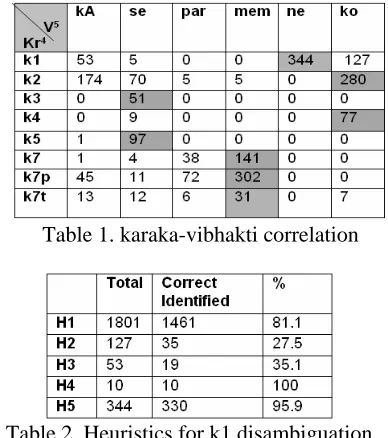
We found a strong co-relation between most vibhakti-karaka occurrences (shaded cells in Table 1). k7 (‘place’) for example, overwhelmingly takes
mem post-position, k3 (karana) takes se in all the cases. Of course, there are some competing rela-tions which show preference for the same post-position. In such cases only the post-position in-formation will not be sufficient and we need to take into account other syntactic cues as well. These syntactic cues can be TAM (tense, aspect and modality) of the verb, verb class information, etc. For example, in case of karata karaka (k1), the following heuristics help resolve the ambiguities seen in Table 1. These heuristics are applied se-quentially, i.e. if the first fails then the next follows. Note that the heuristics mentioned below are meant only for illustrative purpose. The cues mentioned in the heuristics will finally be used as features by an efficient ML technique to automate the task of annotation.
H1: k1 agrees in gender, number and person with the verb if it takes a nominative case, H2: k1 takes a ko case-marker if the TAM of the verb has nA,
H3: It takes a kaa/ke/ki if the verb is infinitive, H4: It takes a se or dvaara if the TAM of the verb is passive
H5: It takes a ne case-marker if the verb is tran-sitive and the TAM is perfective
Table-2 shows the results when the heuristics were tested on the annotated corpus to test their effectiveness.
Table 1. karaka-vibhakti correlation
Table 2. Heuristics for k1 disambiguation
The field ‘Total’ in Table-2 gives us the number of instances where a particular heuristic was ap-plied. For example, there were 1801 instances where k1 appeared in a nominative case and H1 correctly identified 1461 instances. H1 failed due to the errors caused by the morphological analyzer, presence of conjuncts, etc. Of particular interest are H2 and H3 which didn’t work out for large number of cases. It turns out that H2 failed for what is understood in the literature as dative sub-jects. Dative subjects occur with some specific verbs, one possible solution could be to use such verbs for disambiguation. Automatic identification of conjunct verbs is a difficult problem; in fact, there isn’t any robust linguistic test which can be
4
karaka relations (see,
used to identify such verbs. Similar heuristics can be proposed for disambiguating other karakabased on some syntactic cues. Based on the above results one can safely conclude that arriving at some ro-bust generalization (like, karaka-vibhakti correla-tion) based on the syntactic cues is in fact possible. This can help us immensely in building an efficient parser for Hindi (and other ILs). It goes without saying that there exists a lot of scope for automat-ing the annotation task.
7
Conclusion
In this paper we have introduced an ongoing effort to annotate Indian languages with dependency rela-tion. We stated the motivation behind following the Paninian framework in the Indian Language scenario. We discussed the basic scheme along with some new relations such as ccof, POF, etc. We also showed the results of some experiments conducted on the annotated data which showed that there is a strong co-relation between vibhakti-karaka relations.
Acknowledgement
Thanks are due to Prof. Ramakrishnamacharyulu who has been guiding us throughout the develop-ment of the proposed scheme.
References
Akshar Bharati and Rajeev Sangal. 1993. Parsing Free Word Order Languages in the Paninian Framework,
ACL93: Proc. of Annual Meeting of Association for Computational Linguistics.
Akshar Bharati, Vineet Chaitanya and Rajeev Sangal. 1995. Natural Language Processing: A Paninian Perspective, Prentice-Hall of India, New Delhi, pp. 65-106.
Akshar Bharati, Rajeev Sangal, T Papi Reddy. 2002. A Constraint Based Parser Using Integer Programming, In Proc. of ICON-2002: International Conference on Natural Language Processing, 2002.
Cristina Bosco and V. Lombardo. 2004. Dependency and relational structure in treebank annotation. In
Proceedings of Workshop on Recent Advances in Dependency Grammar at COLING'04.
S. Brants, S. Dipper, S. Hansen, W. Lezius and G. Smith. 2002. The TIGER Treebank. In Proceedings of the Workshop on Treebanks and Linguistic Theo-ries.
M. Butt. 2004. The Light Verb Jungle. In G. Aygen, C. Bowern & C. Quinn eds. Papers from the GSAS/Dudley House Workshop on Light Verbs.
Cambridge, Harvard Working Papers in Linguistics, p. 1-50.
Edwin Greaves. 1983. Hindi Grammar. Asian Educa-tional Services, New Delhi, pp. 335-340
E. Hajicova. 1998. Prague Dependency Treebank: From Analytic to Tectogrammatical Annotation. In Proc. TSD’98.
R. Hudson. 1984. Word Grammar, Basil Blackwell, 108 Cowley Rd, Oxford, OX4 1JF, England.
S. H. Kellogg. 1972. A Grammar of the Hindi Language.
Munshiram Manoharlal, New Delhi, pp. 271-279.
P. Kiparsky and J. F. Staal. 1969. ‘Syntactic and Rela-tions in Panini’, Foundations of Language 5, 84-117.
M. Marcus, B. Santorini, and M.A. Marcinkiewicz. 1993. Building a large annotated corpus of English: The Penn Treebank, Computational Linguistics1993.
I. A. Mel'cuk. 1988. Dependency Syntax: Theory and Practice, State University, Press of New York.
K. P. Mohanan. 1982. Grammatical relations in Malaya-lam, In Joan Bresnan (ed.), The Mental Representa-tion of Grammatical RelaRepresenta-tions, MIT Press, Cam-bridge.
Tara Mohanan, 1994. Arguments in Hindi. CSLI Publi-cations.
M. Pedersen, D. Eades, S. K. Amin, and L. Prakash. 2004.Relative Clauses in Hindi andArabic: A Pan-inian Dependency Grammar Analysis. In COLING 2004 Recent Advances in Dependency Grammar,
pages 9–16. Geneva, Switzerland.
O. Rambow, C. Creswell, R. Szekely, H. Taber, and M. Walker. 2002. A dependencytreebank for English. In
Proceedings of the 3rd International Conference on Language Resources and Evaluation.
Anil Kumar Singh. 2006.
http://sourceforge.net/projects/nlp-sanchay
Charudev Shastri. 1973. Vyakarana Chandrodya (Vol. 1 to 5). Delhi: Motilal Banarsidass. (In Hindi)
S. M. Shieber. 1985. Evidence against the context-freeness of natural language. In Linguistics and Phi-losophy, p. 8, 334–343.
L. Tesnière. 1959. Eléments de Syntaxe Structurale. Klincksiek, Paris.