Minimally Supervised Learning of Semantic Knowledge
from Query Logs
Mamoru Komachi Hisami Suzuki
Nara Institute of Science and Technology Microsoft Research
8916-5 Takayama One Microsoft Way
Ikoma, Nara 630-0192, Japan Redmond, WA 98052 USA
[email protected] [email protected]Abstract
We propose a method for learning semantic categories of words with minimal supervi-sion from web search query logs. Our me-thod is based on the Espresso algorithm (Pantel and Pennacchiotti, 2006) for ex-tracting binary lexical relations, but makes important modifications to handle query log data for the task of acquiring semantic categories. We present experimental results comparing our method with two state-of-the-art minimally supervised lexical know-ledge extraction systems using Japanese query log data, and show that our method achieves higher precision than the pre-viously proposed methods. We also show that the proposed method offers an addi-tional advantage for knowledge acquisition in an Asian language for which word seg-mentation is an issue, as the method utiliz-es no prior knowledge of word segmenta-tion, and is able to harvest new terms with correct word segmentation.
1
Introduction
Extraction of lexical knowledge from a large col-lection of text data with minimal supervision has become an active area of research in recent years. Automatic extraction of relations by exploiting recurring patterns in text was pioneered by Hearst (1992), who describes a bootstrapping procedure for extracting words in the hyponym (is-a) relation, starting with three manually given lexico-syntactic patterns. This idea of learning with a minimally supervised bootstrapping method using surface text patterns was subsequently adopted for many tasks, including relation extraction (e.g., Brin, 1998;
Ri-loff and Jones, 1999; Pantel and Pennacchiotti, 2006) and named entity recognition (e.g., Collins and Singer, 1999; Etzioni et al., 2005).
In this paper, we describe a method of learning semantic categories of words using a large collec-tion of Japanese search query logs. Our method is based on the Espresso algorithm (Pantel and Pen-nacchiotti, 2006) for extracting binary lexical rela-tions, adapting it to work well on learning unary relations from query logs. The use of query data as a source of knowledge extraction offers some unique advantages over using regular text.
Web search queries capture the interest of search users directly, while the distribution of the Web documents do not necessarily reflect the distri-bution of what people search (Silverstein et al., 1998). The word categories acquired from query logs are thus expected to be more useful for the tasks related to search.
Though user-generated queries are often very short, the words that appear in queries are gen-erally highly relevant for the purpose of word classification.
Many search queries consist of keywords, which means that the queries include word segmenta-tion specified by users. This is a great source of knowledge for learning word boundaries for those languages whose regularly written text does not indicate word boundaries, such as Chi-nese and JapaChi-nese.
contextual patterns from English query logs. Our work is different in that it does not require a full-scale list of categorized named entities but a small number of seed words, and iterates over the data to extract more patterns and instances. Recent work by Paşca (2007) and Paşca and Van Durme (2007) also uses English query logs to extract lexical knowledge, but their focus is on learning attributes for named entities, a different focus from ours.
2
Related Work
In this section, we describe three state-of-the-art algorithms of relation extraction, which serve as the baseline for our work. They are briefly summa-rized in Table 1. The goal of these algorithms is to learn target instances, which are the words belong-ing to certain categories (e.g., cat for the Animal class), or in the case of relation extraction, the pairs of words standing in a particular relationship (e.g., pasta::food for is-a relationship), given the context patterns for the categories or relation types found in source data.
2.1 Pattern Induction
The first step toward the acquisition of instances is to extract context patterns. In previous work, these are surface text patterns, e.g., X such as Y, for ex-tracting words in an is-a relation, with some heu-ristics for finding the pattern boundaries in text. As we use query logs as the source of knowledge, we simply used everything but the instance string in a query as the pattern for the instance, in a manner similar to Paşca et al. (2006). For example, the seed word JAL in the query “JAL+flight_schedule” yields the pattern "#+flight_schedule".1 Note that we perform no word segmentation or boundary detection heuristics in identifying these patterns, which makes our approach fast and robust, as the
1 # indicates where the instance occurs in the query
string, and + indicates a white space in the original Jap-anese query. The underscore symbol (_) means there was originally no white space; it is used merely to make the translation in English more readable.
2
segmentation errors introduce noise in extracted patterns, especially when the source data contains many out of vocabulary items.
The extracted context patterns must then be as-signed a score reflecting their usefulness in extract-ing the instances of a desired type. Frequency is a poor metric here, because frequent patterns may be extremely generic, appearing across multiple cate-gories. Previously proposed methods differ in how to assign the desirability scores to the patterns they find and in using the score to extract instances, as well as in the treatment of generic patterns, whose precision is low but whose recall is high.
2.2 Sekine and Suzuki (2007)’s Algorithm
For the purpose of choosing the set of context pat-terns that best characterizes the categories, Sekine and Suzuki (2007) report that none of the conven-tional co-occurrence metrics such as tf.idf, mutual information and chi-squared tests achieved good results on their task, and propose a new measure, which is based on the number of different instances of the category a context c co-occurs with, lized by its token frequency for all categories:
C c g f c Score type
) ( log )
(
) 1000 (
) 1000 (
) ( ) ( ) (
ctop F ctop
f C
c F c f c g
inst type
inst type
where ftype is the type frequency of instance terms
that c co-occurs with in the category, Finst is the
token frequency of context c in the entire data and ctop1000 is the 1000 most frequent contexts. Since they start with a large and reliable named entity dictionary, and can therefore use several hundred seed terms, they simply used the top-k highest-scoring contexts and extracted new named entities once and for all, without iteration. Generic patterns receive low scores, and are therefore ignored by this algorithm.
2.3 The Basilisk Algorithm
Thelen and Riloff (2002) present a framework called Basilisk, which extracts semantic lexicons
# of seed Target # of iteration Corpus Language
Sekine & Suzuki ~600 Categorized NEs 1 Query log English
Basilisk 10 Semantic lexicon ∞ MUC-4 English
Espresso ~10 Semantic relations ∞ TREC English
Tchai 5 Categorized words ∞ Query log Japanese
for multiple categories. It starts with a small set of seed words and finds all patterns that match these seed words in the corpus. The bootstrapping process begins by selecting a subset of the patterns by the RlogF metric (Riloff, 1996):
) log( ) ( log i i i i F N F pattern F
R
where Fi is the number of category members
ex-tracted by patterni and Ni is the total number of
instances extracted by patterni. It then identifies
instances by these patterns and scores each in-stance by the following formula:
i P j j i P F word AvgLog i
1 ) 1 log( ) (where Pi is the number of patterns that extract wordi. They use the average logarithm to select
instances to balance the recall and precision of ge-neric patterns. They add five best instances to the lexicon according to this formula, and the boot-strapping process starts again. Instances are cumu-latively collected across iterations, while patterns are discarded at the end of each iteration.
2.4 The Espresso Algorithm
We will discuss the Espresso framework (Pantel and Pennacchiotti, 2006) in some detail because our method is based on it. It is a general-purpose, minimally supervised bootstrapping algorithm that takes as input a few seed instances and iteratively learns surface patterns to extract more instances. The key to Espresso lies in its use of generic pat-terns: Pantel and Pennacchiotti (2006) assume that correct instances captured by a generic pattern will also be instantiated by some reliable patterns, which denote high precision and low recall pat-terns.
Espresso starts from a small set of seed in-stances of a binary relation, finds a set of surface patterns P, selects the top-k patterns, extracts the highest scoring m instances, and repeats the process. Espresso ranks all patterns in P according to reliability rπ, and retains the top-k patterns for
instance extraction. The value of k is incremented by one after each iteration.
The reliability of a pattern p is based on the in-tuition that a reliable pattern co-occurs with many reliable instances. They use pointwise mutual in-formation (PMI) and define the reliability of a pat-tern p as its average strength of association across
each input instance i in the set of instances I, weighted by the reliability of each instance i:
I i r p i pmi p
r i I pm i
) ( max ) , ( ) ( where rι(i) is the reliability of the instance i and
maxpmi is the maximum PMI between all patterns
and all instances. The PMI between instance i = {x,y} and pattern p is estimated by:
,* *, ,*, , , log ) , ( p y x y p x p i pmi
where x,p,y is the frequency of pattern p instan-tiated with terms x and y (recall that Espresso is targeted at extracting binary relations) and where the asterisk represents a wildcard. They multiplied pmi(i,p) with the discounting factor suggested in Pantel and Ravichandran (2004) to alleviate a bias towards infrequent events.
The reliability of an instance is defined similar-ly: a reliable instance is one that associates with as many reliable patterns as possible.
P p r p i pmi i
r p P pm i
) ( max ) , ( ) ( where rπ(p) is the reliability of pattern p, and P is
the set of surface patterns. Note that rι(i) and rπ(p)
are recursively defined: the computation of the pat-tern and instance reliability alpat-ternates between per-forming pattern reranking and instance extraction. Similarly to Basilisk, instances are cumulatively learned, but patterns are discarded at the end of each iteration.
3
The
Tchai
Algorithm
In this section, we describe the modifications we made to Espresso to derive our algorithm called Tchai.
3.1 Filtering Ambiguous Instances and Pat-terns
once we learn an ambiguous instance such as Po-kemon, it will start collecting patterns for multiple categories (e.g., Game, Animation and Movie), which is not desirable.
In order to control the negative effect of the ge-neric patterns, Espresso introduces a confidence metric, which is similar but separate from the re-liability measure, and uses it to filter out the gener-ic patterns falling below a confidence threshold. In our experiments, however, this metric did not pro-duce a score that was substantially different from the reliability score. Therefore, we did not use a confidence metric, and instead opted for not ing ambiguous instances and patterns, where we define ambiguous instance as one that induces more than 1.5 times the number of patterns of viously accepted reliable instances, and ambiguous (or generic) pattern as one that extracts more than twice the number of instances of previously ac-cepted reliable patterns. As we will see in Section 4, this modification improves the precision of the extracted instances, especially in the early stages of iteration.
3.2 Scaling Factor in Reliability Scores
Another modification to the Espresso algorithm to reduce the power of generic patterns is to use local maxpmi instead of global maxpmi. Since PMI ranges
[–∞, +∞], the point of dividing pmi(i,p) by maxpmi
in Espresso is to normalize the reliability to [0, 1]. However, using PMI directly to estimate the relia-bility of a pattern when calculating the reliarelia-bility of an instance may lead to unexpected results be-cause the absolute value of PMI is highly variable across instances and patterns. We define the local maxpmi of the reliability of an instance to be the
absolute value of the maximum PMI for a given instance, as opposed to taking the maximum for all instances in a given iteration. Local maxpmi of the
reliability of a pattern is defined in the same way. As we show in the next section, this modification has a large impact on the effectiveness of our algo-rithm.
3.3 Performance Improvements
Tchai, unlike Espresso, does not perform the pattern induction step between iterations; rather, it simply recomputes the reliability of the patterns induced at the beginning. Our assumption is that fairly reliable patterns will occur with at least one of the seed instances if they occur frequently
enough in query logs. Since pattern induction is computationally expensive, this modification reduces the computation time by a factor of 400.
4
Experiment
In this section, we present an empirical comparison of Tchai with the systems described in Section 2.
4.1 Experimental Setup
Query logs: The data source for instance extrac-tion is an anonymized collecextrac-tion of query logs submitted to Live Search from January to February 2007, taking the top 1 million unique queries. Que-ries with garbage characters are removed. Almost all queries are in Japanese, and are accompanied by their frequency within the logs.
Target categories: Our task is to learn word cate-gories that closely reflect the interest of web search users. We believe that a useful categorization of words is task-specific, therefore we did not start with any externally available ontology, but chose to start with a small number of seed words. For our task, we were given a list of 23 categories relevant for web search, with a manual classification of the 10,000 most frequent search words in the log of December 2006 (which we henceforth refer to as the 10K list) into one of these categories.2 For evaluation, we chose two of the categories, Travel and Financial Services: Travel is the largest cate-gory containing 712 words of the 10K list (as all the location names are classified into this category), while Financial Services was the smallest, contain-ing 240 words.
Systems: We compared three different systems described in Section 2 that implement an iterative algorithm for lexical learning:
2 The manual classification assigns only one category
per word, which is not optimal given how ambiguous the category memberships are. However, it is also very difficult to reliably perform a multi-class categorization by hand.
Category Seeds (with English translation) Travel jal, ana, jr, じゃらん(jalan), his
[image:4.612.312.539.72.135.2]Finance みずほ銀行(Mizuho Bank), 三井住友銀 行(SMBC), jcb, 新 生 銀 行(Shinsei Bank), 野村證券(Nomura Securities)
Table 2: Seed instances for Travel and Financial
Basilisk: The algorithm by (Thelen and Riloff, 2002) described in Section 2.
Espresso: The algorithm by (Pantel and Pennac-chiotti, 2006) described in Sections 2 and 3.
Tchai: The Tchai algorithm described in this paper.
For each system, we gave the same seed instances. The seed instances are the 5 most frequent words belonging to these categories in the 10K list; they are given in Table 2. For the Travel category, “jal” and “ana” are airline companies, “jr” stand for Ja-pan Railways, “jalan” is an online travel informa-tion site, and “his” is a travel agency. In the Finance category, three of them are banks, and the other two are a securities company and a credit card firm. Basilisk starts by extracting 20 patterns, and adds 100 instances per iteration. Espresso and Tchai start by extracting 5 patterns and add 200 instances per iteration. Basilisk and Tchai iterated 20 times, while Espresso iterated only 5 times due to computation time.
4.2 Results
4.2.1 Results of the Tchai algorithm
Tables 3 and 4 are the results of the Tchai algo-rithm compared to the manual classification. Table 3 shows the results for the Travel category. The precision of Tchai is very high: out of the 297 words classified into the Travel domain that were also in the 10K list, 280 (92.1%) were learned rectly.3 It turned out that the 17 instances that
3
As the 10K list contained 712 words in the Travel cat-egory, the recall against that list is fairly low (~40%). The primary reason for this is that all location names are classified as Travel in the 10K list, and 20 iterations are
represent the precision error were due to the ambi-guity of hand labeling, as in東京ディズニーランド „Tokyo Disneyland‟, which is a popular travel des-tination, but is classified as Entertainment in the manual annotation. We were also able to correctly learn 251 words that were not in the 10K list ac-cording to manual verification; we also harvested 125 new words “incorrectly” into the Travel do-main, but these words include common nouns re-lated to Travel, such as 釣り „fishing‟ and レンタカ ー „rental car‟. Results for the Finance domain show a similar trend, but fewer instances are ex-tracted.
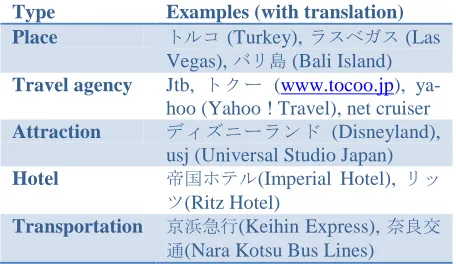
Sample instances harvested by our algorithm
are given in Table 5. It includes subclasses of tra-vel-related terms, for some of which no seed words were given (such as Hotels and Attractions). We also note that segmentation errors are entirely ab-sent from the collected terms, demonstrating that query logs are in fact excellently suited for acquir-ing new words for languages with no explicit word segmentation in text.
4.2.2 Comparison with Basilisk and Espresso
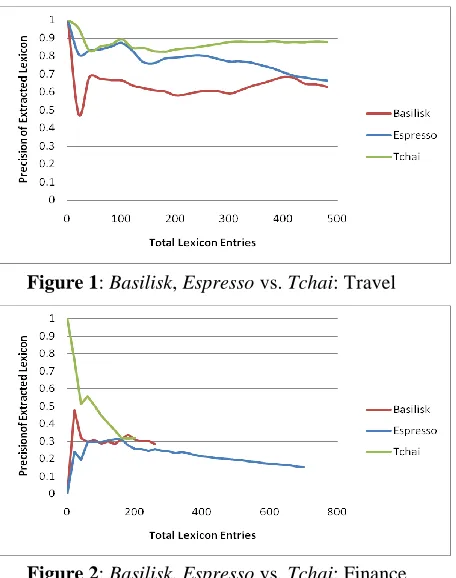
Figures 1 and 2 show the precision results compar-ing Tchai with Basilisk and Espresso for the Travel and Finance categories. Tchai outperforms Basilisk and Espresso for both categories: its precision is constantly higher for the Travel category, and it achieves excellent precision for the Finance cate-gory, especially in early iterations. The differences in behavior between these two categories are due to the inherent size of these domains. For the
not enough to enumerate all frequent location names. Another reason is that the 10K list consists of queries but our algorithm extracts instances – this sometimes causes a mismatch, e.g.,Tchai extractsリッツ „Ritz‟ but the 10K list contains リッツホテル „Ritz Hotel‟. 10K list Not in
10K list Travel Not Travel
[image:5.612.71.291.82.225.2]Travel 280 17 251 Not Travel 0 7 125
Table 3: Comparison with manual annotation:
Travel category
10K list Not in 10K list Finance Not Finance
Finance 41 30 30 Not Finance 0 5 99
Table 4: Comparison with manual annotation:
Financial Services category
Type Examples (with translation) Place トルコ (Turkey), ラスベガス(Las
Vegas), バリ島 (Bali Island) Travel agency Jtb, ト ク ー (www.tocoo.jp),
ya-hoo (Yaya-hoo ! Travel), net cruiser Attraction ディズニーランド (Disneyland),
usj (Universal Studio Japan) Hotel 帝国ホテル(Imperial Hotel), リッ
ツ(Ritz Hotel)
[image:5.612.313.541.253.385.2]Transportation 京浜急行(Keihin Express), 奈良交 通(Nara Kotsu Bus Lines)
smaller Finance category, Basilisk and Espresso both suffered from the effect of generic patterns such as #ホームページ „homepage‟ and #カード „card‟ in early iterations, whereas Tchai did not select these patterns.
[image:6.612.73.301.305.594.2]Figure 1: Basilisk, Espresso vs. Tchai: Travel
Figure 2: Basilisk, Espresso vs. Tchai: Finance
Comparing these algorithms in terms of recall is more difficult, as the complete set of words for each category is not known. However, we can es-timate the relative recall given the recall of another system. Pantel and Ravichandran (2004) defined relative recall as:
|
|
|
|
|
B
P
A
P
C
C
C
C
C
C
R
R
R
B A
B A
B A
B A B
A
where RA|B is the relative recall of system A given
system B, CA and CB are the number of correct
in-stances of each system, and C is the number of true correct instances. CA and CB can be calculated by
using the precision, PA and PB, and the number of
instances from each system. Using this formula, we estimated the relative recall of each system rel-ative to Espresso. Tables 6 and 7 show that Tchai achieved the best results in both precision and rela-tive recall in the Travel domain. In the Finance domain, Espresso received the highest relative call but the lowest precision. This is because Tchai uses a filtering method so as not to select generic patterns and instances.
Table 8 shows the context patterns acquired by different systems after 4 iterations for the Travel domain.4 The patterns extracted by Basilisk are not entirely characteristic of the Travel category. For example, “p#sonic” and “google+#lytics” only match the seed word “ana”, and are clearly irrele-vant to the domain. Basilisk uses token count to estimate the score of a pattern, which may explain the extraction of these patterns. Both Basilisk and Espresso identify location names as context pat-terns (e.g., #東京„Tokyo‟, #九州„Kyushu‟), which may be too generic to be characteristic of the do-main. In contrast, Tchai finds context patterns that are highly characteristic, including terms related to transportation (#+格安航空券 „discount plane tick-et‟, #マイレージ „mileage‟) and accommodation (#+ホテル „hotel‟).
4.2.3 Contributions of Tchai components
In this subsection, we examine the contribution of each modification to the Espresso algorithm we made in Tchai.
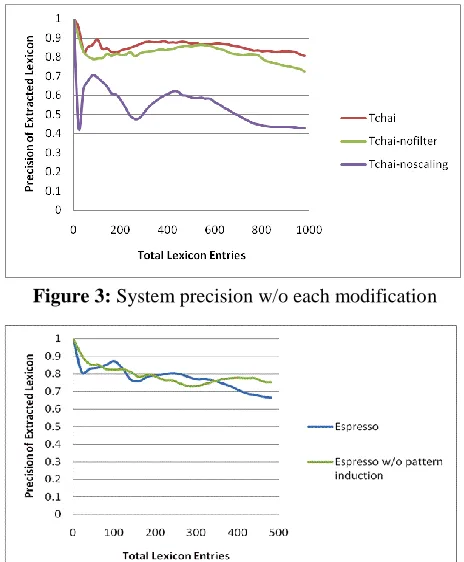
Figure 3 illustrates the effect of each modification proposed for the Tchai algorithm in Section 3 on the Travel category. Each line in the graph corresponds to the Tchai algorithm with and without the modification described in Sections 3.1 and 3.2. It shows that the modification to the maxpmi function (purple) contributes most
signifi-cantly to the improved accuracy of our system. The filtering of generic patterns (green) does not show
4 Note that Basilisk and Espresso use context patterns
only for the sake of collecting instances, and are not interested in the patterns per se. However, they can be quite useful in characterizing the semantic categories they are acquired for, so we chose to compare them here. # of inst. Precision Rel.recall
Basilisk 651 63.4 1.26
Espresso 500 65.6 1.00
Tchai 680 80.6 1.67
Table 6: Precision (%) and relative recall: Tra-vel domain
# of inst. Precision Rel.recall
Basilisk 278 27.3 0.70
Espresso 704 15.2 1.00
Tchai 223 35.0 0.73
a large effect in the precision of the acquired in-stances for this category, but produces steadily bet-ter results than the system without it.
[image:7.612.70.302.366.647.2]Figure 4 compares the original Espresso algo-rithm and the modified Espresso algorithm which performs the pattern induction step only at the be-ginning of the bootstrapping process, as described in Section 3.3. Although there is no significant dif-ference in precision between the two systems, this modification greatly improves the computation time and enables efficient extraction of instances. We believe that our choice of the seed instances to be the most frequent words in the category produc-es sufficient patterns for extracting new instancproduc-es.
Figure 3: System precision w/o each modification
Figure 4: Modification to the pattern induction step
5
Conclusion
We proposed a minimally supervised bootstrap-ping algorithm called Tchai. The main contribution of the paper is to adapt the general-purpose Es-presso algorithm to work well on the task of learn-ing semantic categories of words from query logs. The proposed method not only has a superior per-formance in the precision of the acquired words into semantic categories, but is faster and collects more meaningful context patterns for characteriz-ing the categories than the unmodified Espresso algorithm. We have also shown that the proposed method requires no pre-segmentation of the source text for the purpose of knowledge acquisition.
Acknowledgements
This research was conducted during the first au-thor‟s internship at Microsoft Research. We would like to thank the colleagues at Microsoft Research, especially Dmitriy Belenko and Christian König, for their help in conducting this research.
References
Sergey Brin. 1998. Extracting Patterns and Relations from the World Wide Web. WebDB Workshop at 6th International Conference on Extending Database Technology, EDBT '98. pp. 172-183.
Michael Collins and Yoram Singer. 1999. Unsupervised Models for Named Entity Classification. Proceedings of the Joint SIGDAT Conference on Empirical Me-thods in Natural Language Processing and Very Large Corpora. pp. 100-110.
Oren Etzioni, Michael Cafarella, Dong Downey, Ana-Maria Popescu, Tal Shaked, Stephen Soderland, Da-niel S. Weld, and Alexander Yates. 2005. Unsuper-vised Named-Entity Extraction from the Web: An Experimental Study. Artificial Intelligence. 165(1). pp. 91-134.
Marti Hearst. 1992. Automatic Acquisition of Hypo-nyms from Large Text Corpora. Proceedings of the System Sample Patterns (with English translation)
Basilisk #東日本(east_japan), #西日本(west_japan), p#sonic, #時刻表(timetable), #九州(Kyushu), #+マイレ
ージ(mileage), #バス(bus), google+#lytics, #+料金(fare), #+国内(domestic), #ホテル(hotel)
Espresso #バス(bus), 日本#(Japan), #ホテル(hotel), #道路(road), #イン(inn), フジ#(Fuji), #東京(Tokyo), #料
金(fare), #九州(Kyushu), #時刻表(timetable), #+旅行(travel), #+名古屋(Nagoya)
Tchai #+ホテル(hotel), #+ツアー(tour), #+旅行(travel), #予約(reserve), #+航空券(flight_ticket), #+格安航
空券(discount_flight_titcket), #マイレージ(mileage), 羽田空港+#(HanedaAirport)
[image:7.612.73.301.366.505.2]Fourteenth International Conference on Computa-tional Linguistics. pp 539-545.
Patrick Pantel and Marco Pennacchiotti. 2006. Espresso: Leveraging Generic Patterns for Automatically Har-vesting Semantic Relations. Proceedings of the 21st International Conference on Computational Linguis-tics and the 44th annual meeting of the ACL. pp. 113-120.
Patrick Pantel and Deepak Ravichandran. 2004. Auto-matically Labeling Semantic Classes. Proceedings of Human Language Technology Conference of the North American Chapter of the Association for Com-putational Linguistics (HLT/NAACL-04). pp. 321-328.
Marius Paşca. 2004. Acquisition of Categorized Named Entities for Web Search. Proceedings of the 13th ACM Conference on Information and Knowledge Management (CIKM-04). pp. 137-145.
Marius Paşca. 2007. Organizing and Searching the World Wide Web of Fact – Step Two: Harnessing the Wisdom of the Crowds. Proceedings of the 16th In-ternational World Wide Web Conference (WWW-07). pp. 101-110.
Marius Paşca and Benjamin Van Durme. 2007. What You Seek is What You Get: Extraction of Class Attributes from Query Logs. Proceedings of the 20th International Joint Conference on Artificial Intelli-gence (IJCAI-07). pp. 2832-2837.
Marius Paşca, Dekang Lin, Jeffrey Bigham, Andrei Lif-chits and Alpa Jain. 2006. Organizing and Searching the World Wide Web of Facts – Step One: the One-Million Fact Extraction Challenge. Proceedings of the 21st National Conference on Artificial Intelli-gence (AAAI-06). pp. 1400-1405.
Ellen Riloff. 1996. Automatically Generating Extraction Patterns from Untagged Text. Proceedings of the Thirteenth National Conference on Artificial Intelli-gence. pp. 1044-1049.
Ellen Riloff and Rosie Jones. 1999. Learning Dictiona-ries for Information Extraction by Multi-Level Boot-strapping. Proceedings of the Sixteenth National Conference on Artificial Intellligence (AAAI-99). pp. 474-479.
Satoshi Sekine and Hisami Suzuki. 2007. Acquiring Ontological Knowledge from Query Logs. Proceed-ings of the 16th international conference on World Wide Web. pp. 1223-1224.
Craig Silverstein, Monika Henzinger, Hannes Marais, and Michael Moricz. 1998. Analysis of a Very Large AltaVista Query Log. Digital SRC Technical Note #1998-014.