Multilingual Extension of a Temporal Expression Normalizer using
Annotated Corpora
E. Saquete P. Mart´ınez-Barco R. Mu ˜noz gPLSI
DLSI. UA Alicante, Spain
fstela,patricio,[email protected]
M. Negri M. Speranza ITC-irst
Povo (TN), Italy
fnegri,[email protected]
R. Sprugnoli CELCT Trento, Italy
Abstract
This paper presents the automatic exten-sion to other languages of TERSEO, a knowledge-based system for the recogni-tion and normalizarecogni-tion of temporal ex-pressions originally developed for
Span-ish1. TERSEO was first extended to
En-glish through the automatic translation of the temporal expressions. Then, an im-proved porting process was applied to Ital-ian, where the automatic translation of the temporal expressions from English and from Spanish was combined with the ex-traction of new expressions from an
Ital-ian annotated corpus. Experimental
re-sults demonstrate how, while still adher-ing to the rule-based paradigm, the devel-opment of automatic rule translation pro-cedures allowed us to minimize the ef-fort required for porting to new languages. Relying on such procedures, and without any manual effort or previous knowledge of the target language, TERSEO recog-nizes and normalizes temporal expressions in Italian with good results (72% precision and 83% recall for recognition).
1 Introduction
Recently, the Natural Language Processing com-munity has become more and more interested in developing language independent systems, in the effort of breaking the language barrier hampering their application in real use
scenar-ios. Such a strong interest in
multilingual-ity is demonstrated by the growing number of
1This research was partially funded by the Spanish
Gov-ernment (contract TIC2003-07158-C04-01)
international conferences and initiatives plac-ing systems’ multilplac-ingual/cross-language capabil-ities among the hottest research topics, such as
the European Cross-Language Evaluation Forum2
(CLEF), a successful evaluation campaign which aims at fostering research in different areas of multilingual information retrieval. At the same time, in the temporal expressions recognition and normalization field, systems featuring
multilin-gual capabilities have been proposed. Among
others, (Moia, 2001; Wilson et al., 2001; Negri and Marseglia, 2004) emphasized the potentiali-ties of such applications for different information retrieval related tasks.
As many other NLP areas, research in auto-mated temporal reasoning has recently seen the emergence of machine learning approaches trying to overcome the difficulties of extending a lan-guage model to other lanlan-guages (Carpenter, 2004; Ittycheriah et al., 2003). In this direction, the out-comes of the first Time Expression Recognition
and Normalization Workshop (TERN 20043)
pro-vide a clear indication of the state of the field. In spite of the good results obtained in the
recog-nition task, normalization by means of machine
learning techniques still shows relatively poor re-sults with respect to rule-based approaches, and still remains an unresolved problem.
The difficulty of porting systems to new lan-guages (or domains) affects both rule-based and machine learning approaches. With rule-based ap-proaches (Schilder and Habel, 2001; Filatova and Hovy, 2001), the main problems are related to the fact that the porting process requires rewriting from scratch, or adapting to each new language, large numbers of rules, which is costly and
time-2
http://www.clef-campaign.org/
consuming work. Machine learning approaches (Setzer and Gaizauskas, 2002; Katz and Arosio, 2001), on the other hand, can be extended with little human intervention through the use of lan-guage corpora. However, the large annotated cor-pora that are necessary to obtain high performance are not always available. In this paper we describe a new procedure to build temporal models for new languages, starting from previously defined ones. While still adhering to the rule-based paradigm, its main contribution is the proposal of a simple, but effective, methodology to automate the porting of a system from one language to another. In this pro-cedure, we take advantage of the architecture of an existing system developed for Spanish (TERSEO, see (Saquete et al., 2005)), where the recognition model is language-dependent but the normalizing procedure is completely independent. In this way, the approach is capable of automatically learning the recognition model by adjusting the set of nor-malization rules.
The paper is structured as follows: Section 2 provides a short overview of TERSEO; Section 3 describes the automatic extension of the system to Italian; Section 4 presents the results of our evalu-ation experiments, comparing the performance of Ita-TERSEO (i.e. our extended system) with the performance of a state of the art system for Italian.
2 The TERSEO system architecture
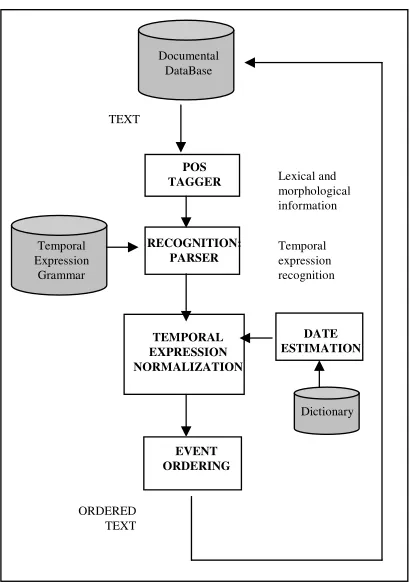
TERSEO has been developed in order to automat-ically recognize temporal expressions (TEs) ap-pearing in a Spanish written text, and normalize them according to the temporal model proposed in (Saquete, 2005), which is compatible with the ACE annotation standards for temporal expres-sions (Ferro et al., 2005). As shown in Figure 1, the first step (recognition) includes pre-processing of the input texts, which are tagged with lexical and morphological information that will be used
as input to the temporal parser. The temporal
parser is implemented using an ascending tech-nique (chart parser) and is based on a temporal grammar. Once the parser has recognized the TEs in an input text, these are passed to the normaliza-tion unit, which updates the value of the reference according to the date they refer to, and generates the XML tags for each expression.
As TEs can be categorized as explicit and im-plicit, the grammar used by the parser is tuned for discriminating between the two groups. On the
TEXT
POS TAGGER
RECOGNITION: PARSER
Lexical and morphological information
Temporal expression recognition
DATE ESTIMATION
Dictionary Temporal
Expression Grammar
TEMPORAL EXPRESSION NORMALIZATION
EVENT ORDERING
ORDERED TEXT
Documental DataBase
Figure 1: Graphic representation of the TERSEO architecture.
one hand, explicit temporal expressions directly provide and fully describe a date which does not require any further reasoning process to be inter-preted (e.g. “1st May 2005”, “05/01/2005”). On the other hand, implicit (or anaphoric) time ex-pressions (e.g. “yesterday”, “three years later”) require some degree of reasoning (as in the case of anaphora resolution). In order to translate such expressions into explicit dates, such reasoning ca-pabilities consider the information provided by the lexical context in which they occur (see (Saquete, 2005) for a thorough description of the reasoning techniques used by TERSEO).
2.1 Recognition using a temporal expression parser
The parser uses a grammar based on two differ-ent sets of rules. The first set of rules is in charge of date and time recognition (i.e. explicit dates, such as “05/01/2005”). For this type of TEs, the grammar adopted by TERSEO recognizes a large number of date and time formats (see Table 1 for some examples).
fecha! dd+‘/’+mm+‘/’+(yy)yy (12/06/1975)
(06/12/1975)
fecha! dd+‘-’+mes+‘-’+(yy)yy (12-junio-1975)
(12-Jun.-1975)
fecha! dd+‘de’+mm+‘de’+(yy)yy (12 de junio de 1975)
Table 1: Sample of rules for Explicit Dates Recognition.
reference! ‘ayer’ (yesterday)
Implicit dates reference! ‘ma˜nana’ (tomorrow)
referring to Document Date reference! ‘anteayer’ (the day before yesterdary)
Concrete reference! ‘el pr´oximo d´ıa’ (the next day)
Implicit Dates reference! ‘un mes despu´es’ (a month later)
Previous Date Period reference! num+‘a˜nos despu´es’(num years later)
Imp. Dates Prev.Date Concrete reference! ‘un d´ıa antes’ (a day before)
Implicit Dates reference! ‘d´ıas despu´es’ (some days later)
Previous Date Fuzzy reference! ‘d´ıas antes’ (some days before)
Table 2: Sample of rules for Implicit Dates recognition.
i.e. TEs that need to be related to an explicit TE to be interpreted. These can be divided into time adverbs (e.g. “yesterday”, “tomorrow”), and nom-inal phrases that are referring to temporal relation-ships (e.g. “three years later”, “the day before”). Table 2 shows some of the rules used for the de-tection of these kinds of references.
2.2 Normalization
When the system finds an explicit temporal ex-pression, the normalization process is direct as no resolution of the expression is necessary. For im-plicit expressions, an inference engine that inter-prets every reference previously found in the input text is used. In some cases references are solved using the newspaper’s date (FechaP). Other TEs have to be interpreted by referring to a date named before in the text that is being analyzed (FechaA). In these cases, a temporal model that allows the system to determine the reference date over which the dictionary operations are going to be done, has been defined. This model is based on the follow-ing two rules:
1. The newspaper’s date, when available, is used as a base temporal referent by default; otherwise, the current date is used as anchor.
2. In case a non-anaphoric TE is found, it is stored as FechaA. This value is updated ev-ery time a non-anaphoric TE appears in the text.
Table 3 shows some of the entries of the dictio-nary used in the inference engine.
3 Extending TERSEO: from Spanish and English to Italian
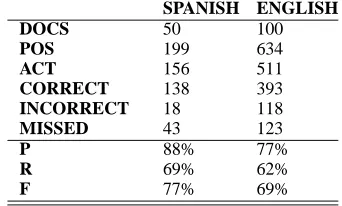
As stated before, the main purpose of this paper is to describe a new procedure to automatically build temporal models for new languages, starting from previously defined models. In our case, an English model has been automatically obtained from the Spanish one through the automatic translation of the Spanish temporal expressions to English. The resulting system for the recognition and normal-ization of English TEs obtains good results both in terms of precision (P) and recall (R) (Saquete et al., 2004). The comparison of the results between the Spanish and the English system is shown in Table 4.
SPANISH ENGLISH
DOCS 50 100
POS 199 634
ACT 156 511
CORRECT 138 393 INCORRECT 18 118 MISSED 43 123
P 88% 77%
R 69% 62%
F 77% 69%
Table 4: Comparison between Spanish TERSEO and English TERSEO.
REFERENCE DICTIONARY ENTRY
‘ayer’ Day(FechaP)-1/Month(FechaP)/Year(FechaP)
(yesterday)
‘ma˜nana’ Day(FechaP)+1/Month(FechaP)/Year(FechaP)
(tomorrow)
‘anteayer’ Day(FechaP)-2/Month(FechaP)/Year(FechaP)
(the day before yesterday)
‘el pr´oximo d´ıa’ Day(FechaP)+1/Month(FechaP)/Year(FechaP)
(the next day)
‘un mes despu´es’
[DayI/Month(FechaA)+1/Year(FechaA)--(a month later) DayF/Month(FechaA)+1/Year(FechaA)]
num+‘a˜nos despu´es’ [01/01/Year(FechaA)+num
--(num years later) 31/12/Year(FechaA)+num]
‘un d´ıa antes’ Day(FechaA)-1/Month(FechaA)/Year(FechaA)
(a day before)
‘d´ıas despu´es’ >>>>FechaA
(some days later)
‘d´ıas antes’ <<<<FechaA
(some days before)
Table 3: Normalization rules
manually obtained and evaluated showing high scores for precision (88%), so better results could be expected when it is used. However, in spite of the fact that the English model has shown lower results on precision (77%), the on-line transla-tors between Italian and English have better sults than Spanish to Italian translators. As a re-sult, both models are considered in the following steps for the multilingual extension:
Firstly, a set of Italian temporal expressions
is extracted from an Italian annotated corpus and stored in a database. The selected cor-pus is the training part of I-CAB, the Ital-ian Content Annotation Bank (Lavelli et al., 2005). More detailed information about I-CAB is provided in Section 4.
Secondly, the resulting set of Italian TEs
must be related to the appropriate normaliza-tion rule. In order to do that, a double transla-tion procedure has been developed. We first translate all the expressions into English and Spanish simultaneously; then, the normaliza-tion rules related to the translated expressions are obtained. If both the Spanish and En-glish expressions are found in their respec-tive models in agreement with the same nor-malization rule, then this rule is also assigned to the Italian expression. Also, when only one of the translated expressions is found in the existing models, the normalization rule
is assigned. In case of discrepancies, i.e. if both expressions are found, but not coincid-ing in the same normalization rule, then one of the languages must be prioritized. As the Spanish model was manually obtained and has shown a higher precision, Spanish rules are preferred. In other cases, the expression is reserved for a manual assignment.
Finally, the set is automatically augmented
using the Spanish and English sets of tem-poral expressions. These expressions were also translated into Italian by on-line
ma-chine translation systems (Spanish-Italian4,
English-Italian5). In this case, a filtering
module is used to guarantee that all the
ex-pressions were correctly translated. This
module searches the web with Google6 for
the translated expression. If the expression is not frequently found, then the translation is abandoned. After that, the new Italian ex-pression is included in the model, and related to the same normalization rule assigned to the Spanish or English temporal expression.
The entire translation process has been com-pleted with an automatic generalization process, oriented to obtain generalized rules from the con-crete cases that have been collected from the
cor-4
http://www.tranexp.com:2000/Translate/result.shtml
5
http://world.altavista.com/
pus. This generalization process has a double ef-fect. On the one hand, it reduces the number of recognition rules. On the other hand, it allows the system to identify new expressions that were not previously learned. For instance, the expression
“Dieci mesi dopo” (i.e. “Ten months later”) could
be recognized if the expression “Nove mesi dopo” (i.e. Nine months later) was learned.
The multilingual extension procedure (Figure 3) is carried out in three phases:
Spanish Temporal Recognition Model
Spanish
Spanish--ItalianItalian
TRANSLATOR
TRANSLATOR
TEs
TEsFILTERFILTER
KEYWORDS
KEYWORDS UnitUnit
NEW
ITALIAN TEsTEs
GRAMATICS
English--ItalianItalian
TRANSLATOR
TRANSLATOR
Italian
Italian--SpanishSpanish
TRANSLATOR
TRANSLATOR
Italian
Italian--EnglishEnglish
TRANSLATOR
Figure 2: Multilingual extension procedure.
Phase 1: TE Collection. During this phase,
the Italian temporal expressions are col-lected from I-CAB (Italian Content Annota-tion Bank), and the automatically translated Italian TEs are derived from the set of Span-ish and EnglSpan-ish TEs. In this case, the TEs are filtered removing those not being found by Google.
Phase 2: TE Generalization. In this phase,
the TEs Gramatics Generator uses the mor-phological and syntactical information from the collected TEs to generate the grammat-ical rules that generalize the recognition of the TEs. Moreover, the keyword unit is able to extract the temporal keywords that will be used to build new TEs. These keywords are augmented with their synonyms in WordNet (Vossen, 2000) to generate new TEs.
Phase 3: TE Normalizing Rule Assignment.
In the last phase, the translators are used to relate the recognizing rule to the appropriate normalization rule. For this purpose, the sys-tem takes advantage of the previously defined Spanish and English temporal models.
4 Evaluation
The automatic extension of the system to Italian (Ita-TERSEO) has been evaluated using I-CAB, which has been divided in two parts: training and test. The training part has been used, first of all, in order to automatically extend the system. Af-ter this extension, the system was evaluated both against the training and the test corpora. The pur-pose of this double evaluation experiment was to compare the recall obtained over the training cor-pus with the value obtained over the test corcor-pus.
An additional evaluation experiment has also been carried out in order to compare the perfor-mance of the automatically developed system with a state of the art system specifically developed for Italian and English, i.e. the Chronos system de-scribed in (Negri and Marseglia, 2004).
In the following sections, more details about I-CAB and the evaluation process are presented, to-gether with the evaluation results.
4.1 The I-CAB Corpus
The evaluation has been performed on the tem-poral annotations of I-CAB (I-CAB-temp)
cre-ated as part of the three-year project ONTOTEXT7
funded by the Provincia Autonoma di Trento.
I-CAB consists of 525 news documents
taken from the local newspaper L’Adige
(http://www.adige.it). The selected news
sto-ries belong to four different days (September, 7th and 8th 2004 and October, 7th and 8th 2004) and are grouped into five categories: News Stories, Cultural News, Economic News, Sports News and Local News. The corpus consists of around 182,500 words (on average 347 words per file). The total number of annotated temporal expres-sions is 4,553; the average length of a temporal expression is 1.9 words.
The annotation of I-CAB has been carried out adopting the standards developed within the ACE
program (Automatic Content Extraction8) for the
Time Expressions Recognition and Normalization
7
http://tcc.itc.it/projects/ontotext
tasks, which allows for a semantically rich and normalized annotation of different types of tempo-ral expressions (for further details on the TIMEX2 annotation standard for English see (Ferro et al., 2005)).
The ACE guidelines have been adapted to the specific morpho-syntactic features of Italian, which has a far richer morphology than English. In particular, some changes concerning the exten-sion of the temporal expresexten-sions have been
in-troduced. According to the English guidelines,
in fact, definite and indefinite articles are consid-ered as part of the textual realization of an entity, while prepositions are not. As the annotation is word-based, this does not account for Italian artic-ulated prepositions, where a definite article and a preposition are merged. Within I-CAB, this type of preposition has been included as possible con-stituents of an entity, so as to consistently include all the articles.
An assessment of the inter-annotator agreement based on the Dice coefficient has shown that the task is a well-defined one, as the agreement is 95.5% for the recognition of temporal expressions.
4.2 Evaluation process
The evaluation of the automatic extension of TERSEO to Italian has been performed in three steps. First of all, the system has been evaluated both against the training and the test corpora with two main purposes:
Determining if the recall obtained in the
eval-uation of the training part of the corpus is a bit higher than the one obtained in the eval-uation of the test part of I-CAB, due to the fact that in the TE collection phase of the ex-tension, temporal expressions were extracted from this part of the corpus.
Determining the performance of the
automat-ically extended system without any manual revision of both the Italian translations and the resolution rules automatically related to the expressions.
Secondly, we were also interested in verifying if the performance of the system in terms of pre-cision could be improved through a manual revi-sion of the automatically translated temporal ex-pressions.
Finally, a comparison with a state of the art sys-tem for Italian has been carried out in order to
es-timate the real potentialities of the proposed ap-proach. All the evaluation results are compared and presented in the following sections using the same metrics adopted at the TERN2004 confer-ence.
4.2.1 Evaluation of Ita-TERSEO
In the automatic extension of the system, a to-tal of 1,183 Ito-talian temporal expressions have been stored in the database. As shown in Table 5, these expressions have been obtained from the different resources available:
ENG ITA: This group of expressions has
been obtained from the automatic translation into Italian of the English Temporal Expres-sions stored in the knowledge DB.
ESP ITA: This group of expressions has been
obtained from the automatic translation into Italian of the Spanish Temporal Expressions stored in the knowledge DB.
CORPUS: This group of expressions has
been extracted directly from the training part of the I-CAB corpus.
Source N % ENG ITA 593 50.1 ESP ITA 358 30.3 CORPUS 232 19.6 TOTAL TEs 1183 100.0
Table 5: Italian TEs in the Knowledge DB.
Both the training part and the test part of I-CAB have been used for evaluation. The results of cision (P), recall (R) and F-Measure (F) are pre-sented in Table 6, which provides details about the system performance over the general recognition task (timex2), and the different normalization at-tributes used by the TIMEX2 annotation standard. As expected, recall performance over the train-ing corpus is slightly higher. However, although the temporal expressions have been extracted from such corpus, in the automatic process of obtain-ing the normalization rules for these expressions, some errors could have been introduced.
Ita-TERSEO: TRAINING Ita-TERSEO: TEST Chronos: TEST
Tag P R F P R F P R F
timex2 0.694 0.848 0.763 0.726 0.834 0.776 0.925 0.908 0.917 anchor dir 0.495 0.562 0.526 0.578 0.475 0.521 0.733 0.636 0.681 anchor val 0.464 0.527 0.493 0.516 0.424 0.465 0.495 0.462 0.478 set 0.308 0.903 0.459 0.182 1.000 0.308 0.616 0.5 0.552 text 0.265 0.324 0.292 0.258 0.296 0.276 0.859 0.843 0.851 val 0.581 0.564 0.573 0.564 0.545 0.555 0.636 0.673 0.654
Table 6: Results obtained over I-CAB by Ita-TERSEO and Chronos.
due to the fact that in the Italian extension, more temporal expressions have been covered with re-spect to the English extension. In this case, in fact, Ita-TERSEO is not only using the temporal expressions translated from the English or Spanish knowledge database, but also the temporal expres-sions extracted from the training part of I-CAB.
4.2.2 Manual revision of the acquired TEs
A manual revision of the Italian TEs stored in the Knowledge DB has been done in two steps. First of all, the incorrectly translated expressions (from Spanish and English to Italian) were re-moved from the database. A total of 334 sions were detected as wrong translated expres-sions. After this, another revision was performed. In this case, some expressions were modified be-cause the expressions have some minor errors in the translation. 213 expressions were modified in this second revision cycle. Moreover, since pattern constituents in Italian might have different ortho-graphical features (e.g. masculine/feminine, ini-tial vowel/consonant, etc.), new patterns had to be introduced to capture such variants. For exam-ple, as months’ names in Italian could start with a vowel, the temporal expression pattern “nell’-MONTH” has been inserted in the Knowledge DB. After these changes, the total amount of ex-pressions stored in the DB are shown in Table 7.
Source N % ING ITA 416 47.9 ESP ITA 201 23.1 CORPUS 232 26.7 REV MAN 20 2.3 TOTAL TEs 869 100.0
Table 7: Italian TEs in the Knowledge DB after manual revision.
In order to evaluate the system after this manual revision, the training and the test part of I-CAB have been used. However, the results of preci-sion (PREC), recall (REC) and F-Measure were
exactly the same as presented in Table 6. That is not really surprising. The existence of wrong expressions in the knowledge database does not affect the final results of the system, as they will never be used for recognition or resolution. This is because these expressions will not appear in real documents, and are redundant as the correct ex-pression is also stored in the Knowledge DB.
4.2.3 Comparing Italian TERSEO with a language-specific system
Finally, in order to compare Ita-TERSEO with a state of the art system specifically designed for Italian, we chose Chronos (Negri and Marseglia, 2004), a multilingual system for the recognition and normalization of TEs in Italian and English. Like all the other state of the art systems address-ing the recognition/normalization task, Chronos is a rule-based system. From a design point of view, it shares with TERSEO a rather similar ar-chitecture which relies on different sets of rules. These are regular expressions that check for spe-cific features of the input text, such as the pres-ence of particular word senses, lemmas, parts of speech, symbols, or strings satisfying specific predicates. Each set of rules is in charge of
deal-ing with different aspects of the problem. In
particular, a set of around 350 rules is designed for TE recognition and is capable of recogniz-ing with high Precision/Recall rates both explicit and implicit TEs. Other sets of regular expres-sions, for a total of around 700 rules, are used in the normalization phase, and are in charge of handling a specific TIMEX2 attribute (i.e. VAL, SET, ANCHOR VAL, and ANCHOR DIR). The results obtained by the Italian version of Chronos over the test part of I-CAB are shown in the last three columns of Table 6.
in terms of the required time and effort, in the de-velopment of the two systems. While the imple-mentation of the manual one took several months, the porting procedure of TERSEO to Italian is a very fast process that can be accomplished in less than an hour. Second, even if an annotated corpus for a new language is not available, the automatic porting procedure we present still remains feasi-ble. In fact, most of the TEs for a new language that are stored in the Knowledge DB are the result of the translation of the Spanish/English TEs into such a target language. In our case, as shown in Table 5, more than 80% of the acquired Italian TEs result from the automatic translation of the expres-sions already stored in the DB. This makes the pro-posed approach a viable solution which allows for a rapid porting of the system to other languages, while just requiring an on-line translator (note that
the Altavista Babel Fish translator9provides
trans-lations from English to 12 target languages). In light of these considerations, the results obtained by Ita-TERSEO are encouraging.
5 Conclusions
In this paper we have presented an automatic ex-tension of a rule-based approach to TEs recogni-tion and normalizarecogni-tion. The procedure is based on building temporal models for new languages starting from previously defined ones. This proce-dure is able to fill the gap left by machine learning systems that, up to date, are still far from provid-ing acceptable performance on this task. As re-sults illustrate, the proposed methodology (even though with a lower performance with respect to language-specific systems) is a viable and effec-tive solution for a rapid and automatic porting of an existing system to new languages.
References
B. Carpenter. 2004. Phrasal Queries with LingPipe and Lucene. In 13th Text REtrieval Conference, NIST Special Publication. National Institute of Stan-dards and Technology.
L. Ferro, L. Gerber, I. Mani, B. Sundheim, and G. Wil-son. 2005. TIDES 2005 Standard for the annotation of temporal expressions. Technical report, MITRE.
E. Filatova and E. Hovy. 2001. Assigning time-stamps to event-clauses. In ACL, editor, Proceedings of the
2001 ACL Workshop on Temporal and Spatial Infor-mation Processing, pages 88–95, Toulouse, France.
9http://world.altavista.com/
A. Ittycheriah, L.V. Lita, N. Kambhatla, N. Nicolov, S. Roukos, and M. Stys. 2003. Identifying and Tracking Entity Mentions in a Maximum Entropy Framework. In ACL, editor, Proceedings of the
NAACL Workshop WordNet and Other Lexical Re-sources: Applications, Extensions and Customiza-tions.
G. Katz and F. Arosio. 2001. The annotation of tem-poral information in natural language sentences. In ACL, editor, Proceedings of the 2001 ACL
Work-shop on Temporal and Spatial Information Process-ing, pages 104–111, Toulouse, France.
A. Lavelli, B. Magnini, M. Negri, E. Pianta, M. Sper-anza, and R. Sprugnoli. 2005. Italian Content An-notation Bank (I-CAB): Temporal expressions (v. 1.0.): T-0505-12. Technical report, ITC-irst, Trento.
T. Moia. 2001. Telling apart temporal locating adver-bials and time-denoting expressions. In ACL, editor,
Proceedings of the 2001 ACL Workshop on Tempo-ral and Spatial Information Processing, Toulouse,
France.
M. Negri and L. Marseglia. 2004. Recognition and normalization of time expressions: Itc-irst at TERN 2004. Technical report, ITC-irst, Trento.
E. Saquete, P. Mart´ınez-Barco, and R. Mu˜noz. 2004. Evaluation of the automatic multilinguality for time expression resolution. In DEXA Workshops, pages 25–30. IEEE Computer Society.
E. Saquete, R. Mu ˜noz, and P. Mart´ınez-Barco. 2005. Event ordering using terseo system. Data and Knowledge Engineering Journal, page (To be
pub-lished).
E. Saquete. 2005. Temporal information Resolution
and its application to Temporal Question Answer-ing. Phd, Departamento de Lenguages y Sistemas
Inform´aticos. Universidad de Alicante, June.
F. Schilder and C. Habel. 2001. From temporal expres-sions to temporal information: Semantic tagging of news messages. In ACL, editor, Proceedings of the
2001 ACL Workshop on Temporal and Spatial Infor-mation Processing, pages 65–72, Toulouse, France.
A. Setzer and R. Gaizauskas. 2002. On the impor-tance of annotating event-event temporal relations in text. In LREC, editor, Proceedings of the LREC
Workshop on Temporal Annotation Standards, 2002,
pages 52–60, Las Palmas de Gran Canaria,Spain.
P. Vossen. 2000. EuroWordNet: Building a Multilin-gual Database with WordNets in 8 European Lan-guages. The ELRA Newsletter, 5(1):9–10.
G. Wilson, I. Mani, B. Sundheim, and L. Ferro. 2001. A multilingual approach to annotating and extract-ing temporal information. In ACL, editor,
Pro-ceedings of the 2001 ACL Workshop on Temporal and Spatial Information Processing, pages 81–87,