EVALUATION OF OREGANO'S ESSENTIAL OIL
INTERFERENCE IN BIODEGRADABILITY OF
POLY (L-CO-D, LACTIC ACID L) (PLDLA)
Amanda A. Moraes1, Bruna V. Quevedo1, Paulo J. Bálsamo1, Daniel Komatsu1, Maira de L. Rezende1
1 Faculdade de Tecnologia José Crespo Gonzales/Fatec
Sorocaba,SP/Brasil
2 Pontifícia Universidade Católica de São Paulo/PUC
Sorocaba, SP/Brasil
Abstract
Active antimicrobial packaging represents a solution to the problem of food waste due to have, in the matrix of the material with which they were made, substances with bactericidal and fungicidal power. The essential oils, synthesized from plants and condiments, are substances of potential interest for use in these, in this category, we can highlight oregano oil (OEO) for having such proven properties. PLDLA is a biodegradable polymer of environmental interest. The objective of this work is to verify if the incorporation of OEO into the PLDLA matrix influences its biodegradability. The samples of PLDLA, with and without the incorporation of oregano essential oil in different proportions, were submitted to biodegradation tests in simulated soil and characterized by DSC. In the soil biodegradation test PLDLA films incorporated with oregano essential oil showed a faster degradation process than samples containing pure PLDLA, which may be justified by the plasticizing effect promoted by OEO.
Keywords: PLDLA, biodegradation, oregano essential oil, active packaging.
1. Introduction
Packaging is defined as the container that stores a product with the function of protecting it and avoid contact with external agents. In the food sector they also have the function of preventing the product is contaminated by impurities or agents that may modify its physical structure or chemical, making it unfit for consumption.1
Polymeric packaging has gained prominence in recent decades for meeting all storage requirements considered effective by the industry, however, their disposal is still inefficient, causing environmental disturbances resulting from the accumulation of waste and material decomposition. An alternative to minimize the environmental impact caused by improper disposal of polymeric packaging is the use of biodegradable polymers produced from renewable sources.
Active packaging has emerged as a strategy to increase the shelf life of products. For the creation and manufacture of these packages, among them the so-called antimicrobials, a number of technologies are employed to ensure the interaction between and food, thus ensuring that their quality and safety are maintained during their permanence at points of sale. The insertion of additives directly into the material matrix of the active packaging aims to inhibit, reduce or slow the growth of fungi and bacteria by increasing thus the shelf life of the product.2,3
Essential oils are organic, aromatic and volatile compounds whose extraction is made from plants and condiments. They are complex substances and can be composed of more than 60 different components, with two to three components present in larger quantities, define which biological properties will have the greatest effect on oil.4
One of the characteristics of interest of essential oils is the antimicrobial and fungicidal capacity, which would make them able to replace synthetic preservatives in food, thus increasing the shelf life. Studies report satisfactory inhibition of microbial growth through effect bacteriostatic, bactericidal and inhibition of fungal and bacterial growth by oils essentials.5
A prominent species in the process of inhibiting fungi and bacteria is oregano (Origanum vulgare), a condiment widely used in popular cooking, whose main characteristics are components carvacrol, thymol, γ-terpene and p-amine with antimicrobial properties and proven antifungal agents and may have their quantities varying according to the parts of the plant where the oil was extracted or the time or region of the harvest.6
2. Materials
2.1 Obtaining the poly (L-co-D, L lactic acid) copolymer (PLDLA)
PLDLA was obtained by synthesis of poly (L-co-D, L lactic acid) copolymer (PLDLA). L-acid copolymers lactic acid and D, L lactic acid (PLDLA) were prepared by polymerization reaction by opening their rings in a glass ampoule and catalyst is tin 2-ethylhexanoate II, better known as Sn (Oct)2. In the case of synthesis of the copolymer, the monomer / catalyst ratio was optimized to be able to generate the high molar mass PLDLA. The masses of the monomers (L-lactate and D, L lactate, both Sigma-Aldrich) and the catalyst were added to a sealed glass ampoule under vacuum and immersed in an oil bath at 130 °C where they were kept for 72 hours. After this time the polymer was dissolved in chloroform (CHCl3), and
precipitated in methanol (CH3OH). The obtained material was then dried, initially in a desiccator, and then in a vacuum
oven at 45 °C for 8 hours.7
2.2 Essential oil
The essential oil used was Oregano Essential Oil (Origanum vulgare) (OEO) under registration n° 25351.183189 / 2017-11 of the Quinarí brand, extracted, according to the company, under the Steam Drag Extraction Method.
3. Methods
PLDLA films were prepared, with and without OEO. The films were obtained by the solubilization and solvent evaporation method, according to the protocol reported in the literature.8
In order to obtain the pure PLDLA films, the copolymer and sufficient amount of chloroform were homogenized in a beaker, in the ratio of 25 mL of solvent for each 1 gram of polymer. After the total solubilization of the copolymer, a sufficient amount of the solution was poured into a petri dish, sufficient to form the film. The set was transferred to a chapel (Lucadema), where it was kept at room temperature (~25 °C) for 24 hours. After complete drying, the films were removed with the aid of a spatula and packed in hermetically sealed dry containers. PLDLA films containing OEO followed the same procedure. The compositions of the films developed in this work are presented in Table 1.
Table 1: Compositions of the films that will be developed in this project.
Sample Solution (PLDLA+OEO) % (m/m) OEO
1 PLDLA pure 0
2 PLDLA + Oregano oil 2,5
3 PLDLA + Oregano oil 5,0
4 PLDLA + Oregano oil 10,0
5 PLDLA + Oregano oil 15,0
6 PLDLA + Oregano oil 25,0
4. Characterization
4.1 Simulated Soil Biodegradation
The samples were buried separately in containers containing previously prepared soil, simulating the degradation conditions to which the material would be subjected if in a landfill or in nature according to ASTM G 160-03. Every 30 days, the samples were taken, washed, dried at room temperature and weighed. They were then stored in a place isolated from light and at room temperature.
The calculation used to determine the percentage of mass retained is presented in Eq. (1):
Where Mi corresponds to the initial mass for 0 days of exposure and Mf corresponds to the final mass at the date of analysis. After each withdrawal date (30, 60, 90, 120, 150 and 180 days) a new comparison was made.
4.2 Differential Exploratory Calorimetry (DSC)
Exploratory Differential Calorimetry analysis was performed on a TA Instruments DSC Discovery 25 calorimeter. Approximately 10 mg of the polymer was heated from 25 to 200 °C at 10 °C/min., maintained at 200 °C for 5 min., cooled to -50 °C to 30 °C/min., maintained at -50 °C for 5 min and then reheated to 300 °C to 10 °C/min. under N2 purge.
5. Results and Discussions
5.1 Simulated Soil Biodegradation
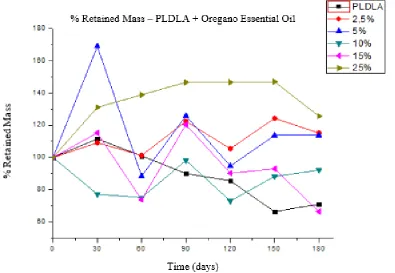
The specimens were removed monthly from the soil (every 30 days), washed, dried and weighed. Figure 1 shows the values for percentage retained mass for samples with and without OEO.
Figure 1: Retained mass of PLDLA samples with and without incorporation of oregano essential oil submitted to simulated soil Biodegradation assay.
Figure 1 shows that pure PLDLA lost, after 180 days, approximately 30% of its initial mass, which may have occurred due to its biodegradability factor and being subjected to water undergoes chemical hydrolysis, successively reducing its molecular weight, thus releasing lactic acid.9
Studies report that the degradation of PLA and its copolymers, in this case PLDLA, occurs slowly and that its degradation process can be interfered by several factors, such as temperature, pH and specific characteristics of the soil used. There are also reports that attribute different degradation kinetics in different geographical locations.11
5.2 Differential Exploratory Calorimetry (DSC)
Table 2 shows Tg values for pure PLDLA and PLDLA samples incorporated with OEO before and after 180 days of degradation.
Table 2: Melt temperature values for pure PLDLA and PLDLA samples incorporated with OEO before, 0 days of degradation, a nd after 180 days of degradation.
Tg (0 days of degradation) Tg (180 days of degradation)
PLDLA 60,5 °C 53 °C
PLDLA + 2,5% OEO 59,18 °C 57,31 °C
PLDLA + 5% OEO 53,01 °C 51,87 °C
PLDLA + 10% OEO 41,41 °C 54,22 °C
PLDLA + 15% OEO 39,98 °C 30,98 °C
PLDLA + 25% OEO 30,42 °C 25,36 °C
Looking at the column for the beginning of the test (0 days), it is possible to notice the decrease of the Tg values of the samples with the increase of the OEO concentration in the films. Similar behavior can be observed in Tg values after 180 days of degradation test. A decrease in melt values is also noted at the end of 180 days of the assay. However, this behavior also suggests that the oil had a plasticizing effect, which may have made the material more flexible. These results corroborate those shown in Figure 1, which illustrates different biodegradation behaviors for different samples. The plasticizing effect may facilitate the absorption of water present in the medium to the polymeric matrix, since the spacing between chains is greater in this case.13,14
6. Conclusions
It can be concluded that OEO, when incorporated into PLDLA films, promotes plasticizing effect, giving more mobility to the polymer chains and making the film more flexible, an aspect that is visibly observed in OEO-containing films, which in turn can confer a slower biodegradation process. Consideration should also be given to the bactericidal property of OEO, which may have interfered with the biodegradation process, as this process depends on the reproduction and survival of soil bacteria.
References
[1] S. Yildirim, B. Rocke in Nanomaterials for Food Packaging, M. A. P. R. Cerqueira, Ed.; Elsevier, Amsterdã, 2018, 173-202. [2] H. Chen, L. Li; M. A. Yichao; T. P. Mcdonald; Y. Wang Food Hydrocoll. 2019, 90, 360-366.
[3] L. R. Braga; F. M. Silva Braz. J. Food Res. 2017, 8, 170-186.
[4] J. L. Ríos in Essential Oils in Food Preservation, Flavor and Safety, V. R. Preedy, Ed.; Academic Press, Massachusetts, 2016, 3-10. [5] G. Lang; G. Buchbauer Flavour Fragr J., 2011, 27, 13.
[6] H. Baydar; O. Sagdiç; G. Ozkan Food Control, 2004,15,169.
[7] T. T. C. Kawanishi, E. C. de Oliveira, M. L. Rezende, Trabalho de Conclusão de Curso, Faculdade de Tecnologia de Sorocaba, 2016. [8] L. F. Wang; J. W. Rhim; S. I. Hong Food Sci. Technol., 2015.
[9] I. M. Rojas, Trabajo Fin de Carrera, Universidad Publica de Navarra, 2010. [10] F. Alexis. Polym Int, 2005, 54, 36-46.
[11] M. Karamanlioglu; R. Preziosi; G. D. Robson Polym Degrad Stabil, 2017, 137, 122-130. [12] M. de L. Rezende, Tese de Mestrado, Universidade São Francisco, 2007.
[13] A.C. Motta; E. A. R. Duek. Polímeros, 2007, 17, 123.
[14] S. F. Hosseini, M. Zand, M. Rezaei, F. Farahmandghavi Carbohydr Polym ,2013, 95, 50-56.
Amanda Alcantara Moraes graduated in Polymer Technology from the Sorocaba Faculty of Technology (FATEC) (2019). Has experience in synthesis of biopolymeric films with the addition of essential oils for application in active biodegradable packaging.
Paulo José Bálsamo graduated in Health Technology from Sorocaba School of Technology (2009), Master in Biological Sciences, Biotechnology and Environmental Monitoring, Federal University of São Carlos - UFSCar (2016). He is currently a PhD student in Biological Sciences, in the area of Biotechnology and Environmental Monitoring, from the Federal University of São Carlos - UFSCar and a student of the Degree in Chemistry, from Universidade Paulista (UNIP). He works as Assistant Professor of Chemistry and Biochemistry at the Sorocaba José Crespo Go nzales Faculty of Technology, accompanying disciplines in the areas of Chemistry and Microbiology of Technology courses in Biomedical Systems and Technology in Polymers. Has experience in the areas of: Biomedical Engineering, with emphasis on Health Technology; Biological Sciences, with emphasis on Environmental Monitoring, terrestrial and aquatic ecotoxicology and Microbiology; Education, with emphasis on Experimental Pedagogical Practic es in the laboratory, acting on the following subjects: Health Technologies, Environment, Environmental Education, Ecotoxicology and Meaningful Learning.
Daniel Komatsu bachelor in Chemistry, with Technological Emphasis, from the University of São Paulo (USP) (2006), Master in Science and Materials Engineering from the University of São Paulo (USP) (2009) and PhD in Sciences, Physical-Chemical Concentration Area , with emphasis on Polymers, at the Department of Chemistry of the Federal University of São Carlos (UFSCar) (2013). He is currently a professor at the Facul ty of Technology of Sorocaba (Fatec) in the course of Polymer Technology and also a researcher at the PUC-SP Biomaterials laboratory, Sorocaba campus.