ISSN 2286-4822 www.euacademic.org
Impact Factor: 3.4546 (UIF) DRJI Value: 5.9 (B+)
School Principal and Leadership Style
MIRELA KARABINA MSc., PhD (candidate) Lecturer, University of Tirana Faculty of Social Sciences, Albania
Abstract:
One of the issues of interest for succesful school management is the form and style of its leadership. This study is an attempt to present an overview of the use of leadership style. The question raised in the study was: "What is the predominant style of leadership in the midlle schools of Tirana city?". The study’s main activity was the description of leadership styles. This is accomplished through critical review of the literature, data collected from questionnaires and interviews. The data obtained supported the hypothesis raised that: "leadership form and style in Tirana schools are among collaborative and consultative style." Style of leadership is recommended to be used according to the situation and care for human relationship oriented and the realization of objectives.
Key words: school leadership, leadership style, collaberative and consultative style.
1. INTRODUCTION AND LITERATURE REVIEW
happening and very good "(Fullan, 2010:9).We have inherited a culture of school leadership, reflecting the development of society from one generation to another. In our practice, the principal is seen as a major figure in our school, but advanced professional experience (Fullan, 2001, 2004, 2010) provides analysis and reports, where the role of principal is crucial at school achievements. The principal must possess several skills, above all, being a good listener, a professional communicator, a clear visionar, an open collaborator and a positive supporter for teachers, students and parents. These skills being used according to situations, determine the leadership form and style. The crucial role of principal related with the above mentioned skills faced with actual problems of our school leadership, were the starting point for this study.
Purpose of the study is leadership style identification prevailing
in the middle schools of Tirana city. Question raise is:What is the predominant style of leadership in in the middle schools of Tirana city?
Interested Audiences. Results and conclusions are important for
education stakeholders to have an overview of leadership form and style used in Tirana city middle schools. These findings might serve as prerequisite for education stakeholders to createing platforms on monitoring constructive leadership and possibilities for intervention strategies
Leadership
leadership calling; leadership and influence. According to Hallinger (2003) leadership should be seen as a mutual process and not just a way to influence one over the others.
Leadership is a relationship “between leaders and followers impactful targeting the real changes and outcomes that reflect their common goal” (Daft, 2005:5). Burns called "leadership as one of the most studied phenomena and less accessible to the earth" (Burns, 1978:2). Leadership is often regarded as a critical point of success or failure of the organization (Bass, 1990). Burke (2008) defines leadership as vision, change, its influence, intuition, and persuasive skills presentative reward people for doing the work and providing opportunities to learn new skills. Yulk defines leadership as a process that carries a person or group over others for structured activities and relationships in the group or organization (cited by Bush, 2013).Hoy&Miskel (2001) define leadership as the art of transformation people and organization in order to improve the organization.
School principal
leadership and school leader is:visionary leadership, visionary leader.
Principal and communication. Aliçka (1998) emphasize the
importance of communication with the staff, orally and written, thus it brings the creation of a positive and effective climate. Communication links (Rapti, 2003) headmaster-teacher developes education progress. Cooperation (Rosenholtz 1986; Elmore 2000) between the headmaster with the teachers is effective and has a great impact to school performance, particularly when the activities for achieving the goals and objectives go into teaching function. Principal (Pascu, 2003) plays in some positions; as an educational leadership and good management bureaucrat as well, he makes the connection and the cohesin of what is stated in school be implimented in activities
Principal and teacher. Showing care toward teachers (Aliçka,
1998), supporting and making them obtain satisfaction for the work they do, it is the duty of the leaders. Use with the efficiency human resources by using a suitable style, brings efficiency and accomplishment of objectives (Muka, 2003). Sipas Fullan (2008) drejtuesi duhet të tregojë kujdes në marrëdhënien me mësuesit, të mbështesë ato. Elmore (2000) highlights the importance of leaders' personality traits. According to him an emotional leader may have more success in school quality.
Principal and student. Principal - student relationship is
headmaster and to have a clear opinion about the school leadership.
Principal and decision-making. Senge (Fullan, 2001) underlines
the importance of seeing the headmaster as the man who does not lead a group of ignorant, but as a person who planns, leades and teaches. Elmore (2000) analyzes and highlights the characteristics of a leadership, where responsibility is distributed. Decision making (Aliçka, 2006) is a complex process, not owned by the leader, but it should come as logical consequence of giving and receiving information (Aliçka, 2006).
Principal and parents. Principal is between the school and
external community (Fullan, 2001; Aliçka 1998, 2006). Perception of parents for the school leadership is reflected by the findings of a study based on the needs of good school leaders. In this study parents request from the headmasters: curriculum implementation, appropriate facilities and monitoring the preparation of teachers and students (Nano et, al., 2003). Conclusions of another study CDE (2004) about the involvement of parents to school activities shows that parents, despite some complains, they believe that the school is a reputable instuticion that serves those who want to cooperate.
Leadership Style
There are many adjectives that characterize leadership form and style, which often lead to confusion in determining the appropriate qualities. (Leithwood, K., Louis, SK, Anderson, S, Wahlstrom, K. 2004). Tannenbaum and Schmidt (1958) present a scheme of leadership styles and form orientations: orientation toward results and orientation towaard relations. The more a person was concerned about the results, the less he or she would be concerned about the relationship and vice versa (cited by Everard, Morris, Wilson, 2004).
Results Relations
autocratic colloborative consultativ democratic
Blanchard and Hersey (1996) constructed the theory of leadership styles based on two basic concepts: the style of leadership and organization, providing staff support. They emphasized the effective use of style depending on the situation and the maturity of the staff. They listed four leadership styles: autocratic, consultative, collaborative, democratic.Blake and Mouton (1994) listed five leadership styles in two dimensions: people versus task orientation. They stressed that the best style for the effectiveness of the organization is, when the headmaster posses them both, high orientation tasks (score), and relationship (cited by Everard et, al., 2004).Aliçka (1998) classifies leaders according to a leadership orientation: oriented towards power; results-oriented; oriented social credibility. He lists three leadership styles: autocratic style - compelling, intervenes to detail; democratic style - delivers guidance to all members to include in the planning; liberal-style - based on the objectives, but do not take care of them, is not persistent.
mobilizes people toward a vision- "Come with me".(b) affiliative: the leader creates harmony and builds emotional bonds- "People come first".(c) aoaching: the leader develops people for the future- "Try this".(d) democratic: the leader forges consensus through participation- "How do you?". (e) Coercive: the leader demands compliance. "Do what I tell you". He recommends that leaders use as many of the six leadership styles as possible to create a state of “fluid leadership”.
According to Hallinger (2003) effective principal responds to context and behavior takes the form of school context. Hallinger proposes three sets of leadership dimensions in his model; (a) defining the school’s mission, includes framing and then communicating the school’s goals; (b) managing the instructional program, includes supervising and evaluating teaching, coordinating the curriculum, and monitoring student progress; (c) promoting a positive school learning climate: encompasses protecting teaching time, promoting professional development, maintaining high visibility, providing incentives for teachers, and providing incentives for learning (cited by Leithwood et al., 2006:20).
Based on transformational leadership (Burn 1979 and Bass,1985) Leithwood & Janzi(1999, 2006) developed a model, which included some of the characteristics of transformational leadership. According to them leader who had success was that he had used a number of mechanisms in management, staff
motivation and involvement in the school climate change. They
programme refers to the establishment of stable routines, structures and procedures to support change.
To achieve good results, to be a future leader, to lead and manage the school effectively, he should pass from time to time to one or the other style, depending on the situation. Leadership form should be oriented to results and relationships in order to create a form of collaborative support for teachers, students, parents, community
2. METHODOLOGY
Methods used. For the purpose of this study it is used
descriptive reaserch. Through critical review of the literature is given an overview of current theories and studies. Measuring the study was done through a quantitative approach to the data obtained from questionnaires and qualitative methods, interviews.
Instruments. The instruments used in this study were
standardized questionnaires, replies given by Likert scale from 1 to 4. Instrument underwent pilot. The questionnaires were designed in three types: for leaders, teachers and students. The study is based on main data collected from questionnaires of the principals. Principals and teachers questionnaire contains 23 statements, and for students 9 statements. Qualitative data collection was conducted semi-structured interviews with parents from different schools.
Sample. The sample is stratified: leaders, teachers, students,
Data Processing. Questionnaires were processed with SPSS (Satistical Package for Social Scientists sofware) version 16, which has facilitated the extraction of quantitative data. Data analysis and conclusions drawn is made by having the frequency percentage of each group and through qualitative analysis, interviews.
Limitations of the study. The study has a description of the
dominant form and style of leadership, based on self-reporting of the headmasters. The study does not provide an active strategy for using the most efficients style.
3. RESULT
Research hypothesis on the dominant style of leadership is based on quantitative analysis of key data.The data obtained from the questionnaires of teachers, students and parents are supportive interview.
3.1 Level of communication.
Based on main data obtained from questionnaires of principals and supportive data obtained from the questionnaires of teachers and students, it has been presented on the data below
on thelevel of communication.
Table 1 Level of communication
By analyzing the data onlevel of communication it has been resulted that: (1) according to the majority of the principas (78%) the pricncipal always informs teachers about the reforms, guidelines, curriculum changes, etc.., while part of them, less than 1/4 (22%), report teachers often on reforms, and guidelines; (2) according to the majority of teachers (51%),
Level of communication Frequency of values in%
Principal Teacher Student
Almost never 0% 0% 10%
Sometimes 0% 8% 17%
Often 22% 40% 17%
principals always inform teachers about the reforms, guidelines, curriculum changes and 40% believe that information is often provided, while 8% say it is provided
sometimes:(3) according to the students (57%) shows that the
director always informs about curricular changes of the guidelines, 17% assert that the principal informs often and 17%
sometimes, whereas only 10% assert that the principal informs
almost never.
The results of the responses of principals and teachers on communication guidelines, changes in the curriculum and programs, show that we are dealing with a high level of this form of leadership.
Graphic 1: Level of communication
3. DECISION-MAKING
Based on main data obtained from questionnaires of principals and supportive data obtained from the questionnaires of teachers has been presented on the data below on the decision-making.
Table: 2 Decision-making
Decision-making Frequency of values in%
Principal Teacher
Almost never 0% 17%
Sometimes. 10% 23%
Often 44% 37%
By analyzing the data ondecision-makingit has been resulted that :(1) according to principals (46%) the principal always
involves teachers in decision making, 44% of them say often, while (10%) answer that the principal involves teachers in decision making sometimes; (2)according to the teachers (23%) the principalalways involves teachers in decision making, 37% answer that the principal takes decisions often with the involvement of teachers, while less than 1/4 (23%) assert that the principal sometimes takes teacher’s opinion in decision making and 17% reply that this happens almost never.
Based on the results on the involvement of teachers in decision-making, principals assessment is too high and the perception of teachers is positive. By becoming part of the decision, the principal uses and trains human resources and makes them increase their job responsibility. Leadership appears consultative and cooperative in his style.
Graphic 2: Decision-making
3.3 Approach to new ideas
Tabel: 3 Approach to new ideas
Approach to new ideas Frequency of values in %
Principal Teacher
Student
Almost never 0% 17% 20%
Sometimes 2% 23% 17%
Often 44% 37% 20%
Always 54% 23% 43%
By analyzing the data on approach to new ideasit has been resulted that: (1) according to principals (54%) the principal
always welcomes new ideas from the staff, 44% report that the
principal often takes teacher’s opinion, while a small part of the principals (2%) state that the principal almost never welcomes ideas from the staff; (2) according to 1/5 (20%) of the teachers, the principal always welcomes ideas from teachers, 32% answer that the principal welcomes new ideas often, while 32% say that it happens sometimes, and 17% answer that they almost never
accept ideas from the staff; (3) according to the students (43%) results that the principal always gets the opinion of the students, 20% answer that the principal often gets student’s opinion, while 17% and 20% say that the principalsometimes or
almost never gets student’s opinion.
Based on the findings, leadership appears as a collaborative leader who accepts ideas from staff, communication is bilateral. Teachers and students have positive perception.
3.4 Avoidance of conflicts
Based on main data obtained from questionnaires of principals and supportive data obtained from the questionnaires of teachers, it has been presented on the data below on the
avoidance of conflicts.
Table 4: Avoidance of conflicts
Avoidance of conflicts Frequency of values in %
Principal Teacher
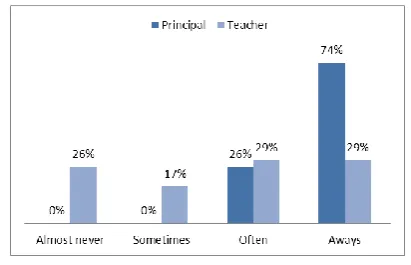
Almost never 0% 26%
Sometimes 0% 17%
Often 26% 29%
Always 74% 29%
By analyzing the data onavoidance of conflictsit has been resulted that: (1) according to most principals, (74%) the principal always avoids conflicts, while 26% answer that the avoiding principal conflicts often; (2)according to the teachers (29%, 29%) answer that the principal always and often avoids conflicts, while 17% answer that he sometimes avoids, 26% answer that the principal almost never avoids conflicts.
The data obtained reveal a principal who manages challenging situations, which if not resolved, becomes a serious obstacle. Teachers see the principal as the man who solves conflict situations. Avoidance or conflict resolution is indicative of professional resolution of the situation.
Graphic 4: Avoidance of conflicts
3.5 Principal-teacher human relationship.
Based on main data obtained from questionnaires of principals and supportive data obtained from the questionnaires of teachers, it has been presented on the data below on the
principal-teacher human relationship.
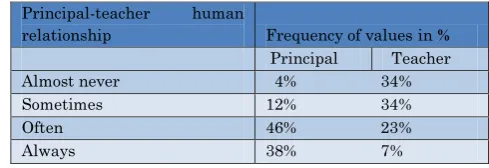
Table 5: Principal-teacher human relationship
Principal-teacher human
relationship Frequency of values in %
Principal Teacher
Almost never 4% 34%
Sometimes 12% 34%
Often 46% 23%
Always 38% 7%
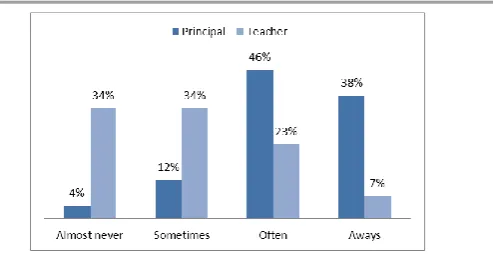
By analyzing the data on principal-teacher human relationship
it has been resulted that: (1)according to some of the principals (38%) the principal always shows concern to teachers’ human feelings, 46% of them report that they do often, but very few of them (12%, 4%) are sometimes and almost never concerned to teachers’ feelings; (2) according to a small fraction of teachers (7%) the principal always shows concern toward teachers’ human feelings and 23% answer that it happens often. While most of them (34%) answer that the principal almost never
(34%) shows concern about teachers’ feelings.
Graphic 5: Principal-teacher human relationship
3.6 Principal-student human relationship
Based on main data obtained from questionnaires of principals and supportive data obtained from the questionnaires of studnets, it has been presented on the data below on the
principal-student human relationship.
Table 6: Principal-student human relationship
Principal-student human relationship
Frequency of values in %
Principal Teacher
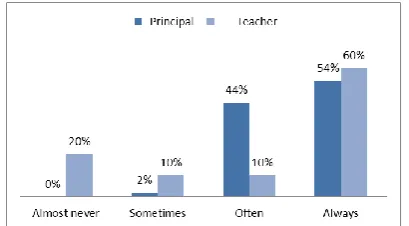
Almost never 0% 20%
Sometimes 2% 10%
Often 44% 10%
Always 54% 60%
By analyzing the data onprincipal-student human relationship
by creating a familiar careing climate, which helps in solving their problems. This brings confidence to the relation between principals and students, subsecuently the relation between school and family. Principals appear more attentive to the students than to other school stakeholders, the students are either acquired by a human professional service of school, or suffer the consequences of a poor service.
Graphic 6: Principal-student human relationship
3.7 Collaborative networks with other schools
Based on main data obtained from questionnaires of principals and supportive data obtained from the questionnaires of teacher, it has been presented on the data below on
thecollaborative networks with other schools.
Table 8: Collaborative networks with other schools
Collaborative networks with other schools
Frequency of values in%
Principal Teacher
Almost never 8% 11%
Sometimes 45% 40%
Often 29% 40%
Always 18% 6%
By analyzing the data on collaborative networks with other
schools it has been resulted that: (1) according to
that networking happens sometimes and 8% answer that it
almost never happens; (2) according to a small group of teachers
(6%) it results that theprincipal of the school always creates collaborative networks and 40% of them answer that networking with other schools is often, 40% answer that cooperation with other schools happens sometimes and 11% of teachers answer that it almost never happens.
Based on the results, the creation of collaborative networks with other schools, has revealed a limited leadership philosophy, closed only within the school. The vision of leadership plays an important role in the opening and connecting with other area schools, in order to be in line with changes in our school system. You can not have success just within the school, if you do not know what's going on around it, to confront and evaluate the school with external indicators.
Graphic 7: Collaborative networks with other schools
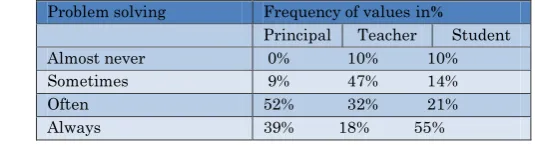
3.8 Problem solving
Based on main data obtained from questionnaires of principals and supportive data obtained from the questionnaires of teacher, it has been presented on the data below on theproblem solving.
Table 8: Problem solving
Problem solving Frequency of values in%
Principal Teacher Student
Almost never 0% 10% 10%
Sometimes 9% 47% 14%
Often 52% 32% 21%
By analyzing the data on problem solvingit has been resulted that: (1)according to principals (39%) the principal of the school supports teachers and always solves problems, while 52% answer that they often supports teachers and solves problems. A small part of the principal (9%) answer that the principal is sometimes supportive; (2) according to the teachers (18%) it results that the principal of the school is always supportive, while 32% answer that the principal is often supportive, while nearly half of teachers (47%) answer that the principal sometimes solves teachers problems and 3% answer the principal almost never solves problems; (3)according to the majority of students (55%) it results that the principal of the school is always supportive and 21% answer that the principal
often solves students' problems. A small group (14%) answer
that the principal is sometimes supportive and 10% answer that the principal almost never solves problems.
Based on the findings above, theprincipal is supportive and helps on solving teacher’s problems and obsticles, and it turns out that the principal is at the top of this form of leadership. But half of the teachers do not see the principal in this position, comparing with student’s perception of it. This indicator weakens the attitude of relation orientation leadership, despite the fact that about 80% of principals report that they are supportive. The teachers feel good and better implement their tasks, when the leader helps, supports, creates good conditions. For the teacher, the principal is only supporting certain activities, not all.
3.9 Qualitative analysis
Question: Does the principal inform you regularly about guidelines and curriculum changes?
Parents, more than half (six of them), responded that they are not informed about the reforms, guidelines, curriculum changes and express their concerns, and four of them answered that the have got the information on corruculum changes, when they requested.Parents are unhappy and confused, as they do not have this service from schools, communication and information. The headmaster appears to be good communicators for teachers and students, but not professional and supportive for parents.
Question: Does the school/principal invite you to speak freely of your thoughts and concerns?
According to the interview with the parents answer that the opportunity of contributing with their ideas is controversial and limited. Some of the respondents say that contributing with ideas is legal, but the princial does not offer opportunities. Only one parent accepts that the principal offers him opportunities to contribute with ideas in all school activities.But parents do not support these indicators, they show concern for the inability to give their opinions. It is displayed a closed form of leadership for parents.
Question Does the school background support you in the salvation of different concerns and problems?
5. CONCLUSIONS
Based on the findings above of the quantitative analysis of questionnaries to principals, teacher, students, parents and the qualitative analysis, these are the conclusions:
Principals assess positively the form and style of their leadership according to communication with teachers, considering it as an important elemet in the learning process. Principals’ result confirm the hypothesis raised that leadership style is collaborative:Principal’decision making is broad-based, involving teachers. It confirms the hypothesis raised that leadership style is collaborative and consultative.The principals appear to be collaborative, generating ideas, accepting opinins from staff and students. Solving the problem by avoiding conflict situations, reveals a careful and effective leadership style. The principal appears to be cooperative, but also as trainers. It confirms the hypothesis raised that leadership style is collaborative and consultative.Creation of positive principal-teacher human relation brings efficiency. The principal show care toward the teachers, but teachers consider this relationship missing, an indicator that weakens the reliability of this result. Creation of positive principal-student human relations is in the attention of the principal. The principal show care toward the students. Leaders appear locked in leadership philosophy, not cooperating with other schools. This indicator is supported by teachers. Professional support in resolving obstacles, reveals a principal who is supportive of the staff, but teachers do not fully support this indicator.
5.1Recommendations
Based on the findings of the quantitative analysis of questionnaires to managers, teachers, students' parents, and qualitative analysis, we recommend:The principal ought to use these kinds of questionnaries to find out the way the teachers percept the way a chool must be led, in order to have improvement.Educational institutions must find some monitoring and evaluating mechanisms of leadership styles, to improve the styles’ efficency.The principal must support and interact with parents in order to create a positive and encouraging atmosphere around.
REFERENCES
1. Aliçka, J. (1998). Drejtimii shkollë –një art, Drejtuesi –
një krijues. Tiranë. Mësonjëtorja.
2. Bolden, R. (2004). What is leadership? Leadership South West, Research report. South West of England, Regional of development agency. Retrieved on 9th. March 2012 from
http://businessschool.exeter.ac.uk/documents/discussion_ papers/cls/mgmt_standards.pdf
3. Bass, B. (1985). Leadership and performance beyond
expectations. New York: The Free Press
4. Bush & Middwood. (2013). Leading and Managing People in education.Sage Publications Ltd
5. Burns, J. M. (1978). Leadership. New York: Harper & Row
6. Burke, W. (2008). Organization change: theory and
practice .2nd.ed. Thousand Oaks, Ca: Sage publication
7. Daft, R, L., (2005) The leadership experience (3rd ed). Canada: Thomson
8. Elmore, R. (2000). Building a Neë Structure for
Leadership. Washington, DC 20001. The Albert
9. Everard, K. B., Morris, G., Wilson, I. (2004). Effective
School Management. Fourth Edition. Paul Chapman
Publishing. Great Britain.
10. Education Leadership. (2009). An Axhenda for School
Improvement. Retrieved on 21st April 2013:http://www.wallacefoundation.org/
11. Fullan, M. (2004). Leading in a culture of change. First Edition. U.S.A: Jossy-Bass.
12. Fullan, M. (2008).The six secret of change. First Edition.
U.S.A: Jossy-Bass.
13. Fullan, M. (2010). Motion Leadership. Corëin. U.S.A 14. Fullan, M. (2011). Change Leader. Corwin. U.S.A
15. Fullan, M. (2001). Kuptimi i ri i ndryshimit në arsim
(bot.3-të). Tiranë. Edualba.
16. Fullan, M. (2002).Principals as Leaders in a Culture of
Change.Paper prepared for Educational Leadership,
Special Issue. Retrieved on 23rd October 2012 from: http://www.michaelfullan.ca
17. Fullan, M. (2002). The Role of the Head in School
Improvment.National College of School Leadership,
England, Background Paper Retrieved on 21st
September 2013from.:http://www.michaelfullan.ca
18. Fullan, M. (2003). Forca e ndryshimit.Instituti i
Studimeve Pedagogjike. Tiranë
19. Fullan, M. (2008). What’s Worth Fighting For in the
principalship. 2nd Edition.Teacher College, Columbia
Universtity.
20. Hersey, P., Blanchard, K., (1999).Situasional-
leadership. Retrieved on 20th May 2014 from:
http://changingminds.org/disciplines/leadership/styles/sit uational_leadership_hersey_blan
21. Hallinger, P. (2003). Leading educational Change: reflections on the practice of instructional and
transformational leadership, Cambridge Journal of
23. Hoy, W. K. & Miskel, C. G. (2001). Educational
Administration: Theory, Research and Practice.
24. Leithwood, K. and Jantzi, D. (1999). Transformational School Leadership Effects: A Replication. School Effectiveness and School Improvement. Vol.10, No.4. 25. Leithwood, K., Louis, S.K., Anderson, S., Wahlstrom, K.
(2004). How leadership influences studen learning. Retrieved on 15th November 2013 from: http://www.wallacefoundation.org/
26. Leithwood K. & Jantzi D., (2006) Transformational School Leadership for Large-Scale Reform: Effects on
students, teachers, and their classroom practices. School
Effectiveness and School Improvement. No. 2: 201 – 227Retrieved on 20th. March 2014 from http://citeseerx.ist.psu.edu/viewdoc/download?doi=10.1.1. 475.86&rep=rep1&type=pdf
27. Louis, S., Leithwood, K., Wahlstrom, K., L., Anderson, E.,S., (2010). Investigating the Links to Improved
Student Learning.Final report of Research Findings.
Retrieved on 21st October 2016 from: http://www.wallacefoundation.org/
28. Mita, N. (2004). Ndryshimet në shkollë. Andministrimi & Menaxhimi Arsimit, nr 6, Tiranë. Botime ISP.
29. MASH. Ligji i ri, Nr.69/2012 “ Për sistemin parauniversitar në Republikën e Shqipërisë.Marrë nga: www.mash.gov.al.
30. Muka, P. (2003). Drejtori i shkollës përballë dhe përkrah
mësuesve. Andministrimi & Menaxhimi Arsimit,
nr.4.Tiranë. Botime ISP.
31. Nano. V., Karameta, P. Muça, E., Zisi, A. (2003). Studim: Gjendja dhe nevojat për kualifikimin e
drejtuesve të shkollave. Andministrimi & Menaxhimi
Arsimit.nr. 5. fq. 5-78. Tiranë. Botime ISP
32. Pasku, P. (2003). Menaxhimi i shkollës dhe
decentralizimi i sistemit arsimor. Andministrimi &
33. Qendra për Arsim Demokratik.(CDE) (2008). Përfshirja
e prindërve në edukim. Raport Studimi. Unicef.
34. Rapti, E. (2003). Drejtuesit dhe grupet sociale në
shkollë.Andministrimi & Menaxhimi Arsimitnr 4. fq.
99-112. Tiranë. Botime ISP.
35. The Wallace Foundation. (2012). The making of the
principal. Five lesson in principalship training. New