Billion-Gate Secure Computation with Malicious Adversaries
Benjamin Kreuter
[email protected]
University of Virginia
abhi shelat
[email protected]
University of Virginia
Chih-hao Shen
[email protected]
University of Virginia
Abstract
The goal of this paper is to assess the feasibility of two-party secure computation in the presence of a ma-licious adversary. Prior work has shown the feasibil-ity of billion-gate circuits in the semi-honest model, but only the 35k-gate AES circuit in the malicious model, in part because security in the malicious model is much harder to achieve. We show that by incorporating the best known techniques and parallelizing almost all steps of the resulting protocol, evaluating billion-gate circuits is feasible in the malicious model. Our results are in the standard model (i.e., no common reference strings or PKIs) and, in contrast to prior work, we do not use the random oracle model which has well-established theoret-ical shortcomings.
1
Introduction
Protocols for secure computation allow two or more mu-tually distrustful parties to collaborate and compute some function on each other’s inputs, with privacy and correct-ness guarantees. Andrew Yao showed that secure two-party protocols can be constructed for any computable function [33]. Yao’s protocol involves representing the function as a boolean circuit and having one party (called the generator) encrypt the circuit in such a way that it can be selectively decrypted by the other party (called the evaluator) to compute the output, a process called garbling. In particular, oblivious transfers are used for the evaluator to obtain a subset of the decryption keys that are needed to compute the output of the function.
Yao’s protocol is of great practical significance. In many real-world situations, the inputs to a function may be too valuable or sensitive to share. Huang et al. ex-plored the use of secure computation for biometric iden-tification [14] in national security applications, in which it is desirable for individual genetic data to be kept pri-vate but still checked against a classified list. In a similar
security application, Osadchy et al. described how face recognition could be performed in a privacy-preserving manner [29]. The more general case of multiparty com-putation has already seen real-world use in computing market clearing prices in Denmark [2].
Yao’s original protocol ensures the privacy of each party’s input and the correctness of the output under the semi-honestmodel, in which both parties follow the pro-tocol honestly. This model has been the basis for sev-eral scalable secure computation systems [4,10,12,13,
17,22,26]. It is conceivable, however, that one of the parties may deviate from the protocol in an attempt to violate privacy or correctness. Bidders may attempt to manipulate the auction output in their favor; spies may attempt to obtain sensitive information; and a computer being used for secure computation may be infected with malware. Securing againstmaliciousparticipants, who may deviate arbitrarily from pre-agreed instructions, in an efficient manner is of more practical importance.
There have been several attempts on practical systems with security against active, malicious adversaries. Lin-dell and Pinkas presented an approach based on garbled circuits that uses the cut-and-choose technique [23], with an implementation of this system having been given by Pinkas et al. [30]. Nielsen et al. presented the LEGO+ system [28], which uses efficient oblivious transfers and authenticated bits to enforce honest behaviors from par-ticipants. shelat and Shen proposed a hybrid approach that integrates sigma protocols into the cut-and-choose technique [32]. The protocol compiler presented by Ishai, Prabhakaran, and Sahai [16] also uses an approach based on oblivious transfer, and was implemented by Lindell, Oxman, and Pinkas [21]. In all these cases, AES was used as a benchmark for performance tests.
mentioned above, can be used to construct a multiparty protocol with security against a dishonest majority in the UC model [16]. Bendlin et al. showed a construction based on homomorphic encryption [1], which was im-proved upon by Damg˚ard et al. [7]; these protocols were also proved secure in the UC model, and thus require ad-ditional setup assumptions. The protocol of Damg˚ard et al. (dubbed “SPDZ” and pronounced “speedz”) is based on a preprocessing model, which improves the amortized performance. Damg˚ard et al. presented an implementa-tion of their protocol, which could evaluate the funcimplementa-tion
(x×y) +z in about 3 seconds with a 128 bit security level, but with an amortized time of a few milliseconds.
This paper presents a scalable two-party secure com-putation system which guarantees privacy and correct-ness in the presence of a malicious party. The system we present can handle circuits with hundreds of millions or even billions of gates, while requiring relatively mod-est computing resources. Our system follows the Fair-play framework, allowing general purpose secure com-putation starting from a high level description of a func-tion. We present a system with numerous technical ad-vantages over the Fairplay system, both in our compiler and in the secure computation protocol. Unlike previ-ous work, we do not rely solely on AES circuits as our benchmark; our goal is to evaluate circuits that are orders of magnitude larger than AES in the malicious model, and we use AES only as a comparison with other work. We prove the security of our protocol assumingcircular 2-correlation robusthash functions and the hardness of the elliptic curve discrete logarithm problem, and require neither additional setup assumptions nor the random or-acle model.
2
Contributions
Our principal contribution is to build a high perfor-mance secure two-party computation system that inte-grates state-of-the-art techniques for dealing with ma-liciousadversaries efficiently. Although some of these techniques have been reported individually, we are not aware of any attempt to incorporate them all into one sys-tem, while ensuring that a security proof can still be writ-ten for that system. Even though some of the techniques are claimed to be compatible, it is not until everything is put together and someone has gone through all the details can a system as a whole be said to be provably secure.
System Framework We start by using Yao’s garbled circuit [33] protocol for securely computing functions in the presence of semi-honest adversaries, and she-lat and Shen’s cut-and-choose-based transformation [32] that converts Yao’s garbled circuit protocol into one that
is secure against malicious adversaries.
We then modify the above to use Ishai et al.’s obliv-ious transfer extension [15] that has efficient amortized computation time for oblivious transfers secure against malicious adversaries, and Lindell and Pinkas’ random combination technique [23] that defends against selec-tive failure attacks. We implement Kiraz’s randomized circuit technique [18] that guarantees that the generator gets either no output or an authentic output, i.e., the gen-erator cannot be tricked into accepting arbitrary output.
Optimization Techniques For garbled circuit gener-ation and evalugener-ation, we incorporate Kolesnikov and Schneider’s free-XOR technique that minimizes the computation and communication cost for XOR gates in a circuit [20]. We also adopt Pinkas et al.’s garbled-row-reduction technique that reduces the communication cost fork-fan-in non-XOR gates by 1/2k[30], which means at least a 25% communication saving in our system since we only have gates of 1-fan-in or 2-fan-in. Finally, we implement Goyal et al.’s technique for reducing commu-nication as follows: during the cut-and-choose step, the check circuits are given to the evaluator by revealing the random seeds used to produce them rather than the check circuits themselves [11]. Combined with the 60%-40% check-evaluation ratio proposed by shelat and Shen [32], this technique provides a near 60% saving in communi-cation. As far as we know, although these techniques ex-ist individually, ours is the first system to incorporate all of these mutually compatible state-of-the-art techniques.
Circuit-Level Parallelism The most important new technique that we use is to exploit the embarrassingly parallel nature of shelat and Shen’s protocol for achiev-ing security in the malicious model. Exploiting this, however, requires careful engineering in order to achieve good performance while maintaining security. We paral-lelize all computation-intensive operations such as obliv-ious transfers or circuit construction by splitting the generator-evaluator pair into hundreds of slave pairs. Each of the pairs works on an independently generated copy of the circuit in a parallel but synchronized man-ner as synchronization is required for shelat and Shen’s protocol [32] to be secure.
sys-tem, through heavy use of circuit-level parallelism, our system needs roughly I+2C to compute hundreds of copies of the circuit. Thus when the circuit size is suf-ficiently larger than the input size, our system (secure in the malicious model) needs roughly twice as much com-putation time as that needed by the original Yao proto-col (secure in the semi-honest model). This is a tremen-dous improvement over prior work [30,32] which needed 100x more time than the semi-honest Yao. In the second instantiation of our scheme, we are able to achieveI+C computation time, albeit at the cost of moderately more communication overhead.
Large Circuits In the Fairplay system, a garbled cir-cuit is fully constructed before being sent over a net-work for the other party to evaluate. This approach is particularly problematic when hundreds of copies of a garbled circuit are needed against malicious adversaries. Huang et al. [13] pointed out that keeping the whole gar-bled circuit in memory is unnecessary, and that instead, the generation and evaluation of garbled gates could be conducted in a “pipelined” manner. Consequently, not only do both parties spend less time idling, only a small number of garbled gates need to reside in memory at one time, even when dealing with large circuits. However, this pipelining idea does not work trivially with other op-timization techniques for the following two reasons:
• The cut-and-choose technique requires the gener-ator to finish constructing circuits before the coin flipping (which is used to determine check circuits and evaluation circuits), but the evaluator cannot start checking or evaluating before the coin flipping. A naive approach would ask the evaluator to hold the circuits and wait for the results of the coin flip-ping before she proceeds to do her jobs. When the circuit is of large size, keeping hundreds of copies of such a circuit in memory is undesirable.
• Similarly, the random seed checking technique [11] requires the generator to send the hash for each gar-bled circuit, and later on send the random seeds for check circuits so that the communication for check circuits is vastly reduced. Note that the hash for an evaluation circuit is given away before the garbled circuit itself. However, a hash is calculated only af-ter the whole circuit is generated. So the generation-evaluation pipelining cannot be applied directly.
Our system, however, integrates this pipelining idea with the optimization techniques mentioned above, and is ca-pable of handling circuits of billions of gates.
AES-NI Besides the improvements by the algorith-mic means, we also incorporate the Intel Advanced
En-cryption Standard Instructions (AES-NI) in our system. While the encryption is previously suggested to be
EncX,Y(Z) =H(X||Y)⊕Z
in the literature [6,20], whereHis a 2-circular correla-tion robust funccorrela-tion instantiated either with SHA-1 [13] or SHA-256 [30], we propose an alternative that
EnckX,Y(Z) =AES-256X||Y(k)⊕Z,
wherekis the index of the garbled gate. With the help of the latest instruction set, an AES-256 operation could take as little as 30% of the time for SHA-256. Since this operation is heavily used in circuit operations, with the help of AES-NI instructions, we are able to reduce the circuit computation timeCby at least 20%.
Performance To get a sense of our improvements, we list the experimental results of the benchmark function— AES—from the most recent literature and our system. The latest reported system in the semi-honest model was built by Huang et al. [13] and needs 1.3 seconds (where I=1.1 andC=0.2) to complete a block of secure AES computation. The fastest known system in the malicious model was proposed by Nielson et al. [28] and has an amortized performance 1.6 seconds per block (or more precisely,I=79 andC=6 for 54 blocks). Our system provides security in the malicious model and needs 1.4 (=I+2C, whereI=1.0 andC=0.2) seconds per block. Note that both the prior systems require the full power of a random oracle, while ours requires a weaker crypto-graphic primitive, 2-circular correlation robust functions, which was recently shown to be sufficient to prove the security of the free-XOR technique. It should also be noted that our system benefits greatly from parallel com-putation, which was not tested for LEGO+.
Scalable Circuit Compiler One of the major bottle-necks that prevents large-scale secure computation is the need for a scalable compiler that generates a circuit de-scription from a function written in a high-level program-ming language. Prior tools could barely handle circuits with 50,000 gates, requiring significant computational resources to compile such circuits. While this is just enough for an AES circuit, it is not enough for the large circuits that we evaluate in this paper.
As a first sign that our compiler advances the state of the art, we observe that it automatically generates a smaller boolean circuit for the AES cipher than the hand-optimized circuit reported by Pinkas et al. [30]. AES plays an important role in secure computation, and obliv-ious AES evaluation can be used as a building block in cryptographic protocols. Not only is it one of the most popular building blocks in cryptography and real life se-curity, it is often used as a benchmark in secure com-putation. With the textbook algorithm, the well-known Fairplay compiler can generate an AES circuit that has 15,316 non-XOR gates. Pinkas et al. were able to de-velop an optimized AES circuit that has 11,286 non-XOR gates. By applying an efficient S-box circuit [3] and using our compiler, we were able to construct an AES circuit that has 9,100 non-XOR gates. As a result, our AES circuit only needs 59% and 81% of the commu-nication needed by the other two, respectively.
Most importantly, with our system and the scalable compiler, we are able to run experiments on circuits with sizes in the range of billions of gates. To the best of our knowledge, secure computation with such large cir-cuits has never been run in the malicious model before. These circuits include 256-bit RSA (266,150,119 gates) and 4095x4095-bit edit distance (5,901,194,475). As the circuit size grows, resource management becomes cru-cial. A circuit of billions of gates can easily result in several GB of data stored in memory or sent over the network. Special care is required to handle these diffi-culties.
Paper Organization The organization of this paper is as follows. A variety of security decisions and optimiza-tion techniques will be covered in Secoptimiza-tion 3 and Sec-tion4, respectively. Then, our system, including a com-piler, will be introduced in Section5. Finally, the experi-mental results are presented in Section6followed by the conclusion and future work in Section7.
3
Techniques Regarding Security
The Yao protocol, while efficient, assumes honest behav-ior from both parties. To achieve security in the mali-cious model, it is necessary to enforce honest behavior. Thecut-and-choosetechnique is one of the most efficient methods in the literature and is used in our system. Its main idea is for the generator to prepare multiple copies of the garbled circuit with independent randomness, and the evaluator picks a random fraction of the received cir-cuits, whose randomness is then revealed. If any of the chosen circuits (calledcheck circuits) is not consistent with the revealed randomness, the evaluator aborts; oth-erwise, she evaluates the remaining circuits (called
eval-uation circuits) and takes the majority of the outputs, one from each evaluation circuit, as the final output.
The intuition is that to pass the check, a malicious gen-erator can only sneak in a few faulty circuits, and the influence of these (supposedly minority) faulty circuits will be eliminated by the majority operation at the end. On the other hand, if a malicious generator wants to ma-nipulate the final output, she needs to construct faulty majority among evaluation circuits, but then the chance that none of the faulty circuits is checked will be negli-gible. So with the help of the cut-and-choose method, a malicious generator either constructs many faulty cir-cuits and gets caught with high probability, or constructs merely a few and has no influence on the final output.
However, the cut-and-choose technique is not a cure-all. Several subtle attacks have been reported and would be a problem if not properly handled. These attacks in-clude thegenerator’s input inconsistency attack, the se-lective failure attack, and thegenerator’s output authen-ticity attack, which are discussed in the following sec-tions. Note that in this section,ndenotes the input size andsdenotes the number of copies of the circuit.
Generator’s Input Consistency Recall that in the cut-and-choose step, multiple copies of a circuit are con-structed and then evaluated. A malicious generator is therefore capable of providing altered inputs to dif-ferent evaluation circuits. It has been shown that for some functions, there are simple ways for the gen-erator to extract information about the evaluator’s in-put [23]. For example, suppose both parties agree to compute the inner-product of their input, that is, f([a2,a1,a0],[b2,b1,b0])7→a2b2+a1b1+a0b0whereai andbi is the generator’s and evaluator’s i-th input bit, respectively. Instead of providing[a2,a1,a0]to all eval-uation circuits, the generator could send[1,0,0],[0,1,0], and[0,0,1]to different copies of the evaluation circuits. After the majority operation from the cut-and-choose technique, the generator learns major(b2,b1,b0), the ma-jority bit in the evaluator’s input, which is not what the evaluator agreed to reveal in the first place.
There exist several approaches to deter this attack. Mohassel and Franklin [27] proposed the equality-checker that needsO(ns2)commitments to be computed and exchanged. Lindell and Pinkas [23] developed an approach that also requiresO(ns2)commitments. Later, Lindell and Pinkas [24] proposed a pseudorandom syn-thesizer that relies on efficient zero-knowledge proofs for specific hardness assumptions and requires O(ns)
In our system, we incorporate the malleable claw-free collection approach because of its efficiency. Although the commitment-based approaches can be implemented using lightweight primitives such as collision-resistant hash functions, they incur high communication overhead for the extra complexity factors, that is, the number of copies of the circuit. On the other hand, the group-based approach could be more computationally intensive, but this discrepancy is compensated again due to the param-eter s.1 Hence, with similar computation cost, group-based approaches enjoy lower communication overhead.
Selective Failure A more subtle attack isselective fail-ure[19,27]. A malicious generator could use inconsis-tent keys to construct the garbled gate and OT so that the evaluator’s input can be inferred from whether or not the protocol completes. In particular, a cheating genera-tor could assign(K0,K1)to an input wire in the garbled circuit while using(K0,K1∗)instead in the corresponding OT, whereK16=K1∗. As a result, if the evaluator’s input is 0, she learns K0 from OT and completes the evalu-ation without complaints; otherwise, she learnsK1∗and gets stuck during the evaluation. If the protocol expects the evaluator to share the result with the generator at the end, the generator learns whether or not the evaluation failed, and therefore, the evaluator’s input is leaked.
Lindell and Pinkas [23] proposed the random input re-placement approach that involves replacing each of the evaluator’s input bits with an XOR of s additional in-put bits, so that whether the evaluator aborts due to a se-lective failure attack is almost independent (up to a bias of 21−s) of her actual input value. Both Kiraz [18] and shelat and Shen [32] suggested a solution that exploits committing OTs so that the generator commits to her in-put for the OT, and the correctness of the OTs can later be checked by opening the commitments during the cut-and-choose. Lindell and Pinkas [24] also proposed a so-lution to this problem using cut-and-choose OT, which combines the OT and the cut-and-choose steps into one protocol to avoid this attack.
Our system is based on the random input replacement approach due to its scalability. It is a fact that the com-mitting OT or the cut-and-choose OT does not alter the circuit while the random input replacement approach in-flates the circuit by O(sn) additional gates. However, it has been shown that max(4n,8s)additional gates suf-fice [30]. Moreover, both the committing OT and the
cut-1To give concrete numbers, with an Intel Core i5 processor and 4GB DDR3 memory, a SHA-256 operation (from OpenSSL) requires 1,746 cycles, while a group operation (160-bit elliptic curve from the PBC library with preprocessing) needs 322,332 cycles. It is worth-mentioning thatsis at least 256 in order to achieve security level 2−80. The gap between a symmetric operation and an asymmetric one be-comes even smaller when modern libraries such as RELIC are used instead of PBC.
and-choose OT require O(ns) group operations, while the random input replacement approach needs onlyO(s)
group operations. Furthermore, we observe that the ran-dom input replacement approach is in fact compatible with the OT extension technique. Therefore, we were able to build our system which has the group operation complexity independent of the evaluator’s input size, and as a result, our system is particularly attractive when han-dling a circuit with a large evaluator input.
Generator’s Output Authenticity It is not uncommon that both the generator and evaluator receive outputs from a secure computation, that is, the goal function is f(x,y) = (f1,f2), where the generator with inputxgets output f1, and the evaluator with inputy gets f2.2 In this case, the security requires that both the input and output are hidden from each other. In the semi-honest setting, the straightforward solution is to let the gener-ator choose a random numbercas an extra input, con-vert f(x,y) = (f1,f2)into a new function f∗((x,c),y) =
(λ,(f1⊕c,f2)), run the original Yao protocol for f∗, and instruct the evaluator to pass the encrypted output f1⊕c back to the generator, who can then retrieve her real out-put f1with the secret input cchosen in the first place. However, the situation gets complicated when either of the participants could potentially be malicious. In partic-ular, a malicious evaluator might claim an arbitrary value to be the generator’s output coming from the circuit eval-uation. Note that the two-output protocols we consider are notfairsince the evaluator always learns her own out-put and may refuse to send the generator’s outout-put. How-ever, they can satisfy the notion that the evaluator cannot trick the generator into accepting arbitrary output.
Many approaches have been proposed to ensure the generator’s output authenticity. Lindell and Pinkas [23] proposed a solution similar to the aforementioned so-lution in the semi-honest setting, where the goal func-tion is modified to compute f1⊕cand its MAC so that the generator can verify the authenticity of her output. This approach incurs a cost of adding O(n2) gates to the circuit. Kiraz [18] presented a two-party computa-tion protocol in which a zero knowledge proof of size O(s)is conducted at the end. shelat and Shen [32] sug-gested a signature-based solution which, similar to Ki-raz’s, addsngates to the circuit, and requires a proof of sizeO(s+n)at the end. However, they observed that witness-indistinguishable proofs are sufficient.
Lindell and Pinkas’ approach, albeit straightforward, might introduce greater communication overhead than the description function itself. We therefore employ the approach that takes the advantages of the remaining two solutions. In particular, we implement Kiraz’s approach
2Heref
(smaller proof size), but only a witness-indistinguishable proof is performed (weaker security property).
4
Techniques Regarding Performance
Yao’s garbled circuit technique has been studied for decades. It has drawn significant attention for its sim-plicity, constant round complexity, and computational ef-ficiency (since circuit evaluation only requires fast sym-metric operations). The fact that it incurs high communi-cation overhead has provoked interest that has led to the development of fruitful results.
In this section, we will first briefly present the Yao garbled circuit, and then discuss the optimization tech-niques that greatly reduce the communication cost while maintaining the security. These techniques include free-XOR, garbled row reduction, random seed checking, and large circuit pre-processing. In addition to these original ideas, practical concerns involving large circuits and par-allelization will be addressed.
4.1
Baseline Yao’s Garbled Circuit
Given a circuit that consists of 2-fan-in boolean gates, the generator constructs a garbled version as follows: for each wirew, the generator picks a random permutation bitπw∈ {0,1}and two random keysw0,w1∈ {0,1}k−1. LetW0=w0||πw andW1=w1||(πw⊕1), which are as-sociated with bit value 0 and 1 of wirew, respectively. Next, for gateg∈ {f|f :{0,1} × {0,1} 7→ {0,1}}that has input wire x with (X0,X1,πx), input wire y with
(Y0,Y1,πy), and output wire zwith(Z0,Z1,πz), the gar-bled truth table forghas four entries:
GT Tg
Enc(X0⊕πx||Y0⊕πy,Zg(0⊕πx,0⊕πy))
Enc(X0⊕πx||Y1⊕πy,Zg(0⊕πx,1⊕πy))
Enc(X1⊕πx||Y0⊕πy,Zg(1⊕πx,0⊕πy))
Enc(X1⊕πx||Y1⊕πy,Zg(1⊕πx,1⊕πy)).
Enc(K,m) denotes the encryption of messagemunder keyK. Here the encryption key is a concatenation of two labels, and each label is a random key concatenated with its permutation bit. Intuitively, πx andπy permute the entries inGT Tgso that forix,iy∈ {0,1}, the(2ix+iy)-th entry represents the input pair(ix⊕πx,iy⊕πy)for gateg, in which case the label associated with the output value g(ix⊕πx,iy⊕πy)could be retrieved. More specifically, to evaluate the garbled gate GT Tg, suppose X||bx and Y||by are the retrieved labels for input wirexand wire y, respectively, the evaluator will useX||bx||Y||byto de-crypt the(2bx+by)-th entry inGT Tgand retrieve label Z||bz, which is then used to evaluate the gates at the next level. The introduction of the permutation bit helps to identify the correct entry inGT Tg, and thus, only one, rather than all, of the four entries will be decrypted.
4.2
Free-XOR
Kolesnikov and Schneider [20] proposed the free-XOR technique that aims for removing the communication cost and decreasing the computation cost for XOR gates. The idea is that the generator first randomly picks a global key R, where R=r||1 andr∈ {0,1}k−1. This global key has to be hidden from the evaluator. Then for each wirew, instead of picking bothW0 andW1at random, only one is randomly chosen from{0,1}k, and the other is determined byWb=W1⊕b⊕R. Note that
πw remains the rightmost bit ofW0. For an XOR gate having input wirexwith (X0,X0⊕R,πx), input wirey with(Y0,Y0⊕R,πy), and output wirez, the generator lets Z0=X0⊕Y0andZ1=Z0⊕R. Observe that
X0⊕Y1=X1⊕Y0=X0⊕Y0⊕R=Z0⊕R=Z1
X1⊕Y1=X0⊕R⊕Y0⊕R=X0⊕Y0=Z0.
This means that while evaluating an XOR gate, XORing the labels for the two input wires will directly retrieve the label for the output wire. So no garbled truth table is needed, and the cost of evaluating an XOR gate is re-duced from a decryption operation to a bitwise XOR.
This technique is only secure when the encryption scheme satisfies certain security properties. The solution provided by the authors is
Enc(X||Y,K) =H(X||Y)⊕Z,
whereH:{0,1}2k7→ {0,1}k is a random oracle. Re-cently, Choi et al. [6] have further shown that it is sufficient to instantiate H(·) with a weaker crypto-graphic primitive, 2-circular correlation robust func-tions. Our system instantiates this primitive with H(X||Y) =SHA-256(X||Y). However, when AES-NI instructions are available, our system instantiates it with Hk(X||Y) =AES-256(X||Y,k),wherekis the gate index.
4.3
Garbled Row Reduction
is assigned to the encryption mask for the 0-th entry of the GT Tg, and the other one is computed by the equa-tionZb=Z1⊕b⊕R. Therefore, when the evaluator gets
(X0⊕πx,Y0⊕πy), bothX0⊕πx andY0⊕πy have rightmost bit
0, indicating that the 0-th entry needs to be decrypted. However, with GRR technique, she is able to retrieve Zg(0⊕πx,0⊕πy)by runningH(·)without inquiringGT Tg.
Pinkas et al. claimed that this technique is compatible with the free-XOR technique [30]. For rigorousness pur-poses, we carefully went through the details and came up with a security proof for our protocol that confirms this compatibility. The proof will be included in the full version of this paper.
4.4
Random Seed Checking
Recall that the cut-and-choose approach requires the generator to construct multiple copies of the garbled cir-cuit, and more than half of these garbled circuits will be fully revealed, including the randomness used to con-struct the circuit. Goyal, Mohassel, and Smith [11] there-fore pointed out an insight that the evaluator could exam-ine the correctness of those check circuits by receiving a hash of the garbled circuit first, acquiring the random seed, and reconstructing the circuit and hash by herself.
This technique results in the communication overhead for check circuits independent of the circuit size. This technique has two phases that straddle the coin-flipping protocol. Before the coin flipping, the generator con-structs multiple copies of the circuit as instructed by the cut-and-choose procedure. Then the generator sends to the evaluator the hash of each garbled circuit, rather than the circuit itself. After the coin flipping, when the eval-uation circuits and the check circuits are determined, the generator sends to the evaluator the full description of the evaluation circuits and the random seed for the check circuits. The evaluator then computes the evaluation cir-cuits and tests the check circir-cuits by reconstructing the circuit and comparing its hash with the one received ear-lier. As a result, even for large circuits, the communi-cation cost for each check circuit is simply a hash value plus the random seed. Our system provides that 60% of the garbled circuits are check circuits. Thus, this opti-mization significantly reduces communication overhead.
4.5
Working with Large Circuits
A circuit for a reasonably complicated function can eas-ily consist of billions of gates. For example, a 4095-bit edit distance circuit has 5.9 billion gates. When circuits grow to such a size, the task of achieving high perfor-mance secure computation becomes challenging.
An(I+2C)-time solution Our solution for handling large circuits is based on Huang et al.’s work [13], which is the only prior work capable of handling large circuits (of up to 1.2 billion non-XOR gates) in the semi-honest setting. Intuitively, the generator could work with the evaluator in a pipeline manner so that small chunks of gates are being processed at a time. The generator could start to work on the next chunk while the evaluator is still processing the current one. However, this technique does not work directly with the random seed checking tech-nique described above in Section4.4because the genera-tor has to finish circuit construction and hash calculation before the coin flipping, but the evaluator could start the evaluation only after the coin flipping. As a result, the generator needs a way to construct the circuit first, wait for the coin flipping, and send the evaluation circuits to the evaluator without keeping them in memory the whole time. We therefore propose that the generator constructs the evaluation circuits all over again after the coin flip-ping, with the same random seed used before and the same keys for input wires gotten from OT.
We stress that when fully parallelized, the second con-struction of an evaluation circuit does not incur overhead to the overall execution time. Although we suggest to construct an evaluation circuit twice, the fact is that ac-cording to the random seed checking, a check circuit is already being constructed twice—once before the coin flipping by the generator for hash computation and once after by the evaluator for correctness verification. As a result, when each generator-evaluator pair is working on a single copy of the garbled circuit, the constructing time for a evaluation circuit totally overlaps with that for a check circuit. We therefore achieve the overall computa-tion timeI+2Cmentioned earlier, where the firstCis for the generator to calculate the circuit hash, and the other Cis either for the evaluator to reconstruct a check circuit or for both parties to work on an evaluation circuit in a pipeline manner as suggested by Huang et al. [13].
evaluate or check the received circuit. In order for the evaluator to get the generator’s input keys for evaluation circuits and the random seed for the check circuits, they run an OT, where the evaluator uses the coin flipping re-sult as input and the generator provides either the ran-dom seed (for the check circuit) or his input keys (for the evaluation circuit). After the generator completes circuit construction and reveals the circuit hash, the evaluator compares the hash with her own calculation, if the hashes match, she proceeds with the rest of the original protocol. Note that this approach comes at the cost of sacrificing the random seed checking technique and its 60% savings in communication.
Working Set Optimization Another problem encoun-tered while dealing with large circuits is the working set minimization problem. Note that the circuit value problemis log-space complete for P. It is suspected that L6=P, that is, there exist some circuits that can be evalu-ated in polynomial time but require more than logarith-mic space. This open problem captures the difficulty of handling large circuits during both the construction and evaluation, where at any moment there is a set of wires, called theworking set, that are available and will be ref-erenced in the future. For some circuits, the working set is inherently super-logarithmic. A naive approach is to keep the most recentDwires in the working set, where Dis the upper bound of the input-output distance of all gates. However, there may be wires which are used as inputs to gates throughout the entire circuit, and so this technique could easily result in adding almost the whole circuit to the working set, which is especially problem-atic when there are hundreds of copies of a circuit of billions of gates. While reordering the circuit or adding identity gates to minimize Dwould mitigate this prob-lem, doing so while maintaining the topological order of the circuit is known to be an NP-complete problem, the graph bandwidth problem[9].
Our solution to this difficulty is to pre-process the cir-cuit so that each gate comes with a usage count. Our system has a compiler that converts a program in high-level language into a boolean circuit. Since the compiler is already using global optimization in order to reduce the circuit size, it is easy for the global optimizer to an-alyze the circuit and calculate the usage count for each gate. With this information, it is easy for the genera-tor and evaluagenera-tor to decrement the counter for each gate whenever it is being referenced and to toss away the gate whenever its counter becomes zero. In other words, we keep track of merely useful information and heuristically minimize the size of the working set, which is small com-pared with the original circuit size as shown in Table1.
AES Dot644 RSA-32 EDT-255
circuit size 49,912 460,018 1,750,787 15,540,196
wrk set size 323 711 235 2,829
Table 1: The size of the working set for various circuits (sizes include input gates)
5
Boolean Circuit Compiler
Although the Fairplay circuit compiler can generate cir-cuits, it requires a very large amount of computational resources to generate even relatively small circuits. Even on a machine with 48 gigabytes of RAM, Fairplay ter-minates with an out-of-memory error after spending 20 minutes attempting to compile an AES circuit. This makes Fairplay impractical for even relatively small cir-cuits, and infeasible for some of the circuits tested in this project. One goal of this project was to have a general purpose system for secure computation, and so writing application specific programs to generate circuits, a tech-nique used by others [13], was not an option.
To address this problem, we have implemented a new compiler that generates a more efficient output format than Fairplay, and which requires far lower computa-tional resources to compile circuits. We were able to generate the AES circuit in only a few seconds on a typi-cal desktop computer with only 8GB of RAM, and were able to generate and test much larger non-trivial circuits. We used the well-knownflexandbisontools to generate our compiler, and implemented an optimizer as a sepa-rate tool. We also use the results from [30] to reduce 3 arity gates to 2 arity gates.
time. Additional language features are planned as future work.
We use some techniques from the Fairplay compiler in our own compiler. In particular we use the single as-signment algorithm from Fairplay, which is required to deal with assignments that occur inside ofifstatements. Otherwise, our compiler has several distinguishing char-acteristics that make it more resource efficient than Fair-play. The front end of our compiler attempts to gener-ate circuits as quickly as possible, using as little memory as possible and performing only rudimentary optimiza-tions before emitting its output. This can be done with very modest computational resources, and the intermedi-ate output can easily be translintermedi-ated into a circuit for evalu-ation. The main optimizations are performed by the back end of the compiler, which identifies gates that can be removed without affecting the output of the circuit as a whole.
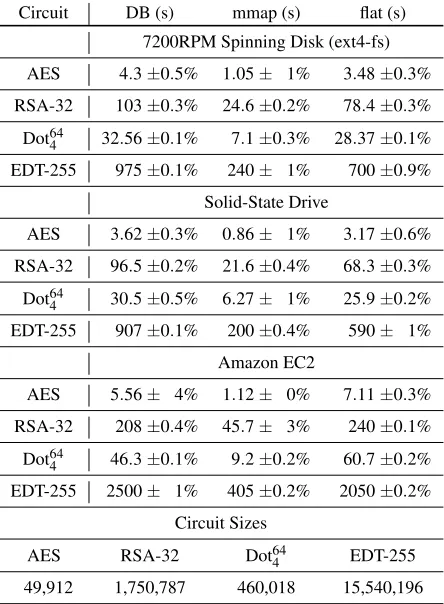
Unlike the Fairplay compiler, we avoided the use of hash tables in our compiler, using more memory-efficient storage. Our system can use one of three storage strate-gies: memory-mapped files, flat files without any map-ping, and Berkeley DB. In our tests, we found that mem-ory mapped files always resulted in the highest perfor-mance, but that Berkeley DB is only sometimes better than direct access without any mapping.
In the following sections, we describe these contribu-tions in more detail, and provide experimental results.
5.1
Circuit Optimizations
The front-end of our compiler tends to generate ineffi-cient circuits, with large numbers of unnecessary gates. As an example, for some operations the compiler gener-ates large numbers of identity ggener-ates i.e. ggener-ates whose out-puts follow one of their inout-puts. It is therefore essential to optimize the circuits emitted by the front end, particu-larly to meet our system’s overall goal of practicality.
Our compiler uses several stages of optimization, most of which are global. As a first step, a local optimization removes redundant gates, i.e. gates that have the same truth table and input wires. This first step operates on a fixed-size chunk of the circuit, but we have found that there are diminishing improvements as the size of this window is increased. We also remove constant gates, identity gates, and inverters, which are generated by the compiler and which may be inadvertently generated dur-ing the optimization process. Finally, we remove gates that do not influence the output, which can be thought of as dead code elimination. The effectiveness of each optimization on different circuits is shown in Figure1. The circuit that was least optimizable was the edit dis-tance circuit, being reduced to only 82% of its size from the front end, whereas the RSA signing and the dot
prod-uct circuits were the most optimizable, being reduced to roughly half of the gates emitted by the front end.
Gate Removal The front-end of the compiler emits gates in topological order, and similar to Fairplay, our compiler assigns explicit identifiers to each emitted gate. To remove gates efficiently, we store a table that maps the identifiers of gates that were removed to the previ-ously emitted gates, and for each gate that is scanned the inputs are rewritten according to this table. The ta-ble itself is then emitted, so that the identifiers of non-removed gates can be corrected. This mapping process can be done in linear time and space using an appropriate key-value store.
Removing Redundant Gates Some of the gates gen-erated by the front end of our compiler have the same truth table and input wires as previously generated gates; such gates are redundant and can be removed. This re-moval process has the highest memory requirement of any other optimization step, since a description of ev-ery non-redundant gate must be stored. However, we found during our experiments that this optimization can be performed on discrete chunks of the circuit with re-sults that are very close to performing the optimization on the full circuit, and that there are diminishing im-provements in effectiveness as the size of the chunks is increased. Therefore, we perform this optimization us-ing chunks, and can use hash tables to improve the speed of this step.
Removing Identity Gates and Inverters The front end may generate identity gates or inverters, which are not necessary. This may happen inadvertently, such as when a variable is incremented by a constant, or as part of the generation of a particular logic expression. While removing identity gates is straightforward, the removal of inverters requires more work, as gates which have in-verted input wires must have their truth tables rewritten. There is a cascading effect in this process; the removal of some identity gates or inverters may transform later gates into identity gates or inverters. This step also removes gates with constant outputs, such as an XOR gate with two identical inputs. Constant propagation and folding occur as a side effect of this optimization.
Figure 1: Average fraction of circuits remaining after each optimization is applied in sequence. We see that therelative changein circuit sizes after each optimization is dependent on the circuit itself, with some circuits being optimized more than others.
Circuit DB (s) mmap (s) flat (s)
7200RPM Spinning Disk (ext4-fs)
AES 4.3±0.5% 1.05± 1% 3.48±0.3%
RSA-32 103±0.3% 24.6±0.2% 78.4±0.3%
Dot644 32.56±0.1% 7.1±0.3% 28.37±0.1%
EDT-255 975±0.1% 240± 1% 700±0.9%
Solid-State Drive
AES 3.62±0.3% 0.86± 1% 3.17±0.6%
RSA-32 96.5±0.2% 21.6±0.4% 68.3±0.3%
Dot644 30.5±0.5% 6.27± 1% 25.9±0.2%
EDT-255 907±0.1% 200±0.4% 590± 1%
Amazon EC2
AES 5.56± 4% 1.12± 0% 7.11±0.3%
RSA-32 208±0.4% 45.7± 3% 240±0.1%
Dot644 46.3±0.1% 9.2±0.2% 60.7±0.2%
EDT-255 2500± 1% 405±0.2% 2050±0.2%
Circuit Sizes
AES RSA-32 Dot644 EDT-255
49,912 1,750,787 460,018 15,540,196
Table 2: Compile times for different storage systems for small circuits (sizes include input gates), using differ-ent storage media. Results are averaged over 30 experi-ments, with 95% confidence intervals. On EC2, a high-memory quadruple extra large instance was used.
Key-Value Stores Unfortunately, even though our compiler is more resource efficient than Fairplay, it still requires space that is linear in the size of the circuit. For very large circuits, circuits with billions of gates or more, this may exceed the amount of RAM that is available. Our compiler can make use of a computer’s hard drive to store intermediate representations of circuits and infor-mation about how to remove gates from the circuit. We used memory-mapped I/O to reduce the impact this has on performance; however, our use ofmmapandftruncate is not portable, and so our system also supports using an unmapped file or Berkeley DB. Our tests revealed that, as expected, memory-mapped I/O achieves the highest performance, but that Berkeley DB is sometimes better than unmapped files on high-latency filesystems. A sum-mary of the performance of each method on a variety of storage systems is shown in Table2.
Using the hard drive in this manner, we were able to compile our largest circuits. The performance im-pact of writing to disk should not be understated; a several-billion-gate edit distance 4095x4095 circuit re-quired more than 3 days to compile on an Amazon EC2 high-memory image, with 68 GB of RAM, one third of which was spent waiting on I/O. Note, however, that this is a one-time cost; a compiled circuit can be used in un-limited evaluations of a secure computation protocol.
5.2
Compiler Testing Methodology
RSA Size Circuit Size Compile Time (s) Gates/s Edit-Dist Size Circuit Size Compile Time (s) Gates/s
16 208,499 2.6 ± 7% 80,000 31x31 144,277 1.70 ±0.7% 84,900
32 1,750,787 21.6 ±0.4% 81,100 63x63 717,233 8.56 ±0.7% 83,800
64 14,341,667 189 ±0.3% 75,900 127x127 3,389,812 41.7 ±0.5% 81,300
128 116,083,983 1810 ±0.3% 64,100 255x255 15,540,196 200 ±0.4% 77,700
Table 3: Time required to compile and optimize RSA and edit distance circuits on a workstation with an Intel Xeon 5506 CPU, 8GB of RAM and a 160GB SSD, using the textbook modular exponentiation algorithm. Note that the throughput for edit distance is higher even for comparably sized circuits; this is because the front end generates a more efficient circuit without any optimization. Compile times are averaged over 30 experiments, with 95% confidence intervals reported.
signing circuit with various toy key sizes, up to 128 bits, to test our compiler’s handling of large circuits; RSA cir-cuits have cubic size complexity, allowing us to generate very large circuits with small inputs. We also used an edit distance circuit, which was the largest test case used by Huang et al. [13]; unlike the other test circuits, there is no multiplication routine in the inner loop of this function. Finally we used a dot product with error, a basic sam-pling function for the LWE problem, which is similar to RSA in creating large circuits, but also demonstrates our system’s ability to handle large input sizes.
After compiling these circuits, we tested the correct-ness by first performing a direct, offline evaluation of the circuit, and comparing the output to a non-circuit imple-mentation. We then compared the output of an online evaluation to the offline evaluation. Additionally, for the AES circuit, we compared the output of the circuit gener-ated by our compiler to the output of a circuit genergener-ated using Fairplay. We tested all three key-value stores on a variety of file systems, including a fast SSD, a spinning disk, and an Amazon EC2 instance store, checking for correctness as described above in each case.
5.3
Summary of Compiler Performance
Our compiler is able to emit and optimize large circuits in relatively short periods of time, less than an hour for circuits with tens of millions of gates on an inexpensive workstation. In Figure1we summarize the effectiveness of the various optimization stages on different circuits; in circuits that involve multiplication in finite fields or modulo an integer, the identity gate removal step is the most important, removing more than half of the gates emitted by the front-end. The edit distance circuit is the best-case for our front end, as less than 1/5 of the gates that are emitted can be removed by the optimizer. The throughput of our compiler is dependent on the circuit being compiled, with circuits which are more efficiently generated by the front-end being compiled faster; in Ta-ble3we compare the generation of RSA circuits to edit distance circuits.6
Experimental Results
In this section, we give a detailed description of our system, upon which we have implemented various real world secure computation applications. The experimen-tal environment is the Ranger cluster in the Texas Ad-vanced Computing Center. Ranger is a blade-based sys-tem, where each node is a SunBlade x6240 blade run-ning a Linux kernel and has four AMD Opteron quad-core 64-bit processors, as an SMP unit. Each node in the Ranger system has 2.3 GHz core frequency and 32 GB of memory, and the point-to-point bandwidth is 1 GB/sec. Although Ranger is a high-end machine, we use only a small fraction of its power for our system, only 512 out of 62,976 cores. Note that we use the PBC (Pairing-Based Cryptography) library [25] to implement the underly-ing cryptographic protocols such as oblivious transfers, witness-indistinguishable proofs, and so forth. However, moving to more modern libraries such as RELIC [31] is likely to give even better results, especially to those cir-cuits with large input and output size.
spawns an even number of processes, half for the gen-erator and the other half for the evaluator. The network match-up process is omitted in the latter mode to sim-plify the testing of this system.
To achieve a security level of 2−80, meaning that a ma-licious player cannot successfully cheat with probability better than 2−80, requires at least 250 copies of the gar-bled circuit [32]. For simplicity, we used 256 copies in our experiments, that is, security parametersk=80 and s=256. Each experiment was run 30 times (unless stated otherwise), and in the following sections we report the average runtime of our experiments.
1 4
3 2
5 5 5
5
Evl Gen
IP server
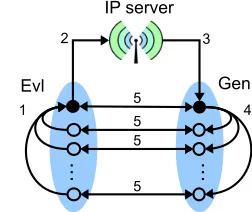
Figure 2: Both the generator and evaluator consist of a root process (solid dot) and a number of slave processes (hollow dots). The match-up works as follows: the slave evaluator processes send their IPs to the root evaluator process (Step 1), who then forwards them to the IP ex-changer (Step 2). Next, the root generator process comes to acquire these IPs (Step 3) and dispatch them to its slaves (Step 4), who then proceed to pair up with one of the slave evaluator processes (Step 5) and start the main protocol. The arrows show the message flow.
Timing methodology When there is more than one process on each side, care must be taken in measuring the timings of the system. The timings reported in this section are the time required by the root process at each stage of the system. This was chosen because the root process will always be the longestrunning process, as it must wait for each slave process to run to completion. Moreover, in addition to doing all the work that the slaves do, the root processes also perform the input consistency check and the coin tossing protocol.
Impacts of the Performance Optimization Techniques We have presented several performance optimization techniques in Section 4 with theoretical analyses, and here we demonstrate their empirical effectiveness in Ta-ble4. As we have anticipated, the Random Seed Check-ing reduces the communication cost for the garbled cir-cuits by 60%, and the Garbled Row Reduction further reduces by another 25%. In the RS and GRR columns,
the small deviation from the theoretical fraction 40% and 30%, respectively, is due to certain implementation needs. Our compiler is designed to reduce the number of XOR gates. In these four circuits, the ratio of non-XOR gates is less than 43%. So after further applying the Free-XOR technique, the final communication is less than 13% of that in the baseline approach.
non-XOR Baseline RS GRR FX
(%) (MB) (%) (%) (%)
AES 30.81 509 39.97 30.03 9.09
Dot644 29.55 4,707 39.86 29.91 8.88
RSA-32 34.44 17,928 39.84 29.88 10.29
EDT-255 41.36 159,129 39.84 29.87 12.36
Table 4: The impact of various optimization techniques: The Baseline shows the communication cost for 256 copies of the original Yao garbled circuit whenk=80; RS shows the remaining fraction after Random Seed technique is applied; GRR shows when Garbled Row Re-duction is further applied; and FX shows when the previ-ous two techniques and the Free-XOR are applied. (The communication costs here only include those in the gen-eration and evaluation stages.)
Performance Gain by AES-NI On a machine with 2.53 GHz Intel Core i5 processor and 4GB 1067 MHz DDR3 memory, it takes 784 clock cycles to run a single SHA-256 (with OpenSSL 1.0.0g), while it needs only 225 cycles for AES-256 (with AES-NI). To measure the benefits of AES-NI, we use two instantiations to con-struct various circuits, listed in Table 5, and observe a consistent 20% saving in circuit construction.3
size AES-NI SHA-256 Ratio
(gate) (sec) (sec) (%)
AES 49,912 0.12± 1% 0.15± 1% 78.04
Dot644 460,018 1.11±0.4% 1.41±0.5% 78.58
RSA-32 1,750,787 4.53±0.5% 5.9±0.8% 76.78
EDT-255 15,540,196 42.0±0.5% 57.6± 1% 72.92
Table 5: Circuit generation time (for a single copy) with different instantiations (AES-NI vs SHA-256) of the 2-circular correlation robust function.
AES We used AES as a benchmark to compare our compiler to the Fairplay compiler, and as a test circuit
for our system. We tested the full AES circuit, as spec-ified in FIPS-197 [8]. In the semi-honest model, it is possible to reduce the number of gates in an AES circuit by computing the key schedule offline; e.g. this is one of the optimizations employed by Huang et al. [13]. In the malicious model, however, such an optimization is not possible; the party holding the key could attempt to re-duce the security level of the cipher by computing a ma-licious key schedule. So in our experiments we compute the entire function, including the key schedule, online.
In this experiment, two parties collaboratively com-pute the function f :(x,y)7→(⊥,AESx(y)), i.e., the cir-cuit generator holds the encryption keyx, while the eval-uator has the messageyto be encrypted. At the end, the generator will not receive any output, whereas the evalu-ator will receive the ciphertext AESx(y).
Type Fairplay Ours-A Pinkas et al. Ours-B
non-XOR 15,316 15,300 11,286 9,100
XOR 35,084 34,228 22,594 21,628
Table 6: The components of the AES circuits from dif-ferent sources. Ours-A comes from the textbook AES algorithm, and Ours-B uses an optimized S-box circuit from [3]. (Sizes do not include input or output wires)
First of all, we demonstrate the performance of our compiler in Table6. We have shown in Section5 that our compiler is capable of large circuit generation. We also found in our experiments that our compiler produces smaller AES circuit than Fairplay. Given the same high-level description of AES encryption (textbook AES), our compiler produces a circuit with a smaller gate count and even fewer non-XOR gates. When applying the compact S-Box description proposed by Boyar and Parelta [3] to the high-level description as input to our compiler, a smaller AES circuit than the hand-optimized one from Pinkas et al. is generated with less effort.
In Table7, both the computational and communica-tion costs for each main stage are listed under the tradi-tional setting, where there is only one process on each side. These main stages include oblivious transfer, gar-bled circuit construction, the generator’s input consis-tency check, and the circuit evaluation. Each row in-cludes both the computation and communication time used. Note that network conditions could vary from set-ting to setset-ting. Our experiments run in a local area net-work, and the data can only give a rough idea on how fast the system could be in an ideal environment. However, the precise amount of data being exchanged is reported.
We notice in Table7that the evaluator spends an un-reasonable amount of time on communication with re-spect to the amount of data to be transmitted in both the oblivious transfer and circuit construction stages.
Gen Eval Comm
(sec) (sec) (KB)
OT comp 45.8±0.09% 34.0±0.2% 5,516
comm 0.1± 1% 11.9±0.6%
Gen. comp 35.6± 0.5% – 3
comm – 35.6±0.5%
Inp. comp – 1.75±0.2%
266
Chk comm – –
Evl. comp 14.9± 0.6% 32.4±0.4% 28,781
comm 18.2± 1% 3.2±0.8%
Total comp 96.3± 0.3% 68.0±0.2% 34,566
comm 18.3± 1% 50.8±0.4%
Table 7: The 95% two-sided confidence intervals of the computation and communication time for each stage in the experiment(x,y)7→(⊥,AESx(y)).
This is because the evaluator spends that time waiting for the generator to finish computation-intensive tasks. The same reasoning explains why in the circuit evalu-ation stage the generator spends more time in commu-nication than the evaluator. This waiting results from the fact that both parties need to run the protocol in a synchronized manner. A generator-evaluator pair can-not start next communication round while any other pair has not finished the current one. This synchronization is crucial since our protocol’s security is guaranteed only when each communication round is performed sequen-tially. While the parallelization of the program intro-duces high performance execution, it does not and should not change this essential property. A stronger notion of security such as universal security will be required if asynchronous communication is allowed. By using TCP sockets in “blocking” mode, we enforce this communi-cation round synchronization.
Note that the low communication during the circuit construction stage is due to the random seed checking technique. Also, the fact that the generator spends more time in the evaluation stage than she traditionally does comes from the second construction for evaluation cir-cuits. Recall that only the evaluation circuits need to be sent to the evaluator. Since only 40% of the garbled cir-cuits (102 out of 256) are evaluation-circir-cuits, the ratio of the generator’s computation time in the generation and evaluation stage is 35.63:14:92'5:2.
node # 4 16 64 256
Gen Evl Gen Evl Gen Evl Gen Evl
OT 12.56±0.1% 8.41±0.1% 4.06±0.1% 2.13±0.2% 1.96±0.1% 0.58±0.2% 0.64±0.1% 0.19±0.2%
Gen. 8.18±0.4% – 1.92±0.7% – 0.49±0.4% – 0.14± 1% –
Inp. Chk – 0.42± 4% – 0.10±10% – – – –
Evl. 3.3± 4% 7.08± 1% 0.80±10% 1.58± 4% 0.23±17% 0.37± 7% 0.12±0.5% 0.05±0.6%
Inter-com 4± 5% 13.2±0.3% 0.93±10% 4.08±0.8% 0.31±20% 1.98± 1% 0.11±40% 0.72±0.2%
Intra-com 0.17±30% 0.23±20% 0.18± 8% 0.25± 6% 0.45±20% 0.48±15% 0.34±30% 0.34±30%
Total time 28.3±0.3% 29.4±0.3% 7.90±0.5% 8.17±0.4% 3.45± 2% 3.44± 2% 1.4±10% 1.3± 9%
Table 8: The average and error interval of the times (seconds) running AES circuit. The number of nodes represents the degree of parallelism on each side. “–” means that the time is smaller than 0.05 seconds. Inter-com refers to the communication between the two parties, and intra-com refers to communication between nodes for a single party.
malicious setting. We estimate a 20% improvement in the performance of garbled circuit generation when the AES-NI instruction set becomes ubiquitous, based on the preliminary results presented above in Table5.
Table 8 shows that the Yao protocol really benefits from the circuit-level parallelization. Starting from Ta-ble7, where each side only has one process, all the way to when each side has 256 processes, as the degree of par-allelism is multiplied by four, the total time reduces into a quarter. Note that the communication costs between the generator and evaluator remain the same, as shown in Ta-ble7. It may seem odd that the communication costs are reducedas the number of processes increase. The real in-terpretation of this data is that as the number of processes increases, the “waiting time” decreases.
Notice that as the number of processes increases, the ratio of the time the generator spends in the construc-tion and evaluaconstruc-tion stage decreases from 5:2 to 1:1. The reason is that the number of garbled circuit each process handles is getting smaller and smaller. Eventually, we reach the limit of the benefits that the circuit-level paral-lelism could possibly bring. In this case, each process is dealing with merely a single copy of the garbled circuit, and the time spent in both the generation and evaluation stages is the time to construct a garbled circuit.
To the best of our knowledge, completing an execution of secure AES in the malicious model within 1.4 seconds is the best result that has ever been reported. The next best result from Nielsen et al. [28] is 1.6 seconds, and it is an amortized result (85 seconds for 54 blocks of AES encryption in parallel) in the random oracle model. This is only a crude comparison, however; our experimental setup uses a cluster computer while Nielsen et al. used only two desktops. A better comparison would be pos-sible given a parallel implementation of Nielsen et al.’s system, and we are interested in seeing how much of an improvement such an implementation could achieve.
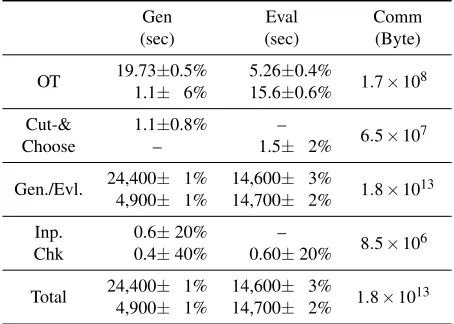
Large Circuits In this experiment, we run the 4095-bit edit distance circuit, that is,(x,y)7→(⊥,EDT(x,y)), wherex,y∈ {0,1}4095. In particular, we use the I+C approach, where the computation time could be roughly a half of that of theI+2Capproach with the price of not getting to use the random-seed technique. Recall that in theI+Capproach, the generator and the evaluator con-duct the cut-and-choose in a way that the generator does not know the check circuits until she finishes transferring all the garbled circuits. Next, both the parties run the circuit generation and evaluation in a pipeline manner, where one party is generating and giving away garbled gates on one end, and the other party is evaluating and checking the received gates at the other end at the same time. The results are shown in Table9.
Gen Eval Comm
(sec) (sec) (Byte)
OT 19.73±0.5% 5.26±0.4% 1.7×10⁸
1.1± 6% 15.6±0.6%
Cut-& 1.1±0.8% –
6.5×10⁷
Choose – 1.5± 2%
Gen./Evl. 24,400± 1% 14,600± 3% 1.8×10¹³
4,900± 1% 14,700± 2%
Inp. 0.6±20% –
8.5×10⁶
Chk 0.4±40% 0.60±20%
Total 24,400± 1% 14,600± 3% 1.8×10¹³
4,900± 1% 14,700± 2%
Table 9: The result of (x,y)7→(⊥,EDT-4095(x,y)). Each party is comprised of 256 cores in a cluster. This table comes from 6 invocations of the system. Simi-larly, the upper row in each stage is the computation time, while the lower is the communication time.
mentioning that, without the random-seed technique, the communication cost shown in Table9 can also be esti-mated by 256×2.4×109×3×10=1.8×10¹³, since 256 copies of the garbled circuits need to be transferred, each copy has 2.4 billion non-free gates, each non-free gate has three entries, and each entry hask=80 bits.
In additional to showing that our system is capable of handling the largest circuits ever reported, we also have shown a speed in the malicious setting that is comparable to those in the semi-honest setting. In particular, we were able to complete an single execution of 4095-bit edit dis-tance circuit in less than 8.2 hours with a rate of 82,000 (non-XOR) gates per second. Note that Huang et al.’s system is the only one, to the best of our knowledge, that is capable of handling such large circuits [13]; they re-ported a rate of over 96,000 (non-XOR) gates per second for an edit-distance circuit in the semi-honest setting.
7
Conclusion
We have presented a general purpose secure two party computation system which offers security against mali-cious adversaries and which can efficiently evaluate cir-cuits with hundreds of millions and even billions of gates on affordable hardware. Our compiler can generate large circuits using fewer computational resources than simi-lar compilers, and offers improved flexibility to users of the system. Our evaluator can take advantage of parallel computing resources, which are becoming increasingly common and affordable. As future work, we plan further improvements to our compiler and language, as well as experiments on systems other than Ranger.
The source code for this system can be down-loaded from the authors’ website (http://crypto.cs. virginia.edu/), along with example functions, includ-ing those describe in this paper.
8
Acknowledgements
We would like to thank Benny Pinkas, Thomas Schnei-der, Nigel Smart and Stephen Williams for providing us with a copy of their optimized AES circuit. We would also like to thank Gabriel Robins for his advice on min-imizing circuits in VLSI systems. We are particularly grateful to Ian Goldberg for his very helpful comments.
This work is supported by Defense Advanced search Projects Agency (DARPA) and the Air Force Re-search Laboratory (AFRL) under contract FA8750-11-2-0211. The views and conclusions contained in this document are those of the authors and should not be in-terpreted as representing the official policies, either ex-pressed or implied, of the Defense Advanced Research Projects Agency or the US government.
References
[1] BENDLIN, R., DAMGARD˚ , I., ORLANDI, C.,ANDZAKARIAS, S. Semi-homomorphic encryption and multiparty computation. InProceedings of the 30th Annual international conference on Theory and applications of cryptographic techniques: advances in cryptology (Berlin, Heidelberg, 2011), EUROCRYPT’11, Springer-Verlag, pp. 169–188.
[2] BOGETOFT, P., CHRISTENSEN, D. L., DAMGARD˚ , I.,
GEISLER, M., JAKOBSEN, T. P., KRØIGAARD, M., NIELSEN,
J. D., NIELSEN, J. B., NIELSEN, K., PAGTER, J.,
SCHWARTZBACH, M. I.,ANDTOFT, T. Secure Multiparty
Com-putation Goes Live. InFinancial Cryptography(2009), pp. 325– 343.
[3] BOYAR, J., AND PERALTA, R. A new combinational logic minimization technique with applications to cryptology. In Pro-ceedings of the 9th international conference on Experimental Al-gorithms(Berlin, Heidelberg, 2010), SEA’10, Springer-Verlag, pp. 178–189.
[4] BRICKELL, J.,ANDSHMATIKOV, V. Privacy-preserving graph algorithms in the semi-honest model. InProceedings of the 11th international conference on Theory and Application of Cryptol-ogy and Information Security(Berlin, Heidelberg, 2005), ASI-ACRYPT’05, Springer-Verlag, pp. 236–252.
[5] CANETTI, R., LINDELL, Y., OSTROVSKY, R.,ANDSAHAI, A. Universally composable two-party and multi-party secure com-putation. InProceedings of the thiry-fourth annual ACM sym-posium on Theory of computing(New York, NY, USA, 2002), STOC ’02, ACM, pp. 494–503.
[6] CHOI, S. G., KATZ, J., KUMARESAN, R.,ANDZHOU, H.-S. On the security of the ”free-xor” technique. InProceedings of the 9th international conference on Theory of Cryptography(Berlin, Heidelberg, 2012), TCC’12, Springer-Verlag, pp. 39–53.
[7] DAMGARD, I., PASTRO, V., SMART, N.,ANDZAKARIAS, S. Multiparty Computation from Somewhat Homomorphic Encryp-tion. InProceedings of the 32th Annual International Cryptology Conference on Advances in Cryptology(2012), CRYPTO ’12.
http://eprint.iacr.org/2011/535.
[8] FIPS.Advanced Encryption Standard (AES), 2001.
[9] GAREY, M., GRAHAM, R., JOHNSON, D., ANDKNUTH, D. Complexity results for bandwidth minimization. SIAM Journal on Applied Mathematics 34, 3 (1978), 477–495.
[10] GENTRY, C., HALEVI, S.,ANDSMART, N. P. Homomorphic Evaluation of the AES Circuit. InProceedings of the 32th Annual International Cryptology Conference on Advances in Cryptology (2012), CRYPTO ’12.http://eprint.iacr.org/2012/099.
[11] GOYAL, V., MOHASSEL, P.,AND SMITH, A. Efficient two party and multi party computation against covert adversaries. InProceedings of the theory and applications of cryptographic techniques 27th annual international conference on Advances in cryptology (Berlin, Heidelberg, 2008), EUROCRYPT’08, Springer-Verlag, pp. 289–306.
[12] HENECKA, W., K ¨OGL, S., SADEGHI, A.-R., SCHNEIDER, T.,
ANDWEHRENBERG, I. Tasty: tool for automating secure
two-party computations. InProceedings of the 17th ACM confer-ence on Computer and communications security(New York, NY, USA, 2010), CCS ’10, ACM, pp. 451–462.
[13] HUANG, Y., EVANS, D., KATZ, J., ANDMALKA, L. Faster secure two-party computation using garbled circuits. In Proceed-ings of the 20th USENIX conference on Security(Berkeley, CA, USA, 2011), SEC’11, USENIX Association, pp. 35–35.
[15] ISHAI, Y., KILIAN, J., NISSIM, K.,ANDPETRANK, E. Extend-ing Oblivious Transfers Efficiently. InCRYPTO’03, vol. 2729 of LNCS. Springer Berlin / Heidelberg, 2003, pp. 145–161.
[16] ISHAI, Y., PRABHAKARAN, M.,AND SAHAI, A. Founding cryptography on oblivious transfer — efficiently. In Proceed-ings of the 28th Annual conference on Cryptology: Advances in Cryptology(Berlin, Heidelberg, 2008), CRYPTO 2008, Springer-Verlag, pp. 572–591.
[17] JHA, S., KRUGER, L., ANDSHMATIKOV, V. Towards prac-tical privacy for genomic computation. InProceedings of the 2008 IEEE Symposium on Security and Privacy (Washington, DC, USA, 2008), SP ’08, IEEE Computer Society, pp. 216–230.
[18] KIRAZ, M.Secure and Fair Two-Party Computation. PhD thesis, Technische Universiteit Eindhoven, 2008.
[19] KIRAZ, M.,ANDSCHOENMAKERS, B. A Protocol Issue for The Malicious Case of Yao’s Garbled Circuit Construction. In 27th Symposium on Information Theory in the Benelux(2006).
[20] KOLESNIKOV, V.,ANDSCHNEIDER, T. Improved garbled cir-cuit: Free xor gates and applications. InProceedings of the 35th international colloquium on Automata, Languages and Program-ming, Part II(Berlin, Heidelberg, 2008), ICALP ’08, Springer-Verlag, pp. 486–498.
[21] LINDELL, Y., OXMAN, E.,ANDPINKAS, B. The IPS Compiler: Optimizations, Variants and Concrete Efficiency. InCRYPTO’11 (2011), pp. 259–276.
[22] LINDELL, Y.,ANDPINKAS, B. Privacy preserving data min-ing. InProceedings of the 20th Annual International Cryptology Conference on Advances in Cryptology(London, UK, UK, 2000), CRYPTO ’00, Springer-Verlag, pp. 36–54.
[23] LINDELL, Y.,ANDPINKAS, B. An efficient protocol for se-cure two-party computation in the presence of malicious adver-saries. InProceedings of the 26th annual international confer-ence on Advances in Cryptology(Berlin, Heidelberg, 2007), EU-ROCRYPT ’07, Springer-Verlag, pp. 52–78.
[24] LINDELL, Y., ANDPINKAS, B. Secure two-party computa-tion via cut-and-choose oblivious transfer. InProceedings of the 8th conference on Theory of cryptography(Berlin, Heidelberg, 2011), TCC’11, Springer-Verlag, pp. 329–346.
[25] LYNN, B. Pairing-Based Cryptography Library, 2006. http: //crypto.stanford.edu/pbc/.
[26] MALKA, L. Vmcrypt: modular software architecture for scal-able secure computation. InProceedings of the 18th ACM con-ference on Computer and communications security(New York, NY, USA, 2011), CCS ’11, ACM, pp. 715–724.
[27] MOHASSEL, P.,ANDFRANKLIN, M. Efficiency tradeoffs for malicious two-party computation. InProceedings of the 9th inter-national conference on Theory and Practice of Public-Key Cryp-tography(Berlin, Heidelberg, 2006), PKC’06, Springer-Verlag, pp. 458–473.
[28] NIELSEN, J. B., NORDHOLT, P. S., ORLANDI, C., AND
BURRA, S. S. A New Approach to Practical Active-Secure Two-Party Computation. InProceedings of the 32th Annual Interna-tional Cryptology Conference on Advances in Cryptology(2012), CRYPTO ’12.http://eprint.iacr.org/2011/091.
[29] OSADCHY, M., PINKAS, B., JARROUS, A.,ANDMOSKOVICH, B. Scifi - a system for secure face identification. InProceedings of the 2010 IEEE Symposium on Security and Privacy (Washing-ton, DC, USA, 2010), SP ’10, IEEE Computer Society, pp. 239– 254.
[30] PINKAS, B., SCHNEIDER, T., SMART, N. P.,ANDWILLIAMS, S. C. Secure two-party computation is practical. InProceedings
of the 15th International Conference on the Theory and Applica-tion of Cryptology and InformaApplica-tion Security: Advances in Cryp-tology(Berlin, Heidelberg, 2009), ASIACRYPT ’09, Springer-Verlag, pp. 250–267.
[31] RELIC.http://code.google.com/p/relic-toolkit/.
[32] SHELAT, A.,ANDSHEN, C.-H. Two-output secure computation with malicious adversaries. InProceedings of the 30th Annual international conference on Theory and applications of crypto-graphic techniques: advances in cryptology(Berlin, Heidelberg, 2011), EUROCRYPT’11, Springer-Verlag, pp. 386–405.


![Table 6: The components of the AES circuits from dif-ferent sources. Ours-A comes from the textbook AESalgorithm, and Ours-B uses an optimized S-box circuitfrom [3]](https://thumb-us.123doks.com/thumbv2/123dok_us/7891985.1309745/13.612.320.535.75.235/table-components-circuits-sources-textbook-aesalgorithm-optimized-circuitfrom.webp)