Post-quantum key exchange for the TLS protocol
from the ring learning with errors problem
Joppe W. Bos
1, Craig Costello
2, Michael Naehrig
2, and Douglas Stebila
3,∗1 NXP Semiconductors, Leuven, Belgium
2 Microsoft Research, Redmond, Washington, USA
3 University of Waterloo, Canada
[email protected],[email protected],[email protected],[email protected]
August 15, 2018
Abstract
Lattice-based cryptographic primitives are believed to offer resilience against attacks by quantum computers. We demonstrate the practicality of post-quantum key exchange by constructing ciphersuites for the Transport Layer Security (TLS) protocol that provide key exchange based on thering learning with errors (R-LWE) problem; we accompany these ciphersuites with a rigorous proof of security. Our approach ties lattice-based key exchange together with traditional authentication using RSA or elliptic curve digital signatures: the post-quantum key exchange provides forward secrecy against future quantum attackers, while authentication can be provided using RSA keys that are issued by today’s commercial certificate authorities, smoothing the path to adoption.
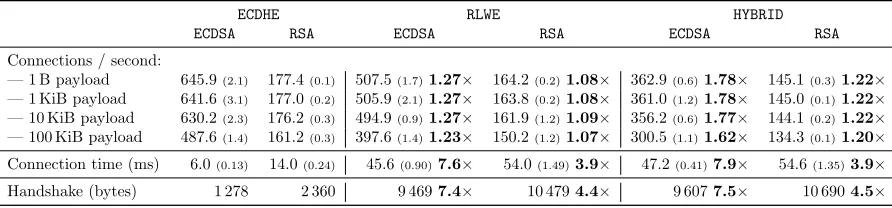
Our cryptographically secure implementation, aimed at the 128-bit security level, reveals that the performance price when switching from non-quantum-safe key exchange is not too high. With our R-LWE ciphersuites integrated into the OpenSSL library and using the Apache web server on a 2-core desktop computer, we could serve 506RLWE-ECDSA-AES128-GCM-SHA256HTTPS connections per second for a 10 KiB payload. Compared to elliptic curve Diffie–Hellman, this means an 8 KiB increased handshake size and a reduction in throughput of only 21%. This demonstrates that provably secure post-quantum key-exchange can already be considered practical.
Keywords: post-quantum; learning with errors; Transport Layer Security (TLS); key exchange
Contents
1 Introduction 3
2 Background on ring learning with errors 6
2.1 Notation. . . 6
2.2 The decision R-LWE problem . . . 6
2.3 Rounding and reconciliation functions . . . 6
2.4 Discrete Gaussians . . . 7
3 Unauthenticated Diffie–Hellman-like key exchange protocol 8 4 Implementing R-LWE 10 4.1 Parameter selection. . . 10
4.2 Sampling from the Gaussian. . . 10
4.3 Correctness of the scheme . . . 12
4.4 Polynomial arithmetic . . . 12
5 Integration into TLS 13 5.1 Message flow and operations. . . 13
5.2 Implementation . . . 13
5.3 Security model: authenticated and confidential channel establishment (ACCE) . . . 15
5.4 Security result . . . 17
6 Performance 22 6.1 Standalone cryptographic operations . . . 22
6.2 Within TLS and HTTPS . . . 23
7 Conclusions 24
References 25
A Sage commands for parameter estimation 28
1
Introduction
While lattice-based primitives [Reg05,Reg06] have been used to achieve exciting new cryptographic function-alities like fully homomorphic encryption [Gen09] and multilinear maps [GGH13], there has also been a great deal of work on instantiating traditional cryptographic functionalities using lattices. One of the catalysts for this direction of research is that, unlike other number-theoretic primitives1 such as RSA [RSA78] and elliptic
curve cryptography (ECC) [Mil86,Kob87], lattices are currently believed to offer resilience against attacks using quantum computers. Motivated by suchpost-quantum security, in this work we replace the traditional number-theoretic key exchange in the widely deployed Transport Layer Security (TLS) protocol [DR08] with one based on the ring learning with errors (R-LWE) problem [LPR13a], which is related to hard lattice problems. Using lattice problems in addition to or instead of number-theoretic problems is useful not only in protecting against attacks by quantum computers but also in providing robustness if other mathematical breakthroughs lead to more efficient algorithms for factoring or compute discrete logarithms.
Our basic key exchange protocol is simple—similar to the unauthenticated Diffie–Hellman protocol [DH76]— and comes with a rigorous proof of security based on the R-LWE problem. We put it in the context of TLS by (i) constructing a TLS ciphersuite that uses R-LWE key exchange rather than elliptic curve Diffie–Hellman (ECDH), (ii) providing a proof in a suitable security model [JKSS12] that this new TLS ciphersuite is a secure channel, and (iii) integrating our software implementation into the OpenSSL library to benchmark its performance against elliptic curve Diffie–Hellman key exchange. This analysis gives practitioners an idea of the price one would pay for using R-LWE to cure post-quantum paranoia today. We focus our work on the key exchange component, not authentication: we assume that a quantum computer does not currently exist so that the standard RSA-based authentication in TLS is secure for now. However, using R-LWE as a current key exchange mechanism would assure us that if a quantum computer is realized at some stage in the future, the ephemeral session keys we establish today will remain secure so long as the R-LWE problem does.
R-LWE at the 128-bit security level. The implementation we describe in this work is intended to serve as a drop-in replacement for traditional forward-secret key exchange mechanisms targeting the 128-bit security level, e.g. in place of the standardized elliptic curvenistp256, which is the most widely used elliptic curve in TLS [BHH+13] and provides much faster key exchange than finite-field Diffie–Hellman. While the
complexities of the best known attacks against these traditional primitives are widely agreed upon, the state of affairs for attacks against R-LWE is altogether different: for one, there are more parameters that affect the security level in the realm of ideal lattices, so many papers differ significantly in their suggested combinations of parameter sizes for particular security levels. In addition, the majority of authors giving concrete parameters in the (R-)LWE setting have done so at the 80-bit security level. Thus, in this work we have always opted for the conservative approach, making security parameters larger or smaller than they might need to be at stages where the actual attack complexity is unclear. The upshot is that our performance timings could be viewed as somewhat of an upper bound for R-LWE key exchange at the 128-bit level.
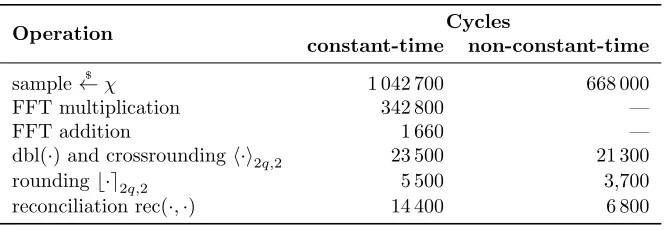
Implementation and performance. We implemented the R-LWE algorithms in C. As it has become mandatory to guard cryptographic implementations against physical attacks, such as the leakage of secret material overside channels [Koc96], we have implemented an important counter-measure against such attacks by ensuring our implementation hasconstant run-time: the execution time of the implementation does not depend on the input. In practice this is usually realized by eliminating all code that contains data-dependent branches, however this often incurs a performance penalty, so we also provide performance of our variable-time implementation in order to highlight the price one pays in practice when guarding against physical attacks in the context of R-LWE. The most expensive R-LWE operation is sampling from the error distribution, which takes slightly over one million cycles, and has to be performed once by the client and twice by the server during key exchange.
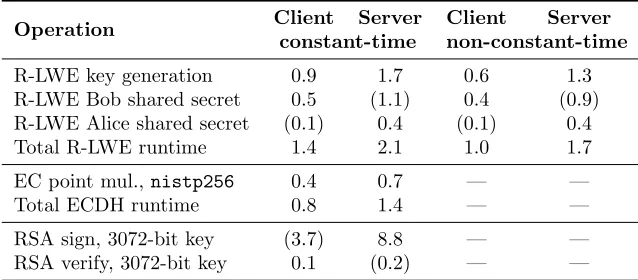
We integrated our R-LWE algorithm into the OpenSSL library. Whereas OpenSSL’s implementation of ECDH using the nistp256curve takes about 0.8 ms total (here we are referring to just the ECDH point operations, no other signing or encryption operations), the R-LWE operations take about 1.4 ms for the client’s operations and 2.1 ms for the server’s operations (on a standard desktop computer; see Section6.2):
1 B 1 KiB 10 KiB 100 KiB 0
100 200 300 400 500 600 700
ECDHE-ECDSA
RLWE-ECDSA
HYBRID-ECDSA
ECDHE-RSA RLWE-RSA HYBRID-RSA
HTTP payload size
Connections
p
er
second
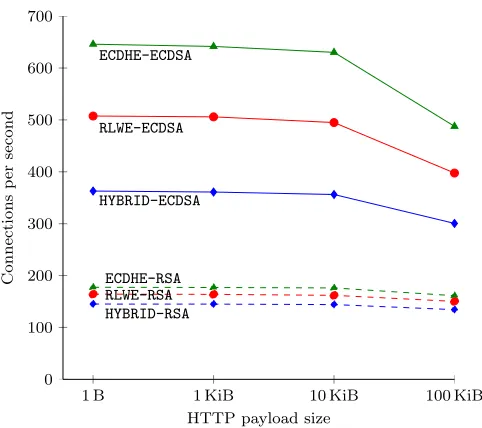
Figure 1: HTTPS connections per second supported by the server at 128-bit security level. All ciphersuites useAES-128-GCMandSHA256.
our constant-time R-LWE implementation is a factor of 1.8–2.6 times slower than ECDH. However, our implementation is entirely in C, so further performance improvements could be achieved through assembly-level optimizations or architecture specific optimization like using the vector instruction set, as well as through a more aggressive parameter selection.
While this is a significant performance difference in terms of raw cryptographic operations, the penalty of using R-LWE becomes less pronounced when used in the context of TLS, as seen in Fig.1. We did performance testing with our modified OpenSSL in the context of the Apache web server. Using a 3072-bit RSA certificate for authentication (we chose RSA for authentication because the vast majority of commercial certificate authorities only support RSA, and we chose 3072-bit RSA keys to match the desired 128-bit security level [NIS12]), our 2-core web server (serving 10 KiB web pages) could handle 177ECDHE-RSA-AES128-GCM-SHA256connections per second, compared to 164RLWE-RSAconnections per second, a factor of about 1.08 difference. Switching to ECDSA-based authentication, we can serve 642 ECDHE-ECDSA versus 506 RLWE-ECDSA connections per second, which is a larger gap, but which shows thatRLWE-ECDSAis still highly competitive. Even forhybrid ciphersuites, which use both ECDH and R-LWE key exchange (for users who worry about the potential of quantum computers but still need to use ECDH for reasons such as FIPS compliance2), performance is
reasonable. It should be noted that using R-LWE instead of ECDH increases the handshake by about 8 KiB. Our performance data demonstrates that R-LWE is a plausible candidate for providing post-quantum key exchange security in TLS. There is a performance penalty for web servers compared to elliptic curve cryptography—a factor of between 1.08–1.27 in our portable C implementation—but this is not too bad. Performance improvements can be expected as future research is done on parameter choices and scheme designs, new optimizations are developed, and CPU speeds increase.
Related work. Regev [Reg05] was the first to give a public key encryption scheme from the learning with errors problem. Like ElGamal public key encryption, this scheme implicitly contains a key encapsulation mechanism and then one-time-masks the KEM shared secret with the message. Peikert [Pei09] describes a corresponding approximate key agreement protocol. Lindner and Peikert [LP10a,LP10b,LP11] gave an improved approximate key agreement protocol allowing a square matrix and relying on two applications of the LWE assumption in the proof. Ding et al. [DXL12, §3] present a DH-like protocol based on LWE and give a security proof. Blazy et al. [BCDP13, Fig. 1, 2] describe a similar DH-like protocol based on LWE but without a detailed analysis. Katz and Vaikuntanathan [KV09] build a password-authenticated key exchange protocol from the LWE problem.
Whereas the hardness of LWE is related to the shortest vector problem (SVP) on lattices, the R-LWE problem is related to the SVP on ideal lattices, allowing for shorter parameter sizes. Lyubashevsky, Peikert, and Regev [LPR10] were the first to give a public key encryption scheme from ring-LWE. Like ElGamal public key encryption, this scheme implicitly contains a key encapsulation mechanism and then one-time-masks the KEM shared secret with the message. Four existing works present key exchange protocols based on R-LWE: Ding et al. [DXL12,§4], Fujioka et al. [FSXY13,§5.2], Peikert [Pei14,§4.1], and Zhang et al. [ZZD+14]. The
first three bear similarities, although differ somewhat in the error correction of the shared secret. Ding [DXL12, version 1] explicitly wrote out the ring-LWE-based key exchange protocol corresponding to LPR public key encryption and gave a reconciliation mechanism for direct approximate key agreement which relies on both most significant and least significant bits and uses a single bit of communication. Peikert [Pei14] explicitly wrote out the key encapsulation mechanism (KEM) corresponding to the LPR public key encryption scheme, and gave a variant on reconciliation which relies on the most significant bits. Fujioka et al. and Peikert phrase their protocols as KEMs which have passive (IND-CPA) security. To achieve a fully post-quantum authenticated key exchange protocol, Fujioka et al. use standard techniques [FO99] to compile a passively secure KEM into an actively secure KEM which is used to provide authentication in a KEM-KEM approach [FSXY12], whereas Peikert uses a SIGMA-like design [Kra03]. Zhang et al.construct an HMQV-like key exchange protocol that uses R-LWE for both long-term and ephemeral keys. Our work builds on Peikert’s passively secure KEM and uses Peikert’s variant of reconciliation, but is phrased in a DH-like fashion. Our work contrasts with Ding’s, Peikert’s, and that of Zhang et al. in that we integrate the R-LWE key exchange directly into TLS, perform authentication using standard signatures for ease of adoption, and provide a constant-time implementation with full performance measurements.
NTRU [HPS97] is another lattice-based cryptographic primitive that potentially resists attacks by quantum computers and relies on arithmetic in a polynomial ring. In 2001 an Internet-Draft was published proposing NTRU-based ciphersuites for TLS, with authentication using either NTRU or RSA signatures [Sin01]. Although not widely adopted or standardized, it has been implemented in the CyaSSL library. A recent open-source implementation of NTRU public key encryption in a standalone setting reports that at the 128-bit security level optimized NTRU key generation and private key operations can require about 1.0 ms and 0.1 ms runtime, respectively, on a desktop CPU with key sizes of 0.6 KiB.3 While outperforming our R-LWE protocol both in terms of performance and key sizes, one major advantage of using R-LWE is that it provides security proofs via reductions to hard standard problems in ideal lattices, whereas NTRU is not known to be provably secure in the sense that no such reduction is known; as well, there are no known patents covering R-LWE, whereas use of NTRU in non-GPL-licensed software is restricted under patents.
Organization and summary of contributions. The main contribution of this work is the design, security analysis, and implementation of key exchange for the TLS protocol which is conjectured to be post-quantum secure. Our work serves as an off-the-shelf, drop-in replacement to the traditional number-theoretic (but post-quantuminsecure) key exchange mechanisms already deployed in TLS, with comparable efficiency.
The first step is the construction of a key agreement protocol whose simplicity, functionality and high-level description closely mimics that of the discrete logarithm-based DH protocol. As mentioned above, previous (R)-LWE-based key exchange constructions were not phrased to resemble traditional DH; this is why we present a new, simple and provably secure key agreement protocol in Section3. In Section4we discuss the implementation details specific to our R-LWE protocol; this includes parameter selection, error sampling, and polynomial arithmetic. Although we prove that our standalone scheme is cryptographically secure in Section3, in Section5we bridge an important practical gap by proving that its integration into the TLS protocol is also secure using the standard security model for TLS. This proof, alongside our constant-time, fast, open-source implementation, are two of the high-level contributions that set our work aside from previous works on lattice-based key-agreement (cf. [BCDP13, KV09, FSXY13, Pei14, ZZD+14]). In Section 6 we
present performance measurements of the standalone R-LWE operations and of our protocol in the context of TLS; our R-LWE implementation is sufficiently optimized to be an order of magnitude faster than another recent lattice-based key agreement protocol [ZZD+14] (which is not integrated into TLS). We conclude the
paper in Section7. The appendix contains additional standard cryptographic definitions.
3
2
Background on ring learning with errors
This section introduces notation and presents the basic background for cryptographic schemes based on the ring learning with errors (R-LWE) problem, which was introduced in [LPR13a] (see also [LPR13b,Pei14]). Terminology is mostly as in [Pei14].
2.1
Notation
Let Z be the ring of rational integers, and let R = Z[X]/(Φm(X)) be the ring of integers of the m-th
cyclotomic number field, i.e. Φm∈Z[X] is them-th cyclotomic polynomial. In this paper, we restrict to the case of mbeing a power of 2. This means that Φm(X) =Xn+ 1 forn= 2l,l > 0 andm= 2n. Let q be an integer modulus and defineRq =R/qR∼=Zq[X]/(Xn+ 1) withZq =Z/qZ. Ifχ is a probability
distribution overR, thenx←$ χ denotes samplingx∈R according toχ. If S is a set, thenU(S) denotes the uniform distribution onS, and we denote samplingxuniformly at random fromS either withx← U$ (S) or sometimesx←$ S. IfAis a probabilistic algorithm,y← A$ (x) denotes runningAon inputxwith randomly chosen coins and assigning the output toy. Different typefaces and cases are used to represent different types of objects: Algorithms (also A,B, . . .); Queries; Protocols, Schemes, and ProtocolMessages; variables;
security-notions; andconstants. AdvxxxY (A) denotes the advantage of algorithmAin breaking security notion
xxxof scheme or protocolY.
2.2
The decision R-LWE problem
Using the above notation, we define the decision version of the R-LWE problem as follows.
Definition 1 (Decision R-LWE problem). Letn, R, q andRq be as above. Let χ be a distribution overR,
and lets←$ χ. Define Oχ,sas the oracle which does the following:
1. Samplea← U$ (Rq),e
$ ←χ, 2. Return(a, as+e)∈Rq×Rq.
The decision R-LWE problem forn, q, χis to distinguishOχ,s from an oracle that returns uniform random
samples fromRq×Rq. In particular, if Ais an algorithm, define the advantage
Advdrlwen,q,χ(A) = Pr
s←$ χ;AOχ,s(·) = 1
−PrAU(Rq×Rq)(·) = 1
.
Note that the R-LWE problem presented here is stated in its so-called normal form, which means that the secretsis chosen from the error distribution instead of the uniform distribution overRq as originally
defined in [LPR13a]. See [LPR13b, Lemma 2.24] for a proof of the fact that this problem is as hard as the one in whichsis chosen uniformly at random.
2.3
Rounding and reconciliation functions
Ding [DXL12, version 1] gave a reconciliation mechanism for direct approximate key agreement which relies on both most significant and least significant bits and uses a single bit of communication. Peikert [Pei14] gives a variant which relies on the most significant bits. The remainder of this section introduces notation and concepts needed for the key exchange protocols below, mainly following Peikert [Pei14]. Letb·e:R→Z be the usual rounding function, i.e. bxe=z forz∈Zandx∈[z−1/2, z+ 1/2).
Definition 2. Let qbe a positive integer. Define the modular roundingfunction
b·eq,2:Zq →Z2, x7→ bxeq,2=
j
2
qx
m
mod 2.
and the cross-roundingfunction
h·iq,2:Zq →Z2, x7→ hxiq,2=
j
4
qx
k
Both functions are extended to elements of Rq coefficient-wise: for f =fn−1Xn−1+· · ·+f1X+f0∈Rq,
define
bfeq,2 =bfn−1eq,2,bfn−2eq,2, . . . ,bf0eq,2
,
hfiq,2 =hfn−1iq,2,hfn−2iq,2, . . . ,hf0iq,2
.
In [Pei14], Peikert defines a reconciliation mechanism using the above functions. If the modulusqis odd, it requires to work inZ2q instead ofZq to avoid bias in the derived bits. Since we use oddqin this paper, we
need to introduce the randomized doubling function from [Pei14]: let dbl :Zq →Z2q, x7→dbl(x) = 2x−e,
whereeis sampled from{−1,0,1}with probabilitiesp−1=p1=14 andp0= 12. The following lemma shows
that the rounding of dbl(v)∈Z2q for a uniform random elementv∈Zq is uniform random inZ2q given its
cross-rounding, i.e. hdbl(v)i2q,2 hidesbdbl(v)e2q,2.
Lemma 1([Pei14, Claim 3.3]). For oddq, ifv∈Zq is uniformly random andv
$
←dbl(v)∈Z2q, thenbve2q,2
is uniformly random given hvi2q,2.
The randomized doubling function dbl is extended to elements f ∈ Rq by applying it to each of its
coefficients, resulting in a polynomial inR2q, which in turn can be taken as an input to the rounding functions b·e2q,2and h·i2q,2.
In [Pei14], a reconciliation function is defined to recoverbveq,2 from an elementw∈Zq close to an element v∈Zq, given onlywand the cross-rounding hviq,2. We recall the definition from [Pei14] working viaZ2q
since the modulusqis odd in this paper. Define the sets I0={0,1, . . . ,
q
2
−1}andI1={−
q
2
, . . . ,−1}. LetE= [−q4,q4), then the reconciliation function rec :Z2q×Z2→Z2is defined by
rec(w, b) =
(
0, ifw∈Ib+E mod 2q,
1, otherwise.
It is shown in the next lemma that one can recover the roundingbdbl(v)e2q,2 of a random elementv∈Zq
from an elementw∈Zq close tov and the cross-roundinghdbl(v)i2q,2.
Lemma 2([Pei14, Section 3.2]). For odd q, let v=w+e∈Zq forw, e∈Zq such that 2e±1∈E (mod q).
Let v= dbl(v). Thenrec(2w,hvi2q,2) =bve2q,2.
Again, reconciliation of a polynomial in Rq is done coefficient-wise using the reconciliation function on
Z2q×Z2. Note that Lemma2 ensures that for two polynomialsv, w∈Rq which are close to each other, i.e. v=w+efor a polynomial e, the polynomialw can be exactly reconciled tobve2q,2given hvi2q,2 whenever every coefficient ei ∈ Zq of the difference e ∈Rq satisfies 2ei±1∈ E (modq). The rounding functions
in Definition 2are trivial to implement. They involve a simple precomputed partitioning of Zq into two
(not necessarily connected) subdomains Dand Zq\D, and on input ofx∈Zq, these functions return a bit
depending on whetherx∈D or not. The time taken by the rounding functions is negligible compared to the other cryptographic operations while the time of the doubling function is dominated by sampling of the necessary random bits (see Section6.1 for details).
2.4
Discrete Gaussians
The distributionχreferred to in the above definition of the R-LWE problem is usually a discrete Gaussian distribution onR. Since this paper restricts to the case ofn= 1024 being a power of 2, sampling from a discrete Gaussian can be done by sampling each coefficient from a 1-dimensional discrete GaussianDZ,σwith parameter σ(see [LPR13a,§1.2]). The discrete Gaussian (see [DG14]) assigns to eachx∈Za probability proportional toe−x2/(2σ2), normalized by the factorS = 1 + 2P∞
k=1e
−k2/(2σ2)
, given by DZ,σ(x) = S1e−x
2/(2σ2)
. The discrete Gaussian distribution onRis the discrete GaussianDZn,σ obtained by sampling each coefficient from
Public parameters
Decision R-LWE parametersq, n, χ a← U$ (Rq)
Alice Bob
s, e←$ χ s0, e0←$ χ b←as+e∈Rq
b
−→ b0←as0+e0∈Rq
e00←$ χ
v←bs0+e00∈Rq
v←$ dbl(v)∈R2q b0,c
←− c← hvi2q,2∈ {0,1}n
kA←rec(2b0s, c)∈ {0,1}n kB← bve2q,2∈ {0,1}n
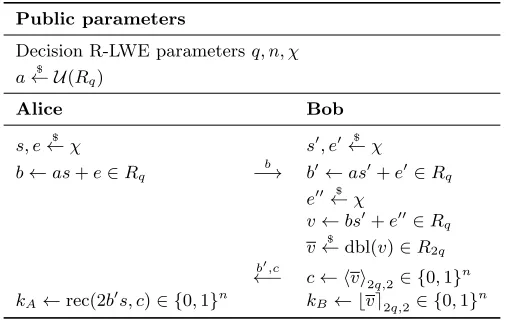
Figure 2: Unauthenticated Diffie–Hellman-like key exchange from R-LWE.
3
Unauthenticated Diffie–Hellman-like key exchange protocol
In this section we describe an unauthenticated Diffie–Hellman-like key exchange protocol based on the R-LWE problem. In order to have an exact key exchange protocol, we need to apply error correction to Alice’s computation of the shared secret. We employ the reconciliation mechanism described in§2.3, resulting in a key exchange protocol that is effectively a reformulation of Peikert’s KEM [Pei14,§4]. There are several advantages to phrasing it as a Diffie–Hellman-like protocol: it is easier to integrate into existing network protocols like TLS that are DH-based; many other cryptographic schemes are built from DH assumptions, so having ring-LWE encapsulated as a DH-like assumption may serve as a suitable building block elsewhere in cryptography; and cryptographers and security practitioners we have spoken with understand this work much better when we phrase it as a DH-like protocol. This protocol, shown in Fig.2, is a rephrasing of the following computational problem:
Definition 3(DDH-like problem). Letq, n, χbe R-LWE parameters. Thedecision Diffie–Hellman-like (ddh`) problem for q, n, χis to distinguish DH-like tuples with a real shared secret from those with a random value, given reconciliation information. IfA is an algorithm, define
Advddhq,n,χ` (A) =|Pr (A(a, b, b0, c, k) = 1)−Pr (A(a, b, b0, c, k0) = 1)| ,
where a ← U$ (Rq), s, s0, e, e0, e00
$
← χ, b ← as+e, b0 ← as0+e0, v ← bs0+e00, v ←$ dbl(v), c ← hvi2q,2,
k← bve2q,2, andk0← U$ ({0,1}n).
Theorem 1 (Hardness of DDH-like problem). Letq be an odd integer, let nbe a parameter, and χ be a distribution onRq. If the decision R-LWE problem forq, n, χis hard, then the DDH-like problem forq, n, χ
is also hard. More precisely,
Advddhn,q,χ` (A)≤Advn,q,χdrlwe(A ◦ B1) + Advdrlwen,q,χ(A ◦ B2)
whereB1 andB2 are the reduction algorithms given in Fig.3.
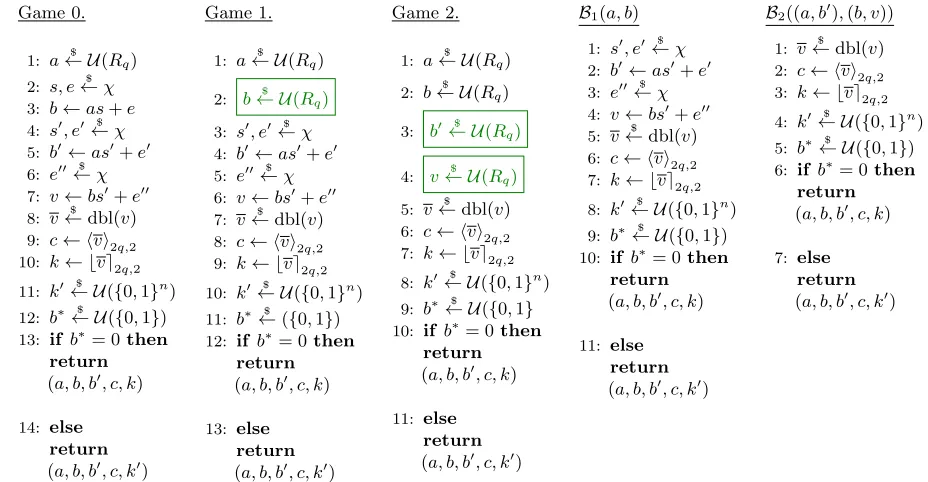
Proof. The proof closely follows Peikert’s proof of IND-CPA security of the related KEM [Pei14, Lemma 4.1]. It proceeds by a sequence of games which are shown in Fig.3. LetSibe the event that the adversary guesses
the bitb∗ in Gamei.
Game 0. This is the original game, where the messages are generated honestly as in Fig.2. We want to bound Pr(S0). Note that in Game 0, the R-LWE pairs are: (a, b) (with secrets); and (a, b0) and (b, v) (both
with secrets0). Hence,
Game 0.
1: a← U$ (Rq)
2: s, e←$ χ 3: b←as+e 4: s0, e0←$ χ 5: b0←as0+e0 6: e00←$ χ 7: v←bs0+e00 8: v←$ dbl(v) 9: c← hvi2q,2
10: k← bve2q,2
11: k0← U$ ({0,1}n)
12: b∗← U$ ({0,1}) 13: if b∗= 0then
return (a, b, b0, c, k)
14: else return (a, b, b0, c, k0)
Game 1.
1: a← U$ (Rq)
2: b← U$ (Rq)
3: s0, e0←$ χ 4: b0←as0+e0 5: e00←$ χ 6: v←bs0+e00 7: v←$ dbl(v) 8: c← hvi2q,2
9: k← bve2q,2
10: k0← U$ ({0,1}n)
11: b∗←$ ({0,1}) 12: if b∗= 0then
return (a, b, b0, c, k)
13: else return (a, b, b0, c, k0)
Game 2.
1: a← U$ (Rq)
2: b← U$ (Rq)
3: b0← U$ (Rq)
4: v← U$ (Rq)
5: v←$ dbl(v) 6: c← hvi2q,2
7: k← bve2q,2
8: k0← U$ ({0,1}n
) 9: b∗← U$ ({0,1}
10: if b∗= 0then return (a, b, b0, c, k)
11: else return (a, b, b0, c, k0)
B1(a, b)
1: s0, e0←$ χ 2: b0←as0+e0 3: e00←$ χ 4: v←bs0+e00 5: v←$ dbl(v) 6: c← hvi2q,2
7: k← bve2q,2
8: k0← U$ ({0,1}n
) 9: b∗← U$ ({0,1}) 10: if b∗= 0then
return (a, b, b0, c, k)
11: else return (a, b, b0, c, k0)
B2((a, b0),(b, v))
1: v←$ dbl(v) 2: c← hvi2q,2
3: k← bve2q,2
4: k0← U$ ({0,1}n
)
5: b∗← U$ ({0,1}) 6: if b∗= 0then
return (a, b, b0, c, k)
7: else return (a, b, b0, c, k0)
Figure 3: Sequence of games and reductionsB1 andB2 for proof of Theorem1.
Game 1. In this game, Alice’s ephemeral public key is generated uniformly at random, rather than being generated as a R-LWE sample from distributionχand public parametera. Note that in Game 1, the R-LWE pairs are: (a, b0) and (b, v) (both with secrets0).
Difference between Game 0 and Game 1. In Game 0, (a, b) is a sample fromOχ,s. In Game 1, (a, b)
is a sample fromU(R2
q). Under the decision ring learning with errors assumption (Definition1), these two
distributions are indistinguishable.
More explicitly, letB1 be the algorithm shown in Fig.3 that takes as input a pair (a, b). When (a, b) is a
sample fromOχ,swheres
$
←χ, then the output ofB1 is distributed exactly as in Game 0. When (a, b) is a
sample fromU(R2
q), then the output ofB1is distributed exactly as in Game 1. Thus, ifAcan distinguish
Game 0 from Game 1, thenA ◦ B1 can distinguish samples fromOχ,s from samples fromU(R2q). Thus,
|Pr(S0)−Pr(S1)| ≤Advdrlwen,q,χ(A ◦ B1) . (2)
Game 2. In this game, the shared secret key k is generated uniformly at random, rather than being generated via a combination of Alice and Bob’s ephemeral keys. Note that in Game 2, there are no R-LWE pairs.
Difference between Game 1 and Game 2. In Game 1, (a, b0) and (b0, v) are two samples fromOχ,s0. In Game 2, (a, b0) and (b0, v) are two samples from U(R2
q). Under the decision ring learning with errors
assumption (Definition1), these two distributions are indistinguishable.
More explicitly, letB2be the algorithm shown in Fig.3that takes as input two pairs ((a, b0),(b, v)). When
(a, b0) and (b, v) are samples fromOχ,s0 wheres0←$ χ, then the output ofB2is distributed exactly as in Game 1. When (a, b0) and (b, v) are samples fromU(R2
q), then the output ofB2 is distributed exactly as in Game
2. Thus, ifAcan distinguish Game 1 from Game 2, then A ◦ B2 can distinguish samples fromOχ,s from
samples fromU(R2q). Thus,
|Pr(S1)−Pr(S2)| ≤Advdrlwen,q,χ(A ◦ B2) . (3)
Analysis of Game 2. In Game 2, the adversary is asked to guessb∗ and thereby distinguish betweenk
andk0. Since kis computed ask← bve2q,2 wherevis chosen uniformly at random fromRq andv
$
←dbl(v), we have from Lemma1thatkis distributed uniformly on{0,1}n, even givenc=hvi
uniformly at random from{0,1}n. Note thatkandk0 are independent of the valuesa, b, b0, cprovided to the
adversary. Thus, the adversary has no information aboutb∗, and hence
Pr(S2) = 1/2 . (4)
Analysis of Game 2. Combining equations (1)–(4) yields the result.
4
Implementing R-LWE
In this section we describe two implementations of the R-LWE key exchange protocol. The difference between the two implementations arises from the fact that one takes additional measures to ensure that the routine runs inconstant-time, meaning that there is no data flow from secret material to branch conditions.
4.1
Parameter selection
For our implementation, we chose the following parameters: n = 1024, q = 232−1, σ = 8/√2π ≈
3.192. These parameters provide a security of at least 128 bits against the distinguishing attack described in [MR09, LP11, vdPS13, LN14] with distinguishing advantage less than 2−128, when run by a classical,
non-quantum adversary. To achieve a certain advantage requires the adversary to find a short vector of a certain length in a corresponding lattice. We evaluated the parameters with the analysis from [LN14], which uses the BKZ-2.0 simulation algorithm according to [CN11]. Based on our simulation results, the parameters guarantee that an adversary running BKZ 2.0 cannot obtain a vector of the required size in 2128
steps, keeping the distinguishing advantage below 2−128.
Albrecht et al. [APS15] provide a variety of Sage scripts for calculating the runtime of several different algorithms for (classically) solving LWE. With our parameters, the best classical attack is to solve LWE via BDD (Bounded Distance Decoding problem) by reducing BDD to uSVP (unique shortest vector problem) by Kannan’s embedding technique, and to implement the SVP oracle via sieving; the total runtime is estimated using Albrecht et al.’s scripts as 2163.8 operations (combining heuristic runtime estimates with experimental observations) with at least 294.4 memory usage. (See Appendix7 for the commands.)
The runtime of the best known quantum attacker is less clear. While Grover’s search algorithm gives a square-root speedup to the search problem, it is not necessarily the case that Grover’s algorithm immediately halves the security level. For example, Laarhoven et al. [LMvdP14] give a quantum algorithm for finding shortest lattice vectors in time 21.799n+o(n), compared to the best known classical algorithm with time
22.465n+o(n). If the best quantum algorithm is just a square-root speedup of the best known classical
algorithm, then our parameters would require 281.9 operations for a quantum attacker to break; but it is
an open question whether Grover’s algorithm can naively be applied in that way, or whether the quantum impact is less dramatic like in the work of Laarhoven et al.
The above mentioned algorithms do not use the ideal lattice structure, which means that they treat the R-LWE problem as a general LWE problem. This is common practice, since currently there is no attack on R-LWE that significantly improves upon the best known attacks on LWE for either a classical or a quantum computer. Previous works on implementing lattice-based cryptographic primitives typically use smaller dimension (usually n= 512, provided the schemes are not used for homomorphic encryption for which dimensions are much larger). By increasing the dimension to 1024 we are particularly conservative against progress in lattice-basis reduction algorithms. The size of the modulusqprovides a large margin for correctness and could possibly be reduced. Note that according to [BLP+13], the form of the modulus does not have an influence on the security of the LWE problem. Assuming that this also holds for R-LWE, we allow the modulus to be composite.
4.2
Sampling from the Gaussian
In this subsection we describe how to samplesmall elements in the ringRq; this corresponds to the operations
each of then= 1024 coefficients of anRq-element from a one-dimensional discrete Gaussian. For more details
on inversion sampling, and on (R-)LWE-style sampling in general, see [DG14].
For a one-dimensional, discrete Gaussian distributionDZ,σ centred atµ= 0 with standard deviationσ,
recall from§2.4the probability of a random variable taking the valuex∈Zis
DZ,σ(x) =
1
Se
−x2/(2σ2)
,
where S=P∞
k=−∞e−k
2/(2σ2)
; in our case, whenσ= 8/√2π, we haveS= 8.
Our adaptation of inversion sampling uses a precomputed lookup table T = [T[0], . . . T[51]] of size 52, where T[0] =b2192· 1
Sc, where
T[i] =
$
2192· 1
S + 2 i
X
x=1
DZ,σ(x)
!%
fori= 1, . . . ,50, and whereT[51] = 2192. SinceS = 8, note that all table elements are integers in [2189,2192], and thatT[i+ 1]> T[i] fori= 0, . . . ,50. The sampling of an elements∈Rq, denoteds
$
←χ, is performed as follows. Writes=P1023
j=0 sjXj. For each j= 0, . . . ,1023, we independently generate a 192-bit integervj
uniformly at random, and compute the unique smallest integer indexindj ∈[0,50] such thatvj < T[indj].
We then generate one additional random bit to decide the signsignj ∈ {−1,1}, and return thej-th coefficient
assj ←signj·indj. Note that since every operation of the form s
$
←χ requires 1024 random strings of
length 192, in total we need 196,608 bits of randomness for each execution of the operation←$ χ. Since the 1024 coefficients ofsare sampled independently, the sampling routine isembarassingly parallelizable.
As outlined above, our implementation needs a large amount of random data (e.g. we need 24 KiB of random data each time we sample a small ring element). It is sufficient from a security perspective and more efficient to use a random number generator to create a seed value whose size is determined by the security parameter, then expand this seed using a pseudo random number generator (PRNG) when sampling ring elements. The PRNG should use quantum-safe primitives to retain security against quantum attackers. In our implementation, we use OpenSSL’sRAND bytes function to generate a 256-bit seed, then use AES in counter mode as the PRNG function to obtain the subsequent 24 KiB of data for sampling. We re-seed the PRNG for each ring element.
The security (proof) of our protocol requires that the statistical difference of our sampling algorithm and the theoretical distribution is less than 2−128. The proposition below shows that this is indeed the case; the
accompanying proof uses two lemmas (and the associated notation) from [DG14].
Proposition 1. Let D00 be the distribution corresponding to the sampling routine described above and let
DZn,σ be the true discrete Gaussian distribution onZn. The statistical difference ∆(D00, DZn,σ)of the two
distributions is bounded by
∆(D00, DZn,σ)<2−128.
Proof. In [DG14, Lemma 1], we use k = 129, m = 1024, σ = 8/√2π and c = 1.30872 to get Pr(||v|| >
42σ) < 2−129 for v ← D
Zn,σ. Subsequently, we take t = 42 and = 2−192 in [DG14, Lemma 2] to get
∆(D00, DZn,σ)<2−k+ 2mtσ= 2−129+ 2·210·42·(8/ √
2π)·2−192<2−128. Finally, for allx∈
Zwith|x|>51, the true probabilitiesDZ,σ(x) in [DG14, Lemma 2] (where they are denotedρx) are such thatDZ,σ(x)<2−192,
meaning that we can zero the approximate probabilities px and maintain |px−DZ,σ(x)| =|DZ,σ(x)|< ;
this allows the individual samples to be instead taken from [−51,51], provided T[51] is set as 2192 so that
P51
x=−51px= 1.
We implemented the above sampling routine in two different ways, based on the way that each indexindj
is retrieved fromT (on input of the random 192-bit integervj). The first uses a plain binary search which
routine that loads every table element and creates a mask based on whether each accessed element is smaller than the input or not. This requires exactly 51 (constant-time) integer comparisons, which explains the performance difference between these routines (see Section6).
4.3
Correctness of the scheme
In this subsection we provide a brief argument as to why the key agreement scheme in Fig.2is indeedexact.
Proposition 2. If two parties honestly execute the protocol in Fig. 2, the probability that the two derived keys are not the same is less than 2−214.
Proof. We usexi to denote thei-th coefficient of a ring elementx∈Rq, i.e. x=Pn−
1
i=0 xiXi. By the cyclic
nature of reduction moduloXn+ 1, it is straightforward to see that (xy)i=Pn−
1
j=0xjy˜j, where for each fixed
(i, j) there is a uniqueksuch that ˜yj=±yk (i.e. the ˜yj’s are, up to sign, just a reordering of theyj’s).
The reconciliation functions that derivekAandkB fromb0s= (as0+e0)sandv= (as+e)s0+e00in Fig.2
can only producekA6=kB if there is at least one value of i∈[0, n−1] such that|vi−(b0s)i| ≥ q8−12, see the
condition in Lemma2. For a fixedi, we bound the probabilitypi that|vi−(b0s)i|>q8−12 as follows. Write |vi−(b0s)i|=|(es0)i+e00i −(e0s)i|=|P
n−1
j=0 ej˜s0j+e00i +
Pn−1
j=0 e
0
js˜j|, where ˜sj and ˜s0j are used to denote the
appropriate reorderings (and sign changes when necessary) of thesj ands0j, respectively. Observe that since
there are 2n+ 1 terms in the previous sum, if |vi−(b0s)i|>q8−12, then at least one of theej,ej0,sj, s0j or
indeede00i must exceed z=q8(2q−n+1)4 in absolute value (note that 511< z <512). As all of these coefficients
are sampled from a one-dimensional discrete Gaussian, we know the probability of an individual coefficient exceedingz in absolute value is equal to 2P∞
x=512DZ,σ(x). Since the probability that at least oneof the
2n+ 1 terms exceedsz is clearly bounded above by the sum of all 2n+ 1 individual probabilities (of each coefficient exceedingz), we have thatpi<2(2n+ 1)P∞x=512DZ,σ(x). Similarly, the probability that at least
one coefficient ofkAandkB disagree is clearly bounded above by the sum of all thepifor 0≤i < n, so we get
Pr(kA6=kB) ≤ n−1
X
i=0
pi < 2n(2n+ 1) ∞
X
x=512
DZ,σ(x).
As an upper bound on the sum on the right hand side, we use the integral
Z ∞
511
DZ,σ(x)dx=
1
S
Z ∞
511
e−x2/(2σ2)dx=
√ 2σ S Z ∞ 511 √ 2σ
e−t2dt.
The integral on the right is equal to
√ π
2 erfc(511/ √
2σ), where erfc is the complementary error function.
We use [CCM11, Thm.1 and Cor.1], and obtain that erfc(x)≤e−x2. Overall, we get that Pr(kA6=kB)≤
2n(2n+ 1)· √ 2σ S · √ π 2 e
−5112/2σ2
. For our parameters, we get Pr(kA6=kB)≤222e−511
2·π/82
<2−214
.
4.4
Polynomial arithmetic
The arithmetic used in the key agreement scheme is polynomial arithmetic in the cyclotomic ring Rq =
Zq[X]/(Φ2l+1(X)) where Zq = Z/qZ and Φ2l+1(X) = X2 l
+ 1 is the 2l+1-th cyclotomic polynomial. We
assume that 2 is invertible in the ringZq (i.e.q is odd). Multiplying two elements inRq can be achieved
by computing the discrete Fourier transform via fast Fourier transform (FFT) [CT65] algorithms. More specifically, we use the approach from Nussbaumer [Nus80] based on recursive negacyclic convolutions (see [Knu97, Exercise 4.6.4.59] for more details) since this naturally applies to cyclotomic rings where the degree is a power of 2.
Nussbaumer observed that for any ringRin which 2 is invertible and whenever 2l=k·rwithk|rthen
R[X]/(X2l+ 1)∼= (R[Z]/(Zr+ 1))[X]/(Z−Xk),
multiplication method requiresO(llogl) multiplications inR. Investigation of other asymptotically efficient polynomial multiplication algorithms, such as Sch¨onhage-Strassen multiplication [SS71], is left as future research.
We implemented the version of Nussbaumer’s method as outlined by Knuth [Knu97, Exercise 4.6.4.59]. We useq= 232−1 to define
Zq, note thatqis not prime (q= (21+ 1)(22+ 1)(24+ 1)(28+ 1)(216+ 1)). This
choice of the modulusqallows us to compute the modular reduction efficiently. We follow the strategy for the modular arithmetic in [BCHL13], and our implementation represents the elements inZq as{0, . . . , q−1}
(rather than, say, {−bq/2e, ...,bq/2e}). If a prime modulusqis required, one could use the eighth Mersenne prime: 231−1. This also allows efficient modular reduction but we found that an exponent which is a multiple
of eight outweighs other positive performance aspects.
5
Integration into TLS
In this section we discuss the integration of R-LWE into the Transport Layer Security (TLS) protocol. We describe how to integrate the R-LWE-based key exchange protocol into the message flow of TLS, discuss our implementation in the OpenSSL software,4 and demonstrate that the new ciphersuites satisfies the standard
security model for TLS.
5.1
Message flow and operations
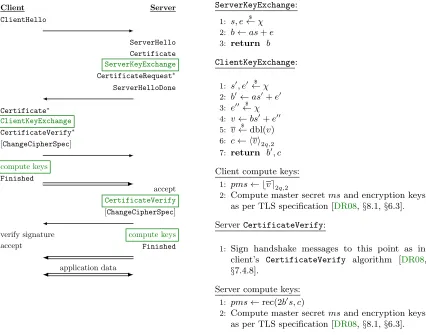
The message flow and cryptographic computations for our TLS ciphersuite with signatures for entity authentication and R-LWE for key exchange are given in Fig.4. The R-LWE key exchange values from the basic protocol (Fig.2) are inserted in theServerKeyExchange andClientKeyExchangemessages. Notice that, compared with signed-Diffie–Hellman ciphersuites, the server’s signature is separated out from the
ServerKeyExchangemessage into a separate CertificateVerifymessage near the end of the handshake; for the rationale of this design choice, see Remark4. Note that current drafts of TLS 1.3 [DR15] also separate out the server signature into a separate message near the end of the handshake even for normal signed-DH ciphersuites, so our message flow is compatible with the design of TLS 1.3. We fixed a public parameterato be used by all parties. We generatedaonce at random; for standardization purposes, a singleavalue should be generated in a verifiably random, “nothing up my sleeve” manner (e.g. as the output of a hash function whose input is a well-defined seed without much room for choosing alternate inputs). The computation of each of the ciphersuite-specific (highlighted) messages, as well as the premaster key derivation, is given in Fig.4. Notice that, since the server sends the first key exchange message, the server plays the role of Alice from the basic unauthenticated DH-like protocol (Fig.2) and the client plays the role of Bob.
5.2
Implementation
We implemented the R-LWE-based ciphersuite described in the previous subsection into OpenSSL. Specif-ically, we created four new ciphersuites, all designed to achieve a 128-bit security level. The first two,
RLWE-ECDSA-AES128-GCM-SHA256andRLWE-RSA-AES128-GCM-SHA256, consist of:
• key exchange based on R-LWE key exchange, as described in Section5.1and Fig.4, with parameters as described in Section 4.1, namelyn= 1024,q= 232−1, andσ= 8/√2π;
• authentication based on ECDSA or RSA digital signatures;5
• authenticated encryption (with associated data) (AEAD) based on AES-128 in GCM (Galois Counter Mode), which provides confidentiality as well as message integrity without the addition of a separate MAC; and
• key derivation and hashing based on SHA-256.
We also created two HYBRIDciphersuites that are as above, except the key exchange includes both R-LWE and ECDH key exchange; the pre-master secret is the concatenation of the ECDH shared secret and the R-LWE shared secret.
4http://www.openssl.org/
Client Server
ClientHello
ServerHello
Certificate ServerKeyExchange
CertificateRequest∗
ServerHelloDone
Certificate∗ ClientKeyExchange
CertificateVerify∗
[ChangeCipherSpec]
compute keys
Finished
accept
CertificateVerify
[ChangeCipherSpec]
verify signature accept
compute keys
Finished
application data
ServerKeyExchange:
1: s, e←$ χ 2: b←as+e 3: return b
ClientKeyExchange:
1: s0, e0←$ χ 2: b0←as0+e0 3: e00←$ χ 4: v←bs0+e00 5: v←$ dbl(v) 6: c← hvi2q,2
7: return b0, c Client compute keys:
1: pms← bve2q,2
2: Compute master secretmsand encryption keys as per TLS specification [DR08,§8.1,§6.3].
ServerCertificateVerify:
1: Sign handshake messages to this point as in client’s CertificateVerify algorithm [DR08,
§7.4.8].
Server compute keys: 1: pms←rec(2b0s, c)
2: Compute master secretmsand encryption keys as per TLS specification [DR08,§8.1,§6.3].
∗
denotes optional messages for client authentication and [ChangeCipherSpec] denotes theChangeCipherSpecalert protocol message, after which all data sent by that party is encrypted and authenticated on the record layer. Single lines ( ) denote unprotected communication, double lines ( ) denote encrypted/authenticated (record layer) communication, rectangles highlight messages or steps which have changed for this ciphersuite.
Figure 4: The TLS protocol with a signed R-LWE key exchange ciphersuite. Left: TLS message flow. Right: R-LWE-specific computations.
All these ciphersuite require TLSv1.2 because of the use of AES-GCM (which we chose since it provably satisfies the stateful length-hiding authenticated encryption notion [PRS11]), but TLSv1.0 ciphersuites using AES in CBC mode are possible.
We integrated our C code implementation of the R-LWE operations described in Section4into OpenSSL v1.0.1f. Specifically, we added the unauthenticated DH-like protocol from Section3to OpenSSL’slibcrypto
module, then added the TLS ciphersuite to OpenSSL’slibsslmodule, and finally extended various OpenSSL command-line programs (such as openssl speed, s client, and s server) appropriately. Note that all required randomness is generated using OpenSSL’sRAND bytesfunction. The resulting libraries can then be used with OpenSSL-reliant applications with few or no changes. For example, to use our R-LWE ciphersuite with Apache’s httpdweb server,6 it suffices to recompile Apache to link against the new OpenSSL library, and set the ciphersuite option in Apache’s runtime configuration files. We report on the performance of the new ciphersuite in Section6.2.
5.3
Security model: authenticated and confidential channel establishment (ACCE)
We now turn to analyzing the security of our new TLS ciphersuite. Jager et al. [JKSS12] introduced the authenticated and confidential channel establishment (ACCE)security model to prove the security of TLS. It is based on the Bellare–Rogaway model for authenticated key exchange [BR94], but leaves the key exchange security property implicit, instead having separate properties for entity authentication and channel security, where the latter property is based on the stateful length-hiding authenticated encryption notion introduced by Paterson et al. [PRS11] for the TLS record layer. In this subsection, we present the ACCE security model, and in the next section we prove security of the ciphersuite in that model. Our model differs slightly from the original model in that it explicitly includes forward secrecy. Our presentation is based largely on the text of Bergsma et al. [BDK+14].
Parties, long-term keys, and sessions. Theexecution environmentconsists ofnPpartiesP1, . . . , PnP,
each of whom is a potential protocol participant. Each partyPi generates a long-term private key / public key
pair (ski, pki). Each party can execute multiple sessions of the protocol, either concurrently or subsequently.
We denote thes-th session of a protocol at partyPi byπis, and usenSto denote the maximum number of
sessions per party. Each session within the party has read access to the party’s long-term key, and read/write access to the per-session variables. We overload notation and useπs
i to denote the collection of the following
per-session variables:
• ρ∈ {init,resp}: The party’s role in this session.
• pid∈ {1, . . . , nP,⊥}: The identifier of the alleged peer of this session, or⊥for an unauthenticated peer. • α∈ {inprogress,reject,accept}: The status of the session.
• k: A session key, or⊥. Note thatkconsists of two sub-keys: bi-directional authenticated encryption keyskeandkd, which themselves may consist of encryption and possibly MAC sub-keys.
• sid: A session identifier defined by the protocol.
• stE, stD: State for the stateful authenticated encryption and decryption algorithms (see Definition9). • b: A hidden bit (used for a security experiment). On session initialization,b← {$ 0,1}.
• Additional state specific to the security experiment as described in Fig.5.
• Any additional state specific to the protocol.
Adversary interaction. The adversary controls all communications: it directs parties to initiate sessions, delivers messages to parties, and can reorder, alter, delete, and create messages. The adversary can also compromise certain long-term or per-session secrets. The adversary interacts with the parties using the following queries.
The first query models normal, unencrypted communication of parties during session establishment:
• Send(i, s, m) →$ m0: The adversary sends message m to session πs
i. Party Pi processes message m
according to the protocol specification and its per-session stateπs
i, updates its per-session state, and
optionally outputs an outgoing messagem0. There is a distinguished initialization message which allows the adversary to initiate the session with the roleρit is meant to play in the session and optionally the identitypid of the intended partner of the session. This query may return error symbol⊥if the session has entered state α=acceptand no more protocol messages are transmitted over the unencrypted channel.
The next two queries model adversarial compromise of long-term and per-session secrets:
• Reveal(i, s)→k: Returns session keyπs i.k.
• Corrupt(i)→sk: Return partyPi’s long-term secret keyski. Note the adversary does not take control
of the corrupted party or learn state variables, but can impersonate Pi in later sessions by using ski.
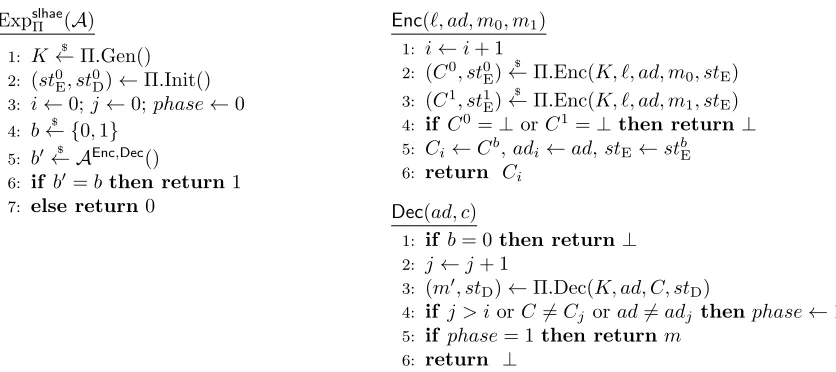
The final two queries model communication over the encrypted channel. The adversary can cause plaintexts to be encrypted as outgoing ciphertexts, and can cause ciphertexts to be decrypted and delivered as incoming plaintexts. The queries are used to capture the security notion of stateful length-hiding authenticated encryption as described in Appendix7.
• Encrypt(i, s, m0, m1) $
→C: Ifπs
i.k=⊥, the query returns⊥. Otherwise, it procceds as in Fig.5. • Decrypt(i, s, C)→mor⊥: Ifπs
Enc(i, s, `, ad, m0, m1) 1: πis.u←π
s i.u+ 1
2: (C0, πsi.st0E)
$
←AENC.Enc(πis.k, `, ad, m0, πis.stE)
3: (C1, πs i.st1E)
$
←AENC.Enc(πs
i.k, `, ad, m1, πis.stE)
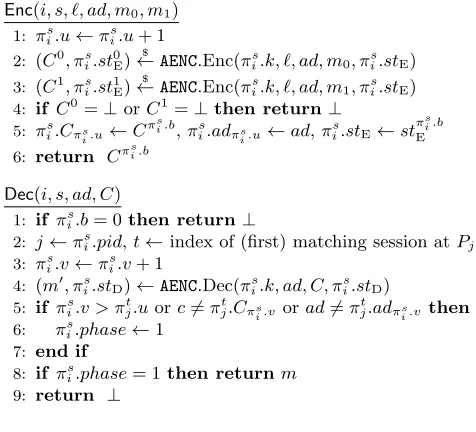
4: if C0=⊥orC1=⊥then return⊥
5: πs i.Cπs
i.u←C
πsi.b,πs i.adπs
i.u←ad,π
s
i.stE←st πsi.b
E 6: return Cπis.b
Dec(i, s, ad, C) 1: if πs
i.b= 0then return⊥
2: j←πis.pid,t←index of (first) matching session atPj
3: πis.v←π s i.v+ 1
4: (m0, πs
i.stD)←AENC.Dec(πsi.k, ad, C, πsi.stD)
5: if πsi.v > π t
j.uorc6=π t j.Cπs
i.v orad6=π
t j.adπs
i.vthen
6: πs
i.phase←1
7: end if 8: if πs
i.phase= 1then returnm
9: return ⊥
Figure 5: Encrypt andDecryptoracles for the ACCE security experiment.
The Encrypt/Decrypt oracles, which embody the stateful length-hiding authenticated encryption property, simultaneously capture four security properties:
• indistinguishability under chosen ciphertext attack: the adversary cannot distinguish whetherm0orm1
is encrypted, even when given access to a decryption oracle;
• integrity of ciphertexts: only ciphertexts generated by legitimate parties successfully decrypt;
• integrity of associated data; and
• stateful delivery of ciphertexts: the adversary cannot deliver ciphertexts out of order. The hidden bitπs
i.bis leaked to the adversary if any of those conditions are violated.
Security experiment. The ACCE security experiment is played between an adversaryAand a challenger
C who implements all parties according to the execution environment above. After the challenger initializes the long-term private key / public key pairs, the adversary receives the public keys and then interacts with the challenger using the queries above. Finally, the adversary outputs a triple (i, s, b0) and terminates. The adversary’s goal is to either break authentication (by causing an honest session to accept without a matching session) or to successfully guess that the bitb used in theEncrypt/Decrypt oracles of session SV owner is equal tob0. The details of these security goals follow. We begin by defining matching sessions.
Definition 4 (Matching sessions). We say that session πt
j matches πsi if πis.ρ =6 πjt.ρ and πsi.sid
prefix-matches πt
j.sid, meaning that (i) ifπsi sent the last message in πis.sid, then πjt.sid is a prefix ofπis.sid, or
(ii) ifπt
j sent the last message inπsi.sid, thenπsi.sid=πjt.sid.
Correctness is defined in the natural way: in the presence of a benign adversary, two communicating oracles will (with overwhelming probability) accept, compute equal session keys, and be able to successfully communicate encrypted application data. For details see [KPW13, full version, Defn. 10].
We can now define server-to-client (a.k.a., server-only) authentication based on the existence of matching sessions.
Definition 5(Server-to-client authentication). LetP be a protocol. Letπsi be a session. Letj=πsi.pid. We say thatπsi accepts maliciouslyif
1. πsi.α=accept; 2. πsi.ρ=init; and
3. noCorrupt(j)query was issued before πis accepted, but there is no unique sessionπt
Define AdvacceP -so-auth(A)as the probability that, whenAtermiantes in the ACCE experiment forP, there
exists a(n initiator) sessionπisthat has accepted maliciously.
We define channel security based on the adversary’s ability to guess the hidden bitbof an uncompromised session, thereby breaking one of the four properties of stateful length-hiding authenticated encryption described above. We focus on channel security in the context of server-only authentication, so the adversary wins if it guesses the hidden bit at any client session, or at any server session in which it was passive.
Definition 6(Channel security with forward secrecy in server-only authentication mode). LetP be a protocol. Let πs
i be a session. Let j =πis.pid. Suppose A outputs (i, s, b0). We say thatA answers the encryption
challenge correctly if 1. πs
i.α=accept;
2. noCorrupt(i) query was issued beforeπs
i accepted;
3. noCorrupt(j)query was issued before any session πt
j which matches πisaccepted;
4. noReveal(i, s)query was ever issued;
5. noReveal(j, t) query was ever issued for any sessionπt
j which matches πis;
6. πsi.b=b0; 7. and either:
(a) πs
i.ρ=init; or
(b) πs
i.ρ=resp and there exists a session which matchesπsi.
Define AdvacceP -so-aenc-fs(A) as |p−1/2|, where pis the probability that, in the ACCE experiment for P,A
answers the encryption challenge correctly.
Remark 1 (Mutual authentication). We focus on the case of server-to-client authentication, as that is the dominant mode in which TLS is used on the Internet. The ACCE framework can deal with the mutual authentication case as well, by removing item2 from Definition5and item7 from Definition6.
5.4
Security result
The following informal theorem summarizes our security result for our R-LWE-based TLS ciphersuite. The proof is in the standard model, and does not rely on random oracles.
Theorem 2 (TLS signed R-LWE is a secure ACCE (informal)). Let TLS-RLWE-SIG-AENC denote the TLS protocol with a R-LWE-based ciphersuite as described in Fig.4, withSIGfor the signature scheme and AENC
as the stateful length-hiding authenticated encryption for the record layer. LetPRFdenote the pseudorandom function used by TLS in that ciphersuite.
If the signature schemeSIGis existentially unforgeable under chosen message attack, thenTLS-RLWE-SIG-AENC
provides secure server-to-client authentication.
If additionally the DDH-like problem for the R-LWE parameters is hard, PRFis a secure pseudorandom function, andAENCis a secure stateful length-hiding authenticated encryption scheme, thenTLS-RLWE-SIG-AENC
provides channel security, with forward secrecy, in server-only auth. mode. Moreover, the protocol is correct with high probability.
Precise statements for the server-to-client authentication property and the channel security property are given in Lemmas3 and4. Precise statements of the correctness property are omitted, as they follow clearly from Section4.3. Security definitions of standard cryptographic components appear in Appendix7.
Lemma 3(Server-to-client authentication). LetAdenote an adversary against the server-only authentication ofTLS-RLWE-SIG-AENC. Then, for the reduction algorithm B2 described in the proof of the lemma,
AdvacceTLS--RLWEso-auth-SIG-AENC(A)≤(nPnS) 2
2`rand +nPAdv
euf-cma
SIG (B
A
2) .
Proof. The proof proceeds via a sequence of games. Since we have altered the TLS protocol so that the server signs the the whole transcript, our proof is simpler than the signed-DH TLS proof of Jager et al. [JKSS12] or Krawczyk et al. [KPW13]. In particular, our proof follows closely the proof of signed-DH in the Secure Shell (SSH) protocol of Bergsma et al. [BDK+14], in which the server signs the whole handshake transcript.
Letbreakδ be the event that occurs when a client session accepts maliciously in Gameδ in the sense of
Game 0 [original experiment]. This game equals the ACCE security experiment described in Section5.3. Thus,
AdvacceTLS--RLWEso-auth-SIG-AENC(A) = Pr(break0) . (5)
Game 1 [exclude colliding nonces]. In this game, we add an abort rule for non-unique noncesrC orrS.
Specifically, the challenger collects a list of all random nonces sampled by the challenger for client or server sessions during the simulation. If one nonce appears on the list twice, the simulator aborts the simulation. This is a transition based on a failure event. There are at most nPnS sampled random nonces, each taken
uniformly at random from{0,1}`rand. Thus,
Pr(break0)≤Pr(break1) +
(nPnS)2
2`rand . (6)
Game 2 [signature forgery]. In this game, we exclude signature forgeries. Technically, we abort the simulation the first time some sessionπs∗
i∗ accepts after receiving a signature that was not the output of a session with a matching session identifier and the signing peer’s long-term public key was uncorrupted at the timeπs∗
i∗ accepted; denote this as eventabort2. We excluded nonce collisions in the previous game, so in this
game all values signed by honest parties are different. We show that the abort event is related to a signature forgery.
To demonstrate the signature forgery, we construct an algorithmBA
2 which simulates the TLS protocol
execution as in Game 1. B2 interacts with A. B2 receives a public key pk∗ from an euf-cma signature
challenger forSIGand guesses a partyj∗. In its simulation of Game 1,B2 usespk∗ asj∗’s public key andB2
uses the signing oracle from theeuf-cmasignature challenger forSIGto generate all signatures forj1. Under
the assumption that the abort eventabort2occurs, with probability 1/nP, sessionπs ∗
i∗ aborted after receiving a forged signature for partyj∗. Moreover, the adversary did not issue aCorrupt(j∗) query. Thus,B2 can
perfectly simulate Game 1: in particular,B2 can answer any Corruptqueries for all parties other thanj∗
without knowing the signing key corresponding to pk∗, and Corrupt(j∗) is not asked.
Since we have excluded nonce collisions, the signature received byπsi∗∗ on the handshake transcript ofπs ∗
i∗ was not output by any instance ofj∗ thatB
2 has simulated. This implies thatBdid not query the signing
oracle of itseuf-cmasignature challenger for this transcript. This transcript and signature is thus a valid forgery.
Thus, if B2guessj∗ correctly (which happens with probability 1/nP), thenAhas helpedB2 find a valid
forgery for theeuf-cmachallenger forSIG. Thus,
Pr(abort2)≤nPAdveufSIG-cma(B A
2) . (7)
Moreover, games 1 and 2 are indistinguishable as long as the failure event does not occur, so
|Pr(break1)−Pr(break2)| ≤Pr(abort2) . (8)
Game 2 only completes if the abort event abort2 does not occur. By definition of the abort event,
this means that no client session accepts without a matching session whenever the peer’s public key was uncompromised. Thus game 2 cannot be won:
Pr(break2) = 0 . (9)
Combining equations (5)–(9) yields the result.
Lemma 4 (Channel security, server-only auth. mode). Let A denote an adversary against the channel security (in server-only authentication mode) ofTLS-RLWE-SIG-AENCin the sense of Definition 6. Then, for the reduction algorithmsB2 described in the proof of Lemma3andD3, . . . ,D6 described in the proof of this
lemma,
AdvacceTLS-RLWE-so-aenc-SIG-fs-AENC(A)≤ (nPnS) 2
2`rand +nPAdv
euf-cma
SIG (B
A
2)
+nPnS
Advddhq,n,χ` (D3A) + Adv
prf
PRF(D A
4) + Adv
prf
PRF(D A
5) + Adv
slhae
AENC(D A
6)
.
Proof. The proof again proceeds via a sequence of games, and follows closely the proofs of signed-DH channel security of TLS by Jager et al. [JKSS12] and of SSH by Bergsma et al. [BDK+14].
The adversary’s goal is to compute that random bitπs∗
i∗.bof a client session (where the peer’s long-term key was uncorrupted at the time the client accepted) or the random bit of a server session (where a matching anonymous client session exists).
Let guessδ be the event that occurs whenA answers the encryption challenge correctly for session π, namely that Aoutputs a tuple (i, s, b0) such thatπ.b=b0 but all freshness conditions in Definition 6are satisfied.
Game 0 [original experiment]. This game equals the ACCE security experiment described in Section5.3. Thus,
AdvacceTLS--RLWEso-aenc-SIG-fs-AENC(A) =|Pr(guess0)−1/2| . (10)
Game 1 [exclude non-matching sessions]. In this game, we exclude sessions that have no matching session. Technically, we abort the simulation in either of the following cases:
1. if the adversary’s chosen sessionπis a client session that accepted without a matching session and no
Corrupt(π.pid) query occurred before πaccepted; or
2. if the adversary’s chosen session πis a server session that accepted without a matching session. In the first case, this directly corresponds to a server impersonation, and thus a break in authentication. The second case is already excluded by Definition6. Thus,
|Pr(guess0)−Pr(guess1)| ≤Adv
acce-so-auth
TLS-RLWE-SIG-AENC(A) . (11)
Game 2 [guess target session]. In this game, we guess which session will be the adversary’s target session. Technically, we pick (i∗, s∗)←$ [nP]×[nS], then continue as in game 1, and at the end abort if the
adversary’s chosen session (i, s)6= (i∗, s∗). Our guess is correct with probability n1
PnS. Thus,
Pr(guess1) =nPnSPr(guess2) . (12)
There now exists a unique partner sessionπt∗
j∗ for the guessed sessionπs ∗
i∗ which can be determined by the simulator by looking for matching client/server nonces.
Game 3 [replace R-LWE premaster secret]. In this game, we replace the premaster secret pmsin sessionπsi∗∗ and its peerπt
∗
j∗ with a value chosen uniformly at random from{0,1}n. Any algorithm that can distinguish game 2 from game 3 can be used to construct an algorithm that can distinguish DH-like R-LWE tuples with a real shared secret from those with a random value, in the sense of Definition3.
More explicitly, letDA
3 be the following algorithm that receives an DDH-like challenge (ˆa,ˆb,bˆ0,ˆc,ˆk) for
R-LWE parametersq, n, χ. D3 executes just as in game 2 and interacts withA, with the following exceptions. • The system uses ˆaas the global R-LWE parametera.
• When the target server session (whichever ofπs∗ i∗ andπt
∗
j∗is the server) is generating itsServerKeyExchange message, the simulator uses the given ˆb value, rather than generatingb as in Fig.4.
• When the target client session (whichever ofπs∗ i∗ andπt
∗
j∗is the client) is generating itsClientKeyExchange message, the simulator uses the given ˆb0 and ˆc values, rather than generatingb0 andcitself as in Fig.4. • When the target client and server sessions are computing keys, the simulator uses ˆkas the premaster
secret rather than generating pmsitself as in Fig.4. WhenAterminates and outputs (i, s, b0),D3 outputsb0.
When D3receives an DDH-like tuple with a real shared secret, thenD3 behaves exactly as in game 2.
When D3 receives an DDH-like tuple with a random shared secret, thenD3 behaves exactly as in game 3.
Thus,D3 behaves differently on real versus random tuples exactly with the same probability thatAbehaves
differently on game 2 versus game 3:
|Pr(guess2)−Pr(guess3)| ≤Adv
ddh`