DIMENSIONAL QUANTIZATION OF TIME DILATION: Analysis of time dilation using dimensional geometry:- G Deeraj Kumar Page 980
DIMENSIONAL QUANTIZATION OF TIME DILATION
Analysis of time dilation using dimensional geometry
G Dheeraj Kumar1
Abstract:
The term time dilation is somewhat seems to be a very difficult to understand whether the dilation is because of relative masses or relative velocities under same gravitational field. The thing interesting here is that, where the theory of relativity explains time dilation is due to gravity well which states that it occurs either because of the relative velocity of motion between two observers, or the difference in their distance from a gravitational mass. Now my contribution to this theory is that the time dilation not only due to because of theory of relativity but also due towave interaction loss of electromagnetic fields in gravitons because of the coordinate transformation in space which is explained by using Euclidean dimensional geometry. The theme of the paper is to produce the theoretical results using dimensional geometry to study the approximation of time dilation and time dimension.
Keywords:
quantum field theory, fundamental interaction, time dilation, dimensional quantization, gravitons, electrostatic field, gravity well.
1
DIMENSIONAL QUANTIZATION OF TIME DILATION: Analysis of time dilation using dimensional geometry:- G Deeraj Kumar Page 981
Introduction:
From the theory of relativity, space-time is an important study to analyze exactly how time behaves in space. Einstein described that time is a fourth dimension when space is taken as 3-Dimensional from Euclidean Geometry. An implication of Einstein’s theory of general relativity is that Euclidean space is a good approximation to the properties of physical space only where the gravitational field is not too strong. So within the inertial frame of reference, gravitational masses have their dependence on the clock vector. From this we can say that when time is taken as dimension it acts as (n+1)th dimension for a known “n” dimensions. For example, let’s consider a 3-D space coordinates where n=3 and the fourth dimension is taken as time, which makes total dimensions as four (4-D) space coordinates. This individuality reveals that time can be taken as fourth dimension. But
when we take effective field theory into consideration, by law of reflection gravity it can be noticed that gravity can be scattered.so, due to this scattering it can be said that the fundamental interaction may takes place if the time is taken as fourth dimension. This fundamental interaction for gravity is taken as the wave interaction of gravitons carrying electromagnetic fields as their force of interactions. Now coming to the time dilation, no way it’s concerned with the field theory and it’s just an experimental determination which induced the mathematical relation as mentioned below.
The above formula is a simple interference of time dilation due to relative velocity.
When coming to the gravitational time dilation, its noticed that for both differently positioned at a definite distanced observers, the clock that is closer to the gravitational mass, i.e. deeper in its "gravity well", appears to go slower than the clock that is more distant from the mass (or higher in altitude away from the center of the gravitational mass). That does not mean that the two observers fully agree: each still makes the local clock to be correct; the observer more distant from the mass (higher in altitude) measures the other clock (closer to the mass, lower in altitude) to be slower than the local correct rate, and the observer situated closer to the mass (lower in altitude) measures the other clock (farther from the mass, higher in altitude) to be faster than the local correct rate. They agree at least that the
clock nearer the mass is slower in rate and on the ratio of the difference.
From the above mentioned two predictions the theory fails to explain why there is dilation in time if it’s a count quantity. So my theory here says that time can be mathematically quantized due to the dimensional isometry of an infinite undefined space geometry, where there is a fundamental interaction of gravitons which carry electromagnetic fields as their waves for interactions.
Theory and techniques used:
DIMENSIONAL QUANTIZATION OF TIME DILATION: Analysis of time dilation using dimensional geometry:- G Deeraj Kumar Page 982
contributions what I made from the theories are as follows. To explain the theory more precisely and technically there were some realities and assumptions made to overcome
the problems of revealing the data. So following table gives the analysis of actual to assumptions made for further outcome of paper.
Actual considerations Assumption considerations
1. Consideration of relative velocities 1.Consideration of relative velocities 2. Consideration of gravity well affects 2.Consideration of gravity well
3. Space time geometry is neglected 3. Consideration of quantum field theory 4. Positional vector is considered 4. Space time geometry is considered 5. Use of temporal coordinate systems 5. Positional vector is considered
6. Dilation due to gravitation and motion 6.Consideration of Theory of relativities 7. Use of general and special theory of 7.Use of mathematical models
Relativity. 8. Use of relative geometry
8. Space time geometry of time dilation 9. Time is not considered as geometry 9. Consideration of time as a dimension Gravity and electromagnetic field is taken as
Dimension
Methodology:
Since it’s a theoretical estimation, there is no specific methodology to specify by giving an experimental analysis. So consideration of different theories in different aspects wherever it’s applicable is the only way where one should understand..
So, for an average mind it seems to be difficult to understand that there exists graviton which carries an electromagnetic field as a force interaction between them. To
explain this in clear, let us take the following analysis
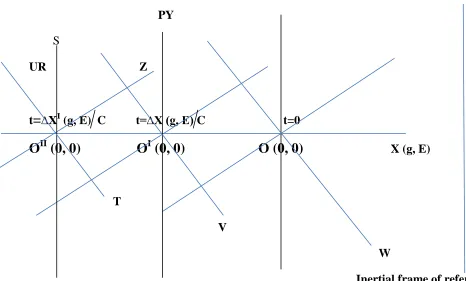
From the below figure it can be noticed that when we consider a 3D space axis with
DIMENSIONAL QUANTIZATION OF TIME DILATION: Analysis of time dilation using dimensional geometry:- G Deeraj Kumar Page 983
to the destiny at same time and yes it does appear.
PY
S
UR Z
t=∆XI
(g, E) C t=∆X (g, E) C t=0
O
II(0, 0) O
I(0, 0) O (0, 0) X (g, E)
T
V
W
Inertial frame of reference
Fig (a) Transformation of space axis in 3D universe
Figure references:
X (g, E) – Electromagnetic field axis
C- Velocity of light
O- Origin and further compliments on the origin specification includes shift in coordinate space axis
Now if the body is not moving relative to observer but moving with same velocity and same distance in different magnitudes within the gravitational field, the time taken for the body and observer take different time
counts. This is the term what time dilation is exactly.
DIMENSIONAL QUANTIZATION OF TIME DILATION: Analysis of time dilation using dimensional geometry:- G Deeraj Kumar Page 984
need that each graviton has its own characteristic flux which behaves differently with respect to the position of interaction of the body within the gravity. So when two bodies having same mass and same velocity and same distance that has to be travelled from same points to different destinies, then the objects passing through gravitational field has to encounter graviton interaction. Since graviton interaction has different property at different positions in the gravitational field, when these bodies travel through the flux of gravitons facing their electrostatic force, there is a loss of momentum in the object which is quite negligible but increases or decreases the time count.
So due to the geometrical isometry in space, we can define that there is no exact specified geometry defining the function of time with respect to space coordinates and gravity. So time has a function of both mass of the body and quantum field on the body. So time can be described with respect to quantum field and can be limited to the limited space. From this we can say that time dilation can be dimensionally quantized.
Importance:
1. Time response analysis in the satellite telemetry and improving the signal feedback system by reduction techniques.
2. Plotting of errors using control systems
References:
Quantum Gravity by Justina Robson and Stephen Hawking