Attacks and Security Proofs of EAX-Prime
⋆Kazuhiko Minematsu1, Stefan Lucks2, Hiraku Morita3, and Tetsu Iwata4
1
NEC Corporation, Japan,[email protected] 2
Bauhaus-Universit¨at Weimar, Germany,[email protected] 3
Nagoya University, Japan,h [email protected] 4
Nagoya University, Japan,[email protected]
Abstract. EAX′ (EAX-prime) is an authenticated encryption (AE) specified by ANSI C12.22 as a standard security function for Smart Grid. EAX′is based on EAX proposed by Bellare, Rogaway, and Wagner. While EAX has a proof of security based on the pseudorandomness of the internal blockcipher, no published security result is known for EAX′.
This paper studies the security of EAX′ and shows that there is a sharp distinction in security of EAX′ depending on the input length. EAX′ encryption takes two inputs, called cleartext and plaintext, and we present various efficient attacks against EAX′ using single-block cleartext and plaintext. At the same time we prove that if cleartexts are always longer than one block, it is provably secure based on the pseudorandomness of the blockcipher.
Keywords: Authenticated Encryption, EAX, EAX′, Attack, Provable Security.
1 Introduction
ANSI C12.22 [3] specifies a blockcipher mode for authenticated encryption (AE) as the standard security function for Smart Grid. It is called EAX′ (or EAX-prime)5. As its name suggests, EAX′ is based on EAX proposed by Bellare, Rogaway, and Wagner at FSE 2004 [8]. Though EAX is already efficient with a small amount of precomputation, EAX′ aims at even reducing the amount of precomputation and memory, for making it suitable to the resource-constrained devices, typically smart meters. ANSI submitted EAX′ to NIST [15] and NIST called for the public comments on the proposal to approve EAX′. Following ANSI C12.22, IEEE 1703 [6] and MC1222 [4] included EAX′. There is also an RFC [5] related to ANSI C12.22.
Though EAX′ is similar to EAX, to the best of our knowledge, its formal security analysis has not been published to date. In this paper, we investigate the security of EAX′ and show that there is a sharp distinction depending on the input length. The encryption algorithm of EAX′ takes two inputs, called cleartext and plaintext. In the standard AE terminology, the cleartext serves as a nonce, or a combination of nonce and associated data (the latter is also called header).
First, we show that if the lengths of cleartext and plaintext are not exceeding one block, there exist attacks against EAX′ for both privacy and authenticity. Specifically, we present
– forgeries, i.e., cleartext/ciphertext pairs with valid authentication tags,
– chosen-plaintext distinguishers, distinguishing the EAX′ encryption from a random encryp-tion process, and
– chosen-ciphertext plaintext recovery attacks, decrypting ciphertexts by asking for the decryp-tion of another ciphertext with a valid authenticadecryp-tion tag.
⋆
A part of the result was presented at DIAC [14], and a preliminary version of this paper appears in the proceedings of FSE 2013. This is the full version.
5
Our attacks are simple and efficient as they require only one or two queries. The simplest one even produces a successful forgery without observing any valid plaintext/ciphertext pair. Our forgery and distinguishing attacks strictly require the target system to accept one-block cleartext and plaintext. The plaintext recovery attacks relax this condition, and given any ciphertext with one-block cleartext it works for any circumstance where ciphertext is decrypted without checking the cleartext length. This makes the possibility of attack even larger. Our attacks imply that, while the original EAX has a proof of security, the security of EAX′ has totally collapsed as a general-purpose AE.
Next, we show that if the cleartext is always longer than one block, it recovers the provable security based on the pseudorandomness of the blockcipher for both privacy and authenticity notions. The security proof is obtained by combining previous proof techniques of EAX by Bel-lare, Rogaway, and Wagner [8] with some non-trivial extensions, such as Iwata and Kurosawa’s one used for proving the security of OMAC [11].
One may naturally wonder if our attacks are applicable to ANSI C12.22. Unfortunately we do not know if ANCI C12.22 protocols exclude one-block cleartexts or not, hence we have no clear answer. Still, considering the effect of our attacks, we conclude that EAX′ must be used with cleartext length check mechanisms at both ends of encryption and decryption.
2 Preliminaries
Basic Notations. LetN={0,1, . . .}. Let {0,1}∗ be the set of all finite-length binary strings, including the empty string ε. The bit length of a binary string X is written as |X|, and let
|X|n def
= ⌈|X|/n⌉. Here|ε|= 0. A concatenation ofX, Y ∈ {0,1}∗ is written as X∥Y or simply
XY. A sequence ofazeros (ones) is denoted by 0a(1a). Fork≥0, let{0,1}>k def=∪i=k+1,...{0,1}i and ({0,1}n)>k def= ∪j=k+1,...({0,1}n)j, and ({0,1}n)+ def= ({0,1}n)>0. We also define {0,1}≥k, ({0,1}n)≥k, {0,1}<k, ({0,1}n)<k, {0,1}≤k, and ({0,1}n)≤k analogously. For X, Y ∈ {0,1}n,
X+Y orX−Y is considered as an addition or a subtraction modulo 2n.
For X ∈ {0,1}∗, let X[1]∥X[2]∥. . .∥X[m] ←n X denote the n-bit block partitioning of X, i.e., X[1]∥X[2]∥. . .∥X[m] =X wherem =|X|n, and|X[i]|=nfor i < m and |X[m]| ≤n. For
X, Y ∈ {0,1}∗, let X⊕endY be the XOR of X into the end of Y if|X| ≤ |Y|, i.e.X⊕endY = (0|Y|−|X|∥X)⊕Y. OtherwiseX⊕endY =X⊕(0|X|−|Y|∥Y).
For a finite setX, ifX is uniformly chosen from X we write X← X$ .
Random Function and Random Permutation. Let Func(n, m) be the set of all functions
{0,1}n → {0,1}m. We may abbreviate Func(n, n) to Func(n). In addition, let Perm(n) be the set of all permutations over{0,1}n. A uniform random function (URF) havingn-bit input and
m-bit output is the set Func(n, m) with uniform distribution over Func(n, m). It is denoted by
R, and the corresponding sampling is written as R ←$ Func(n, m). An n-bit uniform random permutation (URP) is the set Perm(n) with uniform distribution over Perm(n). It is denoted by P, and the corresponding sampling is written as P←$ Perm(n).
Galois Field.Following [8], ann-bit stringX may be viewed as an element of GF(2n) by taking
3 Specification of EAX-Prime
We describe the encryption and decryption algorithms of EAX′. We changed the original nota-tions of EAX′[3,15] following those of EAX [8]. This illustrates the similarities and the differences of EAX and EAX′ (See also the last part of this section).
EAX′ is a mode of operation based on an n-bit blockcipher, E. Here we typically assume (n, E) = (128,AES-128), however other choice is possible [15]. The key of E is written as
K. Formally, the encryption function of EAX′ accepts a cleartext, N ∈ {0,1}∗ with N ̸= ε, a plaintext, M ∈ {0,1}∗, and a secret key, K, to produce the ciphertext, C ∈ {0,1}∗, with
|C|=|M|and the tagT ∈ {0,1}32. The decryption function, which we also call the verification function, acceptsN,C,T, andK and generates the decrypted plaintextM if (N, C, T) is valid, or the flag⊥if invalid. CleartextN contains information that needs to be authenticated, but not encrypted. ANSI document requires that N must be unique for all encryptions using the same key6. Hence N can be seen as a combination of a nonce and associated data in the standard terminology of AE (e.g., see [8]). The plaintext M can be the empty stringε, corresponding to the null string in [15], and in this case EAX′ works as a message authentication code forN.
For generality we assume that the tag length is specified by a predetermined parameter,
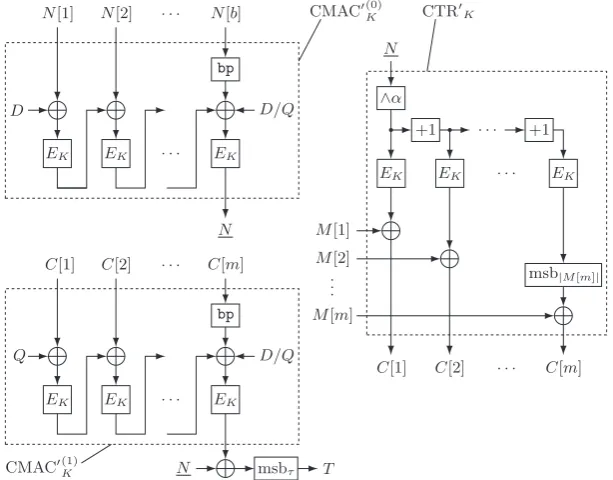
τ ∈ {1, . . . , n}. The original definition employs τ = 32. Let EAX′[E, τ] be EAX′ using n-bit blockcipher E with τ-bit tag. The corresponding encryption and decryption algorithms are written as EAX′-EK,τ and EAX′-DK,τ. If τ is clear from the context we may write EAX′[E] and EAX′-EK and EAX′-DK. These algorithms and their components are shown in Fig. 1. The encryption algorithm of EAX′ is depicted in Fig. 2. In Fig. 1, α denotes an n-bit constant, (1n−32∥0115∥0115). Note that CBC′K(0n, M) is equivalent to the standard CBC-MAC usingEK with input M, denoted by CBCK(M). In our description, we fixed an apparent error in line 72 of the original definition of EAX′.encryptK in [3, 15]. Some editorial errors of [15] were also pointed out by [1].
EAX′ and the Original EAX. The major differences between EAX′ and the original EAX
are summarized as follows. For other minor differences, see Section 3 of [15]. For the definition of EAX, see [8].
1. Role ofN. Inputs to EAX′-EK consist of a cleartext N and a plaintextM, whereas those to the original EAX consist of a nonceN, a header (or associated data)H, and a plaintextM. EAX′ requiresN to be unique, hence it works as a nonce. EAX′ does not explicitly define a headerH; information corresponding to the header is included in the cleartext N.
2. Tweaking method for CMAC. For inputM, CMAC [2] usingEK is defined as CMACK(M) = CBCK(pad(M;D, Q)). The original EAX uses the tweaked CMAC having an n-bit tweak
t, defined as CMACK(t∥M), fort ∈ {0n,0n−11,0n−210}, to process N,H, and C. For fast operation we need to precomputeEK(t) for allt and store them to RAM. EAX′ employs a different way to tweak CMAC accepting two tweak values (i= 0,1) to generate CMAC′(0)K and CMAC′(1)K for processing N and C. For fast operation we can precomputeL=EK(0n). This reduces the precomputation time and RAM consumption from the original EAX. 3. Counter mode incrementation. The original EAX uses CMACK(0n∥N) as an initial counter
block for CTR mode, while that of EAX′ is CMAC′(0)K (N)∧αto set some bits to zero. One can find a similar zeroing-out in the deterministic authenticated encryption called SIV [17]. As explained by [17], this contributes to a slight simpler operation.
6
AlgorithmEAX′-EK,τ(N, M)
1. N←CMAC′(0)K (N)
2. C←CTR′K(N , M)
3. T ←N⊕CMAC′(1)K (C)
4. T ←msbτ(T)
5. return(C, T)
AlgorithmEAX′-DK,τ(N, C, T)
1. N←CMAC′(0)K (N)
2. T ←N⊕CMAC′(1)K (C)
3. Tb←msbτ(T)
4. if Tb̸=T return⊥ 5. M ←CTR′K(N , C)
6. returnM
AlgorithmCMAC′(i)K(M) (fori∈ {0,1})
1. L←EK(0n)
2. D←2L,Q←4L
3. if i= 0then
4. returnCBC′K(D,pad(M;D, Q))
5. if i= 1then
6. returnCBC′K(Q,pad(M;D, Q))
AlgorithmCTR′K(N , M)
1. m← |M|n
2. N∧←N∧α
3. S←EK(N∧)∥ · · · ∥EK(N∧+m−1)
4. C←M⊕msb|M|(S) 5. returnC
AlgorithmCBC′K(I, M) (forM ∈({0,1}n)+)
1. M[1]∥M[2]∥. . .∥M[m]←n M
2. C[0]←I
3. fori←1 tomdo
4. C[i]←EK(M[i]⊕C[i−1])
5. returnC[m]
Algorithmpad(M;B1, B2)
1. if |M| ∈ {n,2n,3n, . . . ,}
2. then returnM⊕endB1
3. else
4. return(M∥10n−1−(|M|modn))⊕endB2
Fig. 1.(Upper) The encryption and decryption algorithms of EAX′[E, τ], originally withτ= 32. (Lower) Com-ponent algorithms of EAX′[E, τ]. Here,α= (1n−32∥0115∥0115).
4 Attacks Based on One-Block Cleartext
4.1 Chosen-Message Forgeries
We first describe forgery attacks against EAX′[E, τ]. Throughout the section D and Q denote 2L and 4L with L = EK(0n). The adversary A we consider here can access both encryp-tion and decrypencryp-tion (verificaencryp-tion) oracles, namely EAX′-EK and EAX′-DK. Suppose A (pos-sibly adaptively) asks q queries to the encryption oracle, (N1, M1), . . . ,(Nq, Mq), and receives (C1, T1), . . . ,(Cq, Tq), and then asks (N, C, T) to the decryption oracle. We sayAis successful if
A receives a string other than⊥and (N, C, T)̸= (Ni, Ci, Ti) for any 1≤i≤q (see also Section 5). Here we assume the nonce-respecting adversary [16]; it is allowed to query any (Ni, Mi) to the encryption oracle as long as Ni is unique.
Suppose M ∈ {0,1}≤n. Then pad(M;D, Q) = M ⊕endD = M ⊕D when |M| = n and
pad(M;D, Q) =M∥10n−1−|M|⊕endQ=M∥10n−1−|M|⊕Q when 0 ≤ |M|< n. Therefore, the definition of CMAC′(i)K in the previous section conforms to that
CMAC′(0)K (M) = {
EK(M) if|M|=n
EK(M∥10n−1−|M|⊕D⊕Q) if 0≤ |M|< n
CMAC′(1)K (M) = {
EK(M⊕D⊕Q) if|M|=n
EK(M∥10n−1−|M|) if 0≤ |M|< n
The above observation immediately gives the following attacks:
Forgery attack 1 (|N|=nand |C|< n).
EK EK EK bp
+1
EK EK
EK
+1 CTRK
EK EK EK bp
CMAC(0)K
CMAC(1)K
N[1] N[2] · · · N[b]
D D/Q
N
N
∧α
M[1]
M[2]
·
·
·
M[m]
msb|M[m]|
C[1] C[2] · · · C[m]
C[1] C[2] · · · C[m]
Q D/Q
N msbτ T
Fig. 2. The encryption algorithm of EAX′. In the figure,|N|n = band |M|n = m. bp(x) = xif |x| =n and bp(x) =x∥10n−1−(|x|modn) if|x|< n.
2. Query (N, C, T) to the verification oracle, where T = 0τ.
This attack always succeeds as the “valid” tag for (N, C) is msbτ(EK(N)⊕EK(C∥10n−1−|C|)) = 0τ.
Forgery attack 2 (|N|< n and |C|=n).
1. Prepare (N, C) such that |N|< n,|C|=n, and N∥10n−1−|N|=C. 2. Query (N, C, T) to the verification oracle, where T = 0τ.
The attack is again successful as the valid tag for (N, C) is msbτ(EK(D⊕Q⊕N∥10n−1−|N|)⊕
EK(Q⊕D⊕C)) = 0τ. These attacks use only one forgery attempt and no encryption query. By using one encryption query the forgery attack is possible even when |N|=nand |C|=n:
Forgery attack 3 (|N|=|M|=n).
1. Query (N, M) with|N|=|M|=nand N ̸= 0n to the encryption oracle.
2. Obtain (C, T) (where|C|=n) from the oracle and see ifC̸= 0n (quit ifC = 0n).
3. Query (N ,e C,e Te) to the verification oracle, where |Ne| < n, Ne∥10n−1−|Ne| = C, |Ce| < n, e
C∥10n−1−|Ce|=N, and Te=T.
The above attack is almost always successful; unless C = 0n we have T = msbτ(EK(N)⊕
EK(Q⊕D⊕C)) and the valid tag for (N ,e Ce) is
msbτ(EK(D⊕Q⊕Ne∥10n−1−|Ne|)⊕EK(Q⊕Q⊕Ce∥10n−1−|Ce|)) = msbτ(EK(D⊕Q⊕C)⊕EK(N)),
thus equals to T. The converse of Forgery attack 3 is also possible for |N|< n and|M|< n:
1. Query (N, M) with|N|< n and |M|< nto the encryption oracle. 2. Obtain (C, T) (where|C|=|M|< n) from the oracle.
3. Query (N ,e C,e Te) to the verification oracle, where |Ne| = |Ce| = n, Ne = C∥10n−1−|C|, Ce =
N∥10n−1−|N|, and Te=T.
We have T = msbτ(EK(D⊕Q⊕N∥10n−1−|N|)⊕EK(Q⊕Q⊕C∥10n−1−|C|)) and the valid tag for (N ,e Ce) is
msbτ(EK(D⊕D⊕Ne)⊕EK(Q⊕D⊕Ce))
= msbτ(EK(C∥10n−1−|C|)⊕EK(Q⊕D⊕N∥10n−1−|N|)) =T.
Partially Selective Forgeries. A forgery isselectiveinstead ofexistential, if the adversary can determine the content of the message to be forged. Since EAX′providesauthenticated encryption with associated data (AEAD), the content of the message consists of both the confidential plain-text M and the non-confidential associated data (or cleartext) N. While the above attacks do not allow to choose M, the adversary can arbitrarily choose N (restricted to |N| ≤n and, for
|N|=n,N ̸= 0n). In this sense, the forgery attacks above arepartially selective.
4.2 Chosen-Plaintext Distinguishers
The forgery attacks above are based on the idea of generating (N, C) that makes the tagT = 0τ. To distinguish EAX′-EKfrom a random encryption process, which produces (|M|+τ)-bit random sequence on receiving (N, M), one can similarly make (N, M) so that EAX′-EK will generate (C, T) withT = 0τ.
Distinguishing attack 1 (|N|=nand |M|= 0).
1. Query (N, M) to the encryption oracle, whereN = 10n−1 and M =ε. 2. Obtain (C, T) from the oracle withC=ε.
3. IfT = 0τ then return 1, otherwise return 0.
As EAX′-EK returns T = 0τ with probability 1 while the same event occurs with probability 1/2τ with a random encryption process, this enables us to easily distinguish T from random with the distinguishing advantage almost 1, using only one encryption query.
Distinguishing attack 2 (|N|=n, 1≤ |M|< n, and fixedifor 1≤i≤n−1).
1. FixM ∈ {0,1}i, and query (N, M) to the encryption oracle withN =M∥10n−1−|M|. 2. Obtain (C, T) from the oracle.
3. IfC=M and T = 0τ then return 1, otherwise return 0.
In this case, we haveC =M with probability 1/2i for both EAX′-EK and a random encryption process. Given the event C=M, we have
T = msbτ(EK(N)⊕EK(C∥10n−1−|C|)) = 0τ
4.3 Chosen-Ciphertext Plaintext Recovery Attacks
Consider a triple (N∗, C∗, T∗) of cleartext N∗, ciphertext C∗ and tag T∗. The corresponding plaintextM∗ is unknown. The adversary can ask a decryption oracle, for the decryption of any (N, C, T) under its choice, except for (N, C, T) = (N∗, C∗, T∗) (otherwise, findingM∗ would be trivial). The adversary receives either ⊥(if verification fails) or the decryption M of C. This is the setting in a chosen ciphertext attack. Below, we focus on plaintext recovery attacks, where the adversary actually finds (a part of)M∗. We describe two attacks: the first for |N∗|=n, the second for |N∗|< n.
Plaintext recovery attack 1 (|N∗|=n).
1. Obtain (N∗, C∗, T∗) for unknown plaintextM∗.
2. PrepareC with |C|< n andC∥10n−1−|C|=N∗ andT = 0τ. 3. Query (N∗, C, T) to the decryption oracle. Let M be the answer. 4. Compute the keystream KS=C⊕M ∈ {0,1}|C|.
Since the decryption of (N∗, C∗, T∗) uses the same keystreamKS, we now can compute the first
|C|bits of M∗, or the fullM∗ if|M∗| ≤ |C|. It succeeds for the same reason as Forgery attack 1 (unless N∗ = 0n, in which case there is noC in Step 2, or C∗∥10n−1−|C∗|=N∗ and T∗ = 0τ, in which case the decryption query in Step 3 makes the attack trivial).
Plaintext recovery attack 2 (|N∗|< n).
1. Obtain (N∗, C∗, T∗) for unknown plaintextM∗.
2. PrepareC with |C|=n andN∗∥10n−1−|N∗|=C andT = 0τ. 3. Query (N∗, C, T) to the decryption oracle. Let M be the answer. 4. Compute the keystream KS=C⊕M ∈ {0,1}n.
Unless N∗∥10n−1−|N∗| = C∗ and T∗ = 0τ, the attack succeeds for the same reason as Forgery attack 2.
4.4 Remarks
The Source of Attacks. Not to mention, our attacks cannot be applied on the original EAX having the proof of security. Our attacks exploit the wrong tweaking method of CMAC in EAX′. While the tweaking method in the original EAX provides a set of computationally in-dependent PRFs, the tweaking method of EAX′ fails to do this. For instance CMAC′(0)K (M) = CMAC′(1)K (M′) holds with probability 1 for any (M, M′) such that|M|=n and |M′|< nand
M′∥10n−1−|M′|=M, which is unlikely to occur if CMAC′(0)
K and CMAC′ (1)
K were computation-ally independent. The SIV-like counter incrementation also increases the collision probability of counter blocks, however this only leads to a small degradation in security, as mentioned by [3], hence our attacks do not rely on this fact.
Applicability to ANSI C12.22 Protocols. All our attacks require |N| ≤ n. The forgery and distinguishing attacks also require|M|,|C| ≤n, and the plaintext recovery attacks actually require at most the firstnbits of the ciphertext. In addition, the forgery and plaintext recovery attacks could not be prevented by restricting the input length at encryption: one must implement the input length check at decryption as well.
One can find some examples that have |M|= n or |M| = 0 (i.e. the authentication of N) with n = 128 in communication examples of ANSI C12.22 (Annex G of [3]) or test vectors7
7
of EAX′ (Section V of [15]). At the same time, we do not know8 whether |N| > n holds for ANSI C12.22 protocols, even though the specification [15] does not, at least explicitly, regulate the length of cleartext. The reference code of EAX′ given by [3, 6] has no restriction on input lengths, and we verified our attacks with that code.
A natural question arises from the above observation: whether EAX′ is provably secure under the restriction |N|> n. In the next section we provide a positive answer to this question.
5 Provable Security for More-than-One-Block Cleartext
Now we are going to prove that EAX′ provides the provable security when the cleartext N
is always more than n bits for both encryption and decryption. Combined with the attacks described in the previous section, the result of this section draws a sharp distinction on the security between the case|N|> nand the case |N| ≤n.
Security Notions.Following [8,16], we introduce two security notions, privacy and authenticity, to model the security of EAX′. For c oracles,O1, O2, . . . , Oc, we writeAO1,O2,...,Oc to represent the adversary Aaccessing thesec oracles in an arbitrarily order. IfF and Gare oracles having the same input and output domains, we say they are compatible.
A CPA-adversary A against EAX′[E, τ] accesses EAX′-EK,τ. The encryption queries made byAare denoted by (N1, M1), . . . ,(Nq, Mq). We defineA’s parameter list as (q, σN, σM), where
σN def
= ∑qi=1|Ni|n and σM def
= ∑qi=1|Mi|n if all |Mi|n > 0. For convention, if |Mi|= 0 for some
i ≤ q, σM def
= (∑qi=1|Mi|n) + 1. We also define random-bit oracle, $, which takes (N, M) ∈
{0,1}∗× {0,1}∗ and returns (C, T)← {$ 0,1}|M|× {0,1}τ. The privacy notion for CPA-adversary
A is defined as
AdvprivEAX′[E,τ](A)def= Pr[K← K$ :AEAX′-EK ⇒1]−Pr[A$⇒1]. (1)
We assumeAin the privacy notion is nonce-respecting, i.e., allNis are distinct. Similarly, a CCA-adversaryAagainst EAX′[E, τ] accesses EAX′-EK,τ and EAX′-DK,τ. The encryption and decryp-tion queries made byAare denoted by (N1, M1), . . . ,(Nq, Mq) and (Ne1,Ce1,Te1), . . . ,(Neqv,Ceqv,Teqv). We defineA’s parameter list as (q, qv, σN, σM, σNe, σCe), whereσNe
def
=∑qvi=1|Nei|n,σCe def
= ∑qvi=1|Cei|n when all |Cei|n>0 and σCe
def
= (∑qvi=1|Cei|n) + 1 otherwise. The definitions of σN andσM are the same as above. The authenticity notion for a CCA-adversary Ais defined as
AdvauthEAX′[E,τ](A)def= Pr[K ← K$ :AEAX′-EK,EAX′-DK forges ], (2)
where A forges if EAX′-DK returns a bit string (other than ⊥) for a query (Nei,Cei,Tei) for some 1 ≤ i ≤ qv such that (Nei,Cei,Tei) ̸= (Nj, Cj, Tj) for all 1 ≤ j ≤ q. We assume A in the authenticity notion is always nonce-respecting with respect to encryption queries; using the same
N for encryption and decryption queries is allowed, and the same N can be repeated within decryption queries, i.e. Ni is different from Nj for any j̸=i butNei may be equal to Nj orNei′ for somej and i′ ̸=i.
Bounds. We denote EAX′ using an n-bit URP as a blockcipher by EAX′[Perm(n), τ] and the corresponding encryption and decryption functions by EAX′-EP and EAX′-DP. Similarly,
the subscript K in the component algorithms is substituted with P, e.g. CMAC′(i)P . We here provide the security bounds for EAX′[Perm(n), τ]; the computational counterpart for EAX′[E, τ] is trivial. The security bound for the privacy notion is as follows.
8
Theorem 1. Let A be the CPA-adversary againstEAX′[Perm(n), τ] who does not query clear-texts of n bits or shorter and has parameter list (q, σN, σM). Let σpriv = σN +σM. Then we
have
AdvprivEAX′[Perm(n),τ](A)≤
18σ2priv
2n . The security bound for the authenticity notion is as follows.
Theorem 2. Let A be the CCA-adversary againstEAX′[Perm(n), τ]who does not query clear-texts of n bits or shorter for both encryption and decryption oracles, and has parameter list
(q, qv, σN, σM, σNe, σCe). Let σauth =σN +σM +σNe +σCe. Then we have
AdvauthEAX′[Perm(n),τ](A)≤ 18σ
2 auth 2n +
qv 2τ.
6 Proofs of Theorem 1 and Theorem 2
6.1 Overview
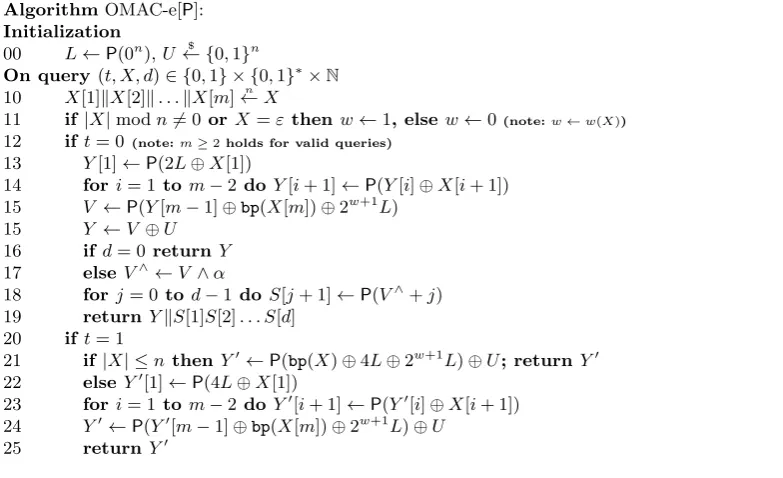
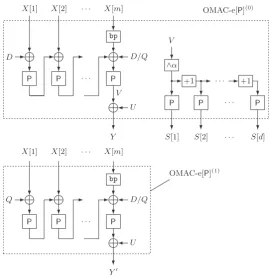
The proofs of Theorems 1 and 2 are bit long, hence we first provide the overview. The ba-sic strategy follows from the proof of the original EAX [8] with some extensions taken from OMAC proofs [11, 12]. We first break down the algorithm of EAX′[Perm(n), τ] into a pair of functions, which we call OMAC-extension, OMAC-e[P] = (OMAC-e[P](0),OMAC-e[P](1)), where OMAC-e[P](0) : {0,1}>n×N → ({0,1}n)>0 and OMAC-e[P](1) :{0,1}∗ → {0,1}n. It uses an
n-bit random permutationP and an additional independent and random value,U ∈ {0,1}n. In-tuitively, OMAC-e[P](0)is a function that takes (N, d), whered=|M|n(d=|C|n) for encryption (decryption), and producesN⊕U and thed-block keystream before truncation, i.e.,S of Fig. 1 (See also Fig. 2). Similarly, OMAC-e[P](1) takes a ciphertext,C, and produces CMAC′(1)P (C)⊕U. Since (N ⊕U)⊕(CMAC′(1)P (C)⊕U) =N ⊕CMAC′(1)P (C), such a function pair can perfectly simulate EAX′[Perm(n), τ]. We introduceU to make the remaining analysis less involved. Then, the bound evaluation for EAX′[Perm(n), τ] is mostly reduced to that of the indistinguishability between OMAC-e[P] and a random function pairRND= (RND(0),RND(1)). HereRND(0) takes (N, d) and samples Y ←$ ({0,1}n)dmax+1 if N is new, and outputs the first (d+ 1) blocks of
Y, where dmax is the maximum possible value of dimplied by the game we consider. Similarly RND(1) takes C ∈ {0,1}∗ and outputs Y′ $
← {0,1}n if C is new. To bound the indistinguisha-bility between OMAC-e[P] andRND, we further break down OMAC-e[P] into a set of ten small functions, Q = {Qi}i=1,...,10, following the proof of OMAC [11]. Using two random values in addition toU, these functions are built so that they behave close to a set of independent URFs or URPs, and at the same time have the capability to perfectly simulate OMAC-e[P] (hence EAX′[Perm(n)]). The indistinguishability ofQfrom the set of URPs/URFs is relatively easy to derive, and as a result the following analysis becomes much easier.
6.2 Proof
Setup.Without loss of generality and for simplicity this section assumes that the space of valid cleartexts of EAX′ is {0,1}>n, rather than restricting the adversary’s strategy.
For convenience we introduce the following notions. Let FK :X → Y and GK′ :X → Y be two keyed functions withK ∈ K and K′∈ K′, and letA be the CPA-adversary. We define
Note that this definition can be naturally extended when GK′ is substituted with the random-bit oracle compatible withFK. Moreover, whenFK and GK′ are compatible with EAX′-EK, we define Advcpa-nrF,G (A) as the same function as AdvcpaF,G(A) but CPA-adversary A is restricted to be nonce-respecting. Let F= (Fe
K, FKd) and G= (GeK′, GdK′) be the pairs of functions that are compatible with (EAX′-EK,EAX′-DK). We define
Advcca-nrF,G (A)
def
= Pr[K ← K$ :AFKe,F d
K ⇒1]−Pr[K′ ← K$ ′:AG e K′,G
d
K′ ⇒1], (4)
where the underlyingA is assumed to be nonce-respecting for encryption queries. Note that we have AdvprivEAX′[E,τ](A) =Advcpa-nrEAX′-EK,$(A) for any nonce-respecting CPA-adversary A.
Step 1: OMAC-extension. For x ∈ {0,1}≤n, let bp(x) = x if |x| = n and bp(x) = x∥ 10n−1−(|x|modn) if|x|< n. Ifx=ε thenbp(x) = 10n−1. We first define OMAC-extension using an n-bit URP, denoted by OMAC-e[P] : {0,1} × {0,1}∗ ×N → ({0,1}n)>0. The definition is given in Fig. 3. See also Fig. 4. Actually it consists of two functions, written as
OMAC-e[P](0):{0,1}>n×N→({0,1}n)>0, and (5) OMAC-e[P](1):{0,1}∗ → {0,1}n, (6)
where the first argument to OMAC-e[P], t ∈ {0,1}, specifies which function to be used, i.e., OMAC-e[P](0, X, d) = OMAC-e[P](0)(X, d) and OMAC-e[P](1, X, d) = OMAC-e[P](1)(X) (d is discarded). Here |OMAC-e[P](0)(X, d)|= (d+ 1)n. For simplicity we assume the input domain of OMAC-e[P] is a set of (t, X, d) ∈ {0,1} × {0,1}∗ ×N that is acceptable for OMAC-e[P](t). More formally, when t= 0 we assume |X|> n and d∈N, and when t= 1 we assume dis fixed (say 0). As described in Section 6.1, OMAC-e[P] enables us to simulate EAX′-EP and EAX′-DP;
note that the simulator only needs to compute the sum of two outputs from CMAC′(0)P and CMAC′(1)P , and not to compute the output itself. For instance, if we want to perform EAX′-EPfor
N = (N[1]∥N[2]) and M = (M[1]∥M[2]) with |N[1]|=|N[2]|=|M[1]|=nand |M[2]|=n−2, then the procedure is (1) Y∥S[1]S[2]← OMAC-e[P](0, N,2), (2) C ← msb2n−2(S[1]S[2])⊕M, (3)Y′ ←OMAC-e[P](1, C,0), where the last argument is arbitrary, (4)T ←msbτ(Y ⊕Y′), and (5) output (C, T). The following proposition is easy to check.
Proposition 1. There exist deterministic procedures, fe(·) and fd(·), that use OMAC-e[P] as a black box and perfectly simulate EAX′-EP and EAX′-DP. That is, we have9 EAX′-EP ≡
fe(OMAC-e[P]) and EAX′-DP≡fd(OMAC-e[P]).
A keyed functionF compatible with OMAC-e[P] is said to have OMAC-e profile, and we de-noteF(t, X, d) byF(t)(X, d). Suppose an adversary queryingF of OMAC-e profile hasq queries (t1, X1, d1), . . . ,(tq, Xq, dq) and corresponding answers areY1, . . . , Yq. Such an adversary is called to be with parameter list (q, σin, σout) whereσin
def
=∑i=1,...,q|Xi|nandσout def
=∑i=1,...,q;ti=0|Yi|n. To further analyze OMAC-e[P], we define a set of ten functions,Q={Qi}i=1,...,10.
9
Here F ≡ G means the equivalence of the output probability distribution functions, i.e. Pr[F(x1) =
y1, . . . , F(xq) =yq] = Pr[G(x1) = y1, . . . , G(xq) = yq]) for any fixed possiblex1, . . . , xq and y1, . . . , yq. The
AlgorithmOMAC-e[P]: Initialization
00 L←P(0n),U ← {$ 0,1}n
On query(t, X, d)∈ {0,1} × {0,1}∗×N 10 X[1]∥X[2]∥. . .∥X[m]←n X
11 if |X|modn̸= 0 orX=ε thenw←1, elsew←0(note:w←w(X))
12 if t= 0 (note:m≥2holds for valid queries)
13 Y[1]←P(2L⊕X[1])
14 for i= 1 to m−2doY[i+ 1]←P(Y[i]⊕X[i+ 1]) 15 V ←P(Y[m−1]⊕bp(X[m])⊕2w+1L)
15 Y ←V ⊕U
16 if d= 0 returnY
17 else V∧←V ∧α
18 for j= 0 tod−1 doS[j+ 1]←P(V∧+j) 19 return Y∥S[1]S[2]. . . S[d]
20 if t= 1
21 if |X| ≤n then Y′←P(bp(X)⊕4L⊕2w+1L)⊕U; returnY′
22 else Y′[1]←P(4L⊕X[1])
23 for i= 1 to m−2doY′[i+ 1]←P(Y′[i]⊕X[i+ 1]) 24 Y′←P(Y′[m−1]⊕bp(X[m])⊕2w+1L)⊕U
25 return Y′
Fig. 3.OMAC-extension using ann-bit URP,P.
Definition 1. Let Qi : {0,1}n → {0,1}n for i = 1,2,3,4,7,8,9 and let Qj : {0,1}n×N → ({0,1}n)>0 for j = 5,6, and letQ
10:{0,1}n\ {0n} → {0,1}n. These functions are defined as
Q1(x)def=P(2L⊕x)⊕Rnd1, Q2(x) def
=P(4L⊕x)⊕Rnd2,
Q3(x)def=P(Rnd1⊕x)⊕Rnd1, Q4(x) def
=P(Rnd2⊕x)⊕Rnd2,
Q5(x, d)def= GP,U(P(2L⊕Rnd1⊕x), d), Q6(x, d) def
=GP,U(P(4L⊕Rnd1⊕x), d)
Q7(x)def=P(2L⊕Rnd2⊕x)⊕U, Q8(x) def
=P(4L⊕Rnd2⊕x)⊕U,
Q9(x)def=P(2L⊕4L⊕x)⊕U, Q10(x)def=P(x)⊕U,
where P is an n-bit URP, and L = P(0n), and Rnd1 and Rnd2 are independent n-bit random
sequences, and U is another random n-bit value. Here, GP,U(v, d) is v⊕U if d = 0 and (v⊕
U∥P(v ∧α)∥P((v ∧α) + 1)∥. . .∥P((v∧α) + (d−1))) if d > 0. The sampling procedures for P,Rnd1,Rnd2, and U are shared by allQis.
We also treat Q as a tweakable function with tweak t ∈ {1, . . . ,10} by writing Q(t, x, d) =
Qt(x, d) when t ∈ {5,6} and otherwise Q(t, x, d) =Qt(x). We can easily see that OMAC-e[P] can be simulated with black-box access toQ, just the same asQfunctions appeared in the proof of OMAC [11] that simulate OMAC.
We next defineQe ={Qei}i=1,...,10. For alli= 1, . . . ,10, Qei is compatible with Qi.
Definition 2. Let P1, . . . ,P4 be four independent n-bit URPs, and let R7, . . . ,R10 be four
-bp
+1 +1
OMAC-e[P](0)
OMAC-e[P](1)
bp · · ·
D D/Q
∧α
· · ·
Q D/Q
S[1] S[2] S[d]
P
X[1] X[2] X[m]
P P
P
P P
U
Y
V
V
· · ·
P
X[1] X[2] X[m]
P P
U
Y
Fig. 4.Component Functions of OMAC-extension. Here Dand Qdenote 2Land 4L withL=P(0n), andU is uniformly random overnbits.
bit output. Using them we define
e
Q1(x)def=P1(x), Qe2(x)
def =P2(x), e
Q3(x)def=P3(x), Qe4(x)
def =P4(x), e
Q5(x, d)def=Rd+15 (x), Qe6(x, d)def=Rd+16 (x) e
Q7(x)def=R7(x), Qe8(x)
def =R8(x), e
Q9(x)def=R9(x), Qe10(x)
def
=R10(x),
where Rd+1i (x) = msbn(d+1)(Ri(x)) for i = 5,6. Here dmax is the maximum possible value of
queried d, which will be determined by the underlying game and the adversary’s parameter.
We say a function compatible with Q is said to have Q profile. An adversary querying a function of Qprofile is characterized by the number of queries, q, and the total sum of output
n-bit blocks fort∈ {5,6},σout. The next lemma shows the CPA-advantage in distinguishingQ
and Qe.
Lemma 1. LetAbe the adversary querying a function of Qprofile with parameter list(q, σout).
Then we have Advcpa
Q,Qe(A)≤(3.5q
2+ 10σ
outq+ 2.5σ2out)/2n. The proof is given in Appendix A.
Step 2: Modified CBC-MAC.For anyn-bit (keyed) permutations,Gand G′, let CBCG,G′ : ({0,1}n)>0 → {0,1}n be defined as
CBCG,G′(X[1]∥. . .∥X[m]) = {
G(X[1]) ifm= 1
where CBCG′ is the standard CBC-MAC using G′. We then define a function compatible with OMAC-e[P], denoted by CBC. For any X ∈ {0,1}∗, let w(X) = 1 if |X|modn ̸= 0 or X =ε
and otherwise w(X) = 0. For |X|> n,CBC(0)(X, d) is computed as follows.
1. X[1]∥X[2]∥. . .∥X[m]←n X and w←w(X)
2. Z ←CBCP1,P3(X[1]∥. . .∥X[m−1])
3. OutputY∥S[1]∥. . .∥S[d]←Rd+15+w(Z⊕bp(X[m]))
Here, if d= 0 the output isY. Similarly, for X∈ {0,1}∗,CBC(1)(X) is computed as follows.
1. X[1]∥X[2]∥. . .∥X[m]←n X and w←w(X)
2. If|X| ≤noutput Y′ ←R9+w(bp(X)),
3. OtherwiseZ′ ←CBCP2,P4(X[1]∥. . .∥X[m−1]), and output Y′ ←R7+w(Z′⊕bp(X[m])).
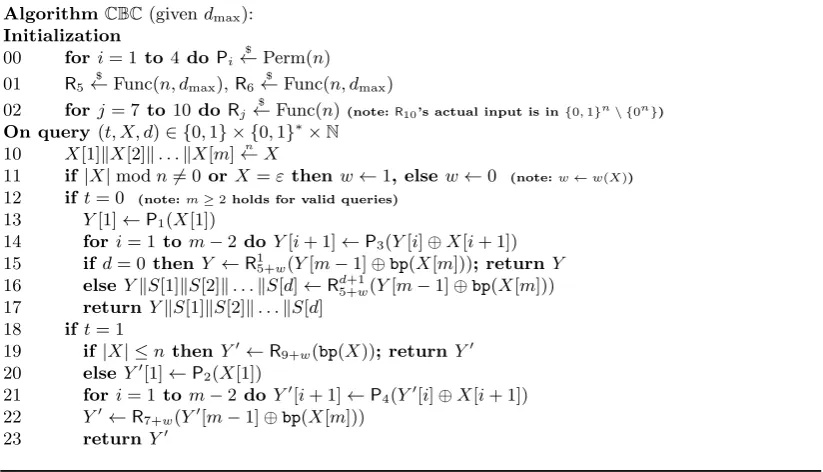
The pseudo-code ofCBC(combiningCBC(0) andCBC(1)) is presented in Fig. 5. Here,Rij(X) for j = 5,6 denotes msbni(Rj(X)). One can simulate OMAC-e[P] via black-box accesses to Q, including the final mask by U. For example, to simulate OMAC-e[P](0, N,2) for |N| = 3n, we first perform N[1]∥N[2]∥N[3] ←n N and then proceed as (1) Y[1] ← Q1(N[1]), (2) Y[2] ←
Q3(N[2]⊕Y[1]), and (3)Y[3]∥S[1]S[2]←Q5(N[3]⊕Y[2]). If|N[3]|=n−2 thenQ5(N[3]⊕Y[2]) is replaced with Q6(N[3]∥10⊕Y[2]). For more examples, OMAC-e[P](1, C,0) for |C|= n can be simulated via calling Q9(C). For |C| < n, OMAC-e[P](1, C,0) can be simulated via calling
Q10(bp(C)) =Q10(C∥10. . .0). Formally, we have the following proposition.
Proposition 2. There exists a procedureh(·) that usesQas a black box and perfectly simulates
OMAC-e[P], i.e. h(Q)≡OMAC-e[P]. Moreover, we have h(Qe)≡CBCfor this h(·).
LetRND(0)andRND(1)be the independent random functions compatible with OMAC-e[P](0) and OMAC-e[P](1). Here,RND(0) takes (N, d)∈ {0,1}>n×N and samplesY ←$ ({0,1}n)dmax+1 ifN is new, and outputs msbn(d+1)(Y), wheredmax is the same asCBC. SimilarlyRND(1) takes
C ∈ {0,1}∗ and outputs Y′ ← {$ 0,1}n if C is new. We define RND as a function consisting of RND(0) and RND(1) and taking t = 0,1 as a tweak. Then, we have the following lemma. The proof is in Appendix B.
Lemma 2. Let A be an adversary querying a function of OMAC-e profile with parameter list
(q, σin, σout). Then,AdvcpaCBC,RND(A)≤2σin2/2n.
Step 3: Derivation of PRIV Bound. Combining the above lemmas and propositions, our
PRIV bound is derived. LetAbe the CPA-adversary against AE with parameter list (q, σN, σM). Then there exist adversary B querying to a function of OMAC-e profile with 2q queries, σin =
AdvprivEAX′[Perm(n)](A) =Advcpa-nrEAX′-EP,$(A) =Advcpa-nrfe(OMAC-e[P]),$(A) (7) ≤Advcpa-nrfe(OMAC-e[P]),fe(CBC)(A) +Advcpa-nrfe(CBC),fe(RND)(A) +Advcpa-nrfe(RND),$(A)
| {z } =0
(8)
≤AdvcpaOMAC-e[P],CBC(B) +AdvcpaCBC,RND(B) (9) =Advcpa
h(Q),h(Qe)(B) +Adv
cpa
CBC,RND(B) (10)
≤Advcpa Q,Qe(C) +
2(σN +σM)2
2n (11)
≤ 3.5(σN+σM)2+ 10(σM +q)(σN +σM) + 2.5(σM+q)2
2n +
2(σN+σM)2
2n (12)
≤ 18(σN +σM)2
2n =
18σpriv2
2n , (13)
as q ≤ σN. Here, the second equality in Eq. (7) follows from Prop. 1, Eq. (10) follows from Prop. 2, Eq. (11) follows from Lemma 2, and Eq. (12) follows from Lemma 1. In addition,
Advcpa-nrfe(RND),(A) = 0 holds because whenAqueries (N, M) tofe(RND) the output is a subsequence ofRND(0)(N,|M|n) with the firstnbits XORed by the output ofRND(1)(whose input is a part of RND(0)(N,|M|n)). As N is always fresh, the output is always random. This concludes the proof of Theorem 1.
Step 4: Derivation of AUTH Bound. The AUTH bound is derived in a similar way. Let
EAX′ be the AE algorithm compatible with EAX′[Perm(n)] using fe(RND) and fd(RND) for the encryption and decryption algorithms. We let A be the CCA-adversary against AE with parameter list (q, qv, σN, σM, σNe, σCe). Then we have the following bound.
AdvauthEAX′(A)≤qv/2τ. (14) The proof of Eq. (14) is in Appendix C. Then, there exist adversaryBquerying to a function of OMAC-e profile with 2(q+qv) queries withσin=σN+σM+σNe+σCeandσout =σM+2q+σCe+2qv, and adversary C querying to a function of Q profile with σN +σM +σNe +σCe queries and
σM +q+σCe+qv output blocks for queries with t= 5,6, such that
AdvauthEAX′[Perm(n)](A)
≤Advcca-nr(EAX′-EP,EAX′-DP),(fe(RND),f
d(RND))(A) +Adv
auth
EAX′(A) (15)
≤Advcca-nr(fe(OMAC-e[P]),fd(OMAC-e[P])),(fe(RND),fd(RND))(A) +qv
2τ (16)
≤AdvcpaOMAC-e[P],RND(B) + qv
2τ (17)
≤AdvcpaOMAC-e[P],CBC(B) +AdvcpaCBC,RND(B) + qv
2τ (18)
=Advcpa
h(Q),h(Qe)(B) +Adv
cpa
CBC,RND(B) +
qv
2τ (19)
≤Advcpa Q,Qe(C) +
2(σN +σM +σNe +σCe)2
2n +
qv
2τ (20)
≤ 3.5(σN +σM+σNe +σCe)
2+ 10(σ
M +q+σCe+qv)(σN+σM +σNe+σCe) 2n
+2.5(σM +q+σCe+qv) 2
2n +
2(σN +σM +σNe+σCe)2
2n +
qv
2τ (21)
≤ 18σauth2 2n +
qv
AlgorithmCBC(givendmax):
Initialization
00 for i= 1to 4doPi
$
←Perm(n) 01 R5
$
←Func(n, dmax),R6
$
←Func(n, dmax)
02 for j= 7 to 10doRj
$
←Func(n)(note:R10’s actual input is in{0,1}n\ {0n}) On query(t, X, d)∈ {0,1} × {0,1}∗×N
10 X[1]∥X[2]∥. . .∥X[m]←n X
11 if |X|modn̸= 0 orX=ε thenw←1, elsew←0 (note:w←w(X))
12 if t= 0 (note:m≥2holds for valid queries)
13 Y[1]←P1(X[1])
14 for i= 1 to m−2doY[i+ 1]←P3(Y[i]⊕X[i+ 1])
15 if d= 0 thenY ←R1
5+w(Y[m−1]⊕bp(X[m])); returnY
16 else Y∥S[1]∥S[2]∥. . .∥S[d]←Rd+15+w(Y[m−1]⊕bp(X[m]))
17 return Y∥S[1]∥S[2]∥. . .∥S[d] 18 if t= 1
19 if |X| ≤n then Y′←R9+w(bp(X)); returnY′
20 else Y′[1]←P2(X[1])
21 for i= 1 to m−2doY′[i+ 1]←P4(Y′[i]⊕X[i+ 1])
22 Y′←R7+w(Y′[m−1]⊕bp(X[m]))
23 return Y′
Fig. 5.CBCusing fourn-bit URPs, fourn-bit URFs, and twon-bit input, (dmax+ 1)n-bit output URFs.
since q ≤σN and qv ≤σNe. Here, Eq. (16) follows from Prop. 1 and Eq. (14), Eq. (19) follows from Prop. 2, Eq. (20) follows from Lemma 2, and Eq. (21) follows from Lemma 1. This concludes the proof of Theorem 2.
7 Fixing the Flaw
There would be ways to fix the flaw of EAX′to make it as a secure general-purpose AE accepting cleartexts of any length. Below, we provide some of them, naming it to EAX′′. The concept here is not to touch the inside of EAX′, instead using it as a black box. We only propose the fixes for encryption, as the corresponding decryptions are fairly straightforward.
Method 1: EAX′′1-EK(N, M) def
= EAX′-EK(0n∥N, M).
Method 2: Use two keys forE,K and K′, and let
EAX′′2-EK,K′(N, M) def =
{
EAX′-EK(N, M) if|N|> n, EAX′-EK′(0n∥N, M) if|N| ≤n,
whereK and K′ are independent orK′ =K⊕cstfor a non-zero constantcst. The choice ofcstmust be done with care to avoid related-key attacks. For instance, lettingcst= 1|K| seems natural while this is problematic with DES due to the complementary property of the key schedule. One option is to use a random-looking constant, say the first few digits of π.
Method 3: Use a key for E,K, and an independentn-bit key, L, and let
EAX′′3-EK,L(N, M) def =
{
EAX′-EK(N, M) if|N|> n, EAX′-EK,L⊕ (0n∥N, M) if|N| ≤n,
where EAX′-EK,L⊕ is EAX′ encryption with blockcipherEeK,Ldefined as EeK,L(X) =EK(X⊕
The security bounds of the above methods are easily derived from the results of Theorems 1 and 2. For the latter option of Method 2 we also need a very restricted form of related-key security of E, and for Method 3 we need the theory of tweakable blockcipher [13]. Each method has its own pros and cons: Method 1 is the simplest but needs additional blockcipher calls irrespective of |N|. Methods 2 and 3 keep the original operation for |N| > n, but need additional key or a stronger security requirement on E. We also warn that Method 3 allows a partial key recovery attack with birthday complexity.
8 Concluding Remarks
Practical Implications.Attacks as those described in the current paper are often turned down by non-cryptographers as “only theoretical” or “don’t apply in practice”. Indeed, none of our attacks is applicable if the cleartext size exceeds n bits. But even if ANSI C12.22 prohibited any cleartexts of size n= 128 bits or shorter, including EAX′ in the standard would be like an unexploded bomb – waiting to go off any time in the future. Remember that EAX′is intended for Smart Grid, i.e., for the use in dedicated industrial systems such as electrical meters, controllers and appliances. It hardly seems reasonable to assume that every device will always carefully check cleartexts and plaintexts for validity and plausibility. Also, vendors may be tempted to implement their own nonstandard extensions avoiding “unnecessarily long” texts.
For a non-cryptographer, assuming a “decryption oracle” may seem strange – if there were such an oracle, why bother with message recovery attacks at all? However, experience shows that such theoretical attacks are often practically exploitable. For example, some error messages return the input that caused the error: “Syntax error in ‘xyzgarble’.” Even if the error message does not transmit the entire fake plaintext, any error message telling the attacker whether the fake message followed some syntactic conventions or not is potentially useful for the attacker. See [10] for an early example.
Also note that our forgery attacks allow a malicious attacker to create a large number of messages with given single-block cleartexts and random single-block plaintexts, that appear to come from a trusted source, because the authentication succeeded. What the actual devices will do when presented with apparently valid random commands is a source of great speculation.
Our Recommendation.Whenever possible, avoid adopting EAX′in new applications. If EAX′ cannot be avoided, then this has to be carefully implemented to exclude one-block cleartexts. We note that specifying the minimum data length in standard documents does not necessar-ily prevent the adversary from using short cleartexts. Therefore, the cleartext length checking mechanisms are needed at both ends of encryption and decryption. Instead, one can safely use EAX′′ which allows the re-use of EAX′ implementations. Other provably secure authenticated encryptions, including the original EAX, are also safe options.
Acknowledgments. The authors thank the anonymous FSE 2013 reviewers for helpful
com-ments. This paper is based on the collaboration started at Dagstuhl Seminar 12031, Symmetric Cryptography. We thank participants of the seminar for useful comments, and discussions with Greg Rose were invaluable for writing Section 8. We also thank Mihir Bellare and Jeffrey Walton for feedback. The work by Tetsu Iwata was supported by MEXT KAKENHI, Grant-in-Aid for Young Scientists (A), 22680001.
References
2. Recommendation for Block Cipher Modes of Operation: The CMAC Mode for Authentication. NIST Special Publication 800-38B (2005)
3. American National Standard Protocol Specification For Interfacing to Data Communication Networks. ANSI C12.22-2008. (2008)
4. Measurement Canada, Specification for Local Area Network/Wide Area Network (LAN/WAN) Node Com-munication Protocol to Complement the Utility Industry End Device Data Tables. MC1222, 2009. (2009)
5. ANSI C12.22, IEEE 1703, and MC12.22 Transport Over IP. RFC 6142 (2011)
6. IEEE Standard for Local Area Network/Wide Area Network (LAN/WAN) Node Communication Protocol to Complement the Utility Industry End Device Data Tables. IEEE 1703-2012. (2012)
7. Bellare, M., Goldreich, O., Mityagin, A.: The Power of Verification Queries in Message Authentication and Authenticated Encryption. Cryptology ePrint Archive, Report 2004/309 (2004),http://eprint.iacr.org/
8. Bellare, M., Rogaway, P., Wagner, D.: The EAX Mode of Operation. In: Roy and Meier [18], pp. 389–407
9. Black, J., Rogaway, P.: CBC MACs for Arbitrary-Length Messages: The Three-Key Constructions. In: Bellare, M. (ed.) CRYPTO. Lecture Notes in Computer Science, vol. 1880, pp. 197–215. Springer (2000)
10. Bleichenbacher, D.: Chosen Ciphertext Attacks Against Protocols Based on the RSA Encryption Standard PKCS #1. In: Krawczyk, H. (ed.) CRYPTO. Lecture Notes in Computer Science, vol. 1462, pp. 1–12. Springer (1998)
11. Iwata, T., Kurosawa, K.: OMAC: One-Key CBC MAC. In: Johansson, T. (ed.) FSE. Lecture Notes in Com-puter Science, vol. 2887, pp. 129–153. Springer (2003)
12. Iwata, T., Kurosawa, K.: Stronger Security Bounds for OMAC, TMAC, and XCBC. In: Johansson, T., Maitra, S. (eds.) INDOCRYPT. Lecture Notes in Computer Science, vol. 2904, pp. 402–415. Springer (2003)
13. Liskov, M., Rivest, R.L., Wagner, D.: Tweakable block ciphers. J. Cryptology 24(3), 588–613 (2011) 14. Minematsu, K., Lucks, S., Morita, H., Iwata, T.: Cryptanalysis of EAX-Prime. DIAC - Directions in
Authen-ticated Ciphers (2012),http://hyperelliptic.org/DIAC/
15. Moise, A., Beroset, E., Phinney, T., Burns, M.: EAX’ Cipher Mode (May 2011). NIST Sub-mission (2011), http://csrc.nist.gov/groups/ST/toolkit/BCM/documents/proposedmodes/eax-prime/ eax-prime-spec.pdf
16. Rogaway, P.: Nonce-Based Symmetric Encryption. In: Roy and Meier [18], pp. 348–359
17. Rogaway, P., Shrimpton, T.: A Provable-Security Treatment of the Key-Wrap Problem. In: Vaudenay, S. (ed.) EUROCRYPT. Lecture Notes in Computer Science, vol. 4004, pp. 373–390. Springer (2006)
18. Roy, B.K., Meier, W. (eds.): Fast Software Encryption, 11th International Workshop, FSE 2004, Delhi, India, February 5-7, 2004, Revised Papers, Lecture Notes in Computer Science, vol. 3017. Springer (2004)
A Proof of Lemma 1
LetQr ={Qri}i=1,...,10 be the set of ten functions defined in the same way asQbut the internal
n-bit URP,P, is substituted withn-bit URF,R. For example,Qr1(x) =R(2L⊕x)⊕Rnd1, where
L=R(0n) andRnd1 is independent and random.
From the PRF/PRP switching lemma (e.g. [9]), we have
AdvcpaQ,Qr(A)≤
(q+σout+ 1)2
2n+1 , (23)
for any adversary Awith parameter list (q, σout) since the underlying n-bit function (P orR) is invoked at most q+σout+ 1 times.
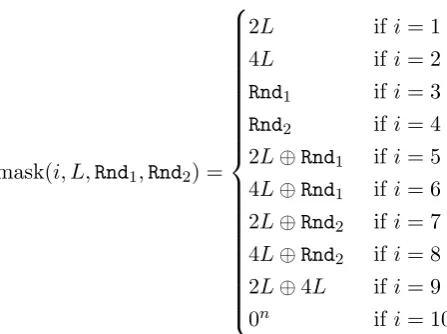
mask(i, L,Rnd1,Rnd2) =
2L ifi= 1 4L ifi= 2
Rnd1 ifi= 3
Rnd2 ifi= 4 2L⊕Rnd1 ifi= 5 4L⊕Rnd1 ifi= 6 2L⊕Rnd2 ifi= 7 4L⊕Rnd2 ifi= 8 2L⊕4L ifi= 9 0n ifi= 10
(24)
Similarly let omask(t,Rnd1,Rnd2, U) be the outer masking value applied to the leftmost n bits of the output, defined as;
omask(i,Rnd1,Rnd2, U) =
Rnd1 ifi∈ {1,3}
Rnd2 ifi∈ {2,4}
U ifi∈ {5,6,7,8,9,10}
(25)
We may abbreviate mask(i, L,Rnd1,Rnd2) and omask(j,Rnd1,Rnd2, U) to mask(i) and omask(j). ClearlyR(mask(i)⊕x)⊕omask(i) corresponds toQir(x) wheni̸= 5,6 and msbn(Qri(x, d)) when
i= 5,6.
From the property of Galois field it is easy to see that
max 1≤i<j≤10,
δ∈{0,1}n
Pr[L← {$ 0,1}n,Rnd1 $
← {0,1}n,Rnd2 $
← {0,1}n: mask(i)⊕mask(j) =δ]≤ 1
2n. (26)
In Eq. (26) we note that the choice ofU is irrelevant sinceU is not used by mask function. For any adversary querying Qr orR, let (ti, Xi, di) ∈ {1, . . . ,10} × {0,1}n×N be the i-th query. Without loss of generality, we assume di is fixed to 0 wheneverti ̸∈ {5,6}, and all queries are distinct, i.e. (ti, Xi, di)̸= (tj, Xj, dj) for any 1 ≤i < j ≤q. Also we do not allow the adversary to query X= 0n witht= 10 (as the input domain is{0,1}n\ {0n} whent= 10).
For query (t, X, d), we defineXE=X⊕mask(t) which is an actual input to the underlying random function when Qr is queried.
Fig. 6 defines two games, GameQr and GameR. It is easy to observe that GameR behaves identically toR. As we assume that a collision in (t, X, d) is not allowed the output of GameRis always independent and uniformly random. The output distribution of the game GameQris also identical to Qr. Note that the generation procedure ofY and V in GameQr is opposite to that ofQr; in GameQr, ifXE is a new value,Y is uniformly sampled and thenY =V ⊕omask(t) is determined, whileQr first samplesV and computesY =V ⊕omask(t). Both yield the identical marginal distribution of (Y, V). IfXE has a collision, both GameQr and Qr take V from the set of previously determined values, andY is determined asY ←V ⊕omask(t).
We define the flag bad and set it when two inputs with input maskings collide. Then both games are identical untilbad gets set totrue, thus we have
AdvQr,R(A)≤Pr[AGameQ r
⇒1]−Pr[AGameR ⇒1]≤Pr[AGameR setsbad]. (27)
![Fig. 1. (Upper) The encryption and decryption algorithms of EAXponent algorithms of EAX′[E, τ], originally with τ = 32](https://thumb-us.123doks.com/thumbv2/123dok_us/7895139.1310409/4.595.70.532.86.361/fig-upper-encryption-decryption-algorithms-eaxponent-algorithms-originally.webp)