Protecting encrypted cookies from
compression side-channel attacks
Janaka Alawatugoda1, Douglas Stebila1,2, and Colin Boyd3
1School of Electrical Engineering and Computer Science, 2 School of Mathematical Sciences
1,2Queensland University of Technology, Brisbane, Australia
[email protected],[email protected] 3 Department of Telematics,
Norwegian University of Science and Technology, Trondheim, Norway
December 28, 2014
Abstract
Compression is desirable for network applications as it saves bandwidth; however, when data is compressed before being encrypted, the amount of compression leaks information about the amount of redundancy in the plaintext. This side channel has led to successful CRIME and BREACH attacks on web traffic protected by the Transport Layer Security (TLS) protocol. The general guidance in light of these attacks has been to disable compression, preserving confidentiality but sacrificing bandwidth. In this paper, we examine two techniques—heuristic separation of secrets and fixed-dictionary compression—for enabling compression while protecting high-value secrets, such as cookies, from attack. We model the security offered by these techniques and report on the amount of compressibility that they can achieve.
1
Contents
1 Introduction 3
2 Definitions 6
2.1 Encryption and compression schemes . . . 6
2.2 Existing security notions . . . 7
2.3 New security notions . . . 7
2.4 Relations and separations between security notions . . . 8
3 Technique 1: Separating secrets from user inputs 9 3.1 The scheme . . . 9
3.2 CCI security of basic separating-secrets technique . . . 10
3.3 Separating secrets in HTML . . . 10
3.4 Experimental results on separating-secrets in HTML . . . 11
3.5 Discussion . . . 11
4 Technique 2: Fixed-dictionary compression 12 4.1 The scheme . . . 12
4.2 CR security of basic fixed-dictionary technique . . . 12
4.3 Experimental results on fixed-dictionary technique . . . 14
4.4 Discussion . . . 14
5 Conclusion 14 A Relations and separations between security notions 16 A.1 IND-CPA =⇒ CCI . . . 16
A.2 CCI =6⇒ IND-CPA . . . 18
A.3 CCI =⇒ RCI . . . 18
A.4 RCI =6⇒ CCI . . . 19
A.5 RCI =⇒ CR . . . 20
A.6 CR =6⇒ RCI . . . 21
B Proof of CCI security of separating-secrets technique 22 C Analysis of security of fixed-dictionary technique 23 C.1 Probability bounds, no prefix/suffix . . . 23
1
Introduction
To save communication costs, network applications often compress data before transmitting it; for example, the Hypertext Transport Protocol (HTTP) [FR14,§4.2] has an optional mechanism in which a server compresses the body of an HTTP response, most commonly using the gzip algorithm. When encryption is used to protect communication, compression must be applied before encryption (since ciphertexts should look random, they should have little apparent redundancy that can be compressed). In fact, to facilitate this, the Transport Layer Security (TLS) protocol [DR08,§6.2.2] has an optional compression mode that will compress all application
data before encrypting it.
While compression is useful for reducing the size of transmitted data, it has had a negative impact when combined with encryption, because the amount of compression acts as a side channel. Most research considers side-channels such as timing [Koc96, KSWH98] or power consumption [HMF07], which can reveal information about cryptographic operations and secret parameters.
Compression-based leakage. In 2002, Kelsey [Kel02] showed how compression can act as a
form of side-channel leakage. If plaintext data is compressed before being encrypted, the length of the ciphertext reveals information about the amount of compression, which in turn can reveal information about the plaintext. Kelsey notes that this side channel differs from other types of side channels in two key ways: “it reveals information about the plaintext, rather than key material”, and “it is a property of the algorithm, not the implementation”.
Kelsey’s most powerful attack is an adaptive chosen input attack: if an attacker is allowed to choose inputsxthat are combined with a target secretsand the concatenationxksis compressed and encrypted, observing the length of the outputs can eventually allow the attacker to extract the secrets. For example, to determine the first character ofs, the attacker could ask to have the string x=prefix*prefixcombined withs, then compressed and encrypted, for every possible character*; in one case, when*=s1, the amount of redundancy is higher and the ciphertext
should be shorter. Once each character ofsis found, the attack can be carried out on the next character. The attack is somewhat noisy, but succeeds reasonably often.
Key to this attack is the fact that most compression algorithms (such as the deflate algorithm underlying gzip) are adaptive: they adaptively build and maintain a dictionary of recently observed strings, and replace subsequent occurrences of that string with a code.
The CRIME and BREACH attacks. In 2012, Rizzo and Duong [RD12] showed how to
apply Kelsey’s adaptive chosen input attack against gzip compression as used in TLS, in what they called the Compression Ratio Info-leak Mass Exploitation (CRIME)attack. The primary target of the CRIME attack was the user’s cookie in the HTTP header. If the victim visited an attacker-controlled web page, the attacker could use Javascript to cause the victim to send HTTP requests to URLs of the attacker’s choice on a specified server. The attacker could adaptively choose those URLs to include a prefix to carry out Kelsey’s adaptive chosen input attack. Some care is required to ensure the padding does not hide the length with block ciphers, but this can be dealt with. The CRIME attack also applies to compression as used in the SPDY protocol [The].
As a result of the CRIME attack, it was recommended that TLS compression be disabled, and the Trustworthy Internet Movement’s SSL Pulse report for December 2014 finds that just 7.2% of websites have TLS compression enabled [Tru14]; moreover, all major browsers have disabled it.
tokens. Suggested by Rizzo and Duong, this was demonstrated by Gluck et al. [GHP13] in the Browser Reconnaissance and Exfiltration via Adaptive Compression of Hypertext (BREACH) attack.
Mitigation techniques. Gluck et al. [GHP13] discussed several possible mitigation techniques
against the BREACH attack, listed in decreasing order of effectiveness:
1. Disabling HTTP compression 2. Separating secrets from user input 3. Randomizing secrets per request
4. Masking secrets (effectively randomizing by XORing with a random nonce) 5. Length hiding (by adding a random number of bytes to the responses) 6. Rate-limiting the requests
Despite the demonstrated practicality of the BREACH attack, support for and use of HTTP compression remains widespread, due in large part to the value of decreasing communication costs and time. In fact, compression is even more tightly integrated into the proposed HTTP version 2 [BPT14] than previous versions. Techniques 2–4 generally require changes to both browsers and web servers. For example, masking secrets such as anti-CSRF tokens requires new mark-up for secrets, which browsers and servers can interpret to apply the randomized masking technique. Techniques 5–6 can be unilaterally applied by web servers, though length hiding can be defeated with statistical averaging, and rate-limiting must find a balance between legitimate requests and information leakage.
Related work. There has been little academic study of compression and encryption. Besides
Kelsey’s adaptive chosen input attack and the related CRIME and BREACH attacks, the only relevant work we are aware of is that of Kelley and Tamassia [KT14]. They give a new security notion calledentropy-restricted semantic security (ER-IND-CPA) forkeyed compression functions which combine both encryption and compression: compared with the normal indistinguishability under chosen plaintext attack (IND-CPA) security notion, in ER-IND-CPA the adversary should not be able to distinguish between the encryption of two messages thatcompress to the same length. Kelley and Tamassia then show how to construct a cipher based on the LZW compression algorithm by rerandomizing the compression dictionary. Unfortunately, theER-IND-CPA notion does not capture the CRIME and BREACH attacks, which depend on observing messages that compress to different lengths.
In leakage-resilient security definitions [AGV09,ADW09, DP08, NS09], leakage of the secret key is addressed. This differs from the setting in compression-based side-channel attacks, which addresses leakage of the plaintext. Thus, previous leakage-resilient approaches are not suitable to model compression-based side-channel attacks.
Our contributions. In this work, we study symmetric-key compression-encryption schemes,
characterizing the security properties that can be achieved by various mitigation techniques in the face of CRIME- and BREACH-like attacks.
To some extent, the side channel exposed by compression is fundamentally unavoidable: if transmission of data is decreased, nothing can hide the fact that some redundancy existed in the plaintext. Hence, we focus our study on the ability of the attacker to learn specific “high value” secrets embedded in a plaintext, such as cookies or anti-CSRF tokens. In our models, we imagine there is a secret value ck, and the adversary can adaptively obtain encryptions
Enck(m0kckkm00) (1)
Google Facebook Youtube Yahoo Baidu Wikipedia Twitter Qq Amazon Taobao 0 2 4 6 8 10 3 .
51 3.5
11 . 19 5 . 38 4 . 28 4 .
33 4.61 5
. 05 4 . 27 8 . 12 3 . 51 3 . 04 11 . 17 5 . 33 4 . 23 4 . 11 3 . 48 4 . 98 4 . 17 8 . 04 1 . 23 1 . 37 2 . 58 1 . 4 1 . 34 1 .
26 1.46
1
.
21 1.55
2
.
06
Compression
ratio
gzip full page separating-secrets/gzip fixed-dictionary compression
Figure 1: Compression ratios of full page compression versus mitigation techniques
The first mitigation technique we consider is that of separating secrets. During compres-sion/encryption, an application-aware filter is applied to the plaintext to separate out any potential secret values from the data, the remaining plaintext is compressed, then the secrets and compressed plaintext are encrypted; after decryption, the inverse of the filter is used to reinsert the secret values in the decompressed plaintext. Assuming the filter fully separates out all secret values, we show that the separating secrets technique is able to achieve a strong notion of protection, which we callchosen cookie indistinguishability (CCI): the adversary cannot determine which of two cookiesck0andck1of the adversary’s choice was encrypted with messages
of the adversary’s choice given ciphertexts as in (1).
The second mitigation technique we consider is the use of a fixed-dictionary compression scheme, where the dictionary used for compression does not adapt to the plaintext being compressed, but instead is preselected in advance based on the expected distribution of plaintext messages, for example including common English words like “the” and “and”.1 We show that, if the secret values are sufficiently high entropy, then fixed-dictionary compression is able to achieve cookie recovery (CR) security: if the secret cookie is chosen uniformly at random, the adversary cannot recover the entire secret cookie even given an adaptive message attack as in (1). While cookie recovery security does not meet the “gold standard” of indistinguishability notions for encryption, it may be sufficient for some settings, for example protecting compressed HTTP traffic from CRIME and BREACH attacks that try to recover cookies and anti-CSRF tokens.
We also characterize the relationship among the CCIand CR security notions, as well as an intermediate notion calledrandom cookie indistinguishability (RCI) and the ER-IND-CPA notion of Kelley and Tamassia [KT14].
In the separating secrets technique, if the number of secrets extracted by the separating filter is relatively small, then the compressibility generally remains close to that of normal compression of the full plaintext. In the fixed-dictionary compression technique, compressibility suffers quite a bit compared to adaptive techniques on the full plaintext, although if the dictionary is constructed from a corpus of text similar to the plaintext, then some compression can be achieved.
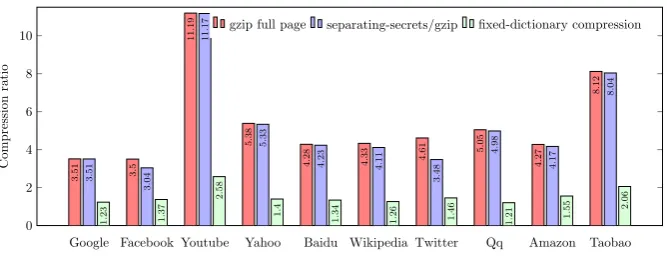
Figure 1 summarizes experimental results comparing compression ratios for these two techniques on the HTML, CSS, and Javascript source code of the top 10 global websites as reported by Alexa Top Sites (http://www.alexa.com/topsites). On average, the compression ratio (uncompressed : compressed size) of gzip applied to the full source code was 5.42×; applying a separation filter that extracted all values following value=in the HTML source code yielded an average compression ratio of 5.20×; compression of each page using a fixed dictionary trained on all 10 pages yielded an average compression ratio of 1.55×.
1
2
Definitions
Notation. If x is a string, then xi denotes the ith character of x; xi:` denotes the length-`
substring of x starting at position i: xi:` =xik. . .kxi+`−1. If x and y are strings, then x y
denotes thatx is a substring ofy. Theindex ofx iny is the smallestisuch thatyi:|x|=x and is denoted by indy(x); ifx6y, we denote indy(x) =⊥. The empty string is denoted by .
2.1 Encryption and compression schemes
Recall the standard definition of an encryption scheme:
Definition 1 (Symmetric-key encryption). Asymmetric-key encryption scheme Π for message
space Mand ciphertext spaceC is a tuple of algorithms:
• KeyGen()→$ k: A probabilistic key generation algorithm that generates a random key k
in the keyspaceK. • Enck(m)
$
→ c: A possibly probabilistic encryption algorithm that takes as input a key
k∈ K and a messagem∈ M and outputs a ciphertextc∈ C.
• Deck(c)→m0 or⊥: A deterministic decryption algorithm that takes as input a keyk∈ K
and a ciphertextc∈ C, and outputs either a message m0 ∈ Mor an error symbol ⊥.
Correctness of symmetric-key encryption is defined in the obvious way: for allk←$ KeyGen() and all m∈ M, we require that Deck(Enck(m)) =m.
Definition 2(Compression scheme). Acompression scheme Γ for message spaceMwith output
space O is a pair of algorithms:
• Comp(m) →$ o: A possibly probabilistic compression algorithm that takes as input a message m∈ Mand outputs an encoded valueo∈ O.
• Decomp(o)→m0 or⊥: Adecompression algorithm that takes as input an encoded value
o∈ O and outputs a messagem0∈ M or an error symbol ⊥.
Note that|Comp(m)|may not necessarily be less than|m|; Shannon’s coding theorem implies that no algorithm can encode every message with shorter length, so not all messages may actually be “compressed”: some may increase in lenth.
Correctness of a compression scheme is again defined in the obvious way: for all m∈ M, we require that Decomp(Comp(m)) =m.
In this paper, we are interested in symmetric-key compression-encryption schemes, which formally are just symmetric-key encryption schemes as in Definition1, but usually have the goal of outputting shorter ciphertexts via some form of compression. Of course, every symmetric-key encryption scheme is also a symmetric-key compression-encryption scheme, with “compression” being the identity function. We will often deal with the following specific, natural composition of compression and symmetric-key encryption:
Definition 3 (Composition of compression and encryption). Let Γ = (Comp,Decomp) be a
compression scheme with message spaceM and output spaceO. Let Π = (KeyGen,Enc,Dec) be a symmetric-key encryption scheme with message space O and ciphertext space C. The symmetric-key compression-encryption scheme Π◦Γ constructed from Γ and Π is the following tuple:
(Π◦Γ).KeyGen() = Π.KeyGen()
(Π◦Γ).Enck(m) = Π.Enck(Γ.Comp(m))
(Π◦Γ).Deck(c) = Γ.Decomp(Π.Deck(c))
ExpINDΠ -CPA(A)
1: k←$ Π.KeyGen()
2: b← {$ 0,1}
3: (m0, m1, st) $
← AE()
4: if |m0| 6=|m1|,then return ⊥
5: c←Π.Enck(mb)
6: b0 ← A$ E(c, st)
7: return (b0 =b)
E(m)
1: return Π.Enck(m)
ExpERΠ,L-IND-CPA(A)
1: k←$ Π.KeyGen()
2: b← {$ 0,1}
3: (m0, m1, st) $
← AE()
4: if m0 6∈ Lorm16∈ L,then return ⊥
5: c←Π.Enck(mb)
6: b0 ← A$ E(c, st)
7: return (b0 =b)
E(m)
1: return Π.Enck(m)
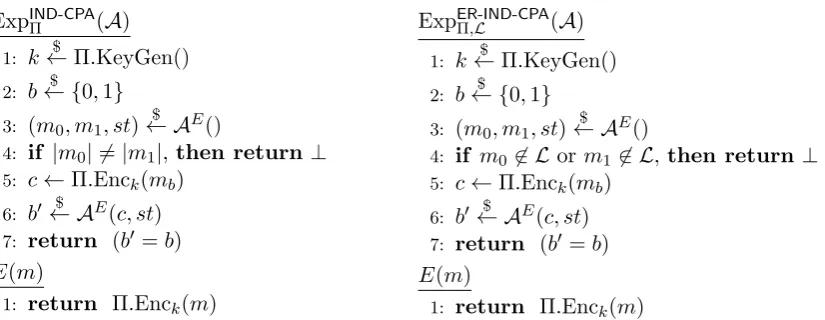
Figure 2: Security experiments for indistinguishability under chosen plaintext attack (IND-CPA, left) and entropy-restrictedIND-CPA (ER-IND-CPA, right)
2.2 Existing security notions
The standard security notion for symmetric-key encryption is indistinguishability of encrypted messages. In this paper, we focus on chosen plaintext attack. The security experiment ExpINDΠ -CPA(A) for indistinguishability under chosen plaintext attack (IND-CPA) of a symmetric-key encryption scheme Π against a stateful adversaryAis given in Figure2. Theadvantage ofA in breaking the IND-CPA experiment for Π is AdvINDΠ -CPA(A) =2 Pr ExpINDΠ -CPA(A) = 1
−1. Kelley and Tamassia [KT14] give a definition ofentropy-restricted IND-CPA security which applies to keyed compression schemes Π, and demands indistinguishability of encryptions of messages from the same classL ⊆ M; typically,Lis the class of messages that encrypt (compress) to the same length under Π.Enc, such as:
L`={m∈ M:|Π.Enc(m)|=`} .
TheER-IND-CPAsecurity experiment is given in Figure2; the corresponding advantage is defined similarly. Kelley and Tamassia note that any IND-CPA-secure symmetric-key encryption scheme Π, combined with any compression scheme Γ, is immediately ER-IND-CPA-secure. As well, it is easily seen that if a symmetric-key encryption scheme is ER-IND-CPA-secure for the class L` ={m∈ M:|m|=`}, then that scheme is also anIND-CPA-secure symmetric-key encryption.
2.3 New security notions
In this paper, we focus on the ability of an attacker to learn about a secret piece of data inside a larger piece of data, where the attacker controls everything except the secret data. We use the term cookie to refer to the secret data; in practice, this could be an HTTP cookie in a header, an anti-CSRF token, or some piece of personal information. We will allow the attacker to adaptively obtain encryptions of compressions of data of the form m0kckkm00 for a secret cookieck and adversary-chosen message prefixm0 and suffixm00.
We now present three notions for the security of cookies in the context of compression-encryption schemes:
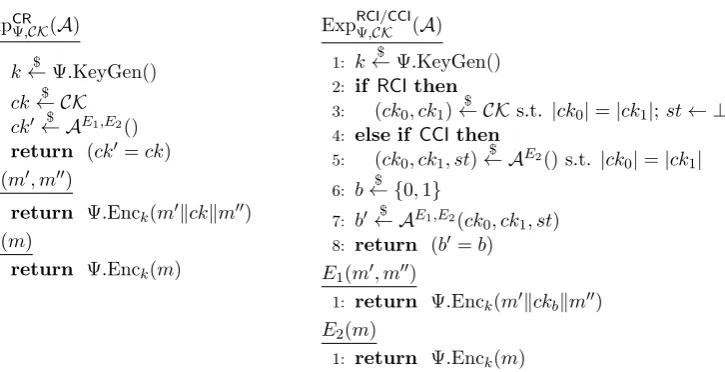
• Cookie recovery(CR)security: A simple, but relatively weak, security notion for symmetric-key compression-encryption schemes: it should be hard for the attacker tofully recover a secret value, even given adaptive access to an oracle that encrypts plaintexts of its choosing with the target cookie embedded.
ExpCRΨ,CK(A)
1: k←$ Ψ.KeyGen()
2: ck← CK$
3: ck0← A$ E1,E2()
4: return (ck0=ck)
E1(m0, m00)
1: return Ψ.Enck(m0kckkm00)
E2(m)
1: return Ψ.Enck(m)
ExpRCIΨ,CK/CCI(A)
1: k←$ Ψ.KeyGen()
2: if RCIthen
3: (ck0, ck1) $
← CKs.t. |ck0|=|ck1|;st← ⊥
4: else if CCIthen
5: (ck0, ck1, st)← A$ E2() s.t. |ck0|=|ck1|
6: b← {$ 0,1}
7: b0← A$ E1,E2(ck
0, ck1, st)
8: return (b0=b)
E1(m0, m00)
1: return Ψ.Enck(m0kckbkm00)
E2(m)
1: return Ψ.Enck(m)
Figure 3: Security experiments for cookie recovery (left) and random cookie indistinguishability and chosen cookie indistinguishability (right) attacks
• Chosen cookie indistinguishability(CCI) security: Here, the adversary has to decide which of two cookies of the adversary’s choice was embedded in the encrypted plaintext, given adaptive access to an oracle that encrypts plaintexts of its choosing with the target cookie embedded.
These security notions are formalized in the following definition, which refers to the security experiments shown in Figure 3.
Definition 4 (CR,RCI,CCIsecurity). Let Ψ be a symmetric-key compression-encryption scheme.
Let A denote an algorithm. Let CK denote the cookie space. Let xxx∈ {CR,RCI,CCI} be a security notion. Consider the security experiment ExpxxxΨ,CK(A) in Figure3. Define AdvCRΨ,CK(A) = Pr ExpCRΨ,CK(A) = 1
as the probability thatAwins the cookie recovery experiment for Ψ and CK. Similarly, define AdvxxxΨ,CK(A) = 2 Pr ExpxxxΨ,CK(A) = 1
−1, xxx ∈ {RCI,CCI}, as the advantage that A has in winning the random cookie and chosen cookie indistinguishability experiments.
Remark. TheCR, RCI, andCCI security notions intentionally include only the confidentiality of the cookie as a security goal, and not the confidentiality of any non-cookie data in the rest of the message. In most applications it would be desirable to obtain confidentiality of non-cookie data as well, and in many real-world situations, the application layer’s cookie and non-cookie data are jointly sent to the security layer (such as SSL/TLS) for encryption. Our notions do not preclude the scheme from encrypting the non-cookie data as well (and in fact our constructions in Sections3 and4do so). However, it is not possible in general to require confidentiality of the non-cookie data while still allowing it to be compressed, as that brings us back around to the original problem that motivated the work—compression of adversary-provided data can lead to ciphertexts of different lengths that break indistinguishability. This cycle can be broken by demanding some length restriction on the separated non-cookie data, such as in theER-IND-CPA
notion described in Section 2.2, but we omit that complication to focus solely on the security of the high-value secret cookies.
2.4 Relations and separations between security notions
The following relations exist between security notions for symmetric-key compression-encryption schemes:
CCI =⇒ RCI =⇒ CR .
In other words, every scheme that provides chosen cookie indistinguishability provides random cookie indistinguishability, and so on. Moreover, these notions are distinct, and we can show separations between them:
CR =6⇒ RCI =6⇒ CCI .
Additionally, we can connect our new notions with existing notions:
ER-IND-CPA =⇒ IND-CPA =⇒ CCI and CCI =6⇒ IND-CPA .
(These last relations should be interpreted as follows. A standard (non-compressing)IND-CPA -secure symmetric-key encryption scheme is alsoCCI-secure. This is not to say, however, that an
IND-CPA-secure symmetric-key encryption scheme combined with a compression scheme, such as Π◦Γ from Definition3, isCCI-secure.)
The proofs of these relations and counterexamples for the separations appear in Appendix A.
3
Technique 1: Separating secrets from user inputs
In this section we analyze a mitigation technique against attacks that recover secrets from compressed data: separating secrets from user inputs. The basic idea of separating secrets from user inputs is: given an input, use a filter to separate all the secrets from the rest of the content, including user inputs. Then the rest of the content is compressed, while the secrets are kept uncompressed. This mitigation technique is a generic mitigation technique against a whole class of compression-based side-channel attacks.
3.1 The scheme
Definition 5 (Filter). Afilter is an invertible (efficient) functionf :{0,1}∗ → {0,1}∗× {0,1}∗.
Given a filter f and a compression scheme Γ, the separating-secrets scheme SSf,Γ is given in
Figure 4.
SSf,Γ.Comp(m)
1: (pts, ptns)←f(m)
2: ptgns←Γ.Comp(ptns)
3: return ptskptgns
SSf,Γ.Decomp(pt)
1: Parseptskptgns←pt
2: ptns←Γ.Decomp(ptgns)
3: m←f−1(pt s, ptns)
4: return m
Figure 4: Abstract separating-secrets compression scheme SS
Our results will make use of the following two conditions on filters. Intuitively, a filter is effective if it removes cookies from an input string, and issafe if no prefix/suffix can fool the filter into separating out one cookie but not another.
Definition 6 (Effective filter). Let CKbe a cookie space, and let f be a filter. We say thatf
is effective at separating outCK if, for all ck∈ CK and allm0, m00, we have thatck6y, where (x, y) =f(m0kckkm00).
Definition 7 (Safe filter). LetCK be a cookie space, and letf be a filter. We say thatf issafe
for CK if, for allck0, ck1 ∈ CKsuch that |ck0|=|ck1|and all m0, m00, we have that|x0|=|x1|
Example cookie space and filter. Let λ∈Nand letCK be the set of alphanumeric strings starting with the literal “secret” and starting and ending with a space (denoted by ), i.e., strings matched by the regular expression
secret[A-Za-z0-9]λ
Letf be a filter that uses the above regular expression to separate out secrets. Consider a string of the formm=m0 ck1 m1 ck2 m2 . . . ckn mn, wheremi contains no substring matching the
above regular expression andcki is a string completely matching the above regular expression (excluding the initial and terminal space ). Then f(m) = (pts, ptns), where pts=ck1k. . .kckn
andptns=m0kτkm1kτk. . .kmn, andτ represents a fixed replacement token that can not appear
as a substring of anym∈ M.
Claim 1. The above filter f is effective at separating out and safe for the above CK.
Proof sketch. Since each cookie begins and ends with a character which does not appear within the cookie, no prefix or suffix can cause the filter to not separate a cookie.
More precisely, for any ck ∈ CKand anym0 that contains no substring matching the above regular expression and any m00 6= , we have that f(m0k ck km00) = (ckkx, m0kτky), where (x, y) =f(m00). Such an f is effective at separating out CKsince it separates every substring of m this is a cookie into the first component of the output. Moreover, f is safe for CK by recursively applying the above identity.
3.2 CCI security of basic separating-secrets technique
In this section we analyze the security of separating-secrets mitigation technique according to CCI notion. Let Π = (KeyGen,Enc,Dec) be anIND-CPA-secure symmetric-key encryption scheme and SSf,Γ be the separating-secrets compression scheme given in Figure4. We consider
the security of the resulting symmetric-key compression-encryption scheme Π◦SSf,Γ, showing
that, if the filter f safely separates out cookies, then breaking chosen cookie indistinguishability of Π◦SSf,Γ is as hard as breaking indistinguishability (IND-CPA) of encryption scheme Π. The
proof of Theorem 1appears in Appendix B.
Theorem 1. Let Π be a symmetric-key encryption scheme and let Γ be a compression scheme.
Let CK be a cookie space, and let f be a filter that is safe for CK. Let A be any adversary against the CCI security of the separating-secrets symmetric-key compression-encryption scheme Π◦SSf,Γ, and letq denote the number of queries that Amakes to its E1 oracle. Then
AdvCCIΠ◦SSf,Γ,CK(A)≤q·Adv
IND-CPA Π (B
A ) ,
where B is an algorithm, constructed using the adversary A as described in the proof, against the IND-CPA security of the symmetric-key encryption scheme Π.
3.3 Separating secrets in HTML
Separating secrets from user inputs is a realistic mitigation technique against the BREACH attack: in the application layer, some fields which contain secrets (such as anti-CSRF tokens) can be identified and separated from the HTTP response body. In order to implement separating secrets from user inputs in HTML we need to describe a filter fHTML.
One possible method to separate secrets in HTML is to separate the content assigned to the
< f o r m a c t i o n = " / m o n e y _ t r a n s f e r " m e t h o d = " p o s t " > < i n p u t t y p e = " h i d d e n " n a m e = " c s r f t o k e n "
v a l u e = " O W T 4 N m Q l O D E 4 O D R j N 2 Q 1 N T l h M m Z l Y W E ... " > ...
< / f o r m >
Figure 5: HTML code segment showing inclusion of anti-CSRF token in a web form
Table 1: Compression performance (file size in bytes and compression ratio) for separating secrets (Section 3) and fixed dictionary (Section4) techniques
Website Uncompressed gzip full page Separating secrets Fixed dictionary
Google.com 145 599 41 455 (3.51×) 41 502 (3.51×) 117 794 (1.23×) Facebook.com 48 226 13 785 (3.50×) 15 863 (3.04×) 35 036 (1.37×) Youtube.com 467 928 41 813 (11.19×) 41 893 (11.17×) 181 676 (2.58×) Yahoo.com 444 408 82 572 (5.38×) 83 342 (5.33×) 318 386 (1.40×) Baidu.com 74 979 17 519 (4.28×) 17 727 (4.23×) 55 950 (1.34×) Wikipedia.org 48 548 11 217 (4.33×) 11 809 (4.11×) 38 406 (1.26×) Twitter.com 57 777 12 520 (4.61×) 16 618 (3.48×) 39 712 (1.46×) Qq.com 626 297 124 108 (5.05×) 125 747 (4.98×) 519 830 (1.21×) Amazon.com 234 609 54 922 (4.27×) 56 278 (4.17×) 150 924 (1.55×) Taobao.com 192 068 23 658 (8.12×) 23 898 (8.04×) 93 410 (2.06×)
The following (case-insensitive) regular expression can be used to separate out quoted anti-CSRF tokens in the valueattribute of HTML elements:
value\s*=\s*"[A-Za-z0-9]+"|value\s*=\s*’[A-Za-z0-9]+’
This filter is effective at separating out and safe for the implied set of cookies, in the sense of Definitions 6and 7.
However, the above regular expression is not perfect, highlighting the challenges of using heuristic techniques to separate out secrets.
First, the above regular expression will also capture thevalue attribute of HTML elements other than hidden inputelements, such as option, which may not need to be treated as secret, so it is not as efficient as it could be.
Second, the above regular expression does not capture anti-CSRF tokens in unquoted
value attributes, such as value=OWT4NmQl, which are allowed by the HTML specification. While it is easy to add an additional term such as |value\s*=\s*[A-Za-z0-9]+to the regular expression to capture unquoted attributes, this filter would no longer be effective in the sense of Definition 6: if a cookie is value=OWT4NmQl, and the adversary constructs m0 = value=, then m0kck = value=value=OWT4NmQl, and the filter applied to m0kck would separate out
value=valueas the cookie and leave=OWT4NmQl unprotected.
3.4 Experimental results on separating-secrets in HTML
Table 1shows the result of applying the above regular expression to separate secrets on the top 10 global websites of Alexa Top Sites. As most pages contain little data in valueattributes, the total amount of space required to transmit the separated secrets plus the remaining data is not much more than when the full page is compressed. (Table 1also contains performance results of the fixed dictionary technique, to be discussed in Section 4.)
3.5 Discussion
above to capture anti-CSRF tokens: it may separate out non-secrets as well as secrets (which yields suboptimal compression) and it does not capture unquoted tokens (which is a problem for security).
Moreover, this HTML filter also only captures secrets in a value attribute, which does not necessarily capture all values that might be considered sensitive. For example, should the titles of books in a search results page on an shopping site be considered secret? If so, an alternative separation filter would have to be developed. To provide complete certainty, secret separation would require additional markup with which the developer clearly identifies which data should be treated as secret. Otherwise, any sensitive values which are not separated may be compressed together with user inputs and other application data, and hence remain open to the compression-based side-channel.
4
Technique 2: Fixed-dictionary compression
The CRIME and BREACH attacks work because the dictionary constructed by the deflate compression algorithm is adaptive: if the attacker injects a substring of the target secret into the plaintext nearby the secret itself, then the plaintext will compress more because of the repeated substring. Some early compression algorithms were non-adaptive, using a fixed dictionary mechanism. For example, Pike [Pik80] used a fixed dictionary of 205 popular English words and a variable length coding mechanism to compress typical English text at a rate of less than 4 bits per character. Another recent algorithm, Smaz [San09], similarly uses a fixed dictionary consisting of common digrams and trigrams from English and HTML source code, allowing it to compress even very short strings. Because the CRIME and BREACH attacks rely on the adaptivity of the compression dictionary, fixed-dictionary algorithms can offer resistance to such attacks while still providing some compression, albeit not as good as adaptive compression.
In this section, we investigate the use of fixed-dictionary compression in the context of encryption. We describe the basic idea of dictionary compression. We show that fixed-dictionary compression-encryption schemes can satisfy cookie recovery security for sufficiently large cookies. We then present an example of a modern fixed-dictionary compression algorithm and report on the compression ratios achieved by our algorithm.
4.1 The scheme
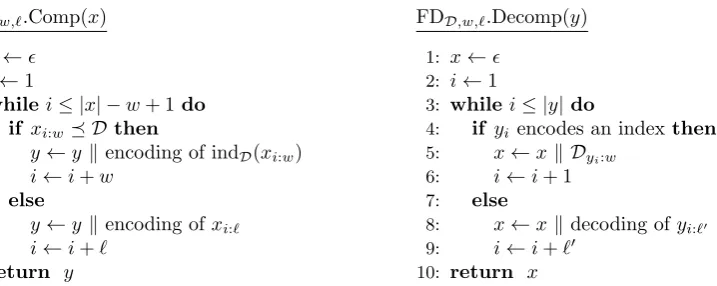
In general, fixed-dictionary compression schemes work by advancing through the stringx and looking to see if the current substring appears in the dictionaryD: if it does, then an encoding of the index of the substring is recorded, otherwise an encoding of the current substring is recorded. The compression scheme must specify the encoding rules in a way that unambiguously discriminates between the two cases to allow for correct decompression.
An abstract version of a fixed-dictionary fixed-width compression algorithm FD is given in Figure6. FD checks if the current substring of length w appears in the dictionaryD. If it does, it records the index of the substring in D and advances w characters. If it does not, it records the next ` characters directly, then advances. (Using ` > 1 but` < w may be more efficient when it comes to encodings.) One could treat Deither as a set of strings (recording which element is matched) or a long string (recording the starting and ending position of the matching substring); we will use the latter in the rest of this section.
For example, ifD=“cookierecoveryattack”, then FDD,4,2.Comp(“recover the cookie”)
yields7ver the 1ie.
4.2 CR security of basic fixed-dictionary technique
Let Π be a symmetric-key encryption scheme. Let Dbe a dictionary of lengthdand FDD,w,`be
FDD,w,`.Comp(x)
1: y← 2: i←1
3: while i≤ |x| −w+ 1 do
4: if xi:w D then
5: y←y k encoding of indD(xi:w)
6: i←i+w 7: else
8: y←y k encoding ofxi:`
9: i←i+` 10: return y
FDD,w,`.Decomp(y)
1: x← 2: i←1
3: while i≤ |y|do
4: if yi encodes an indexthen
5: x←xk Dyi:w
6: i←i+ 1 7: else
8: x←xk decoding ofyi:`0 9: i←i+`0
10: return x
Figure 6: Abstract fixed-dictionary fixed-width compression scheme FD Note the simplification that `characters ofxare encoded as`0 characters ofy.
Suppose the cookie space is binary strings of length 8λ, or equivalently byte strings of length
λ: CK={0x00, . . . ,0xFF}λ.
If Π is a secure encryption scheme, then, intuitively, the only way the adversary can learn information about the cookie from seeing ciphertexts Enck(·kckk·) and Enck(·) is from the length
of the ciphertext: if some substring of ckappears in the dictionary D, thenck will compress, and that length difference tells the adversary that the secret cookie is restricted to some subset of CKmatching D.
The situation is subtler in the full CR experiment: the attacker can provide m0 and m00
and get Enck(Comp(m0kckkm00)). If the last few bytes ofm0 followed by the first few bytes of ck appear in D, then the string will compress more. This allows the attacker to carry out a CRIME-like attack on the first few bytes ofck.
For example, let w = 4 and suppose D= 1234567890ABCDEFGHIJKLMNOPQRSTUVWXYZ and CK = [0-9A-F]λ. The attacker can query m0 =890, m0 = 90A, m0 = 0AB, . . .. In exactly one case, the adversary’s m0 combined with the cookie’s first byte will be in the dictionary, telling the adversaryck1. For example, ifck1=B, then when the adversary queriesm0 =90A, the value
that is compressed and then encrypted ism0kckkm00 =90AB. . ., which is a substring ofD. While this allows the attacker to recover the first byte or two of the secret cookie with decent probability, it drops off exponentially; a similar argument applies to the last few bytes of the secret cookie. Theorem 2 captures this issue. Theorem 2 only provides quantifiable security when the cookie length nis significantly bigger than the compression windoww. Additionally, this type of attack on the first/last few bytes of the cookie precludesindistinguishable security, which is why we focus on cookie recovery here. (Admittedly, in some settings recovering the first/last few cookie bytes may still be quite damaging.)
Theorem 2. Let Π be a symmetric-key encryption scheme. Let D be a dictionary of dwords,
each of length `. Letw be positive integer. LetCK= Ωn. Let A be any adversary against the cookie recovery security of the fixed-dictionary symmetric-key compression-encryption scheme Π◦FDD,w,`. Then
AdvCRΠ◦FDD,w,`(A)≤AdvINDΠ -CPA(B) + 2−∆ ,
where B is an algorithm, constructed using adversaryA, against theIND-CPA security of the symmetric-key encryption scheme Π, and
∆≥ 1−d 1−
1− 1 |Ω|w
n−3w+1!!
·log2 |Ω|n−2w− |Ω|n−2w·d 1−
1− 1
|Ω|w
n−3w+1!!
For example, for cookies of n= 16 bytes, with a dictionary ofd= 4000 words each of length
w= 4, we have ∆≥63.999695. Doubling dgives ∆≥63.999391.
The derivation and proof of the formula in Theorem 2appear in AppendixC.
4.3 Experimental results on fixed-dictionary technique
Table 1 shows the result of applying a fixed-dictionary based compression algorithm to the top 10 global websites of Alexa Top Sites. The 4000-byte dictionary was built from the most common 8-, 16-, and 32-character substrings of the pages. The compression algorithm was based in part on the Smaz [San09] algorithm and was adapted slightly from Figure 6, to allow for variable-length words to be matched. Specifically, when attempting to encode the substring at the current position at line 4 in Figure6, we first try variable length words in order of decreasing length, checking to see if w= 18, thenw= 16, then . . . , then w= 4 characters can be found in the dictionary. This requires the encoding to include both index and length of the dictionary substring.
• To encode a dictionary word at index 0≤ j <4096 of length w = 2w0+ 4,0 ≤w0 ≤7, store 16 bits: 1k [12-bit encoding ofj]k[3-bit encoding of w0]
• To encode 2 lower-ASCII charactersz1z2, store 16 bits: 00 k[7-bit encoding of z1] k [7-bit
encoding ofz2]
• To encode 1 bytez, store 16 bits: 01000000k[8-bit encoding of z]
4.4 Discussion
The main drawback of the fixed dictionary mitigation technique is that in practice it achieves relatively poor—albeit non-zero—compression compared with adaptive compression techniques. However, it does not rely on application-dependent or heuristic techniques for separating secrets.
5
Conclusion
In this paper we introduced theoretical models to analyze compression-based side-channel attacks on high-value secrets embedded inside messages: the notions of cookie recovery (CR) security, random cookie indistinguishability (RCI), and chosen cookie indistinguishability (CCI). Each notion allows an attacker adaptive access to an oracle which encrypts chosen plaintexts alongside a target secret.
The simple, but relatively weak, CR security notion is sufficient to model real-world compression-based side-channel attacks such as CRIME and BREACH that aim to recover the target secret. The CCI security notion addresses stronger situations where the adversary has to decide which of two secrets of the adversary’s choice was embedded in the encrypted plaintext, even given adaptive access to an oracle that encrypts plaintexts of its choosing with the target secret embedded.
Acknowledgements
The authors acknowledge support by Australian Research Council (ARC) Discovery Project DP130104304.
References
[ADW09] Jo¨el Alwen, Yevgeniy Dodis, and Daniel Wichs. Leakage-resilient public-key cryp-tography in the bounded-retrieval model. In Shai Halevi, editor,CRYPTO 2009, LNCS, volume 5677, pp. 36–54. Springer, August 2009.
[AGV09] Adi Akavia, Shafi Goldwasser, and Vinod Vaikuntanathan. Simultaneous hardcore bits and cryptography against memory attacks. In Omer Reingold, editor,TCC 2009, LNCS, volume 5444, pp. 474–495. Springer, March 2009.
[BPT14] Mike Belshe, Roberto Peon, and Martin Thomson. Hypertext Transfer Proto-col version 2, November 2014. Internet-Draft. http://tools.ietf.org/html/ draft-ietf-httpbis-http2-16.
[DP08] Stefan Dziembowski and Krzysztof Pietrzak. Leakage-resilient cryptography. In49th FOCS, pp. 293–302. IEEE Computer Society Press, October 2008.
[DR08] T. Dierks and E. Rescorla. The Transport Layer Security (TLS) Protocol Version 1.2. RFC 5246 (Proposed Standard), August 2008. url http://www.ietf.org/ rfc/rfc5246.txt. Updated by RFCs 5746, 5878, 6176.
[FR14] R. Fielding and J. Reschke. Hypertext Transfer Protocol (HTTP/1.1): Message Syntax and Routing. RFC 7230 (Proposed Standard), June 2014. url http: //www.ietf.org/rfc/rfc7230.txt.
[GHP13] Yoel Gluck, Neal Harris, and Angelo Prado. SSL, gone in 30 seconds: A BREACH beyond CRIME. InBlack Hat USA 2013, August 2013.urlhttps://www.blackhat. com/us-13/archives.html#Prado.
[HMF07] Michael Hutter, Stefan Mangard, and Martin Feldhofer. Power and EM attacks on passive 13.56 mhz RFID devices. In Pascal Paillier and Ingrid Verbauwhede, editors, CHES 2007,LNCS, volume 4727, pp. 320–333. Springer, September 2007.
[Kel02] John Kelsey. Compression and information leakage of plaintext. In Joan Daemen and Vincent Rijmen, editors,FSE 2002, LNCS, volume 2365, pp. 263–276. Springer, February 2002.
[Koc96] Paul C. Kocher. Timing attacks on implementations of Diffie-Hellman, RSA, DSS, and other systems. In Neal Koblitz, editor,CRYPTO’96,LNCS, volume 1109, pp. 104–113. Springer, August 1996.
[KSWH98] John Kelsey, Bruce Schneier, David Wagner, and Chris Hall. Side channel crypt-analysis of product ciphers. In Jean-Jacques Quisquater, Yves Deswarte, Catherine Meadows, and Dieter Gollmann, editors, ESORICS’98, LNCS, volume 1485, pp. 97–110. Springer, September 1998.
[NS09] Moni Naor and Gil Segev. Public-key cryptosystems resilient to key leakage. In Shai Halevi, editor,CRYPTO 2009,LNCS, volume 5677, pp. 18–35. Springer, August 2009.
[Pik80] J. Pike. Text compression using a 4 bit coding scheme. The Computer Journal, 24(4):324–330, September 1980. doi:10.1093/comjnl/24.4.324.
[RD12] Juliano Rizzo and Thai Duong. The CRIME attack, 2012. Presented at ekoparty ’12. http://goo.gl/mlw1X1.
[San09] Salvatore Sanfilippo. Smaz: Small strings compression library, April 2009. https: //github.com/antirez/smaz.
[The] The Chromium Projects. SPDY. url http://dev.chromium.org/spdy. http: //dev.chromium.org/spdy.
[Tru14] Trustworthy Internet Movement. SSL Pulse, December 2014. https://www. trustworthyinternet.org/ssl-pulse/.
A
Relations and separations between security notions
This subsection briefly gives the intuition for the proofs of the relations and separations of the security notions; details follow in the rest of the section.
• IND-CPA =⇒ CCI: A (non-compressing) IND-CPA-secure symmetric-key encryption scheme provides indistinguishability of any pair of equal-length chosen messages, including messages involving a cookie. The proof proceeds by a hybrid argument, making the cookie used in each query made by the adversary to its E1 oracle independent of the secret bitb.
• CCI =6⇒ IND-CPA: A degenerate scheme that uses a separating-secrets filter to extract secret cookies then encrypt the cookies but not the non-cookie data isCCI-secure but not
IND-CPA-secure for the whole message.
• CCI =⇒ RCI: A straightforward simulation: an adversary who cannot distinguish between encryptions of equal-length cookies of its choosing can also not distinguish between encryptions of randomly chosen equal-length cookies.
• RCI =6⇒ CCI: A counterexample is constructed that uses a separating-secrets filter: an extra ciphertext component c2 is added, consisting of a point function applied to the
separated secrets, where the point function is 1 on a single, publicly known cookie value
z. With high probability, two randomly chosen cookies will not match z, so c2 carries
no useful information and the scheme isRCI-secure, but a CCI adversary can choose one cookie that matches z and one that does not, so c2 allows distinguishing of the chosen
cookies.
• RCI =⇒ CR: A straightforward simulation: an adversary who recovers a cookie given only ciphertexts easily distinguishes encryptions of cookies.
• CR =6⇒ RCI: A counterexample is constructed: an extra ciphertext componentc2 is added,
consisting of a random oracle applied to the message. The adversary gets encryptions of m0kckkm00 for m0, m00 of its choice; without querying the random oracle on exactly
m0kckkm00, c2 provides no information to the adversary, so the scheme is CR-secure.
However, an RCIadversary can check the random oracle on the two given random cookies, soc2 allows distinguishing of the given random cookies.
A.1 IND-CPA =⇒ CCI
Theorem 3. Let Ψ be anIND-CPA-secure symmetric-key encryption scheme. Then Ψis also a
let A be an adversary against theCCI security of Ψ, and letq denote the number of queries that A makes to its E1 oracle. Then
AdvCCIΨ,CK(A)≤q·AdvINDΨ -CPA(BA) ,
where B is an algorithm, constructed using the adversary A as described in the proof, against the IND-CPA security of the underlying symmetric-key encryption schemeΨ.
Proof. The proof proceeds in a sequence of games, using a hybrid approach. Each Game i
proceeds as in the original CCI security experiment, except that the queries to E1 are answered
as in Figure 7. Let Advi denote the probability that game ioutputs 1.
E1(m0, m00)
1: if query # ≤ithen
2: return Ψ.Enck(m0kck0km00)
3: else if query #> ithen
4: return Ψ.Enck(m0kckbkm00)
Figure 7: OracleE1 used in Game iin proof of Theorem3.
Game 0. This is the originalCCI security game for Π. By definition,
AdvCCIΨ,CK(A) = Adv0 .
Transition from Game (i−1) to Game i, 1≤i≤q. Each hybrid transition changes how
one query is answered; if the adversary’s behaviour differs because of the change in answering the query, we can construct a simulator Bi that wins the IND-CPA game for Ψ, as shown in
Figure8. When theIND-CPA challenger usesb= 0,c∗ is the encryption ofm0kckˆbkm00, so Bi is
playing game (i−1) withA. When the IND-CPAchallenger uses b= 1,c∗ is the encryption of
m0kckˆ0km00, soBi is playing gamei withA. Thus,
Advi−1−Advi
≤AdvINDΨ -CPA(BAi ) .
BAi ,E()
1: (ck0, ck1, st) $
← AE2() s.t. |ck0|=|ck1|
2: ˆb← {$ 0,1}
3: b0← A$ E1,E2(ck
0, ck1, st)
4: return b0
E2(m)
1: return E(m)
E1(m0, m00)
1: if query # < ithen
2: return E(m0kck0km00)
3: else if query # =ithen
4: Give (m0kckˆbkm00, m0kck0km00) to IND-CPAchallenger
5: Receivec∗ from IND-CPA challegner
6: return c∗
7: else if query # > ithen
8: return E(m0kckˆbkm00)
Figure 8: SimulatorBi used in the proof of Theorem3
Analysis of Game q. Since the adversary’s view is independent ofb in Gameq, we have
Conclusion. Combining the above results, we have
AdvCCIΨ,CK(A)≤
q
X
i=1
AdvINDΨ -CPA(Bi) =q·AdvINDΨ -CPA(B)
(with a small abuse of notation in creating a single B from the disparateBi).
A.2 CCI =6 ⇒ IND-CPA
Theorem 4. There exists a symmetric-key compression-encryption scheme that is CCI-secure
but notIND-CPA-secure.
Theorem 4 is shown using a degenerate counterexample involving the separating-secrets technique. The basic idea is that we encryptonly secret cookies and not the message. Technically, theCCIsecurity definition only requires any confidentiality for the cookie portion of the ciphertext and not the rest of it, so a scheme that extracts and encrypts only the cookies isCCI-secure, but is clearly not IND-CPA-secure.
In particular, let Π be a symmetric-key encryption scheme. LetCK be the cookie space rec-ognized by secret[A-Za-z0-9]λ andf be the corresponding filter, as described in Section3.1. Recall this filter is effective at separating outCK.
We construct Ψ from Π and f as in Figure9. We will show that Ψ isCCI-secure, but is not
IND-CPA-secure.
Ψ.KeyGen()
1: return Π.KeyGen()
Ψ.Enck(m)
1: ptskptns←f(m)
2: c1←$ Π.Enck(pts)
3: return c1kptns
Ψ.Deck(c)
1: Parse c1kptns←c
2: pts ←Π.Deck(c1)
3: m←f−1(pts, ptns)
4: return m
Figure 9: Scheme Ψ used in the proof of Theorem4
Claim 2. Ψ in Figure9 isCCI-secure, assumingΠ is IND-CPA-secure.
Proof sketch of claim. Since f is effective at separating out CK, onlyc1 components carry any
information about b. However,c1 is the encryption of the secrets extracted from m0 and m00
as well as ckb. Since f is safe for CK, the length of pts is the same when derived from either m0kck0km00 orm0kck1km00. Thus any adversary that can guess the bitbserves as a distinguisher
for Π under chosen plaintext attack.
Claim 3. Ψ in Figure9 is notIND-CPA-secure.
Proof sketch of claim. The construction of a successful A against the IND-CPA security of Ψ is straightforward. A picks two distinct messages m00 and m01 that do not match the regular expression defining f, and gives these as the challenge messages to theIND-CPA challenger for Ψ. The resulting ciphertext will have an empty c1 component (since neitherm00 nor m01 has
any value that will be separated out), and the second ciphertext component is encrypted, so the adversary receives back m0b directly. The adversary then can immediately provide a correct guess of b.
A.3 CCI =⇒ RCI
Theorem 5. Let Ψ be a CCI-secure symmetric-key compression-encryption scheme. Then Ψis
space, and let A be an algorithm against the RCIsecurity of Ψ. Then, for the algorithm B given in Figure10,
AdvRCIΨ,CK(A)≤AdvCCIΨ,CK(BA) .
Proof. The proof proceeds via direct simulation. We are given an adversaryA against theRCI
security of Ψ. We must construct an adversary Bagainst theCCI security of Ψ; note thatB will have access to oracles E1 and E2 described in theCCI security experiment. The simulator B
is constructed in Figure 10. Notice in particular that B uses the CCI challenger’s E1 and E2
oracles to answerA’s queries.
BA,E1,E2()
1: (ck0, ck1)← CK$ s.t. |ck0|=|ck1|
2: Give (ck0, ck1) to theCCI challenger
3: b0 ← A$ E1,E2(ck
0, ck1,⊥)
4: return b0
Figure 10: Simulator used in the proof of Theorem5.
B’s simulation of theRCIexperiment toA is perfect. IfA’s guessb0 of the bis correct in the
RCIexperiment, then it is also correct for theCCI experiment, and similarly when the guess is wrong. This yields the bound in the theorem.
A.4 RCI =6⇒ CCI
Theorem 6. There exists a symmetric-key compression-encryption scheme that is RCI-secure
but notCCI-secure.
Theorem 6is shown using a counterexample involving the separating-secrets technique and a point function involving a hard-coded publicly known string. The basic idea is that we append to each ciphertext a single bit representing the output of the point function on the cookie(s) in the message. Since randomly chosen cookies are highly unlikely to be the same as the hard-coded value in the point function, this extra bit provides no useful information for anRCI adversary, but a chosen-cookie adversary could easily pick one cookie to be the hard-coded value and one not to be, the bit thereby allowing him to easily distinguish the two.
In particular, let Π be a symmetric-key encryption scheme and let Γ be a compression scheme. LetCK be the cookie space recognized by secret[A-Za-z0-9]λ and f be the corresponding filter, as described in Section 3.1. Recall this filter is safe for CK.
Let Ψ = Π◦SSf,Γ be the symmetric-key compression-encryption scheme constructed using
the separating-secrets technique. Recall from Theorem 1that Ψ is CCI-secure if Π is IND-CPA
secure. By Theorem5, Ψ is thus alsoRCI-secure.
Additionally, let z∈ CK, and define the point function
gz(x) =
(
1, ifzx,
0, otherwise.
We will construct Ψ0 as in Figure 11 from Ψ = Π◦SSf,Γ and gz. We will show that Ψ0
remainsRCI-secure, but is notCCI-secure.
Claim 4. Ψ0 in Figure 11is RCI-secure, assuming Π isIND-CPA-secure and CK is large.
Proof sketch of claim. Letck∗0 and ck1∗ denote the random cookies to be distinguished.
Because Π◦SSf,Γ isRCI-secure,c1 gives the adversary no advantage in guessing the bitb.
Ψ0.KeyGen()
1: return Ψ.KeyGen()
Ψ0.Enck(m)
1: ptskptnsg ←SSf,Γ.Comp(m)
2: c1 $
←Π.Enck(ptskptgns)
3: c2 ←gz(pts)
4: return c1kc2
Ψ0.Deck(c)
1: Parsec1kc2←c
2: return Ψ.Deck(c1)
Figure 11: Scheme Ψ0 used in the proof of Theorem6
The second ciphertext component c2 is only useful to the adversary if the adversary can
construct a pair (m0, m00) such that c2 is different form0kck0∗km00 versusm0kck∗1km00.
Consider the construction of pts from m in Ψ0.Enck(m). Since pts consists of a
comma-separated list of cookies, and no cookie contains a comma, gz(pts) = 1 if and only if there
exists someisuch that gz(cki) = 1, where mis parsed as m0kck1km1kck2km2k. . .kcknkmn as
described above.
Now consider the handling of m=m0kck∗bkm00 for m0, m00 of the adversary’s choosing. By the argument above, gz(pts) = gz(ckb∗)∨gz(m0)∨gz(m00). Moreover,gz(ck∗0) 6=gz(ck∗1) if and only if one of them is equal toz but the other is not. Sinceck∗0 andck∗1 are chosen uniformly at random from CK, this occurs with probability at most 2/|CK|.
Claim 5. Ψ0 in Figure 11is not CCI-secure.
Proof sketch of claim. The construction of a successful A against the CCI security of Ψ0 is straightforward. Note that Aknows the valuez in the point functiongz. Thus, Acould issue a
CCI challenge with ck0 =z andck1 6=z, and then make the queryE1(, ), thereby obtaining c1 = Enck(ckb) andc2 =gz(ckb). The last bit of such a ciphertext immediately indicates whether ckb=zor not.
A.5 RCI =⇒ CR
Theorem 7. Let Ψbe an RCI-secure symmetric-key compression-encryption scheme. Then Ψ
is also a CR-secure symmetric-key compression-encryption scheme. Formally, let CK be a cookie space, and let A be an algorithm against the CR security ofΨ. Then, for the algorithmB given in Figure12,
AdvCRΨ,CK(A)≤AdvRCIΨ,CK(BA) .
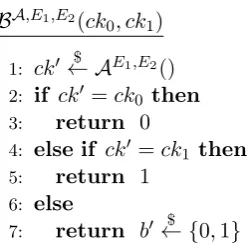
Proof. The proof proceeds via direct simulation. We are given an adversary A against theCR
security of Ψ. We must construct an adversary Bagainst theRCIsecurity of Ψ; note thatB will have access to oracles E1 and E2 described in the RCI security experiment. The simulator B
is constructed in Figure 12. Notice in particular that B uses the RCIchallenger’s E1 and E2
oracles to answerA’s queries.
BA,E1,E2(ck
0, ck1)
1: ck0 ← A$ E1,E2() 2: if ck0 =ck0 then
3: return 0
4: else if ck0=ck1 then
5: return 1
6: else
7: return b0← {$ 0,1}
B’s simulation of theCR experiment toA is perfect: the valueckb used by theE1 oracle in
the RCIchallenger was indeed chosen at random, just as in theCRexperiment, and is indeed consistent.
If A’s guess ck0 of the cookie is correct in theCRsimulation, then it is also correct for the
RCIexperiment, and soB’s output will be correct. IfA’s guess is wrong, then Bdoes as good as random guessing.
A.6 CR =6⇒ RCI
Theorem 8. There exists a symmetric-key compression-encryption scheme that is CR-secure
but notRCI-secure.
Theorem 8 is shown using a counterexample involving a random oracle. The basic idea is that we append to each ciphertext the output of the random oracle applied to the message. For an adversary who is trying to guess an unknown cookie, this provides no information unless it queries the random oracle on the cookie itself, but a random-cookie adversary, who knows that the cookie is one of two values, could easily determine which by querying both to the random oracle.
Let Ψ be a symmetric-key compression-encryption scheme. Let H:{0,1}∗→ {0,1}λ be a
random oracle. Construct Ψ0 as shown in Figure13.
Ψ0.KeyGen()
1: return Ψ.KeyGen()
Ψ0.Enck(m)
1: c1 $
←Ψ.Enck(m)
2: c2←H(m)
3: return c1kc2
Ψ0.Deck(c)
1: Parse c1kc2 ←c
2: return Ψ.Deck(c1)
Figure 13: Scheme Ψ0 used in the proof of Theorem8
Claim 6. Ψ0 is CR-secure in the random oracle model, assuming Ψ is CR-secure and CK is
sufficiently large. Formally,
AdvCRΨ0,CK(A)≤qH·`·AdvCRΨ,CK(BA) ,
where qH is the number of queries that A makes to the random oracle, `is the maximum length of a message queried by A to the random oracle, and B is the algorithm given in Figure 14.
Proof. Let ck∗ denote the cookie to be recovered.
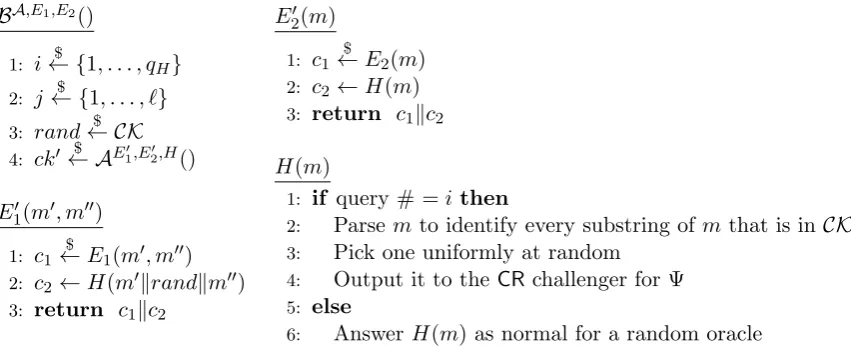
The intuition of the proof is as follows. Because Ψ is CR-secure, c1 does not help the
adversary in guessing the cookie ck∗. We need to assess whetherc2 helps the adversary at all
in winning the CRgame. The second ciphertext component c2 is only useful to the adversary
if the adversary queries the random oracle on the plaintext ofc1, which would mean that the
adversary queries the random oracle on the target cookieck∗. We can thus use this to win the
CRexperiment for Ψ0.
More precisely, the proof proceeds via direct simulation. We are given an adversaryAagainst the CR security of Ψ0. We must construct an adversary B against the CRsecurity of Ψ; note thatB will have access to oracles E1 and E2 described in theCR security experiment for for Ψ.
The simulatorB is constructed in Figure 14.
B’s simulation of the CR experiment for Ψ0 to A is perfect so long as E10 and H remain consistent. The only time an inconsistency arises is if A queries H on m0kck∗km00 for some
BA,E1,E2()
1: i← {$ 1, . . . , qH}
2: j← {$ 1, . . . , `}
3: rand← CK$
4: ck0 ← A$ E10,E20,H()
E10(m0, m00)
1: c1 $
←E1(m0, m00)
2: c2 ←H(m0krandkm00)
3: return c1kc2
E20(m)
1: c1 $
←E2(m)
2: c2←H(m)
3: return c1kc2
H(m)
1: if query # =ithen
2: Parsem to identify every substring of m that is inCK 3: Pick one uniformly at random
4: Output it to the CRchallenger for Ψ
5: else
6: AnswerH(m) as normal for a random oracle
Figure 14: Simulator used in the proof of Theorem8.
Claim 7. Ψ0 is notRCI-secure.
Proof sketch of claim. The construction of a successful A against the RCI security of Ψ0 is straightforward. An adversary Aagainst theRCIsecurity of Ψ0 is told that the target cookie is one of two values,ck0andck1. Acould make the queryE1(, ), thereby obtainingc1= Enck(ckb)
andc2 =H(ckb). A could then queryH(ck0) andH(ck1); one of these will equal c2, telling the
adversary the value ofb.
B
Proof of
CCI
security of separating-secrets technique
Proof of Theorem 1. The proof proceeds in a sequence of games, using a hybrid approach. Each Game iproceeds as in the original CCIsecurity experiment, except that the queries to E1 are
answered as in Figure15. Let Advi denote the probability that gamei outputs 1.
E1(m0, m00)
1: if query # ≤ithen
2: return Π.Enck(SSf,Γ(m0kck0km00))
3: else if query #> i then
4: return Π.Enck(SSf,Γ(m0kckbkm00))
Figure 15: OracleE1 used in Game iin proof of Theorem 1.
Game 0. This is the originalCCI security game for Π. By definition,
AdvCCIΠ◦SSf,Γ,CK(A) = Adv
0 .
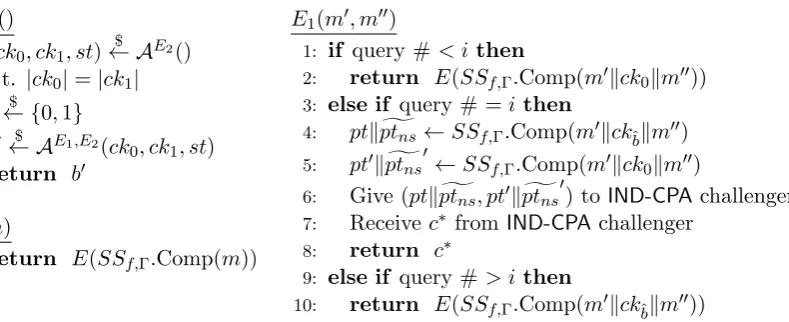
Transition from Game (i−1) to Game i, 1≤i≤q. Each hybrid transition changes how
one query is answered; if the adversary’s behaviour differs because of the change in answering the query, we can construct a simulator Bi that wins the IND-CPA game for Ψ, as shown in Figure16. When theIND-CPAchallenger usesb= 0,c∗ is the encryption of the separating-secrets compression ofm0kckˆbkm00, so Bi is playing game (i−1) withA. When theIND-CPAchallenger
uses b= 1, c∗ is the encryption of the separating-secrets compression of m0kck0km00, so Bi is
playing gameiwithA. Sincef is safe forCK, the separating-secrets compressions ofm0kck0km00
and m0kck1km00 have the same length, and thus the pair of chosen messages given from the
simulator in E1 to the IND-CPA challenger is valid according to the IND-CPA experiment. Thus,
Advi−1−Advi
BiA,E()
1: (ck0, ck1, st) $
← AE2() s.t. |ck0|=|ck1|
2: ˆb← {$ 0,1}
3: b0 ← A$ E1,E2(ck
0, ck1, st)
4: return b0
E2(m)
1: return E(SSf,Γ.Comp(m))
E1(m0, m00)
1: if query # < ithen
2: return E(SSf,Γ.Comp(m0kck0km00))
3: else if query # =ithen
4: ptkptgns←SSf,Γ.Comp(m0kckˆbkm00)
5: pt0kptnsg
0
←SSf,Γ.Comp(m0kck0km00)
6: Give (ptkptns, ptg 0kptnsg
0
) to IND-CPA challenger 7: Receivec∗ from IND-CPAchallenger
8: return c∗
9: else if query #> i then
10: return E(SSf,Γ.Comp(m0kckˆbkm00))
Figure 16: Simulator Bi used in the proof of Theorem1
Analysis of Game q. Since the adversary’s view is independent ofb in Gameq, we have
Advq= 0 .
Conclusion. Combining the above results, we have
AdvCCIΨ,CK(A)≤
q
X
i=1
AdvINDΨ -CPA(BAi ) =q·AdvINDΨ -CPA(BA)
(with a small abuse of notation in creating a single B from the disparateBi).
C
Analysis of security of fixed-dictionary technique
C.1 Probability bounds, no prefix/suffix
In this section, we compute the amount of information given to the adversary from knowing the length of the compressed cookie, without any adversarially chosen prefix or suffix. This can be computed by calculating the amount of information given by knowing how many substrings of the cookie appear in the dictionary. For the analysis, we treatD as a set of strings.
First we calculate the probability that a given string is a substring of a randomly chosen cookie.
Lemma 1. Letx∈Ωw be a word, and letck←$ Ωn=CK be a random string of ncharacters.
Then
Pr(xck)≤1−
1− 1 |Ω|w
n−w+1
.
Proof.
Pr(xck) = 1−Pr(x6ck)
= 1−Pr((x6=ck1:w)∧(x6=ck2:w)∧ · · · ∧(x6=ckn−w+1:w))
≤1−Pr(x6=ck1:w) Pr(x6=ck2:w). . .Pr(x6=ckn−w+1:w)
= 1−
1− 1 |Ω|w
n−w+1
Lemma 2. Let D ⊆ Ωw with |D| = d be a dictionary of d words of w characters. Let
ck←$ Ωn=CK be a random string of ncharacters. Then
Pr(∃x∈ D:xck)≤d 1−
1− 1 |Ω|w
n−w+1!
.
Proof. SupposeD={x1, x2, . . . , xd}.
Pr(∃x∈ D:xck) = Pr((x1ck)∨(x2 ck)∨ · · · ∨(xdck))
≤
d
X
i=1
Pr(xick)
≤d 1−
1− 1
|Ω|w
n−w+1!
Recall the definition of conditional entropy for random variablesX andY:
H(Y |X) = X
x∈supp(X)
Pr(X=x)H(Y |X=x)
=− X
x∈supp(X)
Pr(X=x)
· X
y∈supp(Y)
Pr(Y =y|X=x) log2Pr(Y =y|X=x) .
We now compute the amount of entropy about the cookie given knowledge about the number of substrings of the cookie that appear in the dictionary:
Lemma 3. Fix D. Let #SUB(ck) denote the number of substrings of ck that appear in D.
Suppose CK is a uniform random variable on CK. Then
H(CK |#SUB(CK))≥ 1−d 1−
1− 1 |Ω|w
n−w+1!!
·log2 |CK| − |CK| ·d 1−
1− 1
|Ω|w
n−w+1!!
.
Proof. Let #s denote the number of cookies ck∈ CK such that #SUB(ck) = s. First note that
Pr(#SUB(CK) =s) = #s
|CK| .
Additionally,
Pr(CK=ck|#SUB(CK) =s) = ( 1
#s, if #SUB(CK) =s ,
0, otherwise .
Substituting into the definition of conditional entropy, H(CK |#SUB(CK))
=−X
s∈N
Pr(#SUB(CK) =s)
· X
ck∈CK
Pr(CK =ck|#SUB(CK) =s) log2Pr(CK=ck|#SUB(CK) =s)
=−X
s∈N
#s
|CK|
X
ck∈CK:#SUB(CK)=s
1 #s
log2 1 #s
= 1
|CK| X
s∈N
Let #≥1 denote the number of cookies ck∈ CK such that #SUB(ck)≥1. Then
Pr(#SUB(CK)≥1) = Pr(∃x∈ D:xck) = #≥1
|CK| (by definition of #≥1)
≤d 1−
1− 1 |Ω|w
n−w+1!
(by Lemma2)
Thus, the number of cookies with at least 1 substring in the dictionary is
#≥1 ≤ |CK| ·d 1−
1− 1
|Ω|w
n−w+1!
.
Consequently, the number of cookies with no substring in the dictionary is
#0 =|CK| −#≥1≥ |CK| − |CK|d 1−
1− 1 |Ω|w
n−w+1!
.
Finally,
H(CK |#SUB(CK)) = 1 |CK|
X
s∈N
#slog2#s≥
1
|CK|#0log2#0
≥ 1−d 1−
1− 1
|Ω|w
n−w+1!!
·log2 |CK| − |CK| ·d 1−
1− 1
|Ω|w
n−w+1!!
For example, if we have 16-byte cookies (CK={0x00, . . . ,0xFF}16), and the dictionary Dis a set of d= 4096 words of lengthw= 4 bytes, then
H(CK |#SUB(CK))≥127.998395 .
Concluding our analysis of the information learned given to the adversary without any adversarially chosen prefix or suffix, we give a bound on the amount of entropy about the cookie given the length of the compressed cookie:
Lemma 4. Fix D with dwords of length w over character set Ω. Denote the length of a cookie
ck compressed with dictionary Dby COMPLEN(ck) =|FDD,w,`.Comp(ck)|. Suppose CK is a
uniform random variable on CK. Then
H(CK|COMPLEN(CK))≥H(CK|#SUB(CK))
≥ 1−d 1−
1− 1 |Ω|w
n−w+1!!
·log2 |CK| − |CK| ·d 1−
1− 1 |Ω|w
n−w+1!!
.
C.2 Probability bounds, prefix/suffix
SupposeCK is a uniform random variable onCK= Ωn. We know that H(CK) =nlog2(|Ω|). Trivially, H(CK |CK1) = (n−1) log2(|Ω|), whereCK1 is the first character ofCK. Similarly, H(CK |CK1:a) = (n−a) log2(|Ω|) and finallyH(CK|CK1:a, CKn−b:b) = (n−a−b) log2(|Ω|).
Consider the following CRIME-like attack on the beginning of the cookie. Let D be a dictionary withdwords of length wover character set Ω. Letck∈Ωn. Let O(·) be an oracle that, upon inputaof length w−m, with 1≤m≤w−1, returns 1 if and only ifakck1:m ∈ D.
The CRIME-like attack works as follows:
1. For each x ∈ D, query x1:w−1 to the oracle. If a query for x1:w−1 returns 1, then it is
known thatck1:1∈Z1 ={z:x1:w−1kz∈ D}. If no query returns 1, then return ∅.
2. For m = 2, . . . , w−1: For each x ∈ D such that xw−m ∈ Zm−1, query x1:w−m to the
oracle. If a query forx1:w−m returns 1, then it is known that ck1:m ∈Zm ={z1z2. . . zm : x1:w−mkz1z2. . . zm ∈ D}. If no query returns 1, then return Z1, . . . , Zm−1.
3. Return Z1, . . . , Zw−1.
A corresponding attack on the suffix is obvious.
Let CRIMEpre(ck) denote the output obtained from running the above prefix CRIME attacks on ck, CRIMEsuf(ck) denote the output from the corresponding suffix attack. Let CRIME(ck) = (CRIMEpre(ck),CRIMEsuf(ck)).
Noting that in the best case the CRIME attack allows the attacker to learn the first w−1 and the lastw−1 characters of the cookie, some trivial lower bounds are:
H(CK1:w−1|CRIME(CK))≥0 H(CKn−w+1:w−1|CRIME(CK))≥0
However, the CRIME attack provides no information about the remaining characters, so
I(CK1:w−1, CKw:n−w+1) = 0 and I(CK1:n−w+1, CKn−w+1:w−1) = 0, and thusH(CKw:n−w+2|
CRIME(CK),COMPLEN(CK)) =H(CKw:n−w+2 |COMPLEN(CK)).
Finally, we have that
H(CK|CRIME(CK),COMPLEN(CK))
≥H(CK1:w−1 |CRIMEpre(CK)) +H(CKw:n−w+2|COMPLEN(CK))
+H(CKn−w+1:w−1 |CRIMEsuf(CK))
≥0 +H(CKw:n−w+2 |COMPLEN(CK)) + 0